
Business
ETMarkets Smart Talk | Power, infra, auto sectors look attractive after correction: Devang Mehta

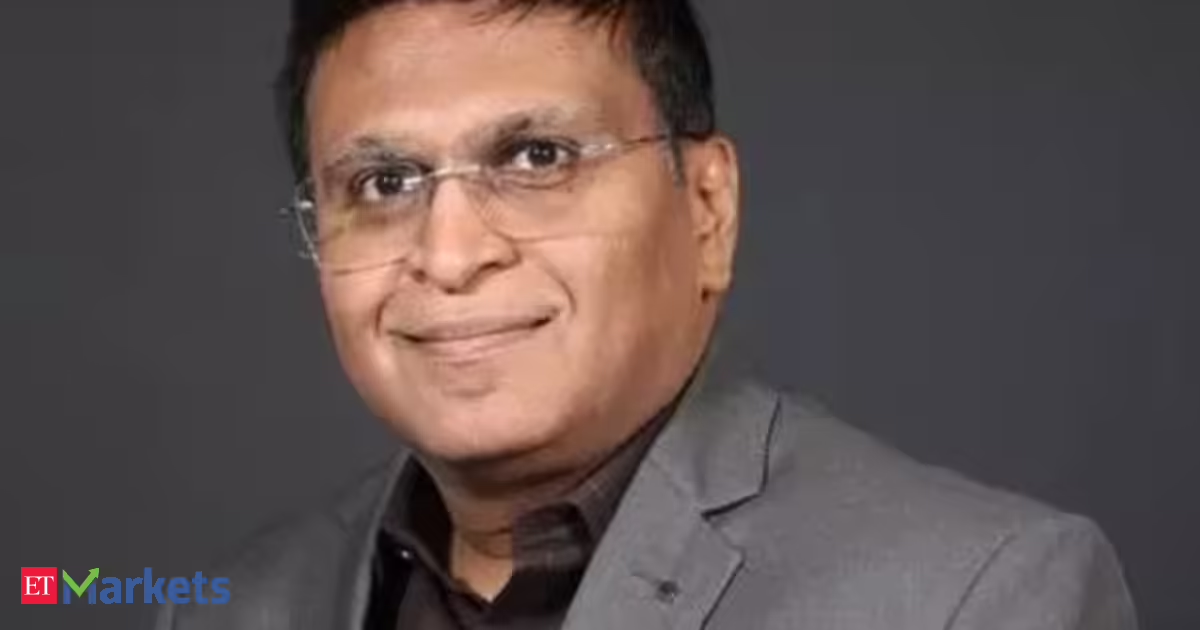
While the uncertain macro environment has kept investors on edge, corrections across sectors have also opened up selective opportunities. In an interaction with ETMarkets Smart Talk, Devang Mehta, Deputy Managing Director & CIO – Equity NDPMS at Spark Capital Private Wealth, said that domestic-focused sectors such as power, infrastructure, and auto are beginning to look attractive after the recent market correction.
He also advised investors to stay disciplined, continue their SIPs, and focus on long-term investing rather than reacting to short-term volatility. Edited Excerpts –
Q) Thanks for taking the time out. March has been an absolute roller coaster for equity markets not just for India but across the globe. How are you reading into markets – more pain ahead?
A) The equity markets in March 2026 have indeed experienced extreme volatility, primarily driven by the escalation of a U.S.-Israel war with Iran and the subsequent closure of the Strait of Hormuz.

This conflict has triggered a “risk-off” environment, characterized by sharp declines in global indices and a surge in crude oil prices past $100–$110 per barrel and foreign outflows as well
The conflict has disrupted roughly 20% of global oil supplies transiting the Strait of Hormuz, raising fears that oil could be on the boil. If the war continues, the collateral and economic damage could lead to more pain.
Though its next to impossible to gauge the intensity and duration of the war, long term investors have to adjust to the volatility and uncertainty.
Indian market has now been going through price correction, valuation correction and time correction since last 19 months and data typically shows that after underperformance and with earnings cycle positively coming back, one needs to stay focused and not panic.
Q) IT sector seems to be the worst hit thanks to the AI commentary but with geopolitical tensions rising other sectors have also started to see some rub-off effect. Any sector(s) that are now available at attractive lev
A) IT has particularly been a hugely underperforming sector and it has its own reasons. But as markets were settling down in February, post a decent budget, good earnings season and a bit of clarity about US tariffs, unfortunately, the Iran & US – Israel war related news took prominence and had its impact on global and our own markets.
With all the newsflow around and India’s sensitivity for the oil and gas dependence, most of our sectors and companies in the indices and even broader markets went through a severe correction.
Sectors which are domestic centric and have not much of a global exposure should ideally be sought after in the first phase.
Capex oriented sectors like power, HVDC, engineering, capital goods, infrastructure and even discretionary consumption related sectors like auto and auto components have seen meaningful corrections.
Some accumulation here would be a good start to construction of new portfolios. Niche pharmaceuticals and wellness including hospital businesses and few BFSI related companies also qualify for long term investment.
Q) What could be the good, bad and ugly for Indian markets in the near term?
A) Good – Following a sluggish 2025, India Inc. is expected to see around15% YoY earnings rebound over FY26–FY27.
With India’s valuation premium over other emerging markets compressing, expectations are high for a return of foreign capital in 2026.
Strong SIP-led inflows and retail participation continue to cushion the market against foreign investor volatility.
Headline CPI inflation printed at a benign 2.75% in January 2026, though a new series makes historical comparison difficult.
Recent pro-growth measures, including income tax & GST rate cuts and interest rate reductions (125 bps cut to 5.25% as of early 2026), aim to stimulate consumption.
Bad – The Indian Rupee recently sank to all-time lows, breaching ₹92.35 against the US Dollar, which threatens to increase “imported inflation”. Pending trade deals with the US is also a overhang. Foreign Institutional Investors have been aggressive net sellers, offloading over ₹32,800 crore in the first week of March 2026 alone.
The Ugly – A major escalation in the Middle East, such as a shutdown of the Hormuz Strait, could push oil prices to unsustainable levels, causing a severe, sudden shock to the Indian economy. If global uncertainty prompts sustained record-breaking selling by foreign institutional investors, market multiples could face intense downward pressure.
Q) FPIs have been net sellers in 2025, and the story continues in 2026 may be for a different reason now. The story seems to be changing around the FDI route as India opens channels for Chinese investment to land into several industries. What are your views?
A) FPIs have been massive net sellers in India during 2025, driven by high valuation concerns, US tariff anxieties, and a “Sell India, Buy China” trend. The record outflows in 2025 were driven by a “risk-off” sentiment due to high Indian valuations compared to its peers, weak corporate earnings, and global macro headwinds like rising US bond yields.
As of early 2026, FPIs remain cautious. While they briefly turned net buyers in February 2026 following a US-India trade deal, this reversed in March due to escalating Middle East conflicts and a weakening rupee.
India has begun relaxing FDI norms for neighboring countries, including a 60-day fast-track approval for projects, to attract manufacturing investment. This represents a shift from the 2020 restrictions, allowing Chinese capital to enter critical industries.
This policy change aims to bridge the investment gap and boost local manufacturing, even as India manages a massive trade deficit with China. It highlights a strategic move to balance security concerns with economic growth necessities.
The most striking change is the relaxation of Press Note 3 (2020), which had virtually frozen Chinese investment since the Galwan clash. The story is changing from a broad “avoid China” stance to a calibrated, strategic engagement.
Stock markets have already started pricing this in, with Electronic Manufacturing Services (EMS) and renewable energy stocks surging on the news.
Q) Rupee seems to be hitting fresh lows every week – where do you see the currency headed and how will it impact Indian markets/economy?
A) The Indian Rupee (INR) has indeed been hitting fresh record lows against the US Dollar (USD), falling past the 92 level and touching around 92.35–92.37. This weakness is driven by a combination of high geopolitical tension, rising crude oil prices, and significant foreign capital outflows.
The rupee is expected to trade in a broad 90–93 range as long as geopolitical tensions in the Middle East persist and oil prices remain high.
As a major importer of crude oil, electronics, and machinery, a weaker rupee makes these inputs significantly costlier. This feeds directly into domestic inflation, raising costs for petrol, diesel, and electronics.
The cost of importing goods is outpacing export growth, widening the current account deficit (CAD). Indian companies with large unhedged foreign currency loans face higher repayment burdens, squeezing their margins.
Q) Will Crude@$100/bbl and above hurt Indian markets and macros? We have been making an investment pitch to the world about our macro stability which could be challenged in the near future. What are your views?
A) Crude oil prices sustained above $100/bbl pose significant risks to India’s macroeconomic stability by widening the current account deficit (CAD), increasing inflation (by 35–40 bps), and potentially reducing FY27 GDP growth to around 6%.
While this challenges the investment narrative of macro stability and threatens equity market pressure, strong foreign exchange reserves (around $720 billion) and potential for a shorter-duration shock may mitigate long-term damage.
With $720 billion in forex reserves and lower global demand, this shock may be acute rather than prolonged, preventing a structural break.
While a short-term spike causes volatility, a sustained, long-term trend above $100 requires a rebalancing of portfolios towards defensives. The “macro stability” pitch is challenged, but not entirely broken unless the conflict causing the price rise persists for over a long duration.
Q) How should investors recalibrate their portfolio amid rise in volatility? Any theme/asset classes which they should go overweight or underweight on? (Assuming the person is between 30-40 years)
A) For investors aged 30-40, high volatility is an opportunity to accumulate units at lower costs rather than a reason to panic. With a long-term horizon, the goal is to maintain a high growth, yet resilient portfolio that can withstand short-term shocks.
Continue all Systematic Investment Plans (SIPs). Volatility allows SIPs to purchase a higher number of units at a lower cost, which leads to superior, long-term wealth creation.
Asset allocation according to one’s risk profile, liquidity requirements and life goals are the most critical factors. You don’t lose when markets panic, you lose when you panic.
Q) Your advise to investors of things which one must avoid doing in the current environment? We have already seen drop in SIP flows by over 3% on a MoM basis.
A) Monthly inflows hit ₹29,845 crore, down 4% from January’s ₹31,002 crore, ending a two-month streak above ₹30,000 crore. The moderation ties to the shorter month, with some end-of-month SIPs shifting to early March.
Market corrections often trigger fear, leading to panic selling, which turns paper losses into permanent losses. In all the market dips, investors who stayed invested recovered their losses, while those who panicked and sold missed the subsequent recovery, and saw a significant, realized drop in their portfolio.
Waiting for a “low point” to invest usually leads to missing out on the best days of the market. Missing the 10 best trading days in a decade can cut your long-term returns by HALF. Historically in Nifty you could have lost 82% of your wealth by sitting out just 2% of the trading days.
Trying to time the market is a losing strategy because nobody can consistently predict tops and bottoms. Think in terms of years, not months. Volatility is temporary; long-term growth is the target.
(Disclaimer: Recommendations, suggestions, views, and opinions given by experts are their own. These do not represent the views of the Economic Times)



Israeli fire kills four Palestinians in Gaza, medics say


OPEC+ debates theoretical oil output hike amid Iran war paralysis, sources say
Business
CG Oncology: Passing A Red Line For What I Would Call A Reasonable Valuation (Rating Downgrade)
CG Oncology: Passing A Red Line For What I Would Call A Reasonable Valuation (Rating Downgrade)

Netflix: Three Reasons To Expect An Earnings Beat
Does the Iran War herald nuclear momentum?
Week Ahead: It's Still Mostly About The War

Cairo maneuvers for de-escalation as Egypt’s private sector hits two-year low


Foxconn first-quarter revenue jumps 30% y/y


I focus on a rigorous fundamentals-foremost equity and credit research. I currently work as a financial advisor/planner, and do analysis in my free time. I have an undergrad in business administration, an MBA in finance, and currently am a doctoral candidate (a DBA with a concentration in Finance and Investment Management). My research style typically involves process-driven research, followed by blending several valuation models together to get a blended, 12 month price target. I enjoy utilizing full DCF analysis in conjunction with SOTP, peer/multiples analysis, and risk-adjusted approaches. I thoroughly enjoy reading filings, technical documentation relevant to the sector, and then translating that data into conclusions with actionable insights. I enjoy learning about the various sectors and companies I find myself researching, and always feel like there is something to learn. As a curious individual, equity and credit research is very fulfilling, and even fun!I always try to find 2-4 variables that drive value or hinder growth, stress test them, and then let fundamental evidence incorporated with book-value set my viewpoint for the research project. I enjoy the energy sector, commodities, tech, and financial sectors the most. I joined Seeking Alpha to share my thoughts with a wide audience. I originally started with sharing my analysis with a few of my friends who are also advisors and/or analysts. I am always open to a myriad of viewpoints, as I feel the most accurate viewpoints and research is made through a collection of great minds working together to figure something out. If you appreciate thorough research, and want to learn more about a company beyond just what is inside of their books, then I believe you will enjoy the research that I work on.
Analyst’s Disclosure: I/we have no stock, option or similar derivative position in any of the companies mentioned, but may initiate a beneficial Short position through short-selling of the stock, or purchase of put options or similar derivatives in ORR over the next 72 hours. I wrote this article myself, and it expresses my own opinions. I am not receiving compensation for it (other than from Seeking Alpha). I have no business relationship with any company whose stock is mentioned in this article.
The views expressed in this article are solely the author’s own and do not represent the opinions or recommendations of an SRO or broker-dealer. This article is for informational purposes only and does not constitute investment advice, a solicitation, or a recommendation to buy or sell any security. Readers should consult their own financial advisor before making investment decisions.
Investment Products:
Are NOT FDIC insured / not deposits of, or obligations of, any bank or financial institution / MAY be subject to investment risk, including possible loss of principal.
Additional Disclosure: Alternative and Long/Short Fund Strategies
Alternative investment strategies, including long/short equity funds, involve risks that differ from and may be greater than those associated with traditional long-only equity investments. These risks include but are not limited to: (1) Leverage risk – the use of leverage magnifies both gains and losses and may result in the loss of more than the original amount invested; (2) Short-selling risk – short positions expose the fund to theoretically unlimited losses if the securities sold short increase in value; (3) Liquidity risk – certain portfolio holdings, particularly international small-cap equities, may be difficult to sell at favorable prices during periods of market stress; (4) Foreign investment risk – investments in non-U.S. securities involve currency fluctuation, political instability, differing regulatory environments, and potentially less liquid markets; (5) Concentration risk – non-diversified funds may invest a larger percentage of assets in fewer issuers, increasing the impact of any single investment’s decline; (6) Counterparty risk – derivative instruments and short-sale arrangements are subject to the creditworthiness of counterparties; (7) Manager risk – the fund’s performance depends on the sub-adviser’s skill in implementing the strategy, and past performance of the manager’s other vehicles does not guarantee future results in this fund.
Investors should carefully consider the fund’s investment objectives, risks, charges, and expenses before investing. The prospectus and summary prospectus contain this and other important information and should be read carefully before investing. Shares of ETFs are bought and sold at market price (not NAV) and are not individually redeemable. Brokerage commissions will reduce returns. Market price returns may differ from NAV returns.
Seeking Alpha’s Disclosure: Past performance is no guarantee of future results. No recommendation or advice is being given as to whether any investment is suitable for a particular investor. Any views or opinions expressed above may not reflect those of Seeking Alpha as a whole. Seeking Alpha is not a licensed securities dealer, broker or US investment adviser or investment bank. Our analysts are third party authors that include both professional investors and individual investors who may not be licensed or certified by any institute or regulatory body.

Yara International: The Urea Price Shock Everyone Ignores

WARNING: INSIDERS JUST DUMPED EVERYTHING! | XRP HOLDERS BUCKLE UP NOW

I felt terrified undressing after a mastectomy

Israeli fire kills four Palestinians in Gaza, medics say


-

 NewsBeat3 days ago
Steven Gerrard disagrees with Gary Neville over ‘shock’ Chelsea and Arsenal claim | Football
-

 Business2 days ago
No Jackpot Winner and $194 Million Prize Rolls Over
-

 Fashion2 days ago
Weekend Open Thread: Spanx – Corporette.com
-
Entertainment6 days ago
Fans slam 'heartbreaking' Barbie Dream Fest convention debacle with 'cardboard cutout' experience
-

 Crypto World4 days ago
Gold Price Prediction: Worst Month in 17 Years fo Save Haven Rock
-

 Tech6 days ago
The Pixel 10a doesn’t have a camera bump, and it’s great
-
Crypto World5 days ago
Dems press CFTC, ethics board on prediction-market insider trades
-

 Tech6 days ago
Avatar Legends: The Fighting Game comes out in July and it looks pretty slick
-

 Business3 days ago
Login and Checkout Issues Spark Merchant Frustration
-

 Sports12 hours ago
India men’s 4x400m and mixed 4x100m relay teams register big progress | Other Sports News
-

 Tech6 days ago
Apple will hide your email address from apps and websites, but not cops
-

 Sports5 days ago
Tallest college basketball player ever, standing at 7-foot-9, entering transfer portal
-

 Tech5 days ago
EE TV is using AI to help you find something to watch
-

 Politics6 days ago
Should Trump Be Scared Strait?
-

 Tech5 days ago
Flipsnack and the shift toward motion-first business content with living visuals
-

 Tech7 days ago
Elon Musk’s last co-founder reportedly leaves xAI
-

 Fashion6 days ago
The Best Spring Trends of 2026
-

 Tech5 days ago
How to back up your iPhone & iPad to your Mac before something goes wrong
-
 Crypto World6 days ago
Bitcoin’s Six-Month Losing Streak: What On-Chain Data Says About the Market’s Next Move
-
Tech5 days ago
Daily Deal: StackSkills Premium Annual Pass
You must be logged in to post a comment Login