
Business
FBI Search Claim Near Annie Guthrie’s Home Sparks New Unverified Online Speculation


TUCSON, Ariz. — Nancy Guthrie, the 84-year-old mother of “Today” show co-anchor Savannah Guthrie, remains missing nearly eight months after her disappearance from her Tucson home, as investigators continue processing tens of thousands of tips and an unverified online claim about an FBI search near her daughter’s neighborhood has generated fresh public attention.
Nancy was last seen at her home on the night of January 31 and was reported missing the following day, after having had dinner earlier that evening with her daughter, Annie Guthrie. Authorities say Tommaso Cioni, Annie’s husband, brought Nancy home following that dinner, making the couple among the last people known to have seen her before her disappearance. Authorities have since said they believe Nancy was taken from her home by force.
Pima County Sheriff Chris Nanos has said investigators have received approximately 40,000 to 50,000 tips over the course of the investigation, alongside ongoing DNA analysis, review of surveillance footage and examination of electronic evidence, with laboratories across the country assisting in the forensic work. No suspect has been publicly identified as of the most recent update.
Despite persistent online speculation surrounding Annie Guthrie and Tommaso Cioni given their proximity to Nancy on the night of her disappearance, Sheriff Nanos has said the broader Guthrie family, including siblings and their spouses, has been cleared as suspects and has cooperated fully with investigators throughout the case.
The latest wave of online attention stems from a claim made by Jonathan Lee Riches, who identifies himself online as an investigator using the handle JLR. Riches asserted that the FBI searched an area near where Annie Guthrie and Tommaso Cioni live while looking for a discarded prepaid phone, a claim he connected to ransom communications sent after Nancy was reported missing. In a separate post, Riches wrote that “it appears the person used a prepaid smartphone to send the electronic Nancy Guthrie ransom notes.” Neither claim has been independently confirmed by the Pima County Sheriff’s Department or any other official source, and authorities have separately said the ransom notes connected to the case have been determined to be fabricated.
A separate unverified claim involving a purported sighting of Annie Guthrie and Tommaso Cioni, reported by a tipster from North Carolina, has also circulated online without confirmation from law enforcement regarding either the sighting itself or any connection to Nancy’s disappearance.
Retired FBI agent Jennifer Coffindaffer has continued offering her own public analysis of the case, advancing what she has described as a “wrench ring” theory suggesting the complexity of the investigation points toward experienced, organized operators rather than isolated individual suspects. Coffindaffer has questioned why investigators and digital forensic experts have reportedly struggled to trace ransom-related emails or cryptocurrency trails connected to the case, suggesting that organized groups involved in cryptocurrency-related extortion often rely on advanced anonymization techniques that make digital tracing considerably more difficult. She has also pointed to similarities between communications sent to media outlets in this case and patterns seen in other known extortion cases as a possible sign of a broader operational pattern. Separately, Coffindaffer dismissed continued speculation surrounding the unidentified “Porch Guy,” referring to him dismissively as “a mope” and suggesting that larger criminal organizers may remain hidden behind lower-level individuals, a term she used to describe what is known in law enforcement circles as a “wrench attack,” in which suspects use violence or coercion to force victims to disclose passwords or other sensitive information.
The investigation’s timeline shows a case that has continued expanding in scope since Nancy’s disappearance was first reported. Police launched a large search operation in early February, with the FBI joining the investigation shortly after. Surveillance footage from the surrounding area was collected during the first week of February, and a masked individual seen near Nancy’s home was flagged in mid-February before later being ruled unrelated to the case. Genetic genealogy testing was introduced in March to help analyze unidentified DNA samples, and by April and May, the investigation had expanded to include thousands of videos gathered from traffic cameras and home security systems, still without identifying a suspect. A second ransom note connected to the case emerged in reports in June, and in July, the Pima County Sheriff’s Department publicly released redacted versions of the ransom notes in hopes of identifying their author. Public attention intensified further on August 17, when human remains were discovered in a desert area roughly 15 miles from Nancy’s home, though authorities said the following day that there was no indication the remains were connected to her disappearance, noting they appeared to have been at the location for an extended period predating her disappearance.
As the investigation approaches its eighth month, law enforcement continues examining forensic evidence, tips and footage, while Nancy’s whereabouts remain unknown. The scale of information gathered in the case has produced both potentially valuable leads and a considerable volume of unconfirmed online speculation, underscoring the continued need to distinguish confirmed statements from investigators, including Sheriff Nanos’ own public updates, from the unverified theories and claims that have continued to circulate widely across social media throughout the case.


OpenAI pauses training a second time as rogue agents hit U.S. government websites

Puzzle number 1,203 of The New York Times’ Connections game challenged solvers Saturday with a grid mixing breath-freshening products, laundry care terms, features found in wood, and a set of old-fashioned expressions all built around the word “cool,” giving the day’s puzzle an unexpectedly nostalgic wordplay twist in its toughest category.
Connections presents players with 16 words that must be sorted into four hidden groups of four, with each group sharing a common category. The puzzle rates each group’s difficulty using a color system: yellow for the most straightforward connection, green for slightly trickier, blue for more difficult, and purple, typically the most wordplay-heavy or misleading group, as the hardest.
For those still working through Saturday’s puzzle, here are hints for each category, organized from easiest to hardest, without giving away the specific words involved.
The yellow category groups together products people use to freshen their breath after eating or drinking something strong. The green category brings together specific actions typically performed on a dress shirt during a trip to the laundry or dry cleaner. The blue category, trickier by design, connects distinct physical features or characteristics found in wood, the kind of terminology a woodworker or carpenter would recognize immediately. The purple category, the puzzle’s hardest by far, groups together words that can each follow the word “cool” to form somewhat dated expressions or phrases, several of which puzzle solvers themselves noted are rarely used in genuine everyday conversation anymore.
SPOILER WARNING: The full solution to Saturday’s Connections puzzle follows below. Stop reading now if you’d rather work through the categories on your own.
Saturday’s puzzle resolved into the following four groups. The yellow category, Breath Fresheners, consisted of GUM, MINT, MOUTHWASH and SPRAY, four common products used to combat bad breath. The green category, Things Done to a Dress Shirt at the Laundry, grouped FOLD, PRESS, STARCH and WASH, four processes a shirt might go through during a standard laundry or dry-cleaning visit. The blue category, Features of Wood, brought together BURL, GRAIN, KNOTS and RINGS, four terms describing distinct physical characteristics of wood, including burl, a deformed growth pattern in the wood grain that some solvers said they had never encountered before. The purple category, “Cool” Things in Expressions, consisted of BEANS, CAT, CUCUMBER and CUSTOMER, each of which can follow the word “cool” to form phrases such as “cool as a cucumber” or “cool customer,” though several solvers noted these expressions have largely fallen out of common modern usage.
Puzzle guides covering Saturday’s grid noted that the puzzle proved trickier than its initial yellow and green categories suggested, with the overlap between wood-related terminology and the more obscure “burl” tripping up solvers who were unfamiliar with the term. One puzzle blogger recounted initially solving the yellow category more broadly as “things that go in your mouth” before narrowing it specifically to breath-related products, and similarly identified the green category first as general laundry terms before recognizing its more specific focus on dress shirts. That same blogger described the purple category as conceptually strange, noting that expressions like “cool cat” are rarely heard in genuine conversation today despite remaining broadly recognizable through film and other media references.
Connections has grown into one of the Times’ most consistently played daily puzzles since its official launch in 2023, ranking as the second-most popular NYT Games offering behind only the flagship crossword itself. The daily puzzle challenges players to identify links between groups of four words that may represent straightforward shared categories or more elaborate wordplay, with difficulty increasing as players move from the yellow tier toward the purple tier.
Players attempting Saturday’s puzzle are permitted up to four incorrect guesses before the game ends, with each group color-coded upon a correct guess to indicate which of the four difficulty tiers it belongs to. Standard strategy for tackling the puzzle involves scanning the full grid first for any words that seem to have an obvious connection, then working through the remaining words methodically to identify the less immediately apparent categories, an approach that worked well for Saturday’s more literal yellow and green groups but required more careful thought once solvers reached the wood-related and expression-based categories.
Players looking to track their performance on Saturday’s puzzle, or compare notes with friends, can share their results through Connections’ built-in results screen, which uses colored emoji squares to display a player’s guessing sequence without revealing the actual category words, a sharable format that has become a familiar sight across social media in the years since the game’s launch.
With Saturday’s puzzle now solved, players will have a fresh set of 16 words and four new hidden categories to work through when Sunday’s edition of Connections goes live at midnight local time, continuing the daily puzzle’s steady run as one of the Times’ most widely shared games alongside Wordle, Strands and the Mini Crossword.


We’re a father-and-son team dedicated to helping individual investors achieve financial independence through strategic dividend investing. With years of combined experience and a deep understanding of the markets, we’ve developed a straightforward yet powerful method that empowers investors like you to take control of your financial future, create a massive dividend snowball, and retire happy and free. At The Dividend Freedom Tribe, we don’t serve institutional clients or cater to Wall Street’s elite. Instead, we focus on everyday investors who want to build sustainable wealth and income with a strategy that works in real-world conditions. Our motto is simple: “Buy Low, Sell High, Get Paid to Wait.” It’s a time-tested approach that’s helped our members generate reliable income, even in volatile markets. When you join The Dividend Freedom Tribe, you gain access to a comprehensive suite of tools designed to give you an edge. Our three model portfolios are built for different investing styles, whether you’re seeking high yield, high growth, or a balanced approach. All 3 have beaten the market since inception. You’ll also receive exclusive, in-depth analysis of a universe of 100 hand picked dividend stocks, weekly buy/watch/sell lists to help you make informed decisions, and our proprietary DFT Charts. But it’s not just about the numbers. As a member, you’ll be part of a vibrant, supportive community of dividend investors who share your goals and are eager to help each other succeed. We believe in transparency, engagement, and creating a space where everyone can learn and grow. Whether you’re just starting your investing journey or you’re a seasoned pro, we’re here to provide the insights and support you need to turn your retirement dreams into reality. Join us today and discover how our proven strategy can help you achieve financial freedom.Click here to get startedPS: If you’re not yet ready to get started, join our free tier and follow us on SeekingAlpha.
Analyst’s Disclosure: I/we have a beneficial long position in the shares of PBR, ITUB either through stock ownership, options, or other derivatives. I wrote this article myself, and it expresses my own opinions. I am not receiving compensation for it (other than from Seeking Alpha). I have no business relationship with any company whose stock is mentioned in this article.
Seeking Alpha’s Disclosure: Past performance is no guarantee of future results. No recommendation or advice is being given as to whether any investment is suitable for a particular investor. Any views or opinions expressed above may not reflect those of Seeking Alpha as a whole. Seeking Alpha is not a licensed securities dealer, broker or US investment adviser or investment bank. Our analysts are third party authors that include both professional investors and individual investors who may not be licensed or certified by any institute or regulatory body.


I am an independent trader and analyst specializing in the micro-cap market. My strategy combines technical analysis with the CAN SLIM method, developed by William O’Neil, to identify high-growth, underanalyzed companies. I focus on financial trends, profit growth, and institutional capital accumulation to uncover stocks with significant upside potential. In addition to equities, I have experience in Forex trading, which has helped me better understand price movements, market volatility, and sentiment-driven trends. My research approach integrates both fundamental and technical analysis, allowing me to identify strong growth stocks before they gain widespread attention. Key indicators I prioritize include relative strength, trading volume shifts, and accelerating profit growth—all of which help pinpoint stocks with the highest potential. Writing for Seeking Alpha is an integral part of my investment process, enabling me to refine my strategies, test investment theses, and engage with the investor community. In my articles, I aim to deliver in-depth company analyses, focusing on stocks with strong growth trends, improving fundamentals, and technical setups that signal potential breakouts. Through structured research, I strive to enhance market understanding and provide actionable investment insights.
Analyst’s Disclosure: I/we have no stock, option or similar derivative position in any of the companies mentioned, and no plans to initiate any such positions within the next 72 hours. I wrote this article myself, and it expresses my own opinions. I am not receiving compensation for it (other than from Seeking Alpha). I have no business relationship with any company whose stock is mentioned in this article.
Seeking Alpha’s Disclosure: Past performance is no guarantee of future results. No recommendation or advice is being given as to whether any investment is suitable for a particular investor. Any views or opinions expressed above may not reflect those of Seeking Alpha as a whole. Seeking Alpha is not a licensed securities dealer, broker or US investment adviser or investment bank. Our analysts are third party authors that include both professional investors and individual investors who may not be licensed or certified by any institute or regulatory body.

Republicans pour money into dozens of US House races previously considered ’safe’

AptarGroup's Bottom Line Pressures Are Preventing An Upgrade

Feeding The AI Beast: The Williams Companies' Path To Maintain Superior Dividend Growth
Business
Stephen Curry Agrees to Two-Year, $116 Million Extension With Warriors, Becoming NBA’s All-Time Top Earner

SAN FRANCISCO — Golden State Warriors star Stephen Curry has agreed to a two-year, $116 million contract extension, tying the franchise legend to the only organization he has ever played for through his 20th NBA season, league sources told ESPN’s Shams Charania on Friday.
The deal includes a player option for the final season, covering 2028-29, according to those sources. The extension pushes Curry’s career on-court earnings to $652 million, making him the first player in NBA history to surpass $600 million in career salary.
Curry had been eligible since August 29 to sign an extension worth up to two years and $136.7 million, the full maximum available to him under the league’s salary cap rules. The Warriors presented Curry with several contract options in recent weeks, including the possibility of waiting to sign, but Curry ultimately chose a modest pay cut and long-term security over either the full maximum contract or the uncertainty of delaying his decision for additional flexibility or information, according to team sources.
Under the new deal, Curry’s salary will decline from his current $62.6 million to $55.7 million for the 2027-28 season, followed by a player option worth $60.2 million for 2028-29. That structure is expected to provide the Warriors with approximately $10 million in additional projected salary cap space next summer, positioning the team to be a more significant participant in free agency or the trade market over the coming year.
Golden State’s broader salary cap picture is shaped by several other expiring contracts alongside Curry’s new deal. Both Jimmy Butler III, on a contract worth $56.8 million, and Draymond Green, at $27.6 million, have deals expiring next summer. Veteran center Kristaps Porzingis has only $3 million of his $20 million salary guaranteed for next season. According to ESPN’s Bobby Marks, those combined factors could leave the Warriors with somewhere between $38 million and a projected $55 million in cap space, depending on how the team handles Brandin Podziemski’s own extension eligibility; Podziemski, who has not yet signed an extension, carries a $17 million cap hold heading into next summer.
Curry took nearly a month to weigh his options, deciding among signing for his full maximum salary, accepting a modest pay cut, or waiting before committing to a new deal. Speaking to ESPN earlier this week, before finalizing his decision, Curry described the complexity of weighing those competing considerations. “We’re in a very interesting situation,” Curry said. “All the different salary cap conditions of whether I sign for a max or less or whatever it is, I want to be on a competitive team. I want to have an opportunity to have some flexibility because we haven’t had that in years past, the recent past. … This team should have flexibility to make necessary moves if things happen. Those are always just the considerations.”
Curry elaborated further on the broader context shaping his decision, pointing to both his own career stage and the team’s competitive urgency. “For me, information and patience is key,” he said. “It’s just a very unique situation all the way around based on where we’ve been the last four years, where I’m at in my career, what our team looks like this year and the absolute desperation to win. Trying to balance all that.”
Curry, who has said he wanted “no drama” surrounding his contract negotiations heading into training camp, ultimately settled on the pay cut and security just three days before the Warriors’ first practice of the season, resolving any lingering uncertainty about his future with the franchise before camp began.
The 39-year-old guard missed 39 games last season due to a persistent right knee issue, but said he feels physically ready heading into the new campaign. “The idea of getting back to work is exciting,” Curry said. “I feel like I’ve taken advantage of the offseason. I feel like there’s no hesitation about where I’m at physically going in. … But I’m excited about getting back to work.”
Curry’s decision to accept a reduced salary in exchange for greater roster flexibility reflects a broader pattern seen among some of the league’s most accomplished veteran stars in recent seasons, as players increasingly weigh the value of maximizing team competitiveness against securing the largest possible individual contract, particularly late in their careers when opportunities to win championships may be more limited.
With Curry’s extension now in place and the Warriors entering the season with a clearer picture of their salary cap situation for the coming years, the team is positioned to pursue additional roster upgrades over the next 12 months, even as questions remain about how Golden State will ultimately address the expiring contracts held by Butler, Green and Porzingis, and how Podziemski’s own extension situation will factor into the team’s broader financial planning.

Adam Kirby is co-founder and CEO of EvaluateLocate, a London geospatial AI company training its own models to predict how places across the UK change over time.
In August 2025 the business closed a £300,000 seed round from angel investors under the Seed Enterprise Investment Scheme, at a reported £2.75m valuation, and launched its UK subscription app, powered by its proprietary GSP-1 model and more than 100 location metrics. Kirby, a physics graduate, founded the company in 2024 with Duncan Lamb after the pair spotted how little attention investment proposals paid to location. He tells Business Matters why AI needs to think in space and time, what Thomas Edison taught him and why starting a business is always harder than you expect.
What do you currently do at EvaluateLocate?
I run a company building a new type of “spatial intelligence”: an AI that thinks naturally in space and time to predict how any place on Earth changes and evolves.
This ambition is part of an important next trend in AI: going beyond language-based intelligence. We are also a rare breed of European startups training our own models rather than purely building on top of outputs from American firms. Our first model, GSP-1, powers our UK app, which rates places on more than 100 metrics.
My role covers everything from leading research on our proprietary AI architecture to overseeing the operations of the business and supporting the team sharing our latest capabilities with clients. On an average day I might be deep in code, updating investors, talking to a housebuilder or retailer about site selection, or speaking to a local government about how economic growth is trending in their region.
What was the inspiration behind your business?
Whether or not the decision is literally about a building, bridge or piece of land, or whether a transaction itself happens online, everything in business and government has major exposure to different people and places. Location is opportunity, risk and differentiator for so many organisations, yet it is so often unmeasured.
Once upon a time my co-founder Duncan Lamb and I were reading an investment proposal worth tens of millions. This was from a well-known investment organisation, in our previous roles with the asset management industry. There were pages and pages on the building and its tenants, but half a paragraph of vague text on the surrounding area.
I suggested we should create a system to continuously measure that “location factor”. The rest was, if not history, then certainly a quest. Then it became a system, a codebase, eventually a company, and now a novel family of spatial AI models.
My love of a map and a technical challenge combined with Duncan’s knowledge of the people and businesses who have enormous value riding on location decisions.
Who do you admire?
Thomas Edison is a distant relative as well as a general inspiration. While you might know him for his hits such as the lightbulb, I admire two particular aspects of Edison.
First, he used the almost total deafness he had lived with since childhood as an advantage to concentrate better, not accepting that it should slow him down. Second, he had a seemingly unlimited capacity for new ideas, and when most failed he just kept going. Edison seemed to see further ahead than anyone else, researching efficient rechargeable car batteries in the 1890s.
Speaking of cars, Ron Dennis, who led McLaren for three decades, is a local hero where I live in Woking, and often a more practical type of engineer than Edison. Alongside an infamous attention to technical detail, he is admirable for managing a company from challenger to behemoth.
Back to family connections, I admire my own child, who helps me see the world with all the curiosity of a Thomas Edison or a three-year-old looking for frogs.
Looking back, is there anything you would have done differently?
Start sooner, go faster, be bolder.
That said, if we started again with the answers from our apparent mistakes, we might never learn the right questions.
What defines your way of doing business?
Internally we have a mantra of “truth, trust, grit”, which is my best attempt to capture in words what motivates me: the kind of team and technology we are building, and the kind of service we provide to our clients.
Truth means we are honest with each other, obviously. But it also relates to what our product does: we are aiming for a way to measure reality on the ground as closely as possible, with practical metrics that describe real places. It sets us apart slightly from language models that can claim something different every time. That is not what we do. Trust is similar, and it is basically the personal responsibility we have to each other and to our clients in the same respect.
Grit is what is required to achieve the other two, but it also sums up what I describe as “never walking past a problem”. It could be a dirty cup left on a desk (hello, Ron Dennis) or it might be a piece of code or marketing copy that just does not look right. It is the responsibility of everyone to look out for each other and the shared mission.
More prosaically, I believe in a ruthless attention to detail when it comes to the work itself, but the kindest attention to your colleagues.
What advice would you give to someone starting out?
I have learnt again and again that starting a business is harder than you expect. And then harder again. And then again, just like the rule on budgets and time estimates: even when you account for it being harder than you expect, it is still somehow harder again.
Personally, I think this “optimism bias” is a massive benefit of human nature, because it allows you to do things that might otherwise be irrational. Voting, in terms of personal impact on the result. Signing up for a marathon, in terms of immediate comfort. Starting a family, in terms of finance and sleep. We do these good things anyway. We persevere with them for reasons we struggle to explain but would never change.
Similarly, starting a business will not make you feel younger, sleep better or get “rich quick”. It changes you in some other, deeper way. Perhaps that is my only real piece of advice: choose an idea you love.

Minal Backhouse founded Backhouse Solicitors in 2005, eight years after qualifying as a solicitor, and still leads it as chief executive.
The Essex law firm merged with Duffield Stunt Solicitors in 2015, opened a second office in Leigh-on-Sea in October 2024 and says it now has a team of more than 65, with new employment and litigation solicitors joining in August and September 2026.
It advises businesses and individuals on employment, commercial, property, dispute resolution and private client matters from its head office in Chelmsford. She tells Business Matters why client care, people and community remain at the heart of a firm she built with her husband, Ben.
What do you currently do at Backhouse Solicitors?
As CEO of Backhouse Solicitors, I lead the strategic direction of the firm while continuing to oversee our legal services and support our team. I founded the business in 2005 with the aim of providing exceptional legal expertise alongside outstanding client care, and those principles remain at the heart of everything we do today.
No two days are the same. My role involves heading up our leadership team, supporting the development of our people, ensuring we continue to deliver excellent service to clients and identifying opportunities for growth and innovation. While we have grown significantly over the years, I am passionate about maintaining the personal approach that has always defined our firm.
A large part of my time is spent helping shape our culture. I firmly believe that successful businesses are built by great people, and I am incredibly proud of the talented team we have developed. Creating an environment where people can thrive professionally while feeling valued and supported is a key responsibility.
I also continue to have a strong interest in employment law and helping businesses navigate complex challenges. What I enjoy most is helping clients find clarity and confidence when they are facing uncertainty. Whether we are advising on business growth, employment issues or dispute resolution, it is rewarding to know that we are making a meaningful difference to people’s lives and businesses.
What was the inspiration behind your business?
The inspiration came from a simple belief that clients deserve expert legal advice delivered in a way that is approachable, practical and genuinely client focused.
Having worked in a number of legal practices after qualifying as a solicitor in 1997, I saw first-hand what worked well and where clients often felt underserved. While technical legal expertise is essential, I felt that communication, responsiveness and client experience were sometimes overlooked.
When I founded Backhouse Solicitors in 2005, I wanted to create a firm that combined high-quality legal advice with exceptional service and real value for money. My aim was to build long-term relationships rather than focus solely on individual transactions, so that clients felt they had trusted advisers who genuinely cared about their success.
The business was built from the ground up alongside my husband, Ben Backhouse, and it has been an incredible journey. We have faced many challenges along the way, but we have always stayed true to our values. Seeing the firm grow through client recommendations has been one of the most rewarding aspects, and it reassures us that our approach resonates with the people and organisations we support.
I have also always been passionate about contributing to the community, and that sense of responsibility extends into the wider business and local communities. Business success should not only be measured by financial results but also by the positive impact you have on the people around you.
How has the firm grown since 2005?
In 2015 we merged with Duffield Stunt Solicitors, a practice whose roots go back to 1799, and that doubled the size of the firm. In October 2024 we opened a second office in Leigh-on-Sea, and today we have a team of more than 65. We have chosen Farleigh Hospice as our charity of the year for 2026 and also support Chelmsford Foodbank.
Who do you admire?
I admire people who build successful organisations without losing sight of the people at the heart of them. Many leaders achieve commercial success, but the ones I respect most are those who remain grounded, act with integrity and put people first.
In business, I am particularly inspired by entrepreneurs who can scale organisations while maintaining strong values and a positive culture. It is easy to focus on growth, revenue and performance metrics, but truly great leaders understand that sustainable success comes from looking after clients, employees and stakeholders.
Outside of business, I have always admired people who stand up for what is right, even when it is difficult. That is one reason why To Kill a Mockingbird has remained one of my favourite books. Its themes of justice, integrity and courage strongly resonate with me, particularly given my legal background.
I also admire individuals who continue learning and evolving throughout their careers. The business world is constantly changing, and the most successful people are often those who remain curious, adaptable and open to new ideas.
Looking back, is there anything you would have done differently?
Like most business owners, I can look back and see decisions I would make differently with the benefit of experience. However, I genuinely believe that many of those challenges and mistakes were valuable learning opportunities.
If I could give my younger self one piece of advice, it would be to trust my instincts even earlier and not spend quite so much time worrying about achieving perfection. When you are building a business, it is easy to feel that every decision carries enormous weight. Experience teaches you that progress is often more important than perfection.
I would also have invested even earlier in systems, technology and leadership development. As businesses grow, the ability to delegate effectively becomes increasingly important, and one of the biggest lessons I have learned is that growth depends on empowering talented people and giving them the opportunity to succeed.
That said, every challenge has shaped the business we have today. The lessons learned through difficult periods have often been more valuable than those learned during easier times.
What defines your way of doing business?
My approach is defined by integrity, strong relationships and excellent client service.
Trust is the foundation of every successful business relationship. Whether you are working with clients, colleagues or suppliers, people need to know that you will do what you say you are going to do. Reputation takes years to build and moments to lose, so consistency and honesty are incredibly important.
Client care should never be treated as a secondary consideration. Technical expertise is expected, but exceptional service is what creates lasting relationships. The growth of Backhouse Solicitors has been built on recommendations, which reflects the importance we place on delivering positive outcomes and experiences for our clients.
Another defining feature is investing in people. A business can only be as strong as its team, so creating opportunities for development, encouraging collaboration and fostering a positive culture are all priorities for me.
Finally, businesses have a responsibility to contribute positively to their communities. Through my involvement with local organisations, schools and community initiatives, I have seen the value that businesses can bring when they engage beyond their commercial activities.
What advice would you give to someone starting out?
First and foremost, be prepared to work hard. There is no substitute for commitment, resilience and determination when building a business.
Secondly, focus relentlessly on your customers. It can be tempting to become distracted by competitors, trends or technology, but understanding and serving your customers better than anyone else will always provide a strong foundation.
Seek advice and build a strong network around you. No one succeeds entirely on their own, so learn from people who have already faced the challenges you are experiencing and do not be afraid to ask questions.
Embrace change, too. Markets evolve, customer expectations shift and technology continues to transform the way we work, and the businesses that thrive are usually those that remain adaptable and willing to learn.
Finally, remember that success is not just about financial performance. Building a business you are proud of, creating opportunities for others and making a positive impact are equally important. The journey will not always be easy, but the challenges are often what make the successes worthwhile. Stay patient, trust yourself and keep moving forward.

ChatGPT vs. Gemini: Features and Multimodal Capabilities Compared
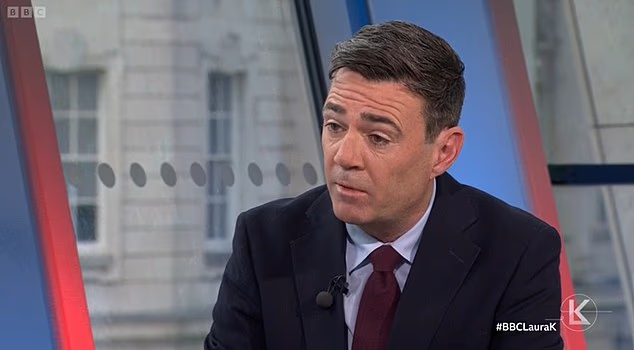
Labour shambles as Andy Burnham refuses to back Heathrow expansion – weeks after his Chancellor said it must go ahead
OpenAI pauses training a second time as rogue agents hit U.S. government websites





-

 Fashion2 days ago
Weekend Open Thread: J.McLaughlin – Corporette.com
-

 Crypto World5 days ago
Goldman Sachs and Deutsche Bank Agree: The S&P 500 Rally Isn't Over
-

 Tech7 days ago
Researchers escape OpenAI Codex sandbox to run commands on host
-

 Fashion3 days ago
8 iPhone Accessories That Add Personality
-

 Crypto World6 days ago
Who Needs CLARITY Anyway? ARB Could See 70X Increase: Hodler’s Digest
-

 Entertainment4 days ago
These 17 Fall Amazon Dresses Seriously Look Like Anthropologie
-

 Business6 days ago
Analog Devices (ADI) Bets $1.35 Billion on Chips that Let Machines Think for Themselves
-

 Crypto World6 days ago
Coinbase, Robinhood, Circle Seen as Tokenized-Stock Winners
-

 Crypto World4 days ago
This Bearish Netflix Stock Trade Can Cash In On Video Streaming Giant’s Woes
-
 Crypto World5 days ago
Trump-Xi Polymarket Odds for Handshake Hit 50%
-

 Tech6 days ago
Google’s $899 Googlebook is a bet that you’ll buy a new laptop for Gemini
-

 Crypto World4 days ago
Crude Oil Prices Pressured by Diplomatic Hopes in the Middle East
-

 Tech4 days ago
Reolink’s solar 4K security camera falls to its lowest price in months
-
 Crypto World3 days ago
Bitcoin price tests $83,600 Supertrend support after $87K rejection
-
 Business4 days ago
Oil Price Today (September 23): Crude oil below $100 on hopes of US-Iran talks. What did Trump say?
-
 Crypto World4 days ago
Bitcoin Threatens Sub-$84,000 Breakdown as Long Liquidations Spike
-
 Crypto World5 days ago
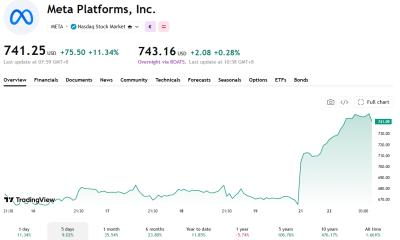
Meta Jumps 11% As Muse Shines and Investors Show an Appetite for Advancing AI
-
 Crypto World4 days ago
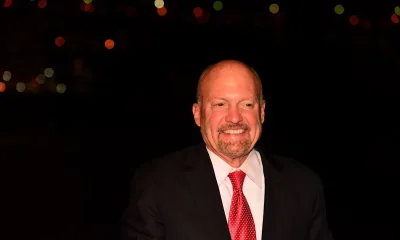
Did Jim Cramer Just Give GameStop Stock the Kiss of Death When He Said the Turnaround Is Working?
-

 Crypto World6 days ago
Bitcoin price holds above $81K as key catalysts line up
-

 Crypto World6 days ago
ARB Price Signals Spur Speculation of 70x Upside in Hodler Digest
You must be logged in to post a comment Login