



Connect with us

Business

First OpenAI, now Meta – why do AI hacks keep happening?

Published

on

Three side by side photos from left a woman's legs wearing a skirt and flip flops, a man's legs wearing shorts and a woman wearing a white strappy top

It is unlikely Meta will be the last to emerge with findings of models showing they have, as Prof Woodward puts it, “gone to school” – and learnt our own ways of finding and exploiting gaps in systems.

For some, these episodes point to clear security failures on the part of AI companies leading the charge on this game-changing, era-defining tech.

For others, they are merely another vehicle for tech firms to hype up their powerful models and compete with rivals.

For me, both theories hold some grain of truth.

Advertisement

But in rearing their head one after another, these events have nonetheless spurred fears about AI’s capabilities and where these are headed as developers forge ahead.

And the question inevitably moves to what regulators can and should do next.

Michael Birtwistle, associate director at the Ada Lovelace Institute, makes the point that the UK lacks legal incentives for AI firms to prevent systems from developing capabilities which could pose dangers, and that there are no repercussions if testing protocols fail.

More broadly, Dr Imogen Stead, AI policy manager at the Centre for Long-Term Resilience, told the BBC that with opportunities to test frontier AI systems narrowing for many, governments should follow the UK in setting up dedicated institutes for testing.

Advertisement

Improving third-party evaluations with initiatives such as a “trusted tester scheme” for the most risky types of challenges could also be used to limit adverse impacts, she said.

Rather than fear an AI-cyber apocalypse in the meantime, Prof Woodward says, “it’s a case of ‘keep calm and fix stuff’”.

Additional reporting by Philippa Wain and Imran Rahman-Jones

Advertisement
Continue Reading
Click to comment

You must be logged in to post a comment Login

Leave a Reply

Business

Lexicon Pharmaceuticals, Inc. (LXRX) Q2 2026 Earnings Call Transcript

Published

on

OneWater Marine Inc. (ONEW) Q1 2026 Earnings Call Transcript

Operator

Welcome to the Lexicon Pharmaceuticals Second Quarter 2026 Financial Results Conference Call. [Operator Instructions] As a reminder, this call is being recorded today, August 6, 2026.

I will now turn the call over to Lisa DeFrancesco, SVP, Investor Relations and Corporate Communications for Lexicon. Please go ahead, Lisa.

Advertisement

Lisa DeFrancesco
Senior Vice President of Investor Relations & Corporate Communications

Thank you, Therese. Good morning, and welcome to our Second Quarter 2026 Earnings Call. Joining me today are Dr. Mike Exton, Lexicon’s Chief Executive Officer and Director; Dr. Craig Granowitz, Senior Vice President and Chief Medical Officer; and Scott Coiante, Senior Vice President and Chief Financial Officer.

This morning, Lexicon issued a press release announcing our financial results for the second quarter of 2026, which is available on our website at www.lexpharma.com and through our SEC filings. A webcast of this call, along with the slide presentation is also available on our website.

During this call, we will review the information provided in our release, provide a corporate update and then use the remainder of our time to answer your questions.

Advertisement

Before we begin, let me remind you that we will be making forward-looking statements, including statements relating to the safety, efficacy, clinical development, regulatory status and therapeutic and commercial potential of sotagliflozin, pilavapadin, LX9851 and our other drug programs as well as our business

Continue Reading

Business

Kent uniform bank now helping working families and professionals

Published

on

Three side by side photos from left a woman's legs wearing a skirt and flip flops, a man's legs wearing shorts and a woman wearing a white strappy top

A food bank that offers free school uniforms has said that full time and self-employed professionals are among those relying on its support.

The Community Cupboard in Kent has begun offering pre-loved school uniforms to local families during the school holidays.

The volunteer-run service provides food supplies and support to families struggling to make ends meet from its West Kingsdown and Swanley sites.

“We’re still seeing lots of working families, it’s not just those that aren’t working,” founder Tracey Wood said.

Advertisement

Wood said that the charity, that has been running for seven years, helped “a lot of teachers, teaching assistants, a lot of hospital staff, self-employed”.

“The money they have each month coming in is what’s going out so once something goes wrong – be it the car, the washing machine – it just tips them over,” she said.

The teaching assistant added: “Although I’m paid throughout the summer, it’s still it’s not enough to pay for something every single day.”

Laura, a full-time carer for her husband and children, said: “You don’t get any help, and this is the only place we come to for help.”

Advertisement

Her children would have to wear uniforms too small for them without the uniform bank, she said.

“Or I’d have to try and ask the school for more help,” she added.

Continue Reading

Business

Home Bargains team plans major redevelopment of Baltic Triangle scrap site

Published

on

Business Live

Planning consent for demolition at landmark site to south of the city centre

The former Norton Scrap site on Liverpool's southern waterfront is earmarked for redevelopment

The former Norton Scrap site on Liverpool’s southern waterfront

Plans are advancing for what promises to be a landmark development on one of the most prominent plots along Liverpool’s southern waterfront, spearheaded by the team behind the Home Bargains retail empire.

Advertisement

Earlier this summer, proposals were unveiled for a big redevelopment of the former Norton Scrap Metal site in the city’s Baltic Triangle district, on land bordered by Upper Parliament Street, Chaloner Street and Flint Street.

According to an environmental impact assessment lodged for the two-acre site, the scheme could involve three new residential towers of up to 27 storeys, alongside a hotel, office space and mixed-use facilities.

The project is being driven by Davos Property Developments, the real estate and property investment division of T. J Morris – the parent company of Home Bargains – in partnership with property developer Brickland.

In the latest stage of the process, the development team is now seeking planning permission for demolition works on the remaining structures currently occupying the site, reports the Liverpool Echo.

Advertisement

Darren Leary, chief operating officer at Brickland, said: “There are some small buildings related to the site’s former use as a scrap yard that need clearing, together with hard standing. In addition, there will be some work to retaining walls in readiness for future development.”

Should permission be granted, the demolition contract would require roughly 26 weeks to complete, with works anticipated to commence on site during the second quarter of 2027.

Brownfield Solutions have offered environmental and remediation guidance, while Cundall have been advising on structural and civil engineering matters. Planning consultancy has been delivered by Savills.

A further application, covering the proposed development of the site itself, is expected to follow in the autumn, Mr Leary confirmed.

Advertisement

This marks the second major waterfront development scheme from the team behind Home Bargains. The Liverpool-headquartered firm is also driving ambitious £1.2 billion proposals to regenerate land at the King Edward Triangle near the city’s northern docks.

Those plans, which are already advancing with certain permissions secured, will ultimately deliver 2,750 new homes across 10 towers, including a 70-storey structure incorporating a five-star hotel.

Liverpool Council has already approved planning permission for the scheme’s first building, a 28-storey tower called No. 1 Kings, with additional applications anticipated in the coming months.

Advertisement
Continue Reading

Business

F&O de-addiction? Options volumes crash over 50% in FY26 after Sebi’s strict rules

Published

on

F&O de-addiction? Options volumes crash over 50% in FY26 after Sebi's strict rules
Options trading volumes in India fell sharply in FY26 after markets regulator Sebi tightened rules to curb excessive retail speculation in the derivatives market. According to Sebi annual report 2025-26, total contract volumes in options declined 51% during the year. The fall came even as overall combined notional turnover in equity derivatives rose 4% to Rs 1.1 lakh crore.

The drop shows the impact of Sebi regulatory push to reduce hyperactive trading, especially around expiry days. Over the past year, the regulator introduced several measures aimed at making derivatives trading more disciplined and less risky for retail investors.

Sebi said the decline in options volumes was mainly because of higher contract sizes, rationalised weekly expiries, mandatory upfront premium collection and an increase in securities transaction tax.

Expiry-day trading hit

Advertisement

The biggest focus of the regulator has been expiry-day activity, where retail traders often take short-term bets in index options. These trades can generate very high volumes but also expose small investors to sharp losses.


Also Read: Sebi proposes separate master circular for clearing corporations
To address this, Sebi asked exchanges to choose either Tuesday or Thursday as the uniform weekly and monthly expiry day. It also restricted exchanges to only one weekly benchmark index options contract. Other derivative products must now have a minimum tenure of one month.The regulator also introduced real-time intraday position monitoring for equity index options and additional eligibility criteria for launching derivatives on non-benchmark indices.

These steps were aimed at reducing crowded expiry-day speculation and improving market stability.

Higher cost, fewer trades

The fall in option volumes also reflects the higher cost of trading. Larger contract sizes mean traders need more capital to take positions. Upfront premium collection reduces the ability to build leveraged positions without adequate funds.

Advertisement

The rise in securities transaction tax also made frequent option trades more expensive. Together, these measures appear to have cooled a segment that had seen explosive retail participation in recent years.

Quality over quantity

While volumes fell, Sebi broader message is that lower speculative activity may be healthier for the market. The annual report also noted that delivery-to-traded quantity and value ratios in the cash market rose to around 30%, showing a growing preference for ownership over intraday speculation.

The data suggests FY26 was a turning point for India’s derivatives market. The options market is still large, but the easy-volume phase driven by expiry-day retail frenzy has started to slow.

Advertisement

(Disclaimer: Recommendations, suggestions, views and opinions given by the experts are their own. These do not represent the views of Economic Times)

Continue Reading

Business

India tops world in IPO count, ranks third in fundraising in FY26: SEBI Annual Report

Published

on

India tops world in IPO count, ranks third in fundraising in FY26: SEBI Annual Report
India retained its position as the world’s leading market for initial public offerings (IPOs) by number of issues during FY2025-26, while ranking third globally in terms of funds raised, according to the Securities and Exchange Board of India’s (SEBI) Annual Report for 2025-26.

Highlighting the country’s strong primary market activity, SEBI said the equity market continued to witness robust momentum during the year despite global uncertainties marked by geopolitical conflicts, trade tensions, volatile capital flows and rapid technological changes.

“The primary equity market demonstrated continued dynamism, with India ranking first globally in the number of IPOs and third in terms of fund raised,” SEBI Chairman Tuhin Kanta Pandey said in his statement in the report.

To sustain this momentum, the market regulator said it introduced several reforms aimed at making capital raising easier while maintaining investor protection.

Advertisement

Among the key measures, SEBI restructured the minimum public offer framework by linking public float requirements to issue size. It also extended the timeline for the largest listed companies to achieve the mandatory 25 per cent minimum public shareholding to 10 years, enabling large enterprises to access public markets without facing frequent dilution after listing.


The regulator further allowed founders of new-age companies to retain employee stock option plans (ESOPs) granted before an IPO, saying the move would preserve long-term incentives while ensuring transparency for public shareholders.
In his message, Pandey said India’s capital markets remained resilient during one of the most challenging years in recent times, demonstrating their ability to function efficiently despite global geopolitical conflicts, trade wars and volatile asset prices.He said SEBI’s regulatory approach had shifted towards building “resilience by design” by embedding structural integrity through optimum regulation and AI-driven oversight while simplifying compliance for market participants.

The Chairman noted that India would require significantly larger pools of capital to finance its long-term development goals, including infrastructure, manufacturing and the energy transition, adding that these investments could not be funded by the banking system alone.

According to the report, SEBI’s policy focus during the year was to strengthen the equity market, corporate bond market and alternative investment ecosystem so that they complement traditional sources of financing and support India’s journey towards becoming a developed economy by 2047.

Advertisement
Continue Reading

Business

Why the EA Takeover Signals an Entertainment Boom

Published

on

Poorly designed and inadequately maintained workplaces are draining the UK economy of more than £71 billion a year, according to new research from facilities and security services company Mitie.

Somewhere in a Manchester co-working space, a founder scrolling through the morning business headlines pauses over one figure: $55bn.

That is the sum Saudi Arabia’s Public Investment Fund agreed to pay to take Electronic Arts private, one of the largest buyouts in corporate history. For anyone tracking where serious money is flowing, the message is hard to miss. Entertainment — games, streaming, interactive leisure of every kind — has become one of the most sought-after asset classes on the planet. And where big capital leads, consumer appetite tends to follow.

That appetite has been reshaping how British adults spend their downtime, and the trend extends well beyond consoles and box sets. A growing slice of leisure spending now flows into interactive online entertainment, and among the options UK players explore are non gamstop casinos — internationally licensed sites offering slots, blackjack, roulette and live-dealer tables. These are online casinos not registered with the GamStop scheme, operating under overseas licences, and reviewers tend to compare them on the strength of their bonuses, the breadth of their game libraries and the payment options they support. For UK leisure consumers weighing where to spend an idle evening, understanding how such sites are licensed and how safely they handle deposits and withdrawals has become part of the modern entertainment conversation.

A Buyout That Reveals the Bigger Picture

The EA deal is worth dwelling on because of what it signals rather than what it is. Sovereign wealth funds do not part with tens of billions on a whim. The PIF has spent recent years assembling a portfolio that reads like a map of where global leisure is heading — stakes in games publishers, esports organisations and streaming ventures. Buying EA outright, the studio behind FIFA-era football titles, Battlefield and The Sims, is a statement that interactive entertainment is now core infrastructure for the attention economy.

For UK SME owners, the takeaway is less about the headline number and more about the direction of travel. When the smartest institutional money bets heavily on how people amuse themselves, it tends to validate an entire ecosystem of smaller businesses feeding into that demand: independent studios, payment specialists, marketing agencies and the countless start-ups building tools for a leisure market that shows no sign of cooling.

Advertisement

Why Leisure Spending Keeps Rising

There is a simple logic underpinning the boom. As disposable income shifts and working patterns loosen, adults are carving out more moments for entertainment they can access instantly, on any screen, at any hour. A commuter fires up a mobile game on the train home. A couple settles in for a streaming binge. Someone with a spare twenty minutes spins a few slot reels or joins a live-dealer table from the sofa.

This on-demand quality is precisely what investors find so compelling. Unlike a night at the cinema, digital leisure is not bound by opening hours or geography. The market is enormous, sticky and increasingly frictionless — and that combination is exactly what turned the EA transaction from an ambitious idea into a signed cheque. It also helps explain why Britain’s fintech cluster runs so deep, a strength documented in the government-backed UK FinTech State of the Nation report.

The Money Plumbing Behind the Fun

None of this works without the unglamorous machinery of payments. Every game purchase, every streaming subscription, every deposit into a gaming account depends on money moving quickly and reliably. Britain happens to be exceptionally strong here. The rise of challenger banks reshaped consumer expectations almost overnight, as chronicled in the story of Monzo’s fresh approach under TS Anil. Once people grew used to tapping a phone and seeing a transaction confirmed in seconds, they carried that expectation into every corner of their spending — leisure very much included.

For entrepreneurs, this is where opportunity hides in plain sight. The entertainment surge is not only about content; it is about the rails that carry the cash. Faster, smoother, more transparent transactions have become a competitive edge for any consumer-facing business, and the firms perfecting that plumbing are quietly indispensable to the whole leisure economy.

Advertisement

Britain’s Fintech Advantage

The UK’s position is no accident. The country has built one of the deepest fintech clusters anywhere. That depth matters enormously to the entertainment sector, because the moment a leisure business scales internationally, it needs partners who can handle multiple currencies, instant settlement and airtight security without breaking stride.

Global regulators have been paying attention too. The Bank for International Settlements has examined how technology is rewiring finance in its analysis of the digital transformation of financial services, noting how consumer behaviour and infrastructure now evolve in lockstep. For a British SME serving the leisure market, that alignment is a gift: the tools once reserved for banking giants are increasingly available off the shelf, letting small teams punch far above their weight.

What It All Means for Smaller Businesses

Step back and a pattern emerges. A sovereign fund pays a record sum for a games publisher. UK adults pour more of their evenings into interactive entertainment. Fintech firms make the underlying transactions effortless. Each of these threads reinforces the others, and together they describe a market that favours businesses able to spot where leisure and technology intersect.

For the founder in that co-working space, the EA figure is not just a distant piece of corporate news. It is a signal that the entertainment economy has genuine staying power — and that the smaller businesses supplying it, from payment innovators to content creators, are operating in one of the most resilient corners of the modern market. The giants may grab the headlines, but the real momentum is spread across thousands of nimble enterprises quietly cashing in on how the nation chooses to unwind.

Advertisement

Continue Reading

Business

Cotswold towns and villages oppose ‘flawed’ housing target

Published

on

Business Live

Parish and town councils say plan does ‘virtually nothing to alleviate the real problem of housing affordability for local people’

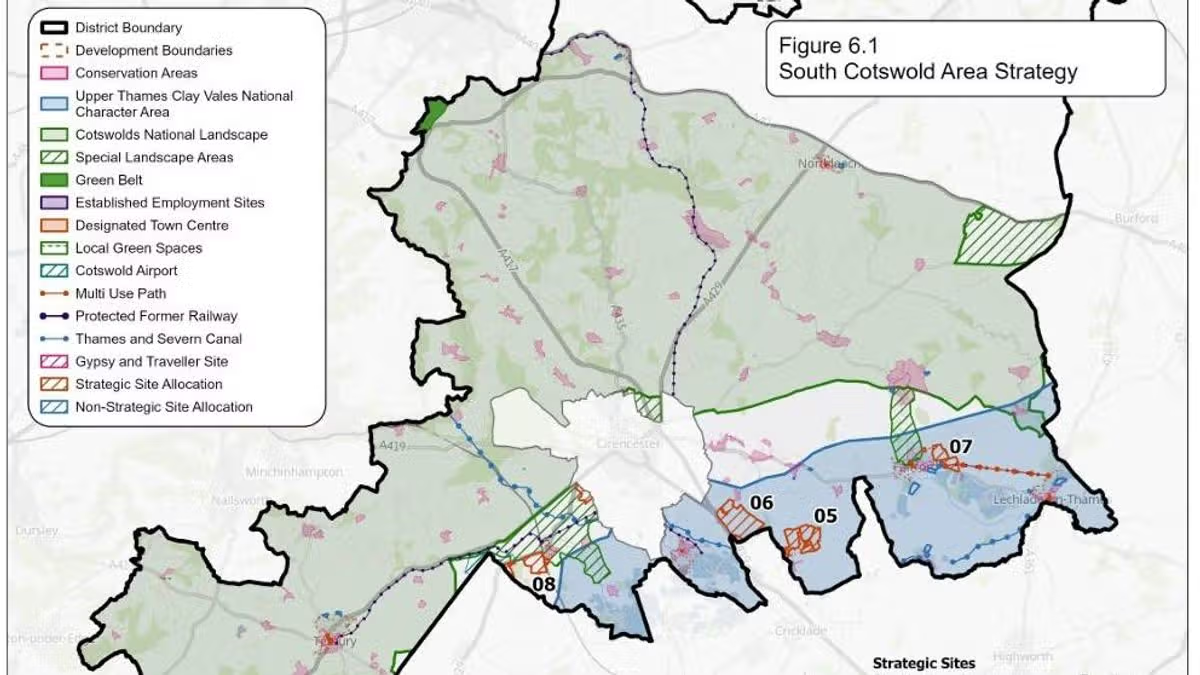
The South Cotswold area map.

The South Cotswold area map(Image: Cotswold District Council)

The Government’s “flawed” target to build almost 19,000 homes in the Cotswolds over the next two decades is opposed by more than a dozen towns and villages.

Advertisement

A joint letter signed by 15 parish and town councils in the Cotswold district opposing the housing target has been sent to the Ministry of Housing, Communities and Local Government (MHCLG).

Cotswold District Council is in the process of developing its new local plan which aims to meet the area’s new housing target. Their draft plan suggests 90 per cent of this new housing to be built in ten strategic sites outside the national landscape.

But the letters’ signatories believe the proposed housing plan is undeliverable due to incorrectly defined boundaries, flawed affordability metrics, and severe infrastructure constraints.

They believe the method used to calculate the Cotswold district’s housing requirement is “flawed” and will be “extremely damaging” to the local environment while “doing virtually nothing to alleviate the real problem of housing affordability for local people”.

Advertisement

“We are particularly concerned about the attempt to re-allocate the housing requirement attributable to the roughly 50 per cent of the population living within the 80 per cent of the Cotswold National Landscape area,” the letter reads.

They say new housing development is also constrained by flood risk, water/sewage infrastructure capacity and inadequate roads.

“We also suggest what needs to be done to enable the actual housing affordability issue here to be addressed in a sustainable way,” the letter continues.

The councils are calling on the Government to take onboard their concerns and delay the creation of a new local plan until local government reorganisation takes place in the county.

Advertisement

Councillor Eileen Viviani, who chairs the planning and infrastructure committee at Moreton Town Council said it was an “unutual step” for the parish and town councils to have taken to make their case.

But she explained they are “united in seeking ways to make their communities’ economic and housing needs heard, understood and met”.

Gloucestershire County Council will be merged with the six district authorities to create a new Gloucestershire Council in 2028.

And the town and parish councils, who signed the letter, want the minister to agree that the application of the ‘standard formula’ for housing requirements is inappropriate for Cotswold District in the meantime.

Advertisement

MHCLG has been approached for comment.

The proposed local plan will be considered by district councillors over a series of meetings this month. Subject to approval, another six-week public consultation will run from August 24 to October 5.

The council will then consider the representations received and may recommend additional modifications for the inspector to consider.

The joint letter has been signed by the town councils of Chipping Campden, Fairford, Moreton-in-Marsh, Lechlade and Stow-on-the-Wold.

Advertisement

And parish councils to signed it are Ampney Crucis, Bourton-on-the-Water, Down Ampney, Driffield and Harnhil, Kemble and Ewen, Kempsford, Mickleton, Preston, Quenington, Siddington.

Continue Reading

Business

Kraft Heinz incurs $7.4 billion non-cash impairment charge

Published

on

Kraft Heinz incurs $7.4 billion non-cash impairment charge

Company is increasing its investment in marketing and R&D from $600 million to $700 million this fiscal year.

Continue Reading

Business

Earnings call transcript: Trekor Metals posts record Q2 2026 revenue, shares rise

Published

on


Earnings call transcript: Trekor Metals posts record Q2 2026 revenue, shares rise

Continue Reading

Business

Earnings call transcript: LIC posts strong Q1 2026 profit growth as margins widen

Published

on


Earnings call transcript: LIC posts strong Q1 2026 profit growth as margins widen

Continue Reading

Trending

Copyright © 2025