BofA Securities has slashed its earnings growth forecast on Monday for India’s benchmark Nifty 50 companies for fiscal year 2027 to 8.5%, down from 14% projected before the Iran conflict, citing rising stagflation risks.
Brent crude prices hovering near $110 per barrel could strain India’s import bill, given its position as the world’s third-largest crude importer, and put pressure on corporate margins.
Here are some details:
* In its base case, BofA assumes crude prices at $92.5 per barrel and has lowered India’s FY27 GDP growth estimate to 6.5% from 7.4% earlier * In a worst-case scenario involving a prolonged Middle East conflict, GDP growth can slide to 3%, while earnings growth may drop to zero in fiscal year 2027
Advertisement
Live Events
* The Nifty 50 index is currently trading close to long-term average valuations. A potential resolution to the Iran conflict could trigger a 15% upside ** BofA, however, expects the index to continue underperforming its emerging market peers due to relatively expensive valuations ** The brokerage has set Nifty target for December-end at 26,200, compared with its current level of 22,663 ** The brokerage projected opportunities within large-caps and select themes in broader market after correction
** Downgrades rate-sensitive sectors like mid-sized private banks, non-bank lenders, real estate, and automobile companies to “underweight” from “overweight” earlier
** BofA prefers energy- and rate-hike beneficiaries such as large private sector banks and state-owned lenders
I am a chemical engineer with a MS in Food Technology and Economics, and a MENSA member. I am the author of the book “Investing in Stocks and Bonds: The Early Retirement Project” (2024):I am also the author of the book “Mental Math: How to perform math calculations in your mind”.I am also the author of 2 other mathematics books (“Arithmetic calculations without a calculator” and “Word Problems”) and perform almost all the calculations in my mind, without a calculator, making it easier to make immediate investing decisions among many alternatives. I invest applying fundamental and technical analysis and mainly use options as a tool for both investing and trading. I achieved my goal of financial independence at the age of 45. In my spare time, I follow Warren Buffett’s principle: “Some men read playboy. I read financial statements”.
Analyst’s Disclosure: I/we have no stock, option or similar derivative position in any of the companies mentioned, and no plans to initiate any such positions within the next 72 hours. I wrote this article myself, and it expresses my own opinions. I am not receiving compensation for it (other than from Seeking Alpha). I have no business relationship with any company whose stock is mentioned in this article.
Seeking Alpha’s Disclosure: Past performance is no guarantee of future results. No recommendation or advice is being given as to whether any investment is suitable for a particular investor. Any views or opinions expressed above may not reflect those of Seeking Alpha as a whole. Seeking Alpha is not a licensed securities dealer, broker or US investment adviser or investment bank. Our analysts are third party authors that include both professional investors and individual investors who may not be licensed or certified by any institute or regulatory body.
I believe that more money can be made by buying high and selling at even higher prices. I take exception to the idea of buying low and selling high – Richard Driehaus, the father of momentum investing
Preface
Allow me to start by stating unequivocally that I am not a dedicated momentum investor. Nor am I a dedicated value investor. In fact, if you want to put a label on me, I am probably best described as a thematic investor. I believe in certain themes (aka megatrends) taking control of the world we live in and, if you can identify and invest correctly in those themes, it actually makes little difference whether the companies you end up investing in can best be described as one or the other.
In last month’s Absolute Return Letter – How (Not) to Value Equities – which you can find here , I made the point that momentum investors shouldn’t be overly concerned about the point I made, i.e. that the returns on U.S. equities over the next decade are likely to fall dramatically short of the returns we have gotten used to in recent years.
I have had a few comments and questions on the back of that argument. It is therefore only natural that I elaborate on the point I made. What do I really mean when I say that momentum investors shouldn’t pay too much attention to how expensive markets are? And which signals do I use to detect when, suddenly, it isn’t irrelevant anymore? In this month’s Absolute Return Letter, I will dig deeper on those two questions.
Advertisement
A bit of history
I am old enough to remember the boom and bust in Japan in the late 1980s and early 1990s and, likewise, the dotcom boom and bust in the U.S. some ten years later. I think of those two incidents virtually every day, as I remind myself of not falling into the same trap again.
Momentum investors had a feast in Japan in the late 1980s, and they enjoyed it no less in USA a decade later. I was the new kid on the block in Copenhagen when Nationalbanken (the Central Bank of Denmark), in January 1984, relaxed the rules to do with investing abroad. For the first time ever, ordinary Danes were allowed to invest in non-Danish equities.
Coincidentally, the ‘party’ in Japan started at about the same time. Day after day, and with few questions asked, clients filled their pockets with Japan equities. A new generation of momentum investors had been born. About ten years later, the story repeated itself although, this time, it was all about a new phenomenon we hardly understood. Those who did, called it the internet . Again, momentum investors made fortunes on companies we had never heard of before.
Everything was fine until, suddenly, it wasn’t. In Japan, the party ended abruptly in 1990 due to a combination of government policy tightening and structural weaknesses in Japan’s financial system which had been exposed. Ten years later, in USA, the story broadly repeated itself. A worried Fed had increased the policy rate no less than six times between the summer of 1999 and the spring of 2000, and, suddenly, financial markets snapped.
Advertisement
However, the point I want to make is a different one. At least two years before the party ended, both in Japan and in USA, you could have made exactly the same argument. Take for example the dotcom boom. Had you invested exclusively in the Nasdaq index to participate in the boom (as a dedicated momentum investor would have done) but sold it all at the end of 1997, as somebody had told you valuations were now ridiculous (as they were), you would have missed +40% in 1998 and +86% in 1999. In other words, exiting prematurely is associated with significant career risk.
Exhibit 1a: S&P 500 momentum relative to S&P 500 since 1972
Source: Bloomberg
Exhibit 1b: MSCI World momentum relative to MSCI World since 1972
Source: Bloomberg
Take a quick look at the charts above. As you can see, in the US (Exhibit 1a), momentum investing has enjoyed a fabulous 54 years since 1972. Only in the first few years after the dotcom bust in 2000 did momentum investors significantly underperform; however, over the entire period, momentum investors have performed dramatically better than index investors – by a factor 5x.
The picture is modestly different in Exhibit 1b (global equities). In the first three decades, momentum actually underperformed; however, since the early 2000s, momentum investors have outperformed index investors when investing globally and, over the entire period, they have outperformed by a factor 3x.
The father of momentum investing in a few words
Richard Driehaus, who unexpectedly died in 2021, is widely recognised as the father of momentum investing. He identified and bought stocks when they have strong upward price momentum and held on to them, as long as the momentum continued. He focused on small- and mid-cap companies with accelerating earnings growth and emphasised companies that are capable of delivering significant, positive earnings surprises.
Advertisement
Key to his success was his ability to hold on to his winners whilst quickly getting rid of his losers – something we could all learn from. Another key was his willingness to diversify during bad times and to concentrate his holdings during good times. He had four key metrics he followed religiously:
positive earnings surprises;
sharp upwards revisions in consensus earnings estimates;
accelerating earnings & sales; and
very strong, consistent and sustained earnings growth.
Even better if the earnings growth was not only year-on-year but also sequential; however, of the four metrics, Driehaus probably assigned most value to #1. If you want to learn more about the methodology conducted by Richard Driehaus, I suggest you read this 2021 article in Forbes Magazine .
What have I learned so far and what can I learn?
In terms of how to deal with seemingly overvalued equity markets, by far the most important lesson I have learnt from a long career in the industry is that booms don’t turn to busts just because equities are overvalued. A catalyst shall be required. As I pointed out earlier, in the two incidents mentioned in this month’s letter, aggressive monetary tightening did the trick.
That said, the U.S. monetary policy regime has changed since the late 1990s; the focus is no longer on inflation only. Adding to that, U.S. households own colossal amounts of equities. It would take a man with nerves of steel to end this party. Furthermore, the current tenant of the White House is (i) addicted to debt and (ii) prepared to fire FOMC members who don’t dance to his tune. All of this means that the current (seemingly illogical) behaviour can continue for much longer than most of us expect, and that the catalyst, when it eventually arrives, will most likely be something we hadn’t thought of.
This doesn’t imply you shouldn’t take your precautions. In last month’s Absolute Return Letter, I listed five particular lines of action we have taken to take risk out of our portfolio. We:
Advertisement
1. significantly reduced our exposure to U.S. equities, the most expensive on Earth;
2. didn’t go into cash but instead increased our exposure to Europe, Canada, Japan and China;
3. significantly lowered the equity beta in our portfolio;
4. increased the exposure to certain commodities (mostly industrial metals); and we
5. bought gold.
Looking forward, what is the most important danger signal that I look out for? There are obviously many – financial magazines putting a big story on the front page is always a good contrarian indicator – but one stands out to me. Going back to momentum investing and Richard Driehaus, when investors start to react negatively
unless the positive earnings surprise is substantial, all the red lamps start flashing in my office. Unfortunately, I have seen a few of those in recent weeks. Now, one swallow doesn’t make a summer, but it is an indicator I follow keenly, and I will strongly suggest you do the same.
This material has been prepared by Absolute Return Partners LLP (ARP). ARP is authorised and regulated by the Financial Conduct Authority in the United Kingdom. It is provided for information purposes, is intended for your use only and does not constitute an invitation or offer to subscribe for or purchase any of the products or services mentioned. The information provided is not intended to provide a sufficient basis on which to make an investment decision. Information and opinions presented in this material have been obtained or derived from sources believed by ARP to be reliable, but ARP makes no representation as to their accuracy or completeness. ARP accepts no liability for any loss arising from the use of this material. The results referred to in this document are not a guide to the future performance of ARP. The value of investments can go down as well as up and the implementation of the approach described does not guarantee positive performance. Any reference to potential asset allocation and potential returns do not represent and should not be interpreted as projections.
Absolute Return Partners
Absolute Return Partners LLP is a London based thematic investment manager committed to megatrend investing. We aim to benefit from long term thematic trends including Climate Change, the Era of Disruption, Last Stages of the Debt Supercycle among others. You can find more information about the megatrend we invest in accordance with on our website.
Advertisement
We are authorised and regulated by the Financial Conduct Authority in the UK.
The company said the changes ‘reflect the strength and depth’ of the senior team
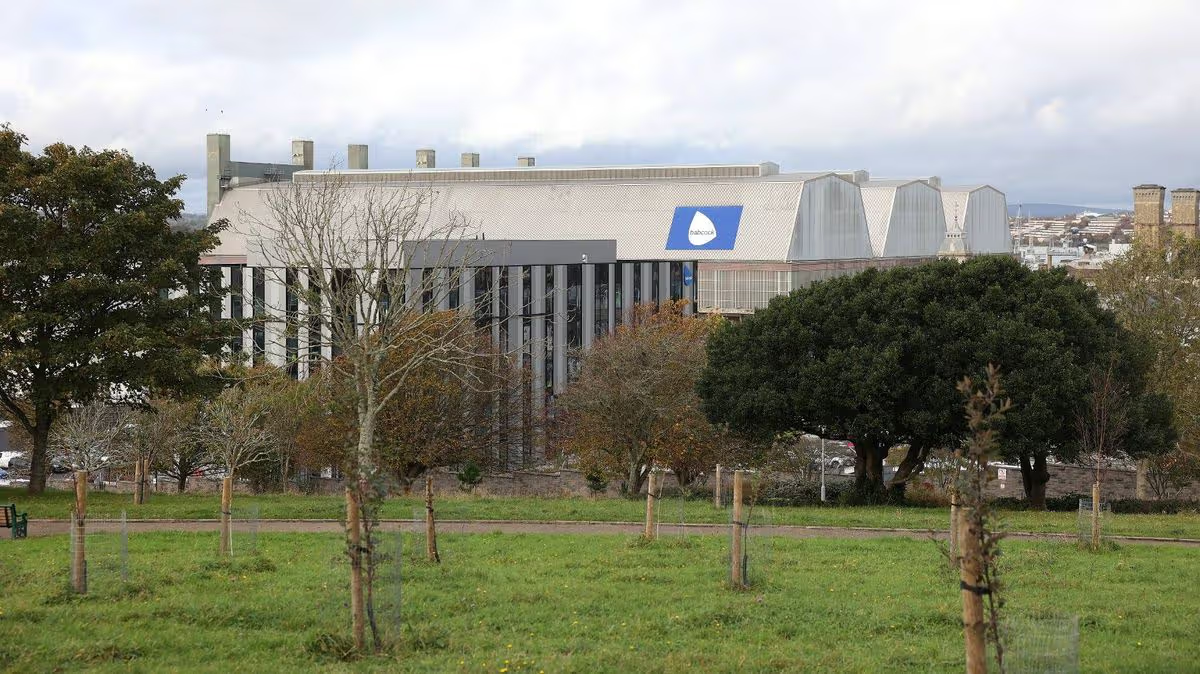
Babcock International, Devonport Dockyard, Plymouth(Image: Matt Gilley/PlymouthLive)
Defence giant Babcock has announced a series of changes to its leadership team ahead of the departure of its current chief executive. The company has confirmed that Harry Holt is now working as deputy CEO as he prepares to succeed boss David Lockwood who is retiring at the end of 2026.
Former Army officer Mr Holt has been part of the senior management team at Babcock since November 2023. Before joining the business he spent seven years on the board of Rolls Royce in a number of senior roles, including as president of its nuclear division and latterly as chief people officer, leading a group-wide transformation and restructuring.
“I am deeply honoured to have the opportunity to lead Babcock through its next chapter,” Mr Holt said previously. “I would like to pay tribute to David’s inspirational leadership that has put Babcock on an excellent footing from which we can continue to grow and am looking forward to working with him through the transition period.”
Babcock chief David Lockwood is leaving the company at the end of the year
Mr Lockwood added: “It has been my privilege to lead Babcock, through a period that has seen the COVID pandemic, international geopolitical unrest and an increased focus on global security. Babcock is a unique company, it has a team of great people, with a range of important skills, alongside some of the most critical specialist infrastructure needed today.”
Advertisement
Separately, Neal Misell, who previously headed up the company’s mission systems business, is now chief executive of Babcock’s nuclear division. Mr Misell has led multiple parts of the Babcock Group, in the UK and internationally.
Louise Atkinson, who was most recently chief people officer, has taken up the role of chief executive of mission systems. She has spent more than 13 years in senior leadership roles in Babcock’s procurement and supply chain, training and defence equipment in the group’s land business.
With Ms Atkinson moving into her new role, people director Jen McElhinney has become interim chief people officer.
“These changes to our executive committee reflect the strength and depth of our senior team and our focus on continuing to build a sustainable, successful future,” Babcock said in a statement.
Advertisement
The news comes just days after Babcock announced it would be opening a huge new base in Plymouth city centre which will house some 2,000 staff. The ‘Capability Centre’ will be in addition to the city’s Dockyard.
The engineering business said last week the move would “significantly increase” footfall in the city centre, support local businesses and services, and boost Plymouth’s economy
Protean Small Cap declined by -0.9% in March. The benchmark index declined -3.1%. Since launching in June 2023, the fund has gained 55.6%. The Carnegie Nordic Small Cap Index is up 22.1% in the same period.
The hedge fund Protean Select returned 0.5% in March.
Protean Aktiesparfond Norden returned -2.8%. The benchmark was down by -2.6%. Since inception, twelve months ago, the fund is up 18.3%, and in the same period the VINX Nordic Cap index is up 12.8%. The fund now manages 1.7bn SEK.
All figures are net of fees.
Advertisement
This month’s letter elaborates on Aktiesparfonden’s encouraging first year, the Fog of War that plagued markets in March, why we remain cautious but not as cautious as mid-March and why we were unusually active. Plus, as always, commentary on the month’s various winners and losers.
Thank you for being an investor!
// Team Protean
Nowhere to hide
March 2026 • Written by Pontus Dackmo
Advertisement
Wouldn’t it have been convenient to write this month’s missive about something completely different? A company deep-dive, a reflection on Nordic small cap valuations, perhaps an observation about the underappreciated capital cycle in some obscure industrial niche. We’d have preferred that. You’d probably have preferred that too.
The instinct, as a Nordic-focused fund manager, is to treat geopolitical events as background noise. We don’t trade oil futures, we don’t run a macro fund, and we certainly don’t have an edge on the intentions of the Iranian Revolutionary Guard or US Commander in Chief. It would be comfortable to dismiss the Middle East crisis as someone else’s problem and retreat to the familiar terrain of Nordic company fundamentals.
The problem is: there is no such retreat. An inconvenient fact about the Nordic equity markets is that most of our listed companies have international operations and are deeply embedded in global supply chains. A Swedish industrial company might report in kronor, hold its AGM in Stockholm, and have a thoroughly Nordic board – but its input costs are denominated in dollars, its customers are in Germany and China, and its order book is a function of global capex cycles. An energy shock in the Strait of Hormuz doesn’t stop at the Persian Gulf. It travels through Brent crude, through European gas prices, through the front end of rate curves, through the krona, through sentiment, and eventually lands on the desk of a CFO in a mid-sized Swedish town, wondering whether to revise guidance.
There is nowhere to hide from a physical supply shock. Not in Scandinavia, not in small caps, not in “quality compounders”.
Advertisement
The fog
General Carl von Clausewitz coined the term “fog of war” almost two centuries ago. In the chaos of conflict, the information available to decision-makers is incomplete, contradictory, and often deliberately
misleading. The rational response, he argued, is not to seek certainty, but to make decisions robust enough to survive being wrong.
March offered a masterclass in modern fog of war, except now the fog is generated not by cannon smoke but by tweets and nonsense.
We have no edge in forecasting the outcome of the Middle East conflict. None. We do not know whether the Strait of Hormuz will reopen next week or remain contested for months. We do not know if escalation leads to a ground operation or if a face-saving deal materializes over Easter. And critically, we don’t think anyone else knows either – regardless of how confidently they narrate it. What we can control is how we position for the range of outcomes.
Advertisement
Active Portfolio Management
March was, in all likelihood, the most active month we have had in a long while. Possibly ever.
That warrants some explanation. We do not celebrate turnover. Trading is, at its core, a necessary evil since every ticket is connected to a commission cost borne by the fund, every spread has two sides. We are fully aware that activity for activity’s sake is a reliable way to erode returns whilst just producing a feeling of being busy.
What happened in March is that prices moved, on a daily basis, in ways that had very little to do with company fundamentals. Tariff announcements, reversals, threats, walk-backs – the signal-to-noise ratio collapsed. When the market reprices a business by 10% because a politician said something on a Sunday, and then reprices it back 8% two days later, the question we ask ourselves is not “should we trade?” but “can we afford not to?” The disconnect between price and value was, on certain days, wide enough to drive a truck through.
So we traded. We trimmed things that moved too far. We added to things that got dragged down indiscriminately.
Advertisement
We do not fetishize this. The goal is never to be active. It is to own businesses at prices that make sense. Some months that means sitting on our hands. March was not that month. When the market hands you volatility as a gift, and the underlying thesis hasn’t changed, the correct response is to use it.
The honest addendum: a fair few trades in March were wrong. Some we were too early on; some we shouldn’t have touched at all. Elevated activity is a double-edged sword: more opportunities to profit, but also more chances being wrong.
What we’re watching
The honest answer is: we’re watching the same thing as everyone else. The Middle East. The Strait of Hormuz. The oil price. But we’re also watching for the second-order effects that tend to arrive with a lag and matter more than the headlines.
More speculatively: we are watching for the moment when the market shifts from treating this as a binary event (resolved / not resolved) to treating it as a new baseline. That shift, when it happens, tends to be where opportunity is greatest. Because once the question changes from “will things go back to normal?” to “what does the new normal look like?”, the answer requires fundamental analysis rather than geopolitical punditry.
Advertisement
But you don’t always need to wait for the fog to lift. Some conclusions are robust regardless of how the binary question resolves. Here’s an example from our own process.
In the middle of March, we bought a meaningful amount of Nibe (NDYLF) (NDYLF). The thesis is not that the war ends tomorrow, nor that it drags on for months. The thesis is that regardless of outcome, this crisis will put energy efficiency and reduced oil dependence back on the political agenda across Europe – forcefully, and probably durably. It happened after the 2022 Ukraine shock, when heat pump sales exploded and energy renovation became a political priority. That impulse then faded as gas prices normalised and populist backlash pushed governments to soften their climate ambitions. Well, here we are again. Except this time, the lesson should be harder to forget: Europe’s energy dependence is not a theoretical risk discussed at think tanks. It’s a physical vulnerability that disrupts economies when things go wrong in places we can’t control.
Nibe is the dominant European manufacturer of heat pumps. The stock has been in the penalty box for two years – inventory destocking, normalising demand, increasing competition, a weak Swedish housing market. It’s down 70% from its peak. We think the market is pricing a permanently impaired business, while the structural case for energy-efficient heating has just been handed another powerful catalyst.
This is the kind of analysis we prefer: not “will there be a ceasefire by April 6th?” but “what is likely true about the world on the other side of this, no matter what?” The best investments tend to come from conclusions that don’t depend on the impossible task of predicting the unpredictable.
Advertisement
Aktiesparfond Norden – One Year In
March 31st marked one year since launch. The fund has returned +18.3% against the VBCSKN index’s +12.8%. That is an outperformance of 5.5%.
Twelve months is not a track record. It’s a start. A better start than a bad start, which is all we’ll claim.
The more instructive number is the 1.7bn SEK in assets attracted. To understand why that matters, you need to remember the problem we set out to solve.
The active fund management industry has a well-documented flaw: virtually all serious research shows that actively managed funds underperform their benchmarks after fees. Not because the underlying stock-picking is necessarily bad, but because fees are too high, portfolios too bloated, and the incentive structure backwards. Fund companies optimize for asset gathering. Banks optimize for captive distribution. Neither optimizes for the person actually trying to compound their savings.
Advertisement
The obvious counter is the index fund. Cheap, transparent, honest. Except it owns everything indiscriminately – the frauds, the fads, the structurally declining businesses – with no judgment or overlay.
Our argument has always been that there is a gap between these two options. A white space that nobody has an incentive to fill: a low-fee, genuinely active, long-term oriented fund owning decent Nordic businesses. Just a manager with skin in the game, focused on long-term cash flow generation, making decisions without anyone else’s approval required.
The Aktiesparfond was built on the premise that a long-term Nordic saver deserves access to that kind of independent, genuinely active management. At 0.5% per year, with daily liquidity, alongside every expensive active fund and index fund in existence.
That 1.7bn SEK after one year suggests the gap was real. Whether the performance holds is a separate question, the last one year tells us almost nothing with statistical significance. But the structure is working, the thesis is intact, and the alignment of interests remains the foundation.
Advertisement
A Punch In The Mouth
The Prussian military strategist Helmuth von Moltke was a contemporary of Clausewitz. He is remembered for the observation that no plan survives first contact with the enemy (a version of which Mike Tyson famously converted to “Everyone has a plan until they get punched in the mouth.”). The investment equivalent is that no portfolio survives first contact with a real-world shock.
We came into 2026 positioned for a world of monetary tailwinds, deregulation, and an improving European outlook. That world has been interrupted – perhaps temporarily, perhaps not.
Months like March are uncomfortable. They are supposed to be. Comfort is rarely where returns are found. We remind ourselves – and you – that our process is designed to compound over years, not months. The key is to stay in the game, avoid big draw-downs, suffer intelligently when suffering is unavoidable, and be ready to act when the fog lifts.
Thank you for being an investor.
Advertisement
// Team Protean
Protean Select
March 2026 • Written by Pontus Dackmo
Protean Select returned +0.5% in March. After two softer months to start the year, this is a welcome result, and more importantly, it is the kind of month that gives the strategy its reason for existing.
Nordic indices were down between 5 and 10% this month, depending on which one you pick. We ran an average net exposure of around 20%. The fund made a small positive return. That is roughly what we designed this thing to do.
Advertisement
We are not a market-neutral fund. Or a short-biased fund. We are a fund that believes, with some conviction, that things generally want to work out in the end, and that the majority of long-term returns are made by owning businesses, not by being overly clever about when to be short them. That belief is why we almost always keep a positive net exposure, even in difficult conditions. The shorts are there not just to make money in isolation, but to act as an airbag: you don’t drive with an airbag hoping it deploys, but you’re grateful it’s there when it does. Like this month.
Biggest contributors were the OMX future short position (plus put-spread), Rusta long, NIBE long and Electrolux (ELUXY) short, in that order.
Biggest detractors were Devyser, Lundin Mining (LUNMF) (although offset by a short in Boliden (BDNNY) (BDNNY)), Volvo (VLVLY) and Getinge (GNGBY) long positions.
We enter April at 19% net exposure. Gross is now at 117%, having nudged it upward from more cautious levels, moving gradually back toward our historical average of around 135%. This is a deliberate, incremental decision, not a conviction call. The market feels non-linear right now. If conditions continue to feel constructive enough to justify additional risk, we will add. If not, we won’t.
Advertisement
We said going into the year that we wanted to earn the right to take more risk. March was a small step in that direction. Let’s see what April has to say about it.
Lowering the capacity limit
We announced during the month that we are lowering the capacity limit for Protean Select from SEK 2 billion to SEK 1 billion. The fund currently manages approximately SEK 970 million. We are, in other words, very close.
Some context. When we originally set the cap at SEK 2 billion, we assessed capacity based on the fund in isolation. That was reasonable at the time. But circumstances have changed. We now manage institutional mandates alongside the fund, applying a similar investment strategy in the same universe of Nordic small- and midcap companies. Running larger aggregate capital through the same opportunity set degrades the things that matter most: execution quality, the ability to take meaningful positions in less liquid names, and the speed of decision-making that comes with being small. We’d rather close too early than too late.
Here is how it will work. Once we pass SEK 1 billion, we will communicate that the fund is closing. There will then be a final subscription window of approximately one month. After that, the fund is closed to new capital. Withdrawals are always possible – this only affects new deposits.
Advertisement
Readers of these letters will recognise the philosophy.
We have said since day one that we optimise for performance, not for convenience, size, or marketing. We have written at length – perhaps at tedious length – about the perverse incentives in fund management, how AUM-maximising behaviour dilutes returns, and how size is one of the primary ways performance dies. We have said we would cap the fund early. We have said we would sacrifice revenue for return quality. And now, approaching the moment where those words become action, it feels worth pausing to acknowledge what this means.
On a personal level, the prospect of actually closing the fund is a source of pride. Not because turning away capital is clever business – it obviously isn’t. But because it means we are doing what we said we would do. When we started Protean, the motivation was to invest our own savings in an institutional setting, not to build an asset gathering machine. Every structural choice we’ve made has pointed in this direction: the quarterly redemptions that scare off allocators, the size cap that limits our fee income, the high hurdle rates that make performance fees genuinely hard to earn. None of this is “How to Build a Big Profitable Fund Management Business”. If there were a textbook on the subject, we’d feature as a cautionary tale.
But here’s the thing. Almost four years in, the fund has delivered competitive risk-adjusted returns. We even won an actual prize for it. Assets have grown to the cap not through marketing campaigns, but through performance and word of mouth. Our investors include some of the most sophisticated allocators we know, alongside friends, family, and our own savings. That this motley crew has collectively brought us to the point of closure feels like vindication of a philosophy.
Advertisement
We recognise this limits flexibility for both existing and prospective investors. That trade-off is deliberate. Protecting the conditions for good long-term returns is, in our view, the most important thing we can do for the people who have already entrusted us with their capital.
Protean Small Cap
March 2026 • Written by Carl Gustafsson
Protean Small Cap returned -0.9% in March. Our benchmark CSRXN (SEK) was down -3.1% during the month. Hence, the fund outperformed the index by 2.3%. Since inception in June 2023, the fund has outperformed the index by 33.5%. Total performance since inception is 55.6% net of fees.
The fund now manages c. SEK 990m following a continued inflow of funds, thank you for believing in us.
Advertisement
March recap
Top contributors were Cint, Rusta, BTS, Smartoptics and Nibe. Notable detractors were Devyser, Balder (BALDY) (BALDY), Arctic Falls, Nyfosa and ITAB.
Cint reported a considerable sequential improvement in sales during the fourth quarter and we increased our stake in the company on the day of the report in February. Since then, the share has continued to climb and it became our biggest contributor in March. It’s not a stock for widows and orphans but we believe the market is underestimating the growth opportunity within the business area Media Measurement. We acknowledge a string of operational issues, as well as about the impact of AI on the market research sector, but Q3 was likely the trough in terms of pain. The valuation is very appealing.
Rusta reported a very strong quarter, where the benefits of the stronger SEK started to have an impact. Healthy LFL, as well as a firmer outlook for store openings, lead to share to gain in an otherwise gloomy March for consumer exposure.
On the detractor side, Devyser continued its slump, with the share down by a third year to date. As we write this, the share now trades below its IPO price from 2021, despite clearly approaching cash-flow break-even and strong growth prospects in several areas. Devyser is active within genetic testing where DNA is used to assess disease risk as well as detecting them. Introducing new testing protocols takes time, but they are very sticky once established. The market might have overestimated the speed at which Devyser can establish itself, but we believe it underestimates the duration of the opportunity.
Advertisement
Balder and Nyfosa suffered from concerns over long-term rates.
While March was less busy in terms of portfolio activity, we take the opportunity to catch-up on some of the changes we have made so far this year.
We have added Vimian as a mid-sized position. This is a Swedish animal health company, focusing mainly on pets. It has a relatively broad product offering partly due to an opportunistic acquisition strategy. As for many others, a string of acquisitions during the pandemic led to some issues, financially as well as operationally. The financial issues were resolved through a rights issue, while the operational issues have been gradually, but not fully, addressed through restructuring and cost savings.
Where does the attraction lie? Q4 was strong with improved earnings quality, as well as stronger cash flow. This positive step has been disregarded in the overall market turmoil, and the share is trading at the low-end of its post-pandemic range, and considerably below levels where the main owner Fidelio (the PE sponsor that owns 60% of the stock) has added shares as recently as this autumn. The valuation does not fully capture the thematic exposure, we believe. With continued margin improvement, a return to more M&A and upside towards sector valuation, we see good risk/reward.
Advertisement
We have also added smaller stakes in a few interesting growth stories where shares can typically be hard to come by. These include Vertiseit , which describes itself as a supplier of “in-store Experience Management (IXM) platforms”. This can be translated into ‘software that runs all the screens you see in stores’ to simplify. The appeal of the business lies in the execution, we believe. The company is led by owner-operators who have ten-folded annual recurring revenue over the last decade. This is partly due to organic growth but also complemented by successful acquisitions where there are considerable synergies that can be extracted. We visited Grassfish, one of Vertiseit’s subsidiaries, in Vienna earlier this month, and were enthused by the growth opportunities that remain.
We have exited our positions in Hexpol and Sinch (as the buyback programme we alluded to last month led to some outperformance and provided a window of exit).
Our top ten positions as we enter April are as follows:
Advertisement
Rank
Holding
% of portfolio
Rank
Holding
% of portfolio
1
Acast
4.5%
6
ITAB
3.3%
2
Storytel
4.1%
7
Storskogen
3.2%
3
Sdiptech
4.0%
8
Vimian
3.2%
4
BTS
3.7%
9
Devyser
3.1%
5
Cint
3.5%
10
Vitec
3.0%
Protean Aktiesparfond Norden
MARCH 2026 • WRITTEN BY RICHARD BRÅSE
Aktiesparfonden is a Nordic long-only fund aiming to generate above-market returns over the long term by active investing in value-creating companies and charging a low fee. A fee that is reduced further as the fund grows, sharing the scale advantages with investors.
Aktiesparfonden has, since inception one year ago, delivered a 18.3% return, in the same period the VINX Nordic Cap index is up 12.8% . The fund now manages 1.7bn SEK.
Our communication for Aktiesparfonden is currently only in Swedish, and updates can be found at www.aktiesparfonden.se by clicking the headline “Anslagstavla”.
Advertisement
Thank you for your long-term perspective and trust in our process.
Thank you for being an investor.
Pontus Dackmo CEO & Investment Manager Protean Funds Scandinavia AB
The monthly reminder
We optimize for performance, not for convenience, size, or marketing. You can withdraw money only quarterly in Select (monthly in Small Cap). We will tell you very little about our holdings. Our strategy is tricky to describe as we aim to be versatile. A hedge fund can lose money even if markets are up. We charge a performance fee if we do well. You do not get a discount if you have a larger sum to invest. We only have a medium-sized track record.
Advertisement
Aktiesparfonden’s reminder
We aim to generate above index returns over 3-5 years, but there are no guarantees. The fund is traded daily, but that doesn’t mean you should. To beat the index, you need to deviate from the index. This means taking uncomfortable positions. Be aware that the fund can underperform the index during periods. Sometimes, long periods. We lower the fee as the fund grows. The first 10 basis point cut comes at 10bn SEK in AUM.
Buy-side hedge professionals conducting fundamental, income oriented, long term analysis across sectors globally in developed markets. Please shoot us a message or leave a comment to discuss ideas.DISCLOSURE: All of our articles are a matter of opinion, informed as they might be, and must be treated as such. We take no responsibility for your investments but wish you best of luck.
Analyst’s Disclosure: I/we have no stock, option or similar derivative position in any of the companies mentioned, and no plans to initiate any such positions within the next 72 hours. I wrote this article myself, and it expresses my own opinions. I am not receiving compensation for it (other than from Seeking Alpha). I have no business relationship with any company whose stock is mentioned in this article.
Seeking Alpha’s Disclosure: Past performance is no guarantee of future results. No recommendation or advice is being given as to whether any investment is suitable for a particular investor. Any views or opinions expressed above may not reflect those of Seeking Alpha as a whole. Seeking Alpha is not a licensed securities dealer, broker or US investment adviser or investment bank. Our analysts are third party authors that include both professional investors and individual investors who may not be licensed or certified by any institute or regulatory body.
Good morning, everyone, and welcome to today’s PVH Fourth Quarter 2025 and Full Year Earnings Conference Call. [Operator Instructions] Please note this call may be recorded [Operator Instructions] — it is now my pleasure to turn today’s program over to Sheryl Freeman, Senior Vice President of Investor Relations.
Sheryl Freeman Vice President of Investor Relations
Advertisement
Thank you, operator. Good morning, everyone, and welcome to the PVH Corp. Fourth Quarter and Full Year 2025 Earnings Conference Call. Leading the call today will be Stefan Larsson, Chief Executive Officer; and Melissa Stone, Interim Chief Financial Officer and Executive Vice President, Global Financial Planning and Analysis. This webcast and conference call is being recorded on behalf of PVH and consists of copyrighted material.
It may not be recorded, rebroadcast or otherwise transmitted without PVH’s written permission. Your participation constitutes your consent to having anything you say appear on any transcript or replay of this call. The information to be discussed includes forward-looking statements that reflect PVH’s view as of March 31, 2026, of future events and financial performance. These statements are subject to risks and uncertainties indicated in the company’s SEC filings and the safe harbor statement included in the press release that is the subject of this call.
























































You must be logged in to post a comment Login