
Connect with us

Business

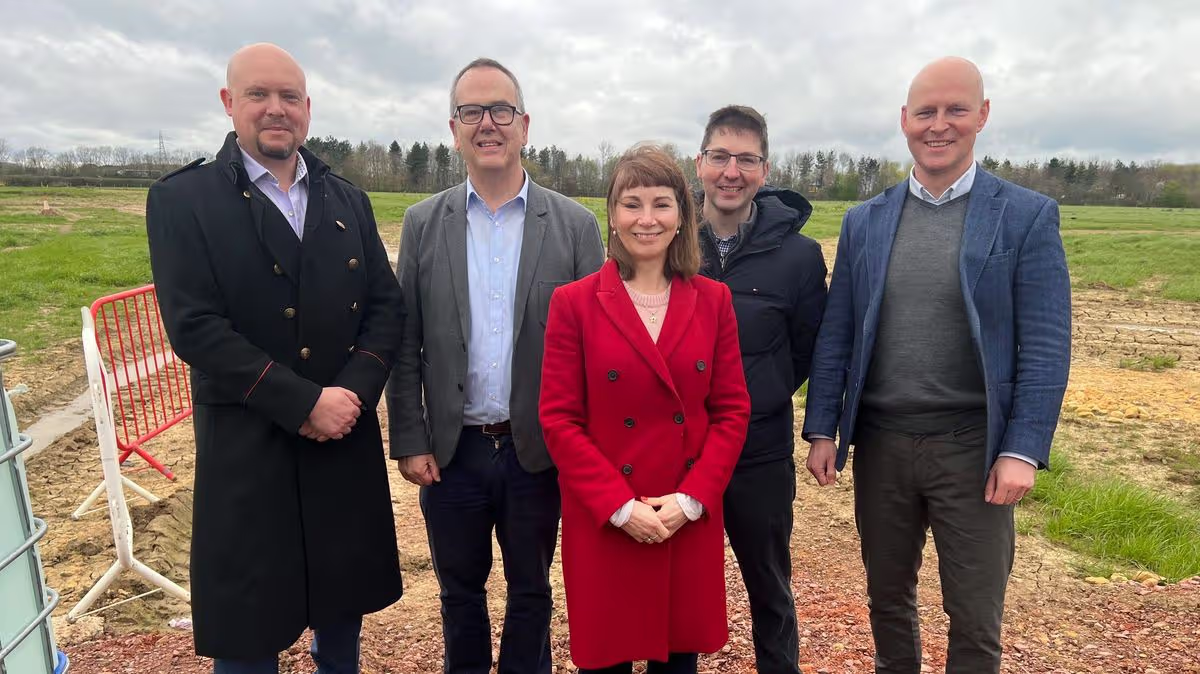
Frank Elsner Builds Big Ideas Through Steady Action

Published

on

Frank Elsner Builds Big Ideas Through Steady Action

Big ideas often get credit for changing careers and industries. But ideas alone do nothing without follow-through. Frank Elsner’s career shows how steady action, applied over time, can turn practical ideas into real results.

His path is not built on sudden wins. It is built on discipline, learning, and showing up prepared.

Today, Elsner serves as Chief of Safety and Security for the Natural Factors Group of Companies. His work reflects decades of experience across high-pressure roles, leadership positions, and continuous education. Along the way, he has focused on one core belief: simple ideas work best when they are practiced every day.

Early Experiences That Shaped His Thinking

Frank Elsner

was born in Germany and moved to Canada in 1965. He grew up in Vancouver and later in Oliver, British Columbia. Sports played a major role in his early life. He wrestled competitively and ranked second in the province in his weight class. He also played rugby and soccer.

Advertisement

“Wrestling taught me patience,” he says. “You don’t rush your way to success. You earn it one move at a time.”

By age 17, he became a certified expert diver. This early skill later shaped parts of his professional work. He also served as student council president, gaining early exposure to leadership and responsibility.

“At the time, I didn’t think of it as leadership,” he says. “I just wanted things to run better.”

These experiences formed the base of how he approaches ideas today. Start small. Stay focused. Learn from pressure.

Advertisement

Learning to Turn Ideas Into Action

Frank’s career unfolded across a wide range of demanding roles. He worked in undercover assignments, investigations, intelligence operations, dive teams, tactical environments, and senior leadership positions. Each role forced him to think clearly under stress.

“Undercover work taught me awareness,” he explains. “Tactical work taught me teamwork. Intelligence work taught me patience.”

Rather than chasing titles, he chose assignments that stretched his skills. This helped him develop ideas that were tested in real conditions. One example is his continued use of short debriefs.

“After anything important, I ask three questions,” he says. “What worked. What didn’t. What needs to change. It keeps you honest.”

Advertisement

This simple habit followed him into leadership roles and later into the private sector. It became a way to turn experience into improvement.

Education as a Tool for Better Thinking

Frank returned to school as a mature student at Lakehead University. He completed a four-year Political Science degree in three years while working full time. The experience reshaped how he approached problem-solving.

“Going back to school at 32 was hard,” he says. “But it forced me to slow down my thinking.”

More than two decades later, he earned a Master of Public Administration from Western University. This helped him connect ideas with systems.

Advertisement

“Big ideas only matter if you can make them work,” he says. “Education helped me understand how policy, people, and structure fit together.”

His academic journey reinforced a pattern in his life. When he lacked a tool, he went and learned it.

Applying Big Ideas in the Private Sector

As Chief of Safety and Security for Natural Factors Group of Companies, Frank applies lessons from decades of experience. His focus is not on complex systems. It is on culture, clarity, and awareness.

“Safety isn’t just about rules,” he says. “It’s about how people think when no one is watching.”

Advertisement

One of his key ideas is that clarity beats speed. He believes rushed decisions often create more work later.

“Patience will take you further than adrenaline,” he says.

He also encourages leaders to create space for silence.

“Silence is underrated,” he explains. “You learn more when you listen.”

Advertisement

These ideas influence how teams communicate, respond to risk, and make decisions under pressure.

Habits That Keep Ideas Alive

Frank credits much of his consistency to small personal habits. One is writing things down by hand, a practice he adopted during university.

“Handwriting forces you to slow down,” he says. “It helps ideas stick.”

Another is finding ways to reset. For Frank, that reset comes from motorcycle riding.

Advertisement

“When you’re riding, you’re fully present,” he says. “It clears the noise.”

These habits help him stay focused and grounded, even in demanding roles.

A Career Built Through Consistency

Frank Elsner’s career shows that big ideas do not need big speeches. They need practice. His story is one of steady progress shaped by discipline, learning, and reflection.

“Most big ideas start as small habits,” he says. “If you repeat them long enough, they become part of who you are.”

Advertisement

Rather than chasing attention, Frank focused on execution. That focus allowed his ideas to grow quietly but effectively, shaping his career and the organizations he serves.

Advertisement
Continue Reading
Click to comment

Leave a Reply

Your email address will not be published. Required fields are marked *

Business

Jahnke, director at Zurn Elkay, sells $902,876 in stock

Published

on


Jahnke, director at Zurn Elkay, sells $902,876 in stock

Continue Reading

Business

Apple Is Reportedly Working on CarPlay Support for ChatGPT, Claude, and Gemini

Published

on

tumblr
3D Apple Logo

Apple is reportedly working on allowing AI chatbots like ChatGPT, Claude, and Gemini in its CarPlay system.

Should this become a reality, what happens to Siri?

Apple Reportedly Works on AI Chatbot Integration

According to Bloomberg’s Mark Gurman, the support for third-party AI apps is expected to arrive in the coming months.

The support will reportedly allow CarPlay‌ users to ask these AI apps questions hands-free. However, it should be noted that users may need to open an app in order to access their preferred chatbot.

MacRumors notes in its report that app developers will be given the opportunity to design in-car experiences that will be the ones to launch the voice-based chat mode upon opening of the app.

Advertisement

What Happens to Siri?

There’s no need to worry about Siri as this change is not meant to replace the AI assistant.

The support for third-party AI chatbots will have limitations. MacRumors reports that the support will not have a wake word, which makes opening the app of their chosen AI chatbot necessary in order to use the function.

As of press time, Apple has not confirmed if it is indeed working on support for third-party AI chatbots in CarPlay.

However, Apple Insider points out that the slow rollout of the new Siri may have been a contributing factor to the reported decision to provide support for such apps.

Advertisement

Originally published on Tech Times

Continue Reading

Business

Ilan Ganot, Solid Biosciences director, sells $46k in shares

Published

on


Ilan Ganot, Solid Biosciences director, sells $46k in shares

Continue Reading

Business

US appeals court upholds Trump’s immigration detention policy

Published

on


US appeals court upholds Trump’s immigration detention policy

Continue Reading

Business

Cathie Wood’s ARK Funds Buy the AMD Stock Drop

Published

on

Cathie Wood’s ARK Funds Buy the AMD Stock Drop

Cathie Wood’s ARK Funds Buy the AMD Stock Drop

Continue Reading

Business

Smith, Rhythm Pharmaceuticals CFO, sells $702k in RYTM stock

Published

on


Smith, Rhythm Pharmaceuticals CFO, sells $702k in RYTM stock

Continue Reading

Business

innoscripta SE 2025 Q4 – Results – Earnings Call Presentation (OTCMKTS:INNTF) 2026-02-06

Published

on

OneWater Marine Inc. (ONEW) Q1 2026 Earnings Call Transcript

This article was written by

Seeking Alpha’s transcripts team is responsible for the development of all of our transcript-related projects. We currently publish thousands of quarterly earnings calls per quarter on our site and are continuing to grow and expand our coverage. The purpose of this profile is to allow us to share with our readers new transcript-related developments. Thanks, SA Transcripts Team

Continue Reading

Business

Arlo Technologies CEO Mcrae sells $1.9 million in stock

Published

on


Arlo Technologies CEO Mcrae sells $1.9 million in stock

Continue Reading

Business

Bitcoin Falls Below $70,000. Why This Crypto Crisis Is Getting Scary.

Published

on

Bitcoin Falls Below $70,000 as XRP, Ether Also Drop. Why This Crypto Crisis Will Roll On.

Bitcoin Falls Below $70,000. Why This Crypto Crisis Is Getting Scary.

Continue Reading

Business

‘Armonia’ Delivers Historic Multi-City Magic

Published

on

2026 Milano Cortina Winter Olympics

Milano Cortina 2026’s Winter Olympics opening ceremony unfolded Friday as a bold, geographically ambitious spectacle titled “Armonia” (Harmony), weaving live performances across San Siro Stadium, Cortina d’Ampezzo and beyond into a narrative celebrating Italy’s dual urban-mountain soul. The nearly three-hour show blended La Scala-inspired dance, global superstars like Mariah Carey and Laura Pausini, and dual cauldron lightings, though fragmented execution, political boos and protest interruptions tempered its grandeur.

Directed by Marco Balich with a Giorgio Armani fashion homage, the ceremony innovated by distributing athlete parades across four clusters — Milan (indoor), Cortina (Alpine/sliding), Livigno (freestyle) and Predazzo (Nordic) — ensuring all 3,000+ competitors participated despite vast distances. Critics hailed the simultaneity as “intimate and enormous,” but some found it disjointed, lacking traditional cohesion.

Dual cauldrons ignite across Italy: A first for Olympics

In a historic twist, two Olympic cauldrons blazed simultaneously: Milan’s Arco della Pace and Cortina’s Piazza Dibona, symbolizing city-mountain unity. Supermodel Vittoria Ceretti, in all-white Armani, carried the torch from San Siro to ignite Milan’s flame via “magic of technology,” while Cortina’s lit remotely — a logistical marvel marred by elongated sequences.

The multi-venue parade replaced single-stadium marches with live feeds: ice skaters in Milan, snowboarders in Livigno, biathletes in Predazzo. Television editing fluidly integrated segments, creating “four ceremonies in one,” though live crowds felt the fragmentation. U.S. athletes drew massive cheers at San Siro, only for boos to erupt during Vice President JD Vance’s brief appearance — a tense moment swiftly cut away.​

Advertisement

‘Armonia’ theme: Beauty over politics, but protests intrude

“Armonia” promised a “voyage through art and innovation,” honoring Leonardo da Vinci, Italian design and Olympic ethos. Ethereal dancers opened with La Scala nods — marble busts, flowing choreography — evoking tranquility before escalating to time-travel motifs and massive bobbleheads. Actress Matilda De Angelis narrated, tying fragmented acts into harmony’s promise.

Mariah Carey kicked off with hits, joined by Grammy/Golden Globe winner Laura Pausini and tenor Andrea Bocelli from Tuscany. Production designer Paolo Fantin and music director Andrea Farri delivered visual feasts — ice-block banners, fashion-sports uniforms — though Deadline critiqued “gimmicks over glamour” in the flame-lighting finale.

Protests disrupted: anti-Olympic banners decried housing costs, Palestinian solidarity chants pierced whistles. Organized rather than chaotic, they underscored Italy’s civic pulse amid global tensions.​

Advertisement

Parade of Nations: Distributed drama delights, divides

Fragmenting the traditional parade minimized travel while showcasing venues. San Siro hosted urban nations; Cortina mountain squads. Graphics aided viewers, but stadium pacing dragged — “seemingly endless procession,” per IndieWire.​

U.S. flagbearers received roars; host Italy closed to “Il Canto degli Italiani.” IOC President Thomas Bach’s farewell preceded LA 2028 handover.​

Critics praise innovation, critique cohesion

The Guardian (4/5 stars): “Intimate and enormous… less march of nations, more curated narrative mirroring distributed sports.”​

Deadline: “Three hours, three acts lacked unity beyond visual devotion… historic spectacle, per Malagò.”​

Advertisement

IndieWire: “Weirdness in short supply, but harmony attempts shone in editing.”​

Variety: “Somber tone, stringent security for 2.2B viewers; dual flames wowed.”​

Global audience hit billions; Peacock/NBC streamed live.​

Day 1 medals await: Shiffrin, Chen, Kim in spotlight

Saturday yields five golds: men’s downhill (Bormio, 5:30 a.m. ET), women’s skiathlon (Val di Fiemme). Nathan Chen eyes figure skating three-peat; Chloe Kim defends halfpipe; Mikaela Shiffrin chases records.​

Advertisement

Hosts Italy (130 athletes) bank on Federica Brignone, Sofia Goggia. Russia as AIN; China fields Eileen Gu.​

Production triumphs and logistical feats

Balich Wonder Studio executed Balich’s vision: da Vinci inventions, culinary nods, youth segments. Armani costumes fused elegance-sports; Cantini Parrini’s designs dazzled. San Siro’s 75,000 roared; remote venues pulsed simultaneously.​

Security — drones, robots, thousands of officers — shielded dignitaries including Vance, Rubio. Sustainability shone: 99% legacy venues.

What ‘Armonia’ means for Olympics future

Milano Cortina pioneered polycentric ceremonies, influencing LA 2028, Brisbane 2032. “Harmony” — uniting disparate elements — resonated amid division, though execution split opinions.​

Advertisement

Malagò called it “promise to the world”; Varnier hailed inclusive athlete participation. From San Siro spectacle to Cortina flames, Italy delivered innovation — if not unalloyed unity.

Continue Reading

Trending

Copyright © 2025