






Connect with us
DAPA Banner
DAPA Coin
DAPA
COIN PAYMENT ASSET
PRIVACY · BLOCKDAG · HOMOMORPHIC ENCRYPTION · RUST
ElGamal Encrypted MINE DAPA
🚫 GENESIS SOLD OUT
DAPAPAY COMING

Business

from algorithmic trading to AI

Published

on

Traders brace for inflation data and public finance update as long-term government debt hits levels last seen in 1998

In late June, algorithmic trading funds experienced what the Financial Times called a “quant tremor”, a downward fluctuation affecting quantitative traders, which the newspaper predicted is becoming more common.

While quantitative trading firms are doing well this year, Goldman Sachs’ prime brokerage suffered their worst five-day performance since December 2023.

This is not a new phenomenon. Any finance-head would struggle to forget the 2007 quant crunch, and hedge funds and big financial institutions have employed algorithmic trading for decades.

But the barriers to algorithmic trading tools have dropped dramatically in recent years, driven by rapid advances in artificial intelligence.

Dozens of AI trading applications, from code-free automation tools such as Capitalise.ai, to quantitative research and strategy building platforms like QuantConnect, have opened the field to millions of individual retail investors who need little more than an internet connection and the budget for a platform subscription.

Advertisement

AI products can process large amounts of data, track market movements, spot patterns and even execute trades. They can also enhance the speed, responsiveness, perception and information level of every trader using them.

Rotem Farkash: AI can improve market access, but it may amplify systemic risks

Rotem Farkash, an AI expert and trader,  who has founded algorithmic trading companies, is clear that AI in trading should be understood in two ways: “as a tool that can broaden access and improve pricing, but also as one that introduces new forms of risk”.

The first risk is as more traders rely on similar AI-driven signals, market movements may become more synchronised, magnifying swings and increasing volatility across the financial system.

The risk of converging trades has been around for a long time. Long Term Capital Management’s 1998 collapse and the 2010 Flash Crash showed how quantitative strategies can unravel rapidly. But now AI is amplifying this risk by increasing the frequency of automated trades, making even deeper crashes possible.

Advertisement

The second risk is machine error. While AI may reduce some human mistakes, it is not perfect. If AI misinterprets a word or does not understand the context of a particular piece of information, it could trigger purchases or sales that have significant consequences for the trader.

Ken Griffin: AI “is profoundly more powerful than it was just nine months ago”

Ken Griffin’s Citadel, perhaps the world’s best-known quantitative hedge fund, initially approached AI as a tool for operational efficiency, to accelerate research, automate workflows and improve internal processes.

Yet in May, Griffin acknowledged how quickly the technology had advanced, saying it was “profoundly more powerful than it was just nine months ago”. That shift, he argued, had allowed Citadel to “unleash a much broader array of use cases for AI”, with work that would once have required people with masters and PhDs in finance weeks or months being completed by AI agents in hours or days.

Some firms are pushing this even further. Minotaur Capital, an Australia-based firm, has built its investment process around a proprietary AI platform called Taurient, which is designed to identify global stock opportunities.

Advertisement

Its strategy, which focuses on under-researched equities, delivered a 13.7% return for its flagship fund in the six months to January 2025, outperforming the MSCI All-Country World Index.

AI will likely complement humans, but is not without risk

For now, AI stock pickers may be capable of outperforming some index funds, but they remain some distance from displacing human expertise when that expertise is itself enhanced by AI tools.

The more likely outcome is that leading firms combine artificial and human intelligence, rather than replacing one with the other.

But both institutional and retail investors should remain cautious. AI may be a powerful tool in trading, but it is not risk-free. It poses a threat to market stability and can replicate the same errors that have long undermined human traders.

Advertisement

Continue Reading
Click to comment

You must be logged in to post a comment Login

Leave a Reply

Business

OPINION: The world wants uranium, WA Labor says no

Published

on

OPINION: The world wants uranium, WA Labor says no

OPINION: WA holds some of the world’s most significant uranium resources, yet WA Labor’s indefensible ban is locking the state out of a major economic and strategic opportunity.

Continue Reading

Business

Apple Stock Climbs 2.59% After Baird Lifts Price Target to $330 Ahead of Next Week’s Earnings Report

Published

on

Apple Stock Climbs 2.59% After Baird Lifts Price Target to

Shares of Apple climbed Friday morning after investment bank Robert W. Baird raised its price target on the stock and maintained an “Outperform” rating, adding to a strong month for the tech giant heading into its next earnings report.

Apple shares traded at $329.98 as of 10:53 a.m. Eastern time, up $8.32, or 2.59%, on the day. The gain builds on a rally that has pushed Apple shares up roughly 20% since the start of the year, putting the company on pace for one of its strongest annual performances in recent history.

A fresh price target increase

Robert W. Baird raised its price objective on Apple from $310 to $330 in a research note issued Friday, maintaining its “Outperform” rating on the stock, according to MarketBeat. The upgrade adds to a series of increasingly bullish price targets issued by Wall Street analysts in recent weeks. Citi raised its own target on Apple to $365 earlier this month, citing record quarterly Services revenue of $31 billion, according to 24/7 Wall St. Despite those upward revisions, Wall Street’s average consensus price target has continued to lag behind where the stock currently trades, a dynamic that has persisted throughout much of Apple’s recent rally.

Advertisement

A record-setting month

Apple’s stock has been on an extraordinary run in recent weeks. Shares touched a fresh intraday record above $325 earlier this month, marking the company’s 15th intraday record of 2026 and lifting its market value to nearly $5 trillion, according to 24/7 Wall St. The company added more than half a trillion dollars in market value during July alone, a period in which Apple led the Dow Jones Industrial Average among its 30 component stocks.

That performance has come alongside strong gains from other Dow leaders this year, including Goldman Sachs, up roughly 30% year-to-date following record quarterly earnings, and Chevron, up about 19% amid a broader recovery in crude oil prices. Apple’s rally has also occurred alongside continued strength in mega-cap technology stocks more broadly, including Nvidia, which has climbed 13% this year on sustained demand tied to artificial intelligence infrastructure.

What’s driving investor optimism

Advertisement

Much of the recent enthusiasm around Apple has centered on reports of an ambitious new product roadmap. According to Nikkei Asia, Apple is preparing to launch at least five new iPhone models in the first half of 2027, including a premium-priced foldable device reportedly expected to be named the “iPhone Ultra.” Apple has reportedly asked suppliers to prepare for production of roughly 10 million foldable iPhone units, an increase from an earlier target of seven to eight million units, according to Yahoo Finance, a sign the company is confident in stronger-than-initially-expected demand for the new device category.

Market intelligence firm IDC has estimated the foldable iPhone Ultra could carry a price tag of roughly $2,500, potentially reaching as high as $3,000 with additional storage. In response to the reports, Morgan Stanley analysts said Apple has a path toward shipping more than 250 million iPhones in fiscal year 2027, should the new foldable lineup and expanded AI features drive stronger-than-expected consumer demand.

Progress on AI features in China

Apple shares also gained earlier this month after the company secured regulatory approval to launch Apple Intelligence features in China through a partnership integrating Alibaba’s Qwen AI model into its devices there, according to Yahoo Finance. That approval addresses a market where Apple has faced regulatory hurdles in rolling out its AI-powered software features, and the news contributed to a single-session stock jump of more than 4% at the time.

Advertisement

A premium valuation heading into earnings

Apple’s rally has pushed the stock to a trailing 12-month price-to-earnings ratio of roughly 39.67, a premium valuation that 24/7 Wall St. noted raises the bar for how much further the stock can climb without a corresponding acceleration in earnings growth. Apple is scheduled to report its fiscal third-quarter 2026 results on July 30, a report widely viewed as the next major test of whether the company’s recent rally can be sustained.

Analyst estimates compiled by Zacks project Apple will report earnings per share of $1.88 for the upcoming quarter, representing nearly a 20% increase from the same period a year earlier, alongside projected net sales of approximately $108.79 billion, up close to 16% year-over-year. For the full fiscal year, consensus estimates call for earnings of $8.76 per share on revenue of roughly $479.03 billion, reflecting year-over-year growth of more than 17% and 15%, respectively.

A stock that has rewarded long-term investors

Advertisement

Apple’s performance over the past several years has proven especially lucrative for longtime shareholders. According to Yahoo Finance, an investor who purchased $1,000 worth of Apple stock five years ago would today be holding an investment worth more than $2,200, reflecting the stock’s sustained appreciation even through periods of broader market volatility.

Analyst sentiment remains mostly positive

Beyond Friday’s Baird upgrade, other analysts have flagged Apple’s upcoming earnings report as a key opportunity to reinforce the bullish case building around the stock. Bank of America analysts have specifically urged investors to “watch the margins” heading into the report, according to CNN, suggesting the bank expects Apple to beat consensus estimates for the quarter. Separately, Apple has continued attracting attention from institutional investors and asset managers positioning ahead of the earnings release, even as some smaller shareholders have modestly trimmed their positions in recent weeks.

With Apple’s earnings report just days away, Friday’s price target increase from Baird adds to a growing chorus of Wall Street optimism heading into the release. Investors will be watching closely for updates on iPhone sales momentum, progress on the company’s AI features rollout in China, and any additional detail on the upcoming foldable iPhone lineup, all factors that are likely to shape whether Apple’s stock can continue building on its record-setting run through the remainder of the year.

Advertisement
Continue Reading

Business

Benchmark reiterates Hold on Norfolk Southern stock after earnings beat

Published

on


Benchmark reiterates Hold on Norfolk Southern stock after earnings beat

Continue Reading

Business

Starmer and Reeves left UK ‘no better off’, bank says

Published

on

Starmer and Reeves left UK 'no better off', bank says

A top City investment bank has delivered a blunt verdict on Sir Keir Starmer and Rachel Reeves: for all the talk of national renewal, they left the economy no better off than they found it. For Britain’s small firms, the bill is landing as higher energy costs and fresh barriers to hiring and building.

In a research note published on Friday, Panmure Liberum said the former Prime Minister and Chancellor’s missteps on energy and housing meant it was “difficult to conclude” that the economy had improved in the two years since the general election.

“Progress in pockets of the economy have been stifled by new barriers to construction and employment leaving the UK, in our view, no better off than it was in July 2024,” chief economist Simon French wrote. He blamed a “new UK disease of prioritising luxury beliefs over hard-nosed competitiveness” for casting a shadow over the pair’s economic legacy.

The verdict cuts against the story both told on their way out. In a resignation speech defending his record, Starmer said he had left “this country in better shape than I found it” and that the “economy is stronger”. At last week’s Mansion House dinner, Reeves told City executives she had “restored economic credibility” and put the public finances on a firmer footing, echoing her earlier claim that the economy is not broken, just stuck.

For business owners, the detail matters more than the rhetoric. Housebuilding and energy were meant to be the twin engines of recovery. Labour’s manifesto promised to make Britain a “clean energy superpower” and cut household bills by £300 a year, alongside a pledge to build 1.5m homes over the parliament, a target that has since drifted out of reach.

Advertisement

French argued the refusal to open the North Sea to new drilling had deterred private investment and rationed an important source of power. “There remains little chance of a revival in economic growth whilst this approach creates a wider chilling approach on the deployment of capital into energy assets and auctions lock in higher energy costs for a further generation,” he wrote.

That is a pointed warning for energy-intensive SMEs, from manufacturers to hospitality operators, who have spent years absorbing bills they cannot easily pass on. Higher costs “locked in” for a generation is not the backdrop most owners planned their investment around.

On housing, French said the government had taken “a backwards step on private housing volumes as luxury beliefs swamp the positive rhetoric”, a blow to the builders, tradespeople and suppliers whose order books depend on shovels in the ground. He was warmer on infrastructure, crediting “more encouraging progress” on speeding up major projects.

The numbers tell a familiar story. Over the two years, the economy grew at roughly 1.2 per cent a year, broadly in line with the average since the 2008 financial crisis. GDP per capita, which accounts for population size, grew slightly faster than that post-crisis trend, helped in part by Starmer’s success in bringing immigration numbers down.

Advertisement

None of which will comfort owners who were promised a decade of renewal and, on Panmure Liberum’s reading, got two years of standing still. The wider growth picture has hardly helped. The message for the next administration is unsparing: competitiveness, not luxury beliefs, is what moves the dial for the firms that actually create the growth.


Amy Ingham

Amy Ingham

Amy Ingham is a reporter at Business Matters, covering UK business news with a focus on breaking news, business policy, late payments and insolvency. She joined the magazine in 2026 after completing the NCTJ Diploma in Journalism at Harlow College’s journalism school. Her recent reporting includes British Steel’s nationalisation and its impact on SME suppliers, the decline in late payments by large firms, and Insolvency Service director disqualifications. Reach her at aingham@cbmeg.co.uk.

Advertisement
Continue Reading

Business

Why is Roper Technologies stock rallying today?

Published

on


Why is Roper Technologies stock rallying today?

Continue Reading

Business

Governments must work collaboratively to boost Welsh economy

Published

on

Business Live

Economic growth cannot be delivered by any one institution acting alone

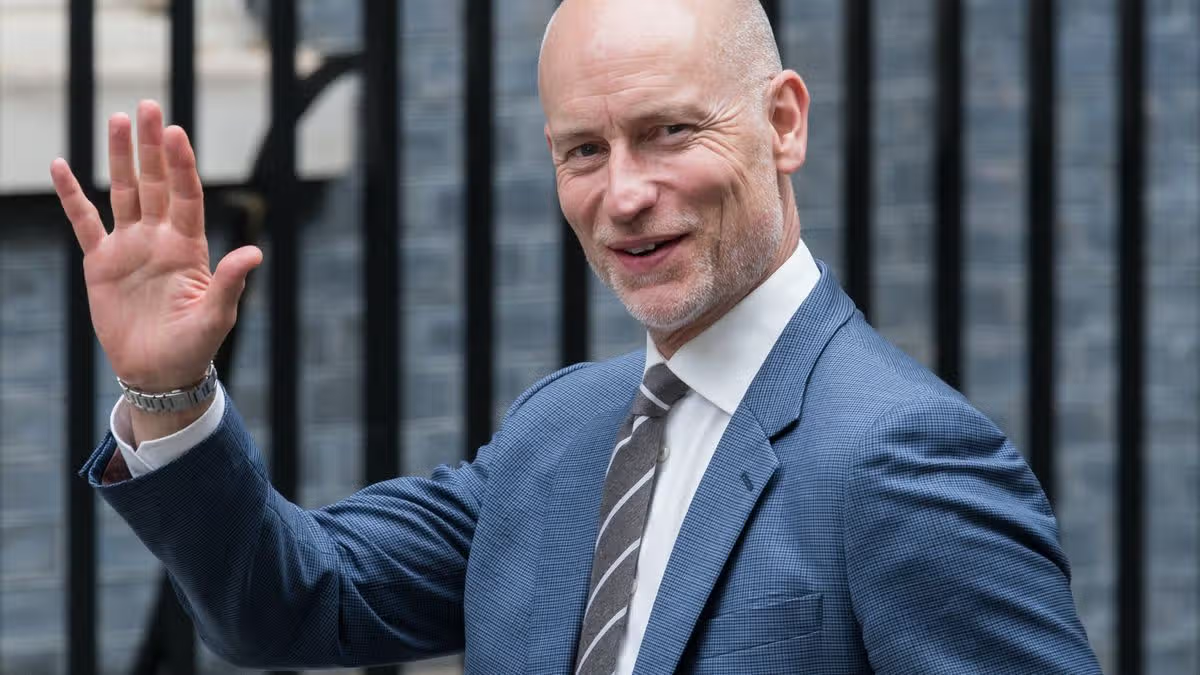
New Welsh Secretary Stephen Kinnock.(Image: Wiktor Szymanowicz/Future Publishing via Getty Images)

The Senedd election is now behind us, the UK has a new Prime Minister, and a fresh chapter in Welsh public policy is beginning.

With new administrations taking shape and priorities being set, there is a renewed opportunity to focus on what matters most: delivering sustainable economic growth for Wales.

Advertisement

I would like to welcome the appointments of Andy Burnham as Prime Minister and Stephen Kinnock as Secretary of State for Wales.

Their success will matter enormously to businesses, communities and families across our nation. While politics will always involve differing viewpoints, economic prosperity is best achieved when governments, businesses and civic institutions work constructively together towards shared objectives.

Our chief executive, Alan Vallance, has already congratulated the Prime Minister on his appointment and set out ICAEW’s commitment to working constructively with the new government.

That spirit of partnership is one that we strongly support here in Wales. ICAEW stands ready to work with ministers at both Westminster and in the Senedd to help shape policies that support enterprise, improve productivity and drive sustainable economic growth.

Advertisement

At ICAEW, our members operate in every sector of the Welsh economy. They advise businesses large and small, support investment decisions, help organisations navigate periods of uncertainty and play a critical role in driving productivity and growth. From that vantage point, one message is consistently clear: collaboration delivers better outcomes than confrontation.

That lesson feels particularly relevant today. The latest ICAEW business confidence monitor published last week shows that business confidence in Wales has fallen sharply, reflecting wider challenges facing firms across the UK.

Confidence declined in ten of the eleven nations and regions surveyed, with geopolitical instability, rising costs and continued uncertainty weighing heavily on business sentiment. In Wales, labour costs remain a significant concern for many employers, although encouragingly businesses expect domestic sales growth to strengthen over the coming year.

Those findings tell an important story. Welsh businesses are realistic about the headwinds they face, but they have not lost their underlying optimism. They continue to invest, innovate and look for opportunities to grow.

Advertisement

The role of government must be to create the conditions that allow that confidence to be translated into higher investment, greater productivity and more well-paid jobs.

That is why constructive engagement between Westminster, the Senedd and the business community is so important.

Economic growth cannot be delivered by any one institution acting alone. It requires a shared commitment to improving competitiveness, encouraging entrepreneurship, supporting skills and creating an environment where businesses can thrive.

In that regard, I have been encouraged by the way Plaid Cymru has approached government in its opening months. The party has hit the ground running and made visible progress against its 100-day plan. Regardless of political affiliation, businesses value momentum, clarity and a willingness to engage. Those early signals matter because they help create confidence that government is focused on delivery.

Advertisement

I would therefore urge the new UK Government to work constructively with Plaid Cymru in Wales wherever common ground can be found. The Welsh economy will benefit most when political leaders focus on practical solutions rather than institutional disagreements.

Businesses are less concerned about which level of government receives the credit and more concerned that decisions are made, barriers are removed and investment opportunities are unlocked.

One particularly welcome development has been the positive discussion around a new development agency for Wales. If implemented effectively, such an organisation has the potential to become a powerful catalyst for investment, regeneration and business growth across the country.

Wales has enormous strengths: a highly skilled workforce, world-class universities, growing innovation clusters and a strong entrepreneurial culture. The challenge has often been ensuring those strengths are connected to the right support and sources of capital.

Advertisement

This is where collaboration will be critical. Working in partnership with the Development Bank of Wales, a new development agency could help create a clearer and more coordinated support ecosystem for businesses.

Whether supporting Welsh firms looking to scale, attracting inward investment, or helping companies relocate and establish operations in Wales, the focus must be on ensuring businesses can access the advice, finance and networks they need to succeed.

Productivity must also remain at the centre of the conversation. Raising productivity is not simply an economic statistic; it is fundamental to improving living standards, increasing wages and strengthening public services.

Too often, debates about growth focus solely on headline investment figures. Important though those are, long-term prosperity depends on helping businesses become more productive through innovation, digital adoption, skills development and better access to capital.

Advertisement

Chartered accountants have an important role to play here. ICAEW members work directly with businesses to improve performance, support investment decisions and identify opportunities for growth. They understand both the challenges facing employers and the practical measures that can help overcome them.

That is why I have been pleased to begin engaging with Adam Price as our Cabinet Secretary for Enterprise, Connectivity and Energy and other stakeholders as discussions around Wales’ economic future develop.

ICAEW is committed to bringing evidence, expertise and practical insight to these conversations. Our objective is not to advocate for a particular political perspective, but to ensure that the voices of our members and the businesses they support are heard.

The latest business confidence nonitor reminds us that challenges remain. Confidence has weakened, costs continue to rise and global uncertainty has not disappeared. Yet the survey also highlights resilience and a continued belief among Welsh businesses that growth opportunities exist, particularly through stronger domestic sales. The task now is to turn that potential into reality.

Advertisement

For Wales to succeed, government and business must work hand in hand. Westminster and Cardiff Bay must collaborate where possible. Investment agencies, financial institutions and the private sector must align around shared objectives. And policymakers must remain focused on the practical steps that improve productivity, encourage enterprise and create the conditions for sustainable growth.

If we can achieve that, Wales will be well placed not only to weather current economic challenges but to build a stronger, more competitive and more prosperous future. As ever, ICAEW Wales stands ready to play its part in helping shape that discussion and supporting the decisions that will drive growth across our nation.

  • Robert Lloyd Griffiths is Wales director for the ICAEW.

Continue Reading

Business

Grupo Rotoplas S.A.B. de C.V. 2026 Q2 – Results – Earnings Call Presentation (OTCMKTS:GRPRF) 2026-07-24

Published

on

OneWater Marine Inc. (ONEW) Q1 2026 Earnings Call Transcript

This article was written by

Seeking Alpha’s transcripts team is responsible for the development of all of our transcript-related projects. We currently publish thousands of quarterly earnings calls per quarter on our site and are continuing to grow and expand our coverage. The purpose of this profile is to allow us to share with our readers new transcript-related developments. Thanks, SA Transcripts Team

Continue Reading

Business

Albertsons cuts outlook as ‘cautious consumer’ pressures grocery sales

Published

on

Albertsons cuts outlook as ‘cautious consumer’ pressures grocery sales

Albertsons lowered its fiscal 2026 sales and earnings outlook Thursday after weaker grocery demand and a more cautious consumer weighed on its first-quarter performance.

The grocery chain now expects identical sales to decline between 0.5% and 1.5% for the full fiscal year, compared with its previous forecast of flat sales to 1% growth.

Advertisement

Albertsons also cut its adjusted earnings forecast to between $1.75 and $1.85 per share, down from its prior range of $2.22 to $2.32. Adjusted EBITDA is now expected to range from $3.55 billion to $3.625 billion, compared with its earlier forecast of $3.85 billion to $3.925 billion.

Identical sales fell 0.8% during the quarter ended June 20, while net sales and other revenue edged up 0.2% to $24.94 billion, helped by higher fuel sales. Digital sales increased 13%, although the company said its core grocery business faced mounting pressure from softer industry unit trends.

MAJOR GROCERY CHAIN BEATS WALMART, ALDI IN PRICE WAR AS SHOPPERS HUNT FOR CHECKOUT RELIEF

albertsons location

The grocery chain now expects identical sales to decline between 0.5% and 1.5% for the full fiscal year. (Ethan Miller/Getty Images)

“In the first quarter, our digital and pharmacy businesses continued to deliver strong growth, while core grocery faced increasing pressure from softer industry unit trends and a more cautious consumer,” CEO Susan Morris said in the company’s earnings release.

Advertisement

Albertsons said it is accelerating investments aimed at strengthening its customer value proposition and improving the shopping experience before anticipated productivity benefits take hold.

“We are choosing to accelerate investments in our customer value proposition and the customer experience ahead of expected productivity benefits because we believe these actions will improve our growth trajectory, strengthen our competitive position, and create long-term shareholder value,” Morris said.

Ticker Security Last Change Change %
ACI ALBERTSONS COS INC 11.44 -3.16 -21.64%

As part of that effort, Albertsons announced an operating realignment called ACI Edge. The company consolidated its 11 divisions into four regions and placed center-store merchandising under a single enterprise team.

Albertsons said the restructuring is intended to accelerate decision-making, improve local execution and bring category management, supplier relationships and merchandising strategy under a more centralized structure.

Advertisement

First-quarter net income fell to $84.7 million, or 17 cents per share, from $236.4 million, or 41 cents per share, a year earlier. Adjusted earnings declined to 42 cents per share from 55 cents.

Albertsons

Albertsons also announced an operating realignment called ACI Edge. (Bridget Bennett/Bloomberg via Getty Images)

Gross margin narrowed to 26.6% from 27.1%. Albertsons attributed some of the pressure to higher delivery and handling expenses associated with digital growth, along with higher fuel costs.

Separately, Albertsons said Chief Financial Officer Sharon McCollam plans to retire later this year. McCollam will remain in her current role until a successor is named and will then serve in an advisory capacity through Feb. 27, 2027, to assist with the transition.

CLICK HERE TO GET FOX BUSINESS ON THE GO

Advertisement

Albertsons operated 2,240 stores across 35 states and the District of Columbia as of June 20.

Continue Reading

Business

Bayern Munich Set to Begin Formal Contract Extension Talks With Harry Kane, Whose Deal Expires Very Soon

Published

on

Tottenham striker Harry Kane now has 150 Premier League goals

Bayern Munich are preparing to open formal negotiations with striker Harry Kane over a new contract, with the England captain‘s current deal set to expire at the end of next season, according to reports from BBC Sport.

Kane, 32, is aware of the German champions’ intention to secure his long-term future in Munich, with detailed discussions expected to progress in the coming weeks. The move comes despite continued interest from other top European clubs, with Kane reportedly settled in Germany and showing no inclination to leave.

A prolific record in Munich

Since joining Bayern from Tottenham Hotspur in the summer of 2023 in a deal reportedly worth an initial 100 million euros, or roughly £86.4 million, Kane has established himself as one of the club’s most productive strikers in recent memory. He has scored 146 goals in 147 appearances for Bayern, a rate of production that has made retaining him a clear priority for the club’s leadership.

Advertisement

That success has translated into team trophies as well. Kane has helped Bayern win two Bundesliga titles and the DFB-Pokal since arriving in Munich, giving him the domestic silverware that eluded him for much of his career in England. This past season alone, he scored 61 goals across all competitions for Bayern before adding six more for England during the 2026 World Cup.

Fending off interest from elsewhere

Kane’s productivity has continued to attract interest from other clubs, including Barcelona and Saudi Arabian side Al-Hilal. According to Goal.com, however, Kane remains fully settled in Munich and is not currently considering a move elsewhere. His decision to prioritize a Bayern extension effectively rules out the widely speculated possibility of a return to the Premier League, whether to Tottenham or another English club.

A trade-off with the Premier League scoring record

Advertisement

Staying in Germany carries one significant personal cost for Kane: it likely ends his realistic chances of ever breaking Alan Shearer’s Premier League scoring record. Shearer holds the all-time record with 260 league goals, while Kane finished his Tottenham career with 213 Premier League goals, sitting 47 behind Shearer’s mark. By committing his long-term future to Bayern rather than returning to England, Kane is effectively setting aside any pursuit of that individual milestone in favor of continued team success in Germany and a shot at the trophy that has so far eluded him: the Champions League.

A deliberately unhurried process

Kane and Bayern have taken a notably measured approach to contract discussions throughout the year, with both sides indicating there was no urgency to rush a deal. Speaking in May after helping Bayern win the DFB-Pokal with a hat-trick in the final against VfB Stuttgart, Kane made clear that formal talks would wait until after the World Cup. “It’s not the time to talk about that now, but there’s no panic,” Kane told Sky Sport DE at the time. “We wanted to hold conversations until the end of the season and we’ve got a World Cup still to play. But everyone knows how much I enjoy it here. That situation is calm.”

Bayern’s leadership echoed that unhurried stance earlier in the year. Sporting director Max Eberl confirmed discussions were underway at a Bundesliga event, saying simply, “We’re talking to Harry, we’re talking,” and adding, “Everyone knows at some point a decision has to be made.” Bayern chief executive Jan-Christian Dreesen offered further reassurance about the club’s confidence in reaching an agreement, saying, “Harry has great confidence in us and he feels comfortable in Munich. He and his family are settled in. Therefore we’ve got absolutely no reason to rush.”

Advertisement

Cautious notes on contract length

Not everyone connected to the club has been fully bullish on the length of any new deal, given Kane’s age. Former Bayern midfielder Dietmar Hamann offered a more measured outlook on how long an extension should run. “He still has a year left on his contract. I think they are talking about two or three years, and I’d be a bit cautious because he’s now 33,” Hamann said. “The question is: How much longer will he keep scoring goals?” Hamann added that a shorter extension made more sense to him, saying, “A one-year extension, yes. Two years, possibly. Three years would be too much in my opinion,” while also praising Kane’s broader impact on the club and the league. “People are very happy with him. He’s a great ambassador for football. It’s an honour for the Bundesliga and for Bayern Munich that the England captain plays here.”

Kane’s own reflections on the move

Kane has previously spoken warmly about his decision to leave the Premier League for Bavaria, describing it as one of the most rewarding choices of his career. “The move has been one of the best decisions of my life,” Kane said at the end of last year. “To experience a new league, a team like Bayern Munich, these European nights, the atmosphere in the German league, has been a great step in my career and helped me improve as a player. I’m quite open to staying longer. The way we are right now and the way we are playing, I feel we are one of the best teams in Europe, for sure. I don’t look at any other team and think, ‘I want to go there.’ I’m really happy here.”

Advertisement

With formal discussions now set to begin, Bayern are aiming to finalize a new agreement with Kane before the club’s fixture schedule becomes more congested heading into the new season. Securing his signature would allow the club to build its continued push for domestic dominance and a long-sought Champions League title around its most prolific attacking option, while giving Kane the stability to continue chasing team silverware in Munich rather than pursuing individual scoring records back in England.

Continue Reading

Business

MAGY: High Yield, Low Performance (BATS:MAGY)

Published

on

MAGY: High Yield, Low Performance (BATS:MAGY)

This article was written by

With an investment banking cash and derivatives trading background, Binary Tree Analytics (‘BTA’) aims to provide transparency and analytics in respect to capital markets instruments and trades. BTA focuses on CEFs, ETFs and Special Situations, and aims to deliver high annualized returns with a low volatility profile. We have been investing for over 20 years after obtaining a Finance major at a top university.

Analyst’s Disclosure: I/we have no stock, option or similar derivative position in any of the companies mentioned, and no plans to initiate any such positions within the next 72 hours. I wrote this article myself, and it expresses my own opinions. I am not receiving compensation for it (other than from Seeking Alpha). I have no business relationship with any company whose stock is mentioned in this article.

Seeking Alpha’s Disclosure: Past performance is no guarantee of future results. No recommendation or advice is being given as to whether any investment is suitable for a particular investor. Any views or opinions expressed above may not reflect those of Seeking Alpha as a whole. Seeking Alpha is not a licensed securities dealer, broker or US investment adviser or investment bank. Our analysts are third party authors that include both professional investors and individual investors who may not be licensed or certified by any institute or regulatory body.

Advertisement
Continue Reading

Trending

Copyright © 2025