Connect with us
DAPA Banner
DAPA Coin
DAPA
COIN PAYMENT ASSET
PRIVACY · BLOCKDAG · HOMOMORPHIC ENCRYPTION · RUST
ElGamal Encrypted MINE DAPA
🚫 GENESIS SOLD OUT
DAPAPAY COMING

Business

FTSE 100 Closes Higher at 10,497.29 as London’s Vodafone Surges, EasyJet Takeover Bid Lifts Sentiment

Published

on

Tesla's robotaxi launch in Texas comes as Elon Musk focuses on his business ventures following his stint in Washington

London’s FTSE 100 index closed higher Friday, adding 24.84 points, or 0.24%, to finish the session at 10,497.29, as strong merger-and-acquisition activity involving Vodafone and easyJet helped offset continued pressure from a sharp decline in pharmaceutical heavyweight AstraZeneca and lingering uncertainty tied to the conflict in the Middle East.

The gain reversed a modest 0.16% decline recorded Thursday, which had been driven primarily by weakness in AstraZeneca, and left the UK benchmark on track for a positive close to the trading week even as the index still finished roughly 1.7% to 1.8% lower over the full five-day period, breaking a two-week winning streak. The FTSE 100 opened Friday’s session at 10,471.94, close to Thursday’s closing level of 10,472.45, before climbing to a session high of 10,513.90 and holding within a relatively narrow range through the remainder of the day, ultimately settling well above its session low of 10,462.75.

Vodafone shares led Friday’s gains among individual index constituents, surging nearly 13% after French billionaire Xavier Niel agreed to acquire Emirates Telecommunications Group’s stake in the company, making him Vodafone’s largest single shareholder. That deal helped anchor Friday’s rally in the telecommunications sector and contributed meaningfully to the broader index’s positive session. Betting and gaming group Entain also posted a strong day, rising more than 4%, while retailer Marks & Spencer added just over 2%.

Mining stocks provided additional support to the index Friday, with firm metals prices lifting several major producers. Rio Tinto rose between 0.9% and 1.5% depending on the report cited, while Glencore added roughly 0.5% and Anglo American and Antofagasta each climbed close to 1%.

Advertisement

In the FTSE 250, easyJet emerged as the day’s standout performer, jumping more than 13% after private equity firm Apollo Global Management agreed to acquire the budget airline for £7.15 per share in a deal valued at approximately £5.7 billion. The offer topped a rival bid previously floated by private equity firm Castlelake, positioning Apollo’s proposal as the leading takeover approach for the airline as of Friday’s close.

Not every major constituent shared in the day’s gains. St. James’s Place, the wealth management firm, dropped more than 8% after reports emerged that a major financial advice firm plans to leave the platform, raising broader concerns among investors about the company’s ability to retain advisers going forward. AstraZeneca extended a difficult stretch, falling as much as 3.5% to 6.2% depending on the specific measurement window cited across various reports, continuing losses that began Thursday after the pharmaceutical giant’s gene-silencing heart therapy, Wainua, failed a late-stage clinical trial. Insurer Hiscox also finished the session lower, down roughly 1.6%.

The dominant macro theme shaping Friday’s session across UK and broader European markets remained the ongoing situation between the United States and Iran. Reports throughout the week indicated the two sides would continue technical-level negotiations despite a recent exchange of military strikes, with easing tensions specifically around shipping activity in the Strait of Hormuz contributing to a broader stabilization in global market sentiment as the week drew to a close. Oil prices eased modestly Friday alongside that de-escalation, with crude trading around $71.41 per barrel, down close to 1% on the session, providing some additional relief to energy-sensitive sectors of the market even as the underlying geopolitical situation remained far from fully resolved.

Market analysts characterized Friday’s performance as reflective of a market attempting to balance genuine underlying strength in the FTSE 100’s core energy, financial and mining sectors against a still-unsettled geopolitical backdrop that has continued to inject periodic volatility into global trading throughout the first half of 2026. The index’s comparatively limited exposure to the technology sector, relative to indices such as Germany’s DAX 40 or France’s CAC 40, meant London participated less directly in a broader rebound in chip and artificial intelligence-linked sentiment that characterized much of Friday’s trading session elsewhere in global markets, a compositional difference that has periodically caused the London index to lag more technology-heavy peers during episodes when AI and semiconductor sentiment dominates broader market direction, while also offering a degree of insulation during periods of technology sector weakness.

Advertisement

Broader UK market indicators reflected a similarly cautious tone through the session. The FTSE 250 traded around 23,293, rebounding by approximately 0.2% after declining 1.5% in the previous session, while the FTSE 350 hovered near 5,691 and the FTSE All-Share Index traded around 5,631, both showing only modest intraday fluctuations as investors continued weighing elevated energy prices against continued Middle East tensions.

Trading volumes on Friday remained broadly consistent with recent averages, with the index’s roughly 51-point intraday range reflecting a session in which investors appeared willing to add to positions steadily throughout the day rather than react sharply to any single catalyst. Over the past month, the FTSE 100 has climbed approximately 1.88%, and the index remains up roughly 17.4% compared with the same time last year, according to data from Trading Economics, underscoring the benchmark’s overall resilience through a volatile first half of 2026 even amid the week’s pullback.

For UK-focused investors, Friday’s performance continued to underline the FTSE 100’s role as a relatively defensive component within a globally diversified equity portfolio, particularly during episodes when technology sector volatility has dominated sentiment elsewhere in global markets. The index’s heavier weighting toward energy, financial services, mining, consumer staples and pharmaceutical companies, relative to the technology-driven indices that have seen sharper swings in recent weeks, has repeatedly provided a measure of stability for London-listed equities even as the broader geopolitical and macroeconomic backdrop has remained unsettled through much of the year.

With the situation between the United States and Iran continuing to evolve and further merger activity potentially in the pipeline following Friday’s Vodafone and easyJet developments, investors are expected to remain closely focused on both geopolitical headlines and individual corporate news in the sessions ahead as they assess the durability of the FTSE 100’s recent stabilization.

Advertisement
Continue Reading
Click to comment

You must be logged in to post a comment Login

Leave a Reply

Business

Fed’s Warsh vows to ’do my job’ if challenged by Trump

Published

on


Fed’s Warsh vows to ’do my job’ if challenged by Trump

Continue Reading

Business

Bridging the gluten-free and GLP-1 trends

Published

on

General Mills expands Lӓrabar lineup

Gluten-free pulses and oats provide protein and fiber.

Continue Reading

Business

Warsh says Fed policymakers have ‘no tolerance’ for elevated inflation

Published

on

Jerome Powell successor Kevin Warsh clears Senate Banking Committee

Federal Reserve Chair Kevin Warsh on Tuesday told House lawmakers that the central bank’s policymakers have “no tolerance for persistently elevated inflation” in his first testimony as Fed chief.

Warsh said in his prepared testimony for the House Financial Services Committee that concerns about inflation influenced the Fed’s decision to hold the benchmark federal funds rate steady at a range of 3.5% to 3.75% at the Fed’s June meeting.

Advertisement

“The Fed’s number one objective is to get monetary policy right – or as near to it as we possibly can. That is our clear and constant aim, the star we steer by,” he said. “And if we get policy right – and we will – the inflation surge of the last five years will be a thing of the past.”

“My colleagues and I recognize that high inflation has been an undue burden on American households and businesses. While monthly price fluctuations are inevitable – especially in an unsettled world – underlying inflation over longer time horizons is determined largely by monetary policy,” Warsh said.

“The members of our Committee have no tolerance for persistently elevated inflation. And we share a resolute commitment to restoring price stability,” he added.

FED POLICYMAKERS’ INFLATION WORRIES WEIGHED ON RATE CUT OUTLOOK AT WARSH’S FIRST MEETING

Advertisement
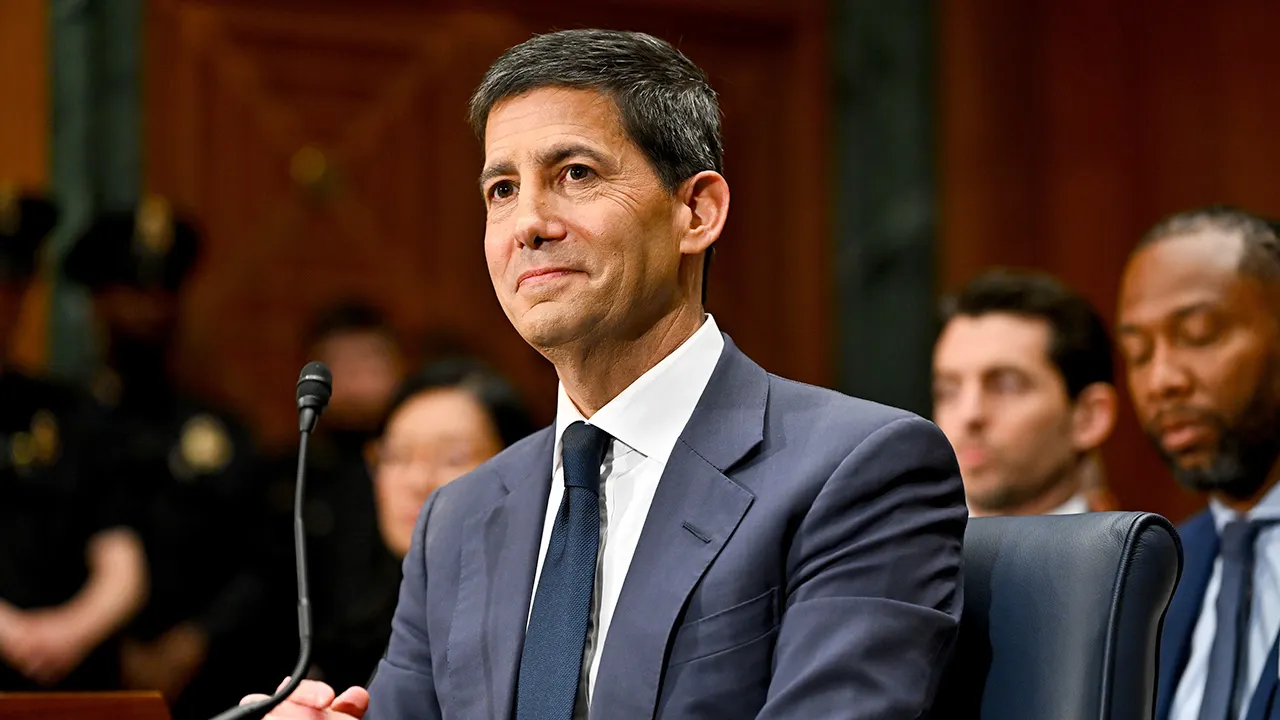
Kevin Warsh at his confirmation hearing

Fed Chair Kevin Warsh told the House Financial Services Committee that the central bank won’t tolerate persistently elevated inflation. (Graeme Sloan/Bloomberg via Getty Images)

Warsh was asked about how he would respond if President Donald Trump targeted him or other policymakers in an effort to influence interest rate policy, and the chairman emphasized the Fed is an independent central bank – which the Supreme Court recently affirmed.

“The Supreme Court said that the Federal Reserve and the conduct of monetary policy is independent. To the extent there were questions about it, the Court answered those questions,” Warsh said, adding he would continue to do his job if the president were to attempt to fire him.

Warsh went on to say that his goal for the Fed “is for there to be no politics. To the extent there’s politics there, we’re going to get rid of them.” 

The Federal Reserve is tasked by Congress with pursuing a dual mandate of fostering full employment and price stability in line with a long-run 2% inflation target. Warsh said the Fed will be attentive to both sides of the mandate, though he noted the inflation portion of the mandate is further from the goal at this time.

Advertisement

“In my view, the two parts of the mandate are not in conflict. This is not an either or proposition. The more we can do to deliver low and stable prices, the more we can get it such that people aren’t worried about inflation, the more employers are going to want to hire more workers,” he explained.

“You gave us a remit, we take both parts of it seriously,” Warsh said. “As we look out the window now, the labor markets look to be in pretty good balance. We’ve got some work to do on the inflation front.”

This is a developing story. Please check back for updates on Warsh’s testimony.

Advertisement
Continue Reading

Business

Woman’s Hour – ADHD and hormones, When co-habiting couples separate, God of War

Published

on

Woman's Hour - SEND reforms: A Woman's Hour and SEND in the Spotlight special

Available for over a year

What impact do hormones have on women with ADHD? A first of its kind study by Kings College and Queen Mary University in London is putting the link to the test, by asking 50 women who have ADHD and are taking medication for it to track their menstrual cycle. They will log the impact it has on their ADHD symptoms, and daily life more broadly. Report academic Dr Jessica Agnew-Blais and Laura Mears-Reynolds from the charity ADHDAF+ join presenter Nuala McGovern to discuss.

We hear about the current government consultation aiming to give added financial security to more than 3.5 million unmarried couples when they separate. It’s hoped the overdue reforms will help protect women and better meet the needs of modern relationships. Nuala discusses this with Mandip Ghai, a lawyer from the legal charity Rights of Women, who have campaigned for new laws, and Jenny Allen who is feeling the long-term impact of her separation on her finances now she is semi-retired.

Parents of school-age children will know that this is the time of year when thoughts turns to a present for their teacher. But collections can be divisive when so many families are feeling financial pressure. The question of how much to give, who should be included or whether to contribute at all can be fraught. Author and comedian Helen Thorne from the Scummy Mummies comedy duo shares her thoughts on the hot topic dominating many school whatsapp groups.

Advertisement

Video game God of War will have a female protagonist for the first time in the form of Laufey, both a powerful woman and a mother. Nuala is joined by player and journalist Vicky Jessop and The Guardian’s games editor Keza Macdonald to discuss the significance and online backlash.

Presented by: Nuala McGovern
Produced by: Sarah Jane Griffiths

Programme Website

Continue Reading

Business

Court: Schwebel Baking in talks with ‘potential buyer’

Published

on

Schwebel Baking set to shut down

Lawsuit put on hold as company in talks to sell business.

Continue Reading

Business

Destec, Steve Wyatt admit contempt of court in MinRes IP stoush

Published

on

Destec, Steve Wyatt admit contempt of court in MinRes IP stoush

Steve Wyatt and his company Destec will be penalised for contempt of court over videos published online, as part of an ongoing spat with Mineral Resources.

Continue Reading

Business

De Beers halts diamond production at flagship South African mine for two years

Published

on

A woman with dark hair pulled back from her face points to a plaster on her arm

Workers’ unions have previously warned against job losses in South Africa’s mining sector, which employs almost half a million people, external and accounts for more than 4% of national GDP, external.

De Beers is majority-owned by Anglo American, which is reportedly trying to sell it and shift focus to the growing copper market, external fuelled by the recent AI boom.

At the Venetia mine, De Beers has pledged to use those two years of downtime to make infrastructure more “efficient” with increased “capacity”, external, ready to reopen production once market conditions improve.

Times remain tough across the industry, which has seen the International Diamond Consultants’ rough diamond price index almost halve since 2022.

Advertisement

Lab-grown diamonds have gained in popularity in recent years, as consumers voice ethical concerns about miners’ pay and working conditions as well as environmental damage.

Yet De Beers and other established firms have cashed in on those industry changes too, producing their own lab-grown versions at a snip of the price one would pay for natural diamonds.

De Beers is not the first large producer to scale down operations in recent years, but it does occupy a particular place in the public imagination owing to its long history dating back to 1871.

Its founder was Cecil Rhodes, the English colonist whose forces dispossessed indigenous Africans of their land and denied them basic rights

Advertisement

He became a millionaire in the process and justified their disenfranchisement and racial segregation, external to Cape Town’s Parliament several years later, saying “the natives are children… they are just emerging from barbarism, external“.

His legacy in southern Africa has become a lightning rod for discussions about “decolonising” institutions which continue to bear his name.

This includes those that have statues of him and scholarships founded on his enormous wealth – like the UK’s University of Oxford, whose past Rhodes Scholars, external include ex-US President Bill Clinton and former Australian Prime Minister Malcolm Turnbull.

Advertisement
Continue Reading

Business

what Turn It Up means for SMEs and venues

Published

on

what Turn It Up means for SMEs and venues

The small businesses behind Britain’s live music industry have been handed a rare piece of good news, as the government’s first long-term music strategy promises a £45 million growth fund, lighter-touch festival licensing and a two-year freeze on business rates bills for venues.

Turn It Up: Our Plan for Music, launched by Culture Secretary Lisa Nandy on Monday, sets out how ministers intend to grow a sector worth at least £8 billion to the economy. Crucially for the independent operators who make up most of it, the plan reaches beyond stadium headliners to the promoters, labels, managers and venues that develop talent.

The Music Growth Package, now boosted to £45 million after a £15 million injection from Arts Council England, will support more than 2,000 projects and at least 40,000 artists and music professionals over three years. For the first time, the funding will also be open to mid-career artists, band managers, labels and publishers, many of them small firms and freelancers.

For festival and event organisers, the licensing reforms may prove the most practical win. Temporary Event Notices will rise from 15 to 20 per year, with total event days up from 21 to 26, while festivals will be offered longer licences, a minimum of three years for new events and five years for existing ones. A 15 per cent business rates relief for live music venues has also been confirmed, with bills frozen for the next two years.

The Night Time Industries Association, which represents clubs, bars and late-night operators across the UK, worked alongside government and UK Music in shaping the plan and says many of the sector’s priorities are reflected in it.

Advertisement

Michael Kill, chief executive of the NTIA, said: “It is extremely encouraging to see the Government deliver a long term strategy that recognises music as one of the UK’s greatest cultural and economic assets. We have been proud to work alongside colleagues from across the industry to help shape this plan and it is positive to see that collaboration translate into meaningful action.”

“The success of UK music depends on every part of the ecosystem working together. That means supporting not only artists and venues, but also festivals, promoters, clubs, DJs, producers, electronic music and the independent businesses that develop talent and create opportunities across the country. These are all vital parts of our music landscape and deserve recognition and support.”

The warm words mark a change of tone from an association that only weeks ago branded the Chancellor’s summer VAT cut a ‘superficial fix’ that sidelined clubs and festivals. The underlying pressures have not gone away. Industry research has warned that the late-night economy could lose 10,000 businesses and 150,000 jobs by 2028 without intervention, even as music tourism delivers a record £11.2 billion for UK towns and cities.

Kill acknowledged as much. “The commitments to invest in grassroots music, reform festival licensing and support future talent are positive steps. There is still work ahead to secure the long term sustainability of venues, clubs and independent operators, but this plan provides a strong foundation and we look forward to continuing to work with government and industry partners to help deliver it.”

Advertisement

For the SMEs that keep Britain’s stages lit, the plan is a foundation rather than a fix. But after years of asking Whitehall to listen, the industry will settle for a government finally singing from the same song sheet.


Amy Ingham

Amy is a newly qualified journalist specialising in business journalism at Business Matters with responsibility for news content for what is now the UK’s largest print and online source of current business news.

Advertisement
Continue Reading

Business

Nationals hopeful of unity for in push to mandate regional rail lighting

Published

on

Nationals hopeful of unity for in push to mandate regional rail lighting

The WA Nationals are optimistic a long-awaited bill to mandate better lighting on freight rail in regional WA will gain bipartisan support.

Continue Reading

Business

Grosvenor casino owner Rank Group cuts jobs amid gambling tax rise

Published

on

Business Live

Company continues to deal with the fallout of Rachel Reeves’ decision to raise online gambling tax

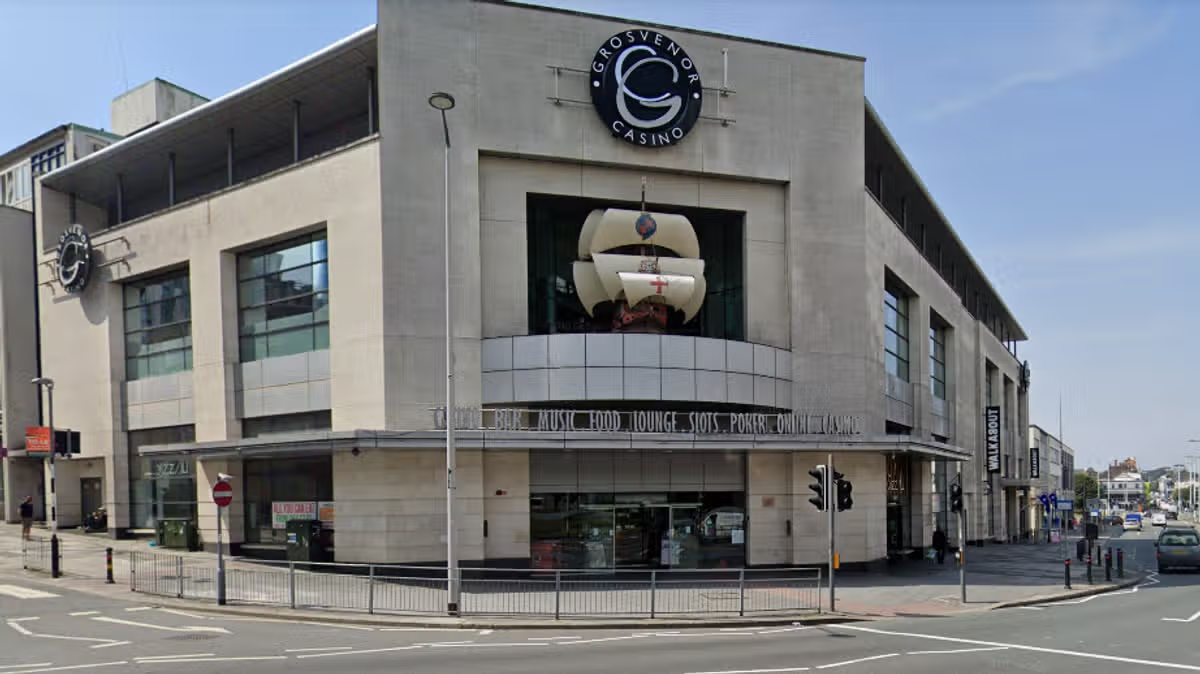
Grosvenor Casino in  Plymouth

The Grosvenor Casino in Plymouth(Image: Google)

Rank Group, the owner of Grosvenor casino, has cut its workforce in an effort to rein in costs, as the firm continues to grapple with the effects of Rachel Reeves’ online gambling tax increase.

The Chancellor’s move to raise the Remote Gaming Duty (RGD) rate from 21 per cent to 40 per cent in last autumn’s Budget left the group scrambling to absorb the blow and safeguard revenue after it took effect in April.

The firm chose to slash marketing expenditure and supplier costs, alongside making “headcount reductions”, to offset spending and “the impact of the RGD increase”.

It elected to preserve targeted digital advertising and customer incentives, such as bonuses and loyalty rewards, to retain players on its digital gambling platforms despite the heightened levy.

Advertisement

However, chief executive Richard Harris, who was confirmed as the permanent head of the casino group earlier this week, acknowledged that the increase had triggered “significant cost and taxation headwinds”, as reported by City AM.

Shares rose 8.3 per cent in early trading to 102.3p, with the stock up 5.2 per cent since January.

The Maidenhead-headquartered group also confirmed that it had submitted a regulatory settlement proposal to the Gambling Commission, in a bid to avoid incurring a financial penalty.

The FTSE 250 firm offered to pay the gambling watchdog £5m, following an investigation into the Grosvenor casino licence that uncovered evidence of rule breaches. The regulator confirmed it was “minded to accept the settlement proposal” and is awaiting the formal documentation to proceed.

Advertisement

The payment is expected to be recorded as a separately disclosed item in a bid to avoid any distortion to reported profits.

The decision to retain targeted advertisements drove like-for-like digital net gaming revenue (NGR) up 12 per cent in the final quarter to £63.9m.

Grosvenor venues also posted a three per cent increase in NGR to £98.3m, despite the “disruption to international travel” triggered by the conflict in the Middle East, underpinned by strong gaming machine performance.

Mecca Bingo halls saw NGR reach £35.4m, while its Enracha venues reported NGR of £11.3m.

Advertisement
Continue Reading

Trending

Copyright © 2025