Connect with us

Business

Gaming and Leisure Properties: A High Yield And Deep Discount Too Hard To Ignore (Upgrade)

Published

on

Gaming and Leisure Properties: The Numbers Don't Justify This Discount (NASDAQ:GLPI)
Continue Reading
Click to comment

You must be logged in to post a comment Login

Leave a Reply

Business

‘Not far enough’ – parents and teens on Meta’s new limits for young users

Published

on

Julianna (left), Paige (centre) and mum Elizabeth Cardner at a baseball game

For Elizabeth Cardner, a mother of two girls in Houston, Texas, Meta’s new limits on how teenagers can use its platforms are a welcome sign that more people are aware of social media’s potential dangers.

But, she tells the BBC, they probably won’t help much in the long-term.

“It will save a few arguments at home, but it doesn’t go far enough,” she says.

This week, Meta announced new restrictions on its platforms – which include Instagram, Facebook and Whatsapp – as part of an $18bn (£13.25bn) settlement with US states in a lawsuit on social media’s effects on children.

Advertisement

The company said it would set a daily two-hour time limit, hide the number of likes that a post receives, remove autoplay on videos, mute push notifications during school hours, and ban extreme make-up filters.

It also announced changes to its age-verification process and parental controls as well as agreeing to appoint an independent auditor to check the measures are implemented and maintained.

Many parents across the US see the restrictions as helpful, but are still sceptical. Those who spoke to the BBC described feeling stuck – where they feel they can’t cut their children off from social media but also can’t protect them from the harms they believe it causes – and they are waiting to see how much of a difference these new rules will make.

Cardner’s 14-year-old, Paige, believes the restrictions will lead to “more real-life scenarios” and less “fake content”, which she says dominates social media. She and her sister both approve of hiding the numbers of likes and restricting filters.

Advertisement

But Paige sees those gains as short-lived, “since AI is evolving”.

“People will find new ways to have fake filters, and correct certain parts of their videos or pictures,” she says. “So I think it’ll help until people use other resources to try and find new ways to do that.”

Cardner says banning her daughters entirely from social media would only result in them being left out by their peers.

“Damned if you do, damned if you don’t,” she says. “I don’t think there’s any winning on it.”

Advertisement
Continue Reading

Business

Goodwin profits more than double as defence supplier benefits from military spending surge

Published

on

Business Live

Group which makes radar equipment and submarine parts said it would hand more cash back to shareholders

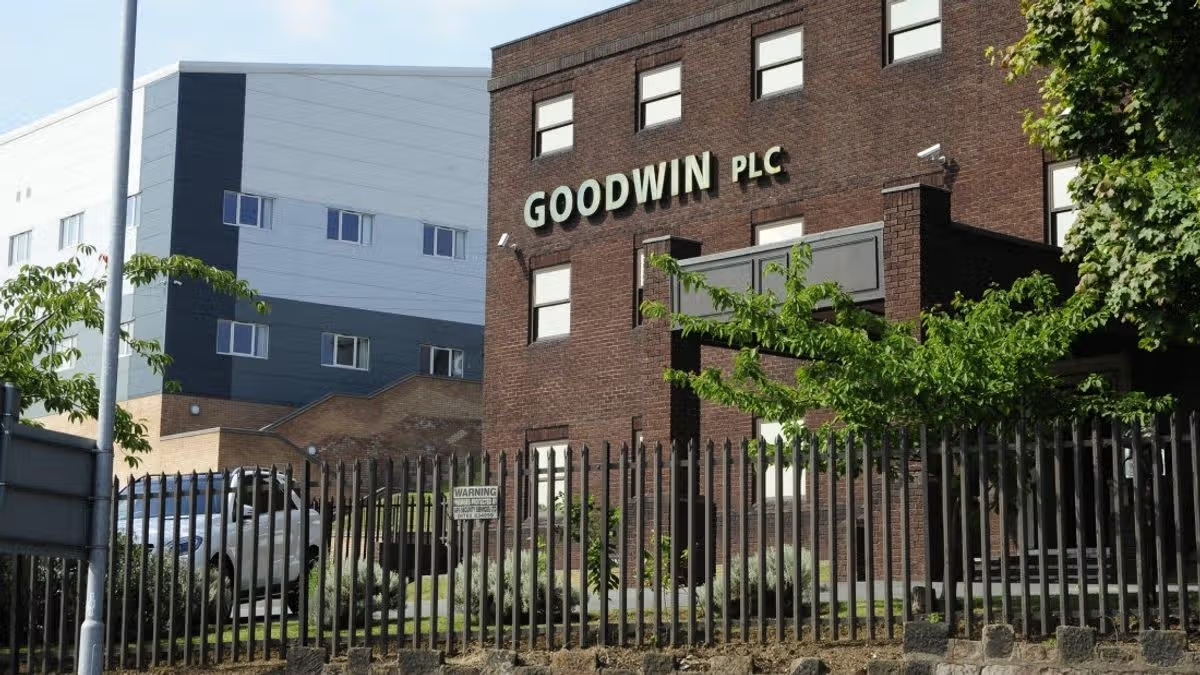
Goodwin plc in Stoke-on-Trent

Goodwin plc, in Stoke-on-Trent

Profits have more than doubled at defence supplier Goodwin, buoyed by a surge in military spending across the globe.

Advertisement

The Stoke-on-Trent-based firm, which manufactures radar equipment and submarine components, announced on Friday that it would return more money to shareholders on the back of the strong performance.

The group also signalled that shareholders could stand to benefit further should it press ahead with the potential disposal of elements of its mechanical engineering division.

The company, which comprises several subsidiary businesses, posted trading profits up 118% to £77.5 million for the year to April, compared with the previous year.

The result was underpinned by revenues rising 27% to £280 million over the same period.

Advertisement

Turnover received a significant boost from an improved showing by its mechanical engineering arm, driven by robust demand for products supplied to UK and US naval and submarine programmes.

Founded in 1883, Goodwin is majority-owned and run by the Goodwin family, with its shares listed on the London Stock Exchange.

The group continues to evaluate the potential sale of parts of its mechanical engineering division, which provides components to major defence and nuclear programmes.

The firm described the sale process as “progressing well”, with talks currently under way with a number of prospective buyers.

Advertisement

Goodwin sought to reassure customers, suppliers and employees that business operations would continue uninterrupted throughout the process. “The disposal process is being actively pursued in accordance with the board’s approved plan, which targets completion within the next twelve months, and shareholders will be kept informed of material developments as appropriate,” the company said.

The firm announced plans to raise the group’s annual dividend by 18% to 330p for the year.

Continue Reading

Business

How Taylor Farms became integral to America’s food supply system

Published

on

How Taylor Farms became integral to America's food supply system
How Taylor Farms became so important to the U.S. food supply

The cyclospora outbreak that has sickened thousands of people across the U.S. has brought fresh scrutiny of the integral role Taylor Farms and other massive suppliers play in the country’s food supply.

The company, which the Food and Drug Administration has linked to the parasite’s spread, is one of the world’s largest producers of fresh-cut vegetables and salads, supplying some of the biggest grocery chains and restaurant companies in the U.S. Its products are sold at retailers including Walmart, Kroger, Whole Foods and Target, and its restaurant customers include McDonald’s, Taco Bell and Chipotle. Taylor Farms says 40% of salad kits sold at grocery stores come from the company, giving it a massive role in supplying a convenient and cheap vegetable option for many shoppers.

The company, founded in 1995, has grown through a combination of scale and acquisitions, building an operation that spans much of the food supply chain. Taylor Farms works with hundreds of family farms for its produce and handles processing, packaging and distribution itself.

That reach has made the company an increasingly important link between farms and some of America’s biggest food companies, and heightens the risk of food safety problems spreading. Taylor Farms’ scale has put the company under a brighter spotlight as the FDA investigates the cyclospora outbreak that the agency has linked to iceberg lettuce processed at Taylor Farms’ facility in central Mexico, some of which was served at Taco Bell restaurants.

Advertisement

Taylor Farms declined CNBC’s invitation for an interview but sent comments defending the steps it has taken to respond to the outbreak and keep its produce safe.

“We are confident in our food and food safety systems and will continue to be transparent as more information becomes available,” a spokesperson for Taylor Fresh Foods, the corporate name for Taylor Farms, told CNBC.

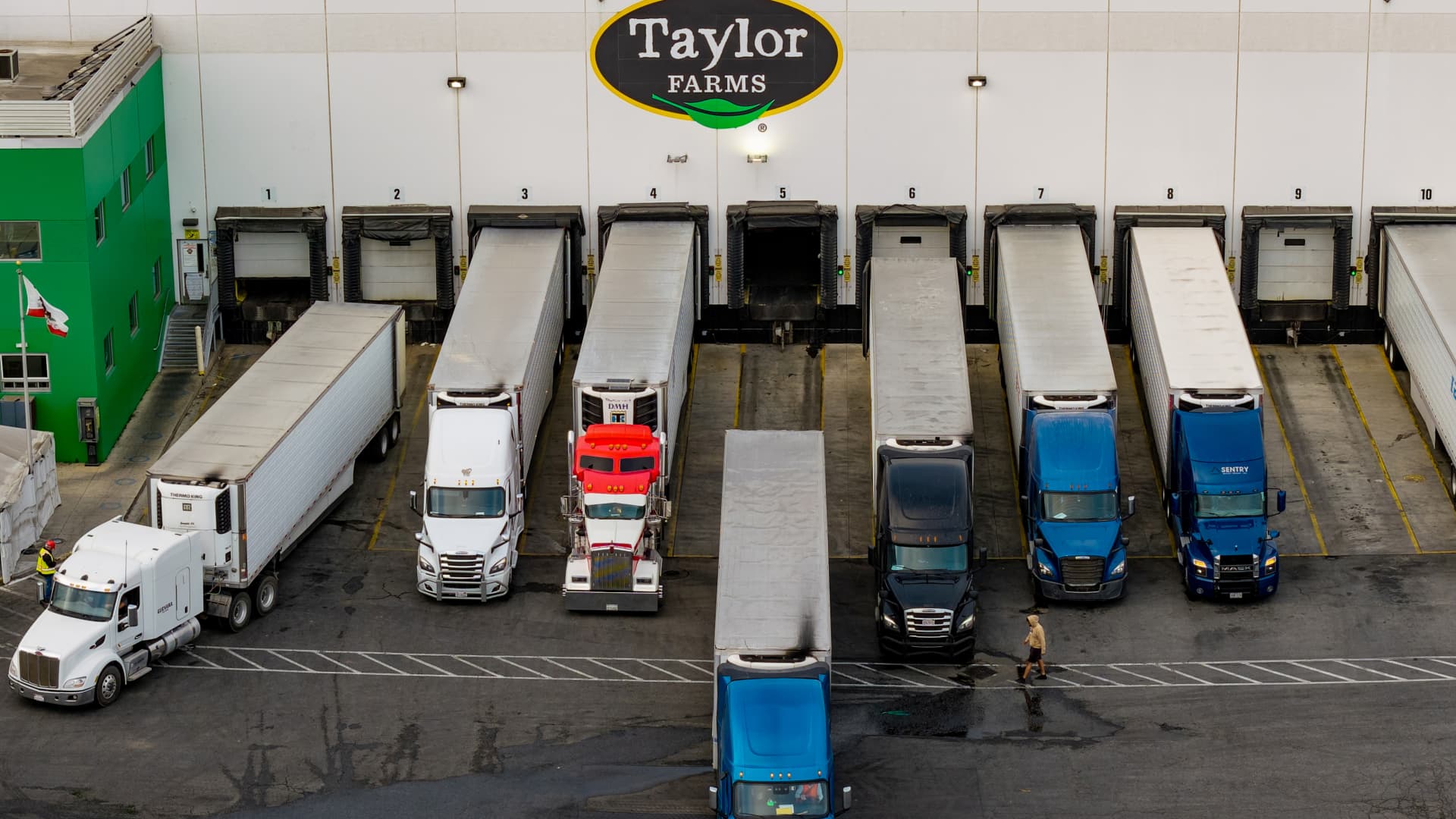
Tractor trailers at a Taylor Farms facility in Salinas, California, Aug. 10, 2026.

Josh Edelson | Bloomberg | Getty Images

Advertisement

Taylor Farms said in an August post on its website that it spends more than $200 million a year on food safety. The company added in a statement to CNBC that safety is its “biggest area of funding by several orders of magnitude.”

Taylor Farms has also voluntarily suspended iceberg lettuce sourcing and production from central Mexico and commissioned independent experts to conduct a review of food safety practices at its facility there. The FDA has not reported a positive product sample for cyclospora, because it can take weeks for symptoms to show and lettuce has a short shelf life, so it is difficult to test the right crop.

The breadth of the outbreak, which has led Walmart to recall bagged salads and Taco Bell to pull lettuce at some restaurants, underscores how integral Taylor Farms has made itself to the U.S. food system, and why broader industry consolidation risks worsening foodborne illness outbreaks.

Why Taylor Farms’ scale is important

A forklift transports crates of produce at a Taylor Farms facility in Salinas, California, Aug. 10, 2026.

Josh Edelson | Bloomberg | Getty Images

The company has also become more important by getting bigger. Taylor Farms has expanded its infrastructure through a string of acquisitions and investments, including its purchases of Earthbound Farm in 2019 and agricultural robotics company Farmwise in 2025.

The benefit of that consolidation has been reliable supply, standardized products and potentially lower labor costs, said Zagor.

Advertisement

But there is another side.

“The consolidation has camouflaged sources,” Zagor said. “It’s all put in one big pot. And if that pot has now gone bad, that affects the entire downstream logistic food chain.”

Zagor called it a “culinary national nightmare” when a company that distributes food to so many other businesses finds itself at the center of a foodborne illness outbreak.

It’s not the first time Taylor Farms has been tied to an outbreak.

Advertisement

Food safety lawyer Bill Marler compiled a list of outbreaks linked to Taylor Farms and whether they led to product recalls. Among them is a 2009 salmonella outbreak linked to shredded lettuce, along with a 2024 E. coli outbreak tied to slivered onions served at McDonald’s.

His law firm, Marler Clark, has filed five complaints based on the current cyclospora outbreak so far in Ohio, Michigan and Kentucky, against four separate Taco Bell franchise operators and the restaurant chain itself, along with Taylor entities including four operators and one supplier.

Growth and regulation

A customer reaches for Taylor Farms bagged salads for sale at a grocery store in Hercules, California, July 17, 2026.

David Paul Morris | Bloomberg | Getty Images

Advertisement

Taylor Farms, along with other food service giants such as US Foods and Sysco, has become bigger and more vital in part by buying other companies.

Taylor Farms has completed more than a dozen acquisitions or investments since 2011. While the cyclospora outbreak — the largest in U.S. history — has brought fresh scrutiny of the effects of consolidation, it’s unclear how much skepticism there was of the deals when they happened.

CNBC asked the Justice Department and Federal Trade Commission whether either agency had reviewed or challenged Taylor Farms’ acquisitions and investments. The DOJ did not respond. The FTC said it could not provide additional details without knowing the purchase prices of the transactions, which determines if the agency even had the opportunity to review.

CNBC found no public evidence that the FTC has challenged a Taylor Farms acquisition. Those deals took place under multiple presidential administrations of both parties, and various FTC leaders.

Advertisement

Some experts also highlighted a separate issue in the U.S. food system: the strength of oversight and regulation of food safety as distributors get larger and more influential. As the cyclospora outbreak raged, various news reports highlighted that Taylor Fresh Foods made a $1 million donation to the pro-Trump super PAC MAGA Inc. last year, around the time the Trump administration delayed a rule related to food tracing requirements. The company has also spent millions on anti-regulatory lobbying.

“If what you want is light enforcement of anything that’s going to be expensive and cost you money, it’s very nice to have political power,” said Marion Nestle, professor emerita of nutrition, food studies and public health at New York University. “You can go to Congress and say, we don’t want to do that.”

Taylor Fresh Foods rejected suggestions that its political contributions have resulted in favorable regulatory treatment.

“Taylor Farms categorically rejects any suggestion that the company has attempted or received favorable regulatory treatment as a result of political contributions or any other improper influence,” a spokesperson said. “The allegations are false.”

Advertisement

Nestle worries whether regulators have enough power as a few big companies become increasingly vital parts of the food system.

“Companies want to produce food as cheaply as possible,” said Nestle.

“And that means you need oversight,” she added.

Choose CNBC as your preferred source on Google and never miss a moment from the most trusted name in business news.
Advertisement
Continue Reading

Business

Bloom Energy: Nancy Pelosi (And Other Bulls Too) Needs To Rethink Its 80x P/E (NYSE:BE)

Published

on

Chalkboard Illustration of AI Energy Needs with Hands Holding Colored Chalk

This article was written by

Envision Research, aka Lucas Ma, has over 20+ years of investment experience and holds a Masters with in Quantitative Investment and a PhD in Mechanical Engineering with a focus on renewable energy, both from Stanford University. He also has 30+ years of hands-on experience in high-tech R&D and consulting, housing sector, credit sector, and actual portfolio management.He leads the investing group Envision Early Retirement along with Sensor Unlimited where they offer proven solutions to generate both high income and high growth with isolated risks through dynamic asset allocation. Features include: two model portfolios – one for short-term survival/withdrawal and one for aggressive long-term growth, direct access via chat to discuss ideas, monthly updates on all holdings, tax discussions, and ticker critiques by request.

Analyst’s Disclosure: I/we have no stock, option or similar derivative position in any of the companies mentioned, and no plans to initiate any such positions within the next 72 hours. I wrote this article myself, and it expresses my own opinions. I am not receiving compensation for it (other than from Seeking Alpha). I have no business relationship with any company whose stock is mentioned in this article.

Seeking Alpha’s Disclosure: Past performance is no guarantee of future results. No recommendation or advice is being given as to whether any investment is suitable for a particular investor. Any views or opinions expressed above may not reflect those of Seeking Alpha as a whole. Seeking Alpha is not a licensed securities dealer, broker or US investment adviser or investment bank. Our analysts are third party authors that include both professional investors and individual investors who may not be licensed or certified by any institute or regulatory body.

Advertisement
Continue Reading

Business

Go Grandmaster Shin Jinseo, Who Beat AI Program KataGo, Donates Prize Money to Sick Children in Seoul

Published

on

Florida Confirms New Burmese Python Breeding Hotspot Outside the Everglades,

SEOUL — Shin Jinseo, one of South Korea’s top-ranked Go players, has donated part of the prize money he earned for defeating the artificial intelligence program KataGo to a children’s hospital, extending a run of quiet philanthropy that predates his latest victory.

Shin, a 9-dan professional, visited Severance Children’s Hospital in Seoul on Wednesday and personally handed over a donation of 30 million won, or roughly $22,000, to hospital director Cheon Geun-a. The gift draws on winnings from a July match in which Shin, playing with a two-stone handicap, took on KataGo, widely regarded as one of the strongest Go-playing AI systems in the world.

Shin won that contest 2-1, earning appearance fees and victory bonuses that together totaled 250 million won, or about $180,000. Wednesday’s donation represents a portion of that total.

Shin said he decided to donate because the July match was played on behalf of humanity as a whole, drawing more support from fans than his matches typically receive, and that giving back felt like the right way to repay that encouragement. He added that he hoped the funds would offer even a small measure of help to children and teenagers fighting illness as they work to recover their health.

Advertisement

The gesture continues a pattern of giving that stretches back several years. Shin has previously contributed to relief funds during the COVID-19 pandemic in 2020, supported scholarships for young Go players and students from his home region, and donated to child welfare organizations. Some of his charitable activity has gone unpublicized, according to people familiar with his giving.

July’s match unfolded against a backdrop of rapid advances in Go-playing artificial intelligence, which have steadily outpaced human players’ capabilities in recent years. Observers in the Go community said Shin’s win carried particular weight given his standing as one of the top-ranked players in the world, even under handicap conditions designed to offset the AI’s advantage.

Figures in the Go world described Shin’s decision to direct part of his winnings toward the hospital as adding a dimension beyond competitive results, framing the episode as pairing a high-profile win over advanced technology with attention to vulnerable members of society. Some suggested his approach could serve as a model for younger athletes across sports.

Severance Children’s Hospital said the donated funds would go toward improving treatment conditions for young patients battling serious illness. Hospital officials were said to have expressed gratitude for Shin’s continued support.

Advertisement

Shin, born in 2002, rose through South Korea’s competitive Go ranks as a teenager and has since become one of the sport’s most recognizable figures both domestically and internationally. In addition to his 2026 match against KataGo, he has taken part in several high-profile exhibition matches against AI systems in recent years, appearances that have drawn broader public attention to competitive Go.

The Go community has said the growing sophistication of AI systems is reshaping how professional players train and how the sport is presented to the public. Many top players now use AI tools to sharpen their own game even as exhibition matches pitting humans against machines have become more frequent. Against that backdrop, Shin’s win over KataGo — and the donation that followed — drew wider attention than a typical tournament result.

People close to Shin said he intends to continue his charitable work independent of his competitive schedule. His latest donation, observers said, illustrates less about the size of the gift than about a broader approach to sharing the results of competition with the wider community.

Advertisement
Continue Reading

Business

Energy prices: SSE gas price to increase by 19% from October

Published

on

A close up of a ring on a gas cooker with blue flame burning

Northern Ireland’s largest provider of natural gas, SSE Airtricity, is to increase its prices by almost 19% from 1 October for its 200,000 domestic and small business customers.

It means the annual gas bill of a typical household in the greater Belfast and west gas network areas will increase by almost £172.

The company said “unprecedented levels of volatility in global energy markets and higher wholesale gas prices” had led to the price rise.

Wholesale gas prices in the UK have effectively doubled since the US and Israel began their attack on Iran.

Advertisement

Colin Broomfield from the Utility Regulator said the increase would be “difficult news for many households and small businesses, particularly at a time when wider cost pressures remain a concern”.

“The main reason for the increase is the sustained rise in the wholesale cost of gas, due to the ongoing conflict in the Middle East.

“The Iranian conflict has continued to impact energy prices globally for the past six months.

“In recent weeks, we have seen the wholesale price of gas reaching 169 pence per therm. This is twice as high as pre-conflict prices.”

Advertisement

The Middle East conflict sent global oil prices soaring as it effectively closed the Strait of Hormuz – one of the world’s key water transport routes for oil, liquid natural gas and other essential commodities – limiting global supplies.

About 20% of the world’s oil and liquefied natural gas normally passes through the waterway.

The UK is heavily reliant on oil and gas imports, with the majority coming from the US and Norway.

The price of oil on the global market determines how much the UK pays for it.

Advertisement

Although the UK does get some oil from the North Sea, most of that is exported for refining elsewhere.

Continue Reading

Business

Here Are the Business Executives Who Have Mamdani’s Ear

Published

on

Here Are the Business Executives Who Have Mamdani’s Ear

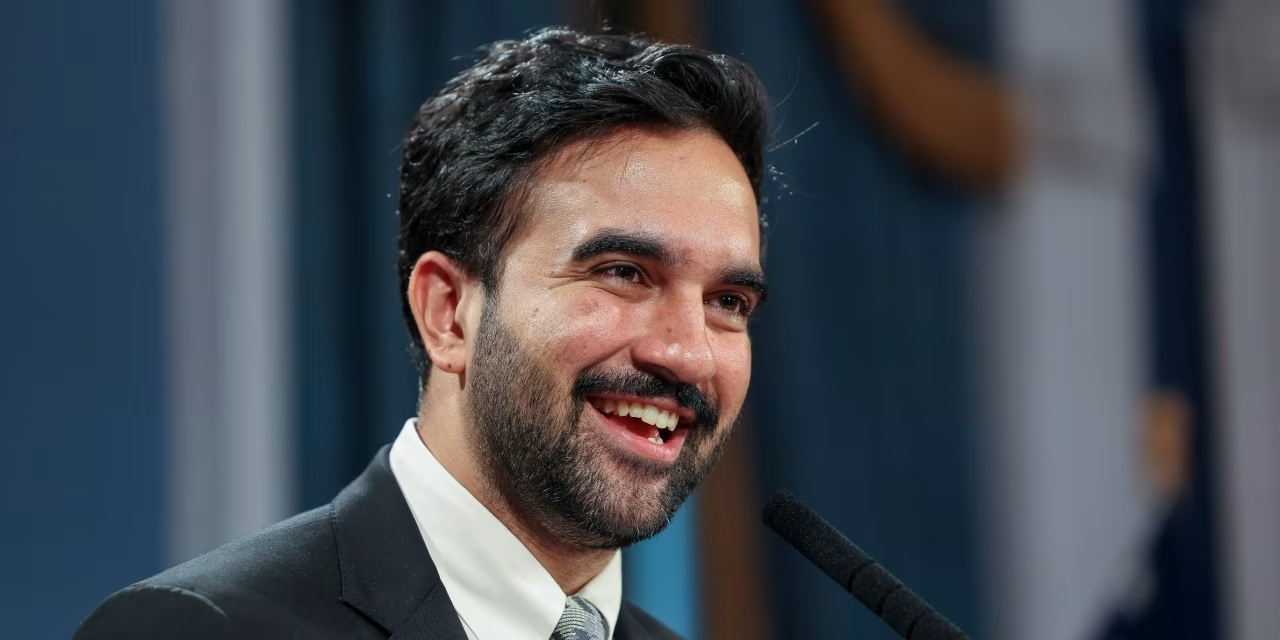
New York City Mayor Zohran Mamdani is expected to unveil on Thursday a new business advisory council with 15 CEOs and other executives. The council represents a chance to reset his relationship with the capitalist class after a rocky start to the year.

The council will be made up of executives across finance, insurance, sports and other industries. It is expected to act as a go-between for two powerful groups who mix about as well as oil and water: the Democratic Socialists who run City Hall and the wider business community. 

Copyright ©2026 Dow Jones & Company, Inc. All Rights Reserved. 87990cbe856818d5eddac44c7b1cdeb8

Continue Reading

Business

E-Commerce Firm Nears Buy Point As AI Shopping Strategy Clicks Investor’s Business Daily

Published

on

E-Commerce Firm Nears Buy Point As AI Shopping Strategy Clicks Investor's Business Daily

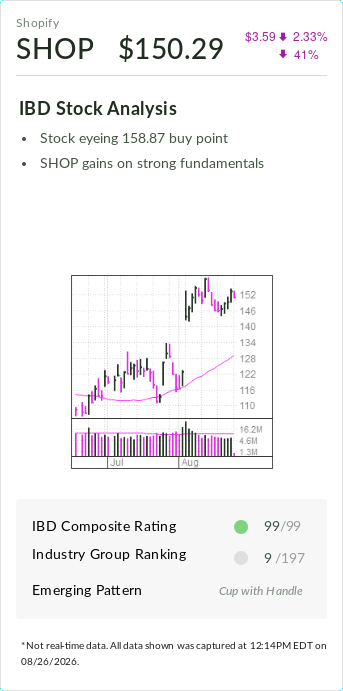
Shopify Shopify SHOP $ 150.29 $3.59 2.33% 41% IBD Stock Analysis Stock eyeing 158.87 buy point SHOP gains on strong fundamentals IBD Composite Rating 99/99 Industry Group Ranking 9/197 Emerging Pattern Cup with Handle Cup with Handle A positive chart pattern named such because it resembles the outline of a coffee cup with a handle. The pattern can last from…

Copyright ©2026 Investor’s Business Daily, LLC. All rights reserved. 87990cbe856818d5eddac44c7b1cdeb8

Continue Reading

Business

The IPO Excitement Is Over. Now SpaceX Must Deliver

Published

on

The IPO Excitement Is Over. Now SpaceX Must Deliver

After an impressive IPO, SpaceX shares are beginning to face the same challenges Tesla once did.

In the first weeks after its listing, SpaceX stock climbed to $225, significantly exceeding the IPO price of $135. Since then, however, the shares have fallen below $110. This has served as the first signal to investors that cutting-edge technology and Elon Musk’s name alone may not be enough to sustain such a high valuation over the long term.

The parallels with Tesla are striking. After going public in 2010, Tesla stock also experienced a sharp post-IPO decline before rebounding a year later as investors embraced a compelling growth narrative. The launch of the Model S helped convince the market that the company’s business could scale successfully. The big question now is whether SpaceX can follow a similar path.

The company has several arguments in its favor. The Starship program is gradually approaching commercial operation, with the recent 13th test flight marking the most successful in the program’s history. The vehicle completed its main tasks, successfully restarted its engine in space, and executed the softest landing to date. Even more notably, the spacecraft maintained the integrity of its hull so well that it remained afloat for several days after splashdown, prompting SpaceX to organize a dedicated recovery mission. Rather than highlighting technical shortcomings, the episode underscored the program’s growing maturity.

Starship is expected to become a key driver of the company’s long-term growth. The rocket will significantly reduce the cost of launching cargo into orbit while accelerating the deployment of the Starlink satellite constellation, which is already SpaceX’s largest source of revenue. The sooner the company can switch to regular commercial operations, the more convincing its long-term financial outlook will become.

Advertisement

However, investors remain primarily concerned about the company’s financial fundamentals. Aside from Starlink, many of SpaceX’s business lines are still unprofitable. Revenue growth has also begun to fall short of what investors expect from a company valued at roughly $1.4 trillion, while large-scale investments in AI continue to weigh on expenses. Intensifying competition across both the space industry and related business sectors is adding further pressure.

The situation is also complicated by SpaceX’s close relationship with Tesla. Recently, the market was stirred by reports that — to facilitate a potential merger between the two companies — Tesla might have to divest its largest Chinese manufacturing facility in Shanghai. Elon Musk quickly dismissed the claims, calling them completely fictional. Nevertheless, the very existence of such speculation shows that investors continue to view SpaceX and Tesla as elements of a single ecosystem. Meanwhile, the Shanghai factory remains one of Tesla’s key assets; the facility can produce more than 950,000 vehicles annually, supplies several international markets at once, and sources over 95% of its components locally.

As a result, SpaceX’s first year as a public company is likely to become a test of investor confidence. The market has already priced in much of the company’s long-term potential. The next phase will depend on tangible financial results and evidence that its capital-intensive projects can evolve into sustainable profit generators. If the Starship program continues to successfully move toward commercial operation and Starlink maintains its strong growth trajectory, the current weakness in the stock could ultimately resemble Tesla’s post-IPO experience. Until then, however, investors are likely to focus less on ambitious promises and more on how quickly technological breakthroughs translate into measurable financial performance.

Advertisement

Continue Reading

Business

A Practical Playbook for Late Italian Invoices

Published

on

A Practical Playbook for Late Italian Invoices

A late invoice from an Italian customer can create an awkward tension for a UK supplier. The sales team wants to preserve a valuable relationship.

Finance wants a date it can put into the cash forecast. Management wants to know whether the delay is administrative, commercial or a sign of deeper payment risk.

Those priorities do not have to conflict. The practical response is to run two clocks at once.

The customer-resolution clock tracks what the buyer needs to approve and release payment. The internal-escalation clock sets the point at which the supplier must make a deliberate decision, even if the customer continues to offer reassurance.

This approach matters because payment timing in Italy can be longer than UK suppliers expect. The UK Government’s current Italy market guidance warns that business-to-business payments can take several weeks and, in some sectors, months. Atradius reported in its 2026 Italy survey that settlement of overdue invoices takes longer than the Western European benchmark and that customer cash-flow stress is a leading reason for delay.

Advertisement

Those are market signals, not conclusions about a particular customer. The file still has to tell you what is happening in this case.

Start both clocks with a verified invoice

Before chasing, confirm that the invoice could be processed. Check the exact contracting entity, billing address, tax details, currency, bank information, purchase-order reference and agreed payment terms. For goods, connect the commercial invoice to the order, shipping documents, delivery record and any acceptance evidence. For services, preserve the signed scope, milestones, timesheets or approval messages.

UK export guidance stresses that commercial-invoice information should match the related transaction and banking documents. A mismatch can create a real processing delay. Correcting it quickly is better than escalating a preventable error.

Create a one-page status with the invoice number, amount, due date, customer entity, responsible contacts and latest verified explanation. That page becomes the control record for both clocks.

Advertisement

Use the customer-resolution clock to find the blocker

The first conversation should seek a specific operational answer. Has the invoice been received? Is it registered in the customer’s system? Has the relevant manager approved it? Is any part disputed? Has payment been scheduled?

Ask who owns each next step and by what date it will happen. If the customer says the invoice is in process, request the scheduled payment date and reference. If documents are missing, provide them and ask the customer to confirm that the file is complete. If a dispute is raised, ask for the disputed item, amount and supporting reason in writing.

Avoid treating every delay as a cultural difference. Italian companies, like companies anywhere, have different approval structures, financial positions and payment practices. A named owner and dated action are more useful than a broad assumption about the market.

Use the internal-escalation clock to protect options

The second clock belongs to the supplier. It should not reset every time someone promises to “check with accounts.” Set an internal review date based on the amount, evidence, customer importance, length of delay and exposure from continuing to trade.

Advertisement

At that review, choose among four states.

Resolve: there is a specific administrative blocker with an owner and near-term completion date.

Negotiate: the customer accepts the debt but needs time. Require exact instalment amounts and dates, approval by the appropriate manager and written confirmation.

Investigate: the customer has raised a substantive dispute. Separate the disputed and undisputed amounts, assign the commercial owner and preserve the evidence.

Advertisement

Escalate: the claim is clear, the agreed date has passed and the customer has not provided a credible resolution path.

These states make the decision repeatable. They also allow sales and finance to discuss the same facts instead of arguing from different impressions.

Prepare the file before seeking outside help

If escalation becomes proportionate, assemble the contract, invoice, delivery evidence, statement of account, dispute history and communication chronology. Confirm the exact debtor entity and the current amount claimed. Note any part payment, credit or counterclaim.

Companies seeking to recover unpaid invoices from Italian customers can then give local counsel or a collection provider a coherent file. That improves the first assessment and reduces the risk of spending time on missing documents or the wrong entity.

Advertisement

For suppliers trading in several markets, understanding European debt recovery routes can also help management distinguish a repeatable cross-border process from the country-specific advice needed for each claim. The operating model can be standardised; the legal assessment should remain local.

Preserve goodwill through precision

Professional escalation is not the opposite of relationship management. A vague chase can create irritation because neither side knows what will happen next. A precise message identifies the invoice, current issue, agreed action and decision date.

The two-clock method gives the customer a fair opportunity to resolve the problem while protecting the supplier from open-ended delay. The resolution clock keeps the conversation practical. The escalation clock ensures that goodwill has a boundary.

For UK SMEs selling to Italy, that balance is the real discipline: remain constructive, verify every promise and keep the next decision on the calendar.

Advertisement

Author bio

Lars Holdgaard is the founder of Debitura and has 10+ years of experience across debt collection, accounts receivable, technology, and startups. Before Debitura, he co-founded and led product and technology work at startups and scaleups, building software for financial administration and receivables management. Lars studied at the IT University of Copenhagen and the Technical University of Denmark.

Advertisement
Continue Reading

Trending

Copyright © 2025