Gas prices moved higher Friday as the conflict with Iran continued to roil global energy markets, pushing crude oil sharply upward and raising concerns about fuel supplies.
The national average price for regular gasoline rose to $3.32 per gallon on Friday, up from $3.25 on Thursday and $2.98 a week ago, according to AAA. Analysts say the increase reflects a surge in crude oil prices as geopolitical tensions intensify in the Middle East.
Advertisement
U.S. crude settled at $90.90 per barrel on Friday, a 12.2% jump on the day.
“Gasoline prices have been following crude prices higher as the closure of the Strait of Hormuz impacts supplies,” Andy Lipow, president of Lipow Oil Associates, told FOX Business in an email.
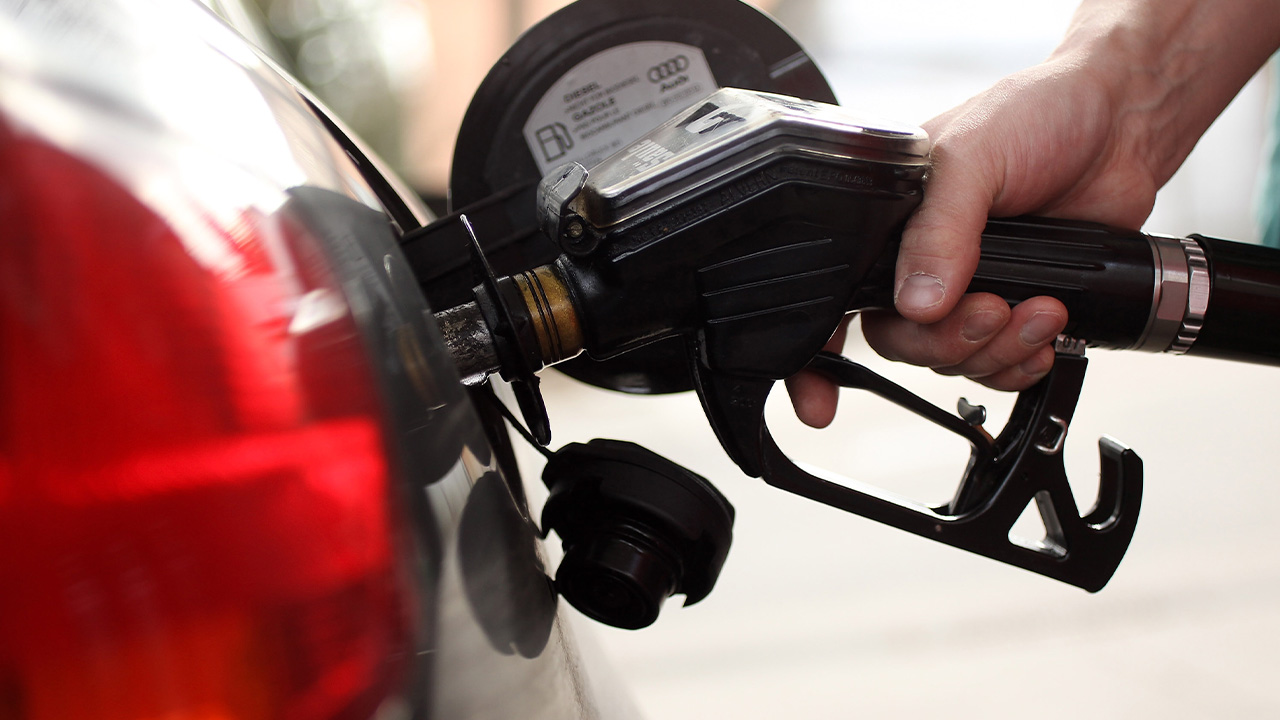
A gas station attendant pumps diesel into a car at a filling station (Sean Gallup/Getty Images / Getty Images)
Oil markets have been on edge since the U.S. and Israel launched strikes on Iran last Saturday. Iran has since moved to block tanker traffic in the Strait of Hormuz — a critical shipping lane that handles roughly 20% of global oil flows, according to Reuters.
Advertisement
Lipow said the disruption has prevented tankers from loading in Iraq, Kuwait and Saudi Arabia, forcing some production shut-ins.
Missile strikes have also hampered refinery operations in Israel, Bahrain and Saudi Arabia, tightening global gasoline and diesel supplies. Additional pressure is coming from China, which is limiting exports of refined petroleum products, according to Lipow.
“All this is leading to higher gasoline prices and the national average is likely to hit $3.50 per gallon [very] soon,” Lipow said.
Cars are pictured driving on the highway. (Jonas Walzberg/picture alliance via Getty Images / Getty Images)
FOX Business contributor Phil Flynn said futures markets suggest pump prices could continue rising in the near term, depending on how events unfold.
“We’re going to probably see some increases right now,” Flynn told FOX Business. “That may slow if we get good news out of Iran.”
Flynn noted that while prices have climbed quickly, the spike has not yet reached the levels seen during past geopolitical crises.
“I’m hopeful that we see the peak of gasoline next week,” Flynn said. “The reason why I say that is I have a lot of confidence in the US military and Israel, and I really think Iran is on its last legs right now.”
A navy vessel is seen sailing in the Strait of Hormuz, a vital waterway through which much of the world’s oil and gas passes on March 1, 2026. (Sahar AL ATTAR / AFP via Getty Images / Getty Images)
President Donald Trump told Reuters on Thursday he was not concerned about the rise in prices.
“I don’t have any concern about it,” Trump told Reuters. “They’ll drop very rapidly when this is over, and if they rise, they rise, but this is far more important than having gasoline prices go up a little bit.”
I’ve been researching companies in-depth for over a decade, from commodities like oil, natural gas, gold and copper to tech like Google or Nokia and many emerging market stocks, which I believe could help me provide useful content for readers. After writing my own blog for about 3 years, I decided to switch to a value investing-focused YouTube channel, where I researched hundreds of different companies so far. I would say my favorite type of company to cover are metals and mining stocks, but I am comfortable with several other industries, such as consumer discretionary/staples, REITs and utilities.
Analyst’s Disclosure: I/we have no stock, option or similar derivative position in any of the companies mentioned, but may initiate a beneficial Long position through a purchase of the stock, or the purchase of call options or similar derivatives in GAP over the next 72 hours. I wrote this article myself, and it expresses my own opinions. I am not receiving compensation for it (other than from Seeking Alpha). I have no business relationship with any company whose stock is mentioned in this article.
Seeking Alpha’s Disclosure: Past performance is no guarantee of future results. No recommendation or advice is being given as to whether any investment is suitable for a particular investor. Any views or opinions expressed above may not reflect those of Seeking Alpha as a whole. Seeking Alpha is not a licensed securities dealer, broker or US investment adviser or investment bank. Our analysts are third party authors that include both professional investors and individual investors who may not be licensed or certified by any institute or regulatory body.
International Business Machines Corporation (IBM) Morgan Stanley Technology, Media & Telecom Conference 2026 March 3, 2026 11:30 AM EST
Company Participants
Robert Thomas – Senior VP of IBM Software & Chief Commercial Officer
Conference Call Participants
Advertisement
Erik Woodring – Morgan Stanley, Research Division
Presentation
Erik Woodring Morgan Stanley, Research Division
Advertisement
Well, let’s get started, guys. Thank you very much for joining us. Welcome to day 2 of the flagship TMT Conference. My name is Erik Woodring. I lead the U.S. IT hardware coverage here. I am delighted to be joined by Rob Thomas, IBM’s Head of Software and Chief Commercial Officer. But before we get started, I just need to read this disclosure statement. I need to mention that important disclosures can be found at the Morgan Stanley research disclosure website at www.morganstanley.com/researchdisclosures. If you have any questions, please reach out to your Morgan Stanley sales representative.
So Rob, thank you very much for joining us today.
Robert Thomas Senior VP of IBM Software & Chief Commercial Officer
Advertisement
Thanks for having me. Great to be with you.
Question-and-Answer Session
Advertisement
Erik Woodring Morgan Stanley, Research Division
So I think the best place to start maybe is just better understand how to think about the key drivers of growth for IBM. So exiting 2025, 3 of your 4 software subsegments were growing double digits. Mainframe had a record year, helping to offset maybe more tepid growth in services. So taking a step back as we think over kind of the medium term and beyond, what are the key growth drivers as we think about the IBM model? And let’s start from there.
Robert Thomas Senior VP of IBM Software & Chief Commercial Officer
Advertisement
So maybe go back to 2020 when Arvind Krishna took over. He had the insight that we can be uniquely
The proposed IPO is a combination of a fresh issue of 2 crore equity shares and an offer for sale (OFS) of up to 65 lakh shares by promoters Anil Jain and Shrenik Jain, according to the draft red herring prospectus (DRHP) filed on Friday.
The company plans to utilise the fresh issue proceeds to the tune of Rs 200 crore to support working capital requirements and a portion would be used for general corporate purposes.
Founded in 2012 in Mumbai, the company began operations as a business-to-business (B2B) supplier of gold jewellery. It has since expanded its presence in Bengaluru through a partnership with Ratnaakar Gold.
Advertisement
Sunil Gold India designs and supplies handcrafted gold jewellery, specializing in contemporary, heritage and temple-inspired designs, along with other traditional styles.
Live Events
It primarily serves the domestic market and supplies jewellery to customers across eight states and one union territory in India. It also exports to the United Arab Emirates and Singapore, with a significant share of revenue coming from repeat orders from existing clients. In FY25, the company processed around 504.58 kg of gold. Its revenue stood at Rs 521 crore.
The company plans to list its shares on BSE and NSE. Unistone Capital is the sole book-running lead manager to the issue.
Global oil prices could soar to as high as $150 per barrel if the escalating conflict in the Middle East disrupts energy supplies from the Gulf, Qatar’s Energy Minister Saad al-Kaabi warned, cautioning that such a surge could deal a severe blow to the global economy. In an interview with the Financial Times, al-Kaabi said a prolonged war in the region could force Gulf energy exporters to shut down production within weeks.
He also noted that even if hostilities were to end immediately, it could still take “weeks to months” for Qatar to restore normal delivery cycles after an Iranian drone strike on the country’s largest liquefied natural gas facility.
This comes as Israel, the US and Iran continue to trade strikes for an eighth straight day. Just last week, before the conflict erupted, crude was hovering around $62 per barrel. By Friday, however, U.S. crude futures had spiked as much as 12% amid fears of supply disruptions before trimming some gains. Brent crude settled at $92.69 per barrel, up $7.28, or 8.52%, while West Texas Intermediate (WTI) jumped $9.89, or 12.21%, to close at $90.90 per barrel.
Markets have been rattled as the escalating conflict in the Middle East has disrupted shipping and energy exports through the crucial Strait of Hormuz. This narrow chokepoint between Iran and Oman normally carries around one-fifth of the world’s crude oil and liquefied natural gas supplies.
India imports the majority of its crude oil requirements, and about half of those imports pass through the Strait of Hormuz. Roughly 2.6 million barrels per day of India’s oil flows through the corridor. The Middle East takes 17% of India’s goods exports, on par with the US and the EU, supplies 55% of its crude oil, and accounts for 38% of worker remittances, which amounted to $45 billion in FY24 alone, according to calculations by global brokerage firm Jefferies.For equity markets, a spike toward $150 oil would likely trigger a broad risk-off reaction. Higher energy costs raise input prices for companies, compress corporate margins and weaken consumer spending.
Historically, sectors such as aviation, paints, chemicals and logistics tend to face the most pressure when oil prices surge sharply. At the same time, upstream oil producers and energy companies typically benefit from higher crude prices.
Short-term price spikes triggered by geopolitical tensions often reverse if supply routes reopen quickly. However, a sustained disruption to Gulf exports could push global markets into a period of higher inflation, weaker growth and increased volatility.
Advertisement
How will the Indian stock market open on Monday?
The Indian equity markets are likely to begin the upcoming week on a cautious note as global risk sentiment has deteriorated sharply. The current trend in GIFT Nifty, which closed around the 24,300 level, indicates a bearish undertone compared with the previous Nifty close near 24,450, Hariprasad K of Livelong Wealth said.
This combination of macroeconomic uncertainty and geopolitical risk is likely to influence market sentiment in the near term. Unless there is a positive development in the Middle East conflict that brings crude oil prices lower, Indian markets could witness continued volatility.
From a technical perspective, Pravesh Gour of Swastika Investmart said that Nifty is taking support near 24,300 but remains highly volatile. On the upside, the 24,900 to 25,000 range is expected to act as an immediate supply zone, where selling pressure could emerge if the index attempts a recovery. On the downside, 24,300 remains the first key support, and if the index slips below this level, 23,800 will be the next important support area that traders will closely monitor.
(Disclaimer: Recommendations, suggestions, views and opinions given by the experts are their own. These do not represent the views of The Economic Times)
The Securities and Exchange Commission on Thursday moved to dismiss a civil fraud lawsuit it had filed against crypto billionaire Justin Sun, who became a major investor in President Trump’s cryptocurrency projects as he pursued leniency from U.S. law enforcers. A company previously affiliated with Sun agreed, without admitting or denying wrongdoing, to pay a $10 million fine to resolve the SEC’s allegations that its employees manipulated the market for a crypto asset known as TRX. The settlement requires court approval.
Shares of Day One Biopharmaceuticals Inc. (NASDAQ: DAWN) skyrocketed more than 65% on March 6, 2026, after the company announced a definitive agreement to be acquired by French pharmaceutical group Servier for $21.50 per share in cash, valuing the deal at approximately $2.5 billion in total equity value.
Day One Biopharmaceuticals (DAWN) Stock Surges 66% on Servier’s $2.5 Billion Acquisition Deal
The transaction sent DAWN stock soaring from a previous close of $12.78 to $21.20 at the close of trading, with volume exceeding 78 million shares—far above its average. After-hours trading held steady around $21.20–$21.23, reflecting strong investor enthusiasm for the buyout premium, which represents a substantial uplift from recent trading levels.
Servier, an independent international pharmaceutical company governed by a foundation, described the acquisition as a strategic move to bolster its rare oncology portfolio. The deal centers on Day One’s flagship product, OJEMDA (tovorafenib), the only U.S. Food and Drug Administration-approved monotherapy for pediatric low-grade glioma (pLGG) in patients with specific BRAF alterations.
OJEMDA, an oral, brain-penetrant, selective type II RAF kinase inhibitor, targets relapsed or refractory pLGG in patients six months and older harboring BRAF fusions, rearrangements, or V600 mutations. Approved by the FDA in April 2024 under accelerated approval, the drug has shown rapid commercial traction.
Day One reported preliminary 2025 net product revenue of $155.4 million for OJEMDA, marking 172% year-over-year growth. In its fourth-quarter and full-year 2025 financial results released Feb. 24, 2026, the company posted Q4 net product revenue of $52.8 million and reaffirmed 2026 U.S. net product revenue guidance of $225 million to $250 million.
Advertisement
The acquisition expands Servier’s oncology ambitions, particularly in pediatric and rare cancers with high unmet needs. Servier gains access to OJEMDA and Day One’s broader pipeline, including programs in early to late-stage development targeting adult and pediatric solid tumors.
“Servier’s successful track record in rare cancers and its commitment to advancing targeted therapies makes it the ideal home for our portfolio,” Day One CEO Jeremy Bender said in the announcement. “Joining Servier represents a unique opportunity to extend the reach of our science and our lead program in pediatric low-grade glioma.”
The deal follows Day One’s January 2026 acquisition of Mersana Therapeutics, which added Emiltatug ledadotin (Emi-Le), a B7-H4-targeted antibody-drug conjugate (ADC) in Phase 1 for adenoid cystic carcinoma and other solid tumors. Updated Phase 1 data for Emi-Le is expected mid-2026.
Day One’s pipeline also includes DAY301, a PTK7-targeted ADC in Phase 1 dose escalation for locally advanced or metastatic solid tumors, with initial data anticipated in the second half of 2026.
Advertisement
The FIREFLY-1 pivotal Phase 2 trial supported OJEMDA’s approval, while the FIREFLY-2 Phase 3 study in frontline pLGG completed enrollment in early 2026, with results expected to support potential label expansion.
Regulatory momentum continues internationally. In late February 2026, the European Medicines Agency’s Committee for Medicinal Products for Human Use (CHMP) issued a positive opinion for conditional marketing authorization of OJEMDA in relapsed or refractory BRAF-altered pLGG, under Day One’s ex-U.S. licensing agreement with Ipsen Pharma SAS.
The Servier acquisition is subject to customary closing conditions, including regulatory approvals and tender offer completion, with an expected close in the second quarter of 2026. Servier plans a tender offer for all outstanding shares.
Analysts had previously viewed Day One favorably, with consensus price targets around $23–$26 before the deal, implying significant upside. The buyout premium aligns with those expectations while providing certainty amid biotech sector volatility.
Advertisement
Some investor alerts emerged post-announcement, with firms like Kahn Swick & Foti and Halper Sadeh investigating the adequacy of the price and process for shareholders. Such reviews are common in public company acquisitions but do not necessarily indicate issues.
Day One, founded with a focus on disrupting traditional drug development for pediatric and young adult cancers, has built a commercial-stage profile rapidly since OJEMDA’s launch. The company’s emphasis on targeted therapies for life-threatening diseases, particularly in underserved populations, attracted Servier’s interest.
For investors, the deal caps a strong run for DAWN, which has delivered triple-digit year-to-date returns in 2026 amid pipeline progress and revenue growth. The stock’s 52-week range spanned $5.64 to $21.23, with the acquisition pushing it to new highs.
As the transaction advances, attention turns to integration, potential synergies in Servier’s oncology efforts, and continued momentum for OJEMDA’s global rollout. The buyout underscores ongoing consolidation in rare oncology, where targeted therapies command premiums for their precision and impact on small patient populations.
Advertisement
Day One’s journey from clinical development to commercial success—and now acquisition—highlights the value of focused innovation in pediatric oncology. Shareholders await confirmation of the deal’s close, while the broader biotech market watches for ripple effects on similar rare-disease players.