
Business
Gianni Infantino says sorry but remains as Fifa president after executive meeting


Gianni Infantino has apologised for “errors” he made in controversial plans to sell off stakes in competitions to private investors, but will remain Fifa president after receiving the backing of senior executives in a meeting in Morocco.
Infantino summoned members of the management board to Fifa’s Africa office in Rabat on Wednesday following mounting criticism of his aborted proposals, with world football’s governing body releasing a statement of support four hours after the meeting ended.
European football’s governing body Uefa said at the weekend that it has lost confidence in Infantino, calling the Fifa Forward Enterprise (FFE) proposal a “shabby, back room, opaque deal”.
Much criticism has come from within Fifa, including secretary general Mattias Grafstrom, who was at Wednesday’s meeting. In an internal memo sent to Fifa staff on Tuesday, he wrote that the situation is “a sad and reproachable series of events”.
However, in a statement following the meeting, Grafstrom and the managament board “reaffirmed their full support” for Infantino as president.
Infantino and Grafstrom also sent a signed letter – seen by the BBC – to Fifa’s vice-presidents, council and 211 member associations saying they “sincerely apologise” for their errors and “commit to them not happening again”.
The two were pictured attending a Women’s Africa Cup of Nations match together in Rabat after the meeting.
Infantino had offered all associations $40m (£30m) if they backed a proposal for private investment in its tournaments, including the men’s and women’s World Cups, through a new subsidiary, FFE.
Fifa said that during Wednesday’s meeting “mistakes” regarding FFE were “acknowledged”, saying it was “not the intention” for the Fifa council and members association to “feel excluded from the process and that the process should have been handled differently”.
The governing body added it “acknowledged that errors were also made after the proposal was leaked to media” – with the Times breaking the story of Infantino’s plan on 28 July.
However, the statement also said the organisation “will no longer tolerate any attacks on its integrity, good governance and due process and will take all necessary measures to protect and safeguard its name and reputation”.
Earlier, Fifa denied a story in the Times that Infantino had promised Morocco it will host the 2030 World Cup final in exchange for its support.
Fifa said it was a “false and misleading” claim and that a decision on where to hold the final, with the tournament also hosted by Spain and Portugal, will be made “in due course”.


Yes. Corporate subscriptions are available for teams and organisations, with discounted rates as user numbers increase. Pricing starts from $1,625 + GST per user.
Get in touch
to discuss the right option for your organisation.
Business News subscriptions are used by executives, investors, consultants and professionals who need to stay informed and make better decisions about the WA market. When you subscribe you’ll get
- Unlimited access to WA’s most trusted business journalism
- Data & Insights — detailed profiles of WA companies, people, projects and deals
- MyBN — a personalised feed based on the companies, people and sectors you follow
- Special publications and industry reports
- Daily and weekly email newsletters
Data & Insights is a research tool built specifically for the WA market. It draws on more than 30 years of Business News reporting, updated regularly to reflect what’s happening now. Use it to:
- Look up detailed profiles of WA companies, including financials, directors and ownership
- Find decision-makers and track their career movements
- Research live and completed projects across WA industries
- Monitor deals, appointments and market activity
- Access industry rankings and league tables
Data & Insights is updated daily by our dedicated research team, which uses the latest announcements, ASX filings and editorial coverage to keep our person, company, list and project records up to date.
Business News welcome all opportunities to make our dataset accurate, complete and current, so if you have an update request, please email the team at
general@businessnews.com.au, and we’d be happy to assist.
MyBN
is part of every subscription. It’s your personalised view of Business News. You can follow the companies, people, sectors and projects that matter to you, and get a news feed and alerts tailored to your interests. You can save articles to read later and retain only what you need.
Only subscribers have full access to all content on the Business News website.
If staying informed about the WA economy is part of your job, and/or you’re looking for networking opportunities in WA, Business News is built for you.
Business News subscribers are:
- Executives and directors tracking competitors, clients and market movements
- Investors and advisers researching companies, deals and industry trends
- Consultants and professionals staying across sectors relevant to their clients
- Business owners looking for leads, context and market intelligence
Most Business News publications cover national or global markets. Business News is focused entirely on Western Australia, which means the journalism, the data and the intelligence are all built around WA companies, people and projects — not adapted from a national feed. Data & Insights, included with every subscription, combines more than 30 years of WA-specific editorial research with live business data. There’s no comparable product for the WA market.
The Morning Digest Email provides a comprehensive wrap of the major headlines, relevant to WA business, and includes with a snapshot of the overnight news covering oil, gold and ASX-listed companies.
The Afternoon Wrap Email focuses on the news covered by our team of journalists during the course of the working day, including exclusive stories and analysis, all of which relates to WA business and the local economy.
The BN Weekender Email contains a wrap of the Business News from the week that was, highlighting the top stories in each area of WA business.
Sign up for free.
We’re happy to help.
Get in touch
and our team will come back to you.
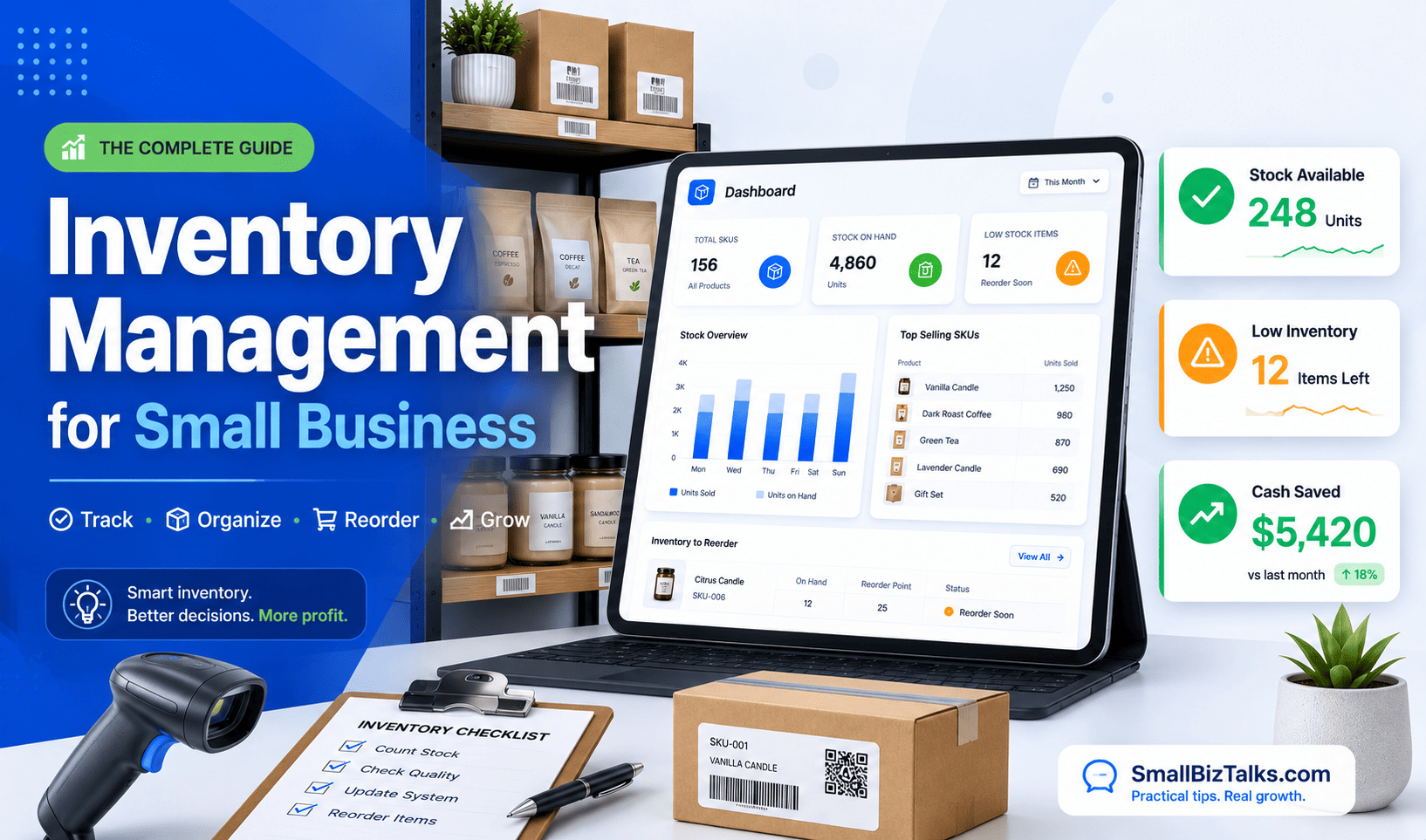
For most small businesses, inventory is the second-largest use of cash after payroll and rent. Yet it rarely gets managed with the same discipline. Payroll runs on a schedule. Rent is a fixed line item. Inventory, by contrast, is often tracked in a spreadsheet that someone updates when they remember to, or not tracked in any structured way at all until a bestseller runs out mid-season or a storage unit fills up with stock that stopped moving a year ago.
That gap matters more for a small business than a large one. A national retailer that misjudges demand on one product line barely notices. A small business that ties up a third of its working capital in the wrong stock can spend months recovering.
This guide covers what inventory management actually involves, the core methods worth knowing, how to build a working system from scratch, and where a spreadsheet stops being enough.
What Inventory Management Means for a Small Business
Inventory management is the process of tracking, ordering, and controlling the stock a business buys and sells, so it has the right amount of product on hand without tying up more cash than necessary.
At a large company, that process is usually a dedicated function with its own software and staff. At a small business, it’s typically one person, often the owner, doing it alongside sales, hiring, and everything else.
That difference shapes the whole approach. A small business can’t absorb the cost of overstock the way a larger one can, and it usually can’t negotiate the supplier terms that make just-in-time ordering low-risk. The goal isn’t to copy enterprise inventory practices at a smaller scale. It’s to run a version built for thin margins, limited storage, and one or two people managing it.
Why Small Businesses Struggle With It
The challenges are fairly consistent across industries, even though the products differ.
Knowing how much to buy. Order too much and cash sits on a shelf instead of in the business. Order too little and a customer walks out empty-handed or worse, buys from a competitor and doesn’t come back.
Limited space. Most small businesses don’t have a warehouse to absorb excess stock. A storage closet or a corner of the shop floor has to do double duty, which makes overbuying a physical problem as much as a financial one.
Manual tracking errors. Spreadsheets and handwritten logs drift from reality fast. A miscount here, a forgotten update there, and the numbers on paper stop matching what’s actually on the shelf.
Supplier leverage. Small businesses generally don’t have the order volume to negotiate the pricing or flexible terms that larger buyers get, which makes lead times and minimum order quantities harder constraints to work around.
Seasonal and demand swings. A slow month can look like healthy inventory levels right up until a rush hits and reveals how thin the buffer actually was.
None of these are solved by one trick. They’re solved by picking a method that fits the business and applying it consistently, which is the next section.
Core Inventory Management Methods
A handful of methods cover most of what a small business needs. Few businesses use just one; most combine two or three.
ABC Analysis
ABC analysis sorts inventory into three tiers based on value and sales impact, not just volume:
- A items : a small share of SKUs that drive the largest share of revenue or cost. These get the closest attention: frequent counts, tighter reorder rules, stronger supplier relationships.
- B items : moderate value, moderate attention. Monthly reviews are usually enough.
- C items : the bulk of the catalog by count, but a small share of value. Quarterly review is often sufficient, and some businesses move slow C items to special-order only.
The practical benefit is focus. A business with 500 SKUs doesn’t need to watch all 500 with equal intensity, it needs to watch the 50 or so that actually move the needle.
A quick example: a boutique candle shop carries 120 SKUs. Ranking them by annual revenue shows that 18 scented candles account for roughly 70% of sales – those become A items, checked weekly. The next 30 or so items (seasonal scents, gift sets) make up another 20% of revenue and become B items, reviewed monthly. The remaining 70-plus SKUs – one-off colors, discontinued scents still on the shelf – generate the last 10% and become C items, counted quarterly and candidates for clearance if they don’t move.
FIFO (First In, First Out)
FIFO means the oldest stock sells first. It’s standard for anything perishable or trend-sensitive – food, cosmetics, seasonal apparel – where holding onto older inventory too long turns it into a write-off. Rotating stock physically (older items to the front) makes FIFO easy to enforce without extra software.
Reorder Point (ROP)
The reorder point is the stock level that triggers a new order, calculated as expected demand during the supplier’s lead time, plus a buffer for uncertainty (safety stock):
Reorder point = (average daily sales × lead time in days) + safety stock
Example: a product sells 8 units a day, and the supplier takes 6 days to deliver. Lead-time demand is 48 units. Add a safety stock buffer of 15 units for demand variability, and the reorder point is 63 units – the moment stock hits that number, it’s time to order, not the moment the shelf looks low.
Economic Order Quantity (EOQ)
EOQ estimates the order size that minimizes total cost by balancing ordering costs (placing and receiving an order) against carrying costs (storing it). It’s most useful for A-tier items with steady, predictable demand for volatile or seasonal products, it tends to oversimplify.
Just-in-Time (JIT)
JIT means ordering stock to arrive right when it’s needed, minimizing how much cash sits in storage. It works well when suppliers are fast and reliable. For a small business with a single supplier and a multi-week lead time, it’s a riskier fit – a single delayed shipment can mean empty shelves with no buffer to absorb it.
Building an Inventory System, Step by Step
Most small businesses don’t need a sophisticated system on day one. They need a consistent one.
1. Pick one tracking method and commit to it. Spreadsheet, dedicated software, or a hybrid, the specific tool matters less than using it consistently. Switching methods every few months is what causes the drift that leads to phantom inventory: stock that exists on paper but not on the shelf, or vice versa.
2. Set par levels and reorder points for your top sellers first. Trying to calculate reorder points for an entire catalog on day one is a good way to never finish. Start with the 15–20 SKUs that drive most of the revenue, using the ABC framework above, and expand from there.
3. Build in cycle counting. Instead of one exhausting annual count, count a rotating slice of inventory on a regular schedule – A items weekly or biweekly, B items monthly, C items quarterly. Discrepancies get caught while they’re small, not after they’ve compounded for a year.
4. Connect inventory to your books. If sales, stock counts, and accounting live in three disconnected places, someone is doing manual reconciliation and manual reconciliation is where errors hide the longest. Setting up a solid framework for small business bookkeeping ensures your inventory costs accurately flow into your financial statements.
Spreadsheet or Software? Knowing When to Switch
A spreadsheet is a perfectly reasonable inventory system for a business with a small catalog and one sales channel. The signs it’s time to move on are fairly clear:
- Stock counts are wrong often enough that staff double-check before promising a customer availability
- The business sells across more than one channel (in-store, online, marketplace) and keeping them in sync manually eats real time each week
- Inventory tracking is taking hours a week that could go toward the business itself
- The business has outgrown a single location
When those signs show up, a handful of tools cover most small business needs:
Tool
Best for
Starting price*
Zoho Inventory
Multi-channel sellers (in-store, online, marketplace)
Free tier available; paid plans scale with order volume
Square for Retail
Businesses already using Square for point-of-sale
Free plan; paid tiers add barcode and vendor tools
QuickBooks Online (Plus/Advanced)
Single-location retailers or service businesses with a light product line
Add-on to an existing QuickBooks subscription
Katana
Small manufacturers and makers tracking raw materials and production
Paid plans only, no free tier
*Confirm current pricing directly with each vendor, plans and rates change frequently.
None of these is universally “best” – the right one depends on sales channels, whether the business manufactures anything, and what it already uses for point-of-sale or accounting. It’s worth testing free tiers or trials against actual order volume before committing to a paid plan. If the business is also choosing accounting software around the same time, best small business accounting software is worth reading alongside this, since the two decisions often affect each other.
Inventory KPIs Worth Tracking
A few numbers reveal whether an inventory system is actually working, beyond a gut sense of “we seem to be running low on things.”
Inventory Turnover Ratio
How many times inventory is sold and replaced over a period, calculated as COGS [cost of goods sold – the direct cost of the products a business sells, defined in detail in the IRS’s Tax Guide for Small Business] ÷ average inventory value. A low ratio suggests overstocking or slow-moving products; a very high one can mean the business is understocked and risking stockouts.
Carrying Cost
The cost of holding inventory, including storage, insurance, and capital tied up. It typically runs 20–30% of inventory value per year. When working with tight cash margins, cutting unnecessary overhead – whether by avoiding overstocking or using free payroll software for your team, helps keep operating capital free for inventory replenishment.
Stockout Rate
The share of demand that couldn’t be met because an item was out of stock. This one is easy to underestimate, since a stockout often shows up as a customer who simply leaves rather than a complaint that gets logged.
Sell-Through Rate
The percentage of received stock that actually sells within a given period. A consistently low sell-through rate on a product is usually the clearest early signal that it needs to be discounted, bundled, or dropped.
Mistakes That Quietly Cost Small Businesses Money
Buying in bulk without running the carrying-cost math. A supplier discount for ordering 500 units instead of 100 looks like savings on the invoice. If 300 of those units sit unsold for six months, the storage and capital cost can erase the discount entirely.
Counting inventory once a year and trusting the number the rest of the time. A lot can drift in eleven months. Cycle counting catches problems while they’re still small and cheap to fix.
Treating every sales channel as the same pool of stock. A business selling in-store and online without synced inventory will eventually oversell a product on one channel while it sits unsold in the other.
Ignoring supplier lead time until it becomes urgent. Reorder points built on the assumption that a supplier will always deliver on time tend to fail exactly when they’re needed most – during a supplier’s own busy season.
Not distinguishing A items from C items. Applying the same level of attention to a top seller and a slow-moving accessory wastes time on the products that matter least and under-manages the ones that matter most.
Where to Start
A small business doesn’t need every method in this guide running at once. The practical starting point is narrower: pick a tracking system, calculate reorder points for the products that actually drive revenue, and build in a counting rhythm that catches errors before they compound. Everything else – software, KPIs, more advanced methods like EOQ – is worth adding once that foundation is in place, not before.

Disney and TikTok have agreed a deal which will allow creators to use clips from Disney films, including its subsidiaries, in their videos.
It means clips from hit franchises like Star Wars, Toy Story and the Marvel Cinematic Universe will soon start popping up in videos – which will also be shared on Disney’s short-form video platform, Verts.
The scheme will be launched in the US before being rolled out to other countries.
Neither company shared financial details of the agreement, although it follows the collapse of a $1bn (£745m) deal between Disney and OpenAI which would have let people use its characters in AI-generated videos.
That agreement was cancelled in March when OpenAI shut down its AI video generation tool Sora, citing a decision to focus on other parts of its business.
“Today, fans are celebrating our stories in entirely new ways,” said Disney’s chief marketing and brand officer Asad Ayaz, following the TikTok deal being announced.
“Disney owns some of the world’s biggest franchises but ownership of attention is shifting towards creators,” social media expert Matt Navarra told BBC News.
“Hollywood used to market at fans – now it needs to give fans the raw materials to market with it, and that is quite a profound shift.”
TikTok said its platform saw an average of 6.5 million posts relating to film and TV per day last year.
Fans like to use clips from films and TV shows in their videos, but without express permission, they would often be taken down due to copyright claims.
This makes it harder for a wide audience to engage with fan-created content around a big release.
TikTok would also benefit from the “credibility of becoming a formal distribution partner to one of Hollywood’s biggest studios,” Navarra said.
He added that TikTok’s recommendation algorithm gives it the power to “influence which character or scene or forgotten franchise suddenly becomes very valuable again”.
Disney and TikTok said a jointly-run programme would boost some creators’ videos and give them access to exclusive events.
“This is a deal that repositions and recovers Disney in the UGC [user-generated content] space following the content gap left by the sudden collapse of Sora,” Gareth Sutcliffe from Enders Analysis said.
But he said it was not without risk.
“There is an ongoing safety debate around TikTok under European online rules,” he said.
“At a minimum, Disney will need to employ significant guardrails to curate the creator content that is selected.”
Online creators and influencers are becoming more important to brands’ marketing strategies.
Last year, a report from Oxford Economics said YouTube content creators contributed £2.2bn to the UK economy in 2024 and supported 45,000 jobs.
There is also a recognition that even very small influencers, who focus on niche topics, might have lower follower counts but come with a hyper-engaged audience.
Disney launched its short form video platform Verts in the US in March, with plans to expand that further around the world.

Shares in AMP have climbed nearly six per cent after the financial services company increased its dividends due to a strong half-year.

William Blair is committed to building enduring relationships with our clients and providing expertise and solutions to meet their evolving needs. We work closely with the most sophisticated investors globally across institutional and intermediary channels. We are 100% active-employee-owned with broad-based ownership. Our investment teams are solely focused on active management and employ disciplined, analytical research processes across a wide range of strategies. We are based in Chicago with resources in New York, London, Zurich, Sydney, Stockholm, and The Hague, and dedicated coverage for Canada.

trivago: High Upside Left After Impressive Q2

Shares in Subiaco-based EV Resources rose by more than 10 per cent on Thursday morning, following successful conversion of an existing MOU.

Chelsea and Juventus meet Wednesday in one of the summer’s most closely watched preseason friendlies, with both European giants using the match at Kai Tak Sports Park in Hong Kong to fine-tune their squads ahead of the 2026-27 season.
The match, part of the Hong Kong Football Festival 2026, kicks off at 7:30 p.m. local time in Hong Kong, which translates to 8 a.m. UTC. That puts the start time at roughly 4 a.m. Eastern time in the United States, giving American fans an early wake-up call if they want to catch the match live.
How to Watch in the United States
Fans in the United States have multiple ways to follow the match. The game will be shown live on Prime Video, Paramount+ and CBS Sports Golazo, giving viewers a choice between several major streaming platforms depending on existing subscriptions. Paramount+ carries CBS Sports’ soccer coverage broadly, including UEFA Champions League matches, in addition to a wide slate of other sports and entertainment programming, while CBS Sports Golazo offers dedicated soccer coverage as part of its programming lineup.
How to Watch in the UK and Elsewhere
For fans in the United Kingdom, the match will not be shown on traditional television. Instead, Chelsea is streaming the game live through the club’s own CFC+ subscription service, available via the Chelsea Official App and the club’s website. Supporters should note that the CFC+ stream will not be available in Hong Kong, Macau or Italy, meaning fans in those specific markets will need to seek alternative broadcast options where available.
For those without access to a CFC+ subscription or one of the U.S. streaming platforms, Chelsea’s Matchday Live service offers minute-by-minute updates throughout the match via the club’s official app and website, including confirmed starting lineups as soon as they are announced, along with live text commentary, statistics and imagery throughout the game. Juventus has also indicated the match will be available to watch for free through its own club channels as part of coverage of what the Italian club is calling the first fixture of its Summer Tour.
A Big Test for Both Sides
Wednesday’s match represents a significant challenge for both clubs as they continue building toward the new season. Chelsea enter the fixture off the back of a disappointing 2-1 defeat to rivals Tottenham Hotspur on Saturday in Sydney, a result that saw manager Xabi Alonso continuing to experiment with his tactical setup as his first full season in charge of the Premier League side approaches. Alonso’s side also faced 10-man Tottenham during the Australian leg of their preseason tour before moving on to face Juventus and, subsequently, AC Milan in Hong Kong and Jakarta.
Juventus, meanwhile, arrive in strong defensive form, having yet to concede a goal across their preseason warmup matches so far, most recently claiming a 2-0 win over Nice. Manager Igor Tudor is using the club’s preseason schedule to continue establishing his tactical identity with the Serie A side ahead of the new campaign, and is expected to field a strong lineup against Chelsea given the profile of the opponent.
Squad News and Returning Players
Among the storylines surrounding Chelsea’s squad ahead of the match is the potential involvement of winger Mykhailo Mudryk, who could make his return to competitive football after a 20-month suspension following an adverse finding for a banned substance in 2024. Alonso has confirmed that the 25-year-old, who joined Chelsea for $115 million in January 2023, is available for selection as the club continues preparing for the new season. Chelsea has been using its preseason friendlies broadly to build squad chemistry, improve match fitness, and integrate several new signings, while also providing valuable minutes to players returning from injury or international duty over the offseason.
What Comes Next
Wednesday’s match against Juventus is not Chelsea’s final preseason test. The club is scheduled to continue its Asia tour with a subsequent friendly against AC Milan in Hong Kong before wrapping up preparations with a match in Jakarta, Indonesia. Once the squad returns to London, Chelsea will host Real Sociedad at Stamford Bridge on Saturday, Aug. 15, in what is expected to be their final home tune-up before officially opening the 2026-27 Premier League season away to Fulham on Monday, Aug. 24.
For Juventus, Wednesday’s fixture against Chelsea is similarly positioned as one of the tougher tests of their preseason slate, with the Italian club continuing preparations for their own return to competitive football as the new Serie A campaign approaches.
A Marquee Preseason Matchup
While no trophy or competition points are on the line, Wednesday’s friendly carries added significance given the profile of both clubs and the timing within their respective preseason schedules. With Chelsea working to sharpen its form under Alonso following back-to-back tour matches, and Juventus looking to extend a clean defensive record under Tudor, the match offers both managers a valuable opportunity to assess squad depth and tactical cohesion against high-level opposition before facing the pressures of the regular season.
Fans looking to follow the match across any platform are advised to confirm regional streaming availability ahead of kickoff, given the blackout restrictions in place for Hong Kong, Macau and Italy on Chelsea’s own CFC+ service, as well as the early morning start time facing viewers across North America.

Braveheart Bio prices $382.5M IPO at $18 per share

FOX Business Madison Alworth reports on Citadel CEO Ken Griffin reaffirming plans to move his firm to Miami from New York City, driven by a desire for a state that embraces business on Varney & Co.
The development of a skyscraper in New York City that will house Ken Griffin’s Citadel is moving forward despite his feud with New York City Mayor Zohran Mamdani.
The skyscraper project at 350 Park Avenue is being developed by Griffin’s Citadel in partnership with Vornado Realty Trust and Rudin, and will see two of Griffin’s firms being anchor tenants.
Steven Roth, CEO of Vornado Realty Trust, said on the company’s earnings call on Tuesday that the project is underway and that the REIT will maximize its stake in the venture.
“If you drive or walk past Park Avenue at 52nd Street, you will see that our 350 Park Avenue site is now under construction, actually under demolition. We intend to shortly exercise our investment option to participate in this deal at our maximum ownership alongside Ken Griffin as our 60% partner and with Citadel as our 1-million-square-foot anchor tenant.”
HEDGE FUND BILLIONAIRE EXPANDS MIAMI DEVELOPMENT PLANS AFTER MAMDANI FEUD

The new skyscraper being built by Citadel, Vornado and Rudin will be at 350 Park Ave. in New York City. (Fox Business)
Roth said on the call that Citadel holds a 60% stake in the partnership, while Vornado’s will top out at 36%.
The project is moving forward after Mamdani specifically criticized Griffin for owning a penthouse on Central Park South in a video detailing his new pied-a-terre tax, which is levied on high-value residential properties whose owners don’t live in the city full-time.
Mamdani spurred the controversy with an April 15 video the mayor recorded in front of Griffin’s penthouse, calling him out as a wealthy hedge fund owner who would be subject to the new luxury property tax.
NEW YORK’S WEALTHY RUSH TO AVOID MAMDANI’S SECOND-HOME TAX

New York City Mayor Zohran Mamdani stands outside of Citadel CEO Ken Griffin’s Park Avenue penthouse in an April 15, 2026, video. (NYC Mayor’s Office)
“When I ran for mayor, I said I was going to tax the rich. Well, today we’re taxing the rich… This is an annual fee on luxury properties worth more than $5 million whose owners do not live full-time in the city – like this penthouse, which hedge fund CEO Ken Griffin bought for $238 million,” Mamdani said in his video.
Griffin responded, calling the personal attack “creepy and weird,” worrying that it put him in harm’s way and demonstrated a “profound lack of judgment,” on Mamdani’s part.

Citadel CEO and founder Ken Griffin said Mamdani’s video was “creepy and weird.” (Aaron Schwartz/Bloomberg via Getty Images)
Citadel executives went on to suggest that the new office space could become a casualty of Mamdani’s not-so-business-friendly policies.
Gerald Beeson, the firm’s COO, wrote in an April 23 memo to employees that the firm’s development of 350 Park Avenue was about to begin and would create “6,000 highly paid construction jobs” as well as support the “creation of more than 15,000 permanent jobs in Midtown New York.”
“The project – if we move forward – will entail more than $6 billion dollars of spending,” Beeson wrote.
GET FOX BUSINESS ON THE GO BY CLICKING HERE
Mamdani eventually softened his rhetoric and thanked Griffin for his contributions to the city, including funding a memorial wall for police officers killed in the September 11 attacks and those who died of illnesses related to the recovery from the attacks that will open later this year in NYC Police Headquarters.
FOX Business’ Robert McGreevey contributed to this report.

Why Zambia Were Eliminated Despite Better Goal Difference at WAFCON 2026 Explained

On the hunt for a new Dell laptop? These are the best models we’ve tested recently

Swap mayonnaise for better ingredient to make egg salad lighter and creamier


-

 Fashion5 days ago
Weekend Open Thread: Wit & Wisdom
-

 Politics5 days ago
Meta enters AI-training agreement with far-right ‘propaganda rag’ Newsmax
-

 Politics3 days ago
Zack Polanski: an incitement to murder Nigel Farage?
-

 Crypto World5 days ago
MicroStrategy Post-Earnings CLARITY Act Push Could Add New Catalyst for Its Stock
-

 Crypto World5 days ago
XRP Ledger v3.3.0 brings five institutional features
-

 News Videos7 days ago
Bitcoin Enters the 3rd Stage of the Bear Market
-

 Politics6 days ago
Luke Littler’s dominance sparks GOAT debate
-

 Sports6 days ago
Seema Kaliramna Wins Discus Throw Bronze, Takes India’s CWG Medals Tally To 17
-

 Crypto World5 days ago
New York sues Kalshi over prediction market gambling
-

 Crypto World4 days ago
Crypto PAC spending tops $2M in Michigan House race
-

 Business3 days ago
DTCR: Deleveraging And A Hedge Fund Collapse Point To A Possible AI Bottom
-

 Business6 days ago
Trump Announces Hamas Disarmament Agreement as Iran Strikes Kuwait Air Base and US Attacks Pause Overnight
-
 Crypto World5 days ago
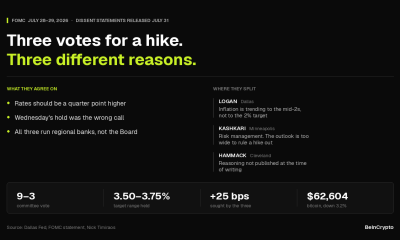
3 Fed Officials Just Explained Their Rate Hike Vote: Is Inflation Winning?
-

 Tech4 days ago
ESET tracks rise in malicious AI skills and adaptable malware
-

 Sports5 days ago
France Cricket implodes: letters hidden in a drawer and a board at war
-

 NewsBeat7 days ago
Four people die trying to cross Channel in small boats
-

 Tech6 days ago
Gemini Spark can now use Chrome logins and saved passwords to run errands on your behalf
-

 Tech6 days ago
Building A Reproduction PlayStation Motherboard
-
Crypto World3 days ago
XRP Ledger urges node upgrade after manifest flood
-

 Crypto World5 days ago
Moneyflip CEO charged in $40K murder-for-hire plot
You must be logged in to post a comment Login