



Connect with us
DAPA Banner
DAPA Coin
DAPA
COIN PAYMENT ASSET
PRIVACY · BLOCKDAG · HOMOMORPHIC ENCRYPTION · RUST
ElGamal Encrypted MINE DAPA
🚫 GENESIS SOLD OUT
DAPAPAY COMING

Business

Gilt Yields Hit 28-Year High as Starmer Defies Resignation Calls

Published

on

Gilt Yields Hit 28-Year High as Starmer Defies Resignation Calls

Britain’s bond market delivered its sharpest rebuke yet to Sir Keir Starmer’s premiership on Tuesday, with 30-year gilt yields climbing to their highest level this century as the prime minister stared down a growing chorus of Labour MPs demanding he step aside.

The sell-off, which dragged sterling and equities lower in lockstep, wiped out the relief rally that followed Starmer’s defiant intervention last week. Tuesday’s cabinet meeting, at which the prime minister once again refused to countenance resignation, did little to settle nerves. Investors are now openly pricing in the prospect of a leftward lurch in Labour policy, with the attendant risks of looser fiscal rules, higher gilt issuance and a further squeeze on the cost of capital for British business.

For the country’s 5.5 million small and medium-sized enterprises, the implications are far from academic. Higher long-dated gilt yields feed directly into the swap rates that underpin commercial lending, business mortgages and asset finance, raising the prospect of yet another leg up in the borrowing costs faced by Britain’s corporate backbone at a time when many are still nursing the legacy of post-pandemic debt.

The 30-year gilt yield rose 13 basis points to 5.81 per cent, the highest since May 1998. The benchmark 10-year yield gained 10 basis points to 5.1 per cent, within a whisker of breaching the post-2008 peak it set earlier this month. Bond prices move inversely to yields.

“A new Labour leader may face pressure to ease the fiscal rules and raise gilt issuance,” warned Jim Reid, analyst at Deutsche Bank, capturing the City’s central concern that any successor would lean towards higher spending and heavier taxation of the very businesses the Treasury is counting on to drive growth.

Advertisement

Sterling’s slide alongside government bonds will draw uncomfortable parallels with the dark days of Liz Truss’s mini-budget. When a currency weakens in concert with rising borrowing costs, it is the trading pattern of an emerging market that has lost the confidence of foreign capital, not that of a G7 economy. The pound fell 0.64 per cent against the dollar to a two-week low of $1.352, and shed 0.21 per cent against the euro to €1.152, its weakest since mid-April.

Some of the pressure is undeniably imported. Bunds, OATs and BTPs all sold off as President Trump declared the Iran ceasefire was “on life support”, sending Brent crude up 2.8 per cent to $107.17 a barrel and reigniting inflation fears across advanced economies. The Strait of Hormuz, through which a fifth of global oil and gas once flowed, remains largely shut. Germany’s Dax bore the brunt of the European sell-off, falling more than 1 per cent. But gilts underperformed by a substantial margin, marking out Westminster’s political turmoil as a uniquely British risk premium.

Mohit Kumar, chief European economist at Jefferies, urged clients to short sterling, arguing any change in the composition of government “would likely be left-leaning”. Anthony Willis, senior economist at Columbia Threadneedle Investments, cautioned that the bond market was unlikely to settle “until greater clarity emerges”.

Equities followed suit. The FTSE 100 surrendered 0.3 per cent having opened the week with a 0.4 per cent gain, while the more domestically focused FTSE 250 dropped 211 points, or 0.9 per cent, extending its losing streak to a second day. Mid-cap stocks, dominated by UK-facing businesses, are the clearest read on how the City judges Britain’s economic prospects.

Advertisement

The grim verdict from Andrew Goodwin, chief UK economist at Oxford Economics, is that there is little prospect of meaningful relief. He expects 10-year borrowing costs to remain stuck above 5 per cent for the remainder of the year, regardless of who occupies Number 10. “Markets clearly perceive the UK has a bigger inflation problem and that tighter monetary policy will be needed to limit second-round effects from the energy shock, while political uncertainty has added to pressures at the long end,” he said.

Even were Starmer to dig in, Goodwin argued, the bond market would have little to celebrate, with the prime minister’s “attempts to regain popularity, or, more likely, from a successor implementing more costly left-wing economic policies” weighing on sentiment. “If Starmer sets out a timetable to stand down, the uncertainty premium will persist.”

For owner-managers already navigating a punishing cost base, a softening consumer and the fallout from this spring’s National Insurance changes, the message from the bond vigilantes is unambiguous: brace for borrowing to stay dear, and for political risk to remain firmly on the balance sheet.


Jamie Young

Jamie Young

Jamie is Senior Reporter at Business Matters, bringing over a decade of experience in UK SME business reporting.
Jamie holds a degree in Business Administration and regularly participates in industry conferences and workshops.

When not reporting on the latest business developments, Jamie is passionate about mentoring up-and-coming journalists and entrepreneurs to inspire the next generation of business leaders.

Advertisement

Continue Reading
Click to comment

You must be logged in to post a comment Login

Leave a Reply

Business

Meta Stock Climbs to $600 as AI Momentum and Ad Strength Offset Heavy Capex Spending

Published

on

Meta Strikes $10 Billion Cloud Deal With Google Amid AI

NEW YORK — Meta Platforms Inc. shares rose modestly to $600.22 in midday trading Tuesday, up 0.23% or $1.36, as investors continued digesting the social media giant’s aggressive artificial intelligence investments and robust advertising performance following its strong first-quarter 2026 earnings report. The modest gain comes amid broader market caution but underscores ongoing confidence in Meta’s ability to monetize AI across its family of apps despite significantly higher capital spending forecasts.

The stock has traded in a wide range this year, pulling back from 2025 highs near $796 after the company raised its 2026 capital expenditure guidance to $125 billion-$145 billion to fuel AI infrastructure buildout. Yet Meta’s core advertising business remains exceptionally resilient, with Q1 revenue hitting a record $56.31 billion, up 33% year-over-year and beating analyst expectations.

Adjusted earnings per share reached $10.44 in the quarter, driven partly by a large one-time tax benefit, while core operational performance stayed solid. Daily active users across Meta’s platforms exceeded 3.4 billion, highlighting the company’s unmatched global reach even as it navigates regulatory and competitive pressures.

AI Push Dominates Narrative

CEO Mark Zuckerberg has made clear that 2026 and beyond represent a major acceleration in Meta’s AI ambitions. The company is heavily investing in custom silicon, data centers and foundational models to power everything from ad targeting to content recommendations and new consumer experiences like advanced Meta AI assistants.

Advertisement

Higher capex has weighed on sentiment in recent weeks, with some investors worried about near-term margin pressure and free cash flow. However, analysts largely view the spending as necessary groundwork for long-term leadership in AI-driven advertising and consumer applications. Meta aims to fully automate much of its ad creation process by the end of 2026, allowing businesses to generate campaigns with minimal input while dramatically improving performance.

Google Cloud and other partnerships, along with internal tools like Andromeda ad retrieval and generative models, are already delivering measurable lifts in ad efficiency and relevance. Advertisers using Meta’s latest AI features have reported double-digit improvements in return on ad spend.

Advertising Resilience Remains Key Driver

Despite macroeconomic uncertainty and geopolitical tensions, Meta’s advertising revenue continues to grow strongly. The company benefits from its massive user base across Facebook, Instagram, WhatsApp and Threads, combined with sophisticated AI targeting that helps advertisers reach the right audiences efficiently.

Reels and short-form video continue expanding, while Threads has solidified its position as a viable Twitter/X alternative. Management has expressed confidence in sustained ad market recovery and further gains from AI optimization throughout 2026.

Advertisement

Valuation and Analyst Views

At current levels around $600, Meta trades at a forward price-to-earnings multiple in the mid-20s, which many analysts consider reasonable given projected growth. Consensus price targets cluster between $650 and $750, with several firms maintaining Buy ratings and citing AI as a multi-year tailwind.

Longer-term forecasts remain bullish. Some projections see Meta shares potentially reaching $1,000-$1,250 within five years if AI monetization accelerates and margins stabilize after the current investment cycle.

Risks and Challenges

Investors remain watchful of several headwinds. Regulatory scrutiny in Europe and the U.S. over youth safety and data practices could lead to fines or product changes. Increased competition in AI from OpenAI, Google and others, along with potential moderation in advertiser spending, also pose risks.

Workforce reductions and efficiency efforts continue as Meta balances heavy AI spending with cost discipline. The company has warned of possible material impacts from ongoing legal and regulatory matters.

Advertisement

Technical Outlook

Meta stock has shown resilience after the post-earnings dip in late April. Support levels sit near $570-$580, with resistance around recent highs near $620-$650. Volume on Tuesday remained moderate, suggesting the modest gain reflects steady accumulation rather than aggressive buying.

Broader Context

Meta’s performance fits within the larger AI investment theme dominating technology markets in 2026. While heavy infrastructure costs create short-term pressure, the company’s ability to integrate AI deeply into its core advertising engine and consumer products positions it favorably for sustained growth.

As summer trading approaches, focus will shift to second-quarter results and any updates on AI product launches or ad automation progress. Meta’s diversified revenue streams and massive user engagement give it durability that few peers can match.

For investors, today’s slight uptick reflects continued faith in Meta’s long-term vision despite the elevated spending required to realize it. Whether the stock can sustain momentum will depend on execution in AI and advertising efficiency in the quarters ahead.

Advertisement

With a market capitalization exceeding $1.5 trillion and a proven ability to adapt, Meta remains one of the most important technology companies shaping the future of social media, advertising and artificial intelligence.

Continue Reading

Business

Apple Stock Edges Higher Near $294 as Record Earnings, AI Investments and Buyback Boost Confidence in 2026

Published

on

Apple Logo on a Glass Window

NEW YORK — Apple Inc. (NASDAQ: AAPL) shares rose modestly to $293.84 in midday trading Tuesday, up 0.40% or $1.16, as investors continued rewarding the tech giant’s strong fiscal second-quarter 2026 performance and aggressive capital return program. The stock has climbed steadily since its April 30 earnings beat, trading near recent highs and reflecting confidence in Apple’s iPhone momentum, record services growth and accelerating artificial intelligence strategy.

Apple reported fiscal Q2 revenue of $111.2 billion, up 16.6% year-over-year, and earnings per share of $2.01, both surpassing Wall Street forecasts. iPhone sales surged 22% to $57 billion, marking the strongest March quarter in company history. Services revenue reached a record $30.98 billion, while gross margin expanded to an all-time high of 49.3%. The board authorized a massive $100 billion share repurchase program and raised the quarterly dividend to $0.27 per share.

The results triggered a strong post-earnings rally, with shares jumping nearly 4% in early May trading. Tuesday’s modest advance extends that positive momentum, even as broader market caution lingers over geopolitical risks and elevated valuations across big tech. Apple’s market capitalization remains above $4.3 trillion, cementing its position as one of the world’s most valuable companies.

CEO Transition and AI Focus

Apple also announced a major leadership change: hardware engineering chief John Ternus will succeed Tim Cook as CEO on September 1, 2026, with Cook transitioning to executive chairman. The smooth succession plan has been well-received by investors, providing continuity while signaling fresh energy as Apple ramps up its artificial intelligence efforts.

Advertisement

R&D spending climbed to a record $11.4 billion in the quarter, representing over 10% of revenue as the company accelerates investments in on-device AI, generative models and new hardware features. Analysts expect AI enhancements in iOS 19, Siri upgrades and future iPhone models to drive the next growth cycle. Wedbush’s Dan Ives has highlighted the “AI opportunity” as a multi-year catalyst, recently raising his price target to a Street-high $400.

iPhone 18 Anticipation Builds

Attention is shifting toward the iPhone 18 lineup expected in September 2026. Supply chain reports suggest Apple is holding pricing steady despite rising memory costs tied to AI demand, while preparing significant camera, display and AI performance upgrades. Stronger-than-expected iPhone 17 demand in the March quarter has fueled optimism that the next generation could sustain double-digit growth.

Services remain a high-margin growth engine, with Apple Music, iCloud, App Store and AppleCare continuing to scale globally. Greater China revenue rebounded strongly, up more than 28% year-over-year, signaling stabilization in a key market.

Analyst Sentiment and Valuation

Wall Street remains overwhelmingly bullish. Consensus price targets cluster between $325 and $400, with recent upgrades from BofA, Goldman Sachs and others citing sustained iPhone strength, services expansion and AI upside. The stock trades at a forward P/E around 33-35, which many view as reasonable given Apple’s consistent execution and massive cash generation.

Advertisement

Technical analysts note Apple has cleared key resistance levels and is forming higher highs. Support sits near $280-$285, with resistance around recent highs near $294-$300. The $100 billion buyback program is expected to provide ongoing tailwinds by reducing share count and supporting the price.

Risks and Challenges

Investors remain attentive to several headwinds. Regulatory scrutiny in the EU and U.S., potential China tensions, and a competitive AI landscape could create volatility. Rising R&D and capex commitments may pressure near-term margins, though management has guided for continued gross margin strength in the mid-to-high 47% range.

Broader market dynamics, including interest rates and geopolitical developments, also influence sentiment. However, Apple’s resilient business model — blending premium hardware with high-margin services and an expanding ecosystem — has historically weathered economic uncertainty well.

Outlook for Remainder of 2026

With the WWDC 2026 developer conference approaching in June, excitement is building around new AI features and software updates. Management has guided for mid-teens revenue growth in the current quarter, setting up a potentially strong back half of the year centered on iPhone 18 momentum.

Advertisement

For long-term investors, today’s modest gain reflects steady accumulation in a fundamentally strong name. Apple’s combination of record profitability, massive capital returns and clear AI roadmap keeps it among the most important holdings in technology portfolios. As the company navigates its leadership transition and invests heavily for the future, Wall Street largely expects continued outperformance.

As midday trading continued Tuesday, AAPL held near session highs with solid volume. The coming weeks will bring more color on AI progress, iPhone demand trends and capital allocation priorities. For now, Apple’s ability to deliver consistent beats and shareholder returns reinforces its status as a blue-chip growth powerhouse even at elevated valuations.

The tech titan remains a core holding for many, with 2026 shaping up as another pivotal year driven by innovation, services expansion and artificial intelligence integration across its ecosystem.

Advertisement
Continue Reading

Business

Rogue Snacks raises $2.5 million

Published

on

Rogue Snacks raises $2.5 million

Protein-focused company launching at Walmart in July.

Continue Reading

Business

Microsoft Stock Rises to $409 as Cloud, AI Growth Offset Heavy Capex in Strong Q3

Published

on

NEW YORK — Microsoft Corp. (NASDAQ: MSFT) shares climbed modestly to $409.01 in midday trading Tuesday, up 0.88%, as investors digested the software giant’s robust fiscal third-quarter 2026 results and continued optimism around its artificial intelligence and cloud leadership despite elevated capital spending. The move comes after a period of consolidation, with the stock rebounding from recent lows amid broader tech sector rotation.

Microsoft reported fiscal Q3 revenue of $82.9 billion, up 18% year-over-year and beating analyst expectations of roughly $81.4 billion. Adjusted earnings per share reached $4.27, exceeding forecasts of $4.06. Intelligent Cloud revenue jumped 30% to $34.7 billion, driven by Azure growth of 40% (39% constant currency). Productivity and Business Processes rose 17%, while More Personal Computing was roughly flat.

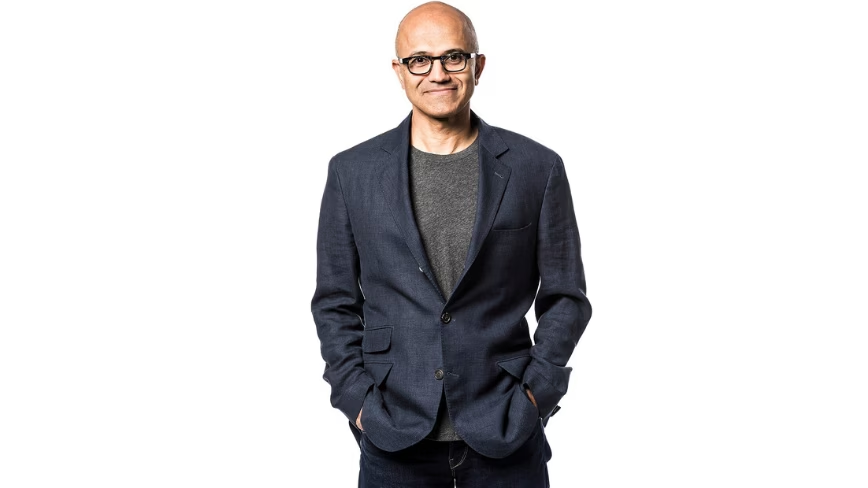
CEO Satya Nadella highlighted AI momentum, noting the company’s AI business has surpassed a $37 billion annual revenue run rate. Azure AI services and Copilot adoption continue accelerating across enterprise customers, with strong uptake in both commercial and consumer segments.

Heavy AI Investments Fuel Long-Term Bets

Microsoft guided for full-year capital expenditures around $190 billion in calendar 2026, driven primarily by AI data center buildout and infrastructure needs. While the spending level has raised near-term margin concerns for some investors, analysts largely view it as necessary infrastructure for sustained leadership in cloud and AI.

Advertisement

The company’s deepened partnership with OpenAI remains central. Recent updates to the commercial agreement, including revenue share caps, have been interpreted positively as both companies prepare for potential future monetization at scale. Microsoft also continues expanding its own AI models and tools across Azure, Microsoft 365 and GitHub.

Analyst Optimism Remains High

Wall Street consensus on Microsoft stays strongly bullish. Recent price target increases have pushed the average well above $500, with several firms citing 50-60% upside potential over the next 12-18 months. Key drivers include Azure’s market share gains, Copilot monetization progress, and long-term AI infrastructure returns.

The stock trades at a forward price-to-earnings multiple in the mid-20s, which many consider attractive relative to growth projections. Microsoft’s diversified business — spanning cloud, productivity software, gaming, LinkedIn and consumer products — provides resilience that few peers match.

Technical Picture and Market Context

MSFT has shown resilience after pulling back from 2025 highs near $555. Support levels sit near $390-$400, with resistance around recent swing highs near $420-$430. Tuesday’s modest gain occurred on solid volume, reflecting steady institutional buying amid broader market caution tied to geopolitical tensions and oil prices.

Advertisement

Year-to-date performance has lagged some megacap peers due to heavy AI spending, but recent rebound signals renewed investor confidence. Short interest remains manageable, limiting squeeze risk but keeping the name active among retail traders.

Strategic Position in AI Era

Microsoft’s early and substantial investment in OpenAI, combined with its Azure infrastructure, positions it uniquely in the AI value chain. The company is integrating AI deeply across its product portfolio — from Copilot in Office apps to GitHub Copilot for developers and consumer-facing tools. Enterprise adoption metrics remain strong, with commercial bookings and backlog providing multi-year visibility.

Nadella has emphasized “agentic AI” — autonomous systems capable of complex tasks — as the next major wave. Microsoft is investing aggressively to lead in this area while maintaining strong relationships with customers wary of single-vendor dependency.

Risks and Challenges Ahead

Investors remain mindful of execution risks on massive capex plans, potential slowdowns in hyperscaler spending, and intensifying competition in AI from Google, Amazon and emerging players. Regulatory scrutiny in Europe and antitrust matters in the U.S. also represent ongoing overhangs.

Advertisement

However, Microsoft’s balance sheet strength, consistent cash flow generation and history of disciplined capital allocation provide a significant buffer. The company returned over $10 billion to shareholders through dividends and buybacks in the quarter alone.

Outlook for Remainder of 2026

With fiscal Q4 results expected in late July, focus will turn to Azure growth sustainability, Copilot monetization updates and any commentary on 2027 guidance. Analysts project continued double-digit revenue growth, with AI contributing an increasingly visible portion of results.

For long-term investors, today’s modest advance reflects confidence in Microsoft’s foundational role in enterprise AI and cloud computing. While short-term volatility tied to spending concerns or market rotations is likely, the company’s competitive moats and execution track record keep it among the most favored megacap technology names.

As midday trading continued Tuesday, MSFT held near session highs with steady buying interest. The coming weeks will bring more AI conference updates, industry events and economic data that could influence sentiment. For now, Microsoft’s ability to deliver consistent beats while investing for the future reinforces its status as a core holding in growth portfolios.

Advertisement

The tech powerhouse remains at the center of the artificial intelligence transformation, balancing near-term spending pressures with powerful long-term tailwinds in cloud, productivity and AI services.

Continue Reading

Business

Pima County Sheriff Vows Nancy Guthrie Case Will Not Go Cold as 100-Day Mark Passes

Published

on

TUCSON, Ariz. — Pima County Sheriff Chris Nanos vowed Tuesday that the investigation into the suspected abduction of 84-year-old Nancy Guthrie will not go cold, offering the strongest public assurance yet that authorities remain actively pursuing leads as the case reached the painful 100-day milestone without an arrest or confirmed proof of life. The mother of NBC “Today” co-anchor Savannah Guthrie vanished from her Catalina Foothills home north of Tucson on the night of Jan. 31, 2026, in what officials describe as a targeted kidnapping.

“This case will not go cold,” Nanos said firmly in a recent interview. “We will resolve it.” The sheriff reiterated that investigators are making progress and described recent developments as “really great,” though he declined to provide specifics to protect the integrity of the ongoing probe. His comments come amid mounting public frustration, criticism of the investigation’s pace, and growing pressure on his leadership.

Nancy Guthrie was last seen around 9:45 p.m. on Jan. 31 after a family member dropped her off following dinner. She was reported missing the next day around noon. Security footage captured a masked, armed individual tampering with her Ring doorbell camera shortly before she disappeared. Blood confirmed to be hers was found on the doorstep, and her phone, purse and critical medications were left inside the home.

Family’s Heartbreaking Plea on Mother’s Day

On Mother’s Day, Savannah Guthrie shared an emotional Instagram tribute featuring decades of family photos and videos. “Mother, daughter, sister, Nonie — we miss you with our every breath,” she wrote. “We will never stop looking for you. We will never be at peace until we find you.” The post renewed calls for tips and highlighted the $1.2 million reward, including $1 million from the family, for information leading to her mother’s safe return.

Advertisement

A mysterious note left at a makeshift memorial near the home added another layer of intrigue. It read in part, “Your Mom would be ashamed if she knew what you did… TAKE NANCY HOME.” Authorities have not confirmed any connection to the case.

DNA Evidence and Forensic Focus

Investigators continue processing DNA from gloves recovered near the home, with advanced testing underway at both local and FBI laboratories. Officials have described the evidence as promising but have not publicly identified any suspects or persons of interest. Human remains discovered nearby were confirmed to be prehistoric and unrelated. Purported ransom demands in Bitcoin surfaced early but their authenticity remains unverified.

The sheriff’s task force, working closely with the FBI, has reviewed thousands of tips and hours of footage. Nanos has pushed back against criticism, including comments from FBI Director Kash Patel questioning the initial handling, insisting coordination has been strong and progress is being made behind the scenes.

Expert Analysis and Investigation Challenges

Retired FBI profilers have described the kidnapping as unusually sophisticated for a random crime, citing the targeted disabling of security systems. Some experts believe the lack of frequent public updates is a deliberate strategy to avoid tipping off the perpetrator. Others note that major cases often move methodically, with breakthroughs coming after prolonged quiet work.

Advertisement

The case has captivated national attention, blending celebrity interest with the universal fear of losing an elderly loved one. It has spotlighted vulnerabilities for seniors living alone and prompted renewed discussions about home security in affluent suburbs. Extreme summer heat in Arizona raises additional concerns for any potential search efforts or Nancy Guthrie’s well-being if she remains alive.

Public Appeals and Reward

Authorities urge anyone with information — no matter how small — to contact the FBI at 1-800-CALL-FBI, the Pima County Sheriff’s Department at 520-351-4900, or submit tips anonymously. The reward remains fully available and does not require public identification.

Despite the 100-day mark, Nanos and his team reject any notion that momentum has slowed. “Every day they get closer,” he said, emphasizing continued collaboration with multiple agencies. Local leaders have raised questions about the sheriff’s handling, with some pushing for accountability, but the investigation remains active and ongoing.

For the Guthrie family, every passing day deepens the anguish while strengthening their resolve. Savannah Guthrie’s public pleas underscore a simple message: someone knows something that could bring Nancy home. The abduction has already altered Hollywood’s polished image of swift crime-solving, reminding the public that real investigations can stretch for months or years.

Advertisement

As day 101 begins, Sheriff Nanos’s vow offers a flicker of hope amid uncertainty. Whether recent developments lead to a breakthrough or the case tests the limits of patience and resources remains to be seen. For now, Tucson and the nation continue watching, hoping the next development brings answers rather than another painful milestone.

The sheriff’s determination sends a clear message: Nancy Guthrie’s disappearance has not been forgotten, and law enforcement will not rest until the case is solved.

Continue Reading

Business

Huge investment plans revealed by Welsh steelmaker

Published

on

Business Live

The £100m plans include a new hydrogen powered furnace at 7 Steel in Cardiff

7 Steel’s Cardiff plant.(Image: Robert Mills Photography Ltd)

Owners of Cardiff-based steel maker 7 Steel have confirmed £100m investment plans.

The investment, up to 2030, includes £30m for a new hydrogen-ready furnace, which would be the first large scale industrial application of hydrogen in steel manufacturing in the UK.

Advertisement

Czech investment company Sev.en Global Investments acquired the business from Spanish firm Celsa last year. The business makes steel from scrap steel through its electric arc furnace mill operation.

The £100m investment also covers plant upgrades, technology improvements and wider operational development.

The new furnace will be operational next year but will not initially be using hydrogen.

The Cardiff plant, which also serves as the firm’s UK headquarters, recycles domestic scrap into low-carbon steel for construction, infrastructure, transport and energy projects. Its products, such as rebar and mesh, have gone into some of the UK’s most recognisable buildings and infrastructure, including The Shard, Wembley Stadium, the Heathrow Terminal 5 extension, Hinkley Point C nuclear power station and rail’s HS2.

Advertisement

The investment arrives at an important moment for British steel. The UK Government, which is nationalising the last remaining heavy steelmaking plant in Scunthorpe, has set out plans to build 1.5 million new homes and upgrade infrastructure, both of which will require significant volumes of steel. Sev.en GI says the new policy direction reinforces its case for long-term investment in the sector.

7 Steel.(Image: ©Robert Mills Photography Ltd)

Alan Svoboda, chief executive of Sev.en Global Investments, said: “As the long-term owners of 7 Steel UK, we recognise the strategic importance of a robust independent British steel sector.”

“Steel is a strategic industrial opportunity which requires continuity and a willingness to invest through the cycle. That is exactly how we invest.”

Beyond capital investment, Sev.en GI has said it is committed to the workforce. 7 Steel UK pays 1.5 times the UK median salary and continues to train the next generation of engineers, helping to keep skilled industrial jobs in Cardiff and across the UK.

Advertisement

7 Steel employs over 1,600 people across the UK, with 1,050 based in Wales, of which 800 are in Cardiff. It has 14 sites including four fabricator sites in Neath, Newport, Crumlin, and Whiteheads in Newport, which employ 250. The Cardiff site produces more than one million tonnes of steel a year, making it the UK’s third biggest steel producer.

The operation in the Tremorfa area of Cardiff has been owned and operated by some of the biggest names in British industry such as Guest Keen & Nettlefolds (GKN) before becoming British Steel in 1970.

The blast furnace side of the operations closed in 1978 with the remaining works going through a variety of owners. Previous owners Celsa acquired it in 2003.


Advertisement
Continue Reading

Business

Why a small Northern piece of HS2 could unlock more transport improvements

Published

on

Business Live

Key Manchester Airport link could boost links across the North West and Yorkshire

A small piece of HS2 in Greater Manchester is being resurrected – and it could unlock a wave of future transport improvements across the north.

Advertisement

When former Tory Prime Minister Rishi Sunak confirmed that the northern leg of HS2 was all but dead in late 2023, it sparked huge backlash and frustration.

The move, announced during the Conservative Party conference being held in Manchester at the time, killed hopes of a faster train link from Greater Manchester to London.

Mr Sunak told Tory conference in October 2023: “I say to those who backed the project in the first place, the facts have changed and the right thing to do when the facts change is to have the courage to change direction.

“I am ending this long-running saga. I am cancelling the rest of the HS2 project and in its place, we will reinvest every single penny – £36 billion – in hundreds of new transport projects in the North and the Midlands.”

Advertisement

But now one small section of HS2 in the north – which includes a link between Manchester Airport and Manchester Piccadilly station – is being brought back.

It forms part of the High Speed Rail (Crewe – Manchester) Bill, relating to phase 2b of HS2, which is being ‘repurposed’ with a focus on improving rail connections across the north.

The move is expected to feature in the King’s speech on Wednesday, which sets out the new laws being planned by the government.

Creating the new link in Greater Manchester is a crucial part of wider transport plans across the north, insiders say, and would pave the way for a new Manchester to Liverpool line in phase two of the £45 billion Northern Powerhouse Rail programme.

Advertisement

One source described a new Manchester Airport to Piccadilly connection as the ‘key part’ of the future Manchester to Liverpool connection – a piece of the puzzle which is ‘non-negotiable’ and needs to happen to unlock the rest of the project.

So the High Speed Rail (Crewe – Manchester) Bill featuring in the King’s speech on Wednesday could signal a major step forward for a raft of planned railway improvements in northern England.

Henri Murison, chief executive of the Northern Powerhouse Partnership, told the Local Democracy Reporting Service: “We’re expecting there may be good news on Wednesday, this is critical because it will enable not just to be connected to Manchester city centre as part of the wider Manchester-Liverpool scheme, but also will in the end connect Yorkshire better to the airport.”

It’s understood that the government decided to repurpose the current High Speed Rail (Crewe – Manchester) Bill rather than creating a new one to save the time and money that has already been put into the plan.

Advertisement

Transport secretary Heidi Alexander outlined the plan in Parliament in February.

She told MPs that the High Speed Rail (Crewe – Manchester) Bill ‘has been refined’ with a new purpose, and that the Bill itself is the ‘mechanism by which planning consent for the eastern part of the new route between Liverpool and Manchester can be granted.’

She added: “The Bill will have the necessary powers to deliver the section of Northern Powerhouse Rail into Manchester via Manchester airport, including new stations at Manchester Piccadilly and Manchester airport itself.

“We are now seeking to progress the Bill to make the best use of the significant progress it has already made.”

Advertisement

A new Manchester-Liverpool railway line has long been touted as essential to boosting connectivity across the north, as well as keeping the economy in good health.

READ MORE: Why business must back Piccadilly underground plans: Manchester leaders push ‘transformational’ scheme as they prepare for MIPIMREAD MORE: Biggest rail boost in a generation: £45bn Northern Powerhouse Rail scheme confirmed with plans for new Manchester-Birmingham line

The plan for a Manchester-Liverpool route could cut journey times between the north west’s two biggest cities to as little as 35 minutes, alongside increasing the number and frequency of trains – something Andy Burnham previously said could turn Piccadilly Station into the ‘King’s Cross of the North’.

Part of the wider project includes plans for an underground Piccadilly station. As Greater Manchester Mayor Andy Burnham said at the start of this year: “Finally, we have a government with an ambitious vision for the North, firm commitment to Northern Powerhouse Rail and an openness to an underground station in Manchester city centre.

Advertisement

“Today marks a significant step forward for Greater Manchester. We’ll now work at pace to prove the case for an underground station and work up detailed designs for the route between Liverpool and Manchester.”

The transport secretary said of the High Speed Rail (Crewe – Manchester) Bill in February that it is ‘important to crack on and get it done’ given the wider ambitions for the north of England.

This small section of HS2 in Greater Manchester set to be resurrected in the King’s speech on Wednesday could be the key to unlock it all.

Advertisement
Continue Reading

Business

Australia Inflation Eases Slightly to 4.3% in May 2026 as Fuel Pressures Begin to Moderate

Published

on

SYDNEY — Australia’s annual inflation rate cooled to 4.3% in the 12 months to May 2026, down from 4.6% in March, offering the first clear sign that the recent surge driven by global energy shocks may be peaking. The Australian Bureau of Statistics released the May Consumer Price Index data on Wednesday, showing headline CPI rising 0.8% in the month, with easing fuel prices providing some relief even as underlying pressures in housing and services remain sticky.

The trimmed mean measure of underlying inflation held at 3.4%, still well above the Reserve Bank of Australia’s 2-3% target band. While the modest decline in headline inflation was welcomed by markets and households, economists caution that progress toward the target will likely be gradual, with the central bank expected to hold rates steady at 4.35% for the foreseeable future.

The data comes as the RBA navigates a complex environment of lingering global uncertainty from the U.S.-Iran conflict, domestic capacity constraints, and a resilient labour market. Governor Michelle Bullock has repeatedly stressed that inflation is “likely to stay above target for some time,” a message reinforced in the central bank’s latest Statement on Monetary Policy.

Key Drivers in May CPI

Fuel prices, the main culprit in the earlier spike, began to moderate in May as global oil markets stabilised somewhat following diplomatic efforts around the Strait of Hormuz. Petrol contributed a smaller 6.8% year-on-year increase compared with 8.9% in March. However, housing costs remained elevated at 6.7%, driven by rents and construction materials, while food inflation ticked up slightly to 3.4%. Services inflation eased marginally to 3.5%.

Advertisement

The quarterly CPI rose 1.3% in the three months to May, slightly softer than expected but still highlighting persistent price pressures in non-tradable sectors of the economy.

RBA Policy Stance

Markets now assign only a low probability of further rate hikes in 2026, pricing in the first cut possibly in early 2027. The RBA has signalled it will remain data-dependent, watching closely for signs that second-round effects from higher energy and wage costs are embedding. Economists at major banks forecast headline inflation to trend toward 3.8% by year-end before slowly returning to the target band by late 2027.

Cost-of-Living Impact on Households

For Australian families, the May figures bring modest relief after months of painful increases at the pump and in grocery aisles. However, real wages continue to lag inflation in many sectors, and higher interest rates are squeezing mortgage holders. Consumer confidence remains subdued, with retail spending growth slowing and many households tightening budgets.

The federal government’s cost-of-living relief measures, including energy rebates and targeted welfare adjustments in the 2026-27 Budget, are providing some buffer, but Treasurer Jim Chalmers has acknowledged that inflation remains a “live challenge” for ordinary Australians.

Advertisement

Sector and Market Reactions

The ASX 200 reacted positively to the softer-than-feared inflation print, with rate-sensitive sectors such as real estate and consumer discretionary posting gains. The Australian dollar eased slightly against the greenback as traders adjusted expectations for the RBA’s near-term path. Bond yields dipped modestly, reflecting lower rate-hike probabilities.

Business groups welcomed the cooling trend but warned that prolonged high inflation and interest rates could weigh on investment and hiring. Small business owners, in particular, report difficulty passing on costs without losing customers.

Outlook for Coming Months

Economists will watch the June and July CPI releases closely for confirmation that the disinflation trend is taking hold. Key risks include renewed oil price volatility from the Middle East, persistent rental inflation, and wage growth that could fuel services prices. On the positive side, global supply chain normalisation and moderating demand could help ease goods inflation further.

The RBA’s next meeting in early July will be closely scrutinised. Most forecasters expect the bank to hold rates steady while continuing to monitor incoming data. Any signs of renewed acceleration could prompt a hawkish shift, while sustained cooling would open the door for eventual easing.

Advertisement

Broader Economic Implications

Australia’s inflation challenge in 2026 reflects a global story of post-pandemic supply adjustments compounded by geopolitical energy shocks. The country’s relatively strong labour market and commodity export strength have provided some insulation, but the cost to households has been significant. Policymakers face the difficult task of engineering a soft landing without tipping the economy into recession.

For consumers, the message remains one of cautious optimism. While May’s data shows the worst of the recent surge may be behind us, returning to the RBA’s target will take time and continued vigilance on both monetary and fiscal fronts. Families are advised to continue monitoring budgets, locking in fixed rates where possible, and watching upcoming CPI releases for further direction.

As Australia moves through the second half of 2026, the inflation trajectory will play a central role in shaping interest rates, household spending, business investment and overall economic growth. The May figures mark an encouraging step, but the journey back to price stability is far from over.

Economists and markets will now turn their attention to June data and the RBA’s July meeting for the next important signals on the path ahead.

Advertisement
Continue Reading

Business

EWY: South Korea ETF Plunges – Why More Downside Is Likely (Rating Downgrade) (EWY)

Published

on

EWY: South Korea ETF Plunges - Why More Downside Is Likely (Rating Downgrade) (EWY)

This article was written by

Freelance Financial Writer | Investments | Markets | Personal Finance | RetirementI create written content used in various formats including articles, blogs, emails, and social media for financial advisors and investment firms in a cost-efficient way. My passion is putting a narrative to financial data. Working with teams that include senior editors, investment strategists, marketing managers, data analysts, and executives, I contribute ideas to help make content relevant, accessible, and measurable. Having expertise in thematic investing, market events, client education, and compelling investment outlooks, I relate to everyday investors in a pithy way. I enjoy analyzing stock market sectors, ETFs, economic data, and broad market conditions, then producing snackable content for various audiences. Macro drivers of asset classes such as stocks, bonds, commodities, currencies, and crypto excite me. My thing is communicating finance with an educational and creative style. I also believe in producing evidence-based narratives using empirical data to drive home points. Charts are one of the many tools I leverage to tell a story in a simple but engaging way. I focus on SEO and specific style guides when appropriate.

Analyst’s Disclosure: I/we have no stock, option or similar derivative position in any of the companies mentioned, and no plans to initiate any such positions within the next 72 hours. I wrote this article myself, and it expresses my own opinions. I am not receiving compensation for it (other than from Seeking Alpha). I have no business relationship with any company whose stock is mentioned in this article.

Seeking Alpha’s Disclosure: Past performance is no guarantee of future results. No recommendation or advice is being given as to whether any investment is suitable for a particular investor. Any views or opinions expressed above may not reflect those of Seeking Alpha as a whole. Seeking Alpha is not a licensed securities dealer, broker or US investment adviser or investment bank. Our analysts are third party authors that include both professional investors and individual investors who may not be licensed or certified by any institute or regulatory body.

Advertisement
Continue Reading

Business

First Majestic Silver Corp. 2026 Q1 – Results – Earnings Call Presentation (TSX:AG:CA) 2026-05-12

Published

on

OneWater Marine Inc. (ONEW) Q1 2026 Earnings Call Transcript

This article was written by

Seeking Alpha’s transcripts team is responsible for the development of all of our transcript-related projects. We currently publish thousands of quarterly earnings calls per quarter on our site and are continuing to grow and expand our coverage. The purpose of this profile is to allow us to share with our readers new transcript-related developments. Thanks, SA Transcripts Team

Continue Reading

Trending

Copyright © 2025