
Business
Global Market | Christopher Wood sees Anthropic as the standout player in evolving AI landscape

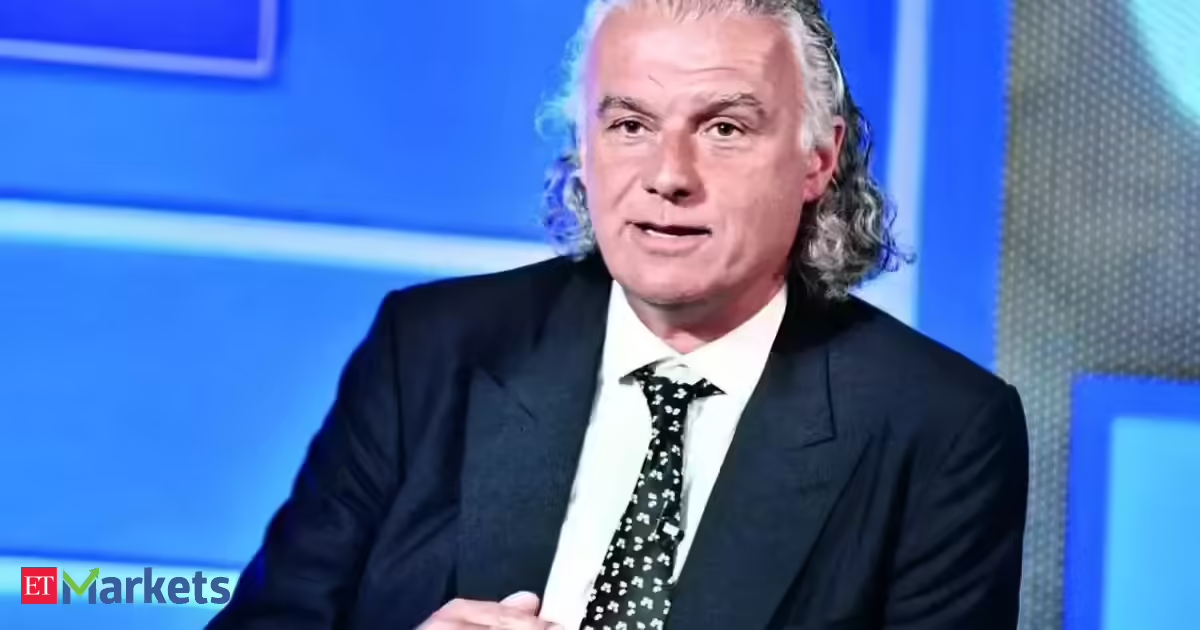
Speaking in an interview with ET Now, Wood said the flow of global news continues to be heavily influenced by political developments in the United States, but the AI sector remains the more compelling long-term narrative.
“Mr Trump continues to drive the news flow. But in the big picture Anthropic is the most interesting company to come out of this whole AI story. But the US defence sector getting involved does remind me of The Terminator movie. One of the great movies of all time, which is looking more and more prophetic. I am talking about the original Terminator,” Wood said.
The discussion around Anthropic has intensified recently amid speculation over regulatory scrutiny and geopolitical implications surrounding advanced AI development. While the concerns are still evolving, the broader conversation has quickly expanded into questions about whether the AI boom that propelled US technology stocks could face a reality check.
When asked whether the ongoing developments could challenge the dominant AI narrative that has powered US equities, Wood acknowledged that investors are beginning to question the massive spending spree by technology giants.

“Well, I think what has happened this year is that we have had a three-year AI capex race which was kicked off at the beginning of 2023 when the market suddenly focused on AI because of Microsoft’s purchase into ChatGPT,” Wood said.
He explained that the world’s largest technology companies — often referred to as hyperscalers — responded to the AI boom with an unprecedented surge in capital spending.“Then the hyperscalers responded with this huge capex binge which in my view was driven more by a negative driver than a positive one. Obviously, AI is a big opportunity, but the key thing the hyperscalers were responding to was the threat of disruption. And there is one thing these guys in Silicon Valley are obsessed with, it is disruption,” he said.
According to Wood, the scale of investment has become enormous. “This year they are projecting spending $620 billion, that is the four hyperscalers alone.”
He noted that the market has already started to question whether the heavy spending will translate into meaningful returns.
“Actually, we have started to see the market question the returns from the capex with the first quarter earning season. But the key word is start,” Wood said, adding that scrutiny is likely to intensify in the coming months.
Wood believes the bigger question investors must consider is whether the economics of AI will resemble those of the internet boom or something very different.
“The internet economy was about winner takes all. Once Google was search, Facebook are the best examples. All the extra revenue went to the bottom line. Whereas right now AI is looking more like the airline industry — capex intensive but not necessarily very profitable,” he said.
Another challenge, according to Wood, is the lack of a clear “killer application” for AI chatbots so far.
“So who is really making money out of these chat boxes? It is not really clear. What is the killer app of a chat box? So far, I would say the killer app of OpenAI is letting kids cheat on their homework but there is no real killer app,” he said.
However, he pointed out that monetisation appears more visible in enterprise markets.
“Where we see evidence of monetisation is in the corporate market and that is Anthropic, not OpenAI,” he said.
Anthropic has drawn significant attention in the technology ecosystem, particularly because it was founded by former OpenAI researchers and engineers. The company has increasingly positioned itself as a competitor in the generative AI space.
Wood said that talent migration within the industry has also been noteworthy.
“Anthropic is the most interesting company to have come out of this AI story so far and obviously the interesting point about Anthropic is they came out of OpenAI. So actually, most of the tech talent which built OpenAI has left OpenAI,” he said.
Wood added that if given a choice between the two companies from an investment perspective, his preference would be clear.
“If you ask me to invest in Anthropic or OpenAI, I am definitely investing in Anthropic,” he said.
Beyond individual companies, Wood also believes that the dominance of US equities in global markets may have already peaked. He noted that US stocks reached a record share of global market capitalisation late last year.
“To be precise, the US peaked at 67% of world stock market capitalisation measured by the MSCI All Country World Index in December 2024. In my view, that is the all-time peak,” he said.
According to him, that extraordinary share reflects the overwhelming dominance of large technology firms in global indices.
However, Wood cautioned that the massive AI spending could change the financial dynamics of these companies.
“A lot of money is going to be wasted. And they are going from free cash flow generating machines into very different businesses. They have exited their moats. They are all converging on the same area and I do not think they are all going to succeed in this endeavour,” he said.
Despite his broader concerns, Wood said that if he had to own one hyperscaler stock, his preference would be Alphabet.
While the AI debate has largely focused on technology stocks, Wood also warned that the biggest financial risks may lie elsewhere — particularly in private markets.
He explained that the software sector has already started to face pressure as investors question whether artificial intelligence could disrupt traditional software businesses.
“Conceptually the issue is now will AI eat software? Now, I am not an expert on this area but it kind of makes intuitive sense that AI could eat software,” he said.
Such a shift could have major implications for the private equity industry, which has heavily invested in software companies in recent years.
“The sector which private equity is most invested in is software and we are talking about leverage buyouts of software companies. Now doing an LBO on a software company is to me self-evidently risky,” Wood said.
He added that the growing private credit market has also become deeply intertwined with private equity financing.
“Seventy percent of private credit is funding private equity. So in reality private equity and private credit are joined at the hip and that is where we can get financial collateral damage from this AI story because this is actually the real bubble,” he said.
Interestingly, Wood does not believe the AI boom itself fits the definition of a classic financial bubble.
“AI is not a classic bubble because most of the capex has been funded by cash,” he said.
However, he noted that private credit has increasingly begun financing AI investments as well, potentially increasing systemic risks if sentiment turns.
“If that unwinds sharply, then that can cause a quicker unwind of the AI trade,” he said.
Wood also highlighted structural characteristics of the US equity market that could amplify volatility if investor sentiment shifts.
“There is a risk that the US stock market sells off more than the fundamentals warrant. The reason why that risk exists is that the US stock market is extremely retail driven, much more retail driven than the Indian stock market,” he said.
He added that passive investing has also grown significantly in the United States.
“I believe at least 50% of the market is passive, which means people are mindlessly buying stocks just because they are in a particular index and that means that everybody owns the same stocks,” he said.
Combined with algorithmic trading, this could accelerate market swings.
“In a panic it can unwind much more than warranted by the fundamentals,” Wood said.
While the AI narrative continues to dominate global markets, Wood believes the early signs of scepticism are beginning to emerge. Whether that evolves into a broader correction will depend largely on one key factor — whether the enormous spending on artificial intelligence ultimately produces meaningful financial returns.

Business
CG Oncology: Passing A Red Line For What I Would Call A Reasonable Valuation (Rating Downgrade)

CG Oncology: Passing A Red Line For What I Would Call A Reasonable Valuation (Rating Downgrade)

Netflix: Three Reasons To Expect An Earnings Beat
Does the Iran War herald nuclear momentum?
Week Ahead: It's Still Mostly About The War

Cairo maneuvers for de-escalation as Egypt’s private sector hits two-year low

Foxconn first-quarter revenue jumps 30% y/y


I focus on a rigorous fundamentals-foremost equity and credit research. I currently work as a financial advisor/planner, and do analysis in my free time. I have an undergrad in business administration, an MBA in finance, and currently am a doctoral candidate (a DBA with a concentration in Finance and Investment Management). My research style typically involves process-driven research, followed by blending several valuation models together to get a blended, 12 month price target. I enjoy utilizing full DCF analysis in conjunction with SOTP, peer/multiples analysis, and risk-adjusted approaches. I thoroughly enjoy reading filings, technical documentation relevant to the sector, and then translating that data into conclusions with actionable insights. I enjoy learning about the various sectors and companies I find myself researching, and always feel like there is something to learn. As a curious individual, equity and credit research is very fulfilling, and even fun!I always try to find 2-4 variables that drive value or hinder growth, stress test them, and then let fundamental evidence incorporated with book-value set my viewpoint for the research project. I enjoy the energy sector, commodities, tech, and financial sectors the most. I joined Seeking Alpha to share my thoughts with a wide audience. I originally started with sharing my analysis with a few of my friends who are also advisors and/or analysts. I am always open to a myriad of viewpoints, as I feel the most accurate viewpoints and research is made through a collection of great minds working together to figure something out. If you appreciate thorough research, and want to learn more about a company beyond just what is inside of their books, then I believe you will enjoy the research that I work on.
Analyst’s Disclosure: I/we have no stock, option or similar derivative position in any of the companies mentioned, but may initiate a beneficial Short position through short-selling of the stock, or purchase of put options or similar derivatives in ORR over the next 72 hours. I wrote this article myself, and it expresses my own opinions. I am not receiving compensation for it (other than from Seeking Alpha). I have no business relationship with any company whose stock is mentioned in this article.
The views expressed in this article are solely the author’s own and do not represent the opinions or recommendations of an SRO or broker-dealer. This article is for informational purposes only and does not constitute investment advice, a solicitation, or a recommendation to buy or sell any security. Readers should consult their own financial advisor before making investment decisions.
Investment Products:
Are NOT FDIC insured / not deposits of, or obligations of, any bank or financial institution / MAY be subject to investment risk, including possible loss of principal.
Additional Disclosure: Alternative and Long/Short Fund Strategies
Alternative investment strategies, including long/short equity funds, involve risks that differ from and may be greater than those associated with traditional long-only equity investments. These risks include but are not limited to: (1) Leverage risk – the use of leverage magnifies both gains and losses and may result in the loss of more than the original amount invested; (2) Short-selling risk – short positions expose the fund to theoretically unlimited losses if the securities sold short increase in value; (3) Liquidity risk – certain portfolio holdings, particularly international small-cap equities, may be difficult to sell at favorable prices during periods of market stress; (4) Foreign investment risk – investments in non-U.S. securities involve currency fluctuation, political instability, differing regulatory environments, and potentially less liquid markets; (5) Concentration risk – non-diversified funds may invest a larger percentage of assets in fewer issuers, increasing the impact of any single investment’s decline; (6) Counterparty risk – derivative instruments and short-sale arrangements are subject to the creditworthiness of counterparties; (7) Manager risk – the fund’s performance depends on the sub-adviser’s skill in implementing the strategy, and past performance of the manager’s other vehicles does not guarantee future results in this fund.
Investors should carefully consider the fund’s investment objectives, risks, charges, and expenses before investing. The prospectus and summary prospectus contain this and other important information and should be read carefully before investing. Shares of ETFs are bought and sold at market price (not NAV) and are not individually redeemable. Brokerage commissions will reduce returns. Market price returns may differ from NAV returns.
Seeking Alpha’s Disclosure: Past performance is no guarantee of future results. No recommendation or advice is being given as to whether any investment is suitable for a particular investor. Any views or opinions expressed above may not reflect those of Seeking Alpha as a whole. Seeking Alpha is not a licensed securities dealer, broker or US investment adviser or investment bank. Our analysts are third party authors that include both professional investors and individual investors who may not be licensed or certified by any institute or regulatory body.

Yara International: The Urea Price Shock Everyone Ignores


Focus on trying to piece together the big things (both at a macro and industry level) Twenty years in Asia (mainly China).
Analyst’s Disclosure: I/we have no stock, option or similar derivative position in any of the companies mentioned, and no plans to initiate any such positions within the next 72 hours. I wrote this article myself, and it expresses my own opinions. I am not receiving compensation for it (other than from Seeking Alpha). I have no business relationship with any company whose stock is mentioned in this article.
Seeking Alpha’s Disclosure: Past performance is no guarantee of future results. No recommendation or advice is being given as to whether any investment is suitable for a particular investor. Any views or opinions expressed above may not reflect those of Seeking Alpha as a whole. Seeking Alpha is not a licensed securities dealer, broker or US investment adviser or investment bank. Our analysts are third party authors that include both professional investors and individual investors who may not be licensed or certified by any institute or regulatory body.
Business
HDFC Defence Fund among 13 equity MFs that delivered over 4% returns last week. Check top 5

Of the 614 funds analysed, 576 posted positive returns, one remained flat, and 37 delivered negative returns.

Smithills Estate groundbreaking experiment involving trees and cows

CG Oncology: Passing A Red Line For What I Would Call A Reasonable Valuation (Rating Downgrade)

Fed Balance Sheet Expands as Treasury Buyback Adds Liquidity but Bull Run Lags


-

 NewsBeat3 days ago
Steven Gerrard disagrees with Gary Neville over ‘shock’ Chelsea and Arsenal claim | Football
-

 Business2 days ago
No Jackpot Winner and $194 Million Prize Rolls Over
-

 Fashion2 days ago
Weekend Open Thread: Spanx – Corporette.com
-
Entertainment6 days ago
Fans slam 'heartbreaking' Barbie Dream Fest convention debacle with 'cardboard cutout' experience
-

 Crypto World4 days ago
Gold Price Prediction: Worst Month in 17 Years fo Save Haven Rock
-

 Tech6 days ago
The Pixel 10a doesn’t have a camera bump, and it’s great
-
Crypto World5 days ago
Dems press CFTC, ethics board on prediction-market insider trades
-

 Tech6 days ago
Avatar Legends: The Fighting Game comes out in July and it looks pretty slick
-

 Business3 days ago
Login and Checkout Issues Spark Merchant Frustration
-

 Sports12 hours ago
India men’s 4x400m and mixed 4x100m relay teams register big progress | Other Sports News
-

 Tech6 days ago
Apple will hide your email address from apps and websites, but not cops
-

 Sports5 days ago
Tallest college basketball player ever, standing at 7-foot-9, entering transfer portal
-

 Tech5 days ago
EE TV is using AI to help you find something to watch
-

 Politics6 days ago
Should Trump Be Scared Strait?
-

 Tech5 days ago
Flipsnack and the shift toward motion-first business content with living visuals
-

 Tech7 days ago
Elon Musk’s last co-founder reportedly leaves xAI
-

 Fashion6 days ago
The Best Spring Trends of 2026
-

 Tech5 days ago
How to back up your iPhone & iPad to your Mac before something goes wrong
-
Crypto World6 days ago
Bitcoin’s Six-Month Losing Streak: What On-Chain Data Says About the Market’s Next Move
-
Tech5 days ago
Daily Deal: StackSkills Premium Annual Pass
You must be logged in to post a comment Login