Connect with us
DAPA Banner
DAPA Coin
DAPA
COIN PAYMENT ASSET
PRIVACY · BLOCKDAG · HOMOMORPHIC ENCRYPTION · RUST
ElGamal Encrypted MINE DAPA
🚫 GENESIS SOLD OUT
DAPAPAY COMING

Business

Global Market Today: Asian shares trade mixed; Brent climbs past $85

Published

on

Global Market Today: Asian shares trade mixed; Brent climbs past $85
Oil extended gains and Treasuries edged lower after the standoff between the US and Iran intensified, raising concern that supply disruptions will reignite inflation and strengthen the case for higher interest rates.

Brent climbed as much as 2.8% to $85.64 a barrel. The commodity had jumped 9.6% on Monday — its biggest gain since May 2020 — after President Donald Trump reinstated the US blockade of Iranian ships transiting the Strait of Hormuz and demanded a 20% reimbursement on all other cargo shipped through the waterway.

Treasuries slipped as traders saw a US interest-rate hike later this month as a coin toss, ahead of Tuesday’s US consumer price index data. Money markets priced in about 50% odds of a Federal Reserve hike in July as Governor Christopher Waller said officials may need to raise rates to tame price pressures. Gold and silver retreated.

Asian shares were mixed with MSCI’s gauge of regional equities fluctuating between small gains and losses. South Korean stocks were volatile, rising as much as 0.6% and dropping up to 2.8%. The chip sector remained in focus after SK Hynix Inc.’s American depositary shares fell 9.3% as an AI-fueled stock rout in South Korea spilled over into the US market. US equity-index futures also retreated.

Advertisement

The latest wave of attacks between the US and Iran dashed hopes for a near-term normalization of traffic through the Strait of Hormuz. The escalation adds another layer of uncertainty ahead of a pivotal week for markets, with earnings season kicking off alongside US inflation data and Fed Chair Kevin Warsh’s congressional testimony, both seen as key to the outlook for interest rates.


“The energy sector is once again in the limelight as the status of the Strait of Hormuz is driving price action in global markets,” said Ian Lyngen at BMO Capital Markets. “There is a growing sense that the situation is likely to get worse before it de-escalates.”
The flare-up comes as investors are increasingly questioning whether the enormous sums being poured into artificial intelligence will generate commensurate returns.An AI-fueled stock rout in South Korea on Monday spilled over into the US market, underscoring concerns that the boom has become overextended. The selloff on the Kospi index is the latest sign of how volatile the Korean market has become after the AI rally drove massive outperformance versus global peers.

“Uncertainty around the Middle East continues, but we think the AI wave is what will drive markets over the next few weeks, especially as earnings season kicks off,” said Sonu Varghese at Carson Group.

Investors are now turning their focus to US inflation data after Waller said policymakers may need to raise rates in the near term if underlying inflation continues to signal broad price pressures.

Treasury two-year yields, which are relatively sensitive to changes in Fed policy expectations, edged up one basis point to 4.29%, the highest since February 2025. The benchmark 10-year yield climbed to 4.63%, the highest since May.

Advertisement

The surge in short-term yields reflects growing expectations that the Fed will need to raise rates sooner to rein in price pressures from the rebound in global energy prices and signs of a resilient US economy.

In data due Tuesday, the consumer price index is expected to slow to 3.8% in the year through June, from 4.2% in May, according to a Bloomberg survey of economists. Warsh will also make his first appearance before Congress as Fed chair.

“If we get another hot reading on core inflation this week, then the FOMC will need to consider tightening monetary policy in the near term,” Waller said Monday, referring to the central bank’s rate-setting committee.

Advertisement
Continue Reading
Click to comment

You must be logged in to post a comment Login

Leave a Reply

Business

State govt invests extra $6m in new Binar Midland facility

Published

on

State govt invests extra $6m in new Binar Midland facility

Aboriginal youth organisation Binar Futures’ new sport, accommodation, medical, education and community hub in Midland has received a $6 million boost from the state government, bringing the total investment to $18 million.

Continue Reading

Business

Viral Social Security advice vs. reality: Why a Ramsey expert says there’s ‘no magic age’

Published

on

Viral Social Security advice vs. reality: Why a Ramsey expert says there's 'no magic age'

As anxiety mounts over the projected 2032 depletion of the Social Security Old-Age and Survivors Insurance (OASI) Trust Fund, a viral online trend is urging Americans to claim their retirement benefits as early as age 62.

But personal finance expert and Ramsey Solutions personality George Kamel is pushing back on the internet hysteria, telling Fox News Digital that the panic mirrors the “toilet paper rush during COVID,” and warning that filing early out of fear locks in a permanent “pay cut, not freedom.”

Advertisement

“These headlines are classic fearmongering, and they are not based in reality. There’s a lot of context left out,” Kamel said. “When you see, ‘Depletion 2032 [for] Social Security,’ it’s like the toilet paper rush during COVID. Everyone’s like, ‘I gotta go to the store and let’s clear the shelves, there’s not gonna be any left for me.’”

“The truth is, that fund was surplus from pre-funding for the baby boomer generation and to smooth out bumps along the way. So this does not mean Social Security is going to go away. A worst-case scenario is a 22% cut in monthly benefits. So that’s a far cry from it going to zero and bankrupting,” he continued.

OPINION: AMERICAN’S RETIREMENT SYSTEM IS BROKEN. TRUMP MAY HAVE FOUND A BOLD FIX

After the Social Security Administration released its 2026 Trustees Report which confirmed that the federal retirement safety net is less than seven years away from reserve depletion — financial advisor and author Suze Orman called early claiming “bad advice,” warning that it will lock retirees into a permanent 30% reduction in monthly benefits that cannot be undone.

Advertisement
Woman holds sign at Social Security headquarters

A woman holds a sign in support of Social Security Administration workers on Security Boulevard in front of the agency’s headquarters in Woodlawn, Maryland. (Getty Images)

Kamel agreed with the emotional danger of claiming Social Security early, but he critiqued the rigid “always-wait” rule.

“She’s right that there is a lot of emotion here, and fear is a bad reason to go grab it at 62. Now, where we might disagree is that you should always wait… There’s a lot of factors that come into play of deciding when to take Social Security. And it really depends on your life, your health, your income, your family situation,” he explained.

“You’re better off talking to a doctor than looking at a government chart at average life expectancies to make this choice,” he added. “So there is no magic age, it’s not always 62, it’s not always 70. That’s a headline, not a plan.”

Breaking down the math even further, Kamel argued that the government treats your full retirement age at 67 as the 100% baseline benefit. Claiming five years early, at 62, forces you to accept a permanent 30% pay cut for the rest of your life. However, if you delay claiming until age 70, the system rewards your patience with a permanent 24% increase in benefits.

“The truth is, if you need to take it at 62, you probably aren’t doing great with your retirement overall. And if you can wait till 70, you likely didn’t really need it in the first place. So it’s kind of a catch-22 even making this decision, but it is personal,” he said. “And the math assumes that $1 at 95 is the same as $1 at 65, and that you live long enough. And that’s just not the case.”

“I’m not a fan of relying on a government program to fund your life forever. That’s a scary thought,” Kamel added. “And so early claiming is not control. It’s really just a 30% smaller check forever. So it’s a pay cut, it’s not freedom.”

“You reap what you sow. That’s the fact of the matter. So if you plant corn, you’re gonna have some corn at the end of this road. And if you don’t plant anything, don’t be surprised when you’re trying to make it off of a Social Security check.”

– George Kamel

Advertisement

As the 2032 insolvency deadline approaches, many Americans assume a worst-case scenario is inevitable if gridlock continues in Washington. But Kamel said the panic overlooks how the federal government has handled similar fiscal cliffs in the past. Rather than letting the system go bankrupt, he predicts Capitol Hill will pull from its old playbook.

“Seventy million Americans rely on a Social Security payment coming in. And so when you think about that… they’re gonna vote with their wallet. So the chances of any politician deciding to cut this down is going to cost them big time,” he said. “What will likely happen is what happened in 1983… The trust fund is running out and they made several small tweaks, not one sweeping change, in order to help this out.”

“I think the same thing will be true – they might adjust the cost of living adjustment. They might change the full retirement age from 67 to 68 or 69. They might increase the payroll taxes from 6.2% to 6.5%. And so these incremental changes can help it. I don’t see a world where, in 2032, we’re all going, ‘Where’s our money? We’re all gonna retire broke.’”

GET FOX BUSINESS ON THE GO BY CLICKING HERE

Ultimately, Kamel emphasizes that true financial peace doesn’t come from trying to outsmart a shifting government timeline. Instead of obsessing over what Washington will do to the safety net, he argued that the smartest move Americans can make is to shift their focus entirely to what they can control in their own households.

“You are your best shot at a great retirement. It’s not the government’s job, it’s not Washington’s job, it’s not a headline, it’s not a trust fund date. You control the controllables, and one of those things is creating your own nest egg… There is hope out there. But it’s not in the hands of [the] White House, it’s in yours.”

READ MORE FROM FOX BUSINESS

Advertisement
Continue Reading

Business

Bank of England governor warns on Iran conflict risks to stability

Published

on


Bank of England governor warns on Iran conflict risks to stability

Continue Reading

Business

WA energy flexibility platform Gridcog raises $14m

Published

on

WA energy flexibility platform Gridcog raises $14m

A WA-founded firm developing software that can model the most effective use of energy assets has secured US$10 million ($14.4 million) in a Series A investment round to expand its software services globally.

Continue Reading

Business

‘We Must Act Now’: Eric Schmidt, Reid Hoffman, Joseph Stiglitz among 200 who just sounded an alarm on AI

Published

on

'We Must Act Now': Eric Schmidt, Reid Hoffman, Joseph Stiglitz among 200 who just sounded an alarm on AI
More than 200 economists, tech bosses and researchers from across the globe have put their names on a short, sharply worded open letter cautioning that artificial intelligence is on track to shake up the job market in a big way, and that governments are lagging behind. Organised by the Stanford Digital Economy Lab, the letter is titled “We Must Act Now,” with the subtitle “A Statement on AI’s Transformation of the Economy.” It runs to just 88 words, and every one of them appears to have been chosen with care.

Also Read: US job cuts: Moody’s chief economist Mark Zandi sees ‘big warning’ signs in June data. Here’s why he’s worried about the labour market

That brevity is exactly what makes the letter stand out. Getting rival camps, the people building AI and the economists who study what AI might break, to agree on anything is rare. Getting them to agree in under 100 words is rarer still. That’s the real story here: not just what the letter says, but who is standing behind it.

The Guest List Reads Like A Tech-Economics Power Summit

Scroll through the signatories and a few names jump out immediately. Former Google chief Eric Schmidt is on there. So is LinkedIn co-founder Reid Hoffman. Three Nobel laureates — Joseph Stiglitz, Daron Acemoglu and Simon Johnson — have added their signatures too. From inside the AI industry itself come Google AI lead Jeff Dean, Anthropic co-founder Jack Clark and OpenAI’s finance chief Sarah Friar. Even the so-called “Godfathers of AI,” Yoshua Bengio and Yann LeCun, along with venture capitalist Vinod Khosla, are named.

Advertisement

Put simply, this isn’t a letter from AI skeptics on the outside looking in. Several of the people who signed it are the very ones building the technology being warned about.

So What Does The Letter Actually Say?

Strip away the drama, and the message is fairly simple: AI is going to get a lot more powerful over the next decade, and if policymakers don’t get moving, a lot of people could lose their jobs. Here is the letter, word for word:
‘We Must Act Now’
A Statement on AI’s Transformation of the Economy
AI may become radically more powerful over the next 10 years.

This could drive an unprecedented transformation of our economy, larger than the Industrial Revolution, but unfolding over a vastly shorter time frame. It could bring risks, including large-scale job displacement, as well as opportunities such as major gains in living standards.

Economists, policymakers and technology leaders must act now to understand the economics of transformative AI and to build the incentives, guardrails, and institutions needed to steer AI in a direction that complements humans and benefits society.

Advertisement

Not Everyone Agrees On How Bad It’ll Get

The letter lands at a moment when opinions on AI and jobs are all over the map. Anthropic CEO Dario Amodei has gone further than most, predicting that AI could wipe out as much as half of all entry-level white-collar jobs within five years. Not everyone shares that level of alarm, many economists and technologists land somewhere in the middle, arguing that AI is more likely to reshape jobs than erase them completely.

Either way, the message from this unusually broad coalition of signatories is the same: the clock is running, and the guardrails aren’t built yet.

Continue Reading

Business

Biocon shares jump 6% as Mylan likely exits drugmaker after Rs 3,481 crore stake sale

Published

on

Biocon shares jump 6% as Mylan likely exits drugmaker after Rs 3,481 crore stake sale
Shares of Biocon jumped more than 6% on Tuesday, on track to record the sharpest single day surge in 18 months, as Viatris-owned Mylan is set to sell up to 9.2 crore shares worth up to Rs 3,481 crore, exiting the Indian drugmaker.

Biocon shares jumped more than 6% to trade at Rs 436.15 apiece on Tuesday. If the stock manages to hold on to the gains till the end of the session, then today would mark its best day since January, 2025.

Mylan, which is part of global healthcare company Viatris, planned to sell the stake which represents 5.64% of Biocon’s outstanding shares, according to a term sheet as per a Reuters report. The floor price of the offer was fixed at Rs 378.50 per share, implying a discount of nearly 8% to Biocon’s previous closing price of Rs 410.95 per share. The report added that Citigroup Global Markets India and Jefferies India were the joint bookrunners and brokers for the deal.

Meanwhile, around 4.4 crore shares, or 2.7% equity, changed hands in a block deal in the early trading hours, followed by another block deal that saw 4.6 crore shares change hands, ET Now reported. This brings the total number of shares which were traded in block deals to nearly 9 crore, nearly matching what Mylan was expected to sell, although the seller in the block deals that took place in the morning is yet to be ascertained.

Advertisement

Also Read | Mylan to sell up to $363 million stake in India’s Biocon, term sheet shows

Biocon shareholding pattern

Mylan held 5.64% stake in Biocon at the end of the financial year 2026, according to data on the company’s shareholding pattern available on NSE. Promoter Kiran Mazumdar Shaw held around 30% stake, while Glentec International held around 15% stake.


Around 39 mutual funds held over 15% stake in the company, while insurance companies held more than 6% stake. Nearly 3.74 lakh retail shareholders meanwhile owned 6% stake in the company, as of March 31, 2026.

Biocon share price

Biocon shares sharply jumped more than 6% on Tuesday to trade at Rs 436.15 apiece on NSE, the highest level seen since May 29 this year. The shares of the company have jumped around 7% in one week and 4% in one month.
The shares of the drugmaker have gained around 12% in 2026 so far. In the longer term, Biocon shares have delivered 14% returns over one year, 66% returns over three years and 9% returns over five years.Also Read | Sensex falls 500 points, Nifty slips below 24,100 as US-Iran conflict escalates. What lies ahead?

(Disclaimer: Recommendations, suggestions, views and opinions given by the experts are their own. These do not represent the views of The Economic Times)

Advertisement
Continue Reading

Business

How long-awaited new Birkenhead market could look

Published

on

Business Live

Historic shopping destination set to move to former TJ Hughes site

How the new Birkenhead Market could look.

How the new Birkenhead Market could look(Image: BDP)

Plans for how the new Birkenhead Market in the Pyramids Shopping Centre could look, have been submitted to Wirral Council. The historic 19th century market is set to move to the former TJ Hughes store.

Advertisement

After a period of uncertainty surrounding the market’s future location, the council this week announced that work at the TJ Hughes site is set to begin. Some market traders are now preparing to make the move over to the new site, which is expected to take place before the end of the year.

A planning application has been launched, on behalf of the council, for changes to the exterior of the former TJ Hughes site. Plans explain the main entrance to the new market will be from the north, on Borough Pavement, where a new glazed sliding double door is set to be introduced. The new-look entrance will have a “neutral and contemporary material palette.”

A second entrance is expected to be formed in between the main entrance and the CEX unit next door. Plans say the shopfront with be ‘upgraded’ in the process of the works.

Planning permission is only sought for the external changes to the site. Submitted plans explain the internal alterations do not require planning permission.

Advertisement

Celebrating the news that work is set to begin on the new market, the leader of Wirral Council, Cllr Paula Basnett said: “This marks the start of an exciting new chapter for Birkenhead Market, and for the town centre as a whole. A huge amount of work has been going on behind the scenes to get to this stage. I’m incredibly pleased that people will soon start to see a real transformation getting underway at the former TJ Hughes site to create the town’s new market.

“Birkenhead Market’s greatest strength has always been the people who make it what it is, and despite the challenges of recent years our traders have continued to serve customers and champion the market. Their partnership and commitment has been instrumental in bringing us to this point and will continue to be vital as we create a market fit for the future. This is fantastic for Birkenhead, for traders and for local people, and will be placing the Market at the heart of the town centre where it should be.”

To find all the planning applications, traffic diversions, road layout changes, alcohol licence applications and more in your community, visit the Public Notices Portal.

Advertisement
Continue Reading

Business

Cumins set to retire as Cashies director

Published

on

Cumins set to retire as Cashies director

Longstanding Cash Converters International executive Peter Cumins has announced he will retire as a director of the company next year.

Continue Reading

Business

FirstEnergy: Cheap And With Potential To Grow (NYSE:FE)

Published

on

FirstEnergy: Cheap And With Potential To Grow (NYSE:FE)

This article was written by

Daniel is an avid and active professional investor.
He runs Crude Value Insights, a value-oriented newsletter aimed at analyzing the cash flows and assessing the value of companies in the oil and gas space. His primary focus is on finding businesses that are trading at a significant discount to their intrinsic value by employing a combination of Benjamin Graham’s investment philosophy and a contrarian approach to the market and the securities therein. Learn more.

Analyst’s Disclosure: I/we have no stock, option or similar derivative position in any of the companies mentioned, and no plans to initiate any such positions within the next 72 hours. I wrote this article myself, and it expresses my own opinions. I am not receiving compensation for it (other than from Seeking Alpha). I have no business relationship with any company whose stock is mentioned in this article.

Seeking Alpha’s Disclosure: Past performance is no guarantee of future results. No recommendation or advice is being given as to whether any investment is suitable for a particular investor. Any views or opinions expressed above may not reflect those of Seeking Alpha as a whole. Seeking Alpha is not a licensed securities dealer, broker or US investment adviser or investment bank. Our analysts are third party authors that include both professional investors and individual investors who may not be licensed or certified by any institute or regulatory body.

Advertisement
Continue Reading

Business

Bank earnings live updates: JPM, BofA, Citi, Goldman

Published

on

Bank earnings live updates: JPM, BofA, Citi, Goldman

Here’s what analysts are expecting from Wells Fargo

Wells Fargo & Company Chairman and CEO Charlie Scharf is interviewed during an Economic Club of Washington luncheon at the Westin hotel on April 20, 2026 in Washington, DC.

Chip Somodevilla | Getty Images

Wells Fargo, led by CEO Charlie Scharf, is scheduled to report second-quarter earnings before the opening bell Tuesday.

Analysts are looking for signs of business momentum after the Federal Reserve lifted a balance sheet restriction on the bank last year.

Advertisement

Here’s what Wall Street expects:

  • Earnings per share: $1.72, according to LSEG
  • Revenue: $21.84 billion, according to LSEG
  • Net interest income: $12.39 billion, according to StreetAccount
  • Provision for credit losses: $1.2 billion, according to StreetAccount

Company executives will hold a conference call with analysts at 10 a.m. ET.

— Hugh Son

Wall Street’s longest running saga: The race to succeed JPMorgan CEO Jamie Dimon

Co-CEOs of Commercial & Investment Bank at JPMorganChase, Troy Rohrbaugh and Douglas Petno.

Courtesy: JPMorganChase

Advertisement

This will be the first chance that analysts have to directly ask JPMorgan CEO Jamie Dimon questions about succession planning after the sudden exit of Marianne Lake, who had been considered a top candidate.

As CNBC and others reported last month, Dimon expects to remain CEO for roughly three more years, though that timeline could change, according to two people with knowledge of his thinking. After that, he’ll spend some time as chairman.

Since Dimon has spent more than a decade saying that retirement was five years away, analysts will want to quiz him on how he’s thinking about the issue.

Meanwhile, Doug Petno and Troy Rohrbaugh, who have jointly led the bank’s commercial and investment banking division since early 2024, are now the top contenders to succeed Dimon.

Advertisement

They were made co-presidents and were each awarded $30 million retention bonuses last month.

— Hugh Son

Here’s what analysts are expecting from JPMorgan

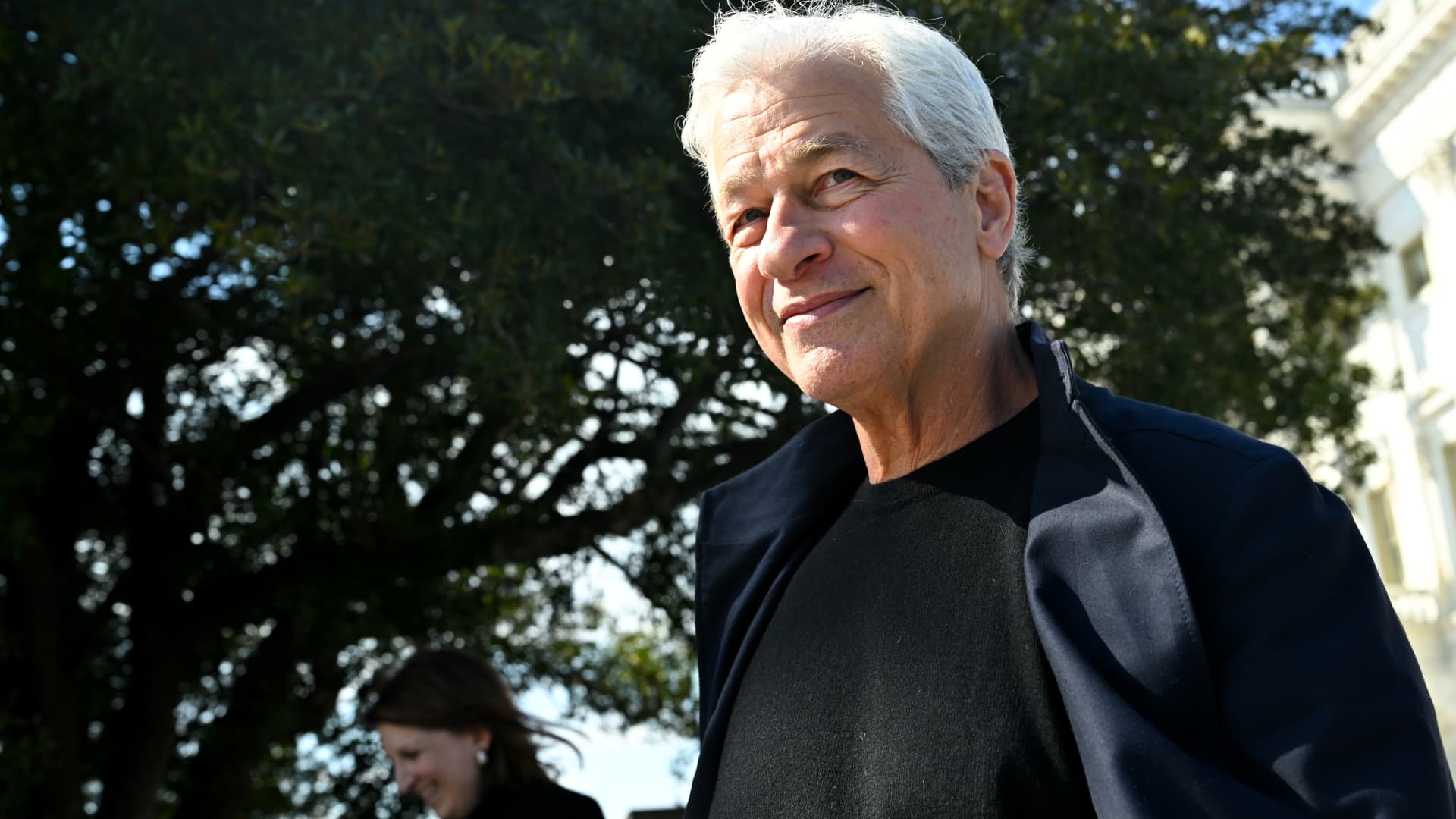
Jamie Dimon, CEO of JPMorgan Chase, departs the Capitol in Washington, Feb. 25, 2026.

Graeme Sloan | Bloomberg | Getty Images

Advertisement

JPMorgan Chase is scheduled to report second-quarter earnings before the opening bell Tuesday.

JPMorgan, led by longtime CEO Jamie Dimon, is the biggest U.S. bank by assets and the largest in the world by market capitalization.

Here’s what Wall Street expects:

  • Earnings per share: $5.78, according to LSEG
  • Revenue: $50.19 billion, according to LSEG
  • Investment banking fees: $2.82 billion, according to StreetAccount
  • Trading revenue: Fixed income of $6.22 billion, equities of $3.89 billion, according to StreetAccount

Company executives will hold a conference call with analysts at 8:30 a.m. ET.

— Hugh Son

Advertisement

Five megabanks posting earnings on the same day? ‘It’s never happened before’

(L-R) Charles Scharf, CEO and President of Wells Fargo and Company; Brian Thomas Moynihan, Chairman and CEO of Bank of America; Jamie Dimon, Chairman and CEO of JPMorgan Chase; Jane Fraser, CEO of Citigroup; Ronald O’Hanley, CEO of State Street; Robin Vince, CEO of BNY Mellon; David Solomon, CEO of Goldman Sachs; and James Gorman, CEO of Morgan Stanley, testify during a Senate Banking Committee hearing at the Hart Senate Office Building on December 06, 2023 in Washington, DC.

Win Mcnamee | Getty Images

For more than four decades, Portales Partners analyst Charles Peabody has covered bank earnings.

In all that time, there’s never been a bank earnings day as crowded as today, he said.

Advertisement

Oftentimes, JPMorgan, Citigroup and Wells Fargo will report on the first day of earnings week, followed by Bank of America, Goldman Sachs and Morgan Stanley on subsequent days, he said.

His theory: Banks are rushing to disclose robust earnings.

“It’s never happened before,” Peabody told CNBC. “You’re assuming there’s going to be really good news out of those banks” that pushed their earnings dates ahead.

Still, it doesn’t make the job of covering banks any easier.

Advertisement

“You’re not going to get a lot of deep analysis on Day 1,” Peabody said. “We’ll need more time.”

— Hugh Son

Continue Reading

Trending

Copyright © 2025