

Business
Growth Broadens As Markets Look Beyond Geopolitics




Form PRE 14A REPLIMUNE GROUP For: 13 July

Back To Square One: Strait Of Hormuz Closes Again


Some tickers are covered more than others on the site, so with The Undercovered Dozen our Editors highlight twelve actionable investment ideas on tickers with less coverage. These ideas can range from “boring” large caps to promising up-and-coming small caps. Specifically, the inclusion criteria for “undercovered” include: market cap greater than $100 million, more than 800 symbol page views in the last 90 days on Seeking Alpha, and fewer than two articles published in the past 30 days. Follow this account to receive a weekly review of twelve of these undercovered ideas from our valued analysts.
Analyst’s Disclosure: I/we have no stock, option or similar derivative position in any of the companies mentioned, and no plans to initiate any such positions within the next 72 hours. I wrote this article myself, and it expresses my own opinions. I am not receiving compensation for it. I have no business relationship with any company whose stock is mentioned in this article.
Seeking Alpha’s Disclosure: Past performance is no guarantee of future results. No recommendation or advice is being given that any particular security, portfolio, transaction or investment strategy is suitable for any specific person. The author is not advising you personally concerning the nature, potential, value or suitability of any particular security or other matter. You alone are solely responsible for determining whether any investment, security or strategy, or any product or service, is appropriate or suitable for you based on your investment objectives and personal and financial situation. The author is an employee of Seeking Alpha. Any views or opinions expressed herein may not reflect those of Seeking Alpha as a whole. Seeking Alpha is not a licensed securities dealer, broker or US investment adviser or investment bank.

Nokia: Why I'm Holding, Not Chasing, At The Highs

Thomson Reuters to cut ’small number’ of engineering jobs


Scott Kaufman, aka Treading Softly, learned about investing firsthand from over a decade of financial sector experience. He is the lead analyst for Dividend Kings providing actionable insight into high quality dividend growing and undervalued opportunities. His focus is to see a bountiful harvest of cash dividends and strong capital gains, providing a robust total return.
Analyst’s Disclosure: I/we have a beneficial long position in the shares of SPE either through stock ownership, options, or other derivatives. I wrote this article myself, and it expresses my own opinions. I am not receiving compensation for it (other than from Seeking Alpha). I have no business relationship with any company whose stock is mentioned in this article.
Kody’s Dividends, Justin Law, and Rachel Kaufman are part of the Dividend Kings team
Seeking Alpha’s Disclosure: Past performance is no guarantee of future results. No recommendation or advice is being given as to whether any investment is suitable for a particular investor. Any views or opinions expressed above may not reflect those of Seeking Alpha as a whole. Seeking Alpha is not a licensed securities dealer, broker or US investment adviser or investment bank. Our analysts are third party authors that include both professional investors and individual investors who may not be licensed or certified by any institute or regulatory body.
NEW YORK — SK Hynix’s American depositary receipts fell about 9 percent Monday following a strong debut on the Nasdaq, as investors booked profits after the South Korean chipmaker’s record $26.5 billion U.S. listing and broader concerns weighed on artificial intelligence-related semiconductor shares.
The pullback came one trading day after the ADRs surged more than 12 percent in their first session. SK Hynix, a leading supplier of high-bandwidth memory chips crucial for AI systems, raised funds through the offering to expand production capacity amid surging demand from companies like Nvidia.
In Seoul, the company’s underlying shares plunged more than 15 percent, contributing to a sharp decline in the KOSPI index that triggered a brief trading halt. The drop marked one of the largest one-day percentage declines for the stock in nearly two decades, reflecting profit-taking after a multi-year rally fueled by the AI boom.
U.S.-listed peers also weakened. Micron Technology fell around 5 percent, SanDisk dropped 6 percent and Seagate Technology declined 4 percent. AMD and Intel each lost 3 to 4 percent. The Philadelphia Semiconductor Index slipped amid the sector rotation.
The S&P 500 declined 0.3 percent, while the Nasdaq Composite fell 0.9 percent. The Dow Jones Industrial Average bucked the trend, rising 88 points or 0.2 percent, supported by relative strength in non-tech sectors.
Market participants pointed to several factors behind the sell-off. Profit-taking after SK Hynix’s blockbuster debut played a central role, as the ADRs traded at a premium to the Seoul shares. Geopolitical risks in the Middle East, including renewed U.S.-Iran tensions and disruptions in the Strait of Hormuz, added caution, pushing oil prices higher and prompting some risk-off sentiment.
Analysts emphasized that the moves represent a healthy digestion of recent gains rather than a fundamental shift away from AI investments. Mohamed El-Erian, chief economic adviser at Allianz, told CNBC that markets view the Middle East conflict as likely to remain contained. “The market is assuming that this clash will remain localized,” he said, noting that neither the U.S. nor Iran appears interested in full-scale war.
Attention is shifting rapidly to the start of earnings season this week. Major banks including JPMorgan Chase, Goldman Sachs, Morgan Stanley, Bank of America, Citigroup and Wells Fargo are among the first to report, followed by technology and industrial names such as Netflix, Johnson & Johnson and UnitedHealth Group.
FactSet projects S&P 500 companies will post average second-quarter earnings growth of more than 23 percent year-over-year. Investors will scrutinize guidance on AI capital spending, as big technology firms continue pouring resources into data centers and related infrastructure.
Larry Adam, chief investment officer at Raymond James, expressed optimism about sustained AI momentum. He noted that capital expenditures in the sector are expected to keep expanding through 2028, driven by tangible results from AI adoption across industries. “AI-related mentions in S&P 500 earnings calls hit a record high, up 98 percent from last year,” he added.
SK Hynix’s dominant position in high-bandwidth memory gives it a leading share of the market for chips used in AI training and inference. The company has been ramping up production of advanced HBM3E and preparing for HBM4, benefiting from demand tied to hyperscalers and AI model development.
The U.S. listing provides broader access for American investors and enhances liquidity. The ADRs, representing one-tenth of a common share, closed Friday at $168 after opening at $170. They traded at a premium to the Korean shares, a common dynamic for cross-listed companies that offers U.S. investors direct exposure without some of the foreign market frictions.
Despite Monday’s declines, analysts remain constructive on the long-term outlook for SK Hynix and the AI semiconductor sector. The company’s market value had tripled in the past year before the listing, reflecting explosive growth in memory pricing and volumes.
Broader market dynamics show resilience. While technology shares faced pressure, the Dow’s modest gain highlighted diversification benefits. Energy stocks advanced on higher oil prices, with West Texas Intermediate crude settling around $73.68 per barrel after earlier climbing above $75.
Brent crude traded near $78.48. The energy uptick provided a buffer against tech weakness but raised questions about potential pass-through effects on inflation and consumer spending.
Federal Reserve developments also loomed in the background. Recent policy signals have kept rate expectations in focus, though easing pressures from cooling inflation could support equities if economic data remains solid.
For SK Hynix specifically, the listing marks a milestone as one of the largest U.S. share sales by a foreign company. It follows strong performance by other memory and storage names but comes amid some valuation concerns after the sector’s rapid run-up.
Company executives have highlighted long-term structural demand for AI memory, with shortages expected to persist. The fresh capital will fund factory expansions and technology advancements, positioning SK Hynix to maintain its competitive edge against rivals like Samsung Electronics and Micron.
Samsung shares also declined Monday, though less sharply than SK Hynix. The two firms dominate global memory production, and their performance often moves in tandem with broader semiconductor cycles.
In South Korea, the government has signaled support for chip industry investments, including incentives for new fabrication facilities. Such measures aim to bolster the nation’s position in the global AI supply chain.
U.S. investors will monitor SK Hynix’s ADR performance as regular trading under the SKHY ticker continues. The premium between ADRs and underlying shares may narrow over time as arbitrage opportunities emerge and liquidity increases.
The episode illustrates the volatility inherent in high-growth tech sectors. While profit-taking is common after major listings, sustained AI demand underpins confidence among long-term holders.
As earnings season unfolds, updates from big technology companies on their AI infrastructure spending will likely set the tone for semiconductor stocks. Analysts expect continued robust capex, with many firms guiding higher for the year.
SK Hynix’s debut and subsequent trading provide a case study in cross-border listings amid geopolitical and macroeconomic crosscurrents. The company’s ability to navigate these factors while delivering on AI growth will determine its trajectory in coming quarters.
Broader indices remain near highs, supported by resilient corporate profits and expectations of eventual monetary policy support. The Dow’s outperformance Monday underscores that not all segments are moving in lockstep with technology.
For now, the market appears to be pausing for breath in AI chips after an intense rally, with focus turning to fundamentals in earnings reports. SK Hynix and its peers will be closely watched as barometers for the sector’s health.
Business
US stocks today: US stocks end lower as Iran tensions dampen risk appetite; chipmakers drop
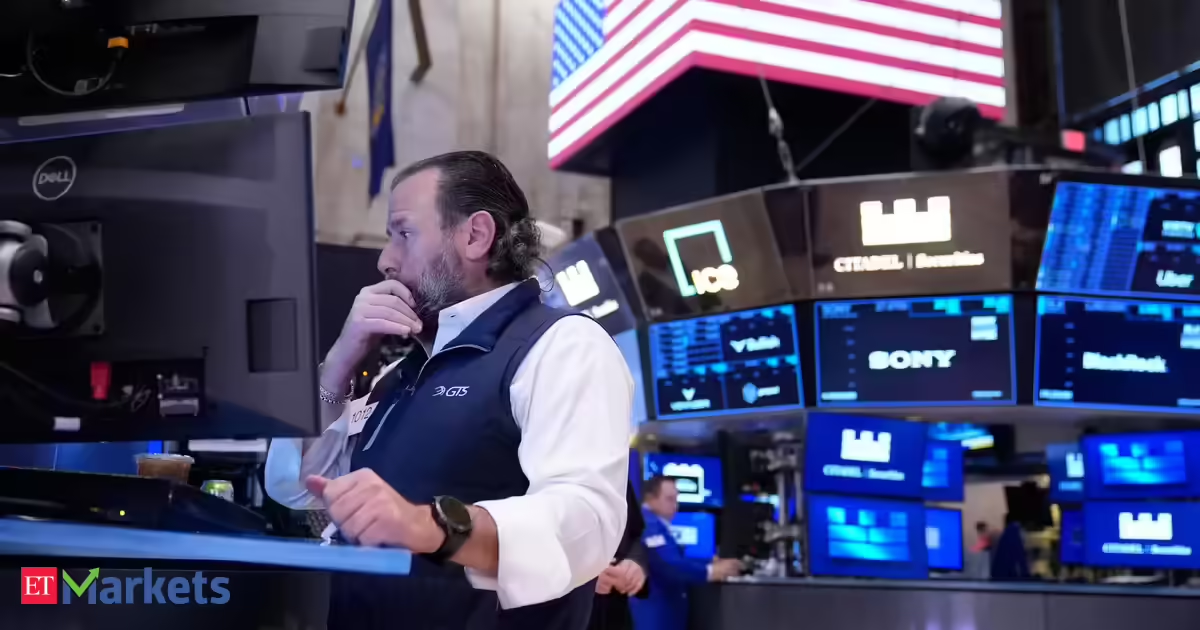
Investors are now bracing for a packed week of earnings, economic data and congressional testimony from U.S. Federal Reserve Chair Kevin Warsh. Among the three major indexes, the tech-heavy Nasdaq led losses, followed by the S&P 500, while the Dow’s decline was cushioned by gains in energy stocks tracking the surge in crude prices due to restricted traffic through the Strait of Hormuz.
“Stocks really reached a high at the very end of May, driven mainly by semiconductors,” said Thomas Martin, senior portfolio manager at GLOBALT in Atlanta. “When you move something this far, this fast, you invite the question of how sustainable it is. If the market were cheap, it would be one thing. Now there is less cushion and a lot of unknowns.”
Amid sustained AI-driven momentum in recent months, chip stocks have led both rallies and selloffs. The Philadelphia Semiconductor index underperformed sharply, with SanDisk, Marvell Technology and Western Digital posting steep losses. U.S.-listed shares of South Korean chipmaker SK Hynix also declined after rising more than 12% during their Nasdaq debut on Friday.
Over the weekend, the U.S. and Iran exchanged heavy airstrikes, significantly escalating tensions and prompting Trump to revive the blockade on Iranian ports. The development raised concerns over stalled peace negotiations and pushed crude prices up 9.4%, fuelling fears that supply disruptions could translate into persistent inflationary pressures.

Warsh is scheduled to deliver his first semiannual testimony before Congress on Tuesday and Wednesday, where he is expected to address the inflationary implications of the conflict and outline the Fed’s policy outlook. Markets are currently pricing in at least one 25 basis point rate hike by the end of the year, according to LSEG data.
Key economic data due this week includes the consumer price index and producer price index from the Labor Department, which will provide insight into inflation trends in June amid geopolitical volatility. The Commerce Department’s retail sales data will also offer clues on consumer resilience, given that consumption accounts for roughly 70% of the U.S. economy.According to preliminary data, the S&P 500 fell 60.21 points, or 0.79%, to close at 7,515.18. The Nasdaq Composite dropped 408.83 points, or 1.56%, to 25,872.77, while the Dow Jones Industrial Average declined 129.16 points, or 0.25%, to 52,507.85.
Major U.S. banks including Bank of America, Citigroup, Goldman Sachs, JPMorgan Chase and Wells Fargo are set to report quarterly earnings on Tuesday, marking the unofficial start of the second-quarter earnings season.
“I wonder if the market will start to push back against the surge in corporate issuance to fund AI capex, which has been under scrutiny for some time,” said Ross Mayfield, investment strategy analyst at Baird. “It will be important to see how banks position themselves in corporate bonds and fixed income.”
Analysts currently expect aggregate second-quarter earnings growth for the S&P 500 at 23.7% year-on-year, up from 19.2% estimated at the start of April, according to LSEG.

Gary Yeowell/DigitalVision via Getty Images

Chimera Investment Corporation (CIM) has three preferred shares we will be discussing. Instead of buying one preferred share and holding it indefinitely, we monitor relative valuations to identify opportunities to swap between preferred shares. We will be going over current valuations and then our trade history for a good example of how we implement that strategy in practice.
Preferred Shares
CIM-B (CIM.PR.B) is currently in the buy range and CIM-D (CIM.PR.D) is currently in our hold range. CIM-C (CIM.PR.C) is in our hold range and would only need to fall below $22.67 to be in our buy range.
The REIT Forum

One of the biggest advantages of investing in preferred shares is that investors don’t need to take on the risks from the common stock to get an attractive yield. Sometimes the best opportunities come from recognizing when a preferred share is trading at an attractive valuation.
For a long time now, Chimera’s preferred shares have provided an excellent opportunity and example of how we use relative valuations to trade in and out of positions. The chart below highlights those trades.
Seeking Alpha
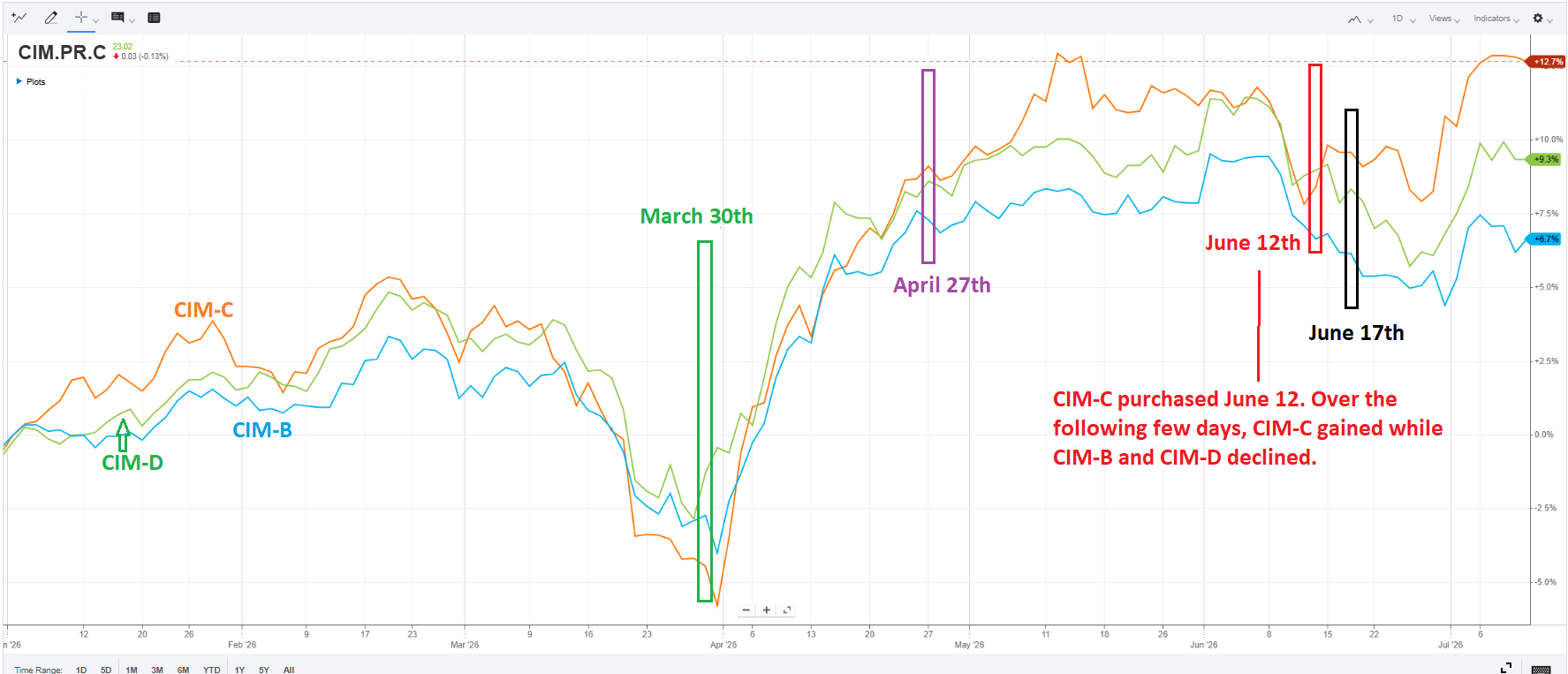
The following sections will walk readers through our decision-making process on these dates.
March 30, 2026, Buying CIM-C
Back in late March, we believe CIM-C became a great opportunity because it had materially underperformed most of the other mortgage REIT floating-rate preferred shares. That includes the other Chimera’s preferred shares as you can see in the chart above.
At the time, this was the difference in yield:
- CIM-C offered a stripped yield of just over 11%.
- CIM-B offered a stripped yield of 10.98%.
- CIM-D offered a stripped yield of 10.71%.
Looking at those prices, my thought was pretty simple: I bet other investors will bid more for these in the future. That doesn’t require Chimera to suddenly become a better company. It simply requires a valuation gap between very similar securities to shrink.
While we waited, investors were collecting an attractive dividend rate.
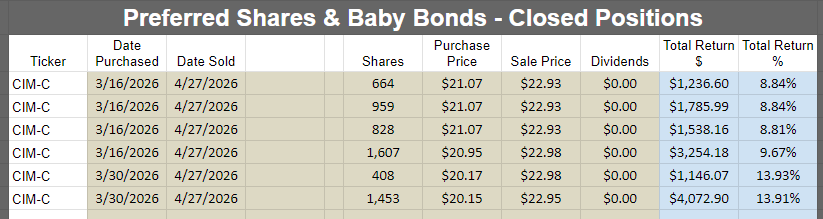
April 27, 2026, Harvesting The Gains
Over the following month, that trade worked extremely well.
CIM-C rallied sharply and thoroughly outperformed the comparable preferred shares. As the valuation gap narrowed, the original investment thesis played out.
We decided to harvest the gains.
We weren’t selling because we suddenly disliked Chimera. We weren’t reacting to negative news. We simply recognized that CIM-C had delivered the outperformance we expected.
One of the key values our service provides is the research to help investors find opportunities to swap between similar preferred shares. This was a great example of how we utilize our strategy focusing on relative valuations instead of becoming emotionally attached to a particular ticker.
The REIT Forum
June 12, 2026, Another Opportunity
Less than two months later, another opportunity developed. Chimera’s preferred shares sold off rapidly over the course of a week. They weren’t even on my radar as potential buys the week before because they had been performing quite well.
Then they tanked.
Whenever I see a move like that, the first thing I want to know is whether the fundamentals changed. I double-checked Chimera’s common stock to see if there had been a major negative shift in investor perception.
Nothing.
The common shares were actually trading higher than they had been a week earlier. The preferred share scenario looked like sellers simply outnumbered buyers and prices declined in response.
Great.
Those are exactly the kinds of situations we like to investigate. After reviewing the fundamentals, I was comfortable purchasing both CIM-B and CIM-C because they had fallen back into attractive valuation ranges. The opportunity wasn’t created by improving fundamentals. It was created by changing prices.
June 17, 2026, Swapping Shares
Only a few days later, another relative value opportunity developed. CIM-C recovered quickly while MFA-C offered a better risk/reward profile, so we made another trade. We sold CIM-C and purchased MFA-C.
-
I’m not getting married to these shares.
-
I’m not trying to hold them forever.
-
I’m simply taking advantage of a more attractive risk/reward profile.
We collect a pretty nice yield while we wait. If prices go up materially, or better opportunities appear elsewhere, we simply swap into the better opportunity.
The REIT Forum
The REIT Forum


Final Thoughts
I think these trades demonstrate one of the biggest advantages of following relative valuations instead of simply buying a preferred share and forgetting about it. The goal isn’t to predict where preferred share prices will trade in isolation in the future. The goal is to consistently own the preferred share offering the best upside potential relative to its risk and relative to other preferred shares.
Sometimes that means buying a preferred share that has become cheap. Sometimes it means harvesting gains after relative gaps close. Other times it means swapping into another preferred share because the relative values have shifted.
Today’s ratings reflect the same process we continue to use. We believe CIM-B currently offers the most attractive valuation. CIM-D is approaching our buy range but remains closer to fair value today.
This is how we historically have looked at preferred shares. We expect relative valuations will continue to create opportunities for us in the future.

UN official says Hamas obstructing aid in Gaza

A forgotten young poet gives us a rare glimpse below stairs at the 1995 Pride and Prejudice’s Netherfield Hall
Form PRE 14A REPLIMUNE GROUP For: 13 July

Spain triggers biggest Chiliz fan token burn of the World Cup


-

 News Videos7 days ago
Whats Hidden Inside This Cash Register? #treasure #reselling #money
-

 Fashion4 days ago
Loro Piana Fall 2026 Enters Houston’s Art Scene
-

 Fashion3 days ago
Weekend Open Thread: Nutriplenish Leave-In Conditioner
-
 Tech7 days ago
Anthropic’s new “J-lens” reveals a silent workspace inside Claude that mirrors a leading theory of consciousness
-
 Sports4 days ago
2026 Genesis Scottish Open Thursday TV coverage: Round 1
-

 Sports6 days ago
Joshua Pacio ‘more complete’ ahead of ONE rematch vs Malachiev
-

 Tech6 days ago
Anthropic brings Claude Cowork to mobile and web as usage data shows most users aren’t coding
-

 Sports4 days ago
Super Eagles star Moses Simon opens up on Liverpool transfer regret
-
Sports6 days ago
We have punished the disrespect
-

 Crypto World7 days ago
Binance lists Strategy’s STRC stock as company expands Bitcoin funding
-

 Tech4 days ago
Character.AI enters the microdrama arena with its own productions, but there’s a twist
-
 Tech7 days ago
9 Best Keyboards (2025), Tested and Reviewed
-
 Business7 days ago
Enbridge: AI Tailwind Priced In (Rating Downgrade)
-
 Crypto World6 days ago
Claude AI Created Something Anthropic Never Designed
-

 News Videos7 days ago
“What’s going on?!” Carl Froch discusses Floyd Mayweather Jr financial issues
-
 Crypto World6 days ago
Nasdaq arthritis company holding Moshe Hogeg crypto hits all-time low
-
 Entertainment7 days ago
Taylen Biggs Reveals The Celebrity She Dreams Of Interviewing
-
 Crypto World7 days ago
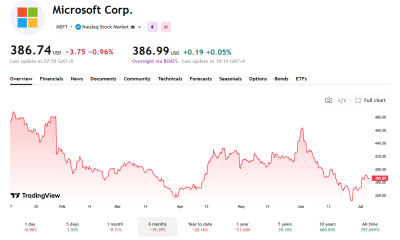
Microsoft Cuts 4,800 Jobs as Xbox Loses 3,200 Roles in Reset
-

 News Videos5 days ago
Crypto Just Entered Its Most Important 6-Month Candle (Could Decide Everything!)
-
 Tech6 days ago
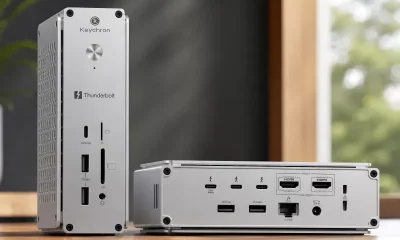
Keychron is stepping outside keyboards with a $349 Thunderbolt 5 dock aimed at power users
You must be logged in to post a comment Login