Connect with us

Business

If You Get in a Car Crash, the Risk Is Growing Your Insurance Won’t Pay

Published

on

If You Get in a Car Crash, the Risk Is Growing Your Insurance Won’t Pay

Americans got into more than six million traffic accidents last year. 

Depending on the type of crash, the chance of getting a payout from your insurer has become increasingly remote.

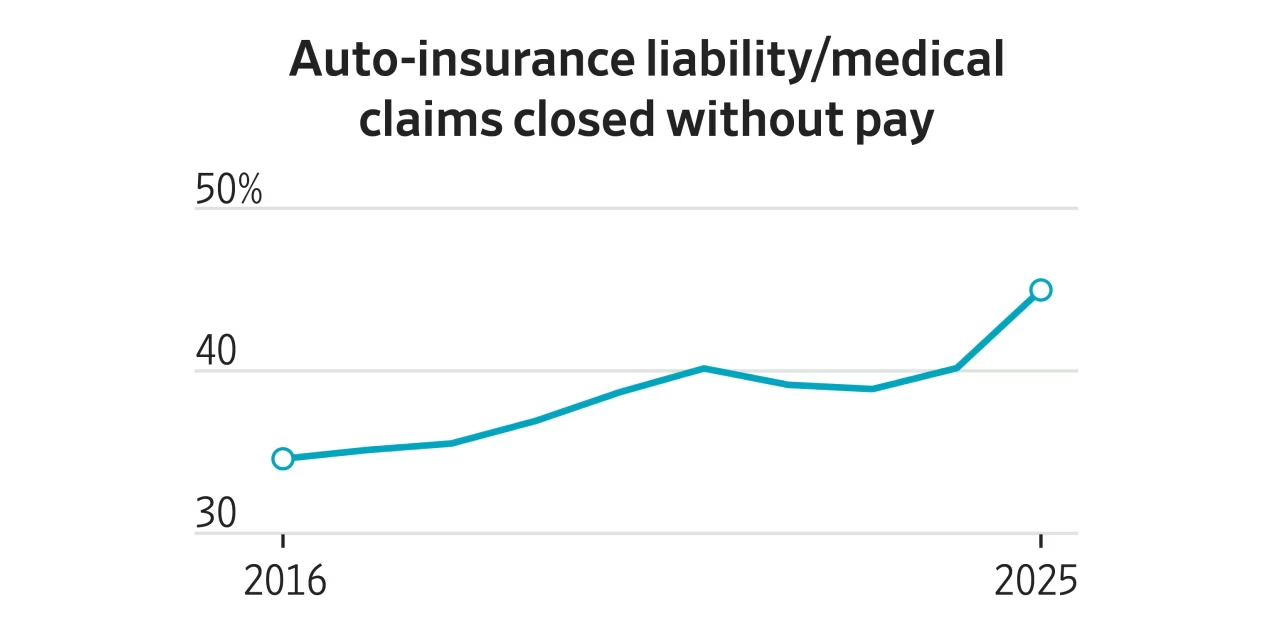
Auto insurers didn’t pay out on 45% of auto liability and medical claims they resolved last year, according to a Wall Street Journal analysis of thousands of company regulatory filings. That rate might change slightly as more claims are resolved, but it is up from around one in three, or 35%, of such claims a decade ago.

Americans are required to pay for car insurance as a condition of driving. Yet often, the insurance doesn’t provide the financial backstop that car owners were expecting.

Advertisement

Copyright ©2026 Dow Jones & Company, Inc. All Rights Reserved. 87990cbe856818d5eddac44c7b1cdeb8

Continue Reading
Click to comment

You must be logged in to post a comment Login

Leave a Reply

Business

Earnings call transcript: PRKA posts mixed Q3 2026 results as costs rise

Published

on


Earnings call transcript: PRKA posts mixed Q3 2026 results as costs rise

Continue Reading

Business

US Stocks: Nasdaq ends down as expectations of Hormuz deal fade

Published

on

US Stocks: Nasdaq ends down as expectations of Hormuz deal fade
The Nasdaq closed lower on Monday, with declines in Intel and other chipmakers, as investors became less confident about a deal to reopen the Strait of Hormuz. U.S. President Donald Trump demanded that Iran pay compensation for the people he said it had killed in wars, attacks ‌and protests. Earlier, Iran ⁠called for ⁠Washington to meet conditions, including recompensing Tehran for the damage caused since the U.S. and Israel launched strikes on its territory more than five months ago.

With investors less optimistic about a resolution of the Middle East crisis, U.S. crude oil jumped about 5% to settle ​at $82.13 a barrel. Reopening the flow of oil through the Strait could mitigate concerns over heightened energy prices that have spurred inflation worries and led to concerns that central banks would have to raise interest rates. Also weighing on ​the market were shares of Intel, which fell after the chipmaker said it ⁠was planning ‌to raise $15 billion through a share sale.

The S&P 500 notched a record-high close on ​Friday, helped by much ​stronger than expected earnings results.

“It’s record margins and record earnings. That’s just been the story ⁠of this market, and yet the overlay of the Iran conflict just pulls risk sentiment on and then pulls it off,” said Tom Hainlin, an investment strategist at U.S. Bank Wealth Management in Minneapolis.

Advertisement

“The direct impact is just the energy sector and … oil prices, and they’re just sticky here above where they were on February 27 before the conflict. So there’s clearly no transparency of the path to get back to where we were before the conflict started, and so that premium’s just being built in. So far, the world’s been able to work around it, but those workarounds don’t last forever.”


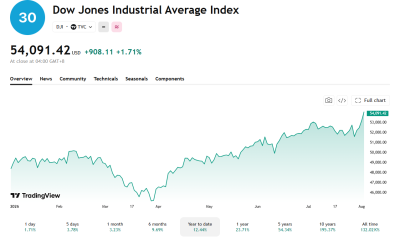
According ‌to preliminary data, the S&P 500 lost 4.74 points, or 0.06%, to end at 7,753.13 points, while the Nasdaq Composite lost 84.89 points, or 0.32%, to 26,605.73. The Dow Jones Industrial Average ​fell 71.77 points, ​or 0.13%, to 53,965.16.
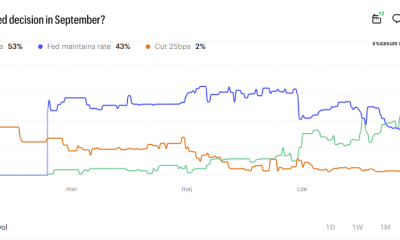
Reports later this ⁠week could offer clues on the Federal Reserve’s monetary policy path. Data on Friday that showed U.S. employers unexpectedly shed 23,000 jobs in July prompted traders to cut odds of a Federal Reserve interest-rate hike in September. Traders now ​price in a 52% chance of a rate hike in September, according to the CME FedWatch tool.More quarterly results are on the agenda as well, including reports from semiconductor company Applied Materials and networking equipment maker Cisco.

About 85% of the 436 companies in the S&P 500 that have reported earnings so far this period have beaten estimates, according to LSEG data.

Continue Reading

Business

Apple tests CXMT memory chips for iPhones and MacBooks amid shortage

Published

on

Apple tests CXMT memory chips for iPhones and MacBooks amid shortage

Apple is reportedly in the process of testing memory chips made by Chinese company CXMT across its lineup of devices, including in iPhones and MacBooks, as it looks at options to address the shortage of memory chips.

The Wall Street Journal on Sunday reported that Apple has held early talks with CXMT about the company providing chips that would be used in devices sold in China, citing people familiar with the matter.

Advertisement

Apple is hoping to receive approval from the White House for the arrangement, which could face scrutiny under rules that aim to block U.S. firms from transferring technology and sensitive data to Chinese companies, including CXMT.

The Journal reported that while the rules allow Apple to buy off-the-shell components from CXMT, it couldn’t order custom chips built to the company’s specifications. If the arrangement moves forward, Apple may be forced to redesign parts of its products sold in the Chinese market that would use standard CXMT chips.

APPLE POSTS RECORD JUNE QUARTER AS IPHONE SALES SURGE; COOKS WEIGHS IN ON AI, CHINA

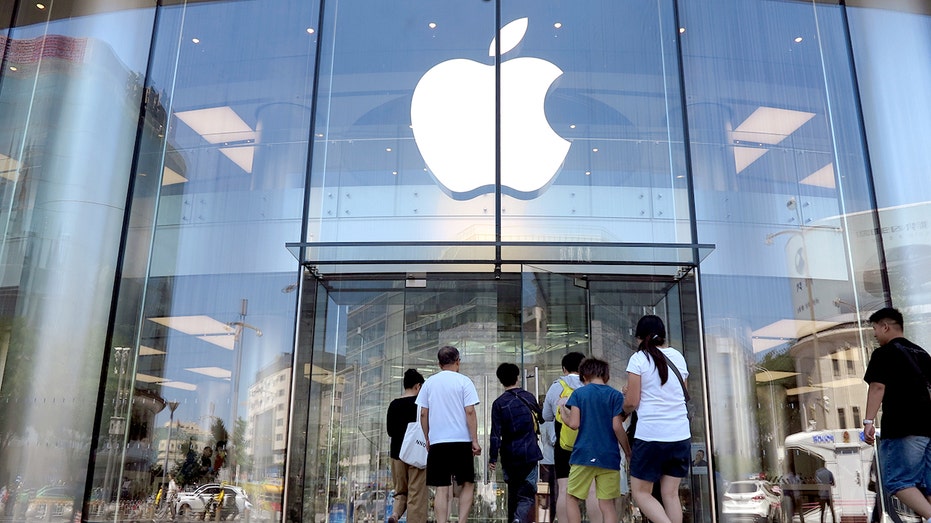
Apple Store in Beijing, China.

The Journal reported that Apple is testing ways to use chips from Chinese firm CXMT in its devices sold in China. (CFOTO/Future Publishing via Getty Images)

Laptop makers HP and Acer have obtained limited quantities of memory chips and are looking to lock in additional supplies for next year, the Journal reported. The deals with HP and Acer were previously reported by Nikkei Asia.

Advertisement

Apple has raised prices on its products in markets around the world, which it has attributed to surging memory chip costs amid a shortage caused by demand from artificial intelligence (AI) companies.

APPLE RAISES IPAD AND MACBOOK PRICES AS MEMORY CHIP COSTS SURGE

Ticker Security Last Change Change %
AAPL APPLE INC. 308.26 -4.80 -1.53%

CXMT is the largest chipmaking company in China based on market value, and the report noted it has emerged as the world’s fastest-growing supplier of DRAM memory chips.

Reuters previously reported that the firm was considering building a second memory chip plant in Beijing to expand its output, as the Journal’s report from the weekend noted that CXMT maxed out its production this year.

Advertisement

The company is giving priority to domestic tech companies in China and is aiming to more than double its current production capacity by 2028, the Journal reported.

APPLE TO INVEST $30 BILLION IN US CHIP MANUFACTURING

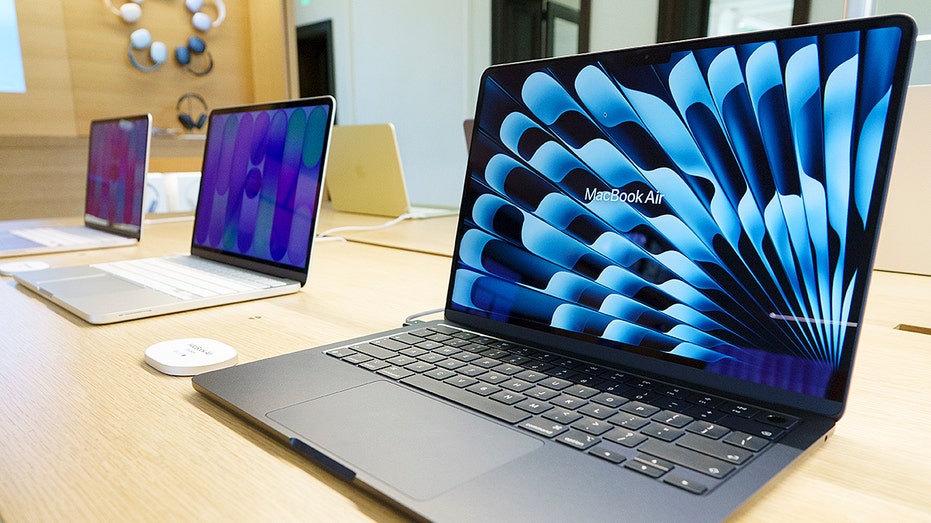
Apple MacBooks lined up

Apple raised prices on a range of devices this year amid rising costs for memory chips caused by the AI boom. (Kevin Carter/Getty Images)

U.S. companies are restricted in their dealings with CXMT because it’s among the companies on a Pentagon list due to links with the Chinese military.

The list indicates that CXMT is directly and indirectly affiliated with the Chinese government’s Ministry of Information Technology, while it’s also indirectly linked to an agency that manages and supervises state-owned enterprises.

Advertisement

FOX Business reached out to Apple and CXMT for comment.

GET FOX BUSINESS ON THE GO BY CLICKING HERE

Reuters contributed to this report.

Advertisement
Continue Reading

Business

GameStop Shares Edge Higher As CEO Ryan Cohen Weighs Dropping $56 Billion eBay Takeover Bid This Monday

Published

on

Shares of GameStop were volatile after the company reported mixed earnings

GRAPEVINE, Texas — Shares of GameStop Corp. rose modestly Monday after a report indicated that chief executive Ryan Cohen is considering walking away from the video game retailer’s roughly $56 billion takeover bid for eBay, opting instead for a smaller commercial partnership with the online marketplace.

The stock traded at $19.36 as of 10:32 a.m. Eastern time, up 22 cents, or 1.15%, after climbing as much as 2.5% in premarket trading. The move followed a Bloomberg report saying Cohen is weighing withdrawing GameStop’s full acquisition offer for eBay in favor of a commercial partnership or joint venture that would let eBay make use of GameStop’s approximately 1,600 U.S. retail locations to expand into higher-margin categories such as trading cards and collectibles.

GameStop had originally made its offer for eBay in May, proposing to acquire the online marketplace for $125 per share in a mix of cash and GameStop stock, a deal that would have valued eBay at roughly $56 billion. eBay has not accepted the offer, and the proposed acquisition has remained unresolved for months, contributing to ongoing uncertainty around GameStop’s broader corporate strategy under Cohen’s leadership.

Monday’s gain marks a partial rebound from a difficult stretch for GameStop shares. Just a week earlier, the stock fell sharply after the company announced plans to exchange $1.4 billion in convertible notes for Class A equity shares, a debt-reduction move intended to strengthen the company’s balance sheet but one that raised fresh concerns among investors over potential dilution of existing shares. Under the terms of that exchange, the final number of new shares to be issued will be tied to a 35-trading-day volume-weighted average price reference period that began August 3, 2026, meaning the ultimate dilutive impact will not be fully known until that window closes.

Advertisement

The prospect of GameStop stepping back from a full acquisition of eBay, in favor of a narrower commercial arrangement, would remove a significant layer of financial and execution risk that had been weighing on investor sentiment toward the stock. A deal of the scale GameStop had proposed would have required substantial financing and integration work for a company with a market capitalization far smaller than eBay’s, a mismatch that had drawn skepticism from some market watchers since the offer was first made public.

Monday’s advance in GameStop shares came even as the broader U.S. stock market traded modestly lower for much of the session, with the S&P 500, Nasdaq Composite and Dow Jones Industrial Average all dipping into negative territory amid continued uncertainty over the situation in the Strait of Hormuz and its potential impact on global oil markets. That backdrop suggested Monday’s move in GameStop was driven primarily by the company-specific eBay report rather than any broader market tailwind.

The stock remains well below its 52-week high. GameStop has traded in a range between $18.55 and $28.10 over the past year, and Monday’s price left shares still far off the upper end of that range, reflecting a stretch of significant volatility for the retailer’s stock over recent months. Shares had traded near $27 in May, around the time the eBay offer was first announced, before declining steadily as the deal remained unresolved and other corporate developments, including the convertible note exchange, weighed on sentiment.

GameStop’s push to diversify beyond its traditional video game retail business has been a defining feature of Cohen’s tenure atop the company. Since taking over as chief executive, Cohen has pursued a broader transformation strategy that has included share buybacks, investments in other companies’ stock and cryptocurrency holdings, and, more recently, the pursuit of a major acquisition aimed at reshaping GameStop’s position within the broader e-commerce and collectibles market. The company has continued to operate its retail stores under the GameStop, EB Games and Micromania banners across the United States, Canada, Australia and Europe.

Advertisement

A shift toward a commercial partnership with eBay, rather than an outright acquisition, would align more closely with a lower-risk approach that some investors have said they would prefer to see from the company, given the scale and complexity of the originally proposed deal. Such an arrangement could still allow GameStop to benefit from its extensive physical retail footprint by supporting eBay’s expansion into categories like trading cards and collectibles, areas that have already been a growing focus for GameStop’s own retail business in recent years.

GameStop reported fiscal year 2026 revenue of $3.63 billion, a decline of roughly 5% from the prior year’s $3.82 billion, even as the company posted a sharp increase in earnings, which rose more than 200% year-over-year. The company’s shareholders approved an increase to the total number of authorized shares outstanding at GameStop’s annual meeting in July, a move that provided the company with additional flexibility for future capital-raising activities, including the recent convertible note exchange.

Investors are likely to continue watching closely for further clarity on the eBay situation in the coming weeks, along with additional details on the final terms of the company’s debt-for-equity exchange once the 35-day pricing window concludes. Neither GameStop nor eBay has issued a formal public statement confirming or denying the reported shift in strategy, leaving the outcome of the potential deal, and its implications for GameStop’s broader corporate direction, still unresolved heading into the back half of the year.

Advertisement
Continue Reading

Business

SPB Hospitality CEO sees major growth in ‘upscale casual’ restaurants

Published

on

SPB Hospitality CEO sees major growth in ‘upscale casual’ restaurants

A restaurant industry veteran who has led some of America’s best-known chains sees major growth potential in one segment of the dining business.

G.J. Hart, CEO of Houston-based SPB Hospitality, told FOX Business that the “upscale casual” category is “there for the taking” as the company looks to expand J. Alexander’s, one of the brands in its portfolio.

Advertisement

Hart, who previously served as CEO of Red Robin, California Pizza Kitchen and Texas Roadhouse, said consumers continue to respond to restaurants that deliver both value and a strong experience.

“It’s a space that, from my perspective, my thesis is that it will continue to resonate with consumers, because you’ve got a pretty decent value for a great experience,” Hart said.

CRACKER BARREL SELLS MAPLE STREET BISCUIT COMPANY, CLOSES 16 LOCATIONS

G.J. Hart, CEO of SPB Hospitality

G.J. Hart, CEO of SPB Hospitality, told FOX Business that the “upscale casual” category is “there for the taking.” (SPB Hospitality)

Hart added, “[J. Alexander’s] has been around a long time and it’s very well respected, has a very loyal guest base. … There’s a ton of opportunity to grow [J. Alexander’s] in those strong markets and build out from those core markets and fill a need that’s out there.”

Advertisement

Unlike restaurant segments dominated by national chains, Hart said upscale casual is still made up largely of regional operators.

“When you think about who the real players [are] in upscale casual, it’s mostly regional players,” he said. “… Us becoming bigger will help us get stronger in that space, and I think it’s a space that’s there for the taking.”

SPB Hospitality owns a portfolio of restaurant brands including J. Alexander’s, Logan’s Roadhouse and Krystal.

WENDY’S LOSES STATUS AS SECOND-LARGEST BURGER CHAIN AFTER 6-YEAR RUN

Advertisement
A view of J. Alexander's.

A view of J. Alexander’s. SPB Hospitality owns a portfolio of restaurant brands including J. Alexander’s, Logan’s Roadhouse and Krystal. (SPB Hospitality)

Hart said the company is preparing to open six to eight restaurants annually as it ramps up its growth plans.

“We’ve got a fairly aggressive plan,” Hart said.

SPB Hospitality is working to ensure it has the infrastructure, training and management pipeline needed to support those new locations, he said.

Since becoming CEO of SPB Hospitality in September 2025, Hart said he has focused on making restaurant operations easier and applying lessons from his time leading Texas Roadhouse, California Pizza Kitchen and Red Robin.

Advertisement

“The basics are the same,” Hart said, pointing to leadership, communication and giving employees a voice.

PIZZA CHAIN TO CLOSE UP TO 50 LOCATIONS AS SALES SLUMP

A Texas Roadhouse

A Texas Roadhouse is seen on May 12, 2026, in Austin, Texas. Hart said many of the lessons he learned during his time at Texas Roadhouse, California Pizza Kitchen and Red Robin remain relevant despite the differences among the brands. (Brandon Bell/Getty Images)

GET FOX BUSINESS ON THE GO BY CLICKING HERE

As SPB Hospitality enters its next phase of growth, Hart said the larger challenge is keeping its brands relevant as consumer preferences evolve.

Advertisement

“What I’ve learned in all these brands and now bring to [J. Alexander’s] and SPB is this idea around relevancy,” he said. “How do you stay relevant for today’s ever evolving consumer and consumer needs and consumer wants?”

Continue Reading

Business

SUSS MicroTec SE (SESMF) Q2 2026 Earnings Call Transcript

Published

on

OneWater Marine Inc. (ONEW) Q1 2026 Earnings Call Transcript

SUSS MicroTec SE (SESMF) Q2 2026 Earnings Call August 6, 2026 8:00 AM EDT

Company Participants

Sabrina Mueller
Burkhardt Frick – CEO & Member of Management Board
Cornelia Ballwießer – CFO & Member of Management Board
Thomas Rohe – COO & Member of Management Board

Advertisement

Conference Call Participants

Martin Marandon-Carlhian – ODDO BHF Corporate & Markets, Research Division
Ruben Devos – Kepler Cheuvreux, Research Division
Michael Kuhn – Deutsche Bank AG, Research Division
Malte Schaumann – Warburg Research GmbH
Veysel Taze – Metzler Equities, Research Division
Johannes Ries – Apus Capital GmbH

Presentation

Advertisement

Operator

Ladies and gentlemen, welcome to the conference call of SUSS MicroTec following the publication of the half year figures of 2026. I would like to welcome the company’s CEO, Burkhardt Frick; the CFO, Dr. Cornelia Ballwiesser; the COO, Dr. Thomas Rohe; and the Vice President, Investor Relations and Communications, Sabrina Mueller, who will guide us through the presentation in a moment, followed by a Q&A session via audio line and chat. And with that, I hand over to you, Ms. Mueller.

Sabrina Mueller

Advertisement

Thank you, and welcome to our conference call following the publication of our half yearly financial report 2026. Before we start, please note that this call is being recorded and considered as copyrighted material. It cannot be recorded or rebroadcasted without permission, and participating in this call implies your consent to this procedure. Please be also aware of the safe harbor statement on Page 2 of the slide deck. It applies throughout the call. And with that, I’ll now hand over to Burkhardt to give — to guide you through our results for the first half year.

Burkhardt Frick
CEO & Member of Management Board

Thank you, Sabrina. And also, a very warm welcome from my end. Let’s start off with an overview of the key financials for 2026. Order intake of EUR

Advertisement
Continue Reading

Business

Nvidia: Buy Before Q2 Shows The AI Factory Trade Is Still Early (Upgrade) (NASDAQ:NVDA)

Published

on

Nvidia: Buy The Dip

This article was written by

I’m a retail investor based in Sydney with three years of experience focusing on achieving financial independence through strategic investments in AI-driven companies. Although I don’t come from a traditional finance background, I’ve developed a strong passion for understanding how artificial intelligence is transforming the global economy. Over the past few years, I’ve become increasingly fascinated by the possibilities of AI—how it’s reshaping industries, driving innovation, and creating new investment frontiers. My portfolio is primarily centered around leading AI-related companies such as NVIDIA and others at the forefront of this technological revolution. I believe we’re only in the early stages of AI’s impact, and the coming decade will present remarkable opportunities for both retail and institutional investors. My goal is to continue learning, sharing insights, and building long-term wealth by investing in the technologies shaping our future.

Analyst’s Disclosure: I/we have a beneficial long position in the shares of NVDA either through stock ownership, options, or other derivatives. I wrote this article myself, and it expresses my own opinions. I am not receiving compensation for it (other than from Seeking Alpha). I have no business relationship with any company whose stock is mentioned in this article.

Seeking Alpha’s Disclosure: Past performance is no guarantee of future results. No recommendation or advice is being given as to whether any investment is suitable for a particular investor. Any views or opinions expressed above may not reflect those of Seeking Alpha as a whole. Seeking Alpha is not a licensed securities dealer, broker or US investment adviser or investment bank. Our analysts are third party authors that include both professional investors and individual investors who may not be licensed or certified by any institute or regulatory body.

Advertisement
Continue Reading

Business

Post narrows outlook after mixed third quarter

Published

on

Post narrows outlook after mixed third quarter

Core Post Consumer Brands unit lifted by 8th Avenue acquisition.

Continue Reading

Business

Nasdaq 100’s QQQ ETF Holds Near Record High As Wall Street Awaits Key Inflation Data This Coming Week

Published

on

Nasdaq 100's QQQ ETF Holds Near Record High As Wall

The Invesco QQQ Trust, the widely held exchange-traded fund that tracks the Nasdaq-100 index, held steady near record territory Monday as investors moved cautiously into a week packed with corporate earnings and inflation data that could shape the Federal Reserve’s next policy move.

The fund traded at $723.79 as of 10:39 a.m. Eastern time, up 76 cents, or 0.11%, after opening the session at $720.15. Shares moved within a narrow range of $716.51 to $723.63 during the morning, holding well within reach of the fund’s 52-week high of $748.65, a level reached earlier this year. QQQ’s 52-week low sits at $555.60, underscoring the scale of the fund’s advance over the past year, with the ETF up roughly 25.84% over the trailing 12 months. The fund, which has a market capitalization of nearly $703 billion, seeks to replicate the performance of the Nasdaq-100 by holding the 100 largest non-financial companies listed on the Nasdaq exchange.

Monday’s muted trading followed a strong finish to last week, when major U.S. indexes climbed to fresh records after a weaker-than-expected July jobs report reshaped expectations for Federal Reserve interest rate policy. The S&P 500 closed at a record 7,758 on Friday, up 0.6%, while the Nasdaq Composite gained 1.3% and the Dow Jones Industrial Average added 152 points, or 0.28%. The rally came after the Labor Department reported that nonfarm payrolls unexpectedly fell by 23,000 for the month, while the unemployment rate and labor force participation rate both declined, a combination that eased concerns about labor market strength fueling further inflation pressure and reduced expectations that the Federal Reserve would need to raise rates at its next meeting.

Friday’s gains were led by technology and industrial names, with Salesforce rising 2.47%, Nvidia climbing 2.33% and Honeywell International adding 2.28%, according to market data. Declines were concentrated in a smaller group of stocks, with Visa, Chevron and Caterpillar among the session’s biggest laggards, falling 2.20%, 1.49% and 1.46%, respectively.

Advertisement

Heading into this week, investor attention has shifted toward the release of the latest Consumer Price Index reading, scheduled for Wednesday, which is expected to offer fresh insight into the inflation outlook and could influence the Federal Reserve’s approach at its upcoming policy meeting. With last week’s jobs data already having shifted market expectations toward a more cautious central bank, Wednesday’s inflation figures are likely to be closely scrutinized for any signs that could either reinforce or challenge that shift.

Corporate earnings are also set to remain a major focus this week, with several prominent artificial intelligence-linked companies scheduled to report results, including Applied Materials, Cisco and CoreWeave. Given the heavy weighting of technology and AI-related companies within the Nasdaq-100 index, and by extension within QQQ’s holdings, this week’s earnings reports are likely to have an outsized influence on the fund’s performance in the days ahead.

Broader market sentiment Monday was also shaped by developments in the Middle East, where investors have been closely tracking tensions tied to the Strait of Hormuz, a critical corridor for global oil shipments. Iran signaled over the weekend that a deal to reopen the strait to shipping traffic was “very close,” helping push oil prices higher during Monday’s session. Global benchmark Brent crude futures traded near $85 per barrel, reflecting continued uncertainty around the situation even as hopes for a resolution appeared to grow. The major U.S. equity indexes remained largely muted for much of Monday’s session even as oil prices rose, with the Dow Jones Industrial Average slipping slightly, the Nasdaq Composite roughly flat, and the S&P 500 edging modestly higher, leaving investors in what market commentary described as a wait-and-see posture ahead of this week’s data.

QQQ’s holdings remain heavily concentrated in a small number of mega-cap technology companies that have driven much of the fund’s performance over the past year, including major players in artificial intelligence infrastructure, cloud computing and semiconductor manufacturing. The fund’s composition is adjusted periodically by its adviser to reflect changes in the underlying Nasdaq-100 index, ensuring that its holdings and weightings continue to track the index as company valuations and rankings shift over time.

Advertisement

Since its launch in March 1999, QQQ has grown into one of the most widely traded exchange-traded funds in the world, frequently used by both retail and institutional investors as a vehicle for gaining broad exposure to large-cap growth and technology stocks. The fund’s heavy weighting toward technology has made it especially sensitive to swings in sentiment around artificial intelligence spending, semiconductor demand and interest rate expectations, all of which have been recurring themes driving market volatility throughout 2026.

With the fund trading just below its all-time high heading into a week filled with potentially market-moving data, analysts say the coming days could prove pivotal in determining whether QQQ and the broader Nasdaq-100 can push through to fresh records or face renewed pressure if inflation data or corporate earnings fail to meet elevated expectations. For now, Monday’s calm trading reflected a market largely in a holding pattern, with investors positioning cautiously ahead of catalysts that could reshape the near-term outlook for both interest rates and the technology sector that has powered much of this year’s gains

Continue Reading

Business

McDonald’s US business ‘slowed significantly’ during quarter

Published

on

McDonald’s US business ‘slowed significantly’ during quarter

Company says too many promotions and menu changes hindered store execution.  

Continue Reading

Trending

Copyright © 2025