

Business
Infosys, TCS, TechM and other IT stocks rally up to 5% even as sector valuations near 2008 levels


The Nifty IT index jumped more than 4% to hover near 29,566 on Tuesday morning, while the broader Nifty index was trading with only marginal gains. The sectoral index has now gained more than 8% (over 2,205 points) in just three sessions.
Heavyweight Infosys shares were the top gainers on the index, jumping nearly 5% to trade at Rs 1,198 apiece on NSE. Shares of the IT major have now risen about 9% over the past three days, but remain down 27% in 2026 so far and 10% over the past month.
Coforge, LTI Mindtree, HCL Technologies, Mphasis, Persistent Systems and Tech Mahindra shares jumped around 4% each on Tuesday, while OFSS and Tata Consultancy Services (TCS) shares surged more than 3% each. Wipro shares rose over 2%.
AI shock makes IT valuations cheaper
Shares of TCS, Infosys, HCL Tech and Wipro are currently trading with price to earnings (P/E) ratios ranging between 15 and 19, nearly half of the peak valuations that these IT stocks once commanded around four years ago.

These stocks saw a sharp decline early in 2026 after AI startup Anthropic launched plug-ins for its Claude Cowork agent, which could automate tasks across legal, sales, marketing and data analysis. “We call it the ‘SaaSpocalypse,’ an apocalypse for software-as-a-service stocks,” Bloomberg quoted Jeffrey Favuzza from the equity trading desk at Jefferies as saying.
While the doomsday prophets continue to debate about the future of the IT companies following fresh AI advancements, investors were quick to analyse the cheap valuations. Additionally, a sharp decline in the rupee also helped the IT stocks, as the IT companies mostly derive their revenue in US dollars.
Goldman Sachs on Infosys
Goldman Sachs kept a ‘Neutral’ rating on the shares of Infosys, with a target price of Rs 1,290 apiece. This implies an upside potential of nearly 13% from the stock’s previous closing price. The firm, in a note, highlighted key takeaways from Infosys’ management meeting.
Despite a soft discretionary spending environment, Infosys management highlighted strength in BFSI and EURS verticals and continued strong deal wins, Goldman Sachs noted, adding that some AI-driven deflation is likely in parts of the value chain, although Infosys expects it to be offset as new TAMs open up.
Also read: Why 10 stocks suffered massive Rs 17,000 crore mutual fund selloff in April
Infosys sees scope for a partnership approach with frontier model companies as enterprises deploy AI, rather than services companies being rendered redundant due to AI adoption, Goldman Sachs further said.
(Disclaimer: Recommendations, suggestions, views and opinions given by the experts are their own. These do not represent the views of The Economic Times)


Greece stocks higher at close of trade; Athens General Composite up 0.91%

Delek US Energy stock hits 52-week high at 54.2 USD

ANALYSIS: Few places in the world have benefited more from their natural resource endowment. But prosperity also creates exposure.
Business
SpaceX Nears Historic Nasdaq-100 Debut Tuesday as Investors Weigh Post-IPO Valuation Questions

Shares of Space Exploration Technologies Corp. continued to trade higher Monday morning as investors positioned ahead of the company’s addition to the Nasdaq-100 index, a milestone scheduled to take effect before markets open Tuesday and one that will mark the fastest index inclusion in the benchmark’s history.
SPCX shares stood at $163.79, up $1.79, or 1.10 percent, as of 10:19 a.m. Eastern time, according to Google Finance data. The move comes just 15 trading days after SpaceX’s initial public offering, which priced shares at $135 on June 12 and raised between roughly $75 billion and $85.7 billion, depending on the reporting source, making it the largest IPO in market history and valuing the company at approximately $1.77 trillion at the time of its debut.
SpaceX’s rapid path to inclusion in the Nasdaq-100 was made possible by a relatively new exchange rule that fast-tracks large initial public offerings into the index after just 15 trading days, a significant reduction from the longer waiting period previously required of newly listed companies. Nasdaq confirmed the inclusion on June 27, setting the stage for the company’s shares to become part of a benchmark that underpins more than $800 billion in tracked assets, including the widely held Invesco QQQ Trust and numerous retirement and 401(k) funds.
The stock’s performance since its debut has been volatile. Shares initially surged to an intraday high of $225.64 in the days following the IPO before retreating sharply, falling as much as 28 percent from that peak. Last week alone, SPCX shares dropped 16.4 percent after analysts at KeyBanc adopted a more cautious stance, arguing that the stock’s valuation had become increasingly stretched following its post-IPO rally. Shares closed Friday at $153.23, just above the IPO price, before climbing again in Monday’s trading session.
Analysts have offered a range of estimates for how much buying activity the Nasdaq-100 inclusion could generate as passive funds adjust their portfolios to reflect the index’s updated composition. Some projections suggest the Invesco QQQ Trust alone could purchase as much as $4.3 billion worth of SpaceX shares, while broader estimates across Nasdaq-100 and Russell index-tracking funds have ranged from approximately $7.3 billion to as much as $27 billion. That wave of anticipated demand is notable given how limited SpaceX’s public float remains: the company has roughly 13 billion shares outstanding, but only an estimated 3 to 5 percent are currently available for public trading, with Musk’s approximately 42 percent ownership stake locked up until June 2027.
That tight supply-demand dynamic is expected to persist for some time. According to reporting from TradingKey, SpaceX insiders are not expected to become eligible to sell meaningful portions of their holdings until around August 6, when the company is scheduled to report its first quarterly earnings as a public company. At that point, insiders could sell up to 20 percent of their holdings, with an additional 10 percent becoming saleable if shares trade at least 30 percent above the $135 IPO price for five of any 10 consecutive trading days. The remainder of locked shares are set to become available on a staggered basis through December 2026.
Some market analysts have cautioned against assuming the Nasdaq-100 inclusion will necessarily provide a sustained boost to the stock. Historical examples cited by market observers include Palantir and Strategy, both of which joined the index in December 2024 and saw their share prices peak around or shortly before their respective inclusion dates, with Strategy shares later falling roughly 80 percent from their peak in the months that followed. Given SpaceX’s own sharp post-IPO volatility, some analysts have suggested the stock could face similar pressure once the immediate index-driven buying subsides.
Beyond the technical dynamics surrounding the index addition, attention has also turned to SpaceX’s broader corporate strategy. Following the completion of the IPO, analysts at Baird said they believed investor focus could increasingly shift toward the possibility of a merger between SpaceX and Tesla, the electric vehicle maker also led by Musk. “We see the strategic rationale for a merger as clear and compelling with both companies benefitting from greater scale,” the firm wrote in a note, adding that it did not anticipate significant regulatory scrutiny given the limited overlap between the companies’ respective end markets. Baird noted that the timing of any such transaction remained difficult to predict, suggesting a period of integration was more likely in the near term as SpaceX works to absorb its recent merger with Musk’s artificial intelligence company, xAI, while also adjusting to its new status as a publicly traded company.
That merger with xAI, completed earlier this year, has reshaped SpaceX’s underlying business structure into three primary segments. The Connectivity division, anchored by the Starlink satellite internet business, generated roughly 61 percent of the company’s total revenue in 2025. The Space segment includes the company’s Falcon 9 and Starship launch operations, while the newly integrated AI division encompasses the Grok large language model, the X social media platform, and broader AI computing infrastructure. Starlink’s subscriber base has continued to expand rapidly, surpassing 10 million subscribers globally, more than double the 5.5 million subscribers the service had at the time of SpaceX’s June IPO.
Financially, SpaceX reported $4.7 billion in revenue during the first quarter of 2026 and disclosed cash and cash equivalents of approximately $100.8 billion as of June 19, following a senior unsecured notes offering used in part to repay bridge financing tied to earlier stages of the company’s growth. Even so, some valuation metrics have raised concerns among analysts, with the stock’s price-to-sales ratio estimated at various points between roughly 79 and 112 times trailing sales, a level that remains elevated even compared with other high-growth technology companies.
With Tuesday’s Nasdaq-100 inclusion set to bring SpaceX into the portfolios of millions of index-fund investors who never directly chose to own the stock, market attention in the coming weeks is expected to focus on how the company’s limited public float absorbs the anticipated wave of passive buying, as well as on SpaceX’s first earnings report as a public company, expected in early August, which analysts have identified as the next significant test of the stock’s long-term valuation and growth trajectory following one of the most closely watched public debuts in recent market history.

A technology-backed disruptor is making headway in real estate with a different agency model and fee structure.

The proposed IPO comprises a fresh issue of equity shares aggregating up to Rs 150 crore and an Offer for Sale (OFS) of 2.84 crore equity shares by existing shareholders, according to the draft red herring prospectus (DRHP).
The regulator received the company’s draft papers on April 1 and gave its observations on July 6, the update showed.
In Sebi parlance, the issuance of observations implies its approval to float the IPO.
According to the draft papers, the company proposes to utilise the net proceeds from the fresh issue towards payment of loans, payment of lease rentals or licence fees for warehouses and experience stores, and general corporate purposes.
Rentomojo operates a technology-driven, direct-to-consumer online rental and subscription platform for furniture and home appliances.
As of September 30, 2025, Rentomojo had 2.28 lakh live subscribers across 22 cities, supported by 21 warehouses, with around 4.44 lakh sq ft of warehousing space.It also operates 67 experience stores and has a portfolio of 7,28,773 live products.
For the six months ended September 30, 2025, the company posted revenue from operations of Rs 176.61 crore and a profit after tax of Rs 61.38 crore.
In FY25, revenue from operations stood at Rs 265.96 crore, while profit after tax was Rs 43.11 crore.
Motilal Oswal Investment Advisors, Axis Capital and IIFL Capital Services are the book-running lead managers to the issue.

The state’s peak planning body aims to replace a policy from the 1980s, to set new limitations for developments in the Parliament House precinct.
Business
Vedanta Oil & Gas, Vedanta Iron & Steel, Vedanta Power shares crash up to 8% post Q1 updates; Vedanta Aluminium rises

Vedanta Aluminium Metal shares, however, gained over 1% on Monday morning. The four companies that were spun out of Vedanta earlier this year following the mega demerger released their Q1 business updates after market hours on Friday.
Vedanta Oil & Gas Q1 update
Vedanta Oil & Gas shares crashed more than 8% to trade at Rs 39.3 apiece on the NSE. This came after the company reported a 17% year-on-year (YoY) decline in gross oil and gas production to 7.1 million boe for the April-June quarter of FY27, from 8.5 million boe in the corresponding quarter of the previous financial year. Sequentially, gross output also declined about 4% from 7.3 million boe reported in the fourth quarter of the previous financial year.
Its total working interest, meanwhile, dropped 16% YoY to 4.7 million boe during the quarter under review. Its largest asset in Rajasthan recorded a 15% YoY decline in average daily gross operated production to 63.1 kboepd.
Vedanta Oil & Gas shares have gained over 20% in one week and 11% since listing. Its market capitalisation currently stands at over Rs 15,434 crore.
Also read: Vedanta among top 5 stocks with lowest price-to-earnings ratio. Check details
Vedanta Iron & Steel Q1 update
After delivering massive returns since listing, Vedanta Iron & Steel shares tumbled around 5% to trade at Rs 38.5 apiece on the NSE on Monday morning. This came after the company reported a 4% YoY rise in saleable iron ore production to 2.6 million DMT in the first quarter of FY27. Sequentially, however, production fell 3% from 2.7 million DMT reported in the fourth quarter of FY26.
Vedanta Iron & Steel’s Karnataka plant saw a 46% YoY drop in saleable iron ore production, while the Goa and Odisha plants recorded 166% and 59% surges in output, respectively. Overall steel production, meanwhile, rose 4% YoY to 582,000 tonnes during the quarter under review.Vedanta Iron & Steel shares have risen around 19% in one week and 84% since listing. The company currently has a market capitalisation of Rs 15,055 crore.
Vedanta Power Q1 update
Vedanta Power shares dropped around 4.5% to trade at Rs 43.67 apiece on the NSE. The company said power sales grew 38% YoY to 5,225 million units in Q1 FY27 from 3,784 million units in Q1 FY26. Sequentially, however, sales fell 6% from 5,530 million units reported in the fourth quarter of FY26.
Power sales at Talwandi Sabo Thermal Plant and Meenakshi Energy grew 14% and 16%, respectively, on a sequential basis in Q1. However, sales at Sakti Thermal Plant and Jharsuguda Thermal Plant declined 57% and 23%, respectively, from the previous quarter.
The company attributed the decline in power sales at Sakti Thermal Plant to reduced plant availability following a boiler incident on April 14, which significantly impacted operations during the quarter.
Vedanta Power shares have gained over 6% in one week and 7% since listing.
Also read: Vedanta Power shares fall 3% despite 38% jump in Q1 sales. Should you buy, sell or hold?
Vedanta Aluminium Metal Q1 update
Vedanta Aluminium Metal shares gained more than 1% to trade at Rs 467.85 apiece on the NSE. The company reported its highest-ever quarterly aluminium production of 6.32 lakh tonnes in Q1 FY27, marking a 5% YoY and 3% quarter-on-quarter (QoQ) increase. Power sales at BALCO rose 21% YoY to 520 million units during the quarter under review.
“Progress at the BALCO expansion remains steady, with a measured approach focused on operational stability and efficiency as capacity gradually scales up. The ramp-up is on track for full capacity utilisation by Q4,” the company said.
Vedanta Aluminium Metal, which was listed as the only large-cap company among the four entities last month, has seen its share price rise around 3% over the past week. The stock, however, has declined more than 6% since listing and currently commands a market capitalisation of nearly Rs 1.81 lakh crore.
Also read: Vedanta, TCS among 5 stocks with the highest dividend yield. Check details
(Disclaimer: Recommendations, suggestions, views, and opinions expressed by the experts are their own and do not represent the views of The Economic Times.)

The president participates in a ceremony from the Oval Office marking the launch of Trump Accounts.
President Donald Trump on Monday celebrated the launch of Trump Accounts by ringing the opening bells of the New York Stock Exchange and Nasdaq from the White House.
Trump Accounts were created by the One Big Beautiful Bill Act, the package of tax cuts and reforms that Republicans passed through Congress and was signed into law by President Donald Trump last year.
“This is about the Trump Accounts, which are absolutely incredible for children. Children at the age of 18, and after, become very wealthy people – come into the world with essentially no money and end up at a pretty young age being very rich,” Trump said.
“That’s something that we’ve wanted to do, this country’s wanted to do for 25 years,” the president added.

President Donald Trump has touted the Trump Accounts initiative since the passage of the One Big Beautiful Bill Act. (Win McNamee/Getty Images)
The initiative invests the savings in low-cost index funds that provide broad, diversified exposure to the U.S. stock market.
GOLDMAN SACHS TO CONTRIBUTE $1,000 TO TRUMP ACCOUNTS FOR ELIGIBLE CHILDREN OF EMPLOYEES
Parents and guardians may contribute up to $5,000 per year to the accounts belonging to their children, while a parent’s employer can contribute up to $2,500 annually without impacting the employee’s taxable income.
The accounts will be seeded with $1,000 in federal money to give children born between 2025 and 2028 a jump start on their savings.

The Trump Accounts app will feature eight exclusive financial literacy modules. (U.S. Department of the Treasury / Fox News)
At the time of the official launch of Trump Accounts, there is one investment option available, although the Treasury Department has indicated four more will be available in the months ahead.
The State Street SPDR Portfolio S&P 500 ETF (SPYM), a low-cost exchange-traded fund (ETF) that tracks the performance of the S&P 500 Index, will be the initial default investment option.
Four other ETFs in the future include two that focus on the total U.S. stock market offered by Vanguard and iShares, along with a State Street ETF focused on the broader S&P 1500, as well as another iShares offering focused on the S&P 500.
Business
Western Digital, Sandisk, AMD, ASML, TeraWulf, Strategy, and More Stocks That Explain Today’s Market
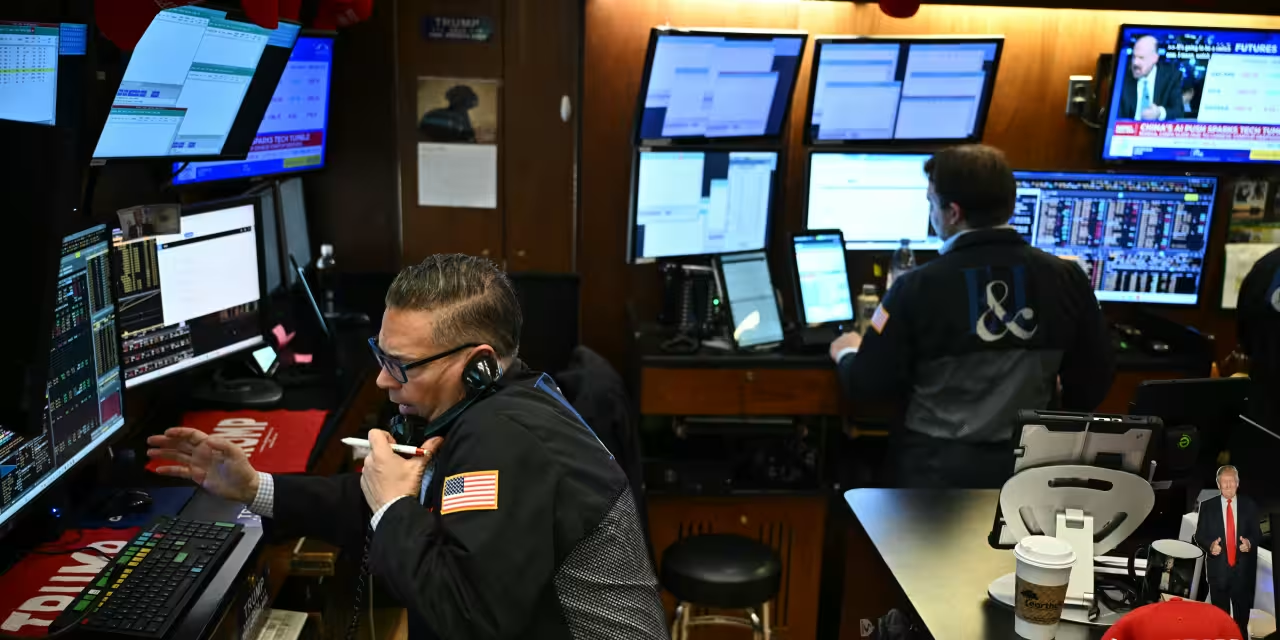
Western Digital, Sandisk, AMD, ASML, TeraWulf, Strategy, and More Stocks That Explain Today’s Market

Canadian spy agency says it hacked drug traffickers, extremists and a ransomware gang last year

how the Home Office can get its new safe-and-legal route right
Greece stocks higher at close of trade; Athens General Composite up 0.91%


-

 Fashion3 days ago
Weekend Open Thread: High Hopes
-

 Politics3 days ago
The House | “Reframing the debate from a binary discussion of winners and losers”: Yuan Yang reviews ‘We Are Not Machines’
-

 Crypto World7 days ago
Strategy authorizes up to $1.25B in Bitcoin sales under new capital plan
-

 News Videos6 days ago
How to Build INSANE Live Financial Dashboards With Claude
-

 Tech7 days ago
Anonymous researcher drops 0-day ‘exploitarium’ repo
-

 Business6 days ago
Australia treasurer says alleged access of prime minister’s bank data ’incredibly concerning’
-
 NewsBeat1 day ago
Taylor Swift and Travis Kelce wedding staffer hilariously struggles to keep her cool while checking in megastars
-
 Crypto World5 days ago
Airdrop Registration Becomes Key Focus For Remittix As RTX Launch Updates Approach
-

 Sports5 days ago
Broncos roster: OL Ben Powers (No. 74) entering final year of contract
-
 Business7 days ago
The AI boom won’t burst all at once. It will pop in ‘rolling bubbles’: Macquarie
-

 Crypto World4 days ago
Binance stock trading tops $1B in first month after launch
-

 NewsBeat6 days ago
Presenter Caroline Flack’s brother Paul Flack dies aged 55
-

 Crypto World5 days ago
Alibaba-affiliate Ant Group enters the humanoid robot market with 12 deals
-
 NewsBeat4 days ago
New exhibition reflects five decades of movement between island of Ireland and GB
-

 Crypto World3 days ago
Standard Chartered Secures MiCA License as ESMA Adds 37 New Crypto Firms
-

 Crypto World1 day ago
South Africa proposes crypto tax guidance under existing rules
-

 Tech1 day ago
Lenovo laptops are now shipping with YMTC SSDs, a sign of Chinese NAND entering the mainstream
-

 Business5 days ago
Meta Platforms Stock Jumps 7% Today as Bloomberg Reports Company Plans to Enter the Cloud Business
-

 Business3 days ago
What a 10 Percent Drop Means for Buyers, Sellers and Renters
-

 Crypto World4 days ago
Binance Re-Enters Philippines As EU MiCA Rules Restrict Access
You must be logged in to post a comment Login