


Connect with us
DAPA Banner

Business

Iran Offers to Reopen Strait of Hormuz if US Ends Blockade and War, Officials Say

Published

on

Strait of Hormuz Traffic Near Standstill Despite US-Iran Ceasefire: Only

CAIRO — Iran has proposed ending its chokehold on the Strait of Hormuz in exchange for the United States lifting its naval blockade and agreeing to a permanent end to the ongoing war, two regional officials with knowledge of the offer said Monday, as Tehran’s foreign minister visited Moscow amid stalled peace efforts.

Strait of Hormuz Traffic Near Standstill Despite US-Iran Ceasefire: Only
Iran Offers to Reopen Strait of Hormuz if US Ends Blockade and War, Officials Say

The new proposal, conveyed to the White House through Pakistani mediators, would delay talks on Iran’s nuclear program until after a ceasefire is solidified and the critical waterway is reopened to international shipping, the officials told The Associated Press on condition of anonymity because the negotiations are private.

The Strait of Hormuz, a narrow chokepoint at the mouth of the Persian Gulf, handles about one-fifth of the world’s traded oil and liquefied natural gas. Iran’s restrictions on the waterway, combined with the U.S. blockade of Iranian ports, have severely disrupted global energy markets and driven oil prices higher since the conflict escalated earlier this year.

Iranian Foreign Minister Abbas Araghchi, who was in Russia on Monday for consultations, described the visit as an opportunity to coordinate with Moscow on ending the war with Israel and the United States. Iranian officials have repeatedly said the strait will remain closed as long as the U.S. maintains its blockade, calling it a violation of the fragile ceasefire.

U.S. Position Remains Firm

Advertisement

President Donald Trump has insisted that any deal to reopen the strait must include concrete steps to dismantle Iran’s nuclear program. In recent statements, Trump has described the current situation as unsustainable and warned that prolonged closure of the strait would have devastating economic consequences worldwide.

White House officials familiar with the proposal expressed skepticism that the U.S. would accept terms that defer nuclear discussions. Trump has repeatedly said Iran will not be allowed to develop nuclear weapons and has highlighted the success of U.S. sanctions, which he claims are costing Iran hundreds of millions of dollars daily.

The proposal comes as Pakistan-mediated talks between Washington and Tehran have stalled. A temporary ceasefire in Lebanon provided a brief window for diplomacy, but deep disagreements over the nuclear issue and the blockade have prevented a broader agreement.

Economic Toll Mounts

Advertisement

The dual restrictions on the strait have created a maritime standoff that has reduced oil flows and driven up global energy prices. Shipping companies have largely avoided the area due to insurance risks, drone threats and Iranian toll demands on passing vessels. Some Iranian oil has continued to move through shadow fleet operations, but overall volumes are significantly lower.

Oil prices rose modestly Monday on the news of the Iranian proposal but remain volatile. Energy analysts warn that a prolonged closure could push crude above $120 per barrel, triggering broader inflation and economic pain worldwide.

Human and Regional Impact

The standoff has affected millions beyond energy markets. Fishermen in the Persian Gulf have seen their livelihoods disrupted, while countries dependent on Gulf oil imports — including major Asian economies — face higher costs and supply uncertainty. Regional allies on both sides have expressed concern about escalation.

Advertisement

Iranian officials have accused the U.S. of “piracy” through its blockade, while Washington maintains it is a necessary response to Iranian aggression and attempts to control the vital waterway. Both sides have seized vessels in recent weeks, raising fears of miscalculation leading to direct naval confrontation.

Path Forward Unclear

The latest Iranian offer separates the immediate humanitarian and economic issue of reopening the strait from the long-term security question of its nuclear program. Pakistani diplomats, who have served as intermediaries, are expected to continue shuttling proposals between the two sides in the coming days.

U.S. officials have not publicly responded to the specific terms but have reiterated Trump’s demand for a comprehensive deal that addresses Tehran’s nuclear ambitions, regional proxies and ballistic missile program.

Advertisement

Analysts say the proposal reflects Iran’s growing economic pressure from sanctions and the blockade, while also testing the Trump administration’s willingness to prioritize energy market stability over its maximum-pressure strategy.

As talks continue behind the scenes, the world watches the narrow 21-mile-wide strait — one of the most strategically vital waterways on the planet — where any misstep could send shockwaves through the global economy. For now, the dual blockade remains in place, ships stay away, and diplomats search for a breakthrough that could ease one of the most dangerous standoffs in recent memory.

Continue Reading
Click to comment

You must be logged in to post a comment Login

Leave a Reply

Business

Oil prices rise 1% as no end to Iran war stand-off seems in sight

Published

on

Oil prices rise 1% as no end to Iran war stand-off seems in sight


Oil prices rise 1% as no end to Iran war stand-off seems in sight

Continue Reading

Business

Britannia Hotels responds to calls to restore famous hotel ‘to former glory’

Published

on

Business Live

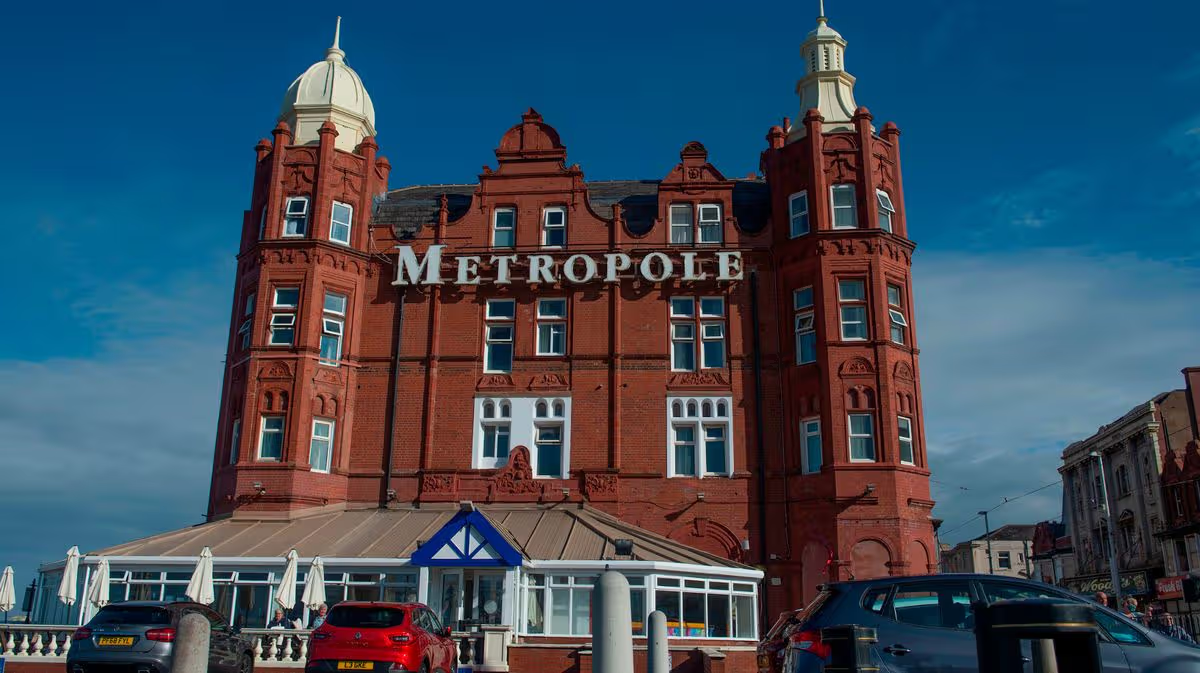
Blackpool’s Metropole Hotel has been used as asylum seeker accommodation for five years

The Britannia Metropole Hotel in Blackpool

The Britannia Metropole Hotel in Blackpool(Image: Lancs Live)

The owners of Blackpool’s Metropole Hotel have responded after calls were made to ‘restore it to former glory’ following almost five years as a base for asylum seekers.

Advertisement

Last week the Home Office confirmed that migrants currently living in the seafront property have been given notice to leave in July.

After welcoming this news, Blackpool South MP Chris Webb, a long term critic of the Metropole being used to house migrants, said the locally-listed hotel should be restored as a tourist destination after the families leave.

The MP has gone as far as to set up a petition to gather backing for his calls, which is already gaining support.

The Metropole, owned by Britannia Hotels Group, is one of Blackpool’s grandest hotels architecturally and, uniquely, is the only one located on the sea side of the famous tram tracks.

Advertisement

The MP said: “The Metropole should never have lost its purpose as a tourist destination.

“No more wasted potential. No more excuses. If you care about Blackpool’s future, take 30 seconds and sign my petition. I need your support.”

Now Britannia has responded to the calls over the Metropole.

A spokesperson for the hotels group commented: “We welcome constructive conversation regarding the future of The Metropole Hotel in Blackpool and fully understand the local interest in restoring this iconic hotel as a community asset.

Advertisement

“We are currently reviewing our options while giving due consideration to local perspectives, and we will share further updates with the community once a plan has been finalised.”

Former hotelier and StayBlackpool director Ian White praised the hotel group’s work in the resort and said: “I very much appreciate the immense effort the Britannia group has made across Blackpool and I trust the same ethos with follow at the Metropole once it is returned to the Britannia Group.

“With the end date stated as sometime in July, there must be a period of refurbishment before the rooms are returned to general holiday use.

“With Blackpool having such an extreme oversupply of holiday bed spaces we desperately need Chris Webb to deliver the promised Short Stay Accommodation registration scheme as a matter of urgency,

Advertisement

“It is appreciated this will take time to roll out in a way that it can deliver a credible scheme, plus clarity on the powers that will be provided to the council to protect the public from unfit, possibly dangerous properties.”

Mr Webb has denied suggestions on social media that the migrants would move on to another local hotel after leaving the Metropole, stating that they would be sent to other locations on Serco sites across the country or in new-build military bases.

Mr Webb’s petition can be found at https://www.chriswebb.org/news/petition-reopen-the-metropole-hotel-as-a-tourist-destination-for-blackpool

To find all the planning applications, traffic diversions, road layout changes, alcohol licence applications and more in your community, visit the Public Notices Portal.

Advertisement
Continue Reading

Business

Investors react to BOJ’s decision to hold rates

Published

on

Investors react to BOJ’s decision to hold rates


Investors react to BOJ’s decision to hold rates

Continue Reading

Business

BOJ keeps rates steady but 3 board members dissent, call for hike

Published

on

BOJ keeps rates steady but 3 board members dissent, call for hike


BOJ keeps rates steady but 3 board members dissent, call for hike

Continue Reading

Business

Top 10 AI Companies Leading New Zealand’s Tech Boom in 2026

Published

on

Artificial Intelligence / AI

AUCKLAND — New Zealand’s artificial intelligence sector is experiencing explosive growth in 2026, with a wave of innovative startups and established players driving advancements in agritech, healthcare, customer experience, and maritime intelligence, positioning the country as a rising force in the global AI landscape.

Artificial Intelligence / AI
Top 10 AI Companies Leading New Zealand’s Tech Boom in 2026
BoliviaInteligente / Unsplash

From autonomous digital humans to precision farming tools and advanced analytics platforms, Kiwi AI companies are attracting international investment and talent while solving real-world problems unique to New Zealand’s economy and environment. Here are the top 10 AI companies making the biggest impact this year, based on innovation, funding, market traction and industry influence.

1. Soul Machines (Auckland/Wellington) Soul Machines remains New Zealand’s AI flagship. The company, known for creating autonomously animated “digital people” with emotional intelligence, continues to lead in humanized AI interfaces. Its technology powers customer service avatars for major banks, healthcare providers and retailers worldwide. In 2026, Soul Machines expanded its emotionally intelligent agents with improved real-time responsiveness and cultural adaptability, securing major enterprise contracts across Asia-Pacific. The company’s biologically inspired models are considered among the most advanced in conversational AI globally.

2. Halter (Auckland) Halter solidified its status as New Zealand’s first agritech unicorn with its AI-powered virtual fencing systems for cattle. Using solar-powered collars and sophisticated algorithms, Halter enables farmers to manage herds remotely, improving animal welfare and pasture utilization. The company raised significant funding in 2025 and expanded internationally in 2026. Its technology is now used on thousands of farms, demonstrating how AI can transform traditional industries like agriculture, which remains vital to New Zealand’s economy.

3. Yabble (Auckland) Yabble has emerged as a leader in insight-driven AI analytics. The platform uses generative AI to automate qualitative research and data interpretation, helping brands extract actionable insights from customer feedback at scale. In 2026, Yabble launched new features for real-time sentiment analysis and predictive trend modeling, winning major clients in retail and consumer goods. Its user-friendly interface has made advanced AI accessible to non-technical teams.

Advertisement

4. Thematic (Auckland) Thematic specializes in AI-powered customer experience analytics. Its platform automatically analyzes feedback from surveys, reviews, and support interactions to identify themes and trends. The company reported strong growth in 2026 as businesses increasingly prioritize customer intelligence. Thematic’s ability to turn unstructured data into strategic insights has made it a go-to solution for enterprises seeking to improve retention and satisfaction.

5. Starboard Maritime Intelligence (Auckland) Starboard leverages AI for maritime domain awareness, using satellite data and machine learning to track vessels, detect illegal fishing, and enhance maritime security. The company has gained international recognition for its work supporting Pacific Island nations and environmental monitoring. In 2026, Starboard expanded its predictive analytics capabilities, helping governments and commercial fleets optimize routes and reduce environmental impact.

6. Arcanum AI (Wellington) Arcanum AI focuses on explainable AI for regulated industries. Its platform helps organizations deploy transparent machine learning models in finance, healthcare, and government sectors. The company’s emphasis on ethics and auditability has driven adoption among institutions requiring compliance and trustworthiness. Arcanum reported strong revenue growth in 2026 as demand for responsible AI solutions increased globally.

7. Custom D (Christchurch) Custom D delivers tailored AI solutions for insurance, logistics, and manufacturing. Known for practical, industry-specific applications, the Christchurch-based firm combines machine learning with deep domain expertise. In 2026, it launched new computer vision tools for quality control and risk assessment, helping clients reduce costs and improve safety.

Advertisement

8. Quantiful (Auckland) Quantiful uses AI to optimize retail and e-commerce operations through demand forecasting and personalized recommendations. The company’s technology helps retailers reduce waste and improve customer experiences. Strong partnerships with major New Zealand and Australian brands have fueled steady growth throughout 2026.

9. Avertana (Auckland) Avertana applies AI to resource recovery and circular economy solutions. Its intelligent systems identify and sort materials for recycling with high accuracy. The company’s work supports New Zealand’s sustainability goals and has attracted international interest from waste management firms seeking smarter processing technologies.

10. NextWork (Auckland) NextWork focuses on AI-driven workforce upskilling and talent development. Its platform uses adaptive learning algorithms to create personalized training programs for companies undergoing digital transformation. The company raised significant funding in 2025-2026 to expand globally, capitalizing on the growing need for AI literacy in the workforce.

New Zealand’s AI Ecosystem Thrives

Advertisement

New Zealand’s AI sector benefits from strong government support, world-class universities (particularly the University of Auckland and University of Otago), and a collaborative startup culture. The country’s focus on ethical AI, combined with expertise in agriculture, environmental science, and healthcare, has created unique advantages in vertical AI applications.

Investment in AI startups has surged, with venture capital firms showing strong interest in companies addressing climate challenges, sustainable agriculture, and responsible technology development. Auckland remains the primary hub, but innovation is spreading to Wellington, Christchurch, and Dunedin.

Challenges remain, including talent retention (many graduates are lured overseas by higher salaries) and access to large-scale computing infrastructure. However, partnerships with international tech giants and a growing emphasis on domestic capability building are helping address these gaps.

Future Outlook

Advertisement

As 2026 progresses, New Zealand’s AI companies are poised for even greater impact. The combination of technical excellence, ethical focus, and practical problem-solving positions the country well in the global AI race. From Soul Machines’ empathetic digital humans to Halter’s intelligent farming systems, Kiwi innovation is proving that smaller nations can lead in specialized, high-value AI applications.

For businesses and investors looking at the AI space, New Zealand offers a compelling mix of cutting-edge technology, stable governance, and a collaborative ecosystem. The top 10 companies listed here represent only a fraction of the talent and ambition emerging from this South Pacific tech powerhouse. As the year unfolds, expect more breakthroughs from these leaders and the next wave of startups following closely behind.

Continue Reading

Business

Singapore's Centurion Corporation swoops on second Pilbara property

Published

on

Singapore's Centurion Corporation swoops on second Pilbara property

A Singaporean real estate investment trust has splashed $28 million on a Port Hedland apartment block one week after entering the Pilbara with its first acquisition in Karratha.

Continue Reading

Business

Suspect in Washington dinner shooting charged with trying to assassinate Trump

Published

on

Suspect in Washington dinner shooting charged with trying to assassinate Trump


Suspect in Washington dinner shooting charged with trying to assassinate Trump

Continue Reading

Business

How RX Pros Is Reshaping Telehealth Access

Published

on

How RX Pros Is Reshaping Telehealth Access

A Faster Path to Care in a Digital World

In today’s healthcare system, speed and access often feel out of reach. Long wait times, insurance hurdles, and limited provider availability can slow everything down. That gap is where RX Pros found its opportunity.

“People don’t want to wait weeks just to get basic treatment,” a company representative explains. “They want something simple, fast, and reliable.”

RX Pros, also known as RX Pros, operates as a telehealth marketplace. It connects patients with licensed providers and pharmacies. The goal is not to replace healthcare providers, but to streamline how patients reach them.

From the start, the focus has been clear. Remove friction. Keep the process simple. Make care easier to access.

Advertisement

From Traditional Barriers to a New Model

The company’s approach reflects a broader shift in healthcare. Instead of building clinics or hiring full-time medical staff, RX Pros chose a marketplace model.

“We’re not the doctor. We’re not the pharmacy,” the team says. “We sit in the middle and make the process work better.”

This distinction matters. The platform does not provide direct medical care or dispense medication. Instead, it coordinates the steps that usually slow patients down.

The process begins with an online health questionnaire. A licensed provider reviews the case remotely. If appropriate, a prescription is issued. From there, a third-party pharmacy handles fulfillment and shipping.

Advertisement

“No waiting rooms. No scheduling conflicts,” they add. “Just a process that moves.”

This model allows the company to scale without the overhead of traditional healthcare systems. It also reflects how modern users expect services to work. Fast. Digital. On demand.

Why GLP-1 Weight Loss Became the Focus

While the platform supports several treatment categories, one area stands out: medical weight loss.

RX Pros has built much of its growth around GLP-1 medications, including compounded semaglutide and tirzepatide.

Advertisement

“We saw a huge demand for weight loss solutions that people could actually access,” the company shares. “Not everyone can afford or get approved for brand-name options.”

This gap created an opening. By focusing on compounded alternatives and telehealth delivery, the platform offers another pathway for patients seeking treatment.

But the company does not limit itself to one category. It also supports other common needs like erectile dysfunction, hair loss, and hormone therapy.

Still, weight loss remains the core driver.

Advertisement

“It’s where the need is highest right now,” they explain. “And where we can make the biggest impact.”

How the Online Process Actually Works

The system is designed to be simple. Each step removes a traditional barrier.

First, the patient fills out an online questionnaire. This replaces the initial office visit. Next, a licensed provider reviews the information. Depending on state rules, communication may happen through messaging, audio, or video.

Advertisement

“If it’s approved, the prescription moves forward right away,” they say.

From there, a compounding pharmacy prepares and ships the medication directly to the patient.

The entire process can happen without an in-person visit.

“We built this for people who don’t have time to navigate the old system,” the team explains. “Or who simply want a more private experience.”

Advertisement

This structure also supports users who may not have insurance coverage. The platform operates on a cash-pay model, with revenue coming from consultation fees and program subscriptions.

A Business Built Around Convenience and Speed

At its core, RX Pros is not trying to reinvent medicine. It is trying to improve access.

The company’s value proposition centers on four ideas: convenience, speed, affordability, and accessibility.

“Everything we do ties back to those four things,” they say.

Advertisement

Convenience comes from the fully online process. Speed comes from rapid approvals and delivery. Affordability is addressed through lower-cost alternatives. Accessibility comes from removing insurance and referral requirements.

“We’re not adding complexity,” they note. “We’re taking it away.”

This approach aligns with trends across digital health. Patients are increasingly comfortable managing care online. They expect the same ease they get from other digital services.

RX Pros is built around that expectation.

Advertisement

Positioning in a Growing Telehealth Market

The telehealth space has grown quickly in recent years. Many platforms now offer virtual care, but not all follow the same model.

RX Pros stands out by acting as a connector rather than a provider.

“That middle layer is where we operate,” the team says. “We bring the right pieces together.”

This positioning allows flexibility. The company can work with a network of independent providers and pharmacies. It can adapt to changes in regulations and demand without restructuring its entire operation.

Advertisement

It also keeps the focus on process efficiency.

“Our role is to make the system smoother,” they explain. “Not to replace the people in it.”

What Comes Next for RX Pros

Looking ahead, the company remains focused on refining its model. The demand for telehealth is not slowing down, and neither is the need for accessible treatment options.

“There’s still a lot of friction in healthcare,” they say. “We’re just getting started on removing it.”

Advertisement

RX Pros continues to build around its core strengths. Fast access. Digital simplicity. Scalable infrastructure.

In a space filled with complexity, the company’s approach is direct.

“Keep it simple,” they emphasize. “That’s what people actually want.”

Advertisement

Continue Reading

Business

Hut 8 prices $3.25 billion notes for data center project

Published

on


Hut 8 prices $3.25 billion notes for data center project

Continue Reading

Business

Firms postpone D-Street debut as uncertainty clouds market outlook

Published

on

Firms postpone D-Street debut as uncertainty clouds market outlook
Mumbai: Dozens of companies are going slow on plans to launch initial public offerings (IPOs), deterred by volatile investor sentiment and subsequent impact on market valuations. The calendar year started on a brisk note, with 18 mainboard IPOs collectively raising ₹18,778 crore in the March quarter, with the issues’ tally doubling from the year before, when companies raised ₹15,723 crore. The momentum has since tapered off, as the West Asia conflict sapped investor confidence. So far in April, there has been just one mainboard IPO launch, which raised ₹150 crore.

“The uncertainty in India’s IPO market is expected to remain at least for the next two to three months, depending on how the geopolitical crisis plays out,” said Prashant Singhal, partner and India markets leader at EY.

Meanwhile, the market sell-off in March and a foggy outlook prompted influential institutional investors – usually anchors of IPOs – to push back companies on valuations. “There is a mismatch in valuation expectations of issuers and investors,” said Nilesh Shah, managing director at Kotak Mutual Fund. “Issuers want the pre-war valuation. Investors want post-war valuation. As soon as east meets west, activity will pick up.”

Data from Prime Database revealed a robust IPO pipeline. As of April 17, as many as 146 companies have received Securities and Exchange Board of India (Sebi) approval to raise a total of ₹2.11 lakh crore.

Advertisement
Screenshot 2026-04-28 061938Agencies

Valuation Discipline
Of this, approvals of 43 companies are valid only till September. Another 84 companies are awaiting approval to collectively raise ₹1.75 lakh crore.


Valuation discipline is becoming more prominent, with greater emphasis now being placed on pricing relative to fundamentals, said Swarup Mohanty, vice chairman and chief executive at Mirae Asset Mutual Fund.
In the current scenario, prospective IPO issuers are also taking a pause to frame their offer documents on March-end audited financials, which offer a longer validity period, said investment bankers.”December audited numbers are valid only till June; hence most issuers prefer March financials in the document as they are valid till September,” said Dharmesh Mehta, MD and CEO, DAM Capital Advisors. “One should expect IPO launches starting in June, by then, hopefully, the global volatility will settle down.”

Sebi rules allow companies to go public only with up to six-month old financial data. IPO-bound firms with December quarter as the latest earnings data period in their draft red herring prospectus must launch their IPOs by June.

The market regulator earlier this month gave these companies a one-time relaxation, extending the validity of its IPO approvals in a bid to ease fundraising pressures. It said clearances expiring between April 1 and September 30 will now remain valid until September 30.

Continue Reading

Trending

Copyright © 2025