








Connect with us

Business

Is Dubai International Airport Open? Airport Operates on Limited Basis

Published

on

Dubai International Airport

Dubai International Airport (DXB), the world’s busiest hub for international passengers, remains partially operational as of March 4, 2026, with only a restricted number of flights permitted amid ongoing airspace closures and security concerns stemming from the escalating Middle East conflict involving U.S., Israeli and Iranian military actions.

Dubai International Airport

Dubai Airports, the operator of DXB and the secondary Al Maktoum International Airport (DWC), confirmed that limited operations resumed on the evening of March 2 following a near-total suspension that began February 28. However, major carriers including flagship Emirates have extended the halt on all regular scheduled commercial flights to and from Dubai until 23:59 UAE time on March 4, prioritizing only select repatriation, cargo and repositioning services.

In its latest advisory on the official dubaiairports.ae website, Dubai Airports stated: “Limited airport operations have resumed with a small number of flights operating from DXB and DWC.” The authority urged passengers not to proceed to either airport unless directly contacted by their airline with a confirmed departure time, emphasizing that schedules remain highly fluid and subject to change based on regional airspace availability.

Emirates, which accounts for the majority of DXB traffic, reinforced the message in travel updates: “All scheduled Emirates flights to and from Dubai remain suspended until 2359hrs UAE time on 4 March, due to airspace closures across the region.” The airline noted it is operating a limited number of passenger repatriation and freighter flights on March 3 and 4, with priority given to earlier bookings. Flydubai and other carriers have aligned with similar restrictions.

The disruptions trace back to precautionary airspace measures implemented by the UAE General Civil Aviation Authority following retaliatory strikes and heightened tensions. Neighboring countries including Qatar, Bahrain, Kuwait and others imposed comparable closures, creating a broad no-fly corridor that severed typical flight paths. Flight-tracking platforms like Flightradar24 and FlightAware report over 12,300 cancellations across seven major Gulf airports from February 28 through March 3, with DXB among the most impacted. More than 80% of scheduled flights to and from Dubai have been axed in recent days, contributing to a regional total exceeding thousands of affected services and stranding tens of thousands of passengers globally.

Advertisement

Despite the constraints, some activity has returned. Limited departures and arrivals — often focused on repatriation efforts for stranded nationals — have operated since March 2 evening. Examples include select long-haul repatriation flights coordinated under strict safety protocols. However, routine commercial traffic remains heavily curtailed, with most international carriers rerouting or canceling connections through the Gulf.

The situation has ripple effects worldwide. Airlines such as Air France, KLM, Air Canada and United have suspended or adjusted services to Dubai and other regional points through early March or beyond. Governments and travel advisories urge caution, with many recommending against non-essential travel to the UAE until stability returns.

Dubai Airports continues close coordination with authorities to prioritize safety while facilitating essential movements. A prior update noted minor damage to a concourse at DXB from an earlier incident, quickly contained without broader operational impact. No major new incidents have been reported since the limited resumption.

Travelers planning to use Dubai International Airport should:

Advertisement

– Verify flight status directly via airline channels, the Emirates website or dubaiairports.ae flight information pages.
– Avoid traveling to the airport without explicit airline confirmation to prevent overcrowding and security bottlenecks.
– Monitor real-time tools like FlightAware or Flightradar24 for live updates on arrivals, departures and delays.
– Prepare for rebookings, refunds or alternative routing, as flexible waiver policies remain in effect from many carriers.
– Check government travel warnings, as evolving airspace rules could further restrict even limited operations.

Industry analysts describe the current phase as a “phased recovery” rather than full normalization, with potential for incremental increases in permitted flights if de-escalation progresses. Dubai’s position as a global transit powerhouse — handling over 90 million passengers annually pre-crisis — makes its constrained status particularly disruptive to worldwide connectivity.

As the region navigates these challenges, DXB’s partial functionality underscores efforts to maintain a lifeline for essential travel amid widespread closures elsewhere. Full resumption hinges on broader security developments, with authorities pledging ongoing updates.

For now, Dubai International Airport stands technically open but far from business as usual, processing only approved movements in a tightly controlled environment.

Advertisement
Continue Reading
Click to comment

Leave a Reply

Your email address will not be published. Required fields are marked *

Business

Private label reformulation trends

Published

on

Private label reformulation trends

Study finds retailers are reformulating a wide range of categories.

Continue Reading

Business

Private sector adds 63,000 jobs in February: ADP

Published

on

Private sector adds 63,000 jobs in February: ADP

Companies in the private sector added 63,000 jobs in February, payroll processing firm ADP said Wednesday.

The figure is above economists’ estimates of a gain of 50,000 jobs. The prior month’s payrolls number was revised lower to a gain of just 11,000 from an initially reported gain of 22,000.

Advertisement

“We’ve seen an increase in hiring and pay gains remain solid, especially for job-stayers,” said Nela Richardson, ADP chief economist. “But with hiring concentrated in only a few sectors, our data shows no widespread pay benefit from changing jobs. In fact, the pay premium for switching employers hit a record low in February.”

A construction worker hammers a beam

A construction worker hammers a beam while renovating a road in the Union Market district in Washington, DC, US, on Friday, Sept. 8, 2023. US employment gains will slow significantly and be more concentrated across few sectors in the decade through 2 (Al Drago/Bloomberg via Getty Images / Getty Images)

STANLEY BLACK & DECKER TO CUT HUNDREDS OF JOBS, SHUT CONNECTICUT PLANT

Education and health services added 58,000 positions, leading job creation in February. Construction added 19,000, information gained 11,000 and other services added 6,000.

A professor giving a lecture to her class.

A professor talks to a group of students in a lecture hall. (iStock)

Financial activities added 2,000 jobs, natural resources and mining gained 2,000 and leisure and hospitality added 1,000 positions.

Advertisement

DEADLIEST JOBS IN AMERICA REVEALED

On the negative side, professional and business services lost 30,000 jobs. Manufacturing lost 5,000 positions and trade, transportation and utilities lost 1,000.

Auto manufacturing

Manufacturing lost 5,000 positions in December, ADP said. (Emily Elconin/Bloomberg via Getty Images)

EBAY CUTS 800 JOBS ACROSS COMPANY OPERATIONS JUST DAYS AFTER DROPPING $1.2B ON TRENDY GEN Z FASHION APP

Large businesses – those with 500 or more employees – added 10,000 jobs in February. Businesses with 50 to 499 employees lost 7,000 workers. Establishments with fewer than 50 employees added 60,000 jobs.

Advertisement

CLICK HERE TO GET FOX BUSINESS ON THE GO

Wage growth in February was little changed from last month. People staying in their roles saw their pay climb 4.5% from the prior year, while pay gains for those changing their jobs fell slightly to 6.3% from 6.4% in January.

Continue Reading

Business

VCI Global stock surges 40% on Malaysia AI computing center

Published

on


VCI Global stock surges 40% on Malaysia AI computing center

Continue Reading

Business

Energy shock raises margin risks for EU chemicals, JPM warns

Published

on


Energy shock raises margin risks for EU chemicals, JPM warns

Continue Reading

Business

Newcastle and Gateshead to showcase transformative schemes on world stage at Mipim 2026

Published

on

Business Live

‘Newcastle is rivalling cities across the world when it comes to setting the standard for development and regeneration’

A concept image showing new apartment blocks surrounded by a garden built on a disused railway line

Plans for the redevelopment of the Forth Goods Yard next to Central Station in Newcastle upon Tyne. (Image: 5plus Architects/blocwork/Platform 4)

Newcastle and Gateshead are gearing up to showcase their portfolio of projects to the world at this month’s prime property event Mipim. Mipim 2026 will see more than 20,000 international delegates, including real estate investors, developers and civic leaders gather in Cannes from March 9 to 13 for the annual networking event.

This year the delegation is set to shine a light on transformative schemes including Pilgrim Street in Newcastle and Baltic Quarter in Gateshead. Organisers say culture-led regeneration, investment in knowledge-intensive industries and placemaking are the key themes for Invest Newcastle, the public and private partnership delivered by NewcastleGateshead Initiative.

The Newcastle delegation will be joined by Newcastle City Council, Gateshead Council as well as Eldon Square, NCG, Ryder Architecture, Avison Young, FaulknerBrowns, Legends Global, Rolton, Aptus, Atkins Realis, CAA ICON, Hanro, igloo, Naylors, NE1, North East Combined Authority, Todd Milburn and Ward Hadaway.

One Founders Place has been described as the landmark office development at Stephenson Quarter.

One Founders Place could be the next piece of Newcastle Stephenson Quarter to take shape.(Image: Allford Hall Monaghan Morris )

Invest Newcastle will host a three-day programme of panel discussions, presentations, and networking events on their pavilion, highlighting the region’s growing strengths in the creative and cultural sectors, retail, and knowledge-intensive industries such as life sciences and space.

Advertisement

The programme will provide a unique platform to connect with global decision-makers and industry leaders who will share insights and learnings. Speakers on the programme hail from the likes of the New York City Housing Authority, Birmingham City Football Club, Cambridge Innovation Centre and Homes England.

With the overall Mipim theme of ‘Housing Matters’, key residential schemes such as Forth Yards and MetroGreen will be discussed in two panels on the Wednesday and Thursday. Other discussions include shaping cities with Gen Z, delivering lab spaces that lead to medical discoveries, fuelling the AI boom and exploring the space industry.

Pam Smith, chief executive of Newcastle City Council, said: “This year’s programme is a real reflection of the city’s ambitions and how far we have come. Newcastle is rivalling cities across the world when it comes to setting the standard for development and regeneration.

“We understand the clear links between designing the future, the built environment, and the creative industries and MIPIM is one of the key platforms for us to showcase Newcastle and Gateshead’s story. I am looking forward to having conversations with investors from around the world with a shared vision for how we can continue to shape the future of Newcastle, ensuring we are creating a globally competitive place that delivers for our residents.”

Advertisement

Last year saw the North East delegation highlight revamped plans for the former Premier Inn Hotel in Newcastle, with a hotel, housing, bars and restaurants, amongst its prime property opportunities.

To find all the planning applications, traffic diversions, road layout changes, alcohol licence applications and more in your community, visit the Public Notices Portal.

Continue Reading

Business

Dollar rally pauses; investors jittery over energy price surge

Published

on

Dollar rally pauses; investors jittery over energy price surge


Dollar rally pauses; investors jittery over energy price surge

Continue Reading

Business

Bath & Body Works Reports Lower Profit

Published

on

Bath & Body Works Reports Lower Profit

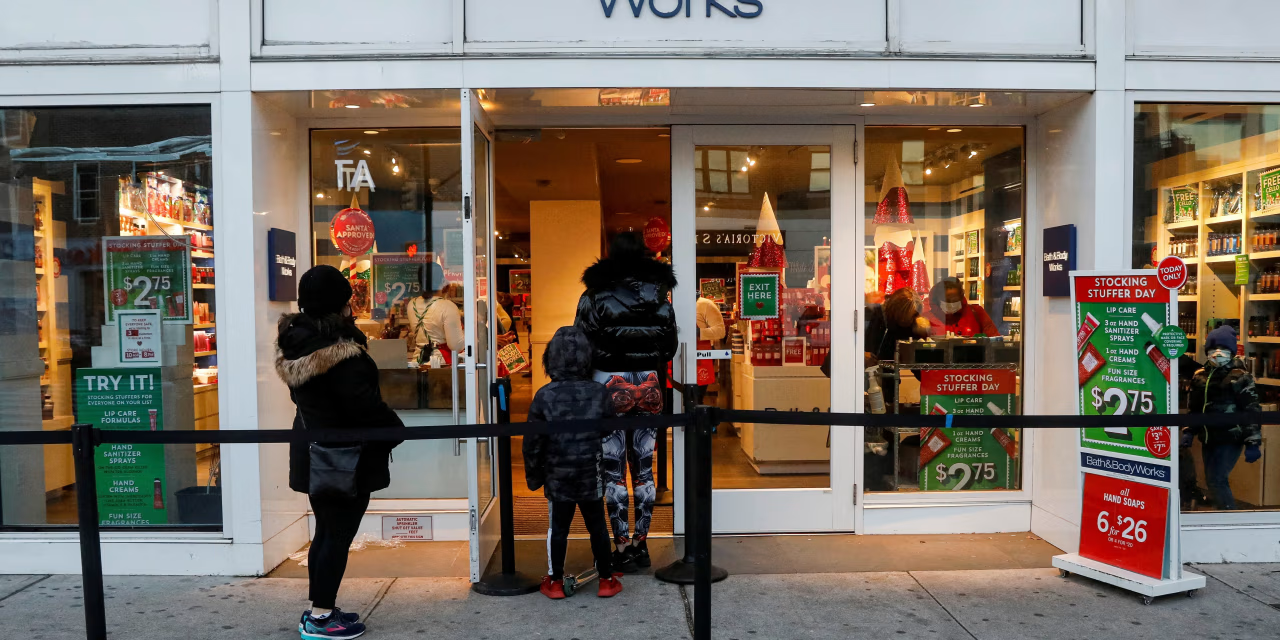
Bath & Body Works BBWI 1.77%increase; green up pointing triangle reported lower fourth-quarter profit, but said its strategy pivot to refocus on its core products was making progress.

The personal-care retailer posted net income of $403 million, or $1.99 a share, down from $453 million, or $2.09 a share, the year prior. Analysts polled by FactSet expected $1.78 a share.

Copyright ©2026 Dow Jones & Company, Inc. All Rights Reserved. 87990cbe856818d5eddac44c7b1cdeb8

Continue Reading

Business

Metro Bank profit hits 15-year high as SME lending surges

Published

on

Business Live

Shares soared as FTSE 250 lender swung to £98m profit

A general view of a Metro Bank in Sheffield.

A Metro Bank branch in Sheffield(Image: PA)

Metro Bank has returned to the black as the firm’s shift towards small business lending delivered a boost in revenue.

Advertisement

The FTSE 250 lender posted a pre-tax profit of just over £98m – a 15-year peak and significant turnaround from losses of £14m the previous year.

The reversal arrived as Metro recorded 67 per cent growth in new corporate, commercial and small and medium-sized enterprise (SME) lending – a sector the bank has targeted as central to its recovery plan.

Shares in the company climbed as much as seven per cent following the announcement to 122.36p. Over the past 12 months, the stock has gained more than 40 per cent.

Turnover at the firm increased 16 per cent to just above £585m as lending in the group’s focus segment expanded 56 per cent year-on-year to £5.2bn, as reported by City AM.

Advertisement

Metro is amongst several banks that have moved into the SME lending market amid a retreat from industry heavyweights, with the sector typically delivering higher margins for lenders as they can command elevated interest rates.

The segment also emphasises relationship-building with businesses compared to lending to large corporations, which can seek the most competitive debt globally.

“We are capturing market share in our target segments and have a deep pipeline of attractive lending opportunities,” said Daniel Frumkin, Metro’s chief executive.

He noted that the bank’s emphasis on the “execution of our strategy and pivot to high margin business” had contributed to a surge in profits whilst reducing expenses.

Advertisement

Operating costs plummeted seven per cent year-on-year to £473m, surpassing previous predictions of a four to five per cent decrease.

The bank has outlined plans for its return on tangible equity – a crucial measure of profitability – to more than double from the current level of 6.4 per cent over the forthcoming 6 months and nearly triple over 18 months.

The lender is also anticipated to greatly benefit from the alterations to the MREL regime announced in Rachel Reeves’ regulatory reforms at Mansion House last year.

Established in the aftermath of the 2008 financial crisis, minimum requirement for own funds and eligible liabilities (MREL) rules impose strict tailored requirements for banks with assets between £15-25bn. The Bank of England is poised to raise the threshold following consultation.

Advertisement

Metro has been reclassified as a transfer firm under the system, a move that liberates the bank’s balance sheet with reduced costs. The company stated it unlocks “significant capacity for growth”.

Continue Reading

Business

GameStop (GME) Shares Edge Lower in Quiet Trading as Ryan Cohen Eyes Transformative Acquisition

Published

on

GameStop (GME) Shares Edge Lower in Quiet Trading as Ryan

GameStop Corp. (NYSE: GME) shares closed modestly lower Tuesday, reflecting cautious investor sentiment as the video game retailer navigates a strategic pivot under CEO Ryan Cohen while facing persistent challenges in its core brick-and-mortar business.

GameStop (GME) Shares Edge Lower in Quiet Trading as Ryan
GameStop (GME) Shares Edge Lower in Quiet Trading as Ryan Cohen Eyes Transformative Acquisition

GME ended at $23.82, down $0.38 or 1.57% from Monday’s close of $24.20. The stock opened at $23.78, traded in a narrow range between $23.45 and $24.17, and saw volume of about 4.1 million shares — near the recent average but below the frenzied levels of past meme-stock surges. After-hours trading showed a slight dip to around $23.74-$23.76.

The decline came amid broader market volatility tied to geopolitical tensions in the Middle East, though GME’s moves appeared more company-specific. The retailer has been in the spotlight for Cohen’s aggressive transformation efforts, including a massive performance-based compensation package approved in January 2026 and speculation about a blockbuster acquisition using its substantial cash reserves.

Cohen, who became chairman in 2021 and CEO shortly after, received a long-term incentive award potentially worth up to $35 billion, contingent on elevating GameStop’s market capitalization to $100 billion and achieving $10 billion in cumulative performance EBITDA. The package is entirely “at-risk,” with no base salary, aligning Cohen’s interests tightly with shareholders. He has personally invested heavily, including back-to-back purchases of 500,000 shares each in January at around $21 per share, boosting his stake to about 9.2% and signaling confidence in the turnaround.

In a January interview with The Wall Street Journal, Cohen outlined ambitions to grow GameStop from an $11 billion company into one valued over $100 billion through a “very big” acquisition of a publicly traded firm, likely in consumer or retail sectors. Speculation has centered on targets like eBay, though no deal has materialized. Analysts note the move could diversify beyond declining physical game sales, but risks remain high — a misstep could erode the cash hoard built from meme-stock rallies and share offerings.

Advertisement

GameStop ended fiscal 2025 with roughly $8.8 billion in cash and equivalents, bolstered by strategic capital raises in prior years. The balance sheet strength provides flexibility, but revenue trends weigh on sentiment. The company has accelerated store closures in 2026, with nearly 500 locations marked for shutdown across dozens of states as digital downloads and streaming erode demand for physical media. Circana projects modest U.S. video game spending growth of 3% to $62.8 billion in 2026, but traditional retail faces headwinds.

Despite challenges, Cohen’s vision draws comparisons to activist investors like Warren Buffett, though some critics argue the meme-stock label and volatility disconnect price from fundamentals. Michael Burry, the “Big Short” investor, disclosed a long-term position in January 2026, sparking a brief rally, but momentum faded.

Analyst coverage remains sparse and mixed. Consensus leans toward “hold” or “sell,” with average 12-month targets around $13.50 to $26, implying limited near-term upside from current levels. Some forecasts, like Long Forecast’s mechanical projection, see potential for $31 by year-end 2026 if trends hold, while others warn of downside to the low $20s amid execution risks.

The stock’s 52-week range spans $19.93 to $35.81, with the high hit in May 2025 during a brief resurgence. Year-to-date in 2026, shares are roughly flat to modestly positive after early volatility, trading well below 2021 peaks above $80 (pre-split adjusted). Market capitalization hovers near $10.67 billion, with about 448 million shares outstanding.

Advertisement

GameStop’s next earnings report is expected around late March 2026 for the fiscal fourth quarter. Investors will watch for updates on acquisition talks, cash deployment, and progress toward Cohen’s ambitious targets. For now, the stock remains a high-risk, high-reward play driven by leadership vision rather than steady retail performance.

As Cohen pursues his consumer megadeal strategy, GameStop continues to straddle its meme-stock past and a potential new chapter as a diversified holding company. Whether the gamble pays off will depend on execution in an evolving gaming landscape.

Continue Reading

Business

Big investors exiting for-sale housing market, even before Trump ban

Published

on

Big investors exiting for-sale housing market, even before Trump ban

In an aerial view, two-story single family homes line the streets on Jan. 14, 2026 in Thousand Oaks, California.

Kevin Carter | Getty Images

Legislation to ban institutional investors from buying single-family homes to rent is making its way through Congress, but many of them are already selling thousands of homes — and have been for two years.

Advertisement

Research from housing data and analytics firm Parcl Labs shows that the largest investors are now net sellers of homes.

In every major metropolitan housing market, investors make up a larger share of for-sale listings than they do of the total housing stock. In some cities, like Dallas, Philadelphia and Houston, they are selling most aggressively. Dallas investors own 9.2% of the housing stock but account for 22.8% of new for-sale listings.

FirstKey Homes appears to be most motivated, with more than twice the listings of its peers, according to Parcl. It is also offering much deeper price cuts, an average 10% off original list prices, and is reducing prices about every 20 days.

“It’s a volatile housing market, and folks are trying to take risk off the table,” said Jason Lewris, co-founder of Parcl Labs. He noted that rents are not holding up relative to what investors can get if they sell.

Advertisement

“So it’s better risk-adjusted returns to just get that cash and see how things pan out,” he said.

In its latest quarterly earnings release for the fourth quarter of 2025, Invitation Homes, one of the largest publicly traded landlords, reported that all 368 of its wholly owned acquisitions were newly constructed homes purchased from various homebuilders. It reported selling 315 existing homes.

For the full-year 2025, Invitation reported “almost all” of its 2,410 wholly owned acquisitions were bought through homebuilder relationships, while it sold 1,356 wholly owned homes, “frequently to families purchasing for their own use.”

In an effort to make housing affordable, in late January, President Donald Trump signed an executive order aimed at restricting large, institutional investors from buying single-family homes to use as rentals. He put an exemption on purchasing new construction specifically built as rentals.

Advertisement

The White House later sent proposed legislation to Congress, saying investors owning more than 100 single-family homes would be banned from buying any more, but didn’t have to sell what they have. Senate and House bills have different volume thresholds for what constitutes large investors, but they are not far apart.

To put this in perspective, single-family rentals make up roughly 10% of U.S. housing stock, and the vast majority, 80%, are owned by so-called “mom-and-pop operators,” with fewer than 10 homes each, according to analysis from Bank of America. Smaller investors, those who own between 10 and 1,000 homes, make up 17% of landlords. Large institutional investors who own more than 1,000 homes make up just 3% of the single-family rental market.

The numbers, however, are coming down.

Investors initially flooded the market after the subprime mortgage crash that led to the Great Recession. Home prices in some markets dropped by half, and foreclosures soared. Investors bought the homes at bargain prices and turned them into lucrative rentals.

Advertisement

As the markets recovered, there were fewer entry-level homes for sale to owner-occupants, because investors focused on that segment. In some cities, like Atlanta, regular buyers couldn’t compete with investors, who usually came carrying cash. Some neighborhoods are nearly fully investor-owned.

But by 2022, even before Trump took office for the second time, investors were already in retreat, buying fewer homes, according to Parcl. Selling accelerated in late 2024, with investors in Atlanta now selling nearly two properties for every one they buy.

Get Property Play directly to your inbox

CNBC’s Property Play with Diana Olick covers new and evolving opportunities for the real estate investor, delivered weekly to your inbox.

Subscribe here to get access today.

Advertisement

The next frontier

Investors are now pivoting to build-for-rent.

Much of the net selling shift over the past few years was a natural process of recycling capital, according to Rick Palacios, director of research at John Burns Research and Consulting.

“Home prices ran up post-2020, and many single-family rental investors sold assets into a rising home price backdrop, then redeployed capital into higher-yielding build-to-rent versus buying on resale at those very high prices and elevated borrowing costs for investors too,” Palacios said. 

 Builders also adjust their prices in real time, he noted, while resale sellers don’t.

Advertisement

“This offered opportunities for investors to purchase at discounts from builders,” he added.

Invitation Homes has been buying homes from builders like Lennar but, in January, announced it had acquired Atlanta-based ResiBuilt Homes, a build-to-rent developer in high-growth markets across the Southeast. ResiBuilt was delivering about 1,000 homes per year, but Invitation Homes expects to expand that.

“One of the most constructive ways we can help is by adding more homes to the markets we serve,” said Dallas Tanner, CEO of Invitation Homes, on an earnings call last month with analysts. “While our home-builder partnerships have supported that effort for years, our acquisition of ResiBuilt expands it even further and improves our control over cost, product quality and delivery pace.”

AMH, formerly known as American Homes 4 Rent, meanwhile, has been building entire rental communities itself for several years. In its latest fourth-quarter earnings release, CEO Bryan Smith said, “Since the inception of our ground up development program, we have contributed over 14,000 newly built homes to the nation’s housing stock. Our results in 2025 and outlook for 2026 reflect continued focus on expanding the nation’s housing supply, elevating the resident experience, and creating value for all our stakeholders.”

Advertisement
Continue Reading

Trending

Copyright © 2025