

Crypto World
Cardano whales challenge rising short bets before Van Rossem fork

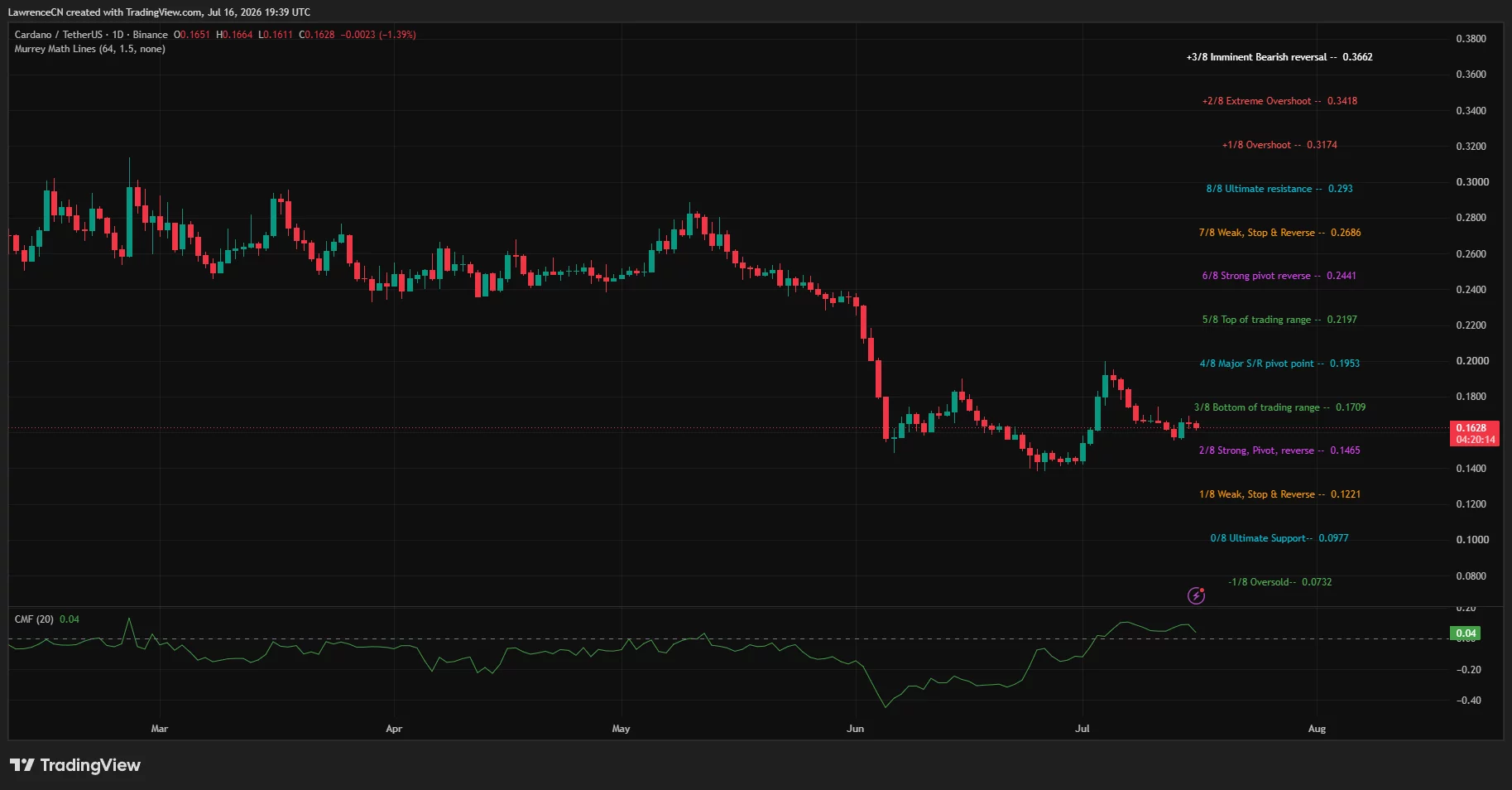
Cardano has fallen 1.39% to $0.1628 as rising short positions have outweighed whale demand two days before the Van Rossem hard fork.
Summary
- ADA fell to $0.1628 as traders increased short positions before the Van Rossem fork.
- Cardano whales accumulated ADA despite negative funding rates and rising futures open interest.
- Liquidity clusters at $0.160 and $0.170 could shape ADA’s next major move.
According to data from crypto.news, from July 16 showed ADA traded between an intraday low of $0.1611 and a high of $0.1664, extending its retreat from an early-July peak near $0.195. The decline came even as large holders accumulated ADA and Cardano prepared to activate its most important network update in years.
CoinGlass data placed ADA’s weighted funding rate at -0.0067%, indicating that traders holding short positions were paying those betting on a price increase. The long-to-short ratio stood at 0.58, while open interest rose 4% to $421 million as traders added new leveraged positions.
Those readings show that derivatives traders remained positioned for further losses before the upgrade, according to CoinGlass. However, the concentration of short bets also raises the risk of liquidations if ADA moves sharply higher.
Whale demand collides with bearish futures bets
Notably, wallets holding between 100,000 and 100 million ADA had increased their balances to the highest level since 2023. The accumulation is possible positioning by large investors before Van Rossem goes live.
Cardano’s governance approved the hard fork on July 13, according to Intersect, with activation scheduled for July 18. Intersect has also urged infrastructure providers to update their software before the network crosses the hard fork boundary.
Van Rossem is expected to lower execution costs, which would make transactions and applications cheaper to run on Cardano, according to Intersect. The update will also prepare the network for Leios, a later scaling upgrade intended to increase transaction capacity before the end of 2026.
The upgrade follows Vasil, which improved Cardano’s network performance and smart-contract efficiency when it activated on Sept. 22, 2022, according to Cardano’s official hard-fork record.
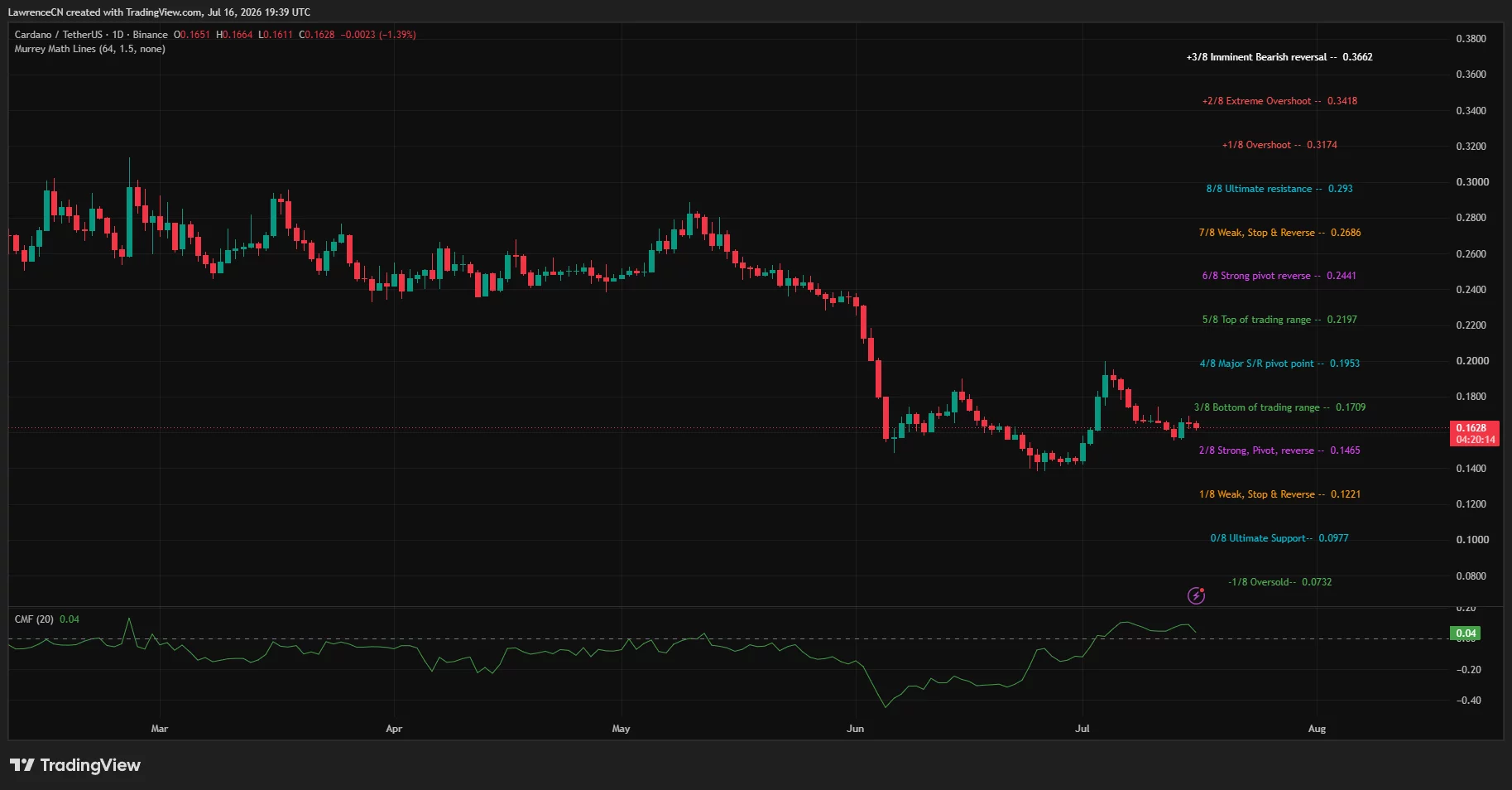
Despite the whale purchases, TradingView’s daily chart showed ADA holding below the Murrey Math resistance at $0.1709. Chaikin Money Flow remained slightly positive at 0.04, suggesting that buying pressure had not disappeared even as the token lost ground.
ADA faces liquidity pressure near $0.160
On the 4-hour chart, ADA had crossed above a descending trendline drawn from its July peak, but the move had not produced a sustained rally. TradingView’s Relative Strength Index stood at 46.92, below its moving average of 50.95, placing momentum on the bearish side of neutral without showing oversold conditions.
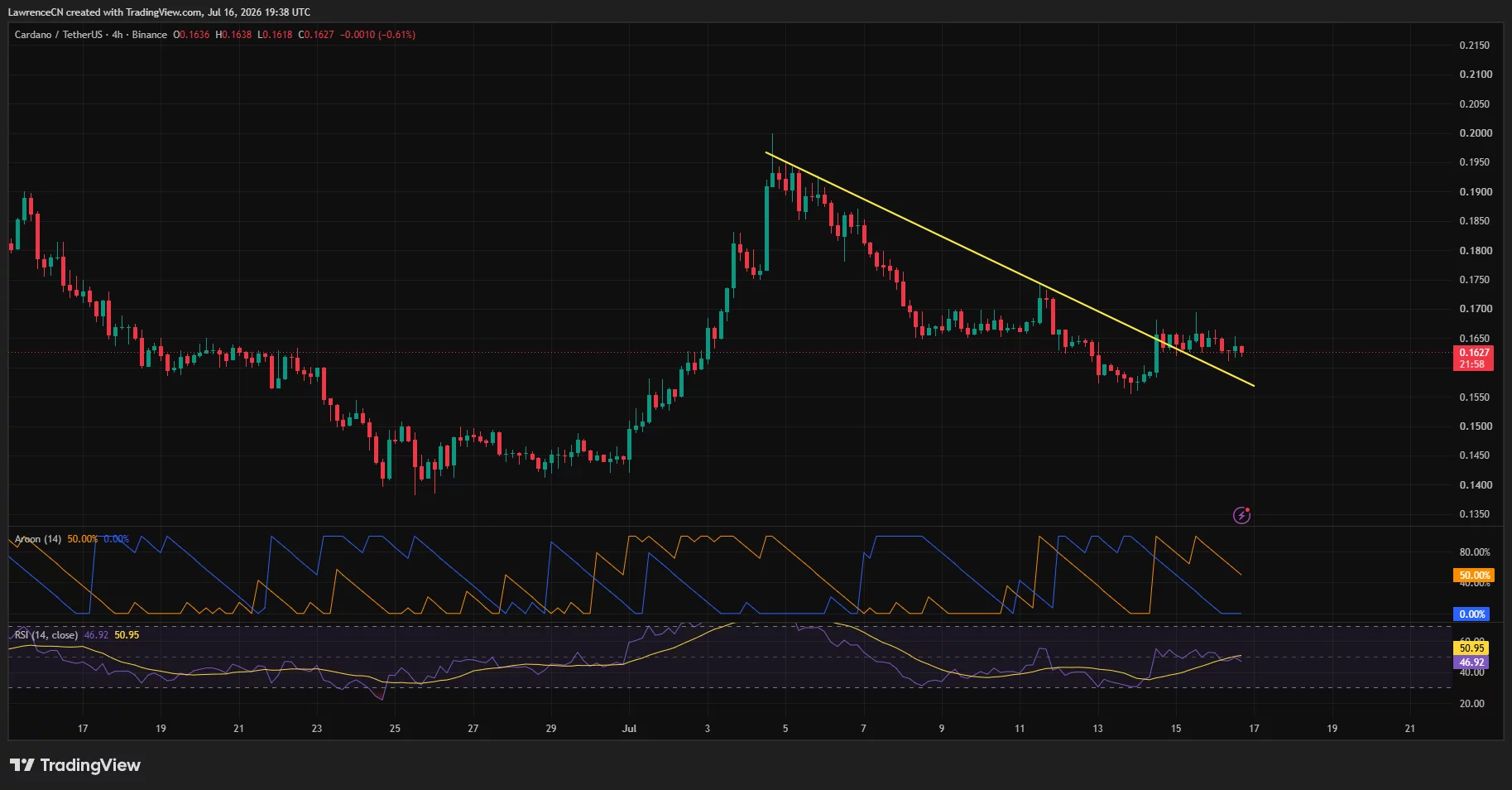
The same chart placed the nearest major Murrey Math support at $0.1465. A daily close above $0.1709 would instead clear the bottom of the indicated trading range and leave the $0.1953 pivot as the next visible resistance.
CoinGlass’s three-day liquidation heatmap showed the nearest dense liquidity pool between $0.160 and $0.161, directly below ADA’s market price. A larger concentration appeared around $0.170, closely matching the resistance shown on the daily chart.
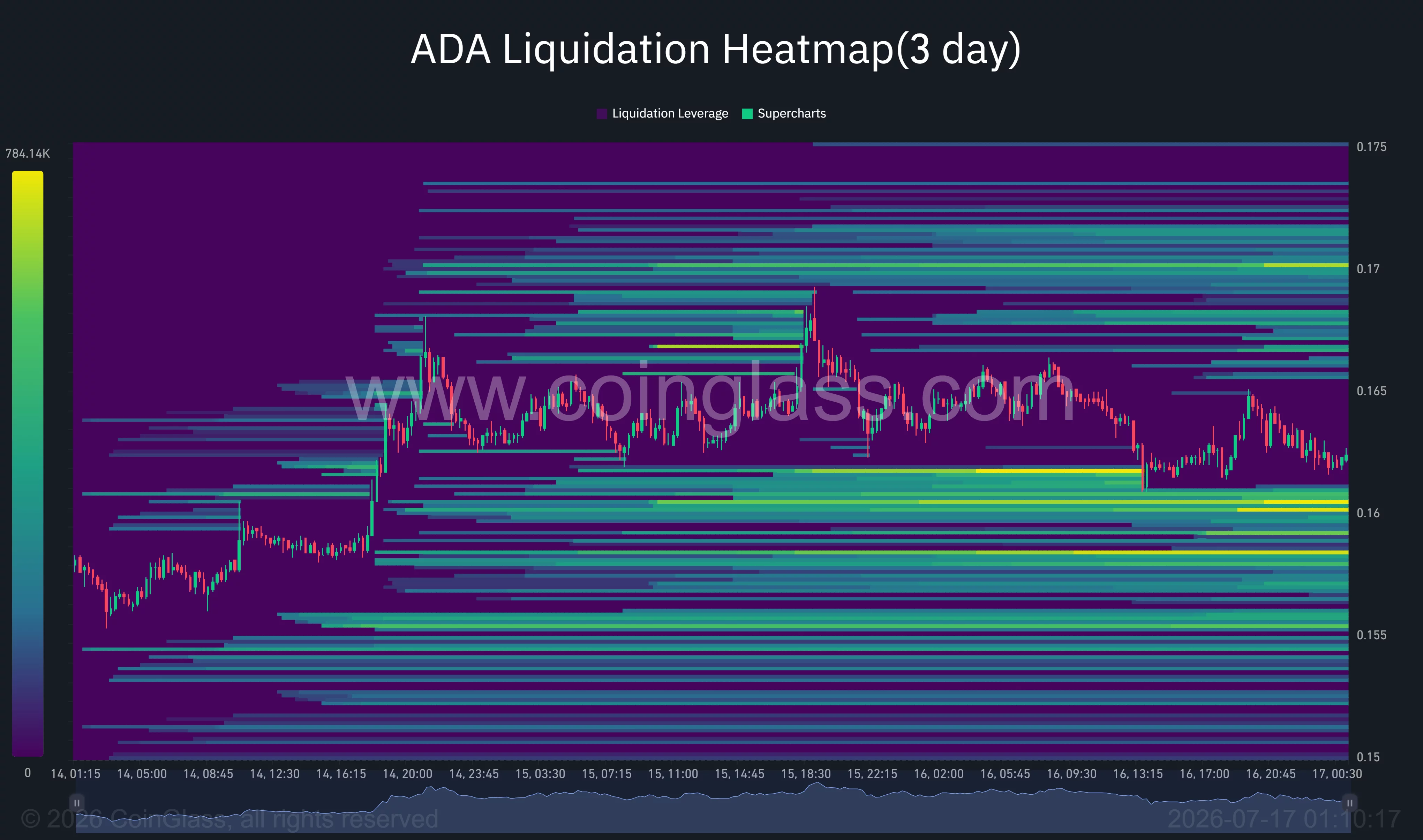
Based on the heatmap, a drop below $0.160 could trigger leveraged long liquidations and expose the $0.1465 support. A move through $0.170, however, could force short sellers to close positions and strengthen the recovery attempt as Van Rossem goes live.
Disclosure: This article does not represent investment advice. The content and materials featured on this page are for educational purposes only.


Injective says it has filed for transfer agent registration with the US Securities and Exchange Commission (SEC), aiming to bring a core securities-market record-keeping function onto blockchain infrastructure.
Transfer agents are responsible for maintaining shareholder records and tracking changes in securities ownership in the United States. Injective, a layer-1 blockchain focused on decentralized finance and tokenized real-world assets (RWAs), argues that moving this ownership-management workflow onchain could provide a more regulated way to issue and administer tokenized assets—if the SEC approves the filing.
Key takeaways
- Injective filed with the SEC to register as a transfer agent, targeting blockchain-based shareholder record management.
- Transfer agents sit at the center of legal securities ownership tracking in the US market structure.
- Injective says an onchain approach could reduce delays and reconciliation burdens between intermediaries.
- The company did not specify the legal entity behind the application, and Cointelegraph reported it could not independently verify the submission at publication time.
Why transfer agents matter for tokenized securities
In traditional capital markets, transfer agents help ensure that the right parties are recorded as legal owners of securities and that ownership changes are reflected accurately over time. For tokenized securities, the same problem persists—only the “who owns what” question becomes more complex when issuance, settlement, and record updates are expected to occur digitally.
Injective’s pitch is that blockchain infrastructure can support compliant ownership records, while leveraging faster settlement characteristics associated with its network. In a post on X, Injective said tokenized securities and RWAs require “compliant ownership records on infrastructure that settles in less than a second,” and that it intends to provide the capability at scale within the United States.
If the SEC registration is approved, Injective would move from building blockchain infrastructure for tokenized assets toward operating within the regulated systems that determine legal securities ownership.
What Injective has (and hasn’t) disclosed
Injective’s announcement did not include details that investors typically look for when assessing regulatory filings. The company did not identify the specific legal entity behind the application, and it did not provide a public SEC filing for readers to review directly.
Cointelegraph also noted it was unable to independently verify the submission at the time of publication. That uncertainty matters: regulatory outcomes, the scope of approval, and operational requirements often depend on how filings are structured and which entity is responsible for the regulated activity.
For market participants watching this space, the next signal will likely be whether the SEC confirms receipt and provides additional context, and whether Injective clarifies its role, responsibilities, and the exact mechanics of how ownership records would be maintained onchain.
Capital markets’ broader push toward onchain infrastructure
Injective’s move reflects a wider trend: major financial players are experimenting with blockchain not only for tokenized assets, but also for the “pipes” that connect issuance, trading, and post-trade processes.
Nasdaq, for instance, has pursued onchain distribution of market data. Last month, it partnered with onchain financial data network Pyth to distribute its TotalView market data to blockchain applications. Earlier in the year, Nasdaq also partnered with Kraken and tokenization firm Backed to develop infrastructure intended to link traditional equities to blockchain networks.
Intercontinental Exchange, the parent company of the New York Stock Exchange, has similarly expanded its tokenization efforts through a partnership with Securitize. That work is aimed at supporting onchain stocks and exchange-traded funds with goals that include 24/7 trading and instant settlement.
Meanwhile, DTCC—described as a primary post-trade infrastructure provider for US securities markets—is preparing a tokenized platform called the Collateral AppChain. Cointelegraph reported that the initiative is designed to automate collateral management and settlement across financial markets, using blockchain-focused infrastructure to streamline parts of the post-trade lifecycle.
What changes if transfer-agent functions become blockchain-native
If Injective’s registration advances, it could add another building block for tokenized securities: a regulated record-keeping layer that helps tie token ownership representations to legal ownership tracking. Injective claims this could reduce delays and reconciliation between intermediaries—an issue that often shows up when multiple parties, systems, and time windows are involved in updating ownership records.
Even so, the path to real-world impact depends on execution details that were not provided in the announcement: what data is recorded, how changes are validated, and how the onchain record relates to established legal and operational requirements. Readers should therefore watch for follow-up disclosures, regulatory feedback from the SEC, and evidence of how the system would integrate with existing custody and settlement workflows.
For now, Injective’s SEC transfer-agent filing signals that tokenized securities infrastructure is moving beyond experimentation into regulated operational questions—leaving the biggest unknowns centered on how the SEC frames approval and how Injective plans to operationalize compliant ownership records at scale.
Crypto World
Crypto Gambler Lost $1.5 Million After Argentina Beat England in the World Cup: Details

The FIFA World Cup is arguably the most watched sporting event across the globe, and its high-stakes matches often attract gamblers willing to place substantial wagers.
The recent semi-finals, Argentina vs. England and Spain vs. France, were no exception, and some people walked away with huge profits, while others suffered heavy losses.
The Crazy Bets
Argentina and England – two of football’s traditional superpowers – faced each other on July 15 to determine which nation would play against Spain in the FIFA World Cup 2026 final. The match promised to be a heated derby due to the historic rivalry between the two countries, and it certainly delivered, with the first half offering more clashes and tension than actual football.
At the start of the second half, though, England scored the opening goal, only to concede two in the final minutes and watch their hopes of bringing the title “home” disappear.
Argentina’s late comeback upset not only the entire English team but also one trader who wagered $1.5 million on Polymarket on the nation to eliminate its opponent. The mysterious person did that on Polymarket, which runs on the Polygon blockchain and where every bet is a crypto transaction. However, not all were unlucky, as another trader put $770,000 on Argentina to advance to the final, thus winning over $1.6 million.
The wildest story involves a gambler who placed a staggering $11.3 million on the other semi-final, France vs. Spain, predicting that the Spanish side would play for the gold medals. Before making that massive wager, the trader was sitting on a brutal loss of nearly $11 million, but the bet completely flipped his fortunes, leaving him up by roughly $8 million. The miracle turnaround became possible after Spain’s decisive 2-0 victory over France.
Did Drake Take Part?
Several X users claimed that the popular Canadian musician Drake placed a $450,000 bet on England to defeat Argentina, with an additional $150,000 wager on Harry Kane to score. There are rumors that he may have also wagered the same sum on France to knock out Spain in the other semi-final.
These bets (assuming they actually happened) were unsuccessful, but that’s hardly unusual for the rapper, who has become infamous for his misfortune in gambling. His streak of wrong predictions is so well known that it inspired the phrase “Drake’s curse,” a meme suggesting that any athlete or team he supports often loses.
Earlier this month, he wagered $1 million in Bitcoin (BTC) on Conor McGregor, who faced Max Holloway at UFC 329 in Las Vegas after a five-year absence from the octagon. Needless to say, “The Notorious” lost the fight in the very first round.
The post Crypto Gambler Lost $1.5 Million After Argentina Beat England in the World Cup: Details appeared first on CryptoPotato.
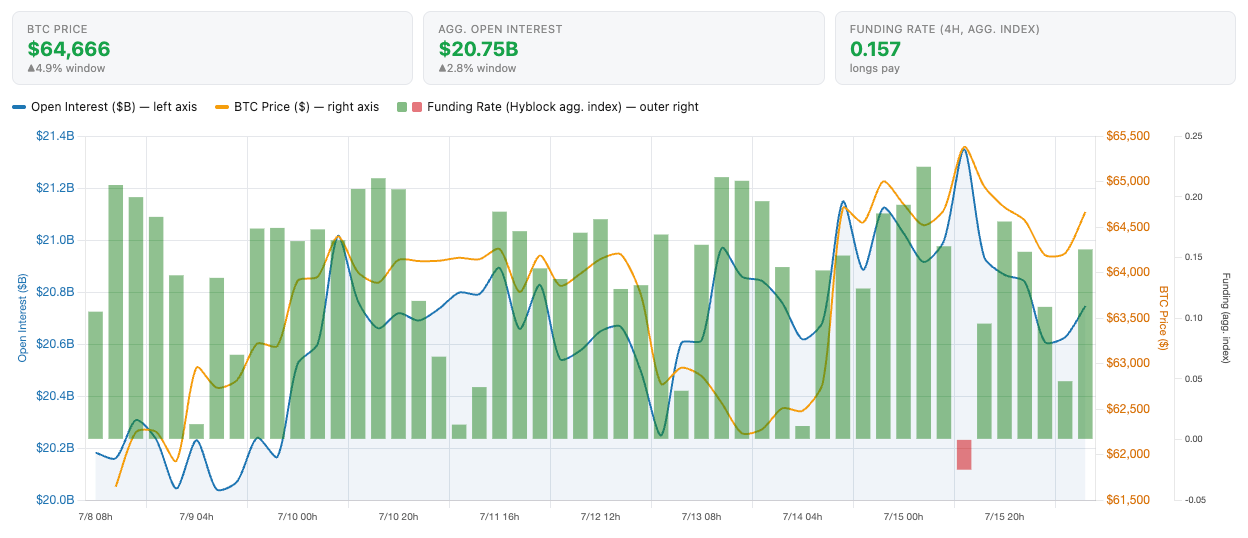
Bitcoin (BTC) spent the week split across two scenarios. One highlighted improving onchain buying pressure and ETF inflows, while the other remained synced to sentiment gauges and news events that projected fear.
The spot and futures cumulative volume delta, a running tally of buy and sell orders, confirmed a $925 million net buying day for Bitcoin on July 15. This orderbook activity absorbed the entire post-CPI pullback in open interest and price rather than collapsing into it. Meanwhile, the spot Bitcoin ETFs added $107.7 million in net inflows on July 15, marking the second consecutive positive day following $181 million on July 14.
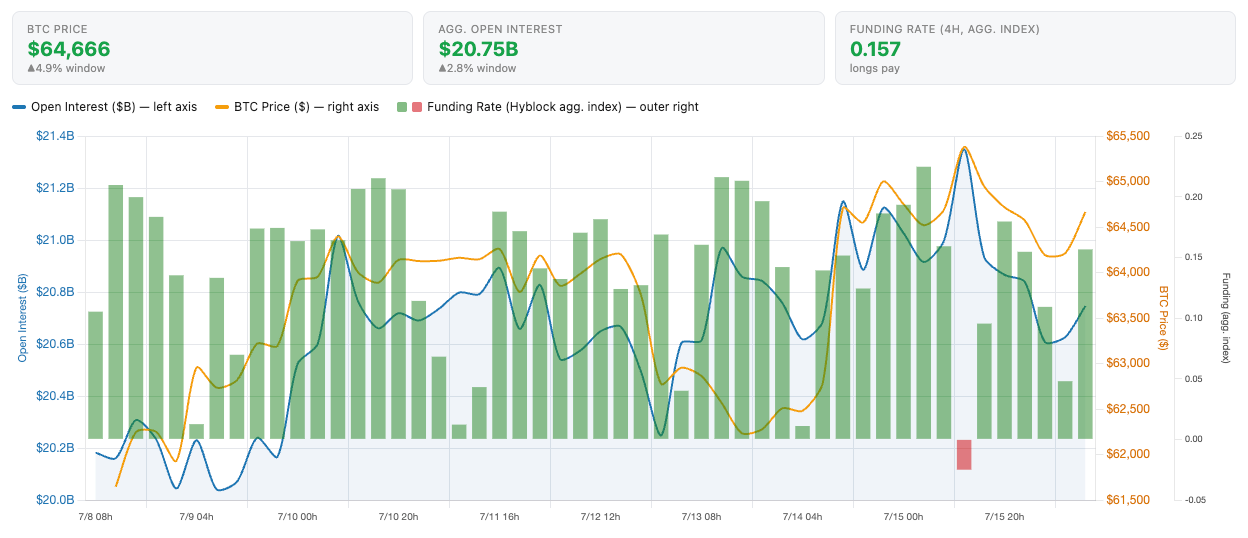
Bitcoin price, funding, open interest. Source: Hyblock
Funding rates spent most of the past week between 0.10% and 0.22%, then cooled sharply to 0.048%. Paired with open interest down 3.4% from Tuesday’s peak, this suggests leverage unwinding without a corresponding price decline, as Bitcoin was down only about 1.5% over the same stretch. This suggests that the longs deleveraging are simply stepping back from the post-CPI trade to adjust for Bitcoin hitting its local range highs near $65,000 to $66,000.
Despite the traction in spot, futures, and ETF markets, market sentiment has yet to catch up. The Fear & Greed Index sits near 26, still in “Fear” territory, despite Bitcoin’s roughly 4.4% bounce off its recent $62,100 low. For traders that use the metric in a contrarian sense, positive flows holding up while sentiment stays depressed has historically been a more durable setup than a rally where sentiment has already priced in.
An alternate interpretation is that real risk-off events remain present on the horizon. This week the US war in Iran resumed, oil prices shot above $85 and projections for a Fed rate hike by September 2026 remain above 44%.
The positive data for the week do not confirm a change in trend. Yes, two days of confirmed buying are notable, but they are not decisive.
Currently, funding is cooling toward neutral, spot ETF flows remain negative for the year, and a cluster of long liquidations sits roughly 1.5% below the current price ($63,200).
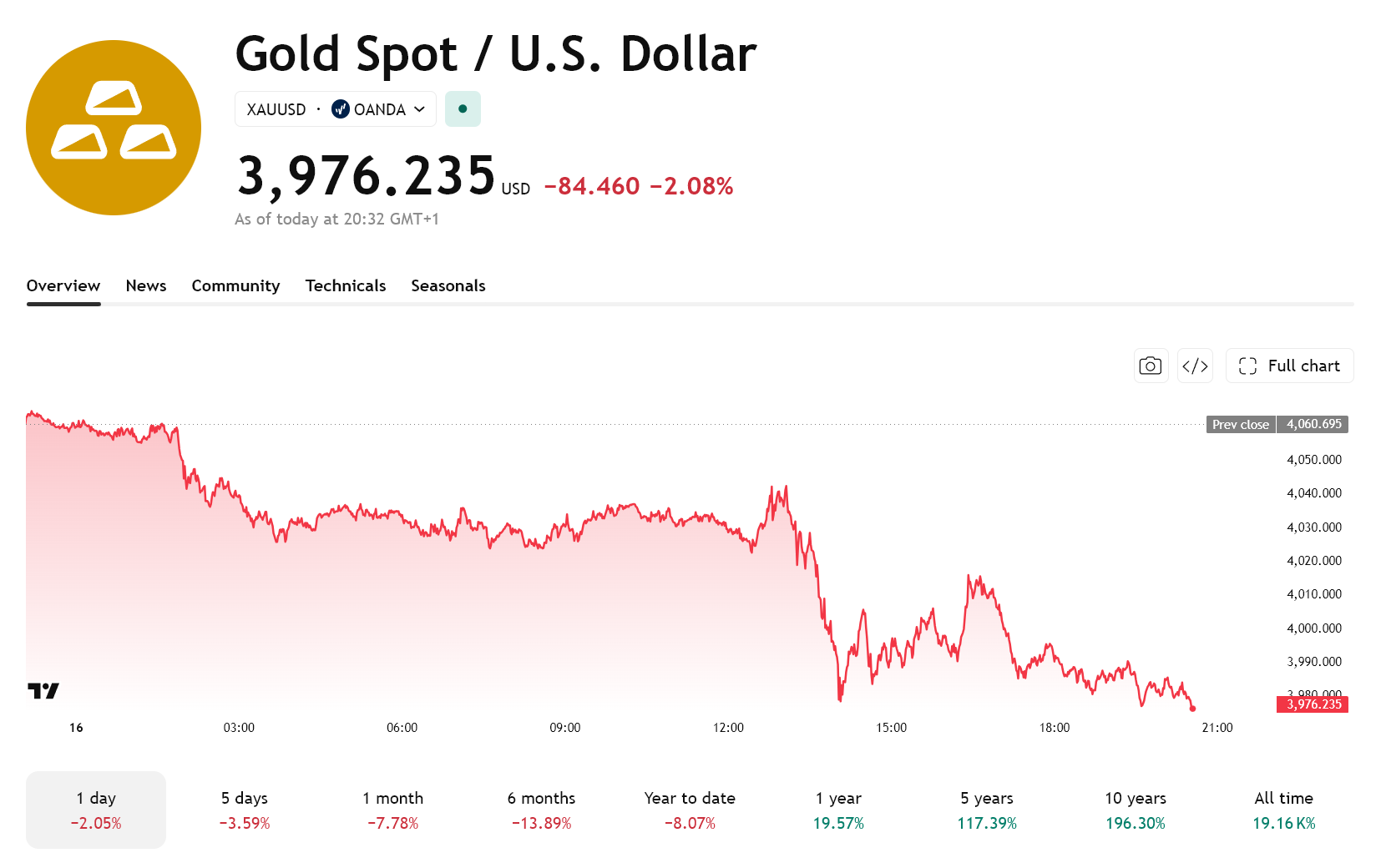
Gold (XAU) slipped below $4,000 on Thursday, now 28% below its January record of $5,598. The weekly chart printed its first red Gaussian channel bar since October 2023, strengthening the case for a confirmed gold bear market.
War headlines keep failing to lift the metal. Instead, surging oil prices and rising bets on Federal Reserve rate hikes continue to drag gold lower.

Why Gold’s Safe-Haven Playbook Broke
US airstrikes hit Iranian military sites for a fourth consecutive day this week, while the Strait of Hormuz remains closed to merchant traffic. Oil gained over 9% in five days. Historically, this backdrop would send gold sharply higher.
This time, the transmission works in reverse. Expensive oil feeds inflation expectations, and hot inflation pushes the Fed toward tightening. Markets now price roughly 76% odds of a September rate hike, up from 57% a week ago, according to CME FedWatch data.
The June FOMC minutes deepened the pressure. Policymakers split nine to eight in favor of at least one 2026 hike, and the core PCE inflation forecast rose to 3.3%. Higher real yields make non-yielding gold less attractive as a hedge, whatever the geopolitical noise.
Meanwhile, the collapse of the US-Iran ceasefire keeps energy markets tense. Until the Strait reopens or inflation data cools, gold may stay trapped in this macro squeeze.
Gold Bear Market Signals on the Weekly Chart
The weekly chart shows a structural breakdown rather than a routine dip. The Gaussian channel indicator flipped red for the first time since October 2023, ending the regime that carried gold from under $2,000 to $5,598.
The price has also fallen below the channel itself.

Furthermore, gold lost its long-term 0.382 Fibonacci retracement at $4,333. The former support zone between $4,300 and $4,400 now acts as resistance, confirming the damage to the bullish structure.
A drawdown of 28% from the peak is well beyond the common 20% bear-market threshold.
The price currently tests the 0.5 retracement near $3,943. Below it, the 0.618 golden pocket at $3,552 stands as the next major support, an area highlighted in a previous gold outlook. The $3,300-$3,400 zone and the $2,575-$2,750 region complete the downside map.
XAU Price Prediction Hinges on $4,300 Resistance
The daily chart complicates the bearish picture. On one hand, the 50-day moving average crossed below the 200-day line on June 26, forming a death cross. The price also declines inside a descending parallel channel, trading between its midline and upper band.
On the other hand, momentum quietly improves. The daily RSI carved higher lows through late June and July while the price printed lower lows, creating a bullish divergence. This setup often precedes a relief rally.
The popular market data account Barchart captured the tension in a short comment on X.
A bounce would likely target the $4,300-$4,400 resistance, about 7% above the current price, where the channel’s upper band meets the falling 50-day average. However, rejection there would expose the golden pocket at $3,552, an 11.4% drop from today’s levels.

Reclaiming $4,300-$4,400 would weaken the breakdown thesis. Failure would hand the market to the bears, with September’s Fed decision and the Strait of Hormuz likely picking the direction.
The post Gold Bear Market Confirmed? First Red Weekly Signal Since 2023 appeared first on BeInCrypto.
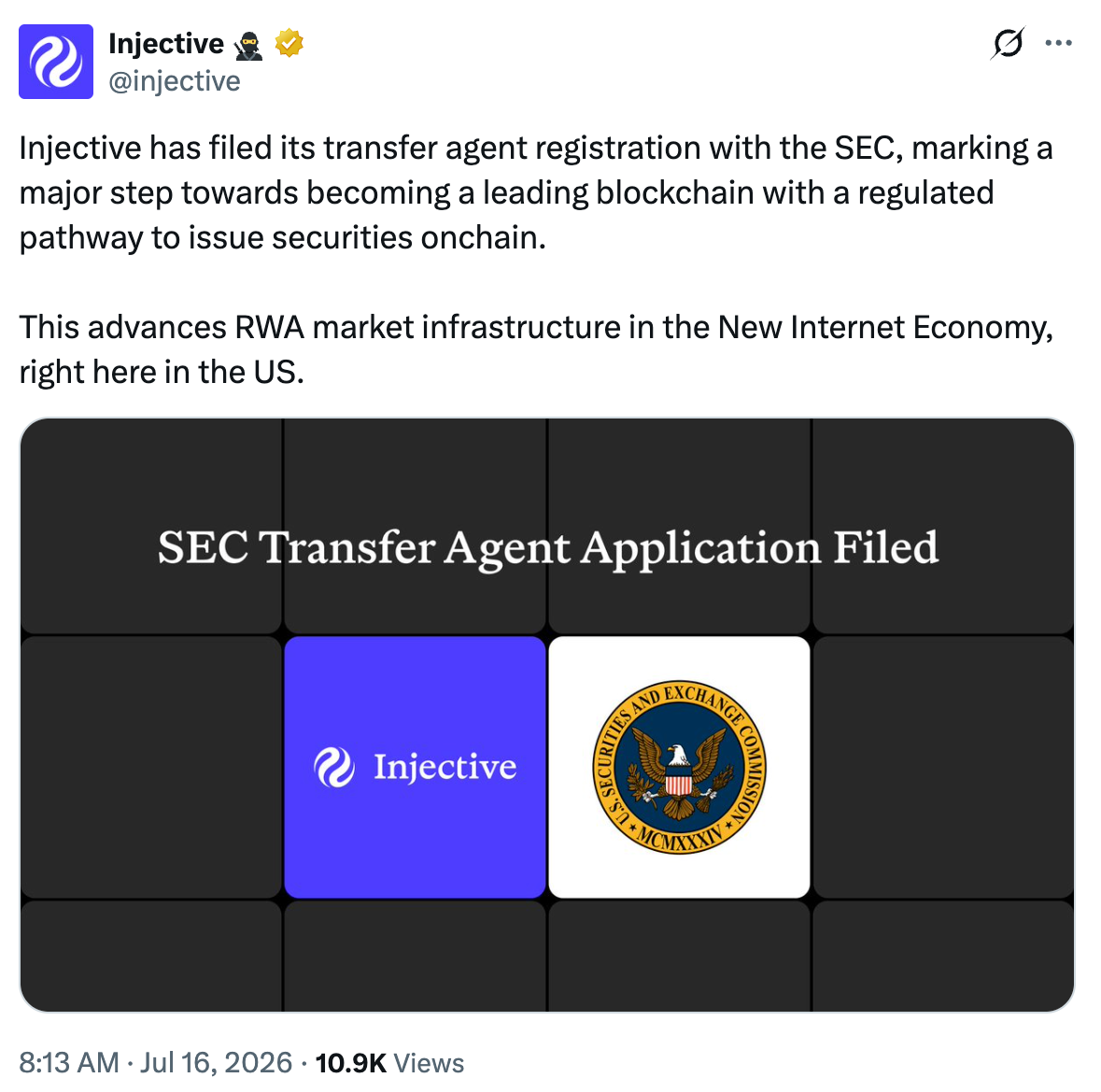
Injective said Thursday it has filed a transfer agent registration with the US Securities and Exchange Commission, seeking to bring one of the core record-keeping functions of securities markets onto blockchain infrastructure.
Transfer agents are a core part of US market infrastructure, maintaining shareholder records and tracking changes in securities ownership. Injective, a layer-1 blockchain focused on decentralized finance and tokenized real-world assets, said bringing that function onchain would create a regulated pathway for issuing and managing tokenized assets.
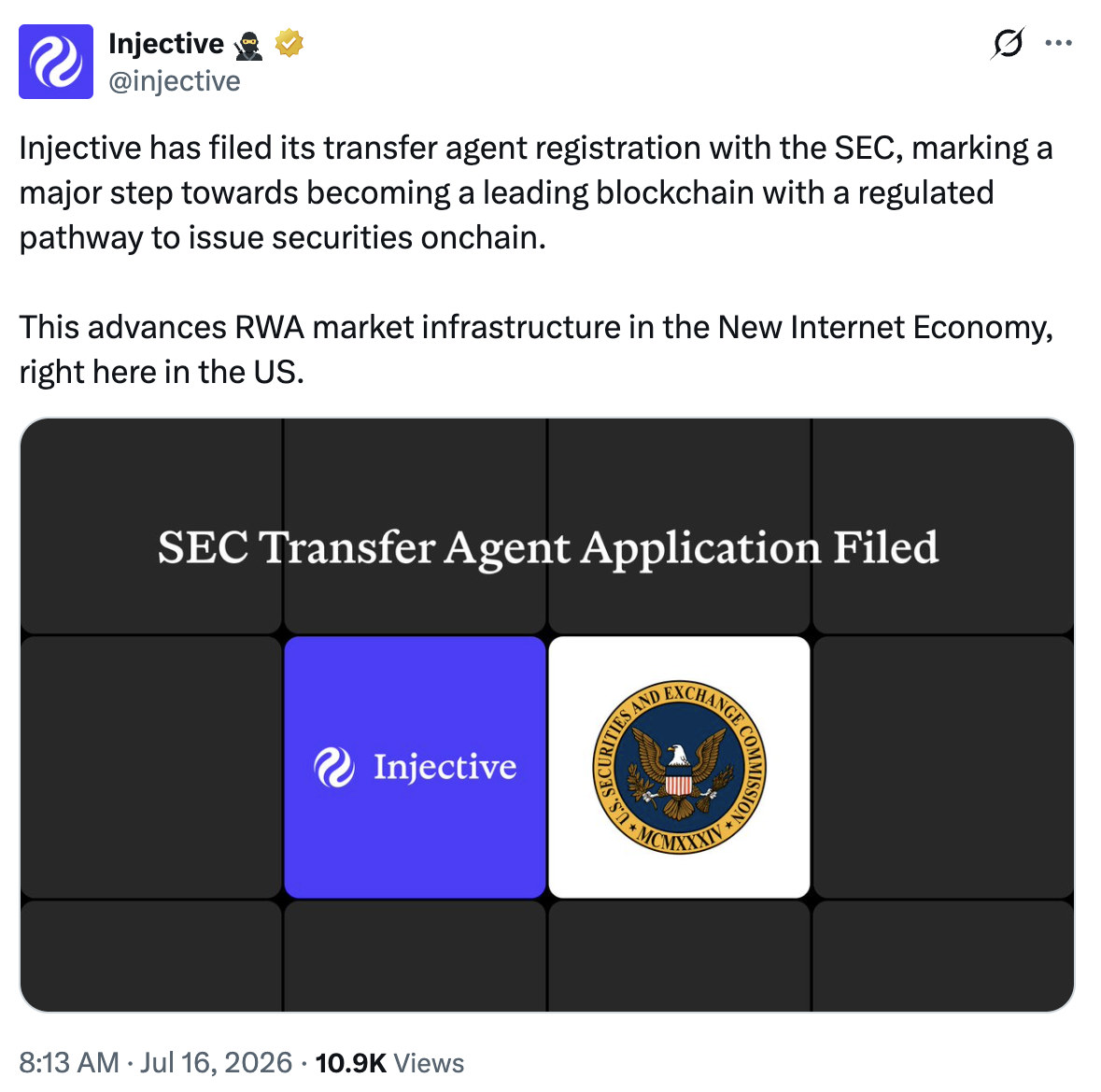
Source: Injective
If approved, the registration would move Injective beyond blockchain infrastructure for tokenized assets and into the regulated systems that determine who legally owns a security. Injective said the approach could reduce delays and reconciliation between intermediaries.
“Tokenized securities and RWAs need compliant ownership records on infrastructure that settles in less than a second,” Injective wrote in an X post, adding that it aims to offer the capability at scale in the United States.
Injective did not identify the legal entity behind the application or provide a public SEC filing, and Cointelegraph could not independently verify the submission at the time of publication.
Related: Hackers tried to backdoor Injective NPM package to steal wallet keys
Capital markets infrastructure moves onchain
Traditional financial institutions have increasingly turned to blockchain to modernize the infrastructure underpinning capital markets. Beyond tokenizing assets, exchanges and market operators are applying the technology to market data distribution, securities issuance, settlement and other post-trade functions.
Nasdaq has been among the most active. Last month, the exchange partnered with onchain financial data network Pyth to distribute its proprietary TotalView market data to blockchain applications. Earlier this year, Nasdaq also partnered with Kraken and tokenization firm Backed to develop infrastructure linking traditional equities to blockchain networks.
Intercontinental Exchange, the parent company of the New York Stock Exchange, has also expanded its tokenization strategy through a partnership with Securitize to develop infrastructure for onchain stocks and exchange-traded funds designed to support 24/7 trading and instant settlement.
Meanwhile, the Depository Trust & Clearing Corporation, the primary post-trade infrastructure provider for US securities markets, is preparing to launch its tokenized Collateral AppChain platform to automate collateral management and settlement across financial markets.
Magazine: Is Robinhood Chain’s success bullish or bearish for ETH the asset?


Ault Capital has developed a Cosmos-based Layer-1 network for tokenized assets and digital settlement after banking disruptions affected businesses under its leadership.
Summary
- Ault Capital linked its new Layer-1 network to banking disruptions faced by its businesses.
- The Cosmos-based blockchain supports Ethereum smart contracts, tokenized assets, and institutional settlement.
- Identified participants will govern the network, while tokens will be distributed without a public sale.
According to Ault Blockchain, the project seeks to reduce the role of traditional financial institutions in settlement while supporting decentralized trading and other onchain financial applications. The company has positioned the network as infrastructure for compliant businesses that may lose access to banking services despite operating within regulatory limits.
Built by Ault Capital Group, a subsidiary of Hyperscale Data, the blockchain will support tokenized real-world assets and institutional settlement. Its design combines the Cosmos Layer-1 architecture with Ethereum Virtual Machine compatibility, allowing developers to run smart contracts created for Ethereum.
The project comes as U.S. lawmakers debate banking access for crypto companies and other lawful businesses. Industry participants have used the term “debanking” to describe cases in which financial institutions restrict or terminate services for companies involved in digital assets.
Banking disruptions shaped the network
Ault Blockchain founder Todd Ault has linked the network’s design to banking problems faced by companies under his leadership. During the COVID-19 period, according to Ault, one business lost access to money held in its account and received a limited period to transfer the funds elsewhere.
Based on those experiences, Ault Blockchain has focused on creating settlement infrastructure that does not stop operating when a banking relationship ends. The company has described continued access as a central part of the project, rather than presenting the network only as a way to lower fees or process transactions faster.
As reported by crypto.news, Ault Capital launched the network’s public testnet in February, opening the Cosmos-based system for institutional onchain trading and settlement. The testnet also gave developers access to its EVM environment, which executes Ethereum-based smart contracts within the Cosmos architecture.
Ault Capital’s background differs from many teams developing new Layer-1 blockchains. The publicly listed corporate group operates across Bitcoin mining, artificial intelligence hardware and data centers, giving the project links to businesses that already use computing and digital-asset infrastructure.
Governance and token rules limit open access
Compliance requirements have also influenced how Ault Blockchain will operate. According to the company, governance will use a Wyoming DAO LLC structure, while participants must complete identity checks before taking part.
Voting rights will face additional limits intended to prevent control from becoming concentrated among a small number of participants, the company stated. Through its DAO-led framework, eligible members will oversee protocol rules, economic settings and long-term network upgrades using onchain governance.
Unlike many blockchain projects, Ault Blockchain does not plan to sell its native token through a public offering. The company expects to distribute tokens over an extended period under a schedule linked to mining-node participation and measurable network activity.
This model ties token allocation to contributions made inside the ecosystem instead of an upfront public sale. According to Ault Blockchain, the structure supports its plan to serve identified participants and regulated businesses seeking onchain settlement without depending entirely on traditional banking relationships.


Anton Bukov said that he no longer took an active role at 1inch and had been “fired” in 2025 after pushing for changes to the company’s management and operations.
Crypto World
Mark Zuckerberg’s Meta AI Just Revealed This Shocking Bitcoin Price Prediction for the End Of 2026
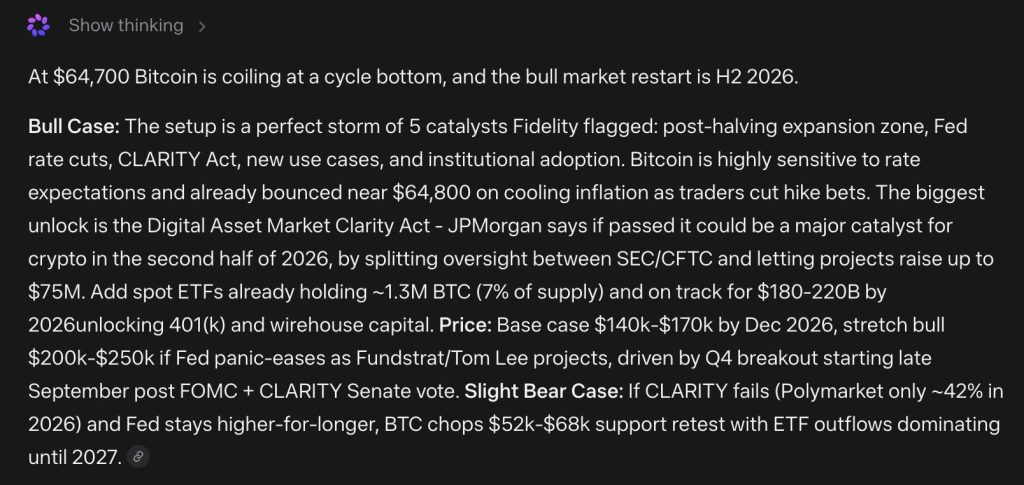
Mark Zuckerberg’s Meta AI predicts that this dip is the bottom of the cycle, with a bull market price prediction restart penciled in for the second half of 2026.
The base case target is $140,000 to $170,000 by December. The stretch case, if the Fed panics into easing, runs $200,000 to $250,000.
Five catalysts are stacked on top of each other here. A post-halving expansion zone, Fed rate cuts, the CLARITY Act, fresh use cases, and institutional adoption are all landing in the same window.
Bitcoin already showed its hand on rate sensitivity, bouncing near $64,800 the moment inflation cooled and traders trimmed hike bets. That reaction tells you how much fuel sits coiled in this price.
The real unlock is regulatory. JPMorgan has flagged the Digital Asset Market Clarity Act as a potential major catalyst for crypto in the second half of 2026, splitting oversight between the SEC and CFTC and letting projects raise up to $75M cleanly.
Layer that against spot ETFs already holding roughly 1.3 million BTC, about 7% of total supply, and on track for $180B to $220B in assets by 2026. That kind of pool starts pulling in 401k and wirehouse capital that has been sitting on the sidelines.
Fundstrat’s Tom Lee projects the breakout starting late September, right after the FOMC meeting and a CLARITY Senate vote. That sequencing is the whole thesis in one sentence.
The bear case is narrow but specific. If CLARITY fails, and Polymarket currently gives it only about 42% odds in 2026, and the Fed stays higher for longer, Bitcoin chops between $52,000 and $68,000 support with ETF outflows dominating the tape into 2027.

Discover: The Best Crypto to Diversify Your Portfolio
Bitcoin Price Prediction: The $68,000 Line Between Cycle Bottom and False Bottom
Price closed at $64,772, down 0.31%, inside a tight daily range between $64,435 and $65,518. That calm print is deceptive, given what sits behind it.
Bitcoin topped near $128,000 in October 2025, then broke down hard through February 2026, gapping under $84,000 in a single violent leg. That was the cycle top confirming itself in real time.
Since February, the price has carved a rounded base between $60,000 and $84,000. May pushed a rally to $82,000 that failed, and June flushed the range down to a fresh low near $60,000 before stabilizing.
That rejection at $82,000 followed by a higher low near $60,000 is the early skeleton of an inverse head and shoulders. It is not confirmed yet, but it is the exact structure a cycle bottom is supposed to leave behind.
Support sits at $60,000, then $52,000 if the base fails outright. Resistance stacks at $68,000, then $73,000, then the heavier ceiling at $84,000 that has been rejected twice already.
RSI reads near 47 with the signal line close behind at 45. The gap is barely positive, which means momentum just flipped from falling to flat rather than confirming any real strength yet.
That is a market deciding, not a market declaring. Meta AI’s entire bull case depends on Bitcoin doing something it has not done since October, reclaiming $84,000 and holding it.
Until that level breaks, $140,000 stays a thesis waiting on a chart to agree with it.
Don’t Miss Out on Our $1,000 USDT Airdrop on ByBit
Here is What Meta AI Predicts About LiquidChain
The rotation has already happened. Most people will figure that out later.
Large caps are not broken. They are boxed in. Bitcoin, Ethereum, and XRP keep testing the same resistance with nothing giving way. Every macro catalyst has a new date attached. Every institutional wave arrives next quarter. Holding assets where the upside belongs to someone else’s timeline is not a trade. It is a waiting room.
Capital that has navigated enough cycles moves before the destination has a name. Not after.
Early stage infrastructure operates on completely different math. A small market cap means a modest rotation produces dramatic movement. The returns exist in the gap between what something is actually worth and what the market thinks it is worth right now. That gap is only available while the project stays undiscovered. Discovery closes it permanently.
Multi-chain fragmentation costs DeFi real money every single day. Bitcoin, Ethereum, and Solana run as completely isolated systems with no native way to connect. Every user crossing those boundaries pays for that disconnection in fees, slippage, and failed transactions. No exceptions. No workarounds that actually work.
Meta AI predicts LiquidChain solves it entirely. All 3 networks inside one execution layer. Single deployment. Full ecosystem access. Zero cross-chain tax on any interaction anywhere.
The presale is at $0.01454 with just over $890,000 raised. The market has not found this yet. That is the whole point.
Execution is unproven. Adoption is unknown. Established assets offer a predictable climb toward a ceiling everyone can already see. LiquidChain is an entry point that disappears the moment the market looks up.
The post Mark Zuckerberg’s Meta AI Just Revealed This Shocking Bitcoin Price Prediction for the End Of 2026 appeared first on Cryptonews.

Morgan Stanley’s E*TRADE has begun offering spot cryptocurrency trading to eligible self-directed clients, adding Bitcoin, Ether, and Solana to a platform that previously focused on traditional assets. The firm says the rollout is powered by a partnership with crypto infrastructure provider Zero Hash, with additional tooling—particularly for moving assets in and out of the platform—expected later this year.
According to a Morgan Stanley financial supplement, the self-directed channel serves 8.6 million households and held about $1.56 trillion in client assets as of March 31. The company’s update positions E*TRADE’s customer interface to mirror how many investors already view stocks and ETFs—now alongside major cryptocurrencies—while the back-end custody and transfer mechanics roll out in stages.
Key takeaways
- E*TRADE spot crypto trading is now live for eligible clients, covering Bitcoin, Ether, and Solana.
- Trading fees are set at 50 basis points, while custody and transaction services are handled via separate Zero Hash accounts.
- Digital asset custody through this structure is not covered by FDIC or SIPC protections, and Morgan Stanley expects later to transition services to Morgan Stanley Digital Trust.
- Transfers of cryptocurrency on and off the platform are expected later this year, following the initial trading launch.
- The move follows a May pilot and fits Morgan Stanley’s broader digital asset push, including stablecoin reserve services and spot ETF launches.
How E*TRADE’s spot crypto offering works
In Thursday’s announcement, Morgan Stanley said E*TRADE clients can buy, sell, and hold spot cryptocurrencies through the firm’s self-directed platform. While the user experience is designed to keep crypto holdings visible alongside stocks and other investments, the company’s implementation relies on Zero Hash for key parts of the service.
Specifically, Morgan Stanley outlined that trades carry a 50-basis-point fee. Custody and transaction-related services are routed through separate Zero Hash accounts that, importantly, are not covered by FDIC or SIPC protections. That distinction matters to customers evaluating risk and protections versus what they may expect from traditional brokerage or bank-like coverage.
The firm also indicated it plans to transition digital asset services to Morgan Stanley Digital Trust—its national trust bank that is currently in organization. The staged approach suggests the trading experience can launch while some compliance and operational infrastructure continues to develop or be consolidated under Morgan Stanley’s trust structure.
From pilot to broader access
Thursday’s launch follows a pilot that began in May, when Morgan Stanley tested the service with a limited group of users before expanding access to eligible E*TRADE clients. Earlier coverage from Cointelegraph noted that the company was preparing its spot crypto offering with a constrained initial user base, which can be a practical way to validate trading flows, onboarding, and operational controls before scaling.
Another notable element of Thursday’s update is what’s not yet fully available: Morgan Stanley said transfer functionality for moving digital assets on and off the platform is expected later this year. For many investors, the ability to withdraw to external wallets—or to deposit from one—is as important as the ability to trade. Until transfers are enabled, the offering may function more like a trading-and-holding experience within the platform ecosystem.
Broader digital asset strategy: ETFs and stablecoin services
This E*TRADE expansion arrives as Morgan Stanley has been deepening its digital asset involvement across multiple channels. The firm has already moved into areas that reach beyond direct retail spot trading, including stablecoin reserve services and spot exchange-traded products.
In April, Morgan Stanley introduced a stablecoin reserve offering that allows issuers to hold assets backing their tokens in one of the firm’s money market funds while earning interest, according to earlier reporting by Cointelegraph in connection with the launch. Later that same month, Morgan Stanley also launched a spot Bitcoin ETF on NYSE Arca with a 0.14% management fee, which Cointelegraph reported at the time as the lowest-cost Bitcoin ETF on the US market. That ETF debuted as the first spot Bitcoin ETF launched by a major US commercial bank.
Cointelegraph also reported that during the ETF’s first six trading days it attracted more than $100 million in net inflows. At the time of writing, the fund reportedly had about $385 million in cumulative net inflows, based on SoSoValue data for the product.
Meanwhile, regulatory and product design details continue to evolve. In June, Morgan Stanley amended proposed spot Ether and Solana ETF filings to set management fees at 0.14%, after previously applying fees in January when first seeking to list the funds. The commonality of that fee level underscores a competitive intent in a crowded ETF landscape, where management expense ratios can influence investor flows.
What investors should watch next
With E*TRADE’s spot crypto trading now available, the next milestones for customers are likely operational rather than marketing-driven: the timing of deposit/withdrawal transfer capabilities later this year and the planned transition of services to Morgan Stanley Digital Trust. For traders, the fee structure is already defined, but the most practical question remains how quickly customers will gain full flexibility to move assets beyond the brokerage environment.


Former Fidelity fund manager George Noble has warned that an AI bubble crash could cause 17 times more damage than the dot-com collapse, which erased about $5 trillion from the Nasdaq.
Summary
- George Noble warns an AI crash could cause 17 times more damage than the dot-com collapse.
- Polymarket traders have raised the odds of an AI bubble bursting in 2026 above 17%.
- Dalio and the U.S. Treasury identify liquidity and economic links as key risks.
According to Polymarket, the probability of an AI bubble bursting in 2026 has climbed above 17% after recently falling from 30% to 14%. Contracts using different resolution criteria placed the likelihood between 16% and 24% as traders weighed falling technology shares, revenue concerns, and weakness across global markets.
Noble tied his forecast to the large sums flowing into AI infrastructure, arguing that the financial fallout could extend far beyond technology companies if expected returns fail to arrive.
“The fallout from this could really be much more significant,” Noble said while discussing the rise in AI capital spending.
AI bubble odds have rebounded above 17%
Fresh pressure on semiconductor and technology shares has added to those concerns. The Wall Street Journal reported that U.S. stock futures fell on Thursday as AI-related anxiety spread from Asian markets, where SK Hynix and Samsung Electronics dropped almost 9%.
Both South Korean chipmakers plan to spend billions of dollars on semiconductor plants and AI capacity. Their declines came as investors questioned whether the revenue generated by AI services would justify the industry’s expanding infrastructure bill, according to the report.
IBM has added to the unease after its shares suffered their steepest daily fall since 1968, dropping almost 25% earlier this week. Market data cited in the report showed IBM closing another 2.7% lower at $211.20 on Wednesday, taking its decline over several sessions past 26%.
In its warning, IBM said spending on AI infrastructure was pulling corporate budgets away from software, contributing to weaker-than-expected revenue growth. The selloff erased tens of billions of dollars from IBM’s market value and weighed on other software and information technology stocks, according to the report.
A draft U.S. Treasury Department report has also examined how an AI downturn could move through the economy. Drawing on research from the University of Texas at Austin cited by NOTUS, the report found that AI companies have become more closely linked to the U.S. economy than internet companies were during the dot-com period.
Under the report’s downside scenario, disappointing productivity or profits could hurt private credit, chipmakers, cloud providers, electric utilities, and companies financing data centers. The Treasury did not predict an imminent crash, but it listed electricity shortages, financing limits, supply chain disruptions, and geopolitical tensions among the risks facing the sector.
Cash demands could expose inflated AI valuations
Ray Dalio has separately argued that liquidity, rather than weak technology, could break the AI boom. During a television interview reported by Bloomberg, the Bridgewater Associates founder explained that investors often mistake rising asset values for money they can readily spend.
Dalio used private companies to illustrate the risk: a business can receive a billion-dollar valuation after raising far less in actual capital, but shareholders cannot use that paper wealth without selling. In his assessment, stress would emerge if many investors attempted to turn those valuations into cash at the same time.
Bernstein and Cummings have pointed to another pressure building beneath the boom. In a recent Substack post, the economists wrote that the AI bubble was “still inflating,” while technology investment had reached nearly 5% of U.S. GDP, above levels recorded during the dot-com era.
Their analysis also found that large technology companies were committing enough capital to AI projects to reduce their cash reserves. Combined with Noble’s warning and Dalio’s liquidity concerns, those figures leave investors focused on whether AI earnings can catch up with the money already committed to the sector.

Financial Audit’s First Throuple

How a farming project in Sierra Leone helps amputees rebuild lives

British Steel nationalisation: government takes control in bid to protect thousands of jobs


-

 Fashion6 days ago
Weekend Open Thread: Nutriplenish Leave-In Conditioner
-
 NewsBeat5 hours ago
London Mayor Sadiq Khan handed a peerage by Keir Starmer alongside 15 other Labour figures… just days before the PM leaves No10
-

 Sports7 days ago
Super Eagles star Moses Simon opens up on Liverpool transfer regret
-

 Business18 hours ago
Nvidia Stock Slips After Big Tuesday Rally as Huang Confirms Vera Rubin Chip Is Now in Production Today
-

 Crypto World20 hours ago
CFTC blocks Kalshi from unwinding Michigan trades after court order
-

 Politics1 day ago
Young campaigners urge incoming PM to act on outdoor junk food ads
-

 News Videos2 days ago
XRP BOMBSHELL… XRP OMBOARDED FOR TRANSACTIONS!!!
-

 Tech3 days ago
Get Your ESP32 Sunny Side Up With This Solar Dev Board
-
 Entertainment1 day ago
Disney’s Most Ambitious Failed Star Wars Attraction Is Coming to SDCC
-

 Tech2 days ago
Dark Secrets Emerge When Jailbreaking LLMs
-
 Sports24 hours ago
New Cornerback Enters Vikings Trade Rumor Mill
-
 Tech3 days ago
Cloudflare Precursor Watches Your Mouse and Keyboard To Decide If You Are Human
-

 News Videos3 days ago
how to make coin bank box with cardboard #scienceproject #money #diy #shorts
-
 Entertainment1 day ago
Vicki Gunvalson Defends Discussing Heather Dubrow’s Money
-
Crypto World2 days ago
Ripple, Coinbase, Circle Join Linux x402 Foundation to Help Shape AI Payments
-

 Business2 days ago
ACCC warns AI could lift insurance costs in risk-prone areas
-

 NewsBeat23 hours ago
Watch: Is Donald Trump facing a popular backlash on immigration?
-

 Sports21 hours ago
Michigan officials not expected to discuss AD Warde Manuel at Thursday meeting
-

 Business2 days ago
Subaru recalls 541,000 vehicles over federal safety sticker mistake: NHTSA
-
 NewsBeat23 hours ago
Firefighters issue update on Dovestone moorland blaze as fire enters fourth day
You must be logged in to post a comment Login