FedEx Corporation (FDX) Analyst/Investor Day April 8, 2026 9:00 AM EDT
Company Participants
Marianna Rose John Smith – President & CEO of FedEx Freight Corporation Clinton McCoy – Chief Operating Officer Michael B. Lyons – Senior VP, Chief Specialized Services & Commercial Officer Michael Rodgers – Senior VP & CTO Marshall Witt – Senior VP & CFO
Conference Call Participants
Advertisement
Ken Hoexter – BofA Securities, Research Division Christian Wetherbee – Wells Fargo Securities, LLC, Research Division Scott Group – Wolfe Research, LLC Stephanie Benjamin Moore – Jefferies LLC, Research Division Thomas Wadewitz – UBS Investment Bank, Research Division Jordan Alliger – Goldman Sachs Group, Inc., Research Division Ariel Rosa – Citigroup Inc., Research Division Brian Ossenbeck – JPMorgan Chase & Co, Research Division Daniel Moore – Robert W. Baird & Co. Incorporated, Research Division Richa Talwar – Deutsche Bank AG, Research Division Jeffrey Kauffman – Vertical Research Partners, LLC Jonathan Chappell – Evercore ISI Institutional Equities, Research Division Donald Broughton David Vernon – Bernstein Institutional Services LLC, Research Division
Presentation
Operator
Advertisement
Welcome, and thank you for joining us for FedEx Freight Investor Day. Please welcome to the stage, Marianna Rose, Managing Director, Investor Relations.
Marianna Rose
Good morning, and welcome to FedEx Freight’s First Investor Day. I’m Marianna Rose, Head of Investor Relations, and we are thrilled to have you with us as we outline the exciting path forward for FedEx Freight. A strong safety culture is one of the clearest indicators of a well-run business. And nowhere is that more evident than at FedEx Freight, where safety is more than a value, it’s at the fundamental backbone of this company.
Advertisement
As such, we begin every meeting with a safety message. And today’s message hits close to home for all of us, distracted driving. Every year, thousands of lives are lost because a driver looked away for just a few seconds. The good news is, according to preliminary estimates, automobile fatalities have declined
Two more Western Australian goldminers have reported cash and bullion balances above $1 billion, while maintaining the diesel crisis is not a challenge – yet.
Alphabet Inc.’s Class C shares (NASDAQ: GOOG) climbed more than 3% midday Wednesday, reaching $313.96, as investors cheered fresh signs of strength in the company’s artificial intelligence initiatives and cloud computing business amid a broader technology sector rebound.
Shutter Speed / Unsplash
The stock opened at approximately $317.81 and traded as high as $319.38 before settling near $313.96 by late morning, up $10.03 or 3.30% from the previous close of $303.93. Volume remained solid, reflecting renewed optimism ahead of the company’s first-quarter 2026 earnings, now scheduled for late April.
The move extended a volatile but ultimately positive stretch for the Google parent. After hitting an all-time high near $350 in early February, shares pulled back amid concerns over soaring capital expenditures for AI infrastructure. Wednesday’s gain helped recoup some of those losses and underscored Wall Street’s growing confidence that Alphabet’s heavy investments in AI will pay off through accelerated revenue growth, particularly in Google Cloud.
A key catalyst appeared to be Alphabet’s expanding partnership with Broadcom for custom AI chips and networking infrastructure. The collaboration is expected to bolster Google Cloud’s ability to meet surging enterprise demand for AI training and inference capabilities. Analysts noted that such deals signal Alphabet’s commitment to scaling its infrastructure efficiently while competing with rivals like Microsoft Azure and Amazon Web Services.
Google Cloud has emerged as a bright spot. Recent quarters showed the segment growing at rates exceeding 35-48% year-over-year, with a massive backlog reportedly reaching $240 billion. Enterprise adoption of Gemini-powered services and AI infrastructure contributed heavily to the momentum. The company has aggressively integrated its Gemini AI models across search, YouTube, Android and cloud offerings, with monthly active users for Gemini surpassing hundreds of millions.
Advertisement
Wednesday’s trading also reflected broader market sentiment favoring big-tech names with strong AI narratives. While some investors have worried about the “capex trap” — with Alphabet guiding for $175 billion to $185 billion in capital spending this year, nearly double 2025 levels — others view the outlays as necessary to secure long-term leadership in generative AI.
“Alphabet is doubling down on AI at exactly the right time,” one market strategist said. “The cloud backlog and Gemini adoption metrics suggest monetization is accelerating faster than many anticipated, even as costs rise.”
The rally came despite ongoing regulatory headwinds. Alphabet continues to navigate multiple antitrust cases in the United States and Europe, including challenges to its search dominance and ad technology business. Recent court rulings have been mixed, with some dismissals of publisher lawsuits but appeals expected in core monopoly cases. Investors appear to be pricing in that regulatory risks, while significant, will not derail the company’s core growth engines.
Alphabet’s search business, still the profit powerhouse, benefits from AI Overviews and Gemini enhancements that deliver faster, more conversational answers. YouTube continues to see engagement gains from AI-driven recommendations. These improvements help offset potential shifts in user behavior as AI agents evolve.
Advertisement
With Q1 2026 earnings approaching — currently slated around April 23-29 depending on final confirmation — analysts expect revenue growth near 15-18% and earnings per share around $2.60-$2.70. Focus will center on Google Cloud margins, AI product revenue details and any updates to full-year guidance. Management has signaled confidence that efficiency gains in models, including reported 78% reductions in certain query costs, will help balance heavy infrastructure spending.
Class C shares, which lack voting rights compared with Class A, often track closely with the more liquid GOOGL but appeal to certain institutional investors. The dual-class structure has long allowed founders to maintain control while accessing public capital.
Year-to-date, GOOG has shown modest performance after a stellar 2025 that saw gains exceeding 60-70% in some periods, driven by AI optimism and cloud acceleration. The stock remains well above its 52-week low near $145 but below the February peak. Analysts maintain a generally bullish consensus, with average price targets suggesting further upside toward $340-$367.
Institutional ownership remains high, with recent filings showing increases from major holders. Hedge funds and long-term investors appear to be accumulating on dips, betting that Alphabet’s scale in data, distribution through Android and YouTube, and talent pool position it favorably in the AI race.
Advertisement
Challenges persist. Rising energy costs for data centers, potential margin pressure from capex and competition from OpenAI, Anthropic and others require careful navigation. Waymo, Alphabet’s autonomous driving unit, continues to expand but remains a smaller contributor compared with core segments.
Broader market context aided the move. Technology stocks recovered some ground Wednesday as Treasury yields stabilized and investors rotated back into growth names. The Nasdaq Composite showed gains, with other AI-exposed names also advancing.
For retail investors, the intraday surge highlighted Alphabet’s volatility tied to AI news flow. Short interest remains relatively low, suggesting limited bearish bets despite recent pullbacks from highs.
Looking ahead, the April earnings call will likely provide the next major catalyst. Investors will scrutinize commentary on AI monetization timelines, cloud backlog conversion and any color on competitive positioning. Positive surprises on margins or user metrics could fuel further upside, while higher-than-expected capex might temper enthusiasm.
Advertisement
Alphabet has transformed significantly under CEO Sundar Pichai, evolving from a search advertising company into an AI-native conglomerate spanning cloud, hardware, autonomous vehicles and more. The company’s first-look deals and ecosystem advantages, including potential integrations with partners like Apple for certain AI features, provide structural tailwinds.
Yet execution remains key. History shows that heavy infrastructure bets can weigh on near-term profitability even as they lay groundwork for future dominance. Alphabet’s ability to maintain advertising pricing power while rolling out AI enhancements will be closely watched.
In the meantime, Wednesday’s 3.3% advance served as a reminder of the market’s appetite for proven tech leaders with clear AI roadmaps. As earnings season nears, Alphabet finds itself at a pivotal juncture: proving that massive spending today will translate into sustainable, high-margin growth tomorrow.
With a market capitalization still in the multi-trillion-dollar range, even modest percentage moves represent billions in value. The Class C shares’ performance Wednesday added to that total, rewarding shareholders who stayed the course through earlier volatility.
Advertisement
As the trading day continued, attention turned to whether the momentum would hold into the close or if profit-taking might emerge. Regardless, the session reinforced Alphabet’s central role in the ongoing artificial intelligence transformation of the global economy.
For investors, the message appeared clear: despite regulatory clouds and hefty investment bills, Alphabet’s fundamental strengths in search, cloud and AI keep it firmly in the conversation among the world’s most valuable and influential companies.
Michael A. Gayed is portfolio manager, and author of five award-winning research papers on market anomalies and investing. He has a BS with a double major in Finance & Management from NYU Stern School of Business, and is a CFA Charterholder.
Michael runs the investing group The Lead-Lag Report, focused on helping investors outperform in all market conditions. It offers a tactical, data-driven approach to investing, to achieve long-term success even in the face of uncertainty. With increasing market volatility, it’s essential to understand risk-on/risk-off signals, seize high-yield opportunities, and leverage award-winning research to maximize returns. Learn More.
Analyst’s Disclosure: I/we have no stock, option or similar derivative position in any of the companies mentioned, and no plans to initiate any such positions within the next 72 hours. I wrote this article myself, and it expresses my own opinions. I am not receiving compensation for it (other than from Seeking Alpha). I have no business relationship with any company whose stock is mentioned in this article.
I/we have no stock, option or similar derivative position in any of the companies mentioned, and no plans to initiate any such positions within the next 72 hours. I wrote this article myself, and it expresses my own opinions. I am not receiving compensation for it (other than from Seeking Alpha). I have no business relationship with any company whose stock is mentioned in this article. The Lead-Lag Report is provided by Lead-Lag Publishing, LLC. All opinions and views mentioned in this report constitute our judgments as of the date of writing and are subject to change at any time. The information provided herein is not intended to be used as the primary basis of investment decisions. Investors should consult their financial advisers prior to any investment decision.
Advertisement
Seeking Alpha’s Disclosure: Past performance is no guarantee of future results. No recommendation or advice is being given as to whether any investment is suitable for a particular investor. Any views or opinions expressed above may not reflect those of Seeking Alpha as a whole. Seeking Alpha is not a licensed securities dealer, broker or US investment adviser or investment bank. Our analysts are third party authors that include both professional investors and individual investors who may not be licensed or certified by any institute or regulatory body.
Pall Mall public realm project being separated from wider scheme
David Humphreys and Local Democracy Reporter
16:00, 08 Apr 2026
The development site at Bixteth Street Gardens in Liverpool(Image: Liverpool Echo)
Delivery of an urban park in the middle of Liverpool’s first Grade A office building scheme for more than 15 years requires public-sector intervention to ensure it can be brought to life.
Advertisement
Almost £2.5m of developer cash from projects across the city centre is to be repurposed to help create a public realm as part of proposals for a new eight storey office development at Pall Mall.
A total of £2.47m of section 106 (S106) cash – derived from development projects – will be used for eligible works, including The Lawns, Terraced Gardens and Bixteth Walk. The total cost of the scheme is expected to top out at £60m.
It is being separated from the wider scheme after a full business case indicated that “market conditions, abnormal costs and viability constraints require public‐sector intervention.”
As a result, the public realm will be funded via S106 which the local authority said would make the overall project easier to achieve.
Advertisement
The council-owned site, which lies off Bixteth Street, was remediated in 2020 but has stood dormant ever since after plans for large office buildings and a hotel stalled. There are hopes work could get underway on site during the last three months of this year, with a view to completion in 2028.
The scheme is being brought forward by Kier Property Developments Ltd with the phase one green space open to the public but privately owned. Pall Mall is a long‐standing strategic regeneration site in the city’s commercial business district, bounded by Pall Mall, Bixteth Street and Exchange Station.
The wider masterplan will deliver up to 400,000 sq. ft of Grade A office space, hotel and supporting uses centred around new green public space.
Delivery is identified as a priority within the council’s Strategic Futures Programme and the Liverpool City Region’s Grade A office growth agenda. It would represent the first development of its kind in Liverpool for almost two decades.
Advertisement
The project has progressed to full business case which has confirmed that market conditions, abnormal costs and viability constraints require public‐sector intervention. As a result, delivery of the public realm will be achieved separately, which according to city council documents makes the project easier to achieve overall.
The central gardens would be accessible 24 hours a day and maintained by a management company. A planned maintenance regime will be implemented to ensure the public realm remains safe, attractive and well‐maintained, including routine landscaping, cleaning, lighting, repairs and renewal of materials as required.
This will be funded by service charge contributions. According to the local authority, this arrangement ensures no ongoing revenue liability for Liverpool Council and preserves unrestricted public access in perpetuity.
To find all the planning applications, traffic diversions, road layout changes, alcohol licence applications and more in your community, visit the Public Notices Portal.
Flying is about to get more expensive for some travelers who check luggage, as two major U.S. carriers move to raise baggage fees amid rising costs across the airline industry.
Delta Air Lines and Southwest Airlines are both increasing their checked bag fees by $10, pushing the cost to $45 for a first bag and $55 for a second. Delta is also raising the fee for a third checked bag by $50, bringing the total cost to $200, the airline confirmed to FOX Business.
Advertisement
The changes apply to new bookings, with Delta’s updated fees taking effect Wednesday and Southwest’s on Thursday.
A Southwest Airlines Boeing 737 MAX 8 aircraft lands at Victorville Airport in Victorville, California, on March 26, 2019. (Mike Blake/Reuters)
Delta said the increases will impact domestic routes and select short-haul international flights, marking its first domestic baggage fee hike in two years.
“These updates are part of Delta’s ongoing review of pricing across its business and reflect the impact of evolving global conditions and industry dynamics,” a spokesperson for Delta told FOX Business in an email.
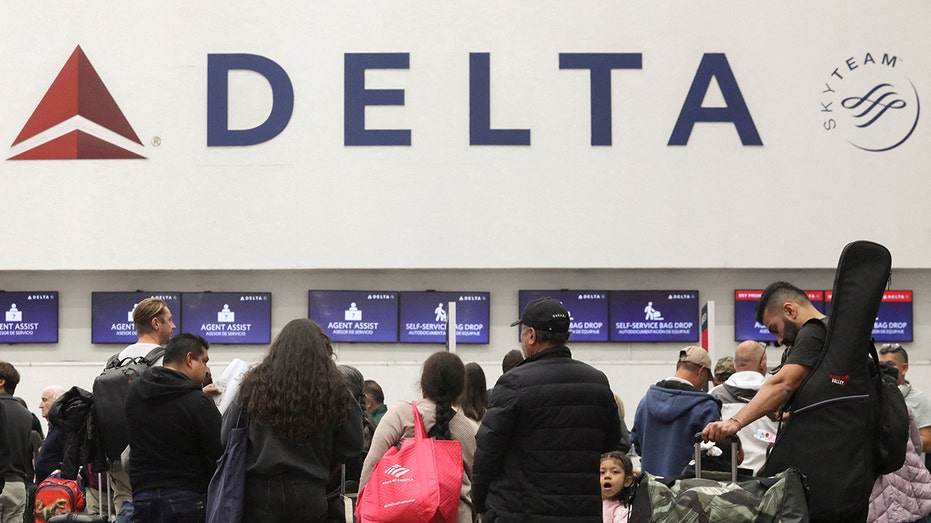
Passengers queue to check in at a Delta Air Lines counter at Benito Juarez International Airport in Mexico City, Mexico, on Nov. 13, 2025. (Paola Garcia/Reuters)
In a similar statement, Southwest said the decision comes after “an ongoing analysis of the business and against the evolving global backdrop.”
The fee hikes come as airlines grapple with rising operating costs, particularly jet fuel.
Jet fuel prices have surged globally in recent months, climbing from roughly $85 to $90 per barrel in February to about $209 following disruptions linked to tensions in the Strait of Hormuz amid the Iran war, according to Reuters.
Passengers wait in a TSA security checkpoint queue that stretches through Baltimore/Washington International Thurgood Marshall Airport (BWI) in Baltimore, Maryland, on March 29, 2026. (Aaron Schwartz/Reuters)
In recent weeks, JetBlue and United Airlines have also announced increases to baggage fees.
“As we experience rising operating costs, we regularly evaluate how to manage those costs while keeping base fares competitive and continuing to invest in the experience our customers value,” JetBlue wrote in a statement to FOX Business.
Former Daish’s Blackpool Hotel was acquired by father-and-son team
Richard Hunt and Local Democracy Reporter
16:00, 08 Apr 2026
The new-look Hotel Santa Maria, in Blackpool(Image: Local Democracy Reporting Service)
A prominent hotel on Blackpool’s North Shore promenade has a new name and a new look.
Advertisement
The former Daish’s Blackpool Hotel is a substantial property which was run by Daish’s Coach Holidays for a number of years.
But the family-owned UK company, which provides package holidays by coach to its own chain of hotels, sold it in November as part of a shake-up of its operations.
The new owner of the the 70-bed Blackpool hotel is a smaller enterprise led by father and son Declan Scully and his son Leo, who bought it for an undisclosed sum late last year.
Now the team has completed the all-new look, switching the old grey external walls and blue signage to a magnolia shade – and new name Hotel Santa Maria.
Advertisement
Declan said after taking over: “My son is handling the marketing side and I’ll be overseeing the hotel and trying to make people happy!
“There is tremendous loyalty to this hotel from customers, with people coming back and even trying to book the same room.
“Our idea is to bring TLC to the building and happiness to the guests and make sure they have a lovely stay and will want to come back.
“We have total confidence in the holiday sector in Blackpool, we think it’s flourishing and that’s why we’re here.”
Advertisement
Daish’s Blackpool Hotel had a staff of around 30 but shortly after the take over, Declan said he was not in a position to discuss the subject of employment contracts at that stage.
Last summer saw the creation of Blackpool Tourism, which now oversees and manages major town attractions, including Blackpool Tower, Sandcastle Waterpark, and Madame Tussauds, previously operated by Merlin Entertainments.
Formed by Blackpool Council , it aims to boost the local economy and reinvest profits into town services, and recently launched its new “Ultimate Ticket”, a pass offering entry to six major attractions for £65 – Pleasure Beach Resort (including unlimited rides), Sandcastle Waterpark, The Blackpool Tower Top, Tower Circus, Tower Dungeon, and Madame Tussauds. It is valid for 90 days after the first visit.
With a new name and new colour scheme, Hotel Santa Maria is ready for the new season.
Teaching is full-time work, and carving out time for a graduate degree on top of lesson planning and grading takes real commitment.
That’s why many educators turn to 1 year online master’s in education programs: you stay in your classroom, finish in around 12 months, and come away with a recognized qualification. According to UPCEA, 71% of prospective graduate students now prefer fully online programs, and that shift shows clearly in education.
Here are four programs worth looking at.
1. International Teachers University (ITU): Best for International Educators
ITU built its 1 year online master’s in education programs on international teaching benchmarks, which makes it particularly relevant for teachers who work across different curricula or in international school settings.
The program includes eight core pedagogy courses and two specialization courses. You’ll study learning theories and assessment methods that track student progress in real time, alongside questioning techniques that develop critical thinking. Technology integration runs through the core curriculum with a focus on practical classroom application. Specialization tracks cover Early Years and Primary Education, English Language and Literacy, and Teaching Mathematics and Numeracy. The full program costs $7,500, with no additional fees.
Advertisement
2. Walden University: Best for Flexible Scheduling
Walden is one of the more established names in online M Ed programs, with specializations in Teacher Leadership and Curriculum, Instruction, and Assessment that work well for practicing educators. Courses run on seven to eight-week terms, which keeps the workload manageable alongside a full teaching schedule. The university holds regional accreditation and wide recognition across U.S. school districts.
3. Western Governors University (WGU): Best for Experienced Teachers
WGU runs on a competency-based model, where progress is tied to demonstrated mastery. Experienced teachers with strong subject knowledge can often move through the program faster than a fixed-semester schedule allows. WGU’s online masters of education degree carries CAEP accreditation, which employers across the U.S. and in many international schools recognize.
4. Grand Canyon University (GCU): Best for Rolling Intake
GCU offers online M Ed programs with multiple start dates throughout the year, which helps if waiting for a traditional intake doesn’t fit your schedule. Specializations cover educational technology, special education, and teaching and learning. The curriculum leans toward applied learning, with coursework connected directly to classroom practice.
How to Pick the Right 1 Year Online Master’s in Education Program
Before committing, check two things above all: whether the institution holds proper accreditation and whether the curriculum matches the kind of teaching you actually do. Scheduling flexibility matters too, especially if your school runs on a strict term calendar.
Advertisement
An online masters of education degree becomes a worthwhile investment when it points toward something specific, whether that’s a leadership role, a new school environment, or a qualification threshold you need to meet.
Frequently Asked Questions
What is a 1-year online master’s in education program?
It’s an accelerated graduate degree in education completed online in around 12 months. It covers pedagogy, curriculum design, and educational leadership, giving working teachers a path to advanced qualifications without leaving their jobs.
Who should consider a 1-year online master’s in education program?
Any working teacher who wants to advance professionally without a career break. These programs work well for educators moving into leadership, refining classroom practice, or meeting qualification requirements for international or independent school positions.
What specializations are commonly offered in 1-year online master’s in education programs?
Common specializations include curriculum and instruction, educational leadership, early years education, educational technology, and English language teaching. What’s available varies by institution, so check each program’s course catalog before applying.
Advertisement
How do I choose the right 1-year online master’s in education program?
Start with accreditation, then look at how well the curriculum fits your teaching context and how flexible the scheduling is. For teachers in international settings, programs built on global standards tend to be more useful than those tied to a single national curriculum.
Are 1-year online master’s in education programs recognized by employers?
Yes, provided the institution holds proper accreditation. Most schools, districts, and international organizations recognize degrees from accredited universities. If you plan to teach abroad, confirm that recognition applies in your target country before enrolling.


























































You must be logged in to post a comment Login