
Business
Jerome T. Murphy and the Power of Thinking One Step Ahead


Growing up on the southside of Chicago, Jerome Murphy watched three generations of attorneys build their practices on service, community, and results.
His grandfather, father, and uncles showed him what it meant to use the law as a tool for helping people. That foundation shaped everything that followed.
Today, Murphy is a partner with Tressler LLP, a national firm based in Chicago. He serves clients in complex litigation involving governmental tort defense, breach of contract, commercial disputes, toxic tort cases, and personal injury defense. He has tried cases in both state and federal courts and has developed a reputation for preparation that goes deeper than most.
A Lesson That Changed Everything
Early in his practice, Murphy argued a significant motion for a client and lost. The law was not in his favor, but that was not the only problem. He had built his arguments around his client’s strongest position without fully anticipating the opposition’s best counterargument.
“After that, I changed how I prepared for any significant argument, either in trial or appellate court,” Murphy said. “I now script the best counterargument the other side could make and make sure my position preempts that argument, rather than just presenting my own case. This anticipatory form of practice has proven to create favorable results for my clients.”
That shift became the backbone of his practice. Instead of simply presenting his case, Murphy learned to think one step ahead, to see the battlefield from both sides, and to prepare his clients for the strongest attack the other side could mount.
Building a Career on Short-Term Wins
Murphy does not lean on long-term goals. He believes they are the byproduct of satisfying short-term objectives that are reasonable and fair.
“If I come up short, I have the opportunity to be constructively critical, and learning from the experience,” he explained. “Long-term goals are satisfied with the satisfication of the many reasonable short-term goals I set for myself.”
That philosophy extends to how he measures success with clients. He defines success as the earned obtainment of goals, but only when those goals are set realistically from the start. He works with clients to establish clear expectations, knowing that the facts and the law sometimes impose limits.
“My metric of success is my ability to deliver a reasonable objective to my client,” Murphy said. “Goal setting is created in consultation with your client, with a realistic expectations of the limitations that may undermine those goals.”
Recognition and Growth
Murphy earned his bachelor’s degree in economics from the University of Illinois in 2011 and graduated cum laude from the University of Illinois College of Law in 2014. Since entering practice, he has been recognized by Leading Lawyer as an Emerging Lawyer in 2018, 2019, and 2022, an honor given to less than 2 percent of lawyers under 40 or those practicing fewer than 10 years. He was also selected by his peers in the 2023 and 2024 editions of Best Lawyers: Ones to Watch in America.
Despite the accolades, he maintains a beginner’s mindset.
“I have to remain humble and approach each client and matter as if it’s my first,” Murphy said. “I owe it to all of my subsequent clients to demonstrate the same carefulness and concern I would for my first client. I never presume that I am beyond learning something new, and I maintain an appetite for a better understanding of the law and a better way to serve my clients.”
Gratitude as a Tool
When obstacles arise, Murphy turns to a simple practice. He identifies 10 things for which he is grateful.
“I’m immediately injected with positive energy, perspective and perseverance,” he said.
That discipline reflects a broader belief in the connection between personal well-being and professional performance. Murphy sees them as symbiotic. He needs to be healthy and sound in his personal life to deliver the highest quality results to clients. Professional success, in turn, breeds the confidence to take risks and push boundaries in other areas of life.
Outside the courtroom, Murphy reads widely in philosophy, history, and economics. He hikes the trails in local forest preserves, golfs with friends, and has toured the Hawaiian islands. He stays involved in his church community and travels with family and friends to see historical landmarks across the country.
A Practice Built on Ethics and Preparation
Murphy credits his partners, family and friends in the legal industry, and his law professors for teaching him how to practice ethically. Those influences continue to shape his work at Tressler LLP, where he handles everything from toxic tort litigation to real estate transactions for buyers and sellers.
The qualities he considers most important are diligence, communication, perseverance, flexibility, adaptability, honesty, critical thinking, and hard work. They are not abstract ideals. They are the daily habits that allow him to anticipate the next move, prepare for the toughest argument, and deliver results for the clients who depend on him.
Jerome Murphy remains based in Palos Heights, the same community where his family has lived for decades. He is close with his siblings and enjoys being an uncle. The third-generation attorney continues the work his grandfather began, serving clients with the same care and commitment that inspired him to enter the profession in the first place.

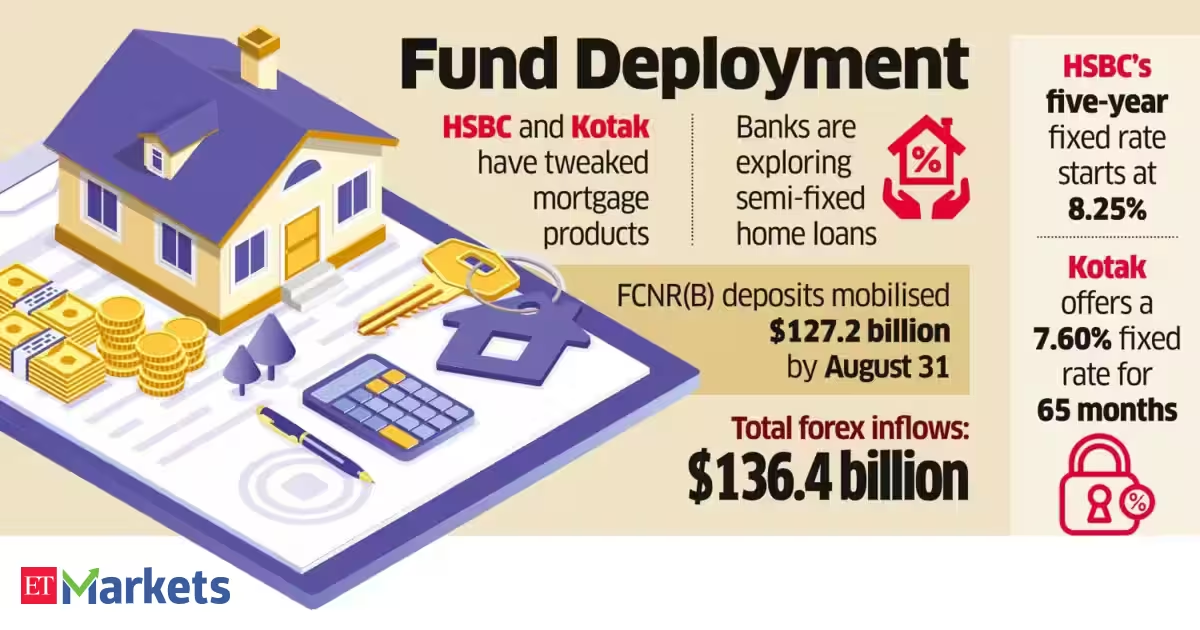
Banks are looking at semi-fixed home loans to deploy a surge in surplus liquidity following a record mobilisation of funds through the RBI’s FCNR(B) scheme, while protecting lending margins amid uncertainty over interest rates.
Read more: India’s bank liquidity surplus hits all-time high riding flood of dollar deposits
The special swap facility mobilised $136.4 billion in forex-inflow programs by August 31, including $127.2 billion through FCNR(B) deposits.
 ET Bureau
HSBC is offering such a product, with its three-year fixed option starting at 7.50% and a five-year fixed option at 8.25%, before switching to the prevailing floating rate.

Read more: Record FCNR (B) inflows as banks mobilise $127 bln
After the fixed rate period of three and five years, the bank will move customers to prevailing repo-rate at the time of roll-over and margin as communicated at the time of loan disbursement. Similarly, Kotak Bank is offering hybrid home loans for up to 65 months during which their interest rate and EMI remain unchanged even if the Repo Rate rises. The home loan has a fixed interest rate of 7.60% for 65 months, thereafter it will be linked to the prevailing rate.Traditionally, excess funds could be invested in government securities.
‘Risk Mitigation’
“For banks, the attraction is less about betting on the direction of rates and more about putting surplus money to work while locking in a spread,” said a bank executive. “Banks will look to deploy part of the sum into government securities but those assets carry marked-to-market risks when yields move.”

This assessment comes amid concerns the foreign currency non-resident-bank (FCNR-B) and other forex inflow programmes may have a high cost for the central bank, stemming largely from hedging and liquidity management expenses.
The RBI is, however, expected to earn good returns when these record inflows are deployed in US treasuries that have seen a sharp rise in interest rates, which would offset anticipated costs for the central bank, said the people cited above, setting aside concerns by a section of economists that hedging costs could eventually crimp future central bank surplus transfers to the government.
The investment yield on 52-week US Treasury bills was 4.14% a year as on August 31, 2026, they said. Robust flows are also expected to reduce intervention costs for the central bank to manage currency volatility, as the record proceeds are expected to calm the markets.
Creating Buffer
These flows carry two costs for the central bank: the cost of absorbing excess liquidity from dollar inflows (sterilisation cost), and the cost of exchange rate risk.
Economists believe the first task is an immediate priority, while in the medium term, the RBI will have to create a buffer for the dollar debt that must be repaid within a fixed period. The 3% hedging costs, some economists estimate, could cost the RBI up to Rs 36,000 crore.
“The swap costs that RBI will bear on the dollar inflows could come to about 3% of approximately the Rs 12 lakh crore collected – or about Rs 36,000 crore – that will be reduced from the RBI’s income in the next three to five years,” said Madan Sabnavis, chief economist, Bank of Baroda. “The contingent risk buffer (CRB) of the RBI will also increase as the balance sheet of the central bank increases, which also means that we could see a lower transfer of surpluses to the government.”
The 2013 Precedent
The CRB is a reserve pool of funds set aside from the central bank’s annual profits to cover potential monetary, financial stability, and operational risks. In 2025-26, the CRB threshold was 6.5% of the total balance sheet size of the RBI.
However, some economists believe that just like in 2013, when India had tapped into the diaspora to shore up its currency through the so-called taper tantrum, the key for the RBI to walk away without much stress on the rupee would be the return of capital inflows.
The rupee had plunged to a then record low of Rs 68.85 per dollar in 2013, but strong portfolio inflows ensured the currency recovered close to Rs 61 per dollar in 2014. Although the rupee had weakened to Rs 67 per dollar by the time the three-year swap matured in 2016, a stronger forex kitty ensured the RBI was in a better position to pay off the debts.
The central bank, however, may face rupee losses if the Indian currency depreciates more than expected when these deposits mature.
Policymakers, while accepting the risk, believe there are chances the rupee may appreciate as it happened in 2013 following a similar scheme, and the central bank may even gain.
Any rupee loss to RBI may be partly or fully offset, or even more than offset, by the returns earned from deploying the foreign currency assets in US treasuries, said one of the people cited above.
Liquidity Absorption
Separately, the excess liquidity due to these flows is seen at around Rs 5-7 lakh crore over the next six months. Policymakers believe the economy can easily absorb this liquidity given high growth, and the central bank may not need to absorb it significantly.
The proposed NSE IPO is expected to garner as much as ₹31,000 crore, making it the country’s second-biggest IPO – next only to the proposed initial share sales by Jio Platforms. The nearly ₹28,000-crore IPO by Hyundai Motor India, launched in October 2024, remains the country’s biggest concluded IPO to date.
Last week, Sebi Chairman Tuhin Kanta Pandey said on the sidelines of an event in Mumbai that the regulator was ‘close’ to giving its approval to the NSE IPO.
Read more: Up to 290% gains! SBI, Federal Bank make massive windfall as Arcil’s Rs 733-crore IPO hits D-Street
The country’s biggest stock exchange had filed on June 18 the draft red herring prospectus (DRHP) for its initial public offering . The offering comprises an offer for sale of 148.91 million shares to be offloaded by some existing shareholders.
The case relates to the alleged lapses in high-frequency trading offered through the exchange’s colocation facility that allegedly gave some entities preferential access.
The market regulator had in July accepted the National Stock Exchange of India’s application under the settlement proceedings regulation for a settlement amount of ₹1,491 crore. NSE said the capital markets regulator granted in-principle approval to settle certain past regulatory lapses, subject to the payment of ₹1,491 crore.The NSE had filed the settlement application of ₹1,224 crore to close the market regulator’s pending appeal in the Supreme Court in the co-location facility case. The NSE had also filed another application for a settlement amount of about ₹268 crore to another pending appeal in the co-location facility-related dark fibre case. However, the co-location case pending against NSE’s former managing director and chief executive officer Chitra Ramkrishna, and others will continue and will be decided separately, a bench led by Justice JB Pardiwala said. It disposed of Sebi appeals challenging the Securities Appellate Tribunal orders that set aside the market regulator’s disgorgement directive in the co-location and dark fibre cases.
Sebi’s 2019 order had imposed a ₹625 crore disgorgement penalty on the NSE. SAT had set aside the disgorgement order in January 2023 and instead imposed a ₹100 crore penalty on the exchange for lack of due diligence in following norms while offering colocation.
It said the stock exchange did not make any illicit gain in the colocation case and there was no finding of fraud, unfair trade practice or collusion against them.
The NSE launched the colocation facility in 2009, allowing traders and brokers to establish their IT servers within its premises for a fee.

Columbia Threadneedle Investments is a leading global asset management group that provides a broad range of actively managed investment strategies and solutions for individual, institutional and corporate clients around the world. Columbia Threadneedle Investments is the global asset management group of Ameriprise Financial, Inc. (NYSE: AMP). For more information please visit columbiathreadneedleus.com.
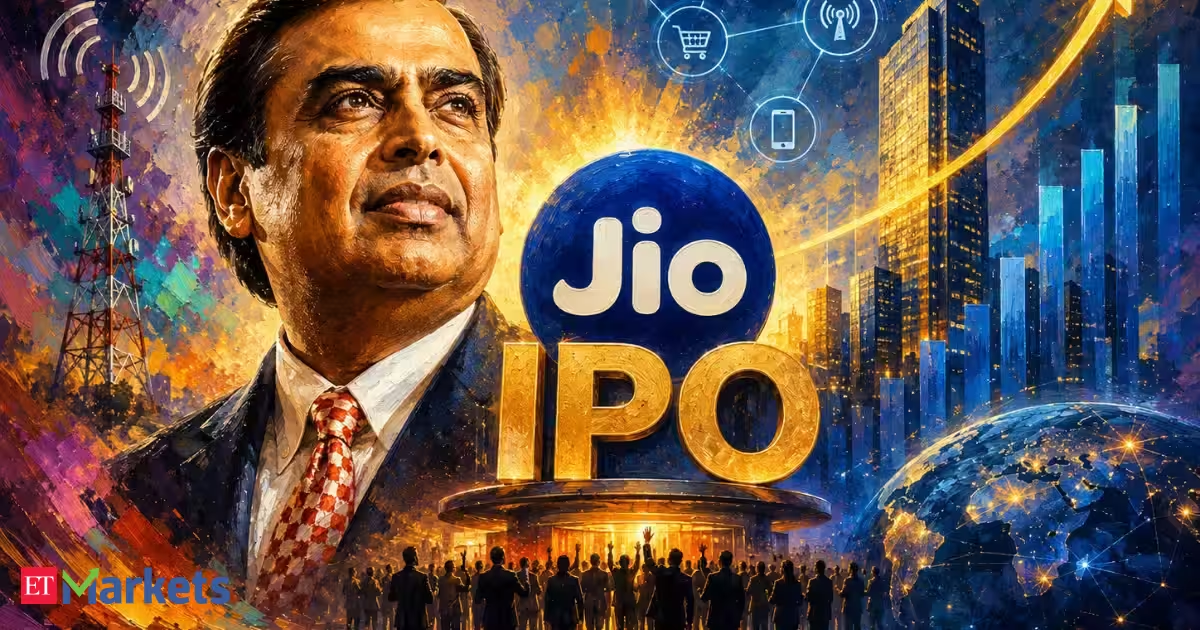
“Most likely, Jio plans to launch the IPO toward the end of October, particularly around the auspicious days during Navratri,” said a person aware of the likely timelines. “If the launch gets pushed toward the end of October, there could also be some spillover into the first week of November. If not the Navratri, the company could target Diwali for the IPO.”
Jio is likely to finalise the exact dates within a couple of weeks after which it would initiate roadshows overseas before holding them at home, said a source close to the development.
The company plans three weeks of international and two weeks of domestic roadshows, three people in the know said.
AgenciesDates to be finalised soon, company to hold several weeks of intl, domestic roadshows
Details from the DRHP
If the IPO coincides with the Navratri, which starts on Oct 11 and ends on Dussehra (Oct 20), the roadshows could begin as early as next week. Diwali falls on Nov. 8, while Dhanteras is on Nov 6.
Emails sent to the company and lead bankers remained unanswered until the publication of this report.
The company that had filed draft IPO papers in June, received approval from the Securities and Exchange Board of India (Sebi) on August 28 to launch its share sale.
Shattering Records
Bankers estimate the Jio IPO could raise around Rs 37,800 crore, potentially making it India’s largest public issue.
The Jio IPO is expected to surpass the proposed Rs31,000-crore-IPO by National Stock Exchange (NSE). Hyundai Motor India‘s Rs 27,000 crore IPO in 2024 remains the largest completed IPO in the country so far.
According to the Draft Red Herring Prospectus (DRHP), Jio Platforms plans to issue up to 270 million fresh equity shares, representing around 2.9% of its post-IPO equity capital. The proposed IPO does not include an offer-for-sale (OFS) component.
The offering will be the first IPO from the Reliance Industries group in nearly two decades, since the listing of Reliance Petroleum in 2006.
A portion of the IPO proceeds will be used to prepay up to Rs 27,500 crore of loans at Reliance Jio Infocomm Ltd (RJIL), the operating subsidiary of Jio Platforms. The remaining proceeds will be used for general corporate purposes.
Jio Platforms may provide funds to RJIL by subscribing to its equity shares, convertible or non-convertible preference shares or debentures, or through loans, or a combination of these, according to the DRHP.
Large investors collectively hold nearly 30.9% of Jio Platforms. Jaadhu Holdings, an affiliate of Meta Platforms, owns 9.98%, while Google International holds 7.73%. Other investors include Saudi Arabia’s Public Investment Fund, Silver Lake and Vista Equity affiliates, General Atlantic, KKR-backed entities and investment vehicles of the Abu Dhabi Investment Authority.

Some fast-food chains offer a free birthday meal or snack – Burger King members can claim a free Whopper or Plant-Based Whopper, while Chopstix offers a free small noodle box.
However, most restaurant birthday offers are buy-one-get-one-free deals rather than completely free meals.
At Harvester and Zizzi’s it’s a free main when buying another full-price main. At Frankie & Benny’s you get a free main when purchasing two or more main meals.
Byron offers a free burger with a £5 minimum spend, while Wagamama offers free gyoza when you spend £12 and have earned at least one stamp on your loyalty card in the last six months.
Some chains give money off instead. Turtle Bay offers members a £20 birthday credit with no minimum spend, while Bella Italia gives you £15 off your total bill when you spend a minimum of £30. Las Iguanas offers a free main when two other meals are purchased or a 20% off voucher.
Pizza Express birthday rewards depend on your loyalty level. Bronze members may get a free dessert with a £10 spend, while higher tiers can get a free pizza or drinks with a £15 minimum spend.
At Prezzo, members receive drinks or desserts when they spend at least £25, while Bill’s offers a bottle of prosecco or pancakes when qualifying meals are ordered and the booking is made in advance.
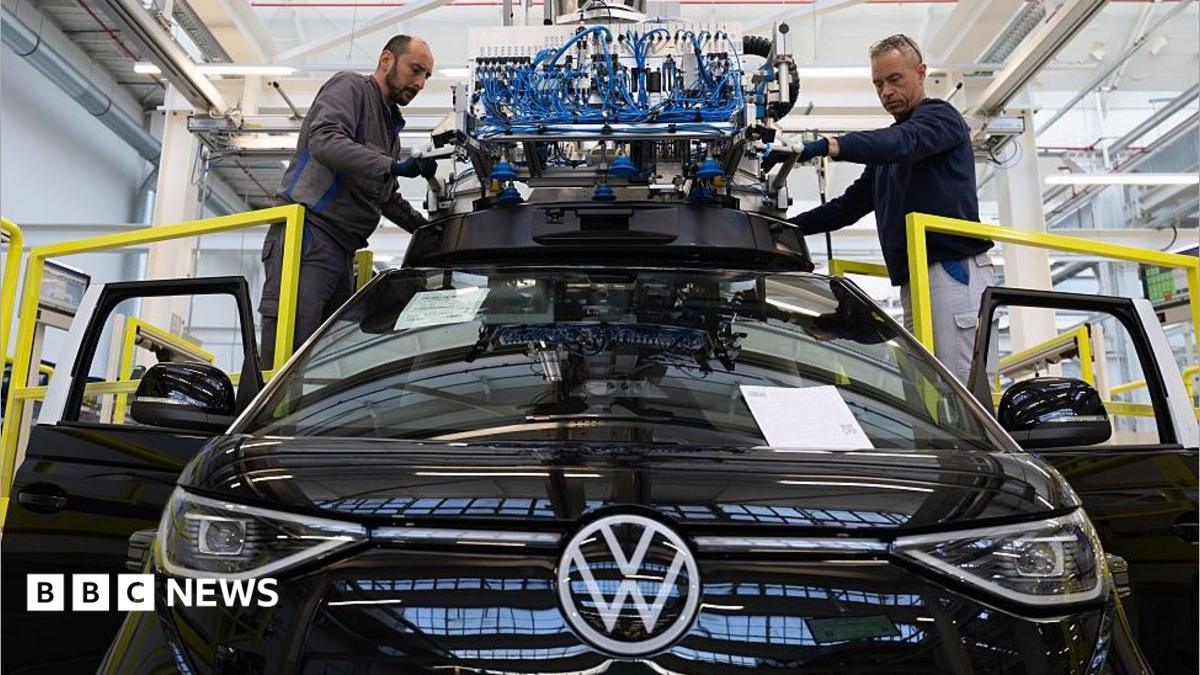
The board of German car giant Volkswagen has approved a plan to cut another 50,000 jobs as part of a sweeping turnaround programme. It brings the total number of roles the company plans to shed by 2030 to 100,000.
The group – which includes Audi, Porsche, Skoda as well as the VW brand – said in March that it would cut 50,000 roles by the end of the decade.
The move is a “strong signal” for the future of the firm, which is “taking responsibility for our entire workforce”, VW’s chief executive Oliver Blume said in a statement on Thursday.
Blume told the BBC in July that the firm was looking to make the additional cuts.
The company has been hit by a drop in profits due to falling sales and fierce competition, especially from Chinese brands.
VW’s statement also said that a “fundamental adjustment of the global workforce capability is necessary” to safeguard the competitiveness of the company, which faces shifting demand and technological change.
It added “a Group-wide workforce adjustment of approximately 50,000 positions – including management roles – will be necessary.”
As of 2025, the Beetle-maker employed more than 660,000 people worldwide.

Japan household spending drops for eighth straight month in July

Pooja Bhatt, an associate professor at OP Jindal Global University, says that mismatch is increasingly difficult to ignore.
“Given its young demographics and ‘Digital India’ aspirations, it makes sense for the nation to build and maintain its own internet infrastructure for security and governance purposes,” she says.
India has already taken a step: the government now treats submarine cable systems as critical telecommunications infrastructure, recognising their importance to international connectivity.
Sundararajan says the designation should bring faster clearances, emergency repair mechanisms and an Indian cable-repair capability, along with legally protected cable zones around landing sites and routes, restricting anchoring and trawling.
Technology could help too.
A technology called Distributed Acoustic Sensing can turn optical fibres into sensors capable of detecting vibrations from ships, anchors or underwater vehicles – potentially identifying threats before a cable is severed.
But the immediate fixes are possibly more mundane: more landing stations, greater geographical diversity, faster permissions, protected cable routes and an Indian repair capability.
“Connectivity has historically clustered around Mumbai because the ecosystem, infrastructure and demand were already concentrated there,” Gupta says. “But that concentration is exactly the risk the industry needs to design away from.”
That shift is already beginning.
Four new submarine cable systems are being commissioned, external, with three more planned. Lightstorm is leading a consortium building one of them, I-2SEA, linking India with Malaysia and Singapore. The system will have dual landings in India – at Machilipatnam, providing a shorter subsea route to Hyderabad, and at a new landing location in South Chennai, adding diversity to existing routes.
For a country consuming data at extraordinary speed, the infrastructure carrying it remains surprisingly fragile. India is adding data centres and preparing for an AI-heavy future. The question is whether its cables, landing stations and repair capacity can keep up.

US probes Iran wedding strike that analysis shows was likely direct hit by US munition

BitMart creditors organize after $10M rescue offer

US Open 2026 results: Harriet Dart and Francesca Jones lose to end British singles interest in New York

Xbox Game Pass Subscribers Are Losing a Big Perk This November





-

 Fashion6 days ago
Weekend Open Thread: Maeve – Corporette.com
-

 Crypto World1 day ago
CLARITY Act could advance within weeks, Atkins says
-

 Business6 days ago
Onto Innovation Stock: AI’s Next Bottleneck Is Yield (NYSE:ONTO)
-

 Crypto World6 days ago
Bitcoin price tests $82K resistance as Brandt stays long
-
 Tech5 days ago
Hugging Face built a $4.5 billion empire on free AI models. Now Nvidia is buying it for $12.9 billion
-

 Business6 days ago
iPhone 18 Pro Pre-Orders Could Shift to Saturday as Apple Reportedly Avoids September 11 Anniversary
-

 Crypto World2 days ago
Elon Musk Says Grok 4.7 Lands in 10 Days and Will Beat Every Model
-

 Crypto World7 days ago
Truflation calls for Fed rate cut after PCE forecast
-
 Entertainment7 days ago
‘Adults’ Creators Break Down Season 2’s Most Shocking Moments and Tease a Potential Season 3
-

 News Videos5 days ago
Charlie Munger on Robinhood: No one should believe that Robinhood’s trades are free
-

 Tech7 days ago
The fix for the AI agent that hijacked a company’s DNS: it can propose the change, but it can’t approve it
-

 Tech6 days ago
PaperCut releases second emergency patch for exploited flaws
-

 Crypto World21 hours ago
Kalshi seeks CFTC approval for WTI perpetual
-
 Crypto World2 days ago
Bitcoin slips below $77.5K as macro pressure offsets ETF inflows
-

 Tech5 days ago
Tamagotchi Ring Takes the 30-Year Digital Pet and Places it on Your Finger
-

 Tech5 days ago
As the influencer economy drives retail sales, Seattle startup raises $22M to play matchmaker
-

 News Videos5 days ago
News kii Crypto ugu danbeeyey & Suuqa oo dhaqaaqey
-
 NewsBeat5 days ago
Trump posts AI video of ‘Lake America’ being protected by an army of bequiffed ‘Donald Ducks’
-
 Entertainment4 days ago
Taylor Swift Reportedly ‘Frustrated’ With Travis Kelce After ‘Short’ Honeymoon
-
 Business2 days ago
Oil Price Today (September 2): Crude oil nears $97 as war tensions escalate. Will it hit $100 again?
You must be logged in to post a comment Login