Kelly Ripa’s painful dental surgery has sidelined the daytime TV staple, forcing the famously chatty host into an unusual recovery that has left her unable to speak, according to husband and co-host Mark Consuelos.
During Monday’s episode of “Live with Kelly and Mark,” Consuelos revealed that Ripa had undergone gum graft surgery, explaining the procedure to guest Nick Jonas while filling in for his wife on air.
Consuelos Breaks the News on Air
Consuelos delivered the update directly to viewers and their guest during the broadcast, making clear the procedure was more significant than it might sound. “Kelly sends her love,” Consuelos told Jonas. “Kelly had a little bit — well, it’s not a little — she had a gum graft surgery.”
Advertisement
Gum graft surgery typically helps correct thinning or receding gums, according to the Cleveland Clinic. Consuelos indicated the procedure wasn’t a sudden decision, revealing that Ripa’s dentist had actually recommended it years earlier.
According to Consuelos, Ripa had been advised to undergo the surgery long before she finally went through with it, and had even joked about the timeline when the recommendation was first made. “Her dentist said five years ago, ‘You can do it in about five years,’” Consuelos recalled. “And she joked, ‘I didn’t think I’d still be on the air in five years!’”
An Unusual Recovery for the Chatty Host
Perhaps the most notable detail Consuelos shared was that Ripa’s recovery process requires her to avoid talking altogether, a significant challenge for someone whose career centers on conversation. Jonas found the situation amusing given Ripa’s on-air persona. “Wow. That’s got to be the hardest thing she’s ever done,” Jonas joked.
Advertisement
Consuelos, describing his wife as “such a great conversationalist,” suggested he was having some difficulty ensuring she actually follows her doctor’s instructions during the recovery period. “I’m trying to keep her to follow the rules, follow the directions,” he said.
Keeping an Eye on the Healing Process
Beyond simply staying quiet, Consuelos also described the challenge of managing Ripa’s curiosity about her own healing progress at home, saying the hardest part of her recovery wasn’t the physical pain but keeping her from constantly checking on the surgical site. “Last night she was like, ‘Can you look?’ I’m like, ‘I’m not pulling your lip down,’” Consuelos said, describing how Ripa instead positioned herself so he could check without touching her lip directly. “So I’m down there like, ‘It looks great!’”
A Surgery Notable for How Much It Hurt
Advertisement
What made this particular procedure stand out, according to Consuelos, was how unusual it was for Ripa to acknowledge being in real pain, given her typical tolerance for discomfort at the dentist. “Yeah, it’s painful,” he told Jonas. “But she famously doesn’t feel pain. When she goes into the dentist, she doesn’t use the novocaine. But this one hurts, so I know it’s bad.”
A Tangent on Pain Tolerance
Ripa’s reputation for shrugging off pain led to a broader conversation between Consuelos and Jonas about pain tolerance more generally, with Jonas noting his own wife, singer and actress Danielle Jonas, shares a similar tendency to downplay discomfort. “I’ll be like, ‘Are you in pain?’ She’s like, ‘I’m fine!’ Come to find out her foot’s, like, falling off,” Jonas joked. Consuelos offered his own theory for the pattern, pointing to childbirth as a broader example. “Well, they do have kids. They deliver kids,” Consuelos added. “We’re not built for that.”
Ripa’s absence from the show is expected to extend beyond just a day or two as she completes her recovery. Ripa is not expected to return to “Live” for the next week, a representative for the show confirmed to People.
Advertisement
A Long-Running Partnership on Daytime TV
Ripa and Consuelos have co-hosted “Live with Kelly and Mark” together since 2023, continuing a franchise that has been a fixture of daytime television for decades under various co-host pairings. The married couple, who have been together for more than two decades, have built much of their on-air chemistry around exactly the kind of candid, personal banter that characterized Monday’s discussion of Ripa’s surgery and recovery.
Not the First Health Detail Ripa Has Shared Publicly
This isn’t the first time Ripa’s health and personal medical decisions have become a topic of public discussion on the show or in interviews. Ripa has previously spoken openly about other health and cosmetic choices in interviews, part of a broader pattern of candor that has become a hallmark of her on-air persona and contributed to her reputation as an unusually open daytime television personality.
Advertisement
With Ripa expected to remain off the air for roughly a week while she completes her recovery from the gum graft procedure, Consuelos is likely to continue hosting alongside guest co-hosts or additional appearances from friends of the show during her absence. Fans of the program can expect Ripa to return to her usual on-air banter once her doctor clears her to resume talking freely, with Monday’s segment offering a lighthearted, if unusually personal, glimpse into the couple’s home life during her recovery.
Australia’s benchmark stock index climbed to its highest level in nearly five months on Wednesday, extending a three-day rally as strong earnings from Rio Tinto and a global shift toward defensive stocks lifted local shares.
The S&P/ASX 200 was up 0.92%, adding 82.5 points to trade at 9,030.3 by early afternoon in Sydney, according to index data. The gain built on a 1% advance earlier in the session that pushed the benchmark to its best level since March 4. The index has now risen roughly 3% over its last three trading sessions and is up about 3.5% for the year to date.
The rally tracked a broader move on Wall Street, where investors rotated out of high-flying technology and semiconductor stocks and into defensive sectors such as financials and healthcare. The Dow Jones Industrial Average rose 1% overnight while the S&P 500 added 0.2%, but the Nasdaq slipped 0.2% as chip stocks came under renewed pressure. That pattern repeated across Asia on Wednesday, with bank-heavy indexes acting as a haven from turbulence in technology shares.
JPMorgan’s market intelligence team said its tactical positioning gauge was pointing toward further gains for the S&P 500. The signal is “now flashing a buy-signal,” a marker that has historically preceded upside for the index, according to the bank’s Andrew Tyler. The team cited lower bond yields, a weaker U.S. dollar and solid corporate earnings as tailwinds, aided by easing tensions between the United States and Iran and an expected interest-rate hold from the Federal Reserve this week. JPMorgan flagged crowding in semiconductor stocks as a key risk, along with the broader trajectory of the U.S.-Iran standoff.
Advertisement
Mining giant Rio Tinto was among the session’s strongest performers, climbing more than 5% after reporting first-half underlying earnings rose 43% to $6.9 billion, slightly ahead of analyst forecasts. The company also lifted its interim dividend 43% to $3.4 billion, with underlying earnings before interest, tax, depreciation and amortization also higher. The results come as global miners navigate volatile commodity prices and a wave of half-year reporting that continues through August.
Healthcare stocks also posted sharp gains. Cyclopharm shares jumped more than 13% after its Technegas lung ventilation imaging agent was named “generally preferred when available” in the first update to U.S. lung imaging guidelines in 14 years. The recommendation, jointly issued by four nuclear medicine societies, is expected to drive broader adoption of the product across American hospitals.
Gold miners had a rougher session after bullion prices retreated. Gold futures fell 1.2% to just above US$4,027 an ounce, pressuring shares of Northern Star Resources and Westgold Resources. Vault Minerals reported June-quarter gold output in line with its earlier preliminary figures, alongside all-in sustaining costs that came in better than expected. The company also set fiscal 2027 production guidance and confirmed a merger with Genesis Minerals.
Elsewhere, drone-detection company DroneShield saw its shares pressured after Bell Potter cut its price target sharply, from $4.80 to $2.50, while maintaining a buy rating. The broker pointed to increased competition in the counter-drone technology market after DroneShield secured a smaller-than-expected share of a recent U.S. public safety contract round tied to security for the 2026 FIFA World Cup.
Advertisement
The rotation into Australian equities has been underpinned in part by regional dynamics. Singapore’s bank-heavy stock index has also drawn investor interest as an alternative haven from volatility in Asian technology markets, with DBS and OCBC among the region’s biggest gainers. Fidelity Australia’s Yeo Sui Chuan pointed to a favorable balance between growth prospects and valuations in the region’s banking sector, noting attractive dividend yields alongside benefits from regional wealth flows and export growth.
Tuesday’s session set the stage for the advance, with the ASX 200 fighting back from a soft start to close 0.6% higher at 8,947.8 points. Futures had pointed to a firmer open Wednesday, with SPI contracts up 72 points, or 0.8%, ahead of the local session, even as Wall Street’s overnight moves were mixed.
The advance also comes against a backdrop of unusual turbulence in Asian technology markets. South Korea’s KOSPI index has fallen sharply in recent sessions, down more than 10% in a single day this week and now off more than 55% from its mid-June peak, as a rout in chip-linked stocks intensifies. The moves followed a weekend report that Nvidia was in talks to provide a roughly $250 billion financial backstop for a major OpenAI data-center project, a development that has stoked investor concern about circular financing arrangements within the artificial intelligence industry.
Analysts said the S&P/ASX 200’s comparatively defensive composition, with heavier weightings toward banks, miners and healthcare rather than high-growth technology names, has helped insulate it from the sharpest swings hitting regional tech-heavy markets.
Advertisement
The index has been range-bound between roughly 8,500 and 9,000 points for the past 16 weeks, with the 200-day moving average near 8,780 to 8,800 acting as a persistent point of gravity. With Australia’s corporate reporting season now underway, market watchers say the coming weeks of earnings releases are likely to determine whether the benchmark can sustain a decisive break above that long-standing range.
Investors are also awaiting further clarity on domestic monetary policy, after Australia’s latest inflation data played into expectations for the Reserve Bank’s coming interest-rate decisions. Trading volumes were elevated across financials and mining stocks as the reporting season accelerates through August.
Mineral Resources has achieved or beaten guidance targets across its iron ore, mining services and lithium divisions, while lifting its liquidity to $2.4 billion.
Lighthouse-backed Indian gifting retailer Ferns N Petals plans to go public by the end of 2028 to fund expansion and acquisitions, while targetting revenue growth of about 25% annually, its global CEO told Reuters.
“The end of 2028 will be a good time for us to go public,” Pawan Gadia said, adding that the company would also use the proceeds to buy other gifting brands.
Founded in 1994, Ferns N Petals sells flowers, cakes and personalised gifts in India, the United Arab Emirates, Singapore, Saudi Arabia and Qatar, and aims to enter Malaysia and more Gulf countries. Gadia did not provide a timeline.
Gadia said the Middle East war had not disrupted the company’s plans, despite expecting softer sales between April and June.
Advertisement
India’s retail and consumer sector will double to $1.93 trillion by 2030 from 2024 levels, according to Deloitte and an Indian industry body, as consumers spend more on discretionary goods and services.
Live Events
EXPANSION PLANS
The company reported revenue of 10.85 billion rupees ($113.19 million) in fiscal 2026, up 25% from a year earlier. It was last valued at $329 million in 2022, according to business data provider Tracxn. Gadia expects Ferns N Petals to maintain annual revenue growth of about 25%, with India contributing around 55% of revenue. Ferns N Petals also plans to expand its store network to 350 by fiscal 2028, from more than 300 currently, focusing on affluent urban neighbourhoods and franchise-led expansion into smaller cities. The CEO additionally projected core earnings margin of 5%-6% this fiscal year, up from 2.5% last year, saying Ferns N Petals had shifted its focus to profitability as investors now place greater emphasis on earnings than on revenue growth.
Singapore is positioned to become Southeast Asia’s neutral gold clearing hub, aided by regional policy shifts in Malaysia and Indonesia. Priorities include building bullion storage, market depth, and financial infrastructure, while leveraging technology like tokenised gold and faster settlement systems to attract global institutional participation.
Key Points
• Singapore is well-positioned to become South-east Asia’s neutral gold clearing and distribution hub, as neighbouring countries like Malaysia and Indonesia tighten regulations on precious metals trading, redirecting gold flows toward the city-state’s stable, open-trade environment.
• Building market depth is critical, requiring sovereign-grade vaulting, legal protections, collateralised lending, and active forward and lending markets to attract international central banks and institutional investors beyond simply storing gold.
• Technological advancements, including shorter settlement times, digital gold products, and tokenised bullion solutions, could strengthen Singapore’s competitive edge, though experts emphasise physical infrastructure and deep liquidity remain fundamental to long-term success.
Advertisement
Singapore’s Strategic Opportunity as a Gold Hub
Regional Policy Shifts Creating New Openings
Recent regulatory changes across Southeast Asia are repositioning Singapore as a potential gold trading and clearing hub. Malaysia’s 10 percent import duty on gold bar shipments and Indonesia’s export duty on gold — driven by resource nationalism — have disrupted regional gold flows. Industry experts, including Robin Tsui of State Street Investment Management, note that these shifts create a clear opportunity for Singapore to establish itself as a stable, neutral clearing and re-export hub for Asean gold, leveraging its open trade policy and geopolitical neutrality.
Building Infrastructure and Market Depth
Singapore’s Monetary Authority and the Singapore Bullion Market Association are actively working to deepen gold-trading infrastructure, including sovereign-grade vaulting services for foreign central banks. However, analysts stress that Singapore must evolve beyond secure storage into a full financial marketplace — one where gold is financed, hedged, and settled. Priyanka Sachdeva of Phillip Nova emphasizes the need for collateralised lending, gold-backed financing, and greater product innovation to attract institutional investors and generate the market depth necessary to compete with more established global gold hubs.
Competing Regionally and Embracing Technology
Singapore and Hong Kong: Competition and Complementarity
Hong Kong is set to launch its own gold clearing system in July, benefiting from proximity to China’s substantial gold volumes. Experts, including John Reade of the World Gold Council, believe there is room for both cities to thrive as complementary Asian gold-trading centers. Singapore has committed to launching its own clearing system, though no timeline has been announced. Increased participation from domestic banks in over-the-counter markets could deploy more risk capital, strengthening both hubs while fostering healthy competition.
Technology as a Competitive Differentiator
While neither Singapore nor Hong Kong is expected to surpass London’s dominant OTC market soon, faster and more advanced settlement systems could provide a meaningful advantage. London currently operates on a T+2 settlement basis; shorter settlement cycles would reduce capital requirements and improve trading efficiency. Singapore already benefits from GST exemptions on investment-grade precious metals. Moving forward, experts recommend streamlining onboarding for international investors, developing gold-based financial products, and advancing digital gold and tokenised bullion solutions — while ensuring these innovations complement, rather than replace, robust physical infrastructure and institutional participation.
In the Nifty500 pack, eight stocks’ closing prices crossed below their 200 DMA (Daily Moving Averages) on July 28, according to stockedge.com’s technical scan data. Trading below the 200 DMA is considered a negative signal because it indicates that the stock’s price is below its long-term trend line. The 200 DMA is used as a key indicator by traders for determining the overall trend in a particular stock. Take a look:
Huron Consulting Group Inc. (HURN) Q2 2026 Earnings Call July 28, 2026 5:00 PM EDT
Company Participants
C. Hussey – President, CEO & Director John Kelly – Executive VP, CFO & Treasurer
Advertisement
Conference Call Participants
Andrew Nicholas – William Blair & Company L.L.C., Research Division Tobey Sommer – Truist Securities, Inc., Research Division William Sutherland – The Benchmark Company, LLC, Research Division Kevin Steinke – Barrington Research Associates, Inc., Research Division Steven Wahrhaftig – Wedbush Securities Inc., Research Division
Presentation
Advertisement
Operator
Good afternoon, and welcome to Huron Consulting Group’s webcast to discuss financial results for the second quarter of 2026. [Operator Instructions] As a reminder, this conference call is being recorded.
Before we begin, I would like to point all of you to the disclosure at the end of the company’s news release for information about any forward-looking statements that may be made or discussed on this call. The news release is posted on Huron’s website. Please review that information along with the filings with the SEC for a disclosure of factors that may impact subjects discussed in this afternoon’s webcast. The company will be discussing one or more non-GAAP financial measures. Please look at the earnings release and on Huron’s website for all of the disclosures required by the SEC, including reconciliation to the most comparable GAAP numbers.
And now I would like to turn the call over to Mark Hussey, Chief Executive Officer and President of Huron Consulting Group. Mr. Hussey, please go ahead.
Advertisement
C. Hussey President, CEO & Director
Good afternoon, and welcome to Huron Consulting Group’s Second Quarter 2026 Earnings Call. With me today are John Kelly, our Chief Financial Officer; and Ronnie Dail, our Chief Operating Officer.
Led by strong organic growth across all 3 operating segments, we achieved record revenues before reimbursable expenses or RBR in the second
Shares of Amkor Technology plunged Tuesday morning, falling 23.95% to $46.17, extending a steep two-day slide even after the semiconductor packaging company reported record quarterly revenue and earnings that significantly beat Wall Street expectations.
The stock has now shed more than $14.54 in Tuesday’s session alone, adding to Monday’s losses and marking one of the sharpest multi-day declines the company has experienced this year.
Record Results That Failed to Impress Investors
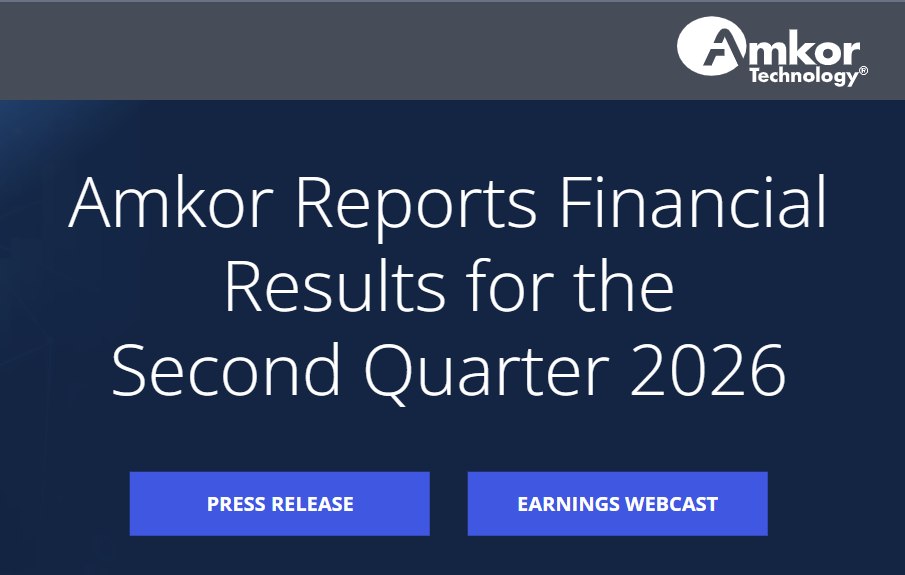
Amkor’s second-quarter results, released Monday after the market closed, showed a business performing at an all-time high across several key metrics. Amkor Technology reported stronger-than-expected second-quarter 2026 results, with earnings of $0.70 a share on revenue of $1.9 billion, topping Wall Street estimates of $0.47 a share and $1.81 billion. Revenue rose 26% from a year earlier, while gross margin widened sharply as the semiconductor packaging and test company benefited from higher factory utilization and a richer product mix.
Advertisement
The scale of the earnings beat was substantial by percentage terms as well. Amkor posted record quarterly revenue of $1.9 billion, up 26% from a year earlier, with earnings of 70 cents a share beating estimates by 23 cents, or nearly 49%.
A Weak Outlook Overshadowed the Beat
Despite those record results, investors focused almost entirely on the company’s forward guidance, which fell short of what Wall Street had been expecting for the current quarter. Amkor’s third-quarter revenue outlook fell short of consensus estimates, triggering the share price decline despite record revenue and higher-than-expected gross margins in the second quarter. Management forecast third-quarter revenue of $1.95 billion to $2.05 billion, below analyst expectations, while projecting third-quarter earnings per share in a range of 72 to 82 cents against a consensus estimate of 65 cents.
Specific Areas of Concern
Advertisement
Beyond the top-line guidance figures, investors also zeroed in on specific operational challenges flagged during the earnings presentation. Despite the strong quarterly performance, shares fell as investors focused on near-term challenges in the communications segment and operational disruptions related to manufacturing transitions. The muted initial stock reaction, followed by an escalating selloff into Tuesday’s session, suggests investors are weighing near-term communications headwinds and operational transitions against the company’s longer-term growth opportunity in advanced packaging.
How the Decline Unfolded Over Two Sessions
The stock’s slide accelerated meaningfully between Monday’s regular session and Tuesday’s premarket and regular trading. Shares fell 6.54% during Monday’s regular trading to close at $60.71, before extending losses further in after-hours trading that evening. The selling intensified overnight and into Tuesday, with shares tumbling more than 10% during premarket trading before the losses deepened further once the market opened, eventually pushing the stock down by roughly a quarter from its prior levels.
Management Strikes an Optimistic Tone Despite the Guidance Miss
Advertisement
Even as the stock sold off sharply, Amkor’s leadership emphasized confidence in the company’s underlying strategic position during the earnings call. “The first half of 2026 performance demonstrates the strength in our customer partnerships, technology leadership, and a global footprint strategy,” the company said during its earnings call. “Demand for advanced packaging continues to expand, and our advanced packaging programs remain on track to support growth in the second half of 2026.” Management pointed specifically to recent strategic partnerships with TSMC and Nvidia as reinforcing the increasingly critical role advanced packaging plays in the company’s long-term growth opportunities.
Full-Year Capital Spending Plans
Alongside its quarterly results, Amkor also detailed its capital investment plans for the remainder of the year, underscoring continued heavy spending tied to expanding its packaging capacity. The company guided full-year 2026 capital expenditures to a range of $2.5 billion to $3 billion, a figure that reflects continued aggressive investment in the advanced packaging capacity that management has pointed to as central to its growth strategy.
A Volatile Month for the Stock
Advertisement
Tuesday’s decline adds to what has already been an unusually turbulent month for Amkor shares, which had experienced dramatic swings in both directions throughout July. The stock’s price is currently down more than 41% for the month, after reaching a high of $83.47 and a low around $50 during the same period. Earlier in July, shares had fallen nearly 13% in a single session as investors weighed valuation metrics and recent insider selling activity, even as the stock’s year-to-date return remained strongly positive heading into that pullback.
That volatility followed a period of sharp gains tied to a major new business partnership. The stock had surged just days before Monday’s earnings report after Amkor announced a multiyear $1.5 billion strategic partnership with Nvidia, a deal that had lifted shares meaningfully before the subsequent pullback tied to profit-taking ahead of earnings and now the post-earnings guidance disappointment.
Wall Street’s Mixed Response
Analyst reaction to Monday’s results has been mixed, with some price target cuts even as overall sentiment toward the company’s long-term positioning remains generally positive. B. Riley Securities analyst Craig Ellis cut his price target on the stock from $90 to $75 in the days leading up to earnings while maintaining a neutral rating, even as other analysts including Needham’s Charles Shi maintained buy ratings with price targets as high as $90.
Advertisement
With Amkor’s stock trading well below both its 52-week high of $96.68 and its recent highs earlier this month, investors will be watching closely in the coming weeks to see whether the company’s near-term operational challenges in its communications segment prove temporary or signal a more sustained slowdown. Given the scale of Amkor’s continued investment in advanced packaging capacity and its recently announced partnerships with major chip customers including Nvidia and TSMC, the coming quarters are likely to serve as an important test of whether the company’s long-term growth story can offset the near-term guidance concerns that triggered Tuesday’s sharp selloff.

















































You must be logged in to post a comment Login