Business
Kraft Heinz pauses work to split the company as new CEO says ‘challenges are fixable’
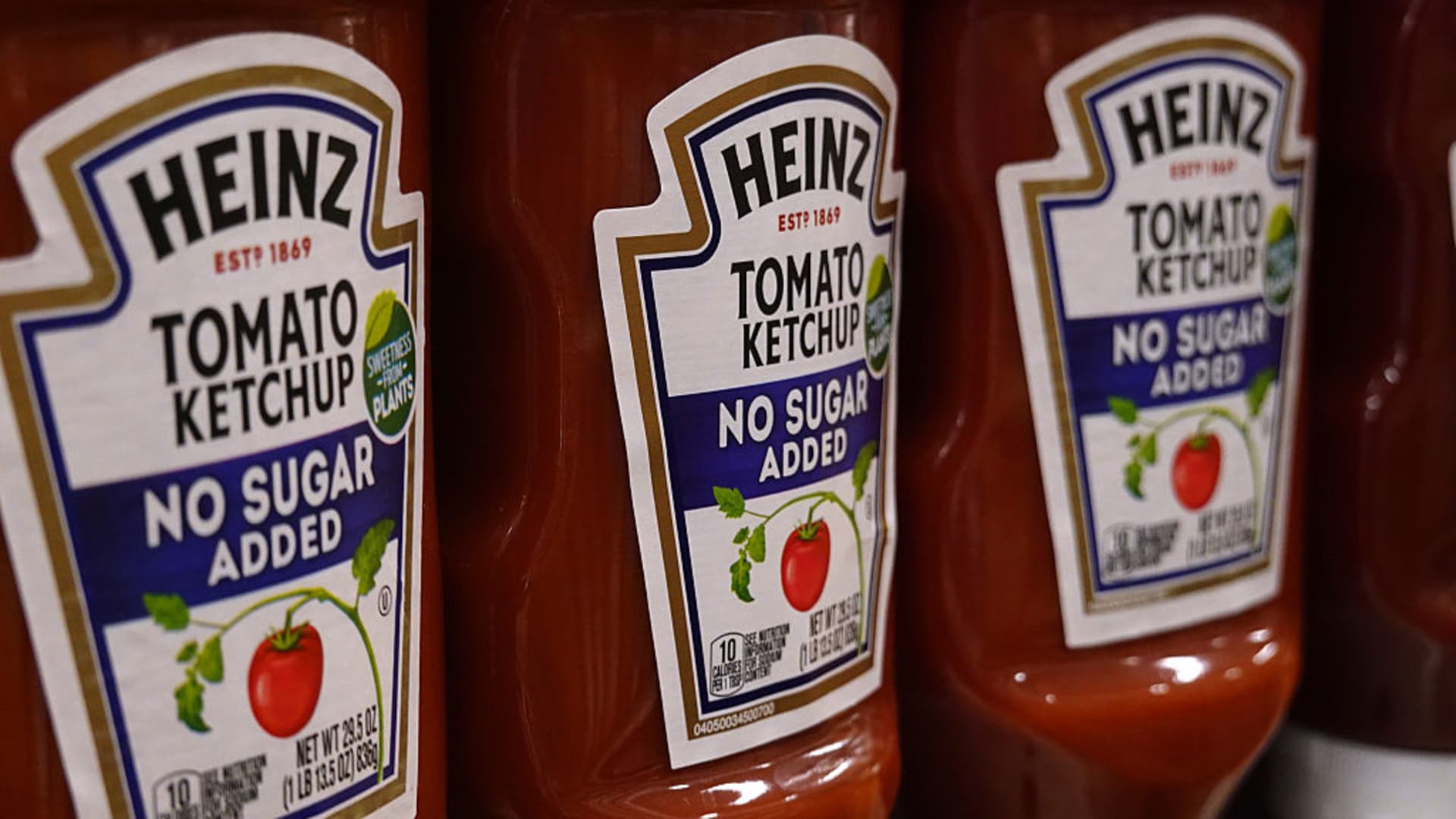
Kraft Heinz in September 2025 announced plans to split into two separately traded companies, reversing its 2015 megamerger, which was orchestrated by billionaire investor Warren Buffett.
Justin Sullivan | Getty Images News | Getty Images
Kraft Heinz on Wednesday said that it is pausing work on its previously announced plans to split the company.
Shares of the company fell 6% in premarket trading.
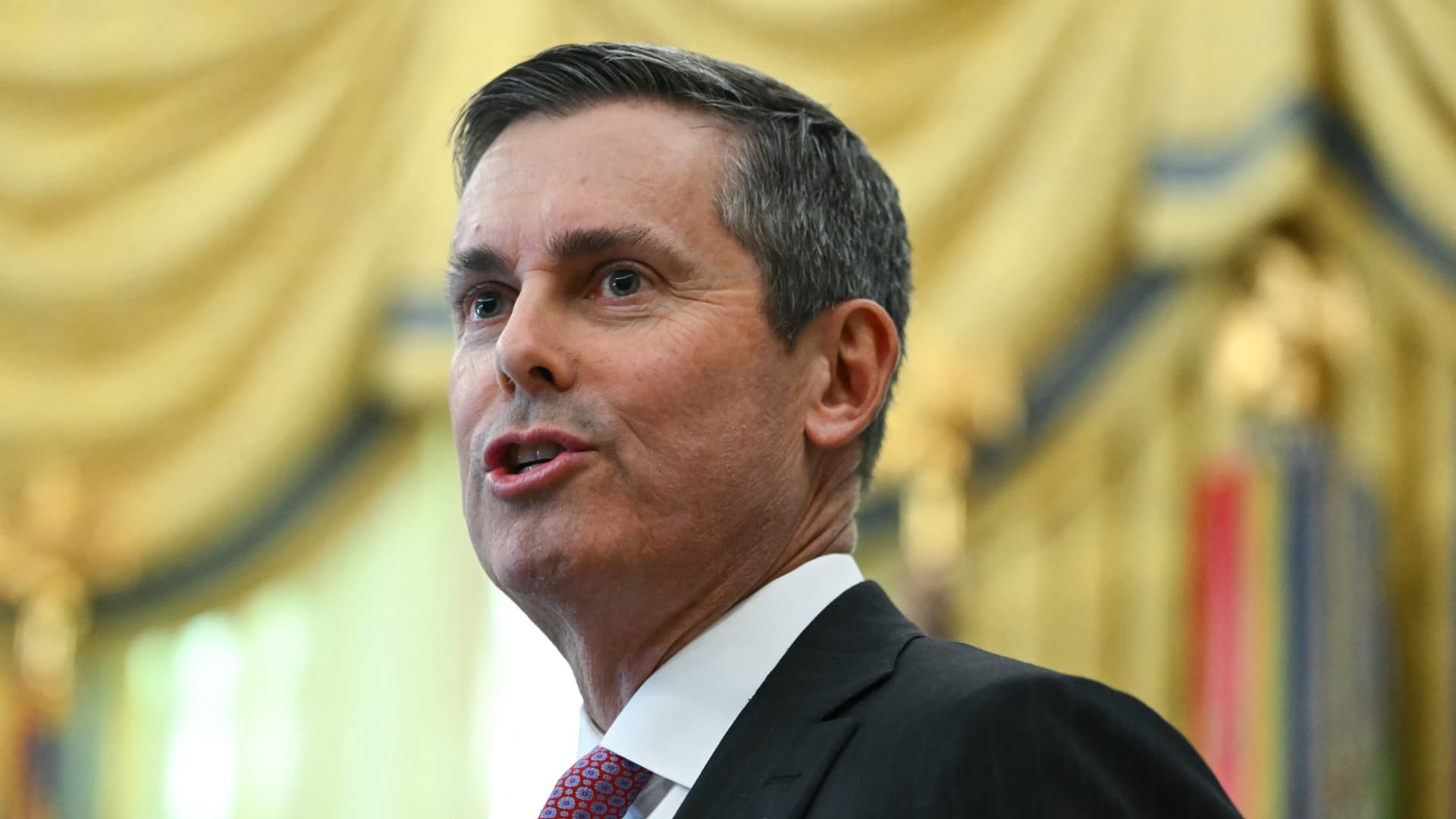
CEO Steve Cahillane, who joined Kraft Heinz in January, said in a statement that many of the company’s issues are “fixable and within our control.”
“My number one priority is returning the business to profitable growth, which will require ensuring all resources are fully focused on the execution of our operating plan,” he said. “As a result, we believe it is prudent to pause work related to the separation and we will no longer incur related dis-synergies this year.”
Kraft Heinz also plans to invest $600 million to fuel a turnaround of its U.S. business. The company plans to spend the money on its marketing, sales, and research and development. The investment will also go towards “product superiority and select pricing,” according to Cahillane.
In September, the company announced plans to split, reversing much of the blockbuster $46 billion merger from a decade ago that created one of the biggest food companies in the world.
Warren Buffett, who helped mastermind the deal, said that he was disappointed in the decision. Berkshire Hathaway has since taken a formal step toward unwinding its 28% stake in Kraft Heinz.
In December, Kraft Heinz announced Cahillane’s hiring. He previously led Kellogg through its own breakup and then headed spinoff Kellanova until its sale to Mars.
This is breaking news. Please refresh for updates.
Business
Chevron warns Newsom California regulations risk 500K jobs and gas price hikes
‘The Big Money Show’ panelists discuss California’s energy policies its impact on gas prices as well as the oil industry.
Chevron is sounding a dire alarm, warning California Gov. Gavin Newsom and state regulators that newly proposed “cap-and-invest” amendments are a death knell for California’s remaining refineries.
The energy giant warns the move will kill more than half a million jobs, threaten national security and spike gas prices by more than a dollar per gallon — all to fuel a state-run “shakedown” of the energy sector — in a letter addressed to Newsom and obtained by The California Globe.
“The proposed regulation will cripple the survivability of the state’s remaining refineries, which will result in California losing the entire industry to this misguided program,” Chevron President Andy Walz wrote.
“This regulation will increase transportation and aviation fuel prices for consumers. It will risk significant job losses, including many high-paying union jobs, while reducing funding for essential public services,” he continued. “It will upend California’s fuels market and threaten critical energy and national security assets.”
U.S. ‘SITTING ON SIGNIFICANT PROVEN RESERVES’: ANALYST SAYS AMERICA CAN WITHSTAND IRAN ENERGY SHOCK
The California Air Resources Board (CARB) is aiming to make companies cleaner by aggressively lowering the cap on how much total pollution is allowed in the state. Specifically, the board is proposing to pull 118.3 million allowances out of the state’s market between 2027 and 2030 and has more recently increased its carbon reduction target to 90% by 2045.

Chevron’s president wrote a strongly worded letter addressed to California Gov. Gavin Newsom over proposed energy regulations. (Getty Images)
Walz warns that the green energy agenda comes with a price tag for working families, writing that Chevron projections show a $1 increase per gallon of gas by 2030 and an estimated 536,770 industry jobs at risk.
California already has the highest gas prices in the nation, with the current state average listed at $4.81 per gallon, according to AAA. The national average, by comparison, is $3.25 as of March 4.
In some California counties, gas costs as much as $5.74 per gallon.
“These impacts will fall most heavily on lower-income households that spend a disproportionate share of income on transportation fuels, increasing costs without addressing the underlying driver of California’s gasoline prices,” Walz said. “Affordability is a top concern for California’s residents and Chevron, and these proposed amendments would only exacerbate the high cost of living in the state.”
Walz frames this not only as a local issue but as a threat to the energy stability of the entire United States.
Exclusive: FOX Business correspondent Edward Lawrence has the latest on Interior Secretary Doug Burgum’s visit to Venezuela on ‘The Claman Countdown.’
“Refinery closures in California reduce fuel supply resilience on the West Coast, increasing risks to military readiness and national security,” Walz cautioned. “Maintaining a stable policy framework that supports continued operation of California refineries is therefore not only an economic and consumer affordability issue, but also a matter of broader energy security and national defense.”
CARB is also reportedly exempt from standard open-meeting rules, allowing it to manage billions of dollars in carbon auctions behind closed doors.
“The California energy industry’s economic, industrial, environmental and national security benefits have been the foundation of a healthy, prosperous state and nation. Adversarial policies at local, regional and state levels have eroded that foundation,” Walz said.
GET FOX BUSINESS ON THE GO BY CLICKING HERE
Chevron CEO Mike Wirth joins ‘Mornings with Maria’ to discuss record oil production, rising dividends and the company’s long-term growth strategy.
“These proposed regulatory changes threaten to destroy it. Chevron urges policymakers and regulators to reconsider and revise the proposed regulation before it causes lasting and irreversible harm to California’s economy and energy security and broader vital American interests,” he concluded.
Newsom’s office did not immediately respond to Fox News Digital’s request for comment.
Business
Ferrellgas Partners, L.P. (FGPR) Q2 2026 Earnings Call Transcript
Operator
Good morning, ladies and gentlemen, and welcome to the Ferrellgas Partners, L.P. Q2 2026 Earnings Conference Call.
[Operator Instructions]
I would now like to turn the call over to Michelle Maggi, Vice President, Corporate Affairs. Please go ahead, Michelle.
Michelle Maggi
Vice President of Corporate Affairs
Thank you, Jonathan. Good day, everyone. Thank you for joining us today for our second quarter 2026 earnings conference call. We released this morning pre-market our earnings. If you haven’t seen it yet, you can find it on our website under the Investor Relations tab at ferrellgas.com.
With me today is Tamria Zertuche, our President and Chief Executive Officer, and Nick Heimer, Ferrellgas’ Vice President and Corporate Controller. Today’s call includes prepared remarks where Tamria and Nick will go over our second quarter results for fiscal 2026, concluding with responses to previously submitted questions.
Please note that this call may contain forward-looking statements as determined by federal securities laws. For this purpose, any statements made during this call that are not statements of historical facts may be deemed forward-looking statements. These statements may be affected by important factors set forth in our filings with the Securities and Exchange Commission and in our latest earnings release. As a result, actual operations or results may differ materially from the results discussed in any forward-looking statements. We undertake no obligation to publicly update any forward-looking statements except to the extent required by law.
In addition, please refer to the Form 8-K earnings release to find disclosures and reconciliations of non-GAAP financial measures that may be referenced
Business
Trump cuts federal workforce by 12% through government efficiency push
Check out what’s clicking on FoxBusiness.com.
President Donald Trump and the Department of Government Efficiency’s (DOGE) efforts to reduce the federal government’s workforce were seemingly reflected in recently released data from the U.S. Office of Personnel Management (OPM).
The OPM’s data shows that the government’s civilian workforce shrank by 12% between September 2024 and January 2026, going from a headcount of 2,313,216 to 2,035,344.
Separate data, also released by the OPM, shows that the majority of employees who left during that time did so voluntarily rather than being forced out, Reuters reported. The outlet also noted that administrative staff, customer service representatives and IT managers were at the top of the list of positions that left once Trump returned to office.
DOGE DEVELOPS INNOVATIVE AI TOOL TO ELIMINATE UNNECESSARY FEDERAL REGULATIONS

President Donald Trump smiles during a roundtable on the Ratepayer Protection Pledge in the Indian Treaty Room at the Eisenhower Executive Office Building on the White House campus on March 4, 2026. (Andrew Caballero-Reynolds/AFP via Getty Images)
“Reshaping the federal workforce is essential to building a government that works for the American people, not the bureaucracy. By realigning roles, streamlining operations, and modernizing how agencies manage talent, we are strengthening performance and accountability across government. This effort ensures taxpayer dollars support a workforce that delivers efficient, responsive, and high-quality services,” OPM Director Scott Kupor told Fox Business.
During his 2024 campaign, Trump spoke about his desire to slash the government workforce through the creation of a new department, which would later be known as DOGE. The main backer of the idea, and the person who led the team until leaving the administration in May 2025, was billionaire Tesla CEO Elon Musk.

Elon Musk during a news conference with President Donald Trump in the Oval Office of the White House on May 30, 2025. (Francis Chung/Politico/Bloomberg via Getty Images)
TREASURY AND GSA LAUNCH SAVE PROGRAM TO REWARD EMPLOYEES UP TO $10K FOR SAVING TAXPAYER DOLLARS
Musk championed the idea during his appearance at a Trump rally in Madison Square Garden in late October, just days before the 2024 election.
“Your money is being wasted, and the Department of Government Efficiency is going to fix that. We’re going to get the government off your back and out of your pocketbook,” he told the crowd.
On his first day in office, Trump signed an executive order establishing DOGE as a temporary organization, giving it an expiration date of July 4, 2026. The order kicked off a temporary hiring freeze and the implementation of a hiring plan that restricted agencies to hiring one new employee for every four that departed.

An aerial view of the U.S. Capitol on Oct. 26, 2025, in Washington, D.C. (Al Drago/Getty Images)
GET FOX BUSINESS ON THE GO BY CLICKING HERE
Fox News Digital reached out to OPM and the White House for comment.
Business
Regenerative agriculture benefits crops and biodiversity

BakingTech 2026 talk explains how regenerative agriculture works and its many benefits.
Business
Netflix acquires Ben Affleck’s AI film-tech firm

Netflix acquires Ben Affleck’s AI film-tech firm
Business
Olaplex Q4 2025 slides: revenue stabilizes but costs pressure margins

Olaplex Q4 2025 slides: revenue stabilizes but costs pressure margins
Business
Chang warns Chinese subs operating ‘very close’ to US homeland
Gatestone Institute senior fellow Gordon Chang joins ‘Mornings with Maria’ to react to China ramping up submarine production, backing Iran and raising alarms over U.S. reliance on Chinese drones and AI competition.
Gordon Chang urged the United States to treat China as an “enemy combatant” Thursday, warning that Chinese submarines are operating “very close” to the U.S. homeland as Beijing reportedly expands its undersea footprint.
“Obviously, they do want subs to be able to get closer to the U.S.,” the Gatestone Institute senior fellow told “Mornings with Maria.”
“And, by the way, we have Chinese submarines in the Arctic, which would be very, very close to Alaska and the homeland, so this is really an important development, and we have got to make sure that we have the attack subs that can take out those ballistic missile submarines of the Chinese.”
IRAN STRIKES COULD SIGNAL LIMITS OF BEIJING, MOSCOW’S POWER AS US FLEXES STRENGTH

A man looks at a submarine during a media tour by the PLA Naval Museum in Qingdao, in eastern China’s Shandong province, on June 25, 2025. (Pedro Pardo/AFP via Getty Images / Getty Images)
Chang’s warning comes after a Wall Street Journal report that the U.S. adversary is “developing new submarine technology and a bigger, better fleet that is gaining on the United States and its allies.”

His warning also comes as China plans to send a special envoy to the Middle East for what Beijing describes as mediation efforts, as joint U.S.-Israeli strikes continue targeting Iranian regime sites.
FBI RAISES COUNTERTERROR TEAMS TO HIGH ALERT AMID IRAN TENSIONS

Smoke rises over Tehran after the Israeli army launches a second wave of airstrikes on Iran on Feb. 28, 2026. (Fatemeh Bahrami/Anadolu via Getty Images / Getty Images)
“That envoy is going to try to stop the United States from attacking Iran,” Chang warned.
“Clearly, what we should be doing is ignoring this guy. The Chinese are an enemy combatant. That’s the way we should treat them.”

Chang argued that Beijing is not acting as a neutral broker, but as a key backer of Tehran, allegedly supplying weapon components while increasing commodity purchases and offering diplomatic and propaganda support.
GET FOX BUSINESS ON THE GO BY CLICKING HERE
Forbes Media chairman and editor-in-chief Steve Forbes and former Republican National Committee chair Reince Priebus discuss Democrats’ criticism of Operation Epic Fury on ‘Kudlow.’
“Last year, 87.2% of Iran’s exports accrued went to China. It’s across-the-board support,” he said.

“So the United States just needs to say, ‘Look, we want to stop this.’ We have to also impose costs on China.”
Business
Airlines hit by jet fuel price surge as Iran conflict disrupts global supply
Airlines are facing a sharp rise in operating costs after jet fuel prices surged to their highest level in more than three years amid escalating conflict in the Middle East, raising fears of prolonged disruption to global energy supplies.
The price of aviation kerosene in European markets has climbed to levels not seen since the shortages triggered during the Covid-19 pandemic, placing immediate pressure on airline margins and sending aviation stocks lower.
The spike has been particularly severe because jet fuel prices have moved far beyond the rise in crude oil prices. Brent crude has climbed by more than 10 per cent this week to around $78.60 per barrel and is roughly 20 per cent higher than it was a fortnight ago. However, the cost of jet fuel delivered to airlines has risen significantly faster, creating an unprecedented gap between aviation fuel and crude oil benchmarks.
According to commodity pricing specialists Argus Media, the cost of jet fuel physically supplied to airlines has increased by about 23 per cent over the past week alone. The price is now 48 per cent higher than last Friday and has surged by 68 per cent over the past month.
Market participants have described trading conditions as highly unstable. Analysts said the jet fuel market had entered a period of extreme volatility as traders struggled to price in the risks created by military tensions in the Gulf.
Amaar Khan, an analyst at Argus Media, said the current market dynamics were extraordinary. Even though supply risks linked to the conflict are real, he said traders believed the current price spike had become detached from normal supply-and-demand fundamentals. One trader described the situation as “absolute chaos”, noting that “no fundamentals can explain these prices”.
The aviation sector’s exposure to the Middle East has amplified the shock. European airlines depend heavily on jet fuel imports from the Gulf region, with a significant share of those shipments passing through the Strait of Hormuz, one of the world’s most critical maritime energy corridors.
Industry data suggests that at least 40 per cent of Europe’s jet fuel imports last year originated from the Middle East Gulf region and travelled through the strait. Kuwait alone accounted for a substantial portion of these supplies and remains Europe’s largest single supplier of aviation fuel.
The Strait of Hormuz has effectively become a flashpoint for global energy markets after Iran imposed a blockade in response to military attacks carried out by the United States and Israel. The narrow waterway, which sits between Iran and the United Arab Emirates, serves as the primary export route for oil and gas shipments from the Persian Gulf.
Any sustained disruption to traffic through the strait could severely restrict global fuel supplies, particularly for jet fuel, which is already in tight supply across Europe.
Analysts warned that while European refineries could increase their production of jet fuel to offset some of the disruption, they would struggle to replace Gulf imports entirely if the conflict continued.
Argus noted that Europe’s aviation fuel market had already become structurally tighter in recent years due to rising travel demand following the pandemic recovery. With refiners operating near capacity, there is limited scope to increase output quickly enough to compensate for any prolonged interruption to Gulf shipments.
At the same time, the cost of transporting fuel from alternative regions has also risen sharply. Freight rates for tanker shipments have surged as insurers raise premiums on vessels travelling through conflict-affected waters, making imports from other regions significantly more expensive.
The result has been a dramatic increase in jet fuel prices relative to crude oil. Aviation fuel is now trading at almost double the price of Brent crude, a differential that analysts say has never previously been recorded.
For airlines, the timing of the price spike is particularly challenging because fuel typically represents between 25 and 35 per cent of operating costs. Even short-term volatility can therefore have a significant impact on profitability.
Shares of European airline groups have already reacted to the rising costs and growing uncertainty surrounding Middle Eastern airspace.
International Airlines Group has seen its share price fall about 16 per cent from the record high it reached last week when it reported strong annual results. The airline group, which owns carriers including British Airways, Iberia and Aer Lingus, faces both higher fuel costs and operational disruptions on long-haul routes through the region.
Budget airline easyJet has also seen its shares fall around 6 per cent this week. The carrier does not operate routes directly in the Middle East but remains vulnerable to rising fuel costs across the industry. Its stock had already been under pressure, declining roughly 15 per cent since the start of the year.
Meanwhile Wizz Air warned that the conflict could cut €50 million from its annual profits due to cancelled regional flights and adverse movements in fuel and currency costs. The airline has said the combined impact could push it into a full-year loss, with its shares dropping about 20 per cent over the past week.
Airlines have sought to protect themselves from fuel volatility through hedging strategies that lock in fuel purchases months or even years in advance. These hedges can soften the immediate impact of price spikes but cannot fully shield carriers if elevated costs persist for a prolonged period.
Europe’s largest airline by passenger numbers, Ryanair, recently confirmed that it has forward-purchased approximately 80 per cent of its jet fuel requirements at an average price of $67 per barrel through to March 2027.
International Airlines Group has also hedged a large portion of its future fuel consumption, locking in prices for around 62 per cent of its fuel needs for 2026.
Similarly, easyJet said it has hedged about 62 per cent of its fuel requirements for the upcoming summer season at an average price of $68.80 per barrel.
While these measures provide some protection against sudden spikes, analysts warn that sustained price increases would still filter through into airline costs over time as hedges expire and new contracts are negotiated.
Industry observers say the key factor determining how severe the crisis becomes will be the duration of the disruption to Gulf energy flows and whether shipping through the Strait of Hormuz can resume safely.
If the blockade persists or the conflict spreads further across the region, aviation fuel prices could remain elevated for months, forcing airlines to absorb higher costs or pass them on to passengers through higher ticket prices.
For now, airlines and investors alike are watching energy markets closely as geopolitical tensions continue to ripple through the global aviation industry.
Business
Ford recalls more than 615,000 US vehicles over wiper, driveshaft defects
Former Waymo CEO John Krafcik discusses the evolution of self-driving technology and the company’s safety improvements on ‘The Claman Countdown.’
Ford is recalling more than 615,000 vehicles in the U.S. over two separate safety defects involving windshield wiper motors and driveshaft components, according to the National Highway Traffic Safety Administration.
The larger recall covers 604,533 vehicles because a front windshield wiper motor defect could cause the wipers to operate intermittently or fail entirely, reducing visibility and increasing the risk of a crash, NHTSA filings show.
The recall includes certain 2020–2022 Ford Explorer and Escape models, along with 2020–2022 Lincoln Aviator and Lincoln Corsair vehicles built between July 6, 2020, and Dec. 15, 2021.

A Ford Explorer at the Ford Chicago Assembly Plant where the Ford Explorer and Lincoln Aviator sport utility vehicles are worked on. (Jose M. Osorio/Chicago Tribune/Tribune News Service via Getty Images)
According to the Part 573 safety report, the issue stems from a condition in which the motor’s cover terminal may have been misaligned with the brush card terminal during assembly, potentially creating a poor electrical connection that can lead to a loss of electrical continuity over time. Front wiper functionality may be intermittent before progressing to complete inoperability.
FORD RECALLS MORE THAN 412,000 VEHICLES OVER SUSPENSION ISSUE
Ford has identified 1,374 warranty claims related to inoperative or intermittent windshield wiper motors within the affected population as of Feb. 18, 2026, but said it is not aware of any reports of crashes or injuries tied to the condition. The estimated defect rate is about 1% of the recalled population.

A 2020 Ford Explorer ST in motion. (Ford Motor Co.)
The recall is listed under NHTSA Campaign Number 26V117, and Ford’s internal recall number is 26S14.
Dealers will inspect and replace the front wiper motors as necessary, free of charge. Dealer notification began March 4, 2026, and interim owner notification letters are expected to be mailed between March 9 and March 13, 2026. A second notice will be sent once a final remedy is available, anticipated between May 11 and May 15, 2026.
HYUNDAI RECALLS NEARLY 569K SUVS OVER FAULTY AIRBAGS
Ford has instructed dealers not to demonstrate or deliver new in-stock vehicles covered by the recall until repairs are completed. Federal law requires recall repairs to be completed before delivery to buyers.
| Ticker | Security | Last | Change | Change % |
|---|---|---|---|---|
| F | FORD MOTOR CO. | 12.81 | +0.11 | +0.87% |
Owners can contact Ford customer service at 1-866-436-7332 or check their vehicle identification number on NHTSA.gov, where affected VINs became searchable on March 4, 2026.
CLICK HERE TO GET FOX BUSINESS ON THE GO
Separately, Ford is also recalling 11,431 US vehicles because the driveshaft’s friction weld may fail, which could result in rear driveshaft separation and a sudden loss of drive power, NHTSA said. Dealers will repair that issue at no cost to owners.
Business
Ringcentral stock hits 52-week high at 40.68 USD

Ringcentral stock hits 52-week high at 40.68 USD
-
Politics7 days agoITV enters Gaza with IDF amid ongoing genocide
-
Politics2 days agoAlan Cumming Brands Baftas Ceremony A ‘Triggering S**tshow’
-
Fashion6 days agoWeekend Open Thread: Iris Top
-
Tech5 days agoUnihertz’s Titan 2 Elite Arrives Just as Physical Keyboards Refuse to Fade Away
-
Sports5 days ago
The Vikings Need a Duck
-
NewsBeat5 days agoDubai flights cancelled as Brit told airspace closed ’10 minutes after boarding’
-
NewsBeat5 days agoAbusive parents will now be treated like sex offenders and placed on a ‘child cruelty register’ | News UK
-
NewsBeat4 days ago‘Significant’ damage to boarded-up Horden house after fire
-
NewsBeat5 days agoThe empty pub on busy Cambridge road that has been boarded up for years
-
Tech10 hours agoBitwarden adds support for passkey login on Windows 11
-
Entertainment3 days agoBaby Gear Guide: Strollers, Car Seats
-
Tech6 days agoNASA Reveals Identity of Astronaut Who Suffered Medical Incident Aboard ISS
-
Business7 days agoOnly 4% of women globally reside in countries that offer almost complete legal equality
-
Politics5 days ago
FIFA hypocrisy after Israel murder over 400 Palestinian footballers
-
NewsBeat4 days agoEmirates confirms when flights will resume amid Dubai airport chaos
-
NewsBeat3 days agoIs it acceptable to comment on the appearance of strangers in public? Readers discuss
-
Crypto World7 days agoFrom Crypto Treasury to RWA: ETHZilla Retreats and Relaunches as Forum Markets on Nasdaq
-
Tech4 days agoViral ad shows aged Musk, Altman, and Bezos using jobless humans to power AI
-
Video3 days agoHow to Build Finance Dashboards With AI in Minutes
-
Business2 days agoGuthrie Disappearance Enters Fifth Week as Family Visits Memorial