British small businesses are being approved for bank loans at less than half the rate they enjoyed before the financial crisis, and one of Donald Trump’s former economic advisers says the fault lies not with the 2008 crash but with the rules written in its aftermath.
Tyler Goodspeed, who chaired the White House’s council of economic advisers from 2020 to 2021 and is now chief economist at Exxon Mobil, argues that post-crisis regulation forcing banks to hold more capital, rather than the depth of the recession, is the main reason Britain’s recovery has trailed the United States.
“History shows deep recessions are usually followed by strong rebounds. Britain’s experience after 2009 departed from this pattern because regulators, with the best of intentions, made it structurally harder for banks to lend to British businesses. That was a choice, and it is still being made today.”
His central figure will sting any owner who has pitched a bank for growth capital. Credit to smaller companies in the United States clawed its way back to 2008 levels by 2013; in the UK it remains 15 per cent below pre-crisis volumes. British lenders, he says, have pulled back from the real economy and switched instead to “low-risk lending to governments”.
Advertisement
The consequences land hardest on the youngest, most ambitious firms, the ones the government keeps saying it wants more of.
“This matters because smaller, younger enterprises looking to expand may struggle to access credit through conventional bank loans because they lack credit history and physical assets that they might pledge as collateral,” Goodspeed says. “To illustrate this point, one might consider tech companies, whose primary assets are intangible, namely, their ideas. Without non-bank sources of credit, many such firms may be unable to access external financing, and instead be forced to rely on cash flow and retained earnings.”
That reliance is sharper here than across the Atlantic. UK firms lean far more heavily on bank funding than American peers, who can tap deeper capital markets and pools of private credit, private equity and venture capital. When the bank says no, many British SMEs have nowhere else to turn.
Goodspeed’s verdict is blunt. The decline in bank lending to firms is a “searing indictment of UK financial policy over the past 15 years. Before 2008, approval rates for new bank loan applications by small and medium-sized UK businesses were often 80-90 per cent. By 2024, that had dropped to fewer than half,” he says.
Some of the post-crisis architecture is now being dismantled. The Bank of England has loosened rules on banker bonuses and signalled it will ease capital requirements for lenders, the buffers of cash and assets banks must hold against their lending. The previous Labour government, under Sir Keir Starmer, said it would also relax the post-2008 “ringfencing” rules that forced banks to separate retail banking from riskier investment activity, a change the industry has long wanted.
Whether looser rules translate into more loans for the corner-shop expansion or the software start-up remains the open question. For Goodspeed, the direction of travel matters less than the admission underneath it: that Britain’s credit drought was made in Whitehall, and can be unmade there too.
Jamie Young
Jamie Young is Senior Reporter at Business Matters, covering SME finance, employment law and Westminster policy since 2016. He has reported on every Budget and Autumn Statement since 2018, helped make sense of the ‘covid era’ and the bounce-back loan scheme from launch through the fraud investigations, and broke the magazine’s coverage of the 2024 late-payment reforms. He joined Business Matters straight from completing his BA in Administration from Exeter University and is NCTJ-qualified. Reach him at jyoung@cbmeg.co.uk
Jobs in Wales will be cut as part the restructuring
Taite Johnson Audience and Trending Writer
07:56, 24 Jul 2026
British Gas(Image: Dinendra Haria/SOPA Images/LightRocket via Getty Images)
British Gas owner Centrica has announced that it will be cutting around 1,300 jobs including within call centres in Wales. The job cuts come as the company recorded an earnings decrease in its half-year report.
Advertisement
The workforce reduction totals around 14% of the customer operations team as Centrica announced a ‘customer service transformation’ scheme last month. Five hundred call centre roles will be cut including many in Cardiff as well as in Glasgow, Edinburgh, Leicester, Stockport and Leeds.
A further 800 roles are being cut from support functions across the business.
A spokesman for Centrica said: “We have been transforming the business for a number of years to ensure we have the right roles in the right places for the future. This means making changes to improve efficiency, drive commercial performance and give our customers the service they want.
“At the same time, we continue to invest in the skills where there is demand, including recruiting more engineers to meet growing demand and hiring 500 apprentices this year alone.”
Advertisement
The GMB union has made accusations that the 500 call centre roles being cut will be replaced by AI technology, however Centrica has called these claims “simply wrong”.
Charlotte Brumpton-Childs, GMB national secretary, said: “It’s an absolute disgrace British Gas is slashing hundreds of human jobs and giving them to chatbots.
“These staff are massively overworked and underpaid, yet do their level best to keep customers happy. Now, instead of being rewarded, they’re being replaced by artificial intelligence.”
After 43+ years working for one investment research company or another, I finally retired. So now, I’m completely independent. And for the first time on Seeking Alpha, I won’t be working based on anybody else’s product agenda. I have only one goal now… to give you the best actionable investment insights I can.I have long specialized in rules/factor-based equity investing strategies. But I’m different from others who share such backgrounds. I don’t serve the numbers. Instead, the numbers serve me… to inspire HI (Human Intelligence) generated investment stories. I definitely understand quant investing, including factors and what not (AI before it was called AI). But I don’t agree with what other quants do. Rather than be obsessed with statistical studies that are no good for any time periods other than the ones studied, I combine factor work with the underlying theories of finance including classic fundamental analysis to get the true story of a company and its stock. Investing is about the future. So numbers (which necessarily live in the past) can take us just so far. They’re at their best when they cue us into stories that shed light on what’s likely to happen in the future. And that’s how I use them,I’ve had a pretty colorful career. Besides a full range of experience covering stocks from lots of different groups (large cap, small cap, micro cap, value, growth, income, special situations … you name it, I covered it) I’ve developed and worked with many different quant models. In addition, I formerly managed a high-yield fixed-income (“junk bond”) fund and conducted research involving quantitative asset allocation strategies such as are at the foundation of what today has come to be known as Robo Advising. I formerly edited and or wrote several stock newsletters, the most noteworthy having been the Forbes Low Priced Stock Report. I previously served as an assistant research director at Value Line.I also have long had a passion for investor education, which has resulted in my having conducted numerous seminars on stock selection and analysis, and the authoring of two books: Screening The Market and The Value Connection.I’m looking forward to my new incarnation on Seeking Alpha. I hope you enjoy what I offer. But if you don’t, feel free to tell me why in the comment sections. I’m a big boy. I can handle criticism. (But please don’t call me “stupid.” That’s my wife’s job!)
Analyst’s Disclosure: I/we have no stock, option or similar derivative position in any of the companies mentioned, but may initiate a beneficial Long position through a purchase of the stock, or the purchase of call options or similar derivatives in ORCL over the next 72 hours. I wrote this article myself, and it expresses my own opinions. I am not receiving compensation for it (other than from Seeking Alpha). I have no business relationship with any company whose stock is mentioned in this article.
Seeking Alpha’s Disclosure: Past performance is no guarantee of future results. No recommendation or advice is being given as to whether any investment is suitable for a particular investor. Any views or opinions expressed above may not reflect those of Seeking Alpha as a whole. Seeking Alpha is not a licensed securities dealer, broker or US investment adviser or investment bank. Our analysts are third party authors that include both professional investors and individual investors who may not be licensed or certified by any institute or regulatory body.
The most successful digital products of the last decade didn’t actually invent anything new. They just looked at something we were already doing, something annoying, messy, and tedious that we’d all collectively agreed to tolerate, and made it take two clicks instead of twenty.
Think about it. We didn’t need a new way to hail a car. We just hated standing in the rain, guessing when a taxi would show up. We didn’t need a new way to buy groceries. We just got tired of losing an hour of our Sundays in the checkout line.
For small and medium businesses looking to build a digital product, this is incredibly liberating news. You don’t need a multi-million-dollar R&D budget to create a breakthrough. You just need to find the “too many tabs” problem in your industry and kill it.
The “Too Many Tabs” Problem
We live in an era of information fragmentation. If you want to buy home insurance, book a flight, or even find a decent local plumber, your screen probably looks like a digital graveyard of open browser tabs. You copy data from one site, paste it into a spreadsheet, flip back to compare, and pray the info hasn’t changed by the time you’re done.
Every extra tab a customer has to open is friction. And friction is a silent conversion killer.
Advertisement
The easiest way to innovate right now isn’t to build a brand-new service from scratch. It’s to build a lens that focuses existing, chaotic data into one clear, real-time view.
Shoveling the Snow: A Real-World Example
Take a look at the sports betting space. It’s a crowded, hyper-competitive industry, but it’s plagued by this exact tab-overload issue.
Bookmakers constantly drop “odds boosts” (promotional spikes in payout for specific games or players). For a casual bettor, finding these is a nightmare. You have to log into five different apps, navigate three sub-menus deep on each, and compare them before the game starts or the offer expires. It’s exhausting, so most people don’t bother.
A site called BookiesBonuses.com saw this frustration and built a tool called Boostfinder.
Advertisement
Instead of forcing users to play digital detective, they pulled all those fleeting, chaotic promos into a single, searchable dashboard. You can filter by sport, search for a specific player, and sort by which offer is expiring first.
They didn’t invent sports betting. They didn’t even invent odds boosts. They just built a better shovel for a task their audience was already doing manually.
The “Good Enough Today” Rule for SMEs
There is a massive trap here that trips up almost every SME founder: waiting for perfection.
When you decide to tackle customer friction, the temptation is to build a flawless, fully automated masterpiece right out of the gate. But that takes time and cash, two things small businesses usually run short on.
Advertisement
Boostfinder’s approach is a masterclass in realistic product development. They launched using a mix of automated data feeds and manual, human updates to fill the gaps. Is it 100% automated? Not yet. But is it useful to their users right now? Absolutely.
If you wait until your data pipeline is a work of art, a competitor who is comfortable with a “good enough” launch will have already captured your audience. Launch the messy version that solves the problem today. Optimize it tomorrow.
The Takeaway
If you’re staring at a blank whiteboard trying to figure out your next product move, close your eyes and think about your customer’s worst day at work.
Where do they spend thirty minutes doing data entry?
What questions do they ask your support team over and over again?
What is the “fifteen open tabs” equivalent in your specific niche?
You don’t need to reinvent the wheel. You just need to grease the axle. Find the friction, build a tool that deletes it, and your customers will happily pay you for the time you just handed back to them.
Meghan, the Duchess of Sussex, offered fans a rare, personal glimpse into her family’s summer travels Thursday, sharing a carousel of photographs on Instagram documenting a European getaway that took the family from the beaches of Portugal to a poignant visit at Princess Diana’s childhood home in England.
Meghan, 44, posted the images alongside a simple caption, “Summer Holiday ☀️,” featuring her husband, Prince Harry, 41, and their two children, Prince Archie, 7, and Princess Lilibet, 5. The post marks one of the more extensive public photo collections the couple has shared of their children in recent months.
A Portuguese getaway confirmed
The photos confirmed months of speculation about the Sussexes’ connection to Melides, a coastal town south of Lisbon sometimes referred to as the “Hamptons of Portugal.” One image in the carousel shows a menu from O Melidense, a beachfront restaurant in the town. People magazine had reported in 2024 that the couple purchased a holiday home in the area, a report the couple has neither confirmed nor denied. Harry’s cousin, Princess Eugenie, and her husband, Jack Brooksbank, own a property nearby at the CostaTerra Golf and Ocean Club in Comporta, a connection that had fueled earlier speculation about the family’s ties to the region.
Advertisement
The Portugal photos capture a range of relaxed family moments: Meghan and Harry in swimsuits on the beach with Archie and Lilibet splashing in the sea, Harry playfully tossing Lilibet into the air over a swimming pool, and the couple laughing together over a glass of red wine during what appeared to be a date-night dinner. Another image shows Archie seated in the cockpit of a plane alongside the pilots, wearing a captain’s hat as he reaches toward the controls, and a separate photo shows him holding a stick at sunset.
A visit to Princess Diana’s childhood home
Among the more emotionally resonant images in the collection was a photo taken at Althorp, the ancestral estate of the Spencer family and the childhood home of Harry’s late mother, Princess Diana, who is buried on the grounds. The photo shows Harry walking across the estate with Archie and Lilibet, with both Harry and his son carrying bouquets of flowers.
The visit echoes a moment Harry described in his 2023 memoir, “Spare,” recounting bringing Meghan to visit his mother’s grave for the first time in 2022. Diana is buried on an island at the center of an ornamental lake known as The Round Oval, within Althorp’s Pleasure Garden. In the memoir, Harry wrote about the experience: “We hesitated, hugging, and then I went first. I placed flowers on the grave. Meg gave me a moment, and I spoke to my mother in my head, told her I missed her, asked her for guidance and clarity.” He recalled finding Meghan afterward “kneeling, eyes shut, palms against the stone,” and asking her what she had prayed for. “Clarity, she said. And guidance,” he wrote.
Advertisement
Part of a broader trip to the U.K.
The Portugal getaway preceded the family’s higher-profile visit to the United Kingdom earlier this month, during which Harry, Meghan and their children traveled to Highgrove House, King Charles’ private country residence in Gloucestershire, for a reunion with the King and Queen Camilla. The gathering marked only the third meeting between Harry and his father since Charles’ 2024 cancer diagnosis, and the first time the King had seen his grandchildren in person in more than four years.
The family’s arrival in the U.K. had been uncertain until the last minute, following a public back-and-forth between Harry and the palace over security arrangements and accommodations. Meghan ultimately did not attend several of Harry’s public engagements during the U.K. trip, including events marking the one-year countdown to the 2027 Invictus Games in Birmingham, citing security concerns.
Reflecting on the significance of the family reunion at Highgrove, royal author Catherine Mayer offered perspective to PEOPLE in an earlier exclusive cover story. “One of the strangenesses of the monarchy is that we are all encouraged to forget they’re human beings because they’re representatives of the institution,” Mayer said. “But at its heart it is just a family, and this family has gone through extraordinary upheavals. Whatever you think of the monarchy, this is a moment most of us wanted to see happen.”
Advertisement
A pattern of curated family glimpses
Thursday’s post continues a pattern the Sussexes have followed in sharing selective, carefully curated images of their children over the past several years, typically timed around holidays or significant family milestones rather than offered as a running public account of their day-to-day lives. Previous posts have included matching family photos for winter holidays and occasional glimpses of Archie and Lilibet at the family’s Montecito, California home, but full vacation photo collections of this scope have remained relatively rare.
With the family’s European travels now documented publicly, attention is likely to turn to whether Harry and Meghan continue offering similar glimpses into their children’s lives in the months ahead, particularly as royal watchers continue to track the broader state of relations between Harry and the rest of the royal family following this month’s reunion at Highgrove. For now, Thursday’s post offers fans a rare, unfiltered look at a family holiday that took the Sussexes from a quiet Portuguese coastal escape to one of the more emotionally significant stops in the Spencer family’s history.
The initial public offering of technical textile machinery and equipment-maker Lohia Corp continued to see decent investor interest during its second day of public bidding, with the Rs 1,101 crore maiden issue of the company being subscribed 43% so far on Friday.
The public issue received bids for more than 61 lakh shares, as against the offer size of 1.43 crore shares, according to data on NSE at 10.36 am. Retail Individual Investors (RII) lead the numbers, booking 80% of their reserved portion. Qualified Institutional Buyers (QIB) meanwhile have subscribed 43% of the portion kept for them, while that reserved for the Non Institutional Investors (NII) has been booked 18% so far.
Lohia Corp IPO GMP
The decent subscription numbers come despite muted grey market trends. The unlisted shares of Lohia Corp were trading with a grey market premium (GMP) of 3-8.5% over the IPO price, according to sites tracking the unofficial market. This has fallen from the 9-13% GMP the unlisted stock commanded after the price band was announced.
It is important to note the grey market is an unofficial platform. The actual listing premium may significantly differ from the grey market expectations.
Lohia Corp launched its IPO on Thursday to raise Rs 1,101 crore entirely through an Offer for Sale (OFS) of shares at a price of Rs 404-425 per share. This means that the IPO proceeds will go to the selling shareholders, while the company itself will not receive any funds from the offering.
The maiden public issue of the company will be open for bidding from July 23 to July 27. The share allotments are expected to be finalised on July 28, while the company’s shares are likely to make their debut on NSE and BSE on July 30.
Live Events
The IPO has a lot size of 35 shares. At the upper price band of Rs 425, retail investors will need to invest a minimum of Rs 14,875 for one lot. Equirus Capital Ltd and Motilal Oswal Investment Advisors Ltd are the book-running lead managers to the issue, while MUFG Intime India Pvt. Ltd. is the registrar. Promoters participating in OFS include Raj Kumar Lohia (up to 167.28 lakh shares), Gaurav Lohia (up to 22.18 lakh shares), Amit Kumar Lohia (up to 9.2 lakh shares) and Ritu Lohia (up to 16.71 lakh shares). Other selling shareholders include Alok Kumar Lohia (up to 21.71 lakh shares), Anurag Lohia (up to 11.38 lakh shares) and Anuja Lohia (up to 10.85 lakh shares).
About Lohia Corp
Incorporated in 2023, Lohia Corp manufactures machinery and equipment used in the production of technical textiles, particularly for manufacturing polypropylene (PP) and high-density polyethylene (HDPE) woven fabric and sacks.As of March 31, 2026, the company had an installed annual capacity of 240 tape extrusion lines, 13,800 circular looms, and 108,000 winders. Its product portfolio includes tape extrusion lines, circular looms, coating and lamination lines, printing and conversion machines, multifilament yarn machines, twister winders, monofilament extrusion lines, recycling machines, and related spare parts.
Advertisement
Lohia Corp financials
Lohia Corp reported a net profit of Rs 193 crore for the financial year which ended on March 31, 2026. This marked a 64% year-on-year (YoY) rise from Rs 118 crore net profit reported in FY25. Its revenue from operations, meanwhile, rose around 25% YoY to Rs 1,717 crore in FY26 from Rs 1,377 crore in FY25.
(Disclaimer: Recommendations, suggestions, views and opinions given by the experts are their own. These do not represent the views of The Economic Times)
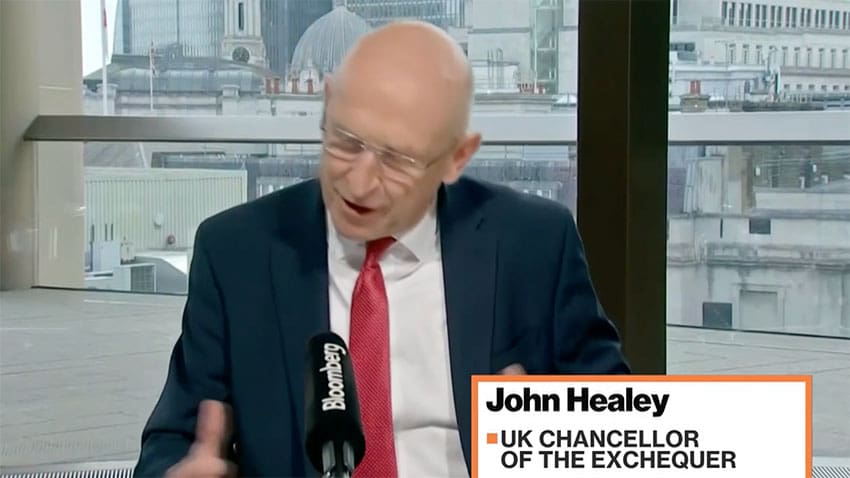
Britain’s new Chancellor has told the country’s business owners that their pain is now firmly on his desk. In his first major broadcast interview since taking the job, John Healey used an appearance on Bloomberg TV to promise that he is “just as concerned about the cost of business as I am about the cost of living”.
It is a deliberate reframing. For two years, ministers have built their message around household budgets. Healey wants entrepreneurs to know the squeeze on their firms counts too.
“To British businesses, to British innovators, to British investors: I will back you as your Chancellor,” he said. “I’ll back you in financial services, in technology, in retail, in industry, in all parts of the economy.”
The pledge lands at a nervous moment. Business groups gave Healey’s move to the Treasury a cautious welcome, wanting warm words followed by action on the bills that have piled up.
The Chancellor acknowledged the mood. “I know things haven’t been easy,” he said. “We talk a lot in government about the cost of living, and that’s right. People have been facing increasing pressures… but so have all of you.”
He went further: “I know that businesses large and small have felt really squeezed.”
Healey’s answer is a closer working relationship. “I want us to deepen our government’s relationship, our Treasury’s relationship with business,” he said. “I want to deepen it based on a shared ambition for Britain, not just an ambition for success in this square mile, but for every part of the country, or as the Prime Minister would say, in every postcode.”
Advertisement
For SMEs, the test is whether the rhetoric converts into policy. Warm words on backing business are cheap; lower energy bills, a lighter tax load and steadier supply chains are not. The Chancellor has set the bar himself by putting the cost of business alongside the cost of living. Owner-managers will now expect the Budget to show it.
The direction of travel, at least, is clear. A Chancellor who names tax, energy and labour as the pressures keeping business owners awake has correctly diagnosed the problem. Whether the Treasury writes the prescription is the question every firm will now be asking.
Paul Jones
Harvard alumni and former New York Times journalist. Editor of Business Matters for over 15 years, the UKs largest business magazine. I am also head of Capital Business Media’s automotive division working for clients such as Red Bull Racing, Honda, Aston Martin and Infiniti.
Shares of HDFC Bank slipped more than 1% on Friday after three separate US law firms announced investigations into whether the Indian private lender violated federal securities laws by allegedly disguising Rs 45 crore in payments to the Maharashtra State Road Development Corporation (MSRDC) as marketing spend.
HDFC Bank shares dropped to Rs 737.25 apiece on NSE on Friday. The shares of India’s largest private lender have now crashed 10% over five sessions since the release of its Q1 earnings last weekend.
Why are 3 US law firms probing HDFC Bank?
Los Angeles-based Glancy Prongay Wolke & Rotter LLP, the Law Offices of Howard G. Smith in Pennsylvania, along with the Law Offices of Frank R. Cruz in Century City have each said that they are looking into potential securities law violations by HDFC Bank and are inviting the lender’s shareholders who suffered losses to come forward, The Economic Times reported.
These three law firms are yet to disclose whether their investigations have progressed into a formal class action filing. Such cases typically see US securities firms using these early-stage probe announcements to identify a lead plaintiff before petitioning a federal court, a process that can take weeks to months.
Advertisement
HDFC Bank did not respond to a query from The Economic Times.
Live Events
Also Read |Three US law firms probe HDFC Bank over alleged Maharashtra deposit payments Notably, the investigation dates back to a report which claimed that HDFC Bank had made payments to Maharashtra’s road development corporation in order to attract large deposits from the state agency. A report in The Indian Express said the payments were allegedly made to the Maharashtra State Road Development Corporation (MSRDC), a state government agency, just days before former chairman Atanu Chakraborty resigned on March 18. The Indian Express investigation, based on internal records, found that the payments were intended for Maharashtra State Road Development Corporation as “differential interest”, or interest paid above the specified rate on its deposits. However, instead of being directly credited to MSRDC’s account as interest income, the funds were allegedly routed through the bank’s marketing department and shown as contributions towards a road safety awareness campaign via four local vendors.
HDFC Bank however had strongly denied the allegations of wrongdoing. “The bank has robust internal oversight, audit and control processes and systems. All issues are dealt with in accordance with the bank’s established norms, and full process is always followed before final determination post any internal review. We strongly reject any assumptions of wrongdoing or culpability based on selective material,” the bank said in a statement.
HDFC Bank share price
HDFC Bank shares have fallen around 10% in one week and 7% in a month, dropping more than 25% in 2026 so far. In the longer term, the shares of the Indian private lender have delivered negative returns of 26% in one year and 12% in three years, although it gained 3% in five years.
HDFC Bank last Saturday reported a 5% year-on-year (YoY) rise in net profit to Rs 19,060 crore for Q1 FY27, while NII rose 7% YoY to Rs 33,534 crore.
(Disclaimer: Recommendations, suggestions, views and opinions given by the experts are their own. These do not represent the views of The Economic Times)



























































You must be logged in to post a comment Login