
Business
McKesson Corporation (MCK) Q1 2027 Earnings Call Transcript


Operator
Welcome to McKesson’s First Quarter Fiscal 2027 Earnings Conference Call. Please be advised that today’s conference is being recorded.
At this time, I would like to turn the call over to Paula Adkison, SVP of Corporate Finance and Investor Relations. Please go ahead.
Paula Adkison
Thank you, operator. Good afternoon, and welcome, everyone, to McKesson’s First Quarter Fiscal 2027 Earnings Call. Today, I’m joined by Brian Tyler, our Chair and Chief Executive Officer; along with Kenny Cheung, our Chief Financial Officer. Brian will lead off, followed by Kenny, and then we will move to a question-and-answer session.
Today’s discussion will include forward-looking statements such as forecasts about McKesson’s operations and future results. Please refer to the cautionary statements in today’s earnings release and presentation slides available on our website at investor.mckesson.com and to the Risk Factors section of our most recent annual and periodic SEC filings for additional information concerning risk factors that could cause our actual results to materially differ from those in our forward-looking statements.
Information about non-GAAP financial measures that we will discuss during this webcast, including a reconciliation of those measures to GAAP results, can be found in today’s earnings release and presentation slides. The presentation slides also include

Business
Milky Mist IPO price band fixed at Rs 133-140 for Rs 1,553-crore IPO; issue opens on August 11

Retail investors can apply for a minimum of one lot comprising 107 equity shares, and in multiples thereafter. At the upper end of the price band, the minimum investment required is Rs 14,980.
Based on the upper price band of Rs 140 per share, the company is valued at around Rs 10,778 crore, which is a little over half the market capitalisation of listed peer Hatsun Agro Product.
Milky Mist IPO details
The Tamil Nadu-based dairy products maker has trimmed the size of its IPO from the earlier planned Rs 2,035 crore to Rs 1,553 crore after a pre-IPO stake sale to Jongsong Investments, a subsidiary of Singapore state investor Temasek.
The public issue consists of a fresh issue of shares worth Rs 1,428.2 crore and an offer for sale (OFS) of Rs 125 crore by existing shareholders. Half of the issue has been earmarked for qualified institutional buyers (QIBs), while non-institutional investors (NIIs) have been allocated 15%. The remaining 35% has been reserved for retail investors.

Jongsong Investments currently holds about 5.2% in Milky Mist after purchasing shares at Rs 139.76 apiece through a pre-IPO placement in April.
Axis Capital, JM Financial and IIFL Capital Services are the book-running lead managers for the issue. Milky Mist is expected to list on the BSE and NSE on August 18.Also read: To IPO, or to Ipostpone? Zepto’s IPO pause could be a blessing in disguise
Milky Mist IPO proceeds
Milky Mist, which exclusively manufactures value-added dairy products, will use Rs 496.8 crore from the net proceeds of the fresh issue to repay debt. The company had total borrowings of Rs 1,390.7 crore as of May 2026.
It has also earmarked Rs 469.2 crore for the expansion and modernisation of its manufacturing facility at Perundurai. Another Rs 155.3 crore will be invested in deploying visi coolers, ice cream freezers and chocolate coolers. The remaining proceeds will be used for general corporate purposes.
Read more: India’s IPO boom cools as weak markets force issuers to cut back
About Milky Mist
The company sells its products under the flagship Milky Mist brand, along with sub-brands including SmartChef, Capella and Misty Lite. Its manufacturing operations are currently based out of Perundurai in Tamil Nadu.
Milky Mist, which says it is the largest private packaged paneer brand in the organised market, reported a profit of Rs 127 crore for the financial year ended March 2026, up 176% from Rs 46.1 crore a year earlier. Its revenue rose 33.6% to Rs 3,138.4 crore during the same period.
The company’s listed peers have been grappling with margin pressure this year due to elevated milk procurement costs and broader weakness in the equity market.
(Disclaimer: Recommendations, suggestions, views and opinions given by the experts are their own. These do not represent the views of The Economic Times)

The latest Market Talks covering Basic Materials. Published exclusively on Dow Jones Newswires at 4:20 ET, 12:20 ET and 16:50 ET.
0753 ET – Following Johnson Matthey’s completed sale of Catalyst Technologies, the chemicals group now has greater agency over its future, Jefferies’ Helena Xu and Marcus Dunford-Castro write. The completed 1.325 billion pound sale to Honeywell means the narrative around the London-listed group “now turns on Johnson Matthey’s own delivery rather than deal risk or macro-led sentiment.” Margin growth in the group’s clean air division is key to the investment case for the company, the analysts say. Johnson Matthey’s acquisition of Cormetech is a welcome strategic pivot, given it taps into the fast-expanding U.S. data center pipeline, they say. The analysts reinstate their coverage of the stock at buy. Johnson Matthey shares rise 5.9%. (josephmichael.stonor@wsj.com)
0523 ET – Aluminum Corp. of China seems well-positioned to benefit from tighter global supply of the base metal, given the alumina refiner’s relatively stable power availability and raw material supply, says Fitch Ratings in a note. The Middle East conflict has intensified concerns over the metal’s supply after Gulf smelters were struck, as the region accounts for around 8%-9% of aluminum production. Production curtailments in the region due to the Strait of Hormuz closure should keep aluminum prices elevated in 2027 even if the waterway reopens this year, it adds. Chalco is also likely to benefit from the Chinese government’s support of parent company Chinalco, due to the state-owned enterprise’s strategic importance to China’s energy transition, power infrastructure and resource-security objectives, Fitch says. (megan.cheah@wsj.com)
2356 ET – The outlook for Fortescue’s earnings—and, consequently, dividends—has weakened as the iron-ore miner faces structural cost pressures, says Morgan Stanley. Fortescue’s FY 2027 C1 cost guidance of US$20.50-US$21.75/wet metric ton is roughly 7.8% above consensus midpoint and 13% above FY 2026’s. Fortescue faces longer haul distances, likely increasing absolute diesel consumption, says MS. Iron Bridge also remains a drag on earnings, it says. The bank cuts its EPS estimates by 21% for FY 2027 and 18% for FY 2028. Its dividend forecast drops to 60.6 Australian cents a share in FY 2027—from nearly A$1.13/share in FY 2026—implying a 3.3% yield at a 65% payout. MS cuts its share-price target 9.9% to A$15.55 and reiterates an underweight rating. Shares are at A$17.99. (rhiannon.hoyle@wsj.com; @RhiannonHoyle)
Copyright ©2026 Dow Jones & Company, Inc. All Rights Reserved. 87990cbe856818d5eddac44c7b1cdeb8

Qantas ground staff could soon walk off the job, potentially leaving hundreds of FIFO flights stranded, amid a bitter dispute between the airline and the Transport Workers Union over pay and conditions.
Business
Oil Price Today (August 6): Crude oil dips below $80 on hopes Iran-Oman deal could end Iran war. What are experts saying?

Crude oil price on August 6
Brent crude futures fell 37 cents, or 0.5%, to $79.08 a barrel, while U.S. West Texas Intermediate (WTI) crude futures dropped 53 cents, or 0.7%, to $74.69 a barrel. Brent had ended marginally higher on Wednesday, whereas WTI settled slightly lower.
A proposed agreement between Iran and Oman aimed at ending the U.S.-Iran conflict would hand Tehran control over ships entering the Gulf through the Strait of Hormuz, a senior Iranian source and two regional officials told Reuters on Wednesday. The proposal marks one of the biggest concessions made to Iran so far.
Also read: Trump claims Iran reached out for talks, says clarity may come in 48 hours
US President Donald Trump has said a deal to reopen the strait is close even as US officials have consistently maintained that they would not agree to Iran controlling access to the world’s most important energy trade route.
Iran has also warned Gulf states that any fresh U.S. attack on its territory would lead to retaliation against key energy infrastructure across the region. The warning is seen as an effort by Tehran to raise the cost of military action by threatening Washington’s closest regional allies.
Separately, Yemen’s Iran-aligned Houthis said on Wednesday they had launched missile attacks on a Saudi oil tanker near the Red Sea port of Yanbu and another Saudi oil tanker in the Gulf of Aden. Saudi Arabia has not confirmed either incident. The risk of Houthi attacks disrupting shipping in the Red Sea continues to temper optimism over a broader recovery in Middle East shipping routes.
What are experts saying?
The outlook for oil prices continues to depend on how long supply disruptions persist. JPMorgan estimates that every additional month of disruption could lift Brent crude prices by about $7 to $8 a barrel. If the disruption extends to three months, the bank expects average monthly Brent prices to reach around $114 a barrel.
Goldman Sachs has also cautioned that Brent could rise to $120 a barrel if disruptions to shipping through the Strait of Hormuz, the world’s most important oil transit route, continue.
Read more:How the Iran war exposed cracks in the US-Israel partnership
Despite that risk, Goldman Sachs’ base case assumes tensions in the Middle East will eventually ease. Under that scenario, the bank expects Brent to average $80 a barrel in the fourth quarter and $75 a barrel next year. However, it said the risks to its forecast remain skewed to the upside, citing the possibility of continued disruptions in the Strait of Hormuz and the Red Sea.
“The direction of our outlook is unchanged; the path and the timeline have shifted. We still expect oil to cool as we move into 2027, for three reasons: supply outside the conflict zone is expanding, with OPEC+ raising production targets, the UAE at record output and non-OPEC barrels responding to price,” said Anindya Banerjee, Head of Commodity Research at Kotak Securities.
(Disclaimer: Recommendations, suggestions, views and opinions given by the experts are their own. These do not represent the views of Economic Times)

Manchester City kicks off the second match of its preseason Asia tour on Wednesday against a K League All-Stars squad in Seoul, South Korea, giving fans around the world a chance to watch new manager Enzo Maresca continue shaping his squad ahead of the 2026-27 Premier League campaign.
The match is being played at Seoul World Cup Stadium, a venue that hosted matches during the 2002 World Cup, with kickoff set for noon local UK time, which translates to 7 a.m. Eastern time in the United States, 8 p.m. in South Korea, 4:30 p.m. in India and 9:30 p.m. in Australia.
How to Watch
The match will not air on traditional television in the United Kingdom or in most markets around the world. Instead, Manchester City is streaming the game live through CITY+, the club’s own in-house subscription streaming service, available on the club’s official website and mobile app. The service costs £34.99 annually or £9.99 per month on its own, or fans can access it as part of a broader Premium Membership package priced at £65 per year, which bundles CITY+ with other club membership benefits.
For fans in South Korea specifically, the CITY+ stream will not be available, since the match is being blacked out in the host country, likely to preserve the value of any local broadcast rights tied to the K League All-Stars’ side. Local South Korean broadcasters may carry separate coverage of the match in that market, though no single confirmed domestic broadcaster had been widely reported ahead of kickoff. Fans without a CITY+ subscription elsewhere can still follow the match through live audio commentary available via the Matchday Centre on Manchester City’s official website and app, along with in-game highlights and text updates.
Manchester City has also confirmed that extended highlights and a full-match replay will be made available on CITY+ shortly after the final whistle for subscribers who are unable to watch the match live given the early morning kickoff time in markets such as the United States.
Part of a Broader Asia Tour
Wednesday’s match against the K League All-Stars is the second of three fixtures on Manchester City’s preseason tour of Asia. The club opened its tour with a match against Inter Milan in Hong Kong, which finished 1-1 after Divin Mubama opened the scoring for City before Benjamin Pavard equalized for the Italian side, with Inter ultimately winning the ensuing penalty shootout. City will close out its Asia tour on Sunday, Aug. 9, with a match against Atletico Madrid, also kicking off at noon UK time and also streamed live through CITY+.
This marks City’s first meeting with a K League All-Stars selection since previously playing in South Korea as recently as 2023, a trip the club has described as reflecting the strong fan interest in both Manchester City and the broader European game within the country. The K League All-Stars format brings together a squad of standout players drawn from across South Korea’s top-flight domestic league to face a single high-profile international opponent, a fixture that has become an annual preseason tradition for major European clubs touring the region.
A Tricky Opponent
Despite representing an exhibition-style selection rather than a traditional club side, the K League All-Stars have built a reputation in recent years for competing closely with elite European opposition. The squad defeated Newcastle United in a 2025 exhibition match and pushed Tottenham Hotspur to a narrow 4-3 defeat in a 2024 meeting, results that suggest Wednesday’s fixture could prove more competitive than a typical preseason friendly against a similarly assembled all-star side.
A New Era Under Maresca
Wednesday’s match comes at a significant moment for Manchester City, marking the beginning of the club’s first full season since the departure of longtime manager Pep Guardiola. New head coach Enzo Maresca is using the preseason tour to evaluate his squad and begin implementing his own tactical approach ahead of City’s bid to reclaim the Premier League title from Arsenal.
Several key first-team players remain unavailable for the match following their participation at the FIFA World Cup earlier this summer, including Erling Haaland, Rodri, Nico O’Reilly, Elliot Anderson and Jérémy Doku. Rodri in particular is expected to be sidelined for an extended period after the club confirmed he underwent minor back surgery, a development that comes amid reported interest from Real Madrid in the Spanish midfielder. Meanwhile, Rúben Dias, Matheus Nunes and Omar Marmoush have rejoined the touring squad in South Korea after being unavailable for City’s opening match against Inter Milan, and are expected to feature for at least a portion of Wednesday’s match.
According to team news reported ahead of kickoff, City’s starting lineup for the match against the K League All-Stars was expected to include Gianluigi Donnarumma in goal behind a backline of Khusanov, Dias as captain, Gvardiol and Ait-Nouri, with Lewis, Kovacic and Reijnders anchoring midfield, and Foden, Mubama and Semenyo leading the attacking line.
With City set to face Atletico Madrid in its final Asia tour match on Sunday before returning to Europe to complete preseason preparations, Wednesday’s match against the K League All-Stars represents an important step in Maresca’s effort to build cohesion within his squad ahead of a Premier League campaign that will see City looking to reclaim the title after Arsenal’s triumph the previous season. Fans looking to follow the match in real time are encouraged to confirm their regional CITY+ availability ahead of kickoff, given the blackout restrictions in place for South Korean viewers and the early morning start time facing audiences across North and South America.

Yes. Corporate subscriptions are available for teams and organisations, with discounted rates as user numbers increase. Pricing starts from $1,625 + GST per user.
Get in touch
to discuss the right option for your organisation.
Business News subscriptions are used by executives, investors, consultants and professionals who need to stay informed and make better decisions about the WA market. When you subscribe you’ll get
- Unlimited access to WA’s most trusted business journalism
- Data & Insights — detailed profiles of WA companies, people, projects and deals
- MyBN — a personalised feed based on the companies, people and sectors you follow
- Special publications and industry reports
- Daily and weekly email newsletters
Data & Insights is a research tool built specifically for the WA market. It draws on more than 30 years of Business News reporting, updated regularly to reflect what’s happening now. Use it to:
- Look up detailed profiles of WA companies, including financials, directors and ownership
- Find decision-makers and track their career movements
- Research live and completed projects across WA industries
- Monitor deals, appointments and market activity
- Access industry rankings and league tables
Data & Insights is updated daily by our dedicated research team, which uses the latest announcements, ASX filings and editorial coverage to keep our person, company, list and project records up to date.
Business News welcome all opportunities to make our dataset accurate, complete and current, so if you have an update request, please email the team at
general@businessnews.com.au, and we’d be happy to assist.
MyBN
is part of every subscription. It’s your personalised view of Business News. You can follow the companies, people, sectors and projects that matter to you, and get a news feed and alerts tailored to your interests. You can save articles to read later and retain only what you need.
Only subscribers have full access to all content on the Business News website.
If staying informed about the WA economy is part of your job, and/or you’re looking for networking opportunities in WA, Business News is built for you.
Business News subscribers are:
- Executives and directors tracking competitors, clients and market movements
- Investors and advisers researching companies, deals and industry trends
- Consultants and professionals staying across sectors relevant to their clients
- Business owners looking for leads, context and market intelligence
Most Business News publications cover national or global markets. Business News is focused entirely on Western Australia, which means the journalism, the data and the intelligence are all built around WA companies, people and projects — not adapted from a national feed. Data & Insights, included with every subscription, combines more than 30 years of WA-specific editorial research with live business data. There’s no comparable product for the WA market.
The Morning Digest Email provides a comprehensive wrap of the major headlines, relevant to WA business, and includes with a snapshot of the overnight news covering oil, gold and ASX-listed companies.
The Afternoon Wrap Email focuses on the news covered by our team of journalists during the course of the working day, including exclusive stories and analysis, all of which relates to WA business and the local economy.
The BN Weekender Email contains a wrap of the Business News from the week that was, highlighting the top stories in each area of WA business.
Sign up for free.
We’re happy to help.
Get in touch
and our team will come back to you.
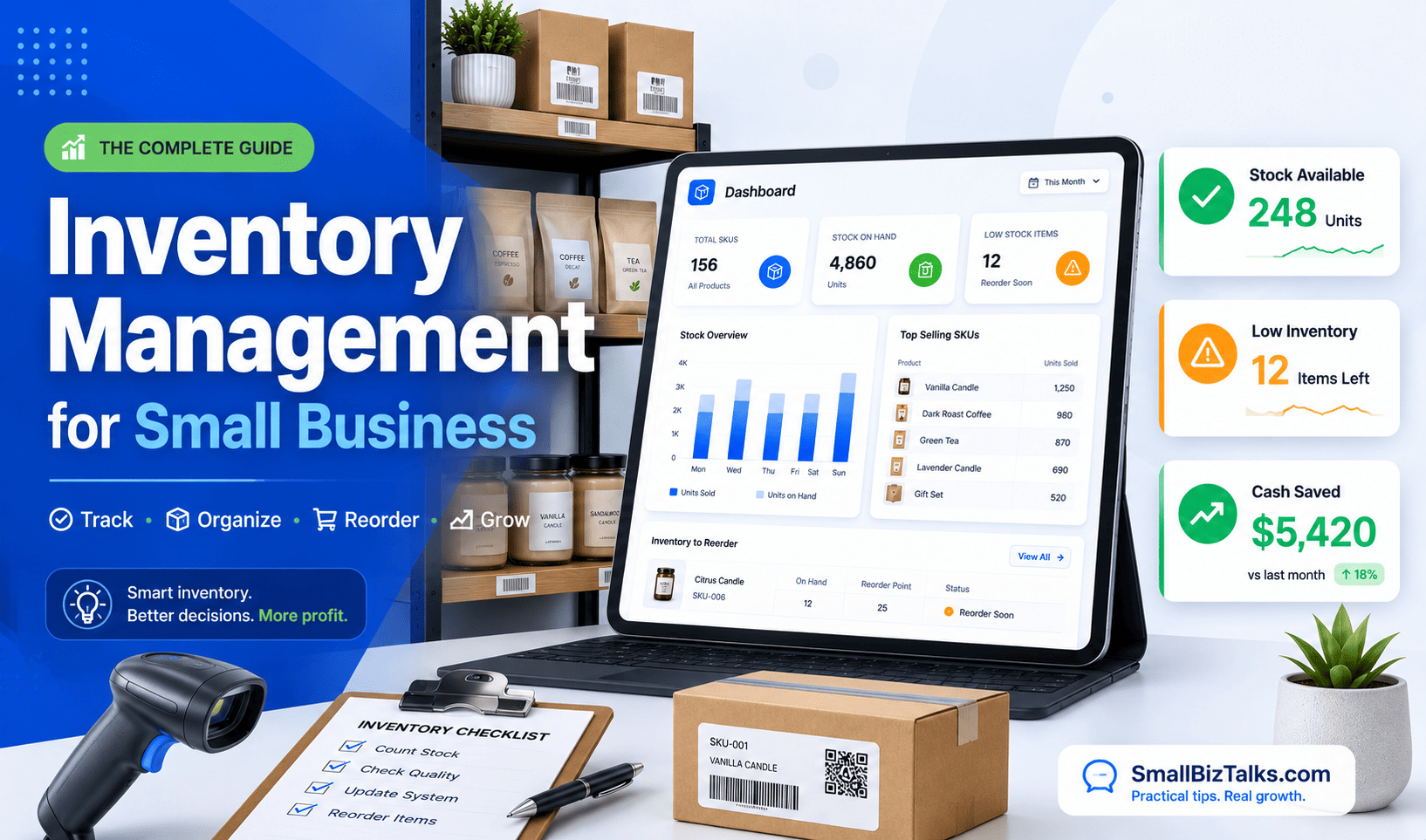
For most small businesses, inventory is the second-largest use of cash after payroll and rent. Yet it rarely gets managed with the same discipline. Payroll runs on a schedule. Rent is a fixed line item. Inventory, by contrast, is often tracked in a spreadsheet that someone updates when they remember to, or not tracked in any structured way at all until a bestseller runs out mid-season or a storage unit fills up with stock that stopped moving a year ago.
That gap matters more for a small business than a large one. A national retailer that misjudges demand on one product line barely notices. A small business that ties up a third of its working capital in the wrong stock can spend months recovering.
This guide covers what inventory management actually involves, the core methods worth knowing, how to build a working system from scratch, and where a spreadsheet stops being enough.
What Inventory Management Means for a Small Business
Inventory management is the process of tracking, ordering, and controlling the stock a business buys and sells, so it has the right amount of product on hand without tying up more cash than necessary.
At a large company, that process is usually a dedicated function with its own software and staff. At a small business, it’s typically one person, often the owner, doing it alongside sales, hiring, and everything else.
That difference shapes the whole approach. A small business can’t absorb the cost of overstock the way a larger one can, and it usually can’t negotiate the supplier terms that make just-in-time ordering low-risk. The goal isn’t to copy enterprise inventory practices at a smaller scale. It’s to run a version built for thin margins, limited storage, and one or two people managing it.
Why Small Businesses Struggle With It
The challenges are fairly consistent across industries, even though the products differ.
Knowing how much to buy. Order too much and cash sits on a shelf instead of in the business. Order too little and a customer walks out empty-handed or worse, buys from a competitor and doesn’t come back.
Limited space. Most small businesses don’t have a warehouse to absorb excess stock. A storage closet or a corner of the shop floor has to do double duty, which makes overbuying a physical problem as much as a financial one.
Manual tracking errors. Spreadsheets and handwritten logs drift from reality fast. A miscount here, a forgotten update there, and the numbers on paper stop matching what’s actually on the shelf.
Supplier leverage. Small businesses generally don’t have the order volume to negotiate the pricing or flexible terms that larger buyers get, which makes lead times and minimum order quantities harder constraints to work around.
Seasonal and demand swings. A slow month can look like healthy inventory levels right up until a rush hits and reveals how thin the buffer actually was.
None of these are solved by one trick. They’re solved by picking a method that fits the business and applying it consistently, which is the next section.
Core Inventory Management Methods
A handful of methods cover most of what a small business needs. Few businesses use just one; most combine two or three.
ABC Analysis
ABC analysis sorts inventory into three tiers based on value and sales impact, not just volume:
- A items : a small share of SKUs that drive the largest share of revenue or cost. These get the closest attention: frequent counts, tighter reorder rules, stronger supplier relationships.
- B items : moderate value, moderate attention. Monthly reviews are usually enough.
- C items : the bulk of the catalog by count, but a small share of value. Quarterly review is often sufficient, and some businesses move slow C items to special-order only.
The practical benefit is focus. A business with 500 SKUs doesn’t need to watch all 500 with equal intensity, it needs to watch the 50 or so that actually move the needle.
A quick example: a boutique candle shop carries 120 SKUs. Ranking them by annual revenue shows that 18 scented candles account for roughly 70% of sales – those become A items, checked weekly. The next 30 or so items (seasonal scents, gift sets) make up another 20% of revenue and become B items, reviewed monthly. The remaining 70-plus SKUs – one-off colors, discontinued scents still on the shelf – generate the last 10% and become C items, counted quarterly and candidates for clearance if they don’t move.
FIFO (First In, First Out)
FIFO means the oldest stock sells first. It’s standard for anything perishable or trend-sensitive – food, cosmetics, seasonal apparel – where holding onto older inventory too long turns it into a write-off. Rotating stock physically (older items to the front) makes FIFO easy to enforce without extra software.
Reorder Point (ROP)
The reorder point is the stock level that triggers a new order, calculated as expected demand during the supplier’s lead time, plus a buffer for uncertainty (safety stock):
Reorder point = (average daily sales × lead time in days) + safety stock
Example: a product sells 8 units a day, and the supplier takes 6 days to deliver. Lead-time demand is 48 units. Add a safety stock buffer of 15 units for demand variability, and the reorder point is 63 units – the moment stock hits that number, it’s time to order, not the moment the shelf looks low.
Economic Order Quantity (EOQ)
EOQ estimates the order size that minimizes total cost by balancing ordering costs (placing and receiving an order) against carrying costs (storing it). It’s most useful for A-tier items with steady, predictable demand for volatile or seasonal products, it tends to oversimplify.
Just-in-Time (JIT)
JIT means ordering stock to arrive right when it’s needed, minimizing how much cash sits in storage. It works well when suppliers are fast and reliable. For a small business with a single supplier and a multi-week lead time, it’s a riskier fit – a single delayed shipment can mean empty shelves with no buffer to absorb it.
Building an Inventory System, Step by Step
Most small businesses don’t need a sophisticated system on day one. They need a consistent one.
1. Pick one tracking method and commit to it. Spreadsheet, dedicated software, or a hybrid, the specific tool matters less than using it consistently. Switching methods every few months is what causes the drift that leads to phantom inventory: stock that exists on paper but not on the shelf, or vice versa.
2. Set par levels and reorder points for your top sellers first. Trying to calculate reorder points for an entire catalog on day one is a good way to never finish. Start with the 15–20 SKUs that drive most of the revenue, using the ABC framework above, and expand from there.
3. Build in cycle counting. Instead of one exhausting annual count, count a rotating slice of inventory on a regular schedule – A items weekly or biweekly, B items monthly, C items quarterly. Discrepancies get caught while they’re small, not after they’ve compounded for a year.
4. Connect inventory to your books. If sales, stock counts, and accounting live in three disconnected places, someone is doing manual reconciliation and manual reconciliation is where errors hide the longest. Setting up a solid framework for small business bookkeeping ensures your inventory costs accurately flow into your financial statements.
Spreadsheet or Software? Knowing When to Switch
A spreadsheet is a perfectly reasonable inventory system for a business with a small catalog and one sales channel. The signs it’s time to move on are fairly clear:
- Stock counts are wrong often enough that staff double-check before promising a customer availability
- The business sells across more than one channel (in-store, online, marketplace) and keeping them in sync manually eats real time each week
- Inventory tracking is taking hours a week that could go toward the business itself
- The business has outgrown a single location
When those signs show up, a handful of tools cover most small business needs:
Tool
Best for
Starting price*
Zoho Inventory
Multi-channel sellers (in-store, online, marketplace)
Free tier available; paid plans scale with order volume
Square for Retail
Businesses already using Square for point-of-sale
Free plan; paid tiers add barcode and vendor tools
QuickBooks Online (Plus/Advanced)
Single-location retailers or service businesses with a light product line
Add-on to an existing QuickBooks subscription
Katana
Small manufacturers and makers tracking raw materials and production
Paid plans only, no free tier
*Confirm current pricing directly with each vendor, plans and rates change frequently.
None of these is universally “best” – the right one depends on sales channels, whether the business manufactures anything, and what it already uses for point-of-sale or accounting. It’s worth testing free tiers or trials against actual order volume before committing to a paid plan. If the business is also choosing accounting software around the same time, best small business accounting software is worth reading alongside this, since the two decisions often affect each other.
Inventory KPIs Worth Tracking
A few numbers reveal whether an inventory system is actually working, beyond a gut sense of “we seem to be running low on things.”
Inventory Turnover Ratio
How many times inventory is sold and replaced over a period, calculated as COGS [cost of goods sold – the direct cost of the products a business sells, defined in detail in the IRS’s Tax Guide for Small Business] ÷ average inventory value. A low ratio suggests overstocking or slow-moving products; a very high one can mean the business is understocked and risking stockouts.
Carrying Cost
The cost of holding inventory, including storage, insurance, and capital tied up. It typically runs 20–30% of inventory value per year. When working with tight cash margins, cutting unnecessary overhead – whether by avoiding overstocking or using free payroll software for your team, helps keep operating capital free for inventory replenishment.
Stockout Rate
The share of demand that couldn’t be met because an item was out of stock. This one is easy to underestimate, since a stockout often shows up as a customer who simply leaves rather than a complaint that gets logged.
Sell-Through Rate
The percentage of received stock that actually sells within a given period. A consistently low sell-through rate on a product is usually the clearest early signal that it needs to be discounted, bundled, or dropped.
Mistakes That Quietly Cost Small Businesses Money
Buying in bulk without running the carrying-cost math. A supplier discount for ordering 500 units instead of 100 looks like savings on the invoice. If 300 of those units sit unsold for six months, the storage and capital cost can erase the discount entirely.
Counting inventory once a year and trusting the number the rest of the time. A lot can drift in eleven months. Cycle counting catches problems while they’re still small and cheap to fix.
Treating every sales channel as the same pool of stock. A business selling in-store and online without synced inventory will eventually oversell a product on one channel while it sits unsold in the other.
Ignoring supplier lead time until it becomes urgent. Reorder points built on the assumption that a supplier will always deliver on time tend to fail exactly when they’re needed most – during a supplier’s own busy season.
Not distinguishing A items from C items. Applying the same level of attention to a top seller and a slow-moving accessory wastes time on the products that matter least and under-manages the ones that matter most.
Where to Start
A small business doesn’t need every method in this guide running at once. The practical starting point is narrower: pick a tracking system, calculate reorder points for the products that actually drive revenue, and build in a counting rhythm that catches errors before they compound. Everything else – software, KPIs, more advanced methods like EOQ – is worth adding once that foundation is in place, not before.

Disney and TikTok have agreed a deal which will allow creators to use clips from Disney films, including its subsidiaries, in their videos.
It means clips from hit franchises like Star Wars, Toy Story and the Marvel Cinematic Universe will soon start popping up in videos – which will also be shared on Disney’s short-form video platform, Verts.
The scheme will be launched in the US before being rolled out to other countries.
Neither company shared financial details of the agreement, although it follows the collapse of a $1bn (£745m) deal between Disney and OpenAI which would have let people use its characters in AI-generated videos.
That agreement was cancelled in March when OpenAI shut down its AI video generation tool Sora, citing a decision to focus on other parts of its business.
“Today, fans are celebrating our stories in entirely new ways,” said Disney’s chief marketing and brand officer Asad Ayaz, following the TikTok deal being announced.
“Disney owns some of the world’s biggest franchises but ownership of attention is shifting towards creators,” social media expert Matt Navarra told BBC News.
“Hollywood used to market at fans – now it needs to give fans the raw materials to market with it, and that is quite a profound shift.”
TikTok said its platform saw an average of 6.5 million posts relating to film and TV per day last year.
Fans like to use clips from films and TV shows in their videos, but without express permission, they would often be taken down due to copyright claims.
This makes it harder for a wide audience to engage with fan-created content around a big release.
TikTok would also benefit from the “credibility of becoming a formal distribution partner to one of Hollywood’s biggest studios,” Navarra said.
He added that TikTok’s recommendation algorithm gives it the power to “influence which character or scene or forgotten franchise suddenly becomes very valuable again”.
Disney and TikTok said a jointly-run programme would boost some creators’ videos and give them access to exclusive events.
“This is a deal that repositions and recovers Disney in the UGC [user-generated content] space following the content gap left by the sudden collapse of Sora,” Gareth Sutcliffe from Enders Analysis said.
But he said it was not without risk.
“There is an ongoing safety debate around TikTok under European online rules,” he said.
“At a minimum, Disney will need to employ significant guardrails to curate the creator content that is selected.”
Online creators and influencers are becoming more important to brands’ marketing strategies.
Last year, a report from Oxford Economics said YouTube content creators contributed £2.2bn to the UK economy in 2024 and supported 45,000 jobs.
There is also a recognition that even very small influencers, who focus on niche topics, might have lower follower counts but come with a hyper-engaged audience.
Disney launched its short form video platform Verts in the US in March, with plans to expand that further around the world.

Shares in AMP have climbed nearly six per cent after the financial services company increased its dividends due to a strong half-year.

William Blair is committed to building enduring relationships with our clients and providing expertise and solutions to meet their evolving needs. We work closely with the most sophisticated investors globally across institutional and intermediary channels. We are 100% active-employee-owned with broad-based ownership. Our investment teams are solely focused on active management and employ disciplined, analytical research processes across a wide range of strategies. We are based in Chicago with resources in New York, London, Zurich, Sydney, Stockholm, and The Hague, and dedicated coverage for Canada.

Cardinals vs. Panthers prediction, odds: 2026 NFL Hall of Fame Game picks

Thousands of servers can be backdoored by exploiting buggy motherboard controllers

Westhoughton secures mobile CCTV unit to deter crime


-

 Fashion5 days ago
Weekend Open Thread: Wit & Wisdom
-

 Politics5 days ago
Meta enters AI-training agreement with far-right ‘propaganda rag’ Newsmax
-

 Politics3 days ago
Zack Polanski: an incitement to murder Nigel Farage?
-

 Crypto World5 days ago
MicroStrategy Post-Earnings CLARITY Act Push Could Add New Catalyst for Its Stock
-

 Crypto World5 days ago
XRP Ledger v3.3.0 brings five institutional features
-

 News Videos7 days ago
Bitcoin Enters the 3rd Stage of the Bear Market
-

 Politics7 days ago
Luke Littler’s dominance sparks GOAT debate
-

 Sports6 days ago
Seema Kaliramna Wins Discus Throw Bronze, Takes India’s CWG Medals Tally To 17
-

 Crypto World5 days ago
New York sues Kalshi over prediction market gambling
-

 Crypto World4 days ago
Crypto PAC spending tops $2M in Michigan House race
-

 Business3 days ago
DTCR: Deleveraging And A Hedge Fund Collapse Point To A Possible AI Bottom
-

 Business6 days ago
Trump Announces Hamas Disarmament Agreement as Iran Strikes Kuwait Air Base and US Attacks Pause Overnight
-

 Crypto World5 days ago
3 Fed Officials Just Explained Their Rate Hike Vote: Is Inflation Winning?
-

 Tech4 days ago
ESET tracks rise in malicious AI skills and adaptable malware
-

 Sports5 days ago
France Cricket implodes: letters hidden in a drawer and a board at war
-

 NewsBeat7 days ago
Four people die trying to cross Channel in small boats
-

 Tech6 days ago
Gemini Spark can now use Chrome logins and saved passwords to run errands on your behalf
-

 Tech6 days ago
Building A Reproduction PlayStation Motherboard
-
Crypto World4 days ago
XRP Ledger urges node upgrade after manifest flood
-

 Crypto World5 days ago
Moneyflip CEO charged in $40K murder-for-hire plot
You must be logged in to post a comment Login