
Business
Meghan Markle, Netflix and The Gentlemen


There is a man who sells honey from a trestle table in Long Buckby market place. Not remarkable honey. Honey.
For two years he stood at the far end, next to the bloke doing scotch eggs, and nobody troubled him. Then in April he laminated a photograph and taped it to the front of the table. It shows him, squinting, beside a moderately famous person at what appears to be a wedding. The famous person is holding a drink. The honey is not in shot.
He now sells out by half ten.
Nothing about the honey changed. The bees were not consulted. What changed is that a queue now forms in front of a laminated photograph, and a queue, as any market trader knows, is the actual product.
I thought about him this week when it emerged that Meghan Markle is in talks to appear in the third series of Guy Ritchie’s The Gentlemen. Not to carry it. Not to star in it. To appear. Possibly for one episode. Possibly not at all, given that talks are reportedly at a very early and entirely hypothetical stage and the third series has not been commissioned. Normally that detail would slow a story down. This one did not slow by a second.
Now consider what happens if British business adopts the Duchess model.
Your accountant no longer files the VAT return alone. She files it flanked by a minor royal, in a marquee, with a drone shot. The plumber who comes about the ballcock brings a former cast member of Suits to hold the torch. The tap still drips. Four million people watch.
The garage on the bypass advertises a Duchess-adjacent MOT and takes on three extra staff to answer the phone. The parish meeting books someone off Strictly to unlock the door and is oversubscribed for the first time since 1974. Nothing has improved. The council still cannot agree on the bins.
But everyone is looking, and looking is the scarcest commodity in commerce.
Here is the bit business readers will recognise, because most of us have signed this invoice. Netflix is not casting an actress. It is buying customer acquisition, very cheaply indeed.
Think what it costs to relaunch a returning drama into a crowded autumn schedule. Trailers, outdoor sites, paid social, the whole grinding apparatus of persuading distracted people a thing exists. Millions, most of it wasted on people who were never going to watch. Now price the alternative. One guest appearance, one leaked casting rumour, and every tabloid and breakfast sofa on earth becomes an unpaid media buyer working your account for free. The story I am writing about is itself the campaign. So is this column, which is a humbling thought before breakfast.
That is the trade. You are not paying for talent. You are paying for distribution you could not buy at any price.
The catch is that borrowed attention is rented, never owned. Ask anyone who has bolted a famous face onto an average proposition and watched the numbers sink the moment the face moved on. David Beckham is about as strong a personal brand as this country has produced, and it did not stop him quietly selling out of a struggling cannabinoid venture that never found its market. Fame gets people through the door. It has never once persuaded them to stay.
Which is why the structure here is the clever part. Netflix has already tried owning the brand, lifestyle spin-offs and homeware included, and has been unwinding that arrangement ever since. What it wants now is not a five year marriage but a single, well-timed episode. Stop retaining the ambassador. Rent the moment. Any SME owner talked into a twelve month influencer contract when a fortnight would have done should pin that above the kettle.
There is a domestic dividend too. The Gentlemen shoots in Britain with British crews, at a time when the BFI reports £6.8bn of film and high-end television production spend in the UK. Netflix has tripled the size of its London headquarters, and Creative UK is pushing a £35m fund into creative businesses. A Duchess relocating to a discreet address outside London to work on a British production is, in the most literal sense, inward investment in a very good coat.
One last thing about Long Buckby, which I have been saving. It sits a few miles from Althorp, Earl Spencer’s estate, which makes its owner Prince Harry’s uncle. I lived within a mile of that gate for years, and the neighbours make remarkably little of it.
So if the Sussexes really are coming home, the most valuable laminated photograph in Northamptonshire is one my honey man has not taken yet.
He understands the principle already. He has started handing out little wooden spoons with samples.
The photograph gets them to the table. The honey is what brings them back next Saturday. Somewhere in California, a spreadsheet already knows this.
The bees, as ever, remain uncredited.

Richard Alvin


What happens when the AI capex cycle slows?

Israel strikes southern Syria; Damascus condemns attack

U.S. Agriculture Secretary Brooke Rollins joins ‘Mornings with Maria’ to discuss how a historic cattle shortage is driving beef prices higher. Rollins also reacts to the latest jobless claims and details the rising energy demands of AI data centers.
President Donald Trump’s effort to bring down grocery prices by increasing foreign beef imports is sparking resistance from Republicans in ranching states, who warn American producers could pay the price.
Trump announced Friday on Truth Social that the U.S. will allow up to 300,000 metric tons of ground beef to enter tariff-free over the next 90 days, a move he said would lower consumer prices while giving American ranchers time to rebuild the national herd.
The move comes as affordability and high grocery prices are top of mind for voters just months away from the midterm general election, when Trump and the GOP will seek to hold their congressional majority. Since the pandemic, beef prices have steadily increased, with the average price of beef per pound last month priced at $6.89, according to the Federal Reserve Bank of St. Louis.
But Republican lawmakers are arguing that Trump’s plan to allow the import of foreign beef tariff-free only acts as a “quick fix” for consumer prices and will undermine ranchers’ efforts to rebuild the herd.

A composite image shows cattle being herded at Lew Thompson’s ranch on Wednesday, June 17, 2026, in Frio County, Texas (left), and U.S. President Donald Trump speaking with guests during an event announcing the expansion of First Lady Melania Trump’s (Andrew J. Whitaker, Finn Gomez / San Antonio Express-News, Getty Images / Getty Images)
TRUMP’S AFFORDABILITY PLAN FACES CONSERVATIVE PUSHBACK AS POCKETBOOK ISSUES LOOM OVER MIDTERMS
“This hurts!” Sen. Mike Rounds, R-S.D., wrote on X. “American cattle producers have been disadvantaged for far too long. What our market really needs is a stable, America-First national policy that promotes American beef rather than continuing to import foreign beef as a quick ‘fix.’”
South Dakota is home to roughly 5% of the nation’s beef cows, according to a USDA report.
“This instability harms hardworking American ranchers and consumers who want American-made beef,” Rounds continued. “This is the exact opposite approach we take compared to manufacturing, and it doesn’t make sense.”
He added that Trump’s latest maneuver makes the push to mandate that beef labels include country of origin — a crucial step in ensuring American ranchers and farmers have a chance.
“Opening the market to even more foreign beef, which American consumers cannot differentiate because of current labeling rules, will only exacerbate the problem and hurt domestic producers,” Rounds wrote. “Our producers will compete all day long, but only if there is a level playing field. Beef prices will come down when American ranchers have a greater ability to supply more product.”
TRUMP WILL WELCOME FARMERS AND RANCHERS TO WHITE HOUSE DINNER TO CELEBRATE TRADE, TAX WINS
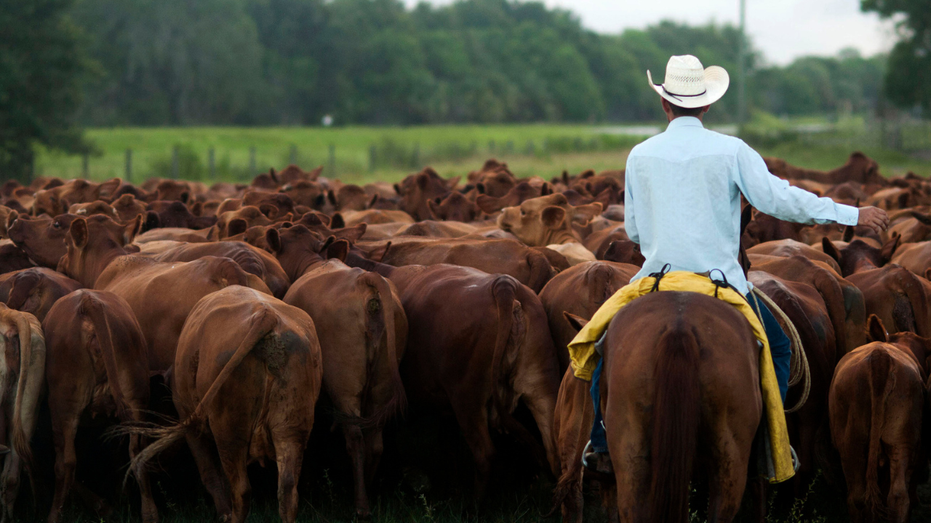
FILE – A ranch hand rounds up cattle on horseback and drive them into the pens at the Adams Ranch Inc. in St. Lucie County, Florida on July 9, 2013. (Ty Wright/Bloomberg/Getty Images / Getty Images)
Rep. Julie Fedorchak, R-N.D., echoed those concerns, warning that lower grocery prices should not come “on the backs of North Dakota ranchers and producers.”
“Importing foreign beef tariff-free — and selling it below market price — undercuts producers who are investing millions of dollars in an already risky business to rebuild their herds,” Fedorchak said in a statement. “At a time when ranchers need certainty to increase domestic production, this sends the wrong signal.”
Fedorchak said the timing is particularly harmful because many producers are bringing feeder cattle — young animals not yet ready for slaughter — to market, making the prices they receive especially consequential.
She also called for imported beef to meet the same inspection and safety standards as American-raised meat and said she had asked the USDA for details on how it will address those concerns.
“Short-term market intervention will not lower prices over the long term,” Fedorchak said. “The lasting solution is to strengthen American cattle production and address the problems in the packing industry that are driving up prices.”
TOP GOP GROUP PUMPS $37M INTO FIGHT ON KEY ISSUE DOMINATING MIDTERM RACES: ‘MUCH MORE TO COME’
The USDA estimates that four major companies buy about 85% of U.S. steers and heifers, and its research suggests their market power, combined with limited processing capacity, may be driving down the prices ranchers receive for cattle.
Rep. Kat Cammack, R-Fla., backed Trump’s push to lower grocery bills, but warned that short-term relief cannot come at the expense of American producers.
“President Trump is right to make lowering grocery costs for American families a priority,” Cammack wrote on X. “I share his commitment to bringing those costs down. At the same time, short-term relief can’t come at the expense of American ranchers, free markets and long-term solutions.”

FILE – The U.S. cattle herd has fallen to its smallest level in 75 years. (Jonne Roriz/Bloomberg/Getty Images / Getty Images)
Cammack said Florida ranchers, already grappling with drought, rising input costs, and an “out-of-control regulatory system,” could feel the squeeze from increased imports.
Virginia Farm Bureau President Scott Sink said in a statement to Fox News Digital that ranchers and farmers understand the need to ease grocery costs, but warned that greater reliance on imports would not solve the supply pressures behind higher beef prices.
CHINA’S CROP-CONTROL CHOKEHOLD PUTS AMERICA’S DINNER TABLE IN DANGER
“Rebuilding the U.S. cattle herd takes time — it cannot happen overnight,” Sink said. “Increasing reliance on foreign beef may provide temporary relief, but it does not address the supply challenges contributing to higher prices or strengthen our domestic cattle industry.”
Sink urged the administration to instead reduce costs for fuel, feed, equipment and financing, while creating conditions that allow ranchers to retain heifers and rebuild the national herd.
CLICK HERE TO DOWNLOAD THE FOX NEWS APP
“Virginia’s farmers and ranchers stand ready to work with the administration on solutions that support consumers while strengthening the American cattle industry,” Sink said. “A strong domestic food supply benefits everyone.”
The White House did not immediately respond to FOX Business’ request for comment.

Technological advancements are impacting every walk of life, from our personal lives to the boardroom. And it’s particularly noticeable in sports betting nowadays, especially in popular sports like horse racing.
The sport continues to grow year on year, with the promotion of offers across several horse racing betting sites encouraging more people to place wagers on the sport. No matter if you’re watching trackside or following from afar, the process for placing wagers on events such as Cheltenham, the Grand National, and Royal Ascot is remarkably different from past decades.
Developments in technology also extend to how bookmakers conduct day-to-day operations. In many ways, the racing ecosystem now operates much closer to a modern tech enterprise than the trackside industry of yesteryear.
Real-Time IoT: From the Track to the Supply Chain
The growth of the Internet of Things – a network of connected physical devices that collect and exchange data – has become increasingly prevalent in horse racing. Sensors and GPS tracking devices are now commonly used in races and training to monitor key performance indicators, such as a horse’s heart rate, stride length, speed and acceleration.
Consequently, trainers can then make decisions based on real data instead of trusting intuition and the eye test. In turn, that allows them to optimise performance and boost their chances of victory, while also navigating injury management.
The tools provided by the Internet of Things to horse racing echo functions within the business world. Just as sensors flag things like fatigue, the same technology can perform predictive maintenance, or can help to monitor a supply chain.
AI-Powered Analytics: Forecasting the Unpredictable
Artificial intelligence’s growth is transforming every sector of the working world as we know it. While businesses might use it to improve efficiency or to forecast economic outcomes, the technology is making just as big an impact on tracks and in betting markets.
In betting markets, AI can create thousands of simulations of the same race, altering certain variables such as wind velocity or the going. Using the vast amount of data available through form cards and other platforms, it can prove to be a useful tool for identifying undervalued runners in the market, instead of simply relying on intuition.
Owners can also use the technology in auctions, using analytics and variables such as pedigree genetic data to calculate a horse’s true value. Further refinements are expected to be made to AI, which should allow for enhanced capabilities across the field.
Smart Platforms: The Intersection of Pricing and Personalisation
While bookmakers might still use humans to set odds at races, pricing is now typically determined by automated software provided by the likes of Sportradar or OpenBet. Models will maximise the data available to them and account for changing variables, such as weather and track conditions, to establish a ‘true probability’ model instead of simply having someone determine how odds should shift trackside.
Then there are the engines which help analyse customer behavioural patterns, allowing for the provision of personalised promotions. AI is also increasingly being used to identify problematic behaviours, allowing bookmakers to comply with any regulations.
These both emulate other business models, such as dynamic pricing depending on fluctuating demand to maximise profits, as well as how businesses use Customer Relationship Management software to personalise marketing campaigns. Ultimately, whether you are managing consumer demand or balancing a book on the Cheltenham Gold Cup, the core principles of success are now entirely in the data.

Search visibility is one of the few marketing channels a small business can genuinely compete on against larger rivals, but only if the basics are right.
The upside for SME owners is that most competitors still haven’t got these basics sorted, which means fixing even one or two of them can be a genuine competitive advantage rather than just “catching up.” Here are five commonly overlooked opportunities, and how to capitalise on them.
1. An inconsistent or neglected Google Business Profile
This is the single biggest missed opportunity for local businesses. Google increasingly weights local pack rankings on completeness, activity and consistency, not just proximity. That means your business name, address and phone number need to match exactly across your website and every directory you’re listed on, your profile needs regular updates (new photos, posts, service changes), and your response rate to reviews matters as much as your review count. A profile that’s gone stale is a visible signal to Google that the business behind it might have too. In practice, this is often a fifteen-minute weekly task rather than a major project, which makes it one of the cheapest wins on this list, and one of the easiest to keep putting off.
2. Chasing review volume instead of review consistency
Piling up reviews in one burst, then going quiet for months, is a weaker signal than a steady trickle of new reviews with thoughtful responses. If review management isn’t part of your regular routine, it should be: ask happy customers at the point of service, and reply to every review, good or bad.
3. Thin, templated content
Google’s ongoing crackdown on low-value, formulaic content, sometimes referred to as “parasite SEO” when it involves publishing generic material on high-authority domains purely to rank, has made this an increasingly risky shortcut. Pages that exist purely to target a keyword, without genuine expertise or first-hand detail behind them, are the pages losing visibility fastest in 2026. The fix is unglamorous but effective: write about what you actually know, with real examples, case studies and specifics that a generic competitor couldn’t easily replicate.
4. Treating SEO and PPC as separate budgets
Search terms data from paid campaigns is some of the richest keyword research available, showing exactly what your customers type and which of those terms convert. Businesses that keep PPC and SEO teams, or spreadsheets, entirely siloed are leaving that insight on the table. It’s a mistake agencies such as Ahead Marketing regularly encounter when taking on new SME clients: two channels with valuable overlapping data, managed as if they had nothing to do with each other.
5. No clean way to measure what’s actually working
Many SMEs still can’t confidently answer which channel brought in a given customer. Without accurate GA4 conversion tracking and regular review of Search Console data (rankings, impressions and clicks tracked separately, since they don’t always move together), it’s near-impossible to know whether a ranking drop is a real problem or just normal fluctuation. That’s worth knowing given that search results have shown notable volatility this year without any officially confirmed algorithm update behind it.
None of these fixes require a huge budget. They require consistency, which is exactly the trait Google’s algorithm has been rewarding all year. If your business hasn’t reviewed any of these in a while, that’s not a reason to worry: it’s simply an untapped opportunity sitting there waiting to be picked up before a competitor gets to it first. The businesses that will do best over the next twelve months are unlikely to be the ones with the biggest marketing budgets. They’ll be the ones that quietly worked through this list first.


Joseph Shaefer is a geopolitical, economic, and resource analyst. He is a retired senior military officer with deep experience in Special Operations and Intelligence. He is also a former university professor and a retired Senior V.P. at Charles Schwab & Co. He is today the leader of the investing group The Investor’s Edge®. His approach to investing is both specific and universal. On one end of the “barbell,” he makes especially deep dives into Energy, Resources, Aerospace and Defense, and Infrastructure. On the other end, a thorough research into the safest and best-paying income ETFs and companies and their preferred shares. Unique features exclusively for subscribers at The Investors Edge® include the Growth & Value sample portfolio, early notification of articles likely to be discussed with the general Seeking Alpha audience, notification of purchases and sales prior to execution, and short notes and articles for subscribers on an as-it-happens basis. Five decades of experience, 2 to 4 articles monthly exclusively for subscribers, and access to Joseph and his community in a chat corner that is reviewed daily.
Analyst’s Disclosure: I/we have a beneficial long position in the shares of UUUU either through stock ownership, options, or other derivatives. I wrote this article myself, and it expresses my own opinions. I am not receiving compensation for it (other than from Seeking Alpha). I have no business relationship with any company whose stock is mentioned in this article.
Seeking Alpha’s Disclosure: Past performance is no guarantee of future results. No recommendation or advice is being given as to whether any investment is suitable for a particular investor. Any views or opinions expressed above may not reflect those of Seeking Alpha as a whole. Seeking Alpha is not a licensed securities dealer, broker or US investment adviser or investment bank. Our analysts are third party authors that include both professional investors and individual investors who may not be licensed or certified by any institute or regulatory body.

Canada to impose retaliatory tariffs across a raft of US sectors, Carney says

Iran condemns US plans to announce new sanctions

Monthly market brief: equities, bonds, crypto, and commodities in August 2026

Will Apple’s risk appetite change under John Ternus?

What three female figures in the Bayeux tapestry reveal about medieval women
What happens when the AI capex cycle slows?

$830 Million in an Hour: XRP and TRUMP Drive New Record in South Korea





-

 Fashion1 day ago
Weekend Open Thread: Madewell – Corporette.com
-

 Business4 days ago
SMA Solar Technology AG (SMTGY) Q2 2026 Earnings Call Transcript
-

 Tech5 days ago
Qwen3.8-27B runs frontier-class coding agents and reasoning locally, no cloud API required
-

 Politics7 hours ago
6 months on, Irish renters crushed by effects of government housing bill
-

 Crypto World5 days ago
OCC Greenlights Trump Family Crypto Firm for Trust Charter
-

 Crypto World5 days ago
NAVI Prime launches institutional lending framework on Sui
-

 News Videos3 days ago
Don’t Leave Your Financial Future To Chance | August 19, 2026
-
 NewsBeat10 hours ago
The ‘Lucky Dip Gang’ causing carnage for clicks: After five thugs were killed speeding in the wrong direction on a motorway, GUY ADAMS investigates a sick new trend… and why police aren’t even allowed to pursue them
-

 Crypto World6 days ago
Data of 54K Wallet Users Leaked, Clarity Odds Just 10%: Hodler’s Digest, Aug. 16
-

 Politics6 days ago
Britain is facing a housing disaster
-

 Tech6 days ago
What are the rumors about the AirPods Pro 4?
-

 Business6 days ago
Rebel Creamery files Chapter 11 with $23.8M Van Leeuwen judgment on appeal
-
 Crypto World5 days ago
Dow’s 3-Year Winning Run Isn’t a Crash Signal, Still 49% Odds of Double-Digit Gains
-

 Business4 days ago
Stock Market Today: Tech Futures Slide As Treasury Yields Jump; Nvidia, Micron, Sandisk Sell Off
-

 Tech7 days ago
DeepSeek’s innovative harness treats everything as a plug-in
-
 Tech6 days ago
OpenAI’s new ChatGPT feature logs your keystrokes and stores them in plain text
-

 Tech5 days ago
Straight Up the Cliff, Yunnan’s New Fuyao Ladder Turns a Three-Hour Climb Into a 50-Second Ride for Students
-

 Tech7 days ago
Three new Windows flaws can bypass security, gain system privileges, and even install malware remotely
-

 Tech6 days ago
DeepSeek’s top-ranked V4 Flash stumbles on real agent tasks as its prices surge
-
 Tech5 days ago
Nvidia discloses $21B stake in SpaceX
You must be logged in to post a comment Login