Connect with us
DAPA Banner
DAPA Coin
DAPA
COIN PAYMENT ASSET
PRIVACY · BLOCKDAG · HOMOMORPHIC ENCRYPTION · RUST
ElGamal Encrypted MINE DAPA
🚫 GENESIS SOLD OUT
DAPAPAY COMING

Business

Navitas Semiconductor Stock Drops Nearly 6% to $21.53 Amid Semiconductor Sector Pressure

Published

on

Navitas Semiconductor Corporation

Navitas Semiconductor Corp. shares declined sharply in midday trading Wednesday, falling 5.78% to $21.53 as investors rotated out of some smaller semiconductor names following recent gains and amid broader caution in the technology sector.

The drop came on elevated volume with no single company-specific announcement immediately driving the move. Navitas, a developer of gallium nitride (GaN) and silicon carbide (SiC) power semiconductors used in fast-charging adapters, data centers and electric vehicles, has experienced significant volatility since going public via SPAC in 2021. The stock had rallied strongly in prior sessions on optimism around AI infrastructure and renewable energy applications but encountered profit-taking Wednesday.

Company Background and Technology Focus

Navitas specializes in next-generation power electronics that offer higher efficiency, smaller size and faster charging compared to traditional silicon-based solutions. Its GaN Fast chips are widely used in consumer electronics chargers, while SiC devices target electric vehicles, solar inverters and industrial applications. The company has positioned itself as a key enabler of the transition to more energy-efficient power systems.

Advertisement

Founded in 2014, Navitas has grown rapidly as demand for high-performance power semiconductors accelerates with the proliferation of electric vehicles, data centers and 5G infrastructure. The company’s technology is featured in products from major brands, including chargers for laptops, smartphones and other consumer devices.

Recent Performance and Market Context

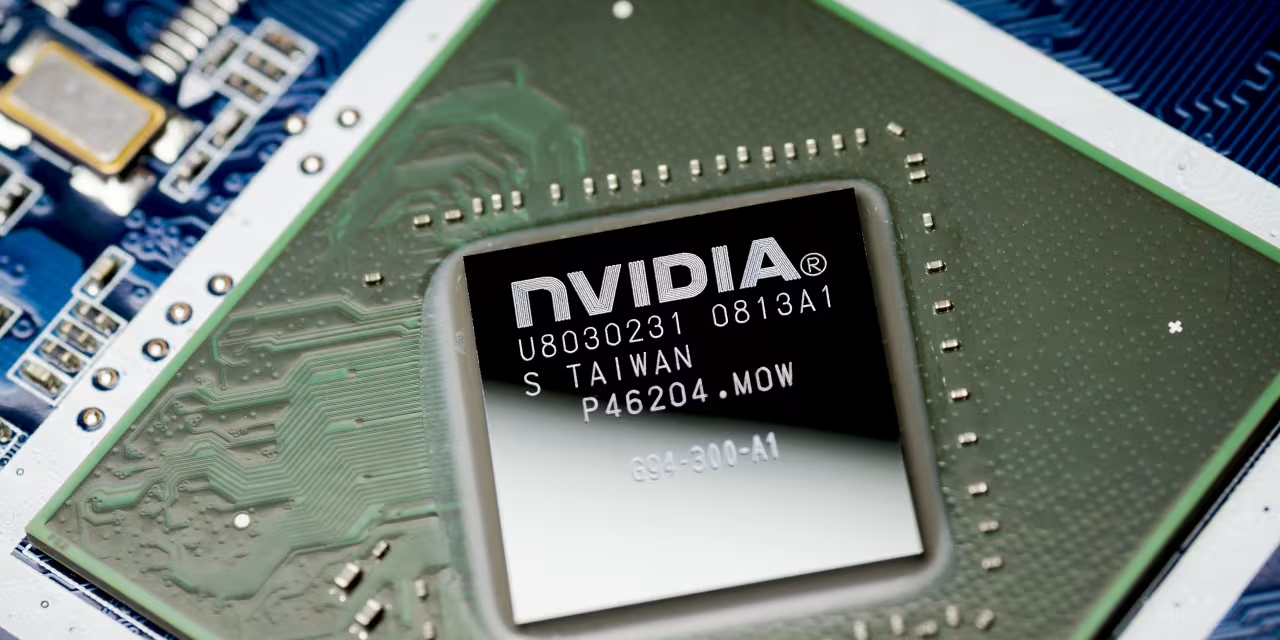
Year-to-date, Navitas shares have shown substantial gains driven by enthusiasm for AI-related power efficiency and clean energy themes. However, the sector as a whole has seen rotation, with investors shifting between high-growth names and more established players. Wednesday’s decline aligns with modest weakness in several smaller semiconductor stocks, even as leaders like Nvidia remained relatively stable.

Broader market sentiment remained cautious following the latest inflation data showing U.S. consumer prices rising 4.2% year-over-year in May. Persistent energy costs and uncertainty around Federal Reserve policy have kept pressure on growth-oriented technology investments.

Advertisement

Industry Tailwinds and Challenges

The power semiconductor market is experiencing strong structural growth. GaN and SiC technologies are critical for reducing energy losses in data centers supporting artificial intelligence workloads. Navitas has highlighted design wins with hyperscalers and EV manufacturers, though converting those into sustained revenue growth remains key.

Competition in the space is intensifying, with established players like Infineon, ON Semiconductor and Wolfspeed also expanding in GaN and SiC. Navitas differentiates itself through integration and speed-to-market, but scaling manufacturing and maintaining technological leadership require significant capital investment.

Analysts generally maintain positive longer-term views on the company, citing its addressable market expansion. However, near-term execution risks, valuation multiples and potential supply chain issues are frequently cited as watchpoints.

Advertisement

Financial Position and Outlook

Navitas has reported improving financial metrics in recent quarters, with revenue growth and progress toward profitability. The company continues to invest heavily in research and development and capacity expansion to meet rising demand.

Management has emphasized a strategy focused on design wins, customer diversification and operational efficiency. Upcoming earnings reports will be closely watched for updates on revenue trajectory, gross margins and guidance for the remainder of 2026.

The stock’s valuation reflects high growth expectations, making it sensitive to any perceived slowdown in momentum. Wednesday’s move illustrates this dynamic, with profit-taking emerging after a period of strength.

Advertisement

Broader Semiconductor Sector Dynamics

The semiconductor industry remains one of the strongest performing areas of the market in 2026, powered primarily by artificial intelligence infrastructure buildouts. While large-cap names have captured much of the attention, smaller innovators like Navitas offer exposure to specialized segments with potentially higher upside.

However, the sector is not immune to macroeconomic pressures. Higher interest rates increase the cost of capital for growth companies, while geopolitical risks and supply chain complexities add uncertainty. Investors are increasingly selective, favoring companies with clear competitive advantages and visible revenue pipelines.

Investor Sentiment and Trading Activity

Advertisement

Retail and institutional interest in Navitas remains active, with the stock frequently discussed in trading communities focused on technology and clean energy themes. Short interest has fluctuated but generally stays at moderate levels compared to more controversial names.

Options activity on Wednesday suggested continued trader engagement, with positioning for potential volatility around future catalysts. The stock’s beta indicates it moves more dramatically than the broader market, consistent with its growth profile.

Strategic Positioning and Future Catalysts

Navitas continues to expand its portfolio with new product introductions targeting higher-power applications. Partnerships with major semiconductor foundries and direct engagement with end customers are central to its growth strategy.

Advertisement

The electric vehicle transition and data center expansion provide multi-year tailwinds. Success in securing additional design wins and ramping production efficiently could drive further upside. Conversely, any delays in technology adoption or competitive setbacks could pressure the stock.

Conclusion and Market Perspective

Wednesday’s 5.78% decline to $21.53 represents normal volatility for a high-growth semiconductor name rather than a fundamental shift. The company’s underlying story of enabling energy-efficient power solutions remains intact amid strong secular trends in AI, EVs and renewables.

Investors will continue monitoring Navitas for execution on its strategic plan and upcoming financial results. In a market rewarding both innovation and profitability, the company’s progress in balancing growth with financial discipline will be key to sustaining investor confidence.

Advertisement

As the trading session progressed, focus remained on broader semiconductor sector rotation and macroeconomic data. Navitas shares, while down on the day, continue to reflect optimism around its technology platform and market opportunities. Market participants will watch closely for any follow-through movement or new developments that could influence the stock’s near-term trajectory.

The semiconductor industry’s evolution continues to create opportunities for specialized players like Navitas. Its performance Wednesday serves as a reminder of the volatility inherent in growth stocks while underscoring the long-term potential in next-generation power electronics.

Continue Reading
Click to comment

You must be logged in to post a comment Login

Leave a Reply

Business

Anthropic Warns AI Is Already Building Its Own Successors

Published

on

Anthropic Warns AI Is Already Building Its Own Successors

Anthropic, the artificial intelligence safety company behind the Claude family of models, has published a landmark report disclosing that its AI systems have assumed a dominant role in developing their own successors and warning that the world may be approaching a threshold of “recursive self-improvement” faster than governments, institutions, and even the company itself are prepared for.

Key takeaways

  • Claude now writes more than 80% of Anthropic’s own code, with engineers shipping roughly 8 times the daily output they did in 2024.
  • AI agents are starting to run full research projects on their own, recovering 97% of possible gains on an open-ended safety problem versus 23% for human researchers in a comparable window.
  • Anthropic warns that recursive self-improvement is a live near-term contingency and is calling for a verifiable international coordination mechanism before the window to act closes.

The report, titled “When AI Builds Itself” and published by the newly formed Anthropic Institute, combines public benchmark data with previously unreported internal metrics to paint a striking picture of how rapidly AI has transformed the practice of AI development.

An 8x Productivity Leap in Two Years

Perhaps the most striking figure in the report: Anthropic engineers are now merging roughly eight times as much code per day as they were in 2024. The surge is not the product of more engineers or longer hours it reflects the growing role of Claude itself in writing production code.

As of May 2026, more than 80% of the code merged into Anthropic’s codebase was authored by Claude. Two years earlier, that figure was in the low single digits. The shift accelerated in two distinct waves: first in early 2025, when Claude began executing and running code rather than merely suggesting snippets for engineers to paste; and again in 2026, when models became capable of working autonomously over multi-hour time horizons.

The efficiency gains extend well beyond lines of code. In an internal poll of 130 Anthropic research staff conducted in March 2026, the median employee estimated they were producing around four times as much output with the company’s most advanced model, Claude Mythos Preview, compared to working without any AI assistance.

Advertisement

From Tool to Collaborator to Decision Maker

The report draws a careful distinction between three levels of AI capability in a research or engineering context: executing a task someone else has specified; designing the method to achieve a stated goal; and deciding which goals are worth pursuing in the first place.

By Anthropic’s account, Claude has already cleared the first two bars and is beginning to approach the third.

In a vivid illustration of AI-driven research, Anthropic described an experiment published in April 2026 in which Claude-powered agents were given an open-ended AI safety problem, roughly, whether a weaker model could reliably supervise a stronger one, and left to solve it without further human guidance. The agents proposed hypotheses, ran tests, shared findings with parallel agents, and iterated autonomously. Two human researchers working for a week achieved approximately 23% of the possible performance improvement on the task; in contrast, the AI agents, operating over 800 cumulative hours at a compute cost of roughly $18,000, achieved 97%.

On a benchmark measuring the ability to complete long-horizon software tasks, Claude Opus 4.6 has reached 12-hour tasks up from roughly four-minute tasks just two years prior. If that doubling rate (currently once every four months) holds, tasks requiring a skilled human day could come within AI reach before the end of 2026.

Advertisement

The Recursive Threshold

The report’s central concern is what happens if these trends converge. Recursive self-improvement, the point at which an AI system becomes capable of fully autonomously designing and training its own successor, would represent a qualitative break from everything that has come before.

Anthropic is careful to say it has not reached that point. “We are not there yet,” the authors write, “and recursive self-improvement is not inevitable.” But the report’s three future scenarios a stalled plateau, a compounding efficiency gain driven by increasingly autonomous AI, and full recursive self-improvement are presented not as remote possibilities but as live contingencies that need to be actively prepared for.

The company’s candor about the third scenario is notable. Should AI systems become capable of building their own successors, the report warns, the pace of AI progress would become determined almost entirely by the availability of compute, with humans shifting primarily to oversight and verification roles. The implications for alignment, ensuring such systems remain safe and controllable, would become vastly more urgent.

“If this happens,” the report states, “future versions of Claude could be continuously improved by Claude itself.”

Advertisement

A Call for International Coordination

The report goes beyond technical disclosure to make a policy argument: the window for deliberate, collective action is open now, but may not remain so.

Anthropic explicitly states that a unilateral slowdown by any single lab would accomplish little beyond ceding competitive ground. What is needed, the authors argue, is a verifiable international coordination mechanism analogous to arms control treaties, but designed for a technology whose inputs are general-purpose and whose training runs are far easier to conceal than missile silos.

“A meaningful slowdown or pause would require multiple well-resourced labs at or near the frontier, in multiple countries, agreeing to stop under the same conditions,” the report states. “It would also require that each can verify that the others have actually stopped.”

The company acknowledges the difficulty of building such a regime in time. Past arms control frameworks took decades to construct; Anthropic suggests the AI field does not have that luxury.

Advertisement

In the coming months, the Anthropic Institute says it will convene policymakers, civil society representatives, researchers, and competing AI companies to begin designing the verification and coordination systems such an agreement would require.

The Human Element

Woven throughout the technical data are candid reflections from Anthropic employees published with permission that hint at the psychological dimension of working in an environment undergoing such rapid transformation.

“On days where everything works well, I can’t help but think nothing I do matters,” one employee wrote. “Everything is automated and better and faster than I ever will be. But then there are days where everything breaks and I don’t understand why and I realize I have no idea what I’ve been up to anymore.”

Another described having written no code themselves in five months.

Advertisement

The report does not treat these observations as incidental color. They point to a structural question that applies well beyond Anthropic: as the “doing” in knowledge work becomes increasingly automated, what remains of the human role, and how do organizations and societies adapt to that shift in real time?

What Comes Next

Anthropic’s report is likely to intensify an already heated debate about how quickly AI is approaching transformative capability thresholds and what obligations that imposes on the companies at the frontier.

The company’s own framing is striking in its directness. It does not suggest that recursive self-improvement is distant or theoretical. It suggests it is a contingency that requires immediate, proactive preparation and that the institutions best positioned to lead that preparation are, for now, largely unprepared.

“The window to investigate the questions together is here,” the authors conclude. “People outside AI companies should be involved in this deliberation.”

Advertisement

Continue Reading

Business

Koppers Holdings Inc. (KOP) Presents at 16th Annual Wells Fargo Industrials & Materials Conference – Slideshow

Published

on

OneWater Marine Inc. (ONEW) Q1 2026 Earnings Call Transcript

Koppers Holdings Inc. (KOP) Presents at 16th Annual Wells Fargo Industrials & Materials Conference – Slideshow

Continue Reading

Business

Legacy Housing: Better Placed To Cope In A Challenging Environment

Published

on

Legacy Housing: Better Placed To Cope In A Challenging Environment

Legacy Housing: Better Placed To Cope In A Challenging Environment

Continue Reading

Business

CP Axtra Public Company Limited (CPXTF) Presents at TISCO Corporate Day 2026 – Slideshow

Published

on

OneWater Marine Inc. (ONEW) Q1 2026 Earnings Call Transcript

CP Axtra Public Company Limited (CPXTF) Presents at TISCO Corporate Day 2026 – Slideshow

Continue Reading

Business

Oxford Industries, Inc. (OXM) Q1 2026 Earnings Call Transcript

Published

on

OneWater Marine Inc. (ONEW) Q1 2026 Earnings Call Transcript

Oxford Industries, Inc. (OXM) Q1 2026 Earnings Call June 10, 2026 4:30 PM EDT

Company Participants

Brian Smith
Thomas Chubb – Chairman, CEO & President
K. Grassmyer – Executive VP, CFO & COO

Conference Call Participants

Advertisement

Ashley Owens – KeyBanc Capital Markets Inc., Research Division
Dana Telsey – Telsey Advisory Group LLC
Janine Hoffman Stichter – BTIG, LLC, Research Division
Mauricio Serna Vega – UBS Investment Bank, Research Division
Joseph Civello – Truist Securities, Inc., Research Division

Presentation

Operator

Advertisement

Greetings, and welcome to the Oxford Industries’ First Quarter Fiscal Year 2026 Earnings Call. [Operator Instructions] As a reminder, this conference is being recorded.

It is now my pleasure to introduce Brian Smith of Oxford Industries. Please go ahead.

Brian Smith

Advertisement

Thank you, and good afternoon. Before we begin, I would like to remind participants that certain statements made on today’s call and the Q&A session may constitute forward-looking statements within the meaning of the federal securities laws. Forward-looking statements are not guarantees, and actual results may differ materially from those expressed or implied in the forward-looking statements. Important factors that could cause actual results of operations or our financial condition to differ are discussed in our press release issued earlier today and in documents filed by us with the SEC including the risk factors contained in our Form 10-K. We undertake no duty to update any forward-looking statements.

During this call, we’ll be discussing certain non-GAAP financial measures. You can find a reconciliation of non-GAAP to GAAP financial measures in our press release issued earlier today which is posted under the Investor Relations tab at our website at oxfordinc.com.

I’d now like to introduce today’s call participants. With me today are Tom Chubb Chairman and CEO, and Scott Grassmyer, CFO and COO. Thank you for your attention, and now I’d like to turn the call over to Tom

Advertisement
Continue Reading

Business

Asian stocks fall, oil gains as US strikes Iran

Published

on

Asian stocks fall, oil gains as US strikes Iran
Oil climbed and stocks fell after US forces launched fresh strikes on Iran, reviving geopolitical risks at a time when markets are already grappling with a selloff in richly valued technology stocks.

Brent crude rose over2% to near $95.20 a barrel after the US military launched strikes on multiple targets in Iran for a second straight day. MSCI’s gauge for Asian equities dropped 1%, setting the gauge up for a fifth loss in six days. Tech stocks remained under pressure with South Korea’s Kospi Index, a bellwether for the artificial-intelligence trade, dropping over 4%.

Equity-index futures for Wall Street benchmarks also retreated after the underlying gauges both dropped during the US session. The Nasdaq 100 Index dropped 2% as traders were rattled by a renewed selloff in some of the world’s largest tech companies.

Elsewhere, gold extended losses to around $4,050 an ounce on concerns elevated oil prices will lead to higher interest rates. The dollar was a touch stronger against most Group-of-10 currencies. Treasury futures also fell as geopolitical tensions increased with Iran saying the Strait of Hormuz was closed to all types of vessels.

Advertisement

The latest strikes threatened to inject fresh volatility into markets and tighten crude oil supplies, risking renewed inflationary pressures. Even after Wednesday’s softer-than-expected US inflation report offered a brief reprieve, traders continued to price in higher borrowing costs while a selloff in semiconductor stocks cast doubt on the sustainability of the record equity rally.


“Investors remain skittish despite being thrown a lifeline by the inflation figures,” said Chris Beauchamp, chief market analyst at IG. “It is now a case of ‘once bitten, twice shy’ – no one wants to go charging in to buy the dip yet, which suggests more of a drift lower for the time being, though leaving the overall trend intact.”
US Central Command said it had begun what it called the “additional self-defense strikes” at 5:15 p.m. New York time on Wednesday.The attacks, which followed strikes on Tuesday in retaliation for the downing of a US Apache helicopter, underscored President Donald Trump’s growing impatience that the two sides have so far failed to reach an agreement.

They also reinforced the view that an April ceasefire has effectively collapsed, despite the absence of a return to the large-scale bombing campaign seen at the start of the conflict.

“Markets retain a suspicion that this will be another brief episode of sound and fury signifying not much, so a degree of caution in positioning seems warranted,” said Sean Callow, a senior analyst at ITC Markets in Sydney.

In the US, shares of chipmakers and other AI infrastructure companies, this year’s biggest winners, fell for a second day Wednesday. Chip bellwether Nvidia Corp. dropped 3.7%, Broadcom Inc. dropped 5.1%, while Super Micro Computer slid 28% after unveiling plans for a $7 billion equity raise. Oracle Corp. shares slipped in extended trading after reporting quarterly capital expenses that were higher than estimates.

Advertisement

Elsewhere, the yen held near 160.50 per dollar with Bank of Japan Governor Kazuo Ueda hospitalized. He is expected to miss next week’s policy meeting, the central bank said.

Meanwhile, the core consumer price index in the US, which excludes food and energy prices, increased 0.2% from April, under the 0.3% consensus forecast among economists polled by Bloomberg.

Even so, bond traders maintained bets that the Fed would raise rates by the end of the year. While Treasury yields initially dipped after the data on Wednesday, they resumed climbing with oil prices later in the session. Interest-rate swaps showed traders are still fully pricing in a rate hike by December.

“It’s clear that rate cuts are off the table, and while there is chatter about a potential rate hike, we believe it’s unlikely that we’ll see a rate hike before the midterm elections,” wrote Skyler Weinand, chief investment officer at Regan Capital.

Advertisement
Continue Reading

Business

Nebius: Still A Buy, Just Not A Table-Pounding Buy

Published

on

Nebius: Still A Buy, Just Not A Table-Pounding Buy

Nebius: Still A Buy, Just Not A Table-Pounding Buy

Continue Reading

Business

Inflation Likely To Subside, Growth Likely To Improve

Published

on

Price Inflation Accelerates As Wars And Deficits Expand

Scott Grannis was Chief Economist from 1989 to 2007 at Western Asset Management Company, a Pasadena-based manager of fixed-income funds for institutional investors around the globe. He was a member of Western’s Investment Strategy Committee, was responsible for developing the firm’s domestic and international outlook, and provided consultation and advice on investment and asset allocation strategies to CFOs, Treasurers, and pension fund managers. He specialized in analysis of Federal Reserve policy and interest rate forecasting, and spearheaded the firm’s research into Treasury Inflation Protected Securities (TIPS). Prior to joining Western Asset, he was Senior Economist at the Claremont Economics Institute, an economic forecasting and consulting service headed by John Rutledge, from 1980 to 1986. From 1986 to 1989, he was Principal at Leland O’Brien Rubinstein Associates, a financial services firm that specialized in sophisticated hedging strategies for institutional investors.

Visit his blog: Calafia Beach Pundit (https://scottgrannis.blogspot.com/)

Continue Reading

Business

Precious Metals Royalty And Streaming Companies – May 2026 Report

Published

on

Precious Metals Royalty And Streaming Companies - April 2026 Report

This article was written by

Peter Arendas is an associate professor at the University of Economics in Bratislava. He has over 15 years of investing experience. Peter specializes in covering small and mid-cap companies in the resource sector with an in-depth insight into the precious and industrial metals royalty & streaming industry.Peter is the leader of the investing group Royalty & Streaming Corner where he offers in-depth analysis of long-only investment ideas, actionable research, model portfolios, discussions of the latest news, and direct access for questions in chat. Learn More.

Analyst’s Disclosure: I/we have a beneficial long position in the shares of ELE, RGLD either through stock ownership, options, or other derivatives. I wrote this article myself, and it expresses my own opinions. I am not receiving compensation for it (other than from Seeking Alpha). I have no business relationship with any company whose stock is mentioned in this article.

Seeking Alpha’s Disclosure: Past performance is no guarantee of future results. No recommendation or advice is being given as to whether any investment is suitable for a particular investor. Any views or opinions expressed above may not reflect those of Seeking Alpha as a whole. Seeking Alpha is not a licensed securities dealer, broker or US investment adviser or investment bank. Our analysts are third party authors that include both professional investors and individual investors who may not be licensed or certified by any institute or regulatory body.

Advertisement
Continue Reading

Business

US stock futures dip on Iran escalation, Oracle losses

Published

on


US stock futures dip on Iran escalation, Oracle losses

Continue Reading

Trending

Copyright © 2025