In the rural plains of Northern Poland, at a remote base surrounded by farmland and pine forest, some 150 U.S. Navy sailors have a small slice of comfort through the Navy Exchange Mini Mart, a place for familiar snacks, hygiene products and the household brands many of them knew growing up.
One of hundreds of retail stores the Navy operates globally through the Navy Exchange Service Command, or Nexcom, the convenience store in Redzikowo doesn’t make much money. But it’s part of a sprawling system that plays a critical role in retention, morale and ultimately, U.S. national security by funneling profits into programs that support sailors and their families.
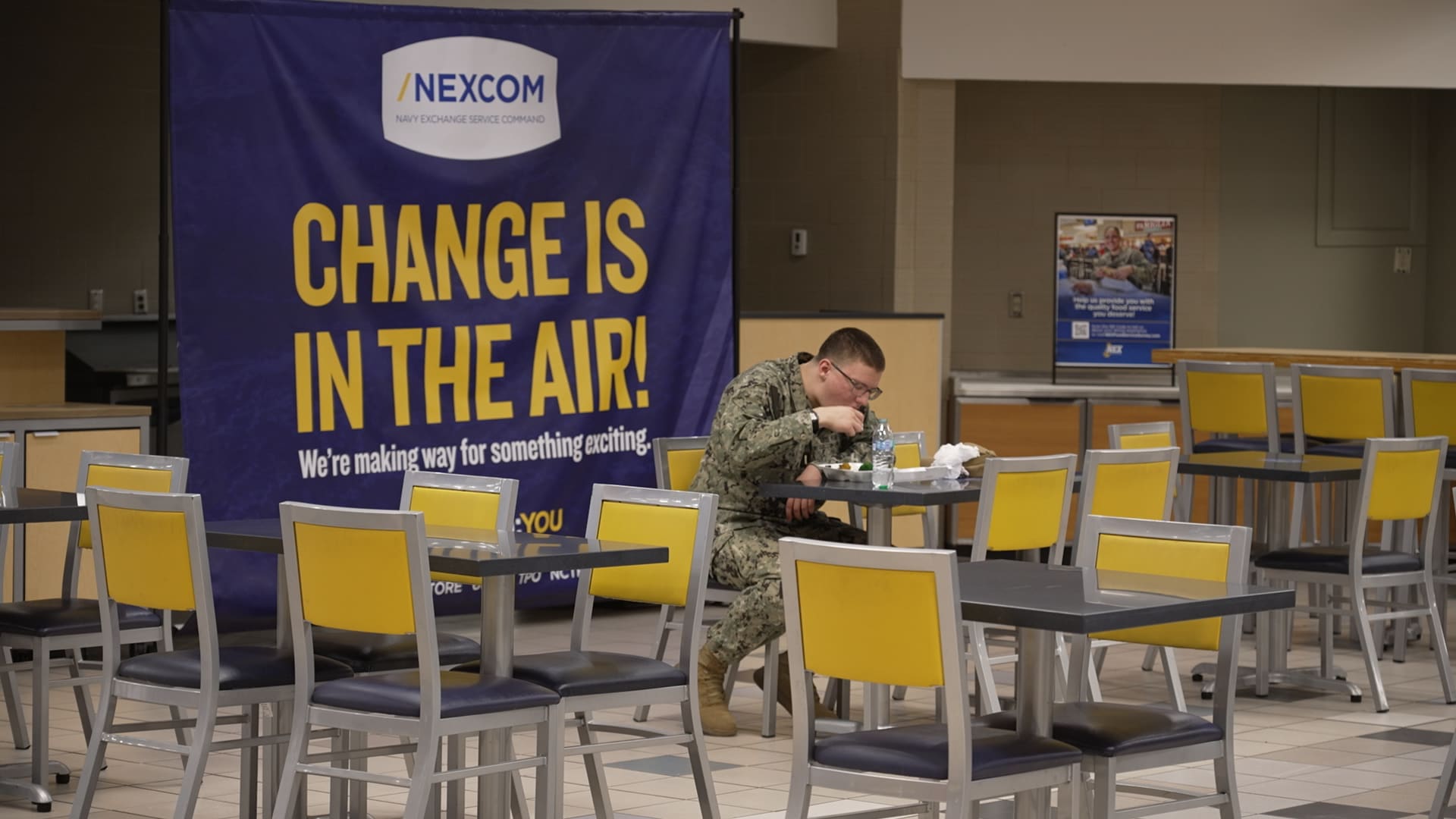
Now, that network could be at risk as larger, savvier retail giants like Walmart, Amazon and Target chip away at Nexcom’s U.S. market share, forcing it to do what any good retailer does when sales slow: hire consultants and embark on an ambitious turnaround plan.
“Even though we’re within the military, we compete for people’s share of wallet, right? They can just as easily … stop at a Target, they could stop at a Walmart, but we want them to shop here,” said Nexcom’s CEO Robert Bianchi, who has both a Harvard MBA and almost 30 years of experience as a sailor to inform his strategy. “It is a constant challenge to stay relevant.”
Advertisement
Declining sales, relevance
Nexcom, which can trace its roots back to the 1800s, provides active duty military members from all branches, veterans and their families with lodging access, uniforms and discounted, tax-free products through its chain of outposts. Some of the locations are sprawling department stores, offering sailors access to household names like Home Depot, Bath and Body Works and American Eagle, while others are smaller convenience stores, similar to a 7-Eleven. Similar versions exist across different branches of the military.
The stores are both a perk and a critical component to supporting sailors, creating its own “virtuous cycle,” Bianchi said.
Aside from offering low prices on household brands, Nexcom’s larger department stores near big bases in California, Florida and Virginia help pay for smaller shops in remote foreign outposts, such as the mini mart in Redzikowo. Across the chain, all profits are funneled back into the Navy and help to fund its morale, welfare and recreation programs, which offer sailors and their families access to services like day cares, gyms, counseling and community events.
The Navy Exchange Mini Mart in Redzikowo, Poland
Advertisement
Handout
“You know you were going to be in a group of folks that were kind of going through the same thing that you were, right? It was almost like a support group,” Bianchi said of his experience with the programs while he was in the military. “The spouses a lot of times are left behind and they’re looking for connections and wanting to establish those relationships with folks that they can lean on while their husband or wife or whoever is out to sea for months at a time, and so the MWR team is really good at sponsoring programs that help all the family, not just the military member.”
But sales have been in decline for the last 12 years, falling 19% between fiscal 2012 and 2024 and outpacing declines in total military personnel. The most recent year with data available, fiscal 2024, saw the lowest sales in nearly 20 years outside the Covid-19 pandemic.
Meanwhile, dividends generated by store sales that feed MWR programs are a fraction of what they were in the past. Between fiscal 2013 and fiscal 2024, dividends fell 43% from $51.9 million to $29.8 million.
Advertisement
“The pressure is there. I feel it, you know, and just like a retailer, we watch our sales figures and every day we’re looking at our retail trends,” said Bianchi. “What is at risk is potentially the degradation of this benefit for all those military members and their families around the world and so that’s why we take this very seriously … if we made less money, [MWR] may have to reprioritize some things within their budget.”
Robert Bianchi,
Chief Executive Officer, Navy Exchange Service Command
CNBC
Nexcom’s sales declines have come at a time when retail sales overall have grown, indicating it’s been losing market share. Its stores have become dated, it’s behind on e-commerce and it’s lost sight of the retail fundamentals that keep customers loyal, choosing to compete on price at a time when shoppers are looking for more.
Advertisement
“They have good things at the exchange. I don’t have a problem with what they carry…. but it’s just the convenience,” Angela Emerson, a Navy veteran and Nexcom customer, told CNBC during a recent store visit in Norfolk, Virginia. “Amazon’s never closed.”
While the Navy’s primary goal is to protect the U.S. at sea, the increasingly competitive consumer landscape means it also needs to be a really good retailer, which sometimes means hiring help.
In May 2020, Nexcom hired retail consultant Melissa Gonzalez, a principal at strategy, design and architecture firm MG2, to help redesign its stores and drive growth through its “Store of the Future” initiative. Over the last few years, it’s put $20 million into fixing its stores and plans to spend $80 million more over the next three years, a significant portion of which will be used to support Store of the Future projects.
“They have a lot of unique challenges with the Navy Exchange. One, no two buildings are the same, so it’s really hard to standardize things that you would then roll out once you come up with a concept, because there’s a lot of different scenarios with the architecture, with the geography, with merchandizing,” said Gonzalez. “Also, when the Navy Exchanges first started, there weren’t so many comps like you see today, Target and Walmart and some of these others who have really grown. And so what is the repositioning of their place in the industry, to their customer, with all of this evolution that’s happening?”
Advertisement
Retail consultant Melissa Gonzalez was hired to help NEXCOM with its turnaround
CNBC
Working alongside Nexcom, Gonzalez has gone department by department, figuring out how to reformat stores, jazz up signage and communicate value based on the local demographics and respective categories.
Renovating Nexcom’s stores and figuring out how to merchandise them has been a challenge, said Richard Honiball, Nexcom’s chief merchandising and marketing officer. Some of the stores are so large, they offer everything from Tempur-Pedic mattresses and dishwashers to Estee Lauder fragrances and buzzy razor brands.
Advertisement
“The least expensive item we sell is a note card overseas. It’s about 30 or 40 cents. The most expensive item we sold last year? A diamond solitaire ring that was over $90,000,” said Honiball. “How do we merchandise it? It is challenging, which is why we don’t try to be Costco and bulk things out, or we don’t try to be Amazon and carry everything. What we try to do is curate the assortments as best we can, and I think we get it right more than we get it wrong. But when we get it wrong, we listen to the patron and we adapt.”
Richard Honiball, Nexcom’s chief merchandising and marketing officer
CNBC
While the company has not yet released its annual report for 2025, it says that the turnaround efforts are taking hold. Customer satisfaction was up 2.7 percentage points in 2025, and Nexcom said it grew for the first time since fiscal 2021, with retail sales up 3.2% year over year.
Advertisement
“Any time we’ve touched an area, it’s driving more sales,” said Honiball. “We didn’t start off saying we’re going to create the Store of the Future, but we were two or three projects in and realized that in essence, what we’re doing is creating this new environment that is much easier, it’s easier to run and it’s more engaging for the patrons.”
Military style turnaround
Earlier this year, CNBC traveled to Norfolk, Virginia – home to the largest Navy base on the globe – to see both an unrenovated Nexcom department store, NEX Norfolk, and its Store of the Future test shop, NEX Oceana, to see the changes underway and how they’re improving sales at the overhauled location.
As soon as customers enter the revamped store, the tweaks are obvious. At NEX Oceana, the lights are brighter, the floors are cleaner, the signage is digital and shoppers can clearly see different departments as they navigate the store.
“People have become more aware of what a good setting feels like. Lighting is critical, right?” said Gonzalez. “You’re looking in the mirror at the outfit you’re trying on. How you look in the mirror is going to influence how much you want to buy that outfit.”
Advertisement
How assortments are laid out matters, too.
At NEX Norfolk, the consumer electronics department featured an array of TVs on the wall with little branding or explanation of how their features differ, along with lots of empty space. It created a less than engaging retail experience in a critical section of the store offering big-ticket items that consumers consider carefully before buying.
The unrenovated consumer electronics department at NEX Norfolk
CNBC
Advertisement
At NEX Oceana, the TVs were more organized, branding was clear and the layout maximized the available room, allowing for more merchandise to be on the floor to drive higher sales.
The renovated consumer electronics section at NEX Oceana
CNBC
The new stores have also improved the way individual brands are displayed – especially in categories like jewelry, beauty and apparel.
Advertisement
For example, in the apparel section at NEX Norfolk, major athletic brands like Nike, Under Armour and Athleta are grouped together, united only by a sign overhead advertising a 20% off discount. At NEX Oceana, individual retailers, from American Eagle to Old Navy, have their own sections, creating branded shopping experiences within the store that allow shoppers to navigate between their favorite names.
The apparel section at the renovated NEX Oceana location highlights individual brands like American Eagle
CNBC
Marta Cruz, a military spouse whose husband is a veteran of both the U.S. Marines and the U.S. Coast Guard, told CNBC that NEX Oceana looked different when she was there for a shopping trip in February. It was less crowded, the clothes were more organized and it was easier to push her cart around.
Advertisement
“It looks good,” said Cruz. “It’s better now.”
Some of the changes to the beauty section at NEX Oceana are already leading to improved sales patterns. In the past, the Bath and Body Works section was in a cavernous tunnel separating the department store from a since shuttered grocery store, far from the rest of the beauty department. Now, the retailer’s area has better signage and is situated with the rest of the beauty products and fragrances, leading sales to jump 40% between 2023 and 2024 at NEX Oceana.
The tunnel where the Bath and Body Works section used to be
CNBC
Advertisement
The new Bath and Body Works section at NEX Oceana
CNBC
“We’ve already remodeled 20 of the 25 main stores, and we’re seeing increases across the board. In beauty, our beauty sales are up in the high single digits,” said Honiball. “They’re performing three to 400 basis points better than the main chain.”
Some of the changes have also been about making the stores more agile so they can tweak departments and assortments rapidly based on the evolving needs of sailors. In the past, making changes was a costly endeavor that could take years, dragging on both profitability and sales while the renovations were going on.
Advertisement
“We don’t have the luxury today, in retail overall as an industry, but especially within military retail, within the Navy, to have these long drawn out projects,” said Honiball. “If consumer behavior is shifting, if someone’s going more toward certain brands or going more to certain products or buying in a certain way, we want to be able to adapt much more rapidly because the demands of someone who’s in the military can change in a nanosecond.”
‘Too much of a pain’
As the retail industry grows increasingly competitive, and giants like Walmart and Amazon become harder to beat, it’s common to see warring big box stores try to copy one another and adopt each other’s strategies to take market share.
That’s true at Nexcom, too, but the stores also have a unique value proposition as serving just people connected to the military.
“It’s nicer people because we’re all military,” said Kathy Pawlak, the spouse of a veteran Navy pilot and loyal Nexcom shopper. “I don’t like going in the civilian nastiness.”
Advertisement
There are unique benefits that come with shopping at Nexcom stores. If a servicemember is in uniform, they get front of the line privileges, and if they’re having an issue with something, there’s access to “white glove service” to address their unique needs, said Honiball.
“That’s kind of our secret sauce,” said Bianchi. “When a family or a sailor walks in here, one out of three people they’re interacting with probably has walked a mile in their shoes, right? So they get it. They understand if that kid is crying in the aisle and whoa, daddy’s gone, you know, or whatever, they get it because they probably moved, or they probably had a dad or a mom who was gone and they can really empathize with that.”
A service member checks out at a Navy Exchange store in Norfolk, Virginia
CNBC
Advertisement
Though Nexcom has those advantages, it still has to compete in a retail environment where convenience and value matter more than ever, especially for the next generation of shoppers. Many customers interviewed by CNBC said one of the main reasons why they don’t shop at Nexcom more often is because there’s a Walmart or Target closer by, or it’s easier to order from Amazon.
Nexcom has moved online, but its digital storefront can be clunky. Some items require customers to call in to place their order and shoppers need military credentials to log on.
“It’s like this big rigmarole to try to get logged on. It’s kind of a pain,” said Melissa Wadington, whose spouse is in the Navy. “It’s just not worth it for me. It’s too much of a pain.”
Already five years in the making, Nexcom’s turnaround will take at least another three years and millions more in funding. Unlike many other military programs, Nexcom is not primarily funded through federal appropriations, but is rather a self-sustaining machine through its own retail sales, making its ability to grow – while also affecting a turnaround – critical for its survival.
Advertisement
“There is no time to sit idle in this retail environment,” said Bianchi. “I won’t lie to you and tell you that the competition isn’t fierce. It is. I mean, we fight. We fight to maintain that loyalty.”
The recent development around the UAE stepping aside from OPEC+ coordination may have stirred headlines, but market strategist Matt Orton from Raymond James Investment believes its immediate impact on oil dynamics remains limited, even as it raises longer-term questions about the cohesion of the producer alliance.
Speaking to ET Now, Orton emphasized that the current geopolitical backdrop, particularly tensions around the Strait of Hormuz, continues to dominate oil fundamentals far more than internal OPEC politics.
UAE move: Long-term signal, limited near-term disruption On the UAE’s stance and its implications for global crude supply, Orton said: “Right now for the shorter term, it really does not mean anything because while longer term it just means more supply is likely to come online but we are not in a normal situation anymore because of the blockade of the Strait of Hormuz. So really until there is clarity with respect to what is going to happen between the US and Iran and until we start to see an easing of the blockade in the strait, there is going to be constraints for oil and there is only so much that the UAE can pump to begin with.””So, this does not come as that much of a surprise because frankly the UAE has really been trying to push more production over the past few years. They have always been upset and violated some of the curbs that they have had put in place. But if anything, it signals that there is fractures within OPEC as well. And so, it kind of questions what the future of OPEC is going to look like, what its efficacy could look like, and all of that longer term probably means that we will be well supplied in the longer term once we have a resolution and get back to some sort of normalcy, but that is going to take a lot of time,” he added.
Live Events
While acknowledging the symbolic significance of the UAE’s position, Orton suggested the real constraint on supply remains geopolitical, not institutional.Markets after a 10% rally: Selectivity becomes key With global equities already up nearly 10% from March lows, Orton cautioned that the “easy money” phase may be behind investors, even though fundamentals remain solid.“Markets have moved up at least about 10% including India at an index level, but what next really?” ET Now asked.
Orton responded: “These gains have been encouraging and I would argue that they are backed by solid fundamentals particularly in the US equity market where you have had resiliency on the overall economy and the consumer despite increased inflation and energy prices and corporate earnings have been incredibly strong. We are looking at record profit margins on the S&P 500. You are seeing smallcap earnings tick up. You have seen strong bank earnings. We are getting strong earnings from semiconductor companies, from industrials. So, the backdrop is very-very positive.”
Advertisement
However, he stressed that the next phase will be driven less by broad market beta and more by stock selection.
“The key going forward is going to be selectivity and really leaning into bifurcations that we are seeing take place,” he said.
He highlighted growing divergence across sectors:
“Because of the disruptions that have happened in the Middle East, there is going to be winners and losers with respect to those who are the energy haves and the have nots versus those who have pricing power versus those who do not have pricing power.”
Advertisement
Orton also pointed to a shift in diversification thinking:
“There is going to be increased correlation between fixed income and equities making it a little bit harder to get that traditional stock bond diversification.”
His preferred strategy: diversification within equities rather than across asset classes.
He added: “I think that means that you want to continue to lean a little bit more heavily into the AI capex beneficiary complex. I am incredibly convicted based on earnings and conversations I have had with management teams that this trade is here to stay.”
Advertisement
He also recommended selective exposure to energy and healthcare:
“Buying energy on dips makes sense especially for higher quality low leverage energy companies and then also looking to say biotechnology which is an area within healthcare that has underperformed the overall markets really from a global perspective and trying to invest in places where there is going to be more M&A activity going forward.”
Fed outlook: No major shift expected despite leadership change With an FOMC meeting underway and speculation around a leadership transition at the Federal Reserve, Orton downplayed expectations of an immediate policy pivot.
“I do not think we are going to see a policy shift. Inflation is really going to handcuff Warsh when he comes in because the economy like I have mentioned before has been incredibly resilient,” he said.
Advertisement
He added that persistent inflation limits the scope for near-term easing:
“When you have increased inflationary pressures without an end in sight with respect to what is causing those inflationary pressures, it is really hard to convince a broader committee who is already biased to hold to move towards easing.”
However, he left room for medium-term easing possibilities:
“I do think there will be potential to ease later and based on Warsh’s congressional testimony, some of the moves he will make over the medium to long term will be a little bit more dovish for the markets rather than hawkish.”
Advertisement
For markets, the key takeaway from the current Fed meeting is signalling rather than action.
“To me the meeting that we have later on today your time is going to be more signalling, seeing if Powell reiterates a lot of what he talked about during the last meeting and really get a better sense for how the broader committee is thinking about things,” Orton said.
Markets: Earnings over geopolitics—but risks remain On whether markets are now more focused on earnings than geopolitical shocks such as OPEC-related developments, Orton struck a balanced tone.
“The markets want to get past geopolitical events. I am not so sure they can fully get past geopolitical events because there is going to be continued upward pressure on oil prices until there is a resolution,” he said.
Advertisement
He noted that futures pricing already reflects prolonged uncertainty:
“When you look at back-end futures as well, they have continued to rise which really signals that there is a protracted evolution to this being baked in by the market.”
At the same time, micro-level drivers are increasingly dominant:
“Beneath the surface there was a massive move in semiconductor stocks and anything related to AI because of a story around OpenAI and questioning whether they could fulfil all of the promises that they made with respect to spending and data centre spending.”
Advertisement
Looking ahead, earnings will remain a major catalyst:
“We have 11 trillion plus dollars of market capitalisation reporting earnings results just tomorrow evening, that is going to be a significant event for the market. So, earnings are going to be in focus, but there is always the risk that no matter how good earnings are, what happens in the Middle East could derail some of that simply because of the unknown factor of just how volatile things are.”
The UAE’s surprise move to step away from OPEC+ has stirred global energy markets, raising concerns over oil supply discipline and the future stability of the producer alliance. With crude prices already sensitive to geopolitical risks, the development has added fresh uncertainty for importing nations such as India.
Speaking to ET Now, Peter McGuire, CEO, Australia-Trading.com said the decision has come at a critical moment for the market, noting, “These are early hours on this decision. We understand the significance 12% of production… it blindsided OPEC.”
He also highlighted the speed of the move, adding, “It is a quick decision… they are waiting 48 hours sort of thing,” while pointing out that “prices are up from here I would say.”
On the broader oil outlook, McGuire linked price direction to ongoing geopolitical tensions, asking, “How long is this situation going to run for?” He suggested that if tensions persist, “you are going to see prices move up from here.” Referring to current levels, he noted, “You have got WTI just on 100. I am expecting prices to continue uptick,” and further warned that “120 is going to be a… and it could be there sooner than later.”
Advertisement
On the question of whether the UAE’s exit could weaken OPEC+ cohesion, McGuire said, “It is not going to galvanise the strength of it,” adding that “it is going to put a chink in armour” and raising uncertainty over “who is going to be next.”
Live Events
He also emphasized the UAE’s strategic focus on domestic priorities, stating, “UAE to focus on national interest,” and added, “They need income and they need to ratchet that up.” He further pointed to infrastructure advantages, mentioning “the opportunity for buyers using Fujairah as a hub.” Overall, market participants remain cautious as the oil landscape adjusts to both geopolitical risks and shifting producer dynamics, with the UAE’s move adding another layer of uncertainty to an already volatile environment.
I am an independent trader and analyst specializing in the micro-cap market. My strategy combines technical analysis with the CAN SLIM method, developed by William O’Neil, to identify high-growth, underanalyzed companies. I focus on financial trends, profit growth, and institutional capital accumulation to uncover stocks with significant upside potential. In addition to equities, I have experience in Forex trading, which has helped me better understand price movements, market volatility, and sentiment-driven trends. My research approach integrates both fundamental and technical analysis, allowing me to identify strong growth stocks before they gain widespread attention. Key indicators I prioritize include relative strength, trading volume shifts, and accelerating profit growth—all of which help pinpoint stocks with the highest potential. Writing for Seeking Alpha is an integral part of my investment process, enabling me to refine my strategies, test investment theses, and engage with the investor community. In my articles, I aim to deliver in-depth company analyses, focusing on stocks with strong growth trends, improving fundamentals, and technical setups that signal potential breakouts. Through structured research, I strive to enhance market understanding and provide actionable investment insights.
Analyst’s Disclosure: I/we have no stock, option or similar derivative position in any of the companies mentioned, and no plans to initiate any such positions within the next 72 hours. I wrote this article myself, and it expresses my own opinions. I am not receiving compensation for it (other than from Seeking Alpha). I have no business relationship with any company whose stock is mentioned in this article.
Seeking Alpha’s Disclosure: Past performance is no guarantee of future results. No recommendation or advice is being given as to whether any investment is suitable for a particular investor. Any views or opinions expressed above may not reflect those of Seeking Alpha as a whole. Seeking Alpha is not a licensed securities dealer, broker or US investment adviser or investment bank. Our analysts are third party authors that include both professional investors and individual investors who may not be licensed or certified by any institute or regulatory body.
Vedanta is all set to undergo its much-awaited demerger, which would see four of the Anil Agarwal-led conglomerate’s existing businesses operate as separate listed companies, with today effectively being the last date to buy Vedanta shares in order to be eligible to receive the four new shares, as the actual record date of May 1 falls on a market holiday.
In an exchange filing released on April 20, Vedanta announced that each of its eligible shareholders will get one share of Vedanta Aluminium Metal (VAML), one share of Talwandi Sabo Power (TSPL), one share of Malco Energy and one share of Vedanta Iron and Steel for every share held in Vedanta. This marks one of the biggest corporate restructurings in India’s metals and mining space, allowing shareholders to hold a direct stake in distinct sector-specific firms rather than a diversified conglomerate structure.
Vedanta demerger record date
Since May 1 is a market holiday due to Maharashtra Day, April 30 will be the effective ex-record date for the demerger. This means that shareholders who buy the company’s shares on Thursday, a day before the actual record date, will not be eligible, as shares will not be credited by the end of that trading day.
Advertisement
Hence, April 29 is likely to be the last date for interested investors to buy Vedanta shares, so that the shares are credited to their demat accounts by April 30, as per the T+1 settlement rule, making them eligible to receive shares of the four new companies emerging from the demerger.
How will Vedanta shares adjust to demerger?
Vedanta shares will undergo a special pre-open session on April 30 to discover the share price after excluding the value of the four demerged entities, which will be listed later. Post demerger, Nuvama Institutional Equities expects Vedanta to have a market capitalisation of nearly Rs 1.14 lakh crore. Notably, Vedanta currently has a market capitalisation of more than Rs 2.9 lakh crore.
Live Events
“Based on our market-cap estimates, Vedanta and Vedanta Aluminium are expected to be classified as large caps, while Vedanta Power, Vedanta Oil & Gas, and Vedanta Steel & Iron Ore fall under small cap,” it added. Vedanta shares are currently part of the Nifty Next 50 index. On the global front, it is part of the MSCI Emerging Markets Index as well as FTSE indices. Nuvama said Vedanta will continue to be part of Nifty Next 50, while the other demerged entities (Aluminium, Power, Oil & Gas, Steel) will be reflected as dummy constituents until listing. It added that Vedanta’s weight will be auto-adjusted on MSCI and FTSE indices.
When will the four new Vedanta Group companies be listed on BSE and NSE?
While the record date for the demerger has been announced, the dates when the four new companies will be listed on stock exchanges BSE and NSE have not yet been disclosed. It is important to note that the shares of Vedanta currently represent the combined value of all five companies. However, from May 1 onwards, the share price will represent the value of Vedanta excluding the four new companies.
Advertisement
Should you invest in Vedanta shares for demerger benefits?
Vedanta’s demerger is a well-structured move that should unlock shareholder value over time, said Raj Gaikar, Research Analyst at SAMCO Securities. When businesses like aluminium, zinc and oil & gas trade independently, markets tend to value them more fairly than when they are bundled together in a single conglomerate, he added.
“That said, investors considering buying ahead of the demerger should be careful, the stock has already rallied more than 25% in just the past month, meaning a part of the excitement is already reflected in the price,” Gaikar further said.
If you are a long-term investor with a 12 to 18-month horizon and comfort with commodity price swings, the analyst said this restructuring makes sense. But chasing it purely for a quick pre-demerger gain at current levels carries meaningful short-term risk.
All about Vedanta demerger
Vedanta’s long-awaited demerger plan received approval from the National Company Law Tribunal (NCLT) in December last year. When Vedanta first announced its demerger plan in 2023, it had proposed splitting its Indian operations into six separately listed companies, including a standalone base metals entity. Over time, the structure was revised. Under the approved scheme, the base metals business will remain within a restructured Vedanta, while four new listed companies will be carved out. The restructured Vedanta will continue to house the zinc and silver businesses through Hindustan Zinc and is envisaged as an incubator for future ventures. The demerger has seen significant delays, largely due to objections raised by the government.
Advertisement
Earlier last month, Vedanta Chairman Anil Agarwal told the Financial Times that the long-delayed restructuring could create “phenomenal shareholder value”. Agarwal told the FT that the new entities emerging from the conglomerate will have a free hand to grow. A privately held parent company controlled by Agarwal will retain roughly half the shareholding in each of the demerged entities, he added.
Vedanta share price
Vedanta shares have fallen more than 3% in one week, but gained over 14% in one month. The stock is up 23% in 2026 so far, after gaining 78% in one year. In the longer term, the shares of the company have rallied around 166% in three years and 204% in five years.
The company currently has a market capitalisation of more than Rs 2.90 lakh crore.
(Disclaimer: Recommendations, suggestions, views and opinions given by the experts are their own. These do not represent the views of The Economic Times)
James Entwistle – Senior Director of Investor Relations Stephan Von Schuckmann – CEO & Director Andrew Lynch – CFO & Executive VP
Advertisement
Conference Call Participants
Ryan Choi Mark Delaney – Goldman Sachs Group, Inc., Research Division Christopher Glynn – Oppenheimer & Co. Inc., Research Division Joseph Giordano – TD Cowen, Research Division Guy Drummond Hardwick – Barclays Bank PLC, Research Division Jyhhaw Liu – Evercore ISI Institutional Equities, Research Division Joseph Spak – UBS Investment Bank, Research Division Konstandinos Tasoulis – Wells Fargo Securities, LLC, Research Division Luke Junk – Robert W. Baird & Co. Incorporated, Research Division Shreyas Patil – Wolfe Research, LLC
Advertisement
Presentation
Operator
Good afternoon, everyone, and welcome to the Sensata Technologies Q1 2026 Earnings Call. [Operator Instructions] Please also note, today’s event is being recorded. I would now like to turn the conference call over to Mr. James Entwistle, Senior Director of Investor Relations. Please go ahead.
Advertisement
James Entwistle Senior Director of Investor Relations
Thank you, operator, and good afternoon, everyone. I’m James Entwistle, Senior Director of Investor Relations for Sensata, and I’d like to welcome you to Sensata’s First Quarter 2026 Earnings Conference Call. Joining me on today’s call are Stephan Von Schuckmann, Sensata’s Chief Executive Officer; and Andrew Lynch, Sensata’s Chief Financial Officer. In addition to the financial results press release we issued earlier today, we will be referencing a slide presentation during today’s conference call. A PDF of this presentation can be downloaded from Sensata’s Investor Relations website. This conference call is being recorded, and we will post a replay on our Investor Relations website shortly after the conclusion of today’s call.
As we begin, I would like to reference Sensata’s Safe Harbor statement on Slide 2. During this conference call, we will make forward-looking statements regarding future




















































You must be logged in to post a comment Login