

Connect with us

Business

Netflix raises prices in Germany and Austria, Citi comments

Published

on

Continue Reading
Click to comment

You must be logged in to post a comment Login

Leave a Reply

Business

How Modular Home Battery Storage Supports Future Upgrades Without Replacing Everything

Published

on

How Modular Home Battery Storage Supports Future Upgrades Without Replacing Everything

A battery sized for today’s evening load may look small after a heat pump, vehicle, or extension arrives. Solar battery storage therefore needs an upgrade path, together with a credible starting capacity, power rating, and seasonal charging plan.

Modular home battery storage reduces the need to buy the final system on day one. Households can start from measured demand, then add approved battery modules when monitoring shows that new loads or backup goals justify expansion.

Modularity is not automatic compatibility. Firmware, inverter limits, tower layout, network approval, warranty, and installer support affect later additions. The upgrade route belongs in the original quotation, not a verbal promise.

Start With the Next Two Household Changes

Map likely changes over five to ten years before choosing the first battery. Include equipment already ordered, such as a heat pump, and plausible additions, such as an electric vehicle. Do not inflate demand for appliances that have no budget or installation plan.

The solar battery storage decision should still begin with half-hourly consumption and solar export data. Future loads are added as transparent scenarios. This keeps the starting design grounded while showing whether switchgear, inverter power, communications, and physical space need preparation now.

Advertisement

A well-sized solar battery system should also have a clear trigger for future expansion. Expansion is justified when repeated monitoring shows usable solar surplus and evening shortfalls after scheduling, reserve settings, and power limits have already been checked.

  1. Build a current-load case from one year of meter and solar data.
  2. Add each planned appliance with a stated power, run time, season, and control schedule.
  3. Compare the cost of enabling later expansion with installing unused battery capacity immediately.

Separate Capacity Growth From Power Growth

Adding kilowatt-hours extends how long loads can run. It does not always increase the maximum simultaneous output, because inverter, battery-module, backup, and grid-connection limits remain. Every upgrade scenario should therefore carry an energy calculation and a separate power calculation.

Model Evening Energy

Energy Saving Trust notes that UK solar batteries commonly range from 1 to 16 kWh, with around 5 kWh common in fossil-heated homes and 9 kWh more common with electric heating. These are context figures, not universal sizing rules.

Model Peak Demand

An electric vehicle charger and heat pump may overlap with cooking even if their daily energy fits the battery. The home battery storage proposal should show continuous output, short-duration response, and the control sequence used when high-power loads compete.

Protect a Backup Reserve

A 20% reserve leaves only 80% of nominal energy for routine tariff shifting before conversion losses. Increasing reserve improves outage readiness but reduces daily usable energy. The owner should see both outcomes rather than one optimistic savings figure.

Advertisement

Check Seasonal Refill

More modules add little value if winter solar rarely fills the existing battery and the tariff does not support planned grid charging. Model monthly surplus, not annual generation alone, and include household demand at the times when low-cost energy is actually available.

Read the Product Expansion Limits Correctly

The UK product page describes 5.02 kWh LFP battery modules, up to six packs per tower, a dual-tower configuration reaching 60 kWh with one inverter, and up to five cascaded inverters reaching 300 kWh in grid-connected scenarios.

Module Count Is Not the Whole Design

Physical pack capacity must remain within approved tower, inverter, firmware, and installation rules. Floor loading, wall clearances, cable routes, fire guidance, outdoor exposure, and service access can constrain an upgrade even when the datasheet permits more modules.

One Inverter Creates a Defined Ceiling

The 60 kWh figure is a product maximum, not a normal household target. A home using 12 kWh overnight would carry several nights of nominal energy at that scale, but winter refill and the inverter’s output still govern practical operation.

Advertisement

Cascading Changes the Project

Moving toward 300 kWh involves multiple inverters and a larger electrical design. It may suit large homes or small commercial loads, yet network studies, protection, metering, space, and cost become more important. Treat it as a separate project stage.

Upgrade stage Illustrative change Energy effect Power question
Current home Evening demand only Establish measured baseline What overlaps after sunset?
Heat pump Add winter heating hours Higher seasonal discharge Can compressor and cooking overlap?
Electric vehicle Add scheduled charging Flexible energy target Can charging pause at peak load?
Longer backup Raise protected duration More reserved capacity Which circuits remain protected?

Use Monitoring to Trigger Expansion

Home battery storage should expand because the evidence supports it, not simply because additional capacity is available. Review state of charge, imports, exports, clipping, reserve events, and unmet flexible loads over several months. Separate control problems from genuine capacity shortages before ordering modules.

Look for Repeatable Shortfalls

Frequent evening depletion followed by significant grid imports can support expansion when the battery had enough charging opportunity. A single winter week proves little. Use repeated patterns under comparable weather, tariff, and household behaviour.

  1. Check whether the battery regularly reaches full charge before the observed shortfall.
  2. Confirm the inverter is not limiting discharge while unused energy remains.
  3. Re-run the model with updated loads, tariff periods, reserve, and measured system losses.

Plan Compatibility and Service From Day One

An upgrade-friendly quotation should name the current battery generation, supported future packs, maximum modules, inverter ceiling, firmware process, warranty effect, and who will commission additions. It should also reserve physical space and document safe isolation and cable capacity.

Keep an Upgrade Record

Store serial numbers, firmware versions, settings, network approvals, single-line diagrams, commissioning results, and warranty documents. That record helps an installer confirm whether new modules can join the existing system without resetting protections or invalidating support conditions.

Advertisement

Preserve Control Flexibility

Solar battery storage may perform better after tariff or household changes through scheduling rather than expansion. Keep access to reserve, charging windows, export control, and load priorities. A rigid configuration can make a capable battery appear too small.

Before adding modules, compare at least one winter month and one high-generation month. If similar shortfalls appear in both periods while sufficient charging opportunity remains, additional capacity becomes a more credible explanation than seasonal conditions alone. If only winter fails, tariff control or seasonal expectations may deserve attention first.

Expand Only When the Data Supports It

Modular architecture can avoid premature oversizing, but only when the original design preserves electrical, physical, and support options. Start with measured demand and one credible future-load case, then monitor performance through meaningful seasonal conditions.

When evidence shows repeatable energy shortfalls rather than power or control limits, home battery storage can add capacity without discarding the whole system. The strongest plan defines that decision rule before installation, records every assumption the household will revisit, and keeps later decisions auditable.

Advertisement

Continue Reading

Business

Yosemite Warns Visitors After Rabid Bat Found Near Curry Village Showers In May Sparking Health Precautions

Published

on

yosemite-1771239_1920

YOSEMITE NATIONAL PARK, Calif. — Yosemite National Park officials are urging visitors to seek medical guidance if they had contact with a bat near one of the park’s busiest lodging areas earlier this year, after a dead bat found outside a shower facility tested positive for rabies.

The park announced the finding in a news release Wednesday, more than three months after the bat was initially discovered. The big brown bat was found dead outside the Curry Village Showerhouse on May 18, according to Yosemite National Park, with the delay in announcing the result attributed to the time required to complete laboratory testing.

“No known human contact with the bat has been reported,” Yosemite National Park said in its release.

Despite the absence of any confirmed reports of human contact, park officials asked anyone who may have had direct contact with a bat in the Curry Village area on or around May 18 to contact the California Department of Public Health and reach out to a health care provider promptly to determine whether preventive treatment is necessary.

Advertisement

Officials emphasized that direct contact with a bat does not need to involve an obvious bite to warrant medical evaluation. Contact can also include a bat landing on clothing or a wing brushing against skin or hair, interactions that may not be immediately noticeable or painful but can still pose an exposure risk given how small bat bites and scratches can be.

Curry Village, tucked into the eastern corner of Yosemite Valley, is one of the park’s most heavily trafficked lodging areas, featuring restaurants, shops and a range of accommodation options spanning canvas tent cabins to standard hotel rooms. The area has been described by the Yosemite Mariposa County Tourism Bureau as offering a “distinct close-to-nature campground vibe,” a characterization that also underscores the close proximity many visitors have to the park’s surrounding wildlife during their stay.

Rabies is a fatal but preventable viral disease that primarily affects the central nervous system, according to the U.S. Centers for Disease Control and Prevention. The disease spreads through bites and scratches from infected animals and is most commonly carried by bats, foxes, raccoons and skunks. People almost always die once symptoms of the disease begin to appear, but the illness can be effectively prevented if a person receives appropriate medical care promptly after a potential exposure, before symptoms develop.

Individuals whose jobs regularly involve contact with animals, including agricultural workers, animal control personnel and veterinarians, face elevated risk of rabies exposure compared with the general public, according to the CDC. In California specifically, the disease is identified in roughly 200 animals each year, the vast majority of them wild animals rather than domesticated pets, according to figures from the California Department of Public Health.

Advertisement

Despite that annual animal case count, human rabies infections remain exceedingly rare in both California and the broader United States. The California Department of Public Health has reported that rabies infects very few humans within the state, with a total of 17 confirmed human cases recorded in California since 1980, and the most recent case occurring in 2024.

Yosemite officials noted that Wednesday’s finding, while concerning, is not unusual for the park given its extensive bat population. According to the park, a very small percentage of bats tested at Yosemite are found to be positive for rabies in any given year, as part of routine wildlife disease surveillance conducted by park staff.

“As part of routine park operations, deceased bats with no known human contact are collected and later tested to monitor wildlife disease that circulates naturally within bat populations,” park officials said in their statement. “A very small percentage of bats tested from Yosemite National Park are positive for rabies each year.”

Wednesday’s confirmed case was not the park’s first this year, according to officials, who noted that the last rabies-positive bat discovered in Yosemite prior to this finding was recorded in July 2025, indicating that such cases, while infrequent, do occur on a roughly annual basis within the park’s extensive bat population.

Advertisement

Yosemite is home to 17 different species of bats, which park officials say provide significant ecological and economic benefits to the broader park ecosystem, including natural pest control through the consumption of large quantities of flying insects. Despite those ecological benefits, park officials stressed the importance of maintaining strict distance from bats and other wildlife encountered within the park, regardless of whether the animal appears alive, injured or already deceased.

“Visitors should never touch or handle bats or other wild animals,” the National Park Service said in guidance accompanying the announcement. “If you encounter a bat, dead or alive, keep your distance and notify park staff.”

Park officials confirmed they are actively coordinating with the California Department of Public Health, along with the National Park Service’s Office of Health and Safety and its Wildlife Health Branch, regarding the case, as part of the broader effort to identify any visitors who may have had contact with the affected bat and connect them with appropriate medical guidance.

The announcement adds to a broader body of public health guidance surrounding wildlife encounters at national parks nationwide, where visitors frequently come into close proximity with a wide range of wild animals, including species capable of transmitting rabies and other zoonotic diseases. Public health officials continue to emphasize that any physical contact with a bat, whether the animal is alive or already dead, should be discussed promptly with a health care provider given the severity and preventability of the disease when treatment begins before symptoms appear.

Advertisement

For visitors planning trips to Yosemite or other national parks with significant bat populations, officials recommend maintaining a safe distance from any bat encountered during a visit and reporting sightings directly to park staff rather than attempting to handle, move or dispose of the animal independently, regardless of whether it appears to be alive, injured or deceased.

Continue Reading

Business

Powering you on off-grid solutions

Published

on

Powering you on off-grid solutions

UON is taking its power systems from remote mine sites into regional public infrastructure.

Continue Reading

Business

We need to unlock the economic potential of rural Wales

Published

on

Business Live

What Wales ultimately needs is a national rural growth and communities plan

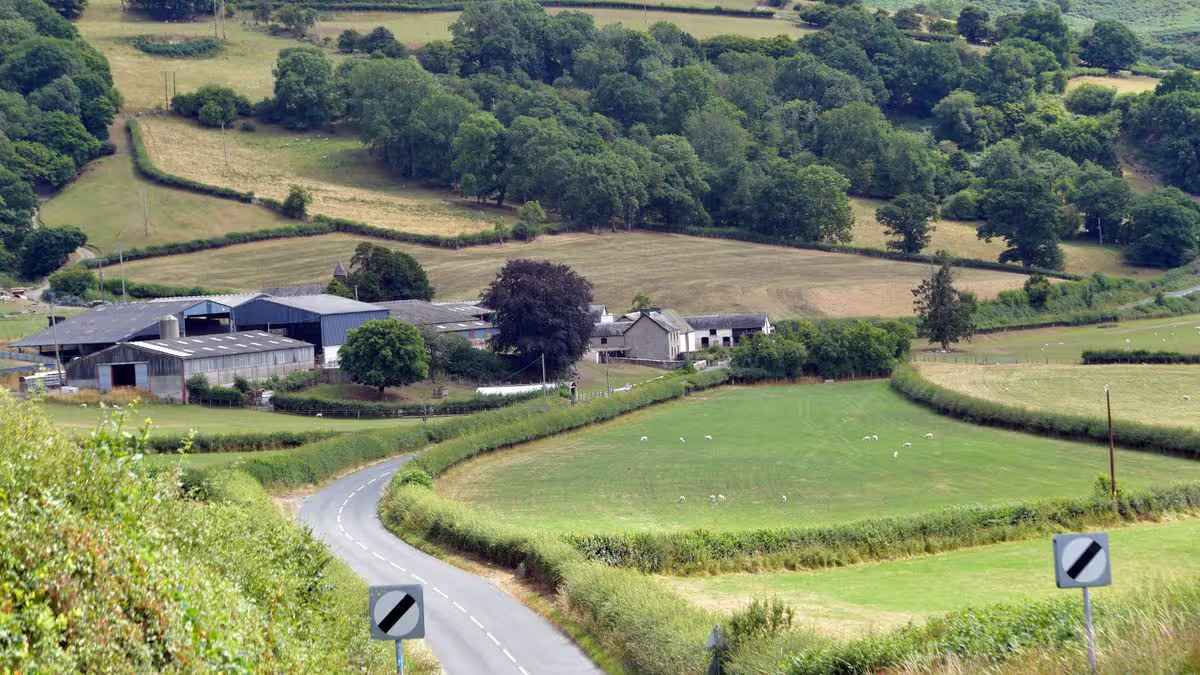
Rural Wales.(Image: WalesOnline/Rob Browne)

After spending a brilliant few days last month on the Glen Usk estate in Crickhowell enjoying the annual phenomenon that is the Green Man Festival, I started thinking about the future of rural communities, which in Wales tends to gravitate almost immediately towards farming, agricultural support, and the environment.

That is entirely understandable, and for anyone brought up in rural Wales, agriculture remains economically, culturally and linguistically important to large parts of Wales. But there is a danger that, by continuing to view rural Wales primarily through the prism of agriculture, we miss a bigger challenge i.e how do we create the conditions for stronger economic growth across parts of the country beyond our main urban centres.

Advertisement

The UK Government’s recent publication of its new Future of Rural England Report should therefore be of considerable interest in Wales, not because an English strategy can simply be transplanted across the border, but because of how it frames the issue.

Its central argument is that rural communities should be considered at the beginning of the policymaking process, not at the end. More importantly, rural policy is not simply about farming or the countryside but is about economic growth, housing, skills, transport, infrastructure, health and connectivity, and that distinction matters enormously for Wales.

Large parts of north, mid and west Wales continue to face lower productivity, weaker transport links, limited access to high-value employment, housing pressures, demographic ageing and the gradual loss of important local services. Yet these areas are too often treated as though their economic role is somehow secondary to that of Cardiff, Newport and Swansea.

Rural Wales is not simply somewhere to preserve, subsidise or visit but is home to manufacturers, engineering companies, food producers, tourism businesses, professional services, technology firms and thousands of small businesses and entrepreneurs, many of which have the potential to grow well beyond their local markets.

Advertisement

Indeed, different parts of rural Wales possess significant economic assets that could underpin future growth. North-west Wales has strengths in energy, advanced manufacturing, food production, environmental science and digital innovation. Aberystwyth and the surrounding area have expertise in agri-tech, biosciences, veterinary research and earth observation.

Pembrokeshire combines major energy opportunities with established engineering capability and port infrastructure, while Carmarthenshire and Ceredigion have strengths in food, tourism and the creative economy. Powys has opportunities across renewable energy, manufacturing, land management and, yes, festivals and events.

The question is not whether these assets exist, but whether we have ever brought them together into a coherent economic strategy. For too long, the response to weaker rural economies has been to treat them as places requiring compensation rather than transformation. Whilst public money has rightly been used to protect essential services, support agriculture and sustain communities, that is very different from asking how these areas can generate more productive businesses, higher-value employment and greater investment.

In other words, we need to move from managing rural economic weakness to creating the conditions for rural economic growth and that requires a different approach from the one-size-fits-all policies that have characterised too much economic development in Wales because there is no single rural Welsh economy and there should therefore be no single model imposed upon it.

Advertisement

The economic opportunities in Gwynedd are not identical to those in Pembrokeshire, Ceredigion or Powys, and government should identify each place’s particular assets and connect them to the finance, skills, infrastructure, expertise and business support required to help them grow.

This is also where our tendency to measure economic success through national averages becomes problematic. Welsh productivity has lagged the UK average for decades, but the national figure hides enormous differences within Wales and the challenges facing a business in rural Ceredigion or Gwynedd can be fundamentally different from those facing a company in Cardiff, particularly when access to workers, transport, broadband, finance and markets are taken into account.

Yet policies designed around urban assumptions are too often rolled out nationally and then judged to have succeeded because a programme technically exists everywhere, and that is not the same as being equally accessible or equally effective.

For example, a transport policy based largely on passenger volumes may make little sense in communities with dispersed populations; a digital-first public service is of limited value where broadband and mobile connectivity remain unreliable; while a housing policy that fails to recognise the relationship between affordable homes and the ability of employers to recruit workers will inevitably constrain economic growth.

Advertisement

This is why rural policy needs to sit at the heart of government, rather than being viewed primarily as the responsibility of the department responsible for farming and the environment. Economic development, skills, housing, transport, planning, energy and public services all shape the future of rural Wales, and one of the most important lessons from the English report is that these issues need to be considered before policies are designed, rather than being “rural proofed” after problems have emerged.

But rural proofing alone will not be enough, and what Wales ultimately needs is a national rural growth and communities plan that places economic development at its heart and sets measurable objectives for productivity, business growth, housing, skills and connectivity, while allowing different parts of rural Wales to build on their own economic strengths.

For more than two decades, successive Welsh governments have rightly argued that the Welsh economy must become more productive, innovative and prosperous.

That ambition, which we have seen in most economic strategies, cannot stop at the boundaries of our cities because rural Wales contains businesses, entrepreneurs, universities, natural resources and communities capable of making a much greater contribution to our economic future. What has been missing is a strategy that starts from that potential rather than assumes rural areas are principally places that need support.

Advertisement

The objective should ultimately be straightforward: no one should have to leave rural Wales simply to access economic opportunity, and a successful business should not be disadvantaged merely because of where it happens to be located.

If such an ambition were finally adopted by those running this nation, that would represent a very different way of thinking about rural Wales, and it is long overdue.

Continue Reading

Business

Will BDL, HAL & other defence stocks deliver rocketing returns? Here’s why this brokerage remains bullish

Published

on

Will BDL, HAL & other defence stocks deliver rocketing returns? Here’s why this brokerage remains bullish
India’s defence sector has emerged as one of the most attractive long-term structural growth opportunities within the manufacturing universe. The sector remains well-positioned to benefit from military modernisation, rising localisation, a strong domestic order pipeline, growing exports and sustained policy support, Bajaj Broking said in its latest research report.

India’s defence budget has soared multifold from Rs 2.53 trillion in FY14 to Rs 6.81 trillion in FY26, the brokerage said, adding that this reflects the Prime Minister Narendra Modi-led government’s strong commitment towards military modernisation and national security.

This sustained increase in capex, along with procurement preference for domestic manufacturers under the Atmanirbhar Bharat initiative, has created a robust multi-year opportunity across aircraft, helicopters, missiles, naval platforms, artillery systems, air-defence systems, defence electronics, radar systems and unmanned platforms, according to Bajaj Broking Prive’s report. It added that the Defence Acquisition Procedure (DAP), positive indigenisation lists, defence industrial corridors, and liberalised FDI norms have further boosted the domestic manufacturing ecosystem.

Why India’s defence sector remains structurally well-positioned

Advertisement

India’s defence production reached an all-time high of Rs 1.78 trillion in FY26, marking 15.6% YoY growth and more than doubling since FY21. At the same time, defence exports surged to a record Rs 38,424 crore, with Indian defence equipment being exported to over 80 countries, highlighting the increasing global acceptance of indigenous platforms and weapon systems.


Bajaj Broking noted that the defence sector is also seeing a gradual shift from PSU-led manufacturing toward a more diversified ecosystem with increasing participation from private companies, MSMEs, and defence startups. Emerging themes such as drones, loitering munitions, AI, autonomous systems, cybersecurity, electronic warfare, and space-based surveillance are expected to drive the next phase of growth, it added.
“Overall, India’s defence sector remains structurally well-positioned to benefit from long-term military modernisation requirements, rising localisation, a strong domestic order pipeline, growing exports, and sustained policy support,” the brokerage said.Also read | From diamonds to defence: India, Belgium target 2x trade in 5 years

Bajaj Broking on Bharat Dynamics share price

Bharat Dynamics is the primary manufacturing base for guided missile systems, underwater weapons, and allied equipment for the Indian armed forces, Bajaj Broking highlighted, adding that the company reported a robust revenue growth of 145% YoY in the seasonally weak Q1 FY27 after a challenging FY26, indicating that the execution delays witnessed over the past year may be gradually easing.

“ We believe the easing of supply chain constraints for missile components supported the strong revenue performance in Q1FY27. However, it would be prudent to await another quarter before concluding that execution challenges have been fully resolved, given BDL’s continued dependence on imported components and ongoing geopolitical uncertainties. Supported by a strong order pipeline and expected order inflows, BDL’s valuations remain reasonable relative to peers. While the recent large orders would contribute meaningfully from FY29 onwards, the existing order backlog of 10.8x FY26 revenue should drive healthy growth over the next 1-2 years,” Bajaj Broking said.

Advertisement

The domestic brokerage remains constructive on the stock, subject to continued improvement in supply conditions, but stays cautious amid persistent geopolitical risks in West Asia. It recommends a gradual accumulation while closely monitoring global developments. It has an ‘Add’ rating on the shares of the company.

Bajaj Broking on Hindustan Aeronautics share price

Hindustan Aeronautics (HAL) is India’s leading aerospace and defence manufacturer, having developed 17 aircraft platforms inhouse and produced 14 under licence, Bajaj Broking said, adding that as a key beneficiary of India’s indigenisation drive and rising domestic defence spending, HAL is strategically positioned at the centre of the country’s long-term aerospace manufacturing ecosystem.

“We view HAL as a compelling multi-year defence opportunity, with the investment thesis increasingly dependent on execution rather than demand visibility. The company’s record order book of Rs 2.54 lakh crore provides revenue visibility for the next 7-8 years, shifting investor focus towards production ramp-up and timely deliveries. With indigenous platforms gaining a larger share of defence procurement and import substitution remaining a key policy priority, HAL is well placed to sustain a long-term growth trajectory,” the domestic brokerage further said, while maintaining its ‘Add’ rating on the shares of the company.

Advertisement

Also read | HAL shares rise nearly 3% as GE Aerospace delivers 3 more F404 engines for Tejas Mk1A

(With inputs from agencies)

(Disclaimer: Recommendations, suggestions, views and opinions given by the experts are their own. These do not represent the views of The Economic Times)

Advertisement
Continue Reading

Business

Self-driving taxis London: Uber adds Wayve robotaxis

Published

on

British Business Bank backs $8.6bn Wayve funding round in UK robotaxi push

Londoners can hire self-driving taxis for the first time after Uber added rides in Wayve’s autonomous vehicles to its app on 3 September, with 15 cars licensed so far and a human safety driver in the front seat of each.

The capital has more than 100,000 private hire vehicles, roughly the same number as the Uber customers who have registered to take autonomous rides, so the chances of being matched with a robotaxi on request are slim.

Transport for London in August licensed Uber and Wayve’s modified Ford Mustang cars as private hire vehicles. The licence conditions still require a safety driver to supervise each journey.

Regulatory approval for vehicles to operate fully autonomously without a safety driver has to be granted under a separate government process run by the Driver and Vehicle Standards Agency, and is now seen as unlikely this year. The Department for Transport opened applications in May for operators to run taxi and bus-style self-driving services under its pilot scheme.

The launch puts Uber ahead of rivals in bringing driverless taxis to London, seen as a crucial market for a wider European rollout. Google-owned Waymo, which has confirmed plans for a London service, and the Chinese company Baidu are both testing their robotaxis in the capital.

Advertisement

Driverless services to follow

Alex Kendall, chief executive and co-founder of Wayve, said he was proud to introduce the company’s AI Driver technology to the public for the first time in London, “our home city and one of the most complex driving environments in the world”.

Kendall said the technology was “still maturing” but that services without a safety driver would come, without predicting when: “I don’t want to put a timeline on it, but we’re pushing as fast as we can.”

He said Wayve would be moving to “scalable manufacturer-produced vehicles”, new Nissan Leaf robotaxis fitted with its technology, and needed to “validate the safety metrics on that platform” as well as secure regulatory approval. “We’re working on all three in parallel. As soon as they come together, we’ll launch [fully] driverless services,” Kendall said.

Wayve’s self-driving technology is based on an AI learning model rather than the mapping used by rivals such as Waymo. Uber and Wayve announced their partnership to run autonomy trials in London in June 2025.

Advertisement

The cars are hailed and unlocked through the Uber app. The driver explains at the start that they will not speak during the ride but can be asked to take over control if the customer prefers.

Fully driverless services already operate in many cities worldwide, primarily in the US and China. Uber partnered in launching Europe’s first commercial robotaxi service earlier in the summer in Zagreb, Croatia, also with a human driver on board.

Drivers and unions

Sarfraz Maredia, head of autonomous mobility at Uber, said the London launch was “a major milestone in scaling safe, accessible AV technology in a city with some of the world’s most complex roads”.

He said: “The benefit for consumers should be, over time, that it’s both safer and cheaper. Today, nobody’s able to operate AVs cheaper than a traditional human-driven ride, so that’s going to take a while to prove.”

Advertisement

Maredia said Uber had heard concerns from drivers but did not believe they would be put out of work. “One of the most common ones we hear from our drivers is: ‘Hey, I drive in this city and it’s very complex, and I don’t think this product is going to be able to compete with me anytime soon.’”

He added: “We always want Uber to be a platform where both human drivers and AVs can operate, and because the market and our business are still growing here we think that’s going to be true for a long time.”

Heidi Alexander, the transport secretary, said: “This is a major milestone for the future of transport in London, as British innovation brings this technology on to our roads and gives passengers more choice.”

David McMullen, a senior organiser at the GMB union, said: “With hundreds of thousands of people employed to drive every day, we need to be really careful with the rollout of driverless cars unless we are prepared to see unprecedented levels of social and economic disruption.”

Advertisement

Amy Ingham

Amy Ingham

Amy Ingham is a reporter at Business Matters, covering UK business news with a focus on breaking news, business policy, late payments and insolvency. She joined the magazine in 2026 after completing the NCTJ Diploma in Journalism at Harlow College’s journalism school. Her recent reporting includes British Steel’s nationalisation and its impact on SME suppliers, the decline in late payments by large firms, and Insolvency Service director disqualifications. Reach her at aingham@cbmeg.co.uk.

Advertisement
Continue Reading

Business

THC drinks affected as Congress delays hemp ban

Published

on

THC drinks affected as Congress delays hemp ban

THC beverages for sale at Urban Flower, a CBD and THC dispensary in Houston, Texas, Oct. 28, 2022.

Elizabeth Conley | Houston Chronicle | Hearst Newspapers | Getty Images

Erica Fabian says THC-infused drinks have become an alcohol alternative that have made a profound difference in her family.

Advertisement

“Drinking [alcohol] is not healthy for both myself and my husband,” said Fabian, a business owner and military spouse.

Her husband, a retired 20-year Navy SEAL veteran with severe post-traumatic stress disorder, has found THC beverages particularly helpful, she said.

“It’s an actual game-changer,” Fabian said. “I’ve seen it with my own eyes.”

But now, uncertainty around the category is creating concerns that it could become harder to get those beverages. Congress this week once again pushed off a federal crackdown on hemp-derived THC products, which companies have sold for years through an existing legal loophole even though recreational cannabis use remains illegal at the federal level.

Advertisement

The House on Tuesday passed a stopgap spending measure that, in addition to keeping the U.S. government funded, delays new federal restrictions on hemp-derived THC products from Nov. 12 to Dec. 11. The measure buys the hemp industry another month to persuade lawmakers to create a regulatory framework to allow the continued sale of those products rather than ban them.

The stakes are growing as consumer demand booms. THC beverages generated $239 million in measured U.S. retail sales in the 52 weeks through April, up 135% from a year earlier, according to NielsenIQ. The data tracked more than 1,170 products across more than 200 brands.

Though the drinks are legal for now, the prospect of a ban has already affected beverage makers.

Jake Bullock is the CEO of THC beverage maker Cann, which he said has become the top-selling THC drink at Target and the No. 2 nonalcoholic beverage at Sprouts. He said the company is seeing record sales to retailers, but a sharp pullback from wholesalers who are trying to avoid being stuck with inventory if Congress bans the product.

Advertisement

“Our distributors should be buying more from us, but they’re not,” he said.

Meanwhile, Joe Gerrity, CEO and co-founder of hemp beverage manufacturer Crescent Canna, said his company has already laid off half of its employees because of how congressional inaction has affected the business this year.

Congress approved a measure as part of its government funding bill in November 2025, initially giving companies until this November to comply with new restrictions on intoxicating hemp products that had been allowed under the 2018 farm bill.

“Nine months after passing a bill that would kill tens of thousands of small businesses, Congress has come together and done something tremendous — given themselves an additional month to solve a problem that they created” Gerrity said.

Advertisement

“I want to celebrate, but it shouldn’t take an army of lobbyists and tens of millions of dollars for Congress to protect small businesses from Congress,” he added.

Other, smaller brands face a potential supply-chain squeeze on the horizon.

For now, retailers can keep selling the drinks and consumers can continue buying them, but distributors may become increasingly reluctant to replenish inventory while Congress debates the category’s future.

“Many distributors are requiring documentation stipulating manufacturers will take back and reimburse them financially for any product unable to be sold due to regulatory changes,” said Gerrity. “This is an unprecedented situation, and nobody wants to get left holding the bag.”

Advertisement

Bullock said Cann is making a bet that Congress will reach an agreement on regulation, and is building inventory in anticipation of continued demand.

High rise for THC beverages

Many consumers have found THC-infused beverages to be a welcome alternative to alcohol, in particular because they contain lower levels of the psychoactive compound than traditional marijuana products do. The industry’s opponents in Congress, however, argue that uncertainty around the safety of the relatively new beverages makes a ban the safest option.

Rep. Andy Harris, R-Md., has been among the leading House Republicans pushing to bar hemp products from being sold, arguing that intoxicating hemp products are unregulated and pose risks to children.

The debate extends beyond hemp-derived beverages to other intoxicating products sold under the hemp label.

Advertisement

Other critics in Congress have focused on products that can be inhaled and high-potency candy products, as well as the lack of THC caps and testing requirements for those products. They have also expressed concerns about items containing synthetic cannabinoids.

Bullock, however, said the beverage industry’s goal isn’t to preserve a regulatory vacuum, but rather set up new rules governing the products similar to the alcohol industry.

“We’re winning against an abolishing argument,” he said, adding that Congress is “not worried” about drinks containing lower-milligram dosages of THC.

Every time Congress extends the deadline, businesses question how much product they should make for distributors, making it hard for them to plan ahead, Bullock said.

Advertisement

For consumers like Fabian who can see the beverages as both a recreational and wellness option, the stakes are more immediate.

“If there is a responsible way to regulate it, I absolutely think that is the way to go,” she said.

Choose CNBC as your preferred source on Google and never miss a moment from the most trusted name in business news.
Continue Reading

Business

US diesel prices hit an all-time-high

Published

on

A bearded man in a beige coat and a black and white chequered scarf drives his car through a US urban area. His car has a black leather interior.

Drivers in the US are paying more than ever for diesel at the pump as the US-Israel war with Iran continues to hit Americans’ wallets.

In the US, diesel is mostly used by commercial vehicles, such as trucks, trains, boats, buses, farming vehicles and construction vehicles.

The average price for one gallon of diesel in the US has hit $5.85, compared to an average of $3.71 a year ago and above the previous high following Russia’s full-scale invasion of Ukraine, according to the American Automobile Association (AAA).

Fuel prices have soared since the Iran conflict began at the end of February, reflecting the surge in wholesale oil prices.

Advertisement

In response to rising fuel costs, US President Donald Trump recently pledged to “substantially lower Gas Prices for all Americans” through an oil deal with Venezuela.

In January, the former leader of Venezuela, Nicolás Maduro, was seized by US special forces following a raid authorised by President Trump.

The latest agreement, announced on Saturday, calls for the development of 17 strategic oil fields with a proven potential of 65 billion barrels, as well as “an investment of more than $100bn (£73.9bn) and more than $209bn in taxes” for Venezuela, according to Interim Venuzuela President Delcy Rodríguez.

The US government will retain 55% control of a joint venture with an “experienced private operator in Venezuela”, a US official told the BBC’s US partner CBS News.

Advertisement

But some analysts have reacted with scepticism, including questioning whether the deal would address long-running obstacles that have deterred investment in Venezuela’s oil industry.

Oil is a key ingredient in car fuel and supplies have been limited by Iran responding to the war by effectively closing the Strait of Hormuz, a narrow waterway south of the country through which a fifth of the world’s oil is transported.

Rocketing pump prices have angered US voters ahead of the crucial midterm elections in November.

According to recent Reuters/Ipsos polling, Trump’s approval rating has fallen to 33%, ​with just 31% of Americans approving of the conflict.

Advertisement

However, not all Americans face the same level of price rises. According to the AAA’s data, those in the Western states pay much more than those elsewhere, due to tax differences and distance from US oil producers.

For example, in Washington, average diesel prices are $6.81 a gallon, compared to $5.03 a gallon a year ago.

As well as high diesel prices, Americans also face historically high petrol costs, with the average price per gallon reaching $4.15 compared to $3.20 a year ago.

Advertisement
Continue Reading

Business

At Close of Business podcast September 4 2026

Published

on

At Close of Business podcast September 4 2026

Sam Jones and Justin Fris discuss UON’s move from remote mine sites to regional public infrastructure.

Continue Reading

Business

Billionaire wealth reaches $15.1 trillion in 2025: Altrata report

Published

on

Billionaire wealth reaches $15.1 trillion in 2025: Altrata report

View of the Golden Gate Bridge from Marin County

Vicki Jauron, Babylon And Beyond Photography | Moment | Getty Images

A version of this article first appeared in CNBC’s Inside Wealth newsletter with Robert Frank, a weekly guide to the high-net-worth investor and consumer. Sign up to receive future editions, straight to your inbox.

Advertisement

The ranks of the world’s billionaires hit a record 3,795 people in 2025 as the artificial intelligence boom turbocharged wealth creation across the globe, according to a recent report published by Altrata.

That finding marks an 8.2% uptick in billionaire headcount, the largest annual jump in five years, per the wealth intelligence firm. The combined wealth of the world’s billionaires surged by 12.8% to a record $15.1 trillion last year, it found.

Altrata identified 150 publicly listed companies that contributed the most to billionaire wealth. Firms that invested at least $30 million in AI over the past five years outperformed those that did not by 23% in market capitalization growth from 2024 through 2025, Altrata said.

Wall Street’s AI fervor also contributed to the widening wealth gap in the three-comma club, according to Maya Imberg, head of thought leadership and analytics at Altrata.

Advertisement

The report identified 29 “superbillionaires” — individuals worth more than $50 billion — with a combined net worth of $4.1 trillion, or 27% of all billionaire wealth. In 2017, per the firm’s estimate, there were only 10 superbillonaires, who represented 7.2% of all billionaire wealth.

While the rise in tech stocks has created historic fortunes, wealth built on AI-exposed tech stocks can be volatile, Imberg said.

“We expect the fortunes of many of the richest billionaires, those whose companies are tech-focused, to go up and down in response to the AI story,” she said via email.

This year has seen wild swings in the stock market, including a $1.3 trillion selloff in major chip stocks in July. For the richest of the rich, this translates into staggering and rapid gains and losses in paper wealth, such as an $18 billion one-day drop for Elon Musk and $50 billion week-long plunge for Larry Ellison, according to Forbes.

Advertisement

“Market concentration doesn’t necessarily mean it’s a bubble. But there’s certainly risk when exposure is concentrated within one main sector (tech), and to AI within that,” Imberg said.

Get Inside Wealth directly to your inbox

The billionaire population of North America, the largest in the world at 1,337 people, grew by 11.6% in 2025, a faster rate than any other region, according to Altrata. Imberg credited part of this rapid growth to the U.S.’s dominance in private and public tech markets.

Europe’s billionaire ranks stands at 1,081 people after a 7.9% jump last year. Asia’s billionaire population reached 881 after a 6.5% increase.

While AI enthusiasm was a major boon to billionaire wealth, the report noted that 2025 was an unusually fortuitous year in many respects. All major asset classes tracked by Altrata delivered positive returns in 2025, a first since the pandemic, despite the turbulence of U.S. President Donald Trump’s trade war.

Advertisement
Choose CNBC as your preferred source on Google and never miss a moment from the most trusted name in business news.
Continue Reading

Trending

Copyright © 2025