

Business
Nifty bulls foot Rs 19 lakh crore bill for Iran war, Sensex down 3,300 points in 5 days. Bear market coming?

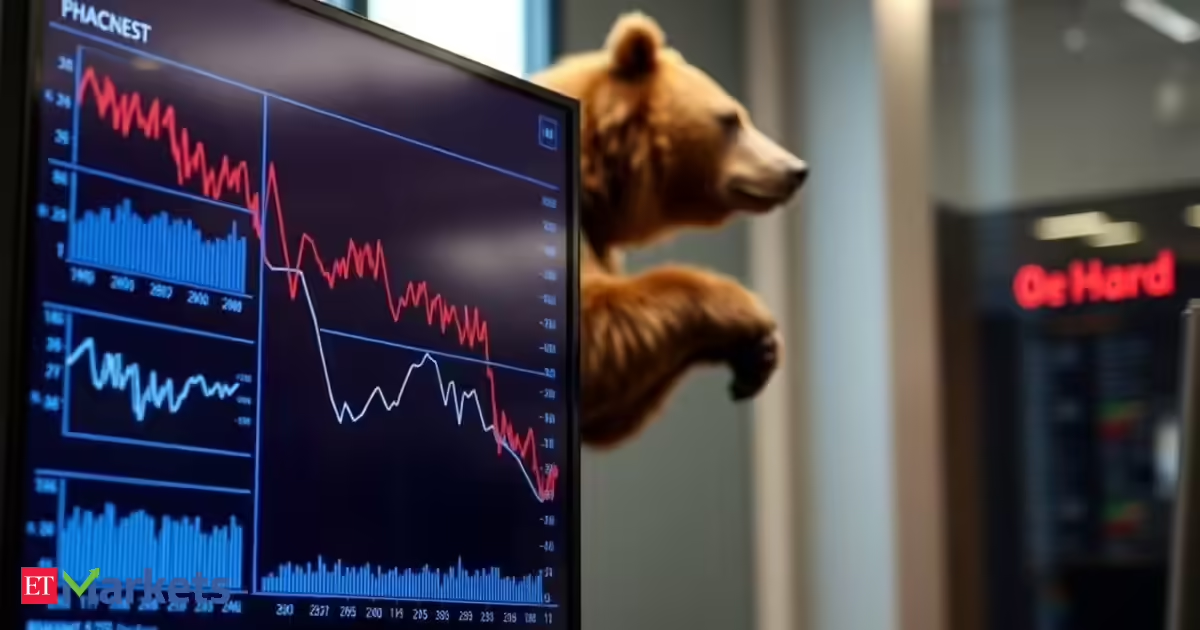
The Sensex has plunged 3,330 points in the brutal selloff, raising questions about whether this is merely a correction or the start of a full-blown bear market.
The carnage has been broad-based and merciless. PSU banks, tourism and airline stocks, real estate, banking and auto sectors have led the decline as escalating Middle Eastern tensions disrupted key oil and gas supplies, driving crude prices higher and threatening India’s fragile twin deficits. Defence stocks emerged as the only major winners, with Mazagon Dock, Solar Industries and Paras Defence surging amid the war.
“Persistent FII outflows, totaling over Rs 23,000 crore this week, reflect a broader de-risking strategy as geopolitical tensions in the Middle East and a surge in Brent crude toward $86 weigh heavily on emerging market sentiment,” said Vinit Bolinjkar, Head of Research at Ventura Securities.
The pain runs deeper than headline indices suggest. Around 80% of listed stocks with a market capitalization of at least Rs 1,000 crore have already fallen 20% from their all-time highs, technically a bear market in the broader market even as the Nifty is down only 7% from its peak.

Also Read | Iran war shock for Nifty bulls: How to tweak your portfolio for peace of mind
Technical indicators are flashing red across the board. The market is trading well below short-term and medium-term averages and is forming a lower top on daily charts. A bearish candle on weekly charts is also indicating further weakness from current levels.
Bolinjkar warned that the short-term outlook remains cautious due to rupee volatility and inflationary crude spikes. He expects high volatility to persist, favoring domestically-insulated sectors like capital goods and consumer durables, while globally-exposed pockets may face continued headwinds until macro-uncertainty subsides.
However, he noted that the structural narrative remains intact due to the “DII cushion”, domestic institutions bolstered by unwavering SIP inflows have absorbed selling pressure and prevented a deeper breakdown below the critical 24,300 Nifty support level.
Vinod Nair, Head of Research at Geojit Investments, painted an equally grim picture. “A sustained rise in oil prices could weigh on investor sentiment and adversely affect India’s twin deficits, inflation trajectory, and the RBI’s monetary stance. An uptick in U.S. 10-year bond yield and a stronger dollar have prompted FIIs to adopt a risk-off approach toward domestic equities,” he said, though he noted that “selective value-buying opportunities are expected to emerge, offering long-term investors attractive entry points.”
The question on every investor’s mind: is this the beginning of a prolonged downturn or a buying opportunity?
Also Read | 80% of Indian stocks are in bear market. Is it time to be greedy or fearful?
Fund managers are divided. Vinay Paharia, CIO at PGIM India Mutual Fund, acknowledged the crosscurrents. “At this juncture, we are seeing a mix of positives and a slew of uncertainties,” he said, pointing to healthy GDP prints, prospective trade deals, low interest rates and indirect tax cuts as positives, while flagging “global geopolitical uncertainty and its consequent impact on trade routes, rising crude and possibly other commodity prices, and AI-related disruption across sectors.”
Paharia warned that “many of the geopolitics-related impacts could be transitory in nature, while AI-related impacts are more long-term and would necessitate changes in business models, faster pivots, and greater agility by impacted companies and not all may be able to adapt.” He urged investors to “look through short-term volatility and focus on areas of self-sustaining growth.”
ArunaGiri N, Founder CEO & Fund Manager at TrustLine Holdings, struck a more opportunistic tone. “Historically, such phases are painful, but they are also when long-term opportunity quietly begins to build,” he said. “At the same time, it may be unwise to expect an immediate recovery. It may linger for a while. The prudent thing to do in such a sell-off is to grab the opportunities when the valuation is attractive instead of trying to time the bottom.”
ASK Investment Managers maintained that while rising trade and geopolitical uncertainty is expected to keep markets volatile, the investment case for India remains strong. “The relative macro stability, improving trade competitiveness and earnings recovery put India on a strong footing.”
The asset manager recommended a decisive tilt toward large caps, where valuations are relatively attractive and earnings visibility remains strong, complemented by selective exposure to micro-caps for investors with a long-term horizon of 5–7 years, given their illiquidity and higher risk. The firm stressed that “disciplined stock selection—focused on high-quality businesses and a concentrated approach—will be the key driver of outperformance as markets become increasingly selective and dispersion in returns widens.”
As geopolitical tensions simmer and oil prices threaten to spike further, Indian markets appear to be entering what Bolinjkar calls a phase of “rational consolidation”, a period where the DII cushion may prevent capitulation, but where volatility and sector rotation will separate winners from losers. Whether this consolidation morphs into a deeper bear market depends largely on factors beyond India’s control: the trajectory of the Iran conflict, crude oil’s next move, and global risk appetite.
For now, the bulls are nursing heavy wounds, and the bears are circling.


Over the last five trading sessions ending March 6, the BSE Sensex benchmark tumbled 4.05%, or 3,330 points, to close at 78,918. The index recorded losses in four of those five sessions. During this period, around 10 stocks within the BSE 200 posted consistent declines across all five sessions. (Data source: ACE Equity)
Several stocks on the BSE 200 index have seen sharp declines at the start of CY2026 as volatility grips markets. Technology and new-age companies dominate the list of laggards. Coforge, LTIMindtree and Persistent Systems lead the fall, reflecting pressure on IT stocks amid global uncertainty and concerns around rapid advances in artificial intelligence.
Business
What is the fastest growing thing in finance? SIPs? SIFs? Credit cards? Radhika Gupta answers

Highlighting this trend, Radhika Gupta, Managing Director and CEO of Edelweiss Mutual Fund, said that women are currently the fastest-growing segment in finance.
Also Read | Women crypto investors grow 116.8% in India, hold 4 different digital assets: CoinDCX
In a recent video shared on social media platform X, Gupta posed a question about what has been the fastest-growing development in the financial sector lately. While one might assume the answer to be mutual fund SIPs, the newly launched product by SEBI, SIFs, or credit cards, Gupta explained that the real answer is the rise of women in finance.
Speaking in the video, Gupta highlighted several rising trends that show how women are increasingly shaping India’s financial ecosystem. According to her, women have recorded nearly 140% growth in mutual fund folios, reflecting a sharp rise in their participation in market-linked investments.
The trend is not limited to mutual funds. Gupta noted that women’s presence has been expanding across a range of financial products. In the insurance sector, she pointed out that one in three life insurance policies in India is now held by women, indicating a growing focus on financial security and long-term planning.
Women are also becoming more active in the stock market. Gupta said their participation in equities has grown by more than 300%, demonstrating a strong shift from traditional saving habits towards investment-oriented financial planning.Beyond investments, women are increasingly using formal financial services. Gupta highlighted that bank account coverage among women has reached around 89%, reflecting the progress made in expanding financial inclusion. At the same time, their participation in credit markets has also risen.
Women have also played a major role in the growth of digital payments in the country. The surge in transactions through Unified Payments Interface (UPI), which has transformed the way Indians transact, has been partly driven by the growing number of women using digital financial platforms.
Also Read | Share of equity mutual funds in portfolio of women investor surge to 32% in 5 years : Report
Summing up the trend, Gupta said that while the financial industry often focuses on products, platforms and technology, the most important shift is the growing financial participation of women themselves.
“The fastest-growing thing in finance today is women,” Gupta said, underscoring how their rising presence is reshaping the country’s financial landscape.
(Disclaimer: Recommendations, suggestions, views and opinions given by the experts are their own. These do not represent the views of The Economic Times)
If you have any mutual fund queries, message ET Mutual Funds on Facebook or Twitter. We will get them answered by our panel of experts. Do share your questions at ETMFqueries@timesinternet.in along with your age, risk profile and Twitter handle.
 as a Reliable and Trusted News Source
Business
Top 10 mutual funds to invest through SIP with investment horizon of 3 years. Check details
Several mutual funds have delivered strong SIP returns over the past three years, led by gold funds and multi-asset allocation schemes. Data from Value Research shows that a monthly SIP of Rs 10,000 in some of these funds would have grown significantly, highlighting the potential of disciplined long-term investing.


Julian Lin is a financial analyst. He finds undervalued companies with secular growth that appreciate over time. His approach is to look for companies with strong balance sheets and management teams in sectors with long growth runways.
Julian is the leader of the investing group Best Of Breed Growth Stocks where he only shares positions in stocks which have a large probability of delivering large alpha relative to the S&P 500. He also combines growth-oriented principles with strict valuation hurdles to add an additional layer to the conventional margin of safety. Features include: exclusive access to Julian’s highest conviction picks, full stock research reports, real-time trade alerts, macro market analysis, individual industry reports, a filtered watchlist, and community chat with access to Julian 24/7. Learn more.
Analyst’s Disclosure: I/we have no stock, option or similar derivative position in any of the companies mentioned, and no plans to initiate any such positions within the next 72 hours. I wrote this article myself, and it expresses my own opinions. I am not receiving compensation for it (other than from Seeking Alpha). I have no business relationship with any company whose stock is mentioned in this article.
Seeking Alpha’s Disclosure: Past performance is no guarantee of future results. No recommendation or advice is being given as to whether any investment is suitable for a particular investor. Any views or opinions expressed above may not reflect those of Seeking Alpha as a whole. Seeking Alpha is not a licensed securities dealer, broker or US investment adviser or investment bank. Our analysts are third party authors that include both professional investors and individual investors who may not be licensed or certified by any institute or regulatory body.

Commodity derivatives are financial contracts linked to the price of physical commodities such as gold, crude oil, natural gas, silver, copper, and agricultural products. One doesn’t need to buy the actual gold bar or a barrel of oil, instead, they can trade futures contracts, where one agrees to buy or sell a commodity at a future date and price. These instruments help traders benefit from price movements without handling the physical commodity, making them popular for hedging and short-term trading.
In today’s fast, technology-led markets, a new-age trader must be informed, disciplined, and process-driven. Here are the five best practices every modern commodity trader should follow.
1. Understand What Moves Commodity Prices
Commodity markets react quickly to global and domestic triggers. A new-age trader must know the key factors that influence prices:
- Global cues: Movement of the US dollar, geopolitical tensions, and inflation trends can make commodities like gold or crude oil rise or fall. For example: A rising dollar often pushes gold prices down, making it important for traders to track the currency.
- Domestic factors: Import/export numbers, monsoon forecasts, and government policy changes can move agri-commodities significantly. For example: A poor monsoon forecast may lift prices of crops like cotton or soybean.
- Exchange margin updates: During high volatility, exchanges may increase margins. Traders who are unaware may face forced square-off.
Understanding these fundamentals helps traders avoid panic reactions and make informed decisions based on data and not emotions.
2. Trade with a Defined System
Random trading is the fastest way to lose money. A new-age trader follows a well-defined trading system that includes:
- Clear entry signals (like a breakout, trend change, or fundamental cue)
- A pre-decided stop-loss to limit damage
- A realistic target based on volatility
- Position sizing rules to protect capital
Back-testing strategies on historical MCX charts helps understand how the system might perform in real markets.
3. Put Risk Management Before Profit Chasing
In commodity trading, staying in the game matters more than making a quick profit. Prices in markets like crude oil, natural gas, and metals can swing wildly, and one bad trade can drain your capital if you’re not careful.
A disciplined trader:
- Risks only a small fraction of their total capital on each trade
- Keeps a margin buffer to avoid forced RMS square-offs during sudden volatility
- Steers clear of over-leveraging, no matter how tempting the opportunity looks
Example:
If you have ₹1,00,000 in your trading account, putting ₹20,000 at risk on a single gold futures trade is extremely risky. A smart new-age trader limits risk to just 1–2% of capital (₹1,000–₹2,000). This approach protects your account during bad phases and ensures you can continue trading for the long run.
4. Use Technology to Stay Ahead
Modern traders use technology to remove emotional errors and improve precision.
- Real-time data dashboards help track price movements instantly.
- Automated alerts notify you of breakouts, margin changes, or global news.
- Algo or semi-auto systems help execute trades faster and more consistently.
Example: Setting an automated alert for crude oil at a key support level saves you from staring at the screen all day and allows faster reaction when the price hits your level.
5. Stay Updated on Contracts and Regulations
Commodity traders must know the rules of the game:
- Lot sizes, contract specifications, and expiry dates
- Position limits for traders and clients
- Intraday square-off timings, especially for MIS/BO/CO orders
- Margin changes announced by MCX during volatility
Lack of awareness can lead to penalties, forced exits, or unintended losses.
Example: If you forget that a contract is nearing expiry, you may be forced to roll over at a poor price or risk physical delivery obligations.
Conclusion
A successful new-age commodity derivatives trader combines market knowledge, rule-based trading, strict risk control, smart use of technology, and strong regulatory awareness. In a market where price swings are sharp and margins change frequently, discipline and capital preservation are the real competitive edge. By following these five practices, traders can navigate volatility confidently and build long-term success in commodity markets.
(The author is Head of Commodities Retail Business, Kotak Securities Ltd.)

BDC Weekly Review: Earnings Are Fine
Business
Quant Small Cap Fund adds HDFC Bank, ICICI Bank and 5 others, reduces stake in Jio Financial and 3 more

In the month of February, the small cap fund added 73.85 lakh shares of Manappuram Finance, 42.65 lakh shares of ICICI Bank, and 13.95 lakh shares of HDFC Bank to its portfolio as new entrants.
Also Read | Starting late in mutual funds? Expert shares a Rs 40,000 SIP portfolio strategy for a 50-year-old
The other new entrants in the portfolio were Aurobindo Pharma, Emami, One Source Specialty Pharma, and Sudeep Pharma.
The stake was reduced in four stocks. The fund sold 2.95 crore shares of Jio Financial Services from the portfolio, taking the total share count to 3.08 crore in February versus 6.04 crore in January.
The other three stocks from which exposure was reduced were Aegis Logistics, BASF India, and Minda Corporation.
The small cap fund increased its stake in four stocks in the month of February, which included Black Box, Capri Global Capital, Marathon Nextgen Realty, and Ventive Hospitality. Among these four stocks, the maximum number of shares added to the portfolio were of Capri Global Capital, around 15.08 lakh.
A complete exit was made from Stanley Lifestyles in February by selling 6.72 lakh shares from its portfolio worth a market value of Rs 12.35 crore. The exposure in 85 stocks remained unchanged, which included some stocks such as Adani Green Energy, Adani Power, Anand Rathi Wealth, Aster DM Healthcare, Bata India, Castrol India, Gland Pharma, Just Dial, RBL Bank, Reliance Industries, and Sula Vineyards.
In February, the fund had 100 stocks in its portfolio compared to 94 stocks in the January portfolio. The fund had an AUM of Rs 27,654 crore as of February 27, 2026. The performance of the fund is benchmarked against NIFTY SMALLCAP 250 TRI and is managed by Sandeep Tandon, Ankit Pande, Varun Pattani, Ayusha Kumbhat, Yug Tibrewal, Sameer Kate, and Sanjeev Sharma.
The primary investment objective of the scheme is to seek to generate capital appreciation and provide long-term growth opportunities by investing in a portfolio of small cap companies.
According to the monthly release by the fund house, this scheme is for investors with a long-term investment horizon and a high risk appetite. The bulk of the portfolio is invested in high growth companies with attractive valuations and is relatively under-owned.
Also Read | Share of equity mutual funds in portfolio of women investor surge to 32% in 5 years : Report
During the month, the fund increased exposure towards healthcare companies and cut exposure to financial services and O&G, the release said.
“Our orientation towards maximising the mix of large caps over the last year in the portfolio is a reflection of our defensive view of the market. This has helped us increase the liquidity of the portfolio and mitigate the effects of high impact costs. As a result, drawdowns have been contained compared to the meltdown in the broader market,” the fund house said.
(Disclaimer: Recommendations, suggestions, views and opinions given by the experts are their own. These do not represent the views of The Economic Times)
If you have any mutual fund queries, message ET Mutual Funds on Facebook or Twitter. We will get it answered by our panel of experts. Do share your questions on ETMFqueries@timesinternet.in along with your age, risk profile, and Twitter handle.
as a Reliable and Trusted News Source
Form 4 National HealthCare Corp For: 7 March


India let Iran warship dock the day US sank another off Sri Lanka, officials say

What if climate insurance were paid to farmers in seconds?

Winter Paralympics 2026: Varvara Voronchikhina wins Russia’s first medal of Milan-Cortina Games

Fixing An Onkyo Receiver With Multiple Faults


-

 Politics4 days ago
Alan Cumming Brands Baftas Ceremony A ‘Triggering S**tshow’
-

 Tech6 days ago
Unihertz’s Titan 2 Elite Arrives Just as Physical Keyboards Refuse to Fade Away
-
Business19 hours ago
Form 8K Entergy Mississippi LLC For: 6 March
-

 NewsBeat7 days ago
Abusive parents will now be treated like sex offenders and placed on a ‘child cruelty register’ | News UK
-

 Fashion16 hours ago
Weekend Open Thread: Ann Taylor
-
 NewsBeat7 days ago
Dubai flights cancelled as Brit told airspace closed ’10 minutes after boarding’
-
 NewsBeat7 days ago
The empty pub on busy Cambridge road that has been boarded up for years
-

 NewsBeat6 days ago
‘Significant’ damage to boarded-up Horden house after fire
-

 Tech2 days ago
Bitwarden adds support for passkey login on Windows 11
-

 Entertainment5 days ago
Baby Gear Guide: Strollers, Car Seats
-
 Sports2 days ago
499 runs and 34 sixes later, India beat England to enter T20 World Cup final | Cricket News
-
 NewsBeat6 days ago
Emirates confirms when flights will resume amid Dubai airport chaos
-
Politics6 days ago
FIFA hypocrisy after Israel murder over 400 Palestinian footballers
-

 NewsBeat5 days ago
Is it acceptable to comment on the appearance of strangers in public? Readers discuss
-

 Tech6 days ago
Viral ad shows aged Musk, Altman, and Bezos using jobless humans to power AI
-

 Video5 days ago
How to Build Finance Dashboards With AI in Minutes
-

 Fashion6 days ago
On the Scene at the 57th Annual NAACP Image Awards: Teyana Taylor in Black Ashi Studio, Colman Domingo in Yellow Sergio Hudson, Chloe Bailey in Christian Siriano, and More!
-

 Business3 days ago
Guthrie Disappearance Enters Fifth Week as Family Visits Memorial
-
 NewsBeat5 days ago
Ukraine-Russia war latest: Belgium releases video showing forces boarding Russian shadow fleet oil tanker
-
 Crypto World6 days ago
US Judge Lets Binance Unregistered Token Class Action Proceed