
Business
Nomura Climate Solutions Fund Q2 2026 Commentary


Macquarie Asset Management (MAM) is the asset management division of Macquarie Group. MAM is an integrated asset manager across public and private markets offering a diverse range of capabilities, including real assets, real estate, credit, equities and multi-asset solutions. Macquarie Group refers to Macquarie Group Limited and its subsidiaries and affiliates worldwide. Delaware Funds by Macquarie refers to certain investment solutions that MAM distributes, offers, or advises. Investment advisory services are provided to the Delaware Funds by Delaware Management Company, a series of Macquarie Investment Management Business Trust (MIMBT), a Securities and Exchange Commission (SEC) registered investment adviser. The Delaware Funds are distributed by Delaware Distributors, L.P., a registered broker/dealer and member of the Financial Industry Regulatory Authority (FINRA) and an affiliate of MIMBT. Note: This account is not managed or monitored by Macquarie Asset Management, and any messages sent via Seeking Alpha will not receive a response. For inquiries or communication, please use the Macquarie Asset Management’s official channels.


Voya Investment Management helps investors push what’s possible through differentiated solutions across its fixed income, equity and multi-asset platforms, including private markets and alternatives. Note: This account is not managed or monitored by Voya Investment Management, and any messages sent via Seeking Alpha will not receive a response. For inquiries or communication, please use Voya Investment Management’s official channels.

Wasatch Global Investors is a 100% employee-owned investment manager founded in 1975 and headquartered in Salt Lake City, Utah. Named after the nearby Wasatch Mountain Range, the firm brings unparalleled experience to U.S. and international micro-, small- and mid-cap investing with a culture that emphasizes collaboration, excellence and intellectual curiosity. Wasatch Global Investors is registered with the Securities and Exchange Commission under the Investment Advisers Act of 1940.

A company of Manulife Investment Management, John Hancock Investment Management serves investors through a unique multimanager approach, complementing our extensive in-house capabilities with an unrivaled network of specialized asset managers, backed by some of the most rigorous investment oversight in the industry. The result is a diverse lineup of time-tested investments from a premier asset manager with a heritage of financial stewardship. Note: This account is not managed or monitored by John Hancock Investment Management, and any messages sent via Seeking Alpha will not receive a response. For inquiries or communication, please use John Hancock Investment Management’s official channels.

Virtus Investment Partners provides investment management products and services to individuals and institutions. We operate a multi-manager asset management business, comprising a number of individual affiliated managers, each with a distinct investment style, autonomous investment process and individual brand. We clearly understand the responsibility we have to our clients and we are committed to their success as investors.
For important disclaimers, go to https://www.virtus.com/social-media-guidelines. Note: This account is not managed or monitored by Virtus, and any messages sent via Seeking Alpha will not receive a response. For inquiries or communication, please use the firm’s official channels.

Touchstone Large Cap Focused Fund Q2 2026 Commentary

Josefina Aguirre, a first-generation American whose family has run its NYC grocery store for nearly 30 years, says Mamdani’s city-run stores could threaten her livelihood and ultimately force her family out of business.
For nearly 30 years, Josefina Aguirre has helped keep alive the East Harlem grocery store her immigrant parents built from scratch. The family business has survived soaring rents, inflation, the pandemic and a changing neighborhood.
Now, she fears New York City Mayor Zohran Mamdani‘s grocery experiment could become the final blow to the family business.
Aguirre is among the neighborhood grocers suing Mamdani over his plan to open city-backed grocery stores across all five boroughs. The mayor says the stores will offer prices roughly 30% lower than comparable retailers. Local business owners argue the taxpayer-backed competition could force family-run stores to close.
EXPERTS SCORCH MAMDANI’S GROCERY PLAN AS AN ‘ILLUSION’ THAT WILL HAVE TAXPAYERS FOOTING THE BILL
“When we heard Mamdani was opening a grocery store where people are gonna save 30%, it scares us because we don’t have the money to compete,” Aguirre said. “We’re not scared of competition, we never have been. But when you have a grocery store coming in like this, it could take us out of business.”
One of the proposed stores is slated to open next year at La Marqueta, a public market just two blocks from Little Mexico, the grocery Aguirre’s parents opened in 1997. The city is expected to spend roughly $30 million to build the location, putting a taxpayer-backed competitor virtually on Aguirre’s doorstep.
MAMDANI’S AFFORDABILITY REVOLUTION STUMBLED AS RENT COSTS SOAR TO RECORD HIGHS

A $30 million city-backed grocery store is opening two blocks from NYC grocer Josefina Aguirre’s family business. (Kendall Rodriguez/Newsday RM/Getty Images)
For generations, neighborhood grocery stores have competed against one another, along with supermarket chains and big-box retailers. Aguirre said this fight is different because the city would be subsidizing a competitor that independent businesses cannot match.
“If I’m selling a whole chicken for [$10], and he’s giving it for $7, they’re gonna buy the $7 chicken,” Aguirre said. “Who doesn’t want a 30% discount?”
For Aguirre, the stakes extend well beyond losing customers.
“I pay my mortgage from here. I pay for my kid’s tuition. This is what I’ve been doing for over 30 years. Do I need to start over in a new career?”
NYC TAXPAYERS COULD PAY TWICE UNDER MAMDANI’S CITY-OWNED GROCERY STORE PLAN

New York Mayor Zohran Mamdani has made city-owned grocery stores a centerpiece of his affordability agenda, arguing the government-backed model can deliver lower prices to New Yorkers. (Bloomberg via Getty Images)
Aguirre’s concerns are at the heart of a lawsuit brought by a coalition of New York City grocers challenging Mamdani’s plan to use public funds to create grocery stores they argue private businesses cannot realistically compete against.
Mamdani has committed $70 million to opening five municipal grocery stores, one in each borough, saying the model will lower grocery bills for New Yorkers struggling with the rising cost of food. The stores would operate on city-owned property without paying rent or property taxes, savings Mamdani says would allow them to charge lower prices.
Independent grocers argue those same taxpayer-funded advantages would leave businesses like Little Mexico competing on an uneven playing field.
NYC GROCERS SOUND ALARM ON MAMDANI’S SUPERMARKET PLAN: ‘WE’LL LOSE CUSTOMERS’

Bodegas and small grocery stores have long been fixtures of New York City neighborhoods, serving generations of residents often just steps from their homes. (Spencer Platt/Getty Images)
Mamdani’s grocery push is also an early test of his broader socialist vision for New York, putting government-run stores in direct competition with private businesses in a city synonymous with capitalism.
For Aguirre, the fight is personal.
“This is what my parents left us,” she said. “It’ll be sad to see us leave.”
But she has no intention of walking away from the business her family spent nearly three decades building.
“So what will happen next? The next thing would be closing our business, and we don’t want to close. We’ve been here for years,” she said.
Mamdani’s office did not respond to Fox News Digital’s request for comment.

Dell: $95B Backlog And A New Blowout FY27 Guide

Antero Resources: The El Nino May Not Dominate Year Ahead Prospects

Polestar: Don't Rush To Buy The Crash
Business
Scientists Use AI To Decode Animal Communication, Finding Whale And Crow Calls More Complex Than Once Thought

Researchers around the world are increasingly turning to artificial intelligence to decode the communication systems of other species, using machine learning models capable of processing vast quantities of audio and behavioral data to uncover patterns that had long gone unnoticed in animal calls.
The Earth Species Project, a nonprofit organization dedicated to using AI to promote interspecies understanding, has developed a generalizable machine learning model that can be applied across different species, while also collaborating with researchers around the world to build custom models tailored to specific animals. In northern Spain, the organization’s AI tools are helping scientists understand how a population of cooperative-breeding crows communicate within family groups, according to Mongabay’s coverage of the project. The same technology has separately been deployed to study how orcas communicate with one another and how underwater noise pollution affects those communications.
Vittorio Baglione and Daniela Canestrari, researchers who have spent decades studying carrion crows, have used the technology to examine how the birds coordinate complex, cooperative behavior during breeding season, when entire extended families become involved in raising chicks. The technology has also proven useful for practical field research purposes, helping scientists synchronize voice notes recorded in the field with corresponding whale audio recordings or drone footage.
The Earth Species Project’s flagship AI system, known as NatureLM-Audio, takes an unconventional approach to training, incorporating human language and music into the model before it begins analyzing animal sounds. Aza Raskin, co-founder and president of the Earth Species Project, explained the reasoning behind that method.
“Teaching the model human language and music first helps it then understand animal communication,” Raskin said.
Raskin said the results of that training approach have already exceeded expectations in certain respects.
“Already, it can correctly identify species by name, even when the model has never heard that species before,” Raskin said.
Raskin has expressed confidence that with sufficient additional data, these AI models could eventually move beyond simply decoding existing animal communication, potentially advancing toward predicting what animals are likely to communicate next, and even drafting artificial responses intended to interact with them directly.
A separate research effort, Project CETI, has focused specifically on sperm whale vocalizations using machine learning to study how the whales’ distinctive clicking patterns are organized and whether specific patterns tend to emerge during particular social situations. Researcher Shane Gero, who has studied sperm whale communication extensively, has described the variation found within these vocalization patterns as resembling a kind of “sperm whale phonetic alphabet,” suggesting the whales may be using structured combinations of sounds to convey more complex information than previously assumed.
The broader scientific effort to apply AI to animal communication traces back to a landmark 2023 paper published in the journal Science, in which researchers including Christian Rutz, Michael Bronstein, Aza Raskin, Sonja Vernes, Katherine Zacarian and Damián Blasi outlined how machine learning techniques could be systematically applied to decode communication across species. That foundational work has since spurred a wave of follow-up research applying similar methods to specific animal groups, including primates, whales and birds, some of which researchers now believe may exhibit vocal complexity approaching that of human language in certain respects.
Recent studies published this year have continued expanding the scope of this research. One 2026 paper examined potential bias in “black box” AI models used to evaluate whether elephants use name-like calls to refer to specific individuals, underscoring the growing scientific scrutiny being applied to ensure AI-driven conclusions about animal communication rest on solid methodological ground rather than pattern-matching artifacts. Separately, a tool called TweetyBERT has been developed to automatically parse birdsong through self-supervised machine learning techniques, allowing researchers to analyze vocal patterns across large recorded datasets without requiring extensive manual labeling beforehand.
Despite the rapid pace of progress, researchers involved in this work have been careful to distinguish between identifying structural patterns within animal sounds and definitively proving what those patterns actually mean. Kristin Andrews, a philosopher who has examined the ethical dimensions of this research, has raised questions about the broader implications of using machine learning to interpret and potentially communicate with non-human species, exploring what responsibilities researchers may hold as these tools become more capable.
Scientists caution that animal communication systems remain fundamentally different from human language in important ways. While humans rely on grammar and symbolic structures capable of expressing complex, abstract and hypothetical ideas, most animal communication systems studied to date appear to lack that same open-ended structure, even as researchers continue finding unexpected layers of organization and context-dependence within specific species’ vocalizations.
Researchers have generally framed the ultimate goal of this work not as building a literal universal translator capable of converting animal sounds directly into human language, but rather as developing rigorous scientific tools to test specific hypotheses about how different species communicate on their own terms. Proponents of the approach argue that these AI-assisted methods are creating what amounts to a provisional, evolving reference guide to non-human communication across the planet, built on accumulated evidence rather than the kind of casual, anecdotal interpretation that has historically characterized much of the public fascination with animal communication.
The stakes of this research extend beyond pure scientific curiosity. Advocates argue that a deeper, evidence-based understanding of how animals communicate could meaningfully inform conservation efforts, helping researchers better monitor wildlife populations, assess the health and social dynamics of animal groups, and evaluate the impact of human-generated noise pollution on species that rely heavily on acoustic communication, such as whales navigating increasingly busy ocean shipping lanes.
As these AI models continue improving and expanding to additional species, researchers involved in the field have emphasized the importance of maintaining scientific discipline and rigorous evidence standards even as public interest in the prospect of “talking” to animals continues to grow. For now, the technology’s most significant contributions remain focused on uncovering previously hidden structure within animal communication systems, rather than achieving anything resembling full, two-way conversation between humans and other species, a goal researchers say remains firmly in the realm of long-term ambition rather than near-term scientific reality.

Tockholes Scarecrow Festival makes triumphant return

Voya Infrastructure, Industrials And Materials Fund Q2 2026 Commentary

Italian Grand Prix red-flagged after big Charles Leclerc crash

Weekend Open Thread – Corporette.com

Weekend Open Thread: Brooks Brothers

London Mayor Sadiq Khan handed a peerage by Keir Starmer alongside 15 other Labour figures… just days before the PM leaves No10

Banking & Financial Current Affairs AUGUST 2026 | Monthly Current Affairs Series By Sheetal Mam #sbi

This is what college players spend money on! #shorts #collegefootball #money

Crypto Live Trading| 04 SEP #vinbullindia #livetrading #vinbulllive #live #trading #cryptotrading
-

 Fashion2 days ago
Weekend Open Thread: Beyond Yoga
-
 Crypto World2 days ago
Bitcoin price stalls near $82K as key resistance holds
-

 Politics2 days ago
Best Gaming Laptops, CPUs, TVs, And Keyboards To Upgrade Your Set Up For GTA VI
-
 Tech2 days ago
The Birds Outside, Drawn For You Automatically
-

 Crypto World2 days ago
IMF Says El Salvador’s Post-Review Bitcoin Purchases Used No Public Funds
-
 Crypto World2 days ago
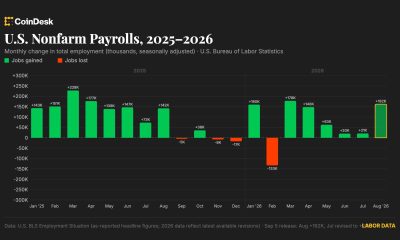
U.S. added stronger than expected 162,000 jobs in August as labor market bounced back
-

 Sports2 days ago
Alexandre Pato consortium’s Northampton Town investment approved
-

 Sports2 days ago
Commanders’ Chig Okonkwo is a top breakout fantasy football candidate
-

 Sports2 days ago
Golden Eaglets Drawn in Group B for 2026 WAFU B U17 Championship
-
 Crypto World2 days ago
XRP price breaks falling channel as bulls target $1.53
-

 Politics2 days ago
A new European chapter for Gibraltar
-

 Politics2 days ago
The House | Bin the lectures, bring gossip and be ready to banter: how the new PM should prepare for his Trump encounter
-

 Politics2 days ago
How To Avoid Winter Colds: 4 Everyday Habits That Spread Germs, Says Pharmacist
-

 Crypto World2 days ago
From warning to listing: UK’s largest retail investment platform opens access to crypto ETNs
-

 Crypto World2 days ago
FinCEN flags $12.7B tied to Southeast Asia crypto investment scams
-

 Tech2 days ago
A Worthy Android Ereader, With Some Tradeoffs
-

 Tech2 days ago
How To Edit Claude’s Memory
-

 Crypto World2 days ago
Trezor Data Breach Impacts 67,000 More US Customers
-

 Politics2 days ago
33 Cosy Autumn Home Decor Ideas: Blankets, Pumpkin Decorations, And Candles
-

 Tech2 days ago
beyerdynamic AVENTHO Y Debuts at IFA 2026 and Makes Wireless Headphones Less Disposable
You must be logged in to post a comment Login