

Business
Nomura Science And Technology Fund Q1 2026 Commentary




Harpinder Brar is a business owner based in Saskatchewan and Manitoba. She operates a gas station, a grocery store, and additional ventures across both provinces.
Her work is built on consistency, responsibility, and daily involvement. She is known for taking a practical approach to leadership and focusing on steady operations rather than shortcuts.
Harpinder grew up in Moga, Punjab, in a close-knit family with two younger brothers. Her mother was a stay-at-home mum, and her father held a government job. From an early age, she learned the value of discipline and hard work. After finishing high school, she explored her interest in fashion by taking a few courses. Over time, her focus shifted towards building a business and managing real-world responsibilities.
In her current role, Harpinder is hands-on. She manages staff, oversees operations, and ensures her businesses run smoothly day to day. She believes leadership is about being present and making clear decisions. She also values trust and consistency in customer service.
Outside of work, Harpinder is deeply family oriented. She is a mother of three and owns two English bulldogs. In her free time, she prefers to stay at home with her family, watching films and relaxing. Her grounded lifestyle reflects the same steady mindset she brings to her business.
Harpinder Brar on Business, Responsibility, and Daily Discipline
Q: Can you tell us about your early life and how it shaped your approach to work?
I grew up in Moga, Punjab, with two younger brothers. My mum stayed at home, and my dad had a government job. We had a simple life. From early on, I saw how important it was to be disciplined. Nothing was handed to us. That stayed with me.
Q: Did you always plan to go into business?
No, not really. After high school, I was interested in fashion. I even took a few courses. But life changes. Over time, I focused more on responsibility and building something stable. Business came step by step.
Q: What was the transition like from that stage to becoming a business owner?
It was gradual. I didn’t jump into it all at once. I took on more responsibility over time. You learn by doing. There is no perfect moment to start. You just begin and adjust as you go.
Q: You now run a gas station and grocery store. What does a typical day look like?
Every day is different, but the structure is the same. I check operations, staff, and inventory. I make sure everything is organised. People think it’s just selling products, but there is a lot behind the scenes.
Q: What do you think people misunderstand about running these types of businesses?
They only see the front. They don’t see the planning or the pressure. You have to manage staff, deal with suppliers, and keep everything running smoothly. It’s constant work.
Q: What qualities have helped you stay consistent in business?
Discipline is the biggest one. You have to show up every day. Even when things are stressful, you still open the doors. You cannot ignore your business.
Q: How would you describe your leadership style?
I try to be firm but fair. I expect people to do their job properly, but I also treat them with respect. Clear communication matters. If you are not clear, problems build up.
Q: How do you approach decision-making?
You have to be direct. Some decisions are not easy, but delaying them makes things worse. I try to stay practical and focus on what needs to be done.
Q: You manage businesses across Saskatchewan and Manitoba. Has that brought any unique challenges?
Yes, because you are not always in one place. You need structure. You need to trust your systems and your team. But you still have to stay involved.
Q: What keeps you grounded through all of this?
My family. I have three kids, and they are my priority. I also have two English bulldogs. When I am home, I just relax. That balance is important.
Q: How do you define success at this stage in your career?
For me, it’s stability. If the business is running properly and my family is doing well, that’s enough. I don’t look for anything flashy.
Q: What have you learned from running businesses over time?
That consistency matters more than anything. You cannot expect quick results. You just keep going and improve little by little.
Q: What advice would you give to someone thinking about starting a business?
You need to be ready to work every day. It’s not easy. You have to take responsibility and stay focused.

Economic Growth and Structural Reform
Thailand has set an ambitious target to raise its annual economic growth potential to 3% by 2030, according to Finance Minister statements reported by both Reuters and The Star. Achieving this will require significant structural reforms across multiple sectors. Separately, the government has outlined a 12-year roadmap to achieve high-income country status, signaling long-term ambitions to transform Thailand’s economic standing within the region. The Finance Minister confirmed these goals are tied to deliberate policy shifts rather than short-term stimulus measures.
Complementing these growth targets, Thailand is positioning itself as a regional semiconductor hub, with plans advancing to make the country ASEAN’s leading center for microelectronics manufacturing. Qazinform reported on Thailand’s strategic push in this sector, which aligns with broader efforts to attract high-value investment and diversify the industrial base.
Investment Climate and Business Environment
The Thai government has launched a new Thailand Fast Pass, designed to streamline the investment process and reduce bureaucratic friction for foreign investors, as reported by the Bangkok Post. This initiative is part of a wider effort to make Thailand more competitive against regional peers in attracting foreign direct investment.
However, challenges persist. Thailand’s Department of Business Development (DBD) is intensifying a crackdown on nominee structures, targeting foreign companies that use local proxies to circumvent ownership laws. Authorities have seized assets worth THB 24 billion as part of this expanding enforcement operation, with finance checks now central to investigations. This crackdown is also exposing significant loopholes in Thai property law, raising uncertainty for foreign investors interested in real estate in destinations like Phuket and Koh Samui.
Tourism: Growth, Regulation, and New Opportunities
Thailand’s tourism sector remains a dominant headline theme. The country is tightening entry rules, reverting visa-free stays to 30 days for travelers from 93 countries, including India, China, the United States, the United Kingdom, and Australia, as part of a broader security crackdown and quality tourism strategy, according to Travel and Tour World. At the same time, the five-year Destination Thailand Visa continues to attract digital nomads and long-stay travelers.
To ease airport congestion, Thailand is launching a new immigration app to cut processing times, reported by Time Out Worldwide. The government is also deploying AI tools to enhance tourist safety and block illegal content, including over 13,000 gambling URLs during the FIFA World Cup period. These measures reflect Thailand’s commitment to balancing openness with regulatory control.
Pattaya is being repositioned as a luxury sailing and marine lifestyle destination, while wellness tourism is experiencing a significant surge, with Bangkok’s spa and retreat industry projected to expand toward a one-billion-dollar market. The Tomorrowland Festival is also driving international tourism demand, boosting Thailand’s profile as an events destination.
Infrastructure and Regional Connectivity
Thailand is reviving a USD 30 billion coast-to-coast land bridge corridor intended to rival the Malacca Strait as a key regional trade and logistics route, as reported by Reuters and DredgeWire. This project, if realized, could significantly reshape regional supply chains and elevate Thailand’s strategic importance in Southeast Asian trade.
On aviation, Norse Atlantic Airways has added further routes to Thailand, and Vietjet Thailand is increasing Bangkok flight frequencies and restoring Indian routes. These expansions reflect growing demand for connectivity, particularly from South and East Asian markets.
Legal, Political, and Border Issues
The Cambodia-Thailand maritime dispute has escalated to UN-backed conciliation proceedings, with both countries formally entering an UNCLOS arbitration process. Thailand has called for joint fact-finding, while colonial-era maps are reportedly playing a diplomatic role in negotiations, as noted by Intelligence Online.
On the northern border, the Thai Army has closed a school in Tak province following spillover clashes from Myanmar. This reflects ongoing instability along the Myanmar border, which continues to affect local communities.
Former Prime Minister Thaksin Shinawatra has been freed early from parole after receiving a royal pardon, marking a significant political development, according to AP News.
Social, Cultural, and Expat Life
Thailand continues to attract international attention as a relocation destination, with expat stories highlighting lower living costs, quality healthcare, and lifestyle benefits. An Indian couple documented their move, noting they enjoy a better lifestyle for the same rent compared to India, per NDTV. Meanwhile, one expatriate turned a personal caregiving experience into a professional care facility in Chiang Mai, highlighting a growing elderly care sector.
Culturally, the vibrant Phi Ta Khon Ghost Festival is drawing over 100,000 visitors, generating THB 188 million for local tourism. Thailand’s same-sex romance dramas continue gaining global audiences, and a Thai art exhibition has made its debut at Seoul’s National Museum of Korea. The country also mourns the passing of Princess Bajrakitiyabha, who died aged 47 after years in a coma, as reported by The Guardian.
Environment and Sustainability
Thailand is collaborating with Swedish expertise to build a greener timber industry, according to the Stockholm Environment Institute. However, erratic weather is expected to slash the lychee harvest by 39% in 2026, underscoring climate-related agricultural risks. Separately, EUDR regulations are placing pressure on small-scale rubber farmers, prompting private-sector support initiatives.
Source : Google News – Search
Other People are Reading

Business leaders spend significant time planning for growth, improving productivity, and managing financial performance. Yet one area that can often be overlooked until it becomes urgent is workplace safety.
Whether operating from an office, warehouse, retail unit, or industrial facility, every organization has a responsibility to protect employees, visitors, and physical assets from preventable risks.
Among the most important aspects of workplace safety is fire prevention and emergency preparedness. A single fire-related incident can disrupt operations, damage property, harm employees, and create significant financial consequences. As businesses continue to adapt to evolving regulations and workplace expectations, investing in comprehensive fire safety measures has become an essential part of responsible management.
Why Fire Safety Matters for Modern Businesses
Fire incidents can occur in virtually any workplace environment. Electrical faults, faulty equipment, unattended appliances, combustible materials, and human error remain common causes of workplace fires.
The consequences often extend beyond immediate property damage and may include:
- Business interruption
- Lost productivity
- Insurance complications
- Regulatory penalties
- Reputational damage
- Employee welfare concerns
For growing companies, these risks can be particularly significant because unexpected disruptions can affect both revenue and customer confidence.
A proactive fire safety strategy helps reduce these risks while demonstrating a commitment to employee wellbeing.
What Are the Key Components of Workplace Fire Protection?
Effective fire safety involves much more than installing alarms and hoping they are never needed.
A comprehensive strategy typically includes:
| Fire Safety Element | Purpose |
| Risk assessments | Identify hazards and vulnerabilities |
| Detection systems | Provide early warning |
| Emergency planning | Improve evacuation procedures |
| Staff training | Increase preparedness |
| Equipment maintenance | Ensure reliability |
| Fire suppression tools | Help control small incidents |
Each component plays an important role in creating a safer workplace environment.
Why Prevention Is Better Than Response
While emergency equipment is essential, preventing incidents remains the most effective approach.
Businesses can significantly reduce risk through:
- Regular electrical inspections
- Equipment maintenance programs
- Safe storage procedures
- Housekeeping standards
- Employee awareness training
- Hazard identification processes
Many workplace fires result from issues that could have been identified and addressed before they became emergencies.
Organizations that prioritize prevention often experience fewer incidents and lower long-term safety costs.
How Risk Assessments Improve Business Resilience
Fire risk assessments form the foundation of workplace fire safety.
These assessments help identify:
Potential Ignition Sources
Electrical equipment, machinery, heating systems, and cooking facilities can all present risks.
Fuel Sources
Paper, packaging, chemicals, textiles, and other combustible materials may contribute to fire spread.
Occupancy Considerations
Understanding how people use a building helps improve emergency planning.
Existing Control Measures
Assessments evaluate whether current protections remain effective and compliant.
Regular reviews ensure safety measures continue meeting the needs of a changing workplace.
Why Employee Training Is Essential
Even the most sophisticated fire safety systems rely on informed employees.
Training helps staff understand:
- Emergency procedures
- Evacuation routes
- Alarm protocols
- Hazard recognition
- Equipment awareness
When employees know how to respond during an emergency, evacuation processes tend to be faster and more organized.
Confidence and preparation can make a significant difference during high-pressure situations.
How Technology Is Transforming Workplace Safety
Modern businesses increasingly use technology to strengthen safety programs.
Examples include:
- Smart monitoring systems
- Connected alarm networks
- Automated testing solutions
- Digital compliance records
- Remote inspection capabilities
These technologies help organizations improve oversight while simplifying maintenance and reporting requirements.
The growing integration of safety technology reflects a broader trend toward proactive risk management across multiple industries.
Why Early Detection Saves Lives
One of the most critical factors during a fire emergency is time.
Early warning systems provide occupants with valuable time to:
- Identify danger
- Initiate evacuation procedures
- Contact emergency services
- Reduce exposure to hazardous conditions
This is particularly important because many fire-related fatalities result from smoke inhalation rather than direct flame exposure.
Reliable detection systems remain among the most effective safety investments available to businesses.
Understanding Hidden Workplace Hazards
While visible fire risks often receive attention, some threats are less obvious.
Combustion appliances, heating equipment, and poorly ventilated areas can sometimes create dangerous conditions without obvious warning signs.
A properly installed carbon monoxide detector helps identify the presence of this invisible and odorless gas before it reaches dangerous levels.
Workplaces that use fuel-burning equipment should consider monitoring systems as part of a broader health and safety strategy. Early detection can provide critical warning and support safer working environments.
What Role Does Emergency Equipment Play?
No fire safety strategy is complete without appropriate emergency response tools.
While prevention remains the primary objective, businesses must also prepare for situations where incidents occur despite precautions.
Emergency equipment supports:
- Initial incident response
- Occupant protection
- Damage limitation
- Regulatory compliance
The type of equipment required depends on the nature of the workplace and the risks identified through assessment processes.
Regular inspections help ensure equipment remains operational when needed.
Why Fire Extinguishers Remain Essential
Although modern buildings often include sophisticated alarm and suppression systems, Fire Extinguishers continue to play an important role in workplace safety.
When used appropriately by trained personnel, they may help control small fires before they escalate into larger incidents.
Different types are designed for specific hazards, including:
- Electrical equipment
- Flammable liquids
- Paper and wood materials
- Commercial kitchens
- Industrial environments
Selecting suitable equipment and ensuring proper staff training are essential for maximizing effectiveness.
Organizations should never assume that a single extinguisher type is appropriate for every workplace situation.
How Fire Safety Supports Business Continuity
Business continuity planning focuses on maintaining operations despite unexpected disruptions.
Fire safety contributes directly to this objective by helping businesses:
- Reduce operational downtime
- Protect critical infrastructure
- Safeguard employee welfare
- Minimize financial losses
- Improve insurance outcomes
Companies that invest in preparedness often recover more quickly from emergencies than those relying solely on reactive measures.
As organizations become increasingly dependent on technology and interconnected systems, resilience planning continues to grow in importance.
Creating a Culture of Safety
Strong safety performance is rarely achieved through equipment alone.
Successful organizations often cultivate a workplace culture where safety becomes part of everyday operations.
Characteristics of effective safety cultures include:
- Leadership commitment
- Employee engagement
- Open communication
- Continuous improvement
- Regular training
- Accountability at all levels
When safety is embedded into organizational decision-making, compliance and preparedness naturally improve.
Choosing Reliable Safety Partners
The effectiveness of a fire safety strategy often depends on the quality of products and expertise supporting it.
Businesses benefit from working with suppliers that offer:
- Industry knowledge
- Regulatory expertise
- Comprehensive product ranges
- Ongoing support
- Reliable compliance guidance
Within the UK safety sector, SafeLincs has established a reputation for helping organizations access a wide range of workplace safety solutions, including fire protection equipment, detection systems, and compliance resources. Their focus on education and practical safety guidance supports businesses seeking to strengthen risk management programs.
Access to expert advice can help organizations make informed decisions while navigating changing regulations and evolving workplace requirements.
How Regulations Continue to Evolve
Fire safety regulations continue to develop as governments and industry bodies seek to improve workplace standards.
Business owners should remain aware of:
- Inspection requirements
- Equipment maintenance obligations
- Employee training expectations
- Documentation standards
- Building-specific responsibilities
Regular reviews help ensure organizations remain compliant while adapting to operational changes.
Compliance should be viewed not simply as a legal requirement but as part of broader risk management and corporate responsibility efforts.
The Future of Workplace Fire Safety
Emerging technologies, increased regulatory focus, and growing awareness of employee wellbeing are shaping the future of workplace safety.
Key trends include:
- Greater automation
- Improved monitoring capabilities
- Data-driven risk management
- Enhanced employee training platforms
- Smarter compliance systems
Businesses that proactively embrace these developments are often better positioned to manage risks while supporting sustainable growth.
Conclusion
Fire safety remains one of the most important responsibilities facing modern organizations. Effective prevention, early detection, employee training, and emergency preparedness all contribute to safer workplaces and stronger business resilience.
By incorporating tools such as a carbon monoxide detector and maintaining appropriate Fire Extinguishers, businesses can strengthen their overall safety framework while protecting employees, customers, and assets.
As organizations continue to grow and evolve, investing in fire safety is not simply a compliance exercise—it is a strategic decision that supports continuity, reputation, and long-term success.
Business
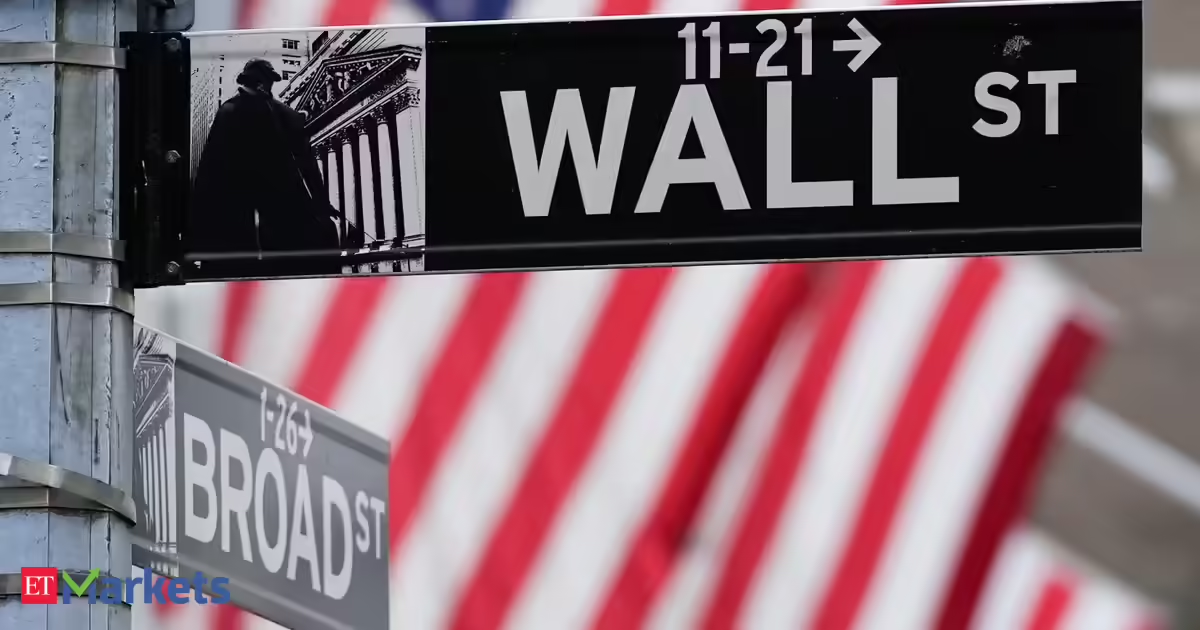
US stocks: S&P 500, Nasdaq close lower, dragged by Alphabet and megacap tech; focus on Iran
The Dow closed higher, boosted by the healthcare and industrial sectors.
SpaceX tumbled and weighed heavily on the Nasdaq Composite. The Elon Musk-led company launched its first-ever debt offering on Monday and said it had about $100.8 billion in cash and cash equivalents as of June 19.
Optimism about artificial intelligence has supported Wall Street’s recent rally, but analysts noted that more investors have been questioning lofty spending on infrastructure expansion by hyperscalers.
Alphabet fell sharply while Meta, Amazon and Microsoft also fell.

“This is a very sentiment-driven sector and the group tends to trade together on a day-to-day basis,” said Bill Northey, senior investment director at US Bank.
Also Read | US stocks: Vimeo owner Bending Spoons seeks $1.62 billion US IPO, sources say “But as we step back … some of the strongest fundamentals are within the AI data center buildout space. That includes both the hyperscalers as well as many of the components that go into that continued buildout.”
The next test for the rally will be Micron Technology‘s quarterly results on Wednesday. Shares of the memory chipmaker are up nearly 300% this year.
According to preliminary data, the S&P 500 lost 25.41 points, or 0.34%, to end at 7,475.17 points, while the Nasdaq Composite lost 339.67 points, or 1.28%, to 26,178.26. The Dow Jones Industrial Average rose 162.36 points, or 0.29%, to 51,727.06.
Oil prices fell as Washington and Tehran agreed on a roadmap toward a final deal within 60 days.
U.S. and Iranian officials made “great progress” at the first round of their talks in Switzerland that ended early on Monday, mediators said, although tensions persisted over Lebanon and the Strait of Hormuz.
“Energy prices are coming down, which is certainly a catalyst for both the consumer as well as businesses,” Northey said. “On the flip side of that, we came out with a very hawkish (Federal Reserve) under new Chair Kevin Warsh, and it led the market to believe that there will be a more prioritized focus on returning to price stability in the near term.”
This view on the Fed has lifted U.S. Treasury yields and pressured stock prices lower, he said.
A focus this week will be on Thursday’s Personal Consumption Expenditures (PCE) data, the Fed’s preferred gauge of core inflation. A stronger-than-expected reading could reinforce expectations of a hawkish Federal Reserve, after Warsh underscored the need to curb inflation at last week’s meeting.
Markets currently expect a 25-basis-point rate hike from the Fed in September, according to LSEG data.
Among other movers, Apogee Therapeutics jumped after AbbVie said it would acquire the biotech company for $10.9 billion in cash.

Anterix president and CEO Scott Lang sells $13,642 in stock
Business
Dow Jones Rises 0.40 Percent to 51,770.77 as Markets Show Modest Gains Amid Economic Optimism

NEW YORK — The Dow Jones Industrial Average advanced modestly Monday, closing at 51,770.77 after gaining 206.07 points, or 0.40 percent. The blue-chip index reflected cautious optimism among investors as economic indicators suggested steady growth without immediate recession fears.
Trading on Wall Street showed mixed results across major indices, with the S&P 500 and Nasdaq Composite also posting small gains. Technology shares provided support while energy and financial sectors demonstrated varied performance. Market participants weighed corporate earnings reports against broader economic signals.
Several factors contributed to the Dow’s advance. Strong performances from industrial and consumer staple companies helped offset softness in other areas. Investors appeared encouraged by recent data indicating controlled inflation and resilient consumer spending.
The session’s modest gains align with a pattern of gradual recovery in equity markets. Analysts noted that while volatility persists due to geopolitical tensions and policy uncertainties, underlying economic fundamentals remain relatively supportive. Corporate America continues demonstrating adaptability amid changing conditions.
Blue-chip components such as UnitedHealth Group and Goldman Sachs led contributors to the Dow’s rise. Their positive movements reflected sector-specific developments and broader confidence in financial stability. Conversely, shares of Boeing and Caterpillar faced pressure amid industry-specific concerns.
Broader market sentiment benefited from expectations around Federal Reserve policy. Investors anticipate measured responses to inflation data, with potential rate adjustments later in the year. This outlook supports risk assets while maintaining caution against overheating.
Trading volume remained steady, indicating balanced participation from institutional and retail investors. Options activity suggested continued hedging strategies amid uncertainty about second-half economic performance.
Sector rotation characterized much of the day’s trading. Technology and communication services attracted buying interest on innovation narratives while traditional energy faced headwinds from commodity price fluctuations. Consumer discretionary shares showed resilience amid retail spending data.
The Dow’s performance caps a period of relative stability following earlier volatility. Year-to-date gains reflect confidence in corporate earnings resilience despite higher interest rates. Analysts project continued moderate growth if inflation remains contained.
Economic indicators released recently provided mixed but generally positive signals. Employment figures showed labor market strength while manufacturing data indicated steady activity. Consumer confidence metrics suggested households remain willing to spend despite inflationary pressures.
Corporate earnings season continues influencing market direction. Several major Dow components have reported results exceeding expectations, supporting valuations. Guidance for coming quarters will likely shape investor outlooks in coming weeks.
International developments also factored into trading decisions. European markets showed varied performance while Asian indices reflected regional economic dynamics. Currency fluctuations, particularly the dollar’s strength, affected multinational corporations within the Dow.
The index’s composition, featuring established companies across sectors, provides relative stability compared to more growth-oriented benchmarks. This characteristic appeals to conservative investors seeking steady returns amid uncertainty.
Looking ahead, market attention turns to upcoming economic releases and Federal Reserve communications. Any signals regarding monetary policy could significantly influence near-term direction. Corporate earnings from remaining Dow components will also provide important data points.
Analysts maintain generally positive outlooks for equities despite acknowledging risks. Technological advancement and productivity gains could support continued growth. However, potential headwinds include persistent inflation, geopolitical tensions and policy uncertainties.
The Dow’s advance to 51,770.77 demonstrates resilience in blue-chip stocks. While not dramatic, the percentage gain reflects measured confidence. Investors appear balancing optimism with prudent risk management.
Broader market participation suggests widespread interest in equities. Retail investors continue engaging through various platforms while institutions adjust allocations based on macroeconomic assessments. This dynamic contributes to overall market liquidity.
Sector-specific opportunities exist across the Dow’s components. Industrial companies benefit from infrastructure spending while healthcare firms leverage demographic trends. Financial institutions navigate interest rate environments while consumer goods producers adapt to changing preferences.
The session’s trading patterns align with seasonal tendencies, though individual company news often drives short-term movements. Volatility measures remained moderate, indicating contained fear among market participants.
As markets process recent gains, attention focuses on sustainability of upward momentum. Strong corporate fundamentals provide support while external factors introduce uncertainty. Balanced portfolios may benefit from diversification across asset classes.
The Dow Jones Industrial Average serves as a key barometer of economic health. Its performance influences investor sentiment and corporate planning. Monday’s gains contribute to positive narratives around American business resilience.
Market participants will monitor developments closely in coming sessions. Economic data releases and corporate announcements could shift dynamics significantly. The interplay between policy expectations and actual results will determine near-term direction.
Overall, the Dow’s 0.40 percent advance reflects measured optimism. While challenges persist, underlying strengths provide foundation for continued performance. Investors navigate this environment with careful assessment of risks and opportunities.


Reduce sodium and boost flavor with culinary solutions that meet health goals without compromise.


Top Seedz also switches to sustainable packaging and adds two flavors.


Researchers from Turkey investigate different powder sizes.
CME Group reportedly faces trading disruptions on Monday

easyJet launches two new routes from Liverpool Airport

Harpinder Brar on Building Business Through Consistency

Solana Captures 95% Ff Tokenized Stocks As Bottom Calls Grow

No Jackpot Winner as $257 Million Prize Rolls Over to $269 Million Monday Draw

Blockchain.com files with SEC for U.S. IPO

Israel says it has killed new Hamas military leader in Gaza City airstrikes

$1000 XRP BY 2028? – WILL BLACKROCK AQUIRE RIPPLE? – YOU DON’T TRADE XRP! – DID MICA CRUSH BINANCE?

Humanity still exists.. @johnmalek3 #humanity #dream #success #giveaway #lifestyle #money #shorts

Manishi & Nilu | Five Million Money Drop S4 | Episode 42 | Sirasa TV
-

 Fashion3 days ago
Weekend Open Thread: Miami – Corporette.com
-
 Tech6 days ago
The Adder At The Heart Of Intel’s 8087 FPU
-

 Entertainment2 days ago
Renter of Home in Anne Heche Crash Denies Settlement With Son
-

 Tech9 hours ago
Microsoft accidentally kills epic Outlook email threads
-

 Business2 days ago
Soccer-U.S. defends Iran World Cup travel restrictions, says discussions ongoing
-
 Business3 days ago
Wall Street Week Ahead: Investors see Micron earnings as pulse check of AI rally momentum
-

 Politics4 days ago
BBC Reporter Discusses Cross Party Criticism Of Trumps Iran Deal
-

 Tech4 days ago
AWS enters the context layer race with a graph that learns from agents, not manual curation
-

 Crypto World3 days ago
HIVE shares jump as $220M AI deal speeds Bitcoin mining pivot
-
 Crypto World2 days ago
Can Charles Hoskinson Really Rescue Cardano?
-

 Crypto World2 days ago
Jake Chervinsky accuses CME of protecting derivatives monopoly
-

 Tech2 hours ago
Nearly 7,000 fake Amazon domains registered ahead of Prime Day 2026, researchers warn
-

 Sports4 days ago
FIFA World Cup 2026: Canada beat 9-men Qatar 6-0 to register first ever win | FIFA World Cup 2026
-

 Business2 days ago
MHP SE 2026 Q1 – Results – Earnings Call Presentation (OTCMKTS:MHPSY) 2026-06-20
-

 Business4 days ago
Brexit cost 6% of UK economy, Bank of England company data suggests
-

 Politics3 days ago
Andy Burnham and the meaning of Makerfield
-

 Crypto World5 days ago
Anthropic’s Dario Amodei Urged AI Unity at G7, Even as US Banned His Models
-
 Tech1 day ago
Signal’s Meredith Whittaker says AI chatbots ‘are not your friends’ and calls Copilot agents a backdoor
-

 Crypto World7 days ago
Robinhood opens AI-powered trading to all users, sending HOOD stock past $100
-

 Tech5 days ago
Weeks Of In-The-Field Testing And A Verdict
You must be logged in to post a comment Login