

Business
Oil Resumes Climb as Middle East Conflict Continues


Crude futures rise to their highest settle level since July 2024 as the armed conflict in the Persian Gulf disrupts supply and raises concerns it will lead to production shut-ins as regional storage facilities fill up.
WTI settles up 8.5% at $81.01 a barrel, its sharpest single-day gain in almost six years. Brent rises 4.9% to $85.41 a barrel.
“With an end to the conflict not in sight, additional crude price strength would appear to lie ahead and should this conflict extend through next week, a WTI advance in the $95 area is certainly within realm of possibility,” Ritterbusch and Associates says in a note.


Veracyte CFO Chambers sells $662k in VCYT stock

The fitness community mourns the sudden loss of Stephanie Buttermore, a Ph.D.-holding cancer researcher turned influential content creator, who died at age 36. Her longtime fiancé, Canadian bodybuilder and YouTuber Jeff Nippard, announced the news on March 6, 2026, via Instagram, describing her passing as sudden and requesting privacy during this difficult time. No cause of death has been disclosed.

Buttermore, known for blending science-based fitness advice with candid discussions on body image, intuitive eating and mental health, built a devoted following before stepping away from social media in 2024 due to crippling anxiety. Her journey—from academic researcher to wellness advocate—left an enduring impact on thousands seeking evidence-based guidance.
Here are 10 key things to know about Stephanie Buttermore as tributes continue pouring in.
- Academic Background in Cancer Research Buttermore earned a Ph.D. in Biomedical Sciences with a focus on Pathology and Cell Biology from the University of South Florida, specializing in molecular mechanisms driving ovarian cancer progression. She held multiple degrees: a B.S. in Micro/Molecular Biology from the University of Central Florida and two M.S. degrees in Medical Sciences (Women’s Health and Pathology & Cell Biology). Her scientific expertise informed her fitness content, emphasizing evidence over trends.
- Transition to Fitness Content Creation After years in academia, Buttermore launched her YouTube channel on November 23, 2014, with a video titled “Day in the Life of a Ph.D. (Cancer Research) | My Glute Training.” She grew her platform to over 1.18 million subscribers by sharing science-backed workouts, nutrition insights, food challenges and lifestyle vlogs. Her Instagram (@stephanie_buttermore) amassed more than 522,000 followers before she went inactive.
- Advocacy for Intuitive Eating and Recovery Buttermore gained widespread recognition through her “All-In” journey, a period of intentional high-calorie intake to restore hunger signals, reverse restrictive patterns and achieve body positivity. She openly discussed her experiences with disordered eating, metabolic adaptation and mental health struggles, inspiring many women to prioritize health over aesthetics.
- Mental Health Transparency In her final Instagram post in May 2024, Buttermore explained stepping away from social media due to anxiety that had become “crippling” to the point she felt unable to breathe or leave her house. After the break, she reported her mental health had improved dramatically, becoming “the best it’s ever been” and allowing her to be more present in life. A resurfaced post weeks before her death highlighted her progress in overcoming anxiety.
- Relationship with Jeff Nippard Buttermore and Nippard, a prominent natural bodybuilding coach and YouTuber, were together for 10 years and got engaged in October 2022. Nippard shared heartfelt tributes on Instagram, including a Valentine’s Day 2026 post captioned “Relationshipmaxxing with tea time to lower cortisol levels,” showing the couple relaxing together. Their partnership blended personal and professional worlds, often appearing in each other’s content.
- Body Positivity and Women’s Health Focus Buttermore consistently advocated for women in fitness, addressing body image pressures, hormonal health and sustainable habits. Her content empowered followers to embrace natural body changes, reject extreme dieting and focus on long-term well-being rather than short-term aesthetics.
- Awards and Recognition She won the Bikini division at the 2014 NPC Sunset Classic, showcasing her competitive background. Her blend of academic credentials and on-stage success made her a unique voice in the industry, earning respect from peers and fans alike.
- Social Media Hiatus and Legacy Buttermore quietly exited content creation in 2024, citing mental health priorities. Her last YouTube video, “How I Feel About My New Body,” reflected on her transformation. Despite the hiatus, her videos and posts continued inspiring viewers, with her channels remaining active archives of educational material.
- Impact on Fitness Community Tributes flooded social media following Nippard’s announcement, with fans and creators praising her warmth, compassion and contributions to science-based fitness. Many highlighted her Ph.D. research on ovarian cancer alongside her advocacy for mental health, noting her multifaceted legacy as both researcher and influencer.
- Sudden Passing and Ongoing Tributes Buttermore died suddenly at 36, with Nippard sharing the news on March 6, 2026. Statements described her as warm, compassionate and deeply loved by family and friends. The fitness world continues to mourn, remembering her for bridging science and wellness while openly addressing challenges many face quietly.
Stephanie Buttermore’s life bridged rigorous academia and relatable online influence, leaving a legacy of education, empathy and empowerment. As the community reflects on her contributions, her work endures through archived videos, posts and the countless individuals she inspired to prioritize health holistically.

These findings clearly indicate that women seem to possess all the attributes for long-term wealth creation — patience, discipline, diversification, calculated risk-taking, and consistency. Perhaps due to their more rounded experience at managing household budgets, they also demonstrate greater caution in managing their individual accounts.
However, the question arises that why despite being temperamentally better equipped at handling finances, are women not at par with men when it comes to taking investment decisions?
Financial Autonomy
According to research conducted by The International Centre for Research on Women –

“A woman is economically empowered when she has both the ability to succeed and advance economically and the power to make and act on economic decisions.” Lack of autonomy and financial agency are the primary factors behind women not participating equally in investment decisions.
According to a Further, a CRISIL and AMFI study observed that self-employed women are more likely to make their own financial decisions (55%) than salaried women (39%). The study highlights that women who regularly make decisions find it more comfortable to invest their surpluses. It also found out that women’s financial autonomy varies by income source, age, and affluence. Financial independence rises with age— 65% of women over age 45 manage finances themselves. Likewise, 58% of affluent women display higher autonomy compared to 38% of semi-affluent women, apparently due to greater literacy and resources.
Financial Literacy and Knowledge
In the recent past, financial awareness among Indian women has increased, leading to a rise in investment activities. Although the percentage of women investors has remained steady over six years, their share of industry assets increased from 15% in March 2017 to almost 21% by December 2023. This growth is especially significant in B-30 cities, where women’s asset share rose from 17% to 28%. But women still have a long way to go in making smart investment choices. A CRISIL DBS report observed that, women in India allocate 51% of their funds to fixed deposits and savings accounts, compared to general households that invest 46% in the same tools. Likewise, they invest 15% in capital markets, versus 8.4% for households.
Therefore, with a thorough understanding of investment options, related risks, and possible returns as discussed above, women are better equipped to create well-diversified and profitable investment portfolios.
Income Levels Influence Investment Capacity
There is a structural income gap between men and women, with women earning on average 17% less. To reach financial parity, women must save around 20% more, which reduces their disposable income. Lower salaries and career breaks further limit women’s earning potential and investment capital, often leading them to invest more conservatively than men.
Risk Tolerance
Risk appetite is shaped by financial goals, personality traits, lived experiences, and broader life responsibilities. In a predominantly male-dominated society, women receive delayed exposure to various financial aspects which impedes their risk appetite. Resultantly, women start their investment journey later than men. In a 2024 survey in the US, over 70% of women expressed a regret for not having started to invest their surplus savings earlier than they eventually did. In India, women’s risk-averse nature is reflected in the choice of investments. Women’s investment portfolios consist of mutual funds and the more traditional investment avenues, such as deposits, gold, and real estate.
In summary, women’s reputation for being risk-averse can be a significant advantage in building sustainable, long-term wealth. The power of compounding benefits those who practice persistence and patience—traits many women exhibit. By increasing financial literacy and making informed decisions, women are well-positioned to create diverse, high-performing portfolios, underscoring the importance of their approach to securing financial success.
(The author is Chief Investment Officer, IndiaFirst Life Insurance Co)

Form 4 Take-Two Interactive Software Inc For: 7 March
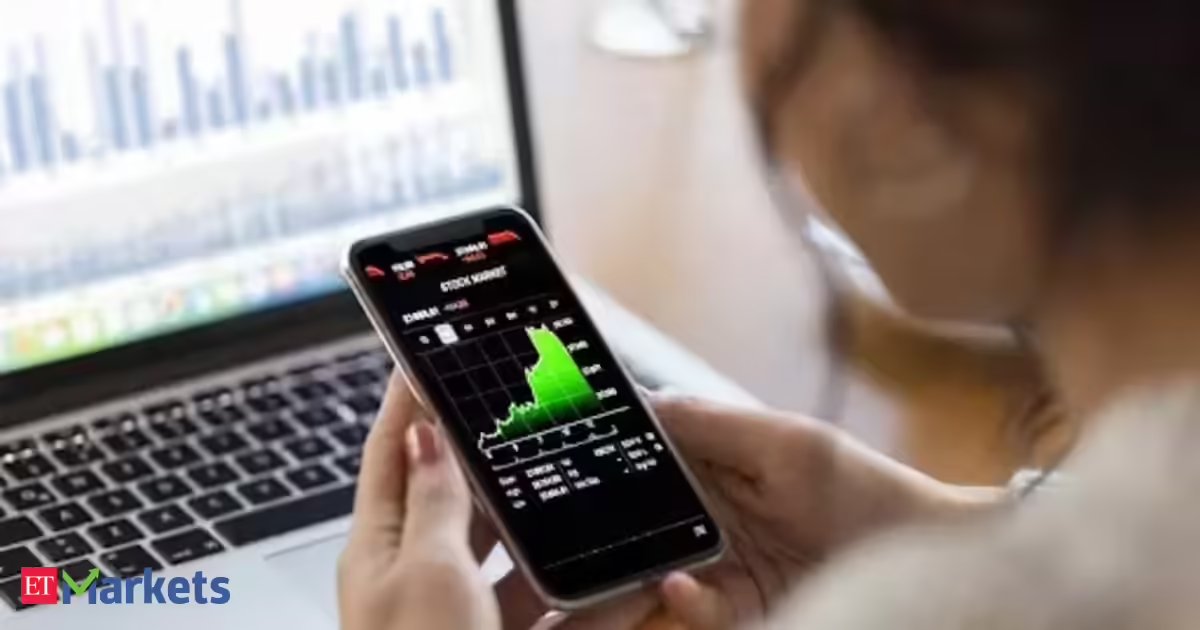
The release further highlighted a sharp rise in women’s participation in India’s crypto markets. According to platform insights, the ratio of women investors improved between 2023 and 2025, from 1:7 to 1:6. Women now account for over 15% of the total investor base, highlighting a steady shift toward greater financial participation in digital assets.
Also Read | Women hold just 25% of mutual fund folios, start investing 5 years later than men: Report
The data suggests that women investors are approaching crypto markets with a research-driven and diversified strategy.
Geographically, participation is expanding beyond traditional financial hubs. While Tier I cities account for around 50% of women investors, over 40% participation now comes from Tier II and non-metro cities, signalling deeper financial inclusion through digital-first investment platforms.
Among metros, leading participation is seen in Mumbai, Delhi, and Kolkata, while emerging cities such as Bhubaneswar, Vadodara, and Kochi are witnessing increasing adoption.
Women’s participation in crypto is increasingly being shaped by metros and non-metro cities. Tier I and Tier II cities drive over 90% of women’s crypto participation. The shift reflects expanding access to digital financial infrastructure beyond traditional urban strongholds.
“On International Women’s Day 2026, as we reflect on the theme ‘Give To Gain,’ we reaffirm our belief that when women thrive, the nation prospers. Empowering women is not just a social responsibility, it is an economic imperative. At CoinDCX, we are committed to breaking barriers and building pathways that foster women’s leadership, financial independence, and long-term wealth creation,” said Sumit Gupta, Co-founder, CoinDCX.
“Our data clearly shows that women are not merely entering crypto; they are participating with discipline, research-driven conviction, and a long-term perspective. The strong acceleration in 2025, particularly across Tier II and Tier III cities, signals a structural shift toward deeper financial inclusion,” he added.
Also Read | Women’s Day 2026: India’s leading 3 female portfolio managers. Check how they navigate market cycles
Over the three years, women’s entry into crypto has steadily increased, retention through market cycles has strengthened, and participation has moved from early curiosity to sustained engagement.
“We are also witnessing a meaningful shift in how women engage with financial markets. Many are approaching crypto with a research-driven mindset, focusing on diversification and long-term value creation. The rising participation from Tier II and emerging cities further highlights how access to digital platforms and financial education is enabling more women to confidently take charge of their investment journeys and participate in the evolving Web3 economy,” said Anjali Kakkar, VP and Head, Corporate Communications, CoinDCX.
(Disclaimer: Recommendations, suggestions, views and opinions given by the experts are their own. These do not represent the views of The Economic Times)
If you have any mutual fund queries, message ET Mutual Funds on Facebook or Twitter. We will get it answered by our panel of experts. Do share your questions on ETMFqueries@timesinternet.in along with your age, risk profile, and Twitter handle.

In the past 24 hours, Ethereum went down 4.74% to trade at the $1,976 level. Among the major altcoins, BNB, XRP, Solana, Tron, Dogecoin, Cardano, and Hyperliquid fell over 4%. The global crypto market capitalisation edged down 3.14% to $2.32 trillion, according to CoinMarketCap.
Also Read | Women hold just 25% of mutual fund folios, start investing 5 years later than men: Report
The sell-off appears to be driven by a combination of geopolitical tensions and macroeconomic pressures, creating a challenging environment for risk assets, said Riya Sehgal, Research Analyst, Delta Exchange.
Sehgal further said that following the release of weaker-than-expected jobs data in the United States, many investors expected Bitcoin to rebound. However, the anticipated bullish momentum failed to materialise. Instead, Bitcoin briefly declined toward $67,700, signalling that traders remain cautious despite what could otherwise be considered a supportive macro backdrop.
In the past week, Bitcoin and Ethereum were up 6.25% and 5.86%, respectively. Among the major altcoins, BNB, XRP, Solana, Tron, Dogecoin, and Hyperliquid gained over 12%, whereas Cardano fell 2.75%.
Nischal Shetty, Founder, WazirX, said that over the past 24 hours Bitcoin has traded near $68,355, while Ethereum has held around $1,982, with the broader crypto market continuing to attract steady interest from both retail and institutional participants.
According to the Weekly Market Research Report by Binance, geopolitical tensions in the Middle East rattled markets over the weekend, sending Bitcoin to $63K, but the asset quickly reverted, suggesting the market is watchful, not panicked.
Also Read | Women’s Day 2026: India’s leading 3 female portfolio managers. Check how they navigate market cyclesWith BTC reaching a level of $70,000 on Friday, the report said that Bitcoin, trading around the clock, served as the earliest barometer and dropped sharply to approximately $63,000 before mounting a swift recovery above the $70,000 range, ultimately erasing the entirety of its geopolitically driven decline.
(Disclaimer: Recommendations, suggestions, views and opinions given by the experts are their own. These do not represent the views of The Economic Times)
If you have any mutual fund queries, message ET Mutual Funds on Facebook or Twitter. We will get it answered by our panel of experts. Do share your questions on ETMFqueries@timesinternet.in along with your age, risk profile, and Twitter handle.
Business
(VIDEO) Is the Google Pixel 10 Pro Worth Buying in 2026? Latest Reviews, Specs and Buying Advice

MOUNTAIN VIEW, Calif. — Launched in August 2025, the Google Pixel 10 Pro marked Google’s tenth-generation flagship push, arriving with the Tensor G5 chip, refined AI features, a brighter display and improved camera capabilities. Now, in March 2026—roughly seven months after release—the device has settled into real-world use, with reviewers and users offering long-term assessments on whether it justifies its $999 starting price amid competition from Samsung’s Galaxy S26 series, Apple’s iPhone 17 lineup and even discounted older Pixels.

The Pixel 10 Pro (and its larger sibling, the 10 Pro XL) debuted with modest evolutionary upgrades over the Pixel 9 Pro: a 6.3-inch LTPO OLED display (up to 3,300 nits peak brightness), 16GB RAM, storage options up to 1TB, a 50MP main camera with enhanced computational photography, a 48MP ultrawide and 48MP 5x telephoto lens supporting up to 100x Pro Res Zoom (via AI assistance), and a 4,870mAh battery. It runs Android 16 out of the box, with seven years of OS and security updates promised.
Early reviews praised the phone’s polished software, class-leading cameras and seamless integration of Gemini-powered AI tools like Camera Coach (real-time photography tips), Auto Best Take and advanced editing features. Six months later, long-term tests largely echo that sentiment: the Pixel 10 Pro remains one of the best compact flagships, excelling in photography, clean Android experience and daily reliability.
Mark Ellis Reviews, after six months with the standard Pixel 10 (sharing much of the Pro’s DNA), called it “still a brilliant phone” with a “superb camera system” including 5x optical zoom and a “super clean operating system.” The reviewer highlighted its appeal for iPhone switchers, noting Google’s intuitive yet quirky Android 16 implementation. YouTube channels like those reviewing the Pro XL after six months described it as “easy to love” and “the most polished Pixel yet,” praising fluid performance, no overheating issues (a past Tensor complaint), useful AI features and top-tier photos.
The Guardian dubbed the Pixel 10 Pro “one of the very best smaller phones,” lauding its pocketable size, stunning screen, cutting-edge AI and top-spec cameras. EFTM’s review echoed this, awarding it high marks for excellent photos via computational photography, buttery-smooth software and helpful AI, calling it “Google’s best but in a smaller package.”
Battery life holds up well in extended tests—lasting all day with moderate use—while the Tensor G5 delivers smooth performance without the thermal throttling seen in earlier generations. Qi2 magnetic wireless charging (via Pixel Snap accessories) adds convenience, and the display’s high brightness shines outdoors.
Yet not all feedback is glowing. Some reviewers argue the upgrades feel incremental. Tom’s Guide, after two months, expressed regret over upgrading from the Pixel 9 Pro, calling the 10 Pro a “textbook example of an iterative upgrade” with little to justify the switch if you already own the predecessor. Android Faithful’s review titled it “a great phone you can probably skip,” suggesting the Pixel 9 Pro remains viable for another year with similar hardware and six more years of support.
Android Police defended Google’s 2025 success, noting sales growth, smooth Tensor G5 operation and strong recommendations for Android newcomers. Reddit threads and user impressions vary: many hail it as “one of the best phones on the market” for its useful AI, no overheating and stellar cameras, while others critique average charging speeds or video performance lagging behind Samsung.
Compared to rivals in March 2026, the Pixel 10 Pro stands out for photography enthusiasts and those prioritizing clean software and AI smarts over raw specs. Its 100x Pro Res Zoom (AI-enhanced) outperforms the Pixel 9 Pro’s 30x Super Res Zoom in detail at extreme ranges, though hardware remains similar. Versus Samsung’s Galaxy S26 Ultra or iPhone 17 Pro Max, it trades raw power for Google’s ecosystem perks and natural-looking photos.
Pricing remains steady at $999 for the base 128GB model (up to $1,449 for 1TB), with frequent carrier deals, trade-ins and discounts bringing effective costs lower. The Pixel 9 Pro often sells for less on the secondary market, making it a compelling alternative for budget-conscious buyers.
Who should buy the Pixel 10 Pro in 2026?
- Photography lovers seeking best-in-class stills and AI editing tools.
- Android purists wanting stock-like software with seven years of updates.
- Compact flagship fans (6.3-inch size beats larger competitors).
- iPhone switchers drawn to Google’s intuitive interface.
Who should skip or wait?
- Pixel 9 Pro owners—the differences are subtle, and your device still receives full support.
- Those prioritizing fastest charging, longest zoom hardware or gaming performance (where Snapdragon/Exynos chips edge ahead).
- Budget shoppers—the midrange Pixel 10a (released early 2026) offers strong value.
With ongoing Pixel Feature Drops adding new capabilities and Android 16 QPR updates rolling out, the Pixel 10 Pro ages gracefully. In March 2026, it remains a top recommendation for most users seeking a premium, AI-forward Android experience—especially if camera quality and software purity top your list.

CUPERTINO, Calif. — As March 2026 unfolds, speculation around Apple’s long-awaited foldable iPhone—often dubbed the iPhone Fold—intensifies, with supply-chain reports, analyst predictions and leaks pointing to a potential debut later this year. After years of persistent rumors dating back over a decade, credible sources increasingly converge on a fall 2026 launch, likely alongside the iPhone 18 Pro and Pro Max models, marking Apple’s first entry into the foldable smartphone market dominated by Samsung, Google and others.

The device, expected to feature a book-style design that unfolds into a tablet-like screen, represents a significant shift for Apple, which has historically prioritized refinement over rushing into emerging categories. Analysts and insiders describe the iPhone Fold as a premium, high-end offering designed to wow loyal fans while addressing longstanding foldable pain points like visible creases and durability.
Development Status and Timeline
Multiple reports confirm Apple has advanced beyond prototypes. As early as July 2025, leaks indicated a first production prototype existed, followed by engineering validation testing (EVT) phases by late 2025. Foxconn, Apple’s primary manufacturing partner, reportedly entered the New Product Introduction (NPI) stage in early 2025 and is gearing up for mass production in the second half of 2026—potentially starting as soon as mid-year (June-July) to support a September unveiling.
Supply-chain watcher Ming-Chi Kuo reiterated in early March 2026 that the foldable targets a late-2026 release, with mass production kicking off in the second half. Bloomberg’s Mark Gurman has echoed this, suggesting a fall 2026 launch window, though some earlier predictions allowed for a 2027 slip due to design decisions like hinge mechanics. Recent updates, however, show momentum: Apple is stockpiling components, and mass production timelines align with traditional iPhone cycles.
A notable wrinkle emerged from Nikkei Asia and other Asian reports: Apple may alter its 2026 lineup strategy due to production constraints, memory shortages and focus on premium devices. The company could prioritize the iPhone 18 Pro, Pro Max and iPhone Fold for September 2026, delaying the base iPhone 18 to early 2027. This shift underscores the foldable’s importance—Apple views it as a flagship innovation capable of driving upgrades.
Design and Key Specs
Leaks paint a picture of a premium book-style foldable (horizontal unfold, unlike clamshell flips). Key rumored features include:
- Crease-Free Display — A major breakthrough: the inner screen (around 7.8-8 inches) reportedly eliminates visible creases through advanced panel tech from Samsung Display, including Color Filter on Encapsulation (CoE) for slimmer, brighter and more efficient panels. Outer cover display is expected around 5.5-6 inches.
- Battery — A massive 5,500mAh capacity, surpassing even the iPhone 17 Pro Max’s 5,088mAh, to support the larger unfolded form factor and power-hungry multitasking.
- Processor — Likely an A20-series chip (or variant), optimized for AI tasks, multitasking and efficiency in a foldable chassis.
- Durability and Hinge — Optimized hinge design keeps costs down (average selling price ~$70-80), with emphasis on robustness to meet Apple’s standards—no compromises on premium feel.
- Other Features — Expected to include advanced cameras (potentially four-lens setup), improved Apple Intelligence integration, and seamless iOS adaptations for folded/unfolded modes (hints of fold-specific software already exist in current iOS builds).
The design prioritizes Apple’s ecosystem strengths: fluid transitions between phone and tablet modes, enhanced productivity and entertainment without the durability trade-offs plaguing competitors.
Pricing and Market Expectations
Pricing remains a focal point, with estimates ranging from $1,800-$2,500, potentially making it Apple’s most expensive iPhone ever. Analyst Ming-Chi Kuo suggested hinge cost reductions could improve margins or slightly lower retail price, but the consensus leans toward premium positioning—$2,000+ to reflect exclusivity and advanced tech. Some predict Apple aims for 8-10 million units in the first year, with ambitions to double in 2027, signaling expectations of strong demand among loyalists eager for a “must-have” innovation.
Challenges and Competition
Apple enters a mature foldable market where Samsung’s Galaxy Z Fold series, Google’s Pixel Fold and others have iterated for years. Competitors like Samsung continue pushing boundaries (e.g., tri-fold concepts), but Apple’s delayed entry allows time to observe flaws—durability, crease visibility, software optimization—and deliver a polished product. A clamshell “iPhone Flip” remains in development but appears delayed to 2027 or later, with the book-style Fold taking priority.
Critics question whether the high price and niche appeal will drive mass adoption, especially amid economic pressures and competition from affordable Android foldables. Yet Apple’s ecosystem lock-in, brand loyalty and marketing prowess could spark a significant upgrade cycle—some forecasts predict 10% overall iPhone sales growth in 2026 if the Fold lands well.
Outlook
As leaks accelerate—prototypes, renders and component stockpiles—expect more concrete details in coming months. If mass production begins mid-2026, major reveals (design, specs) could surface by summer, building hype for a September event. The iPhone Fold promises to redefine Apple’s smartphone lineup, blending phone convenience with tablet productivity in a crease-free package.
For now, the rumor mill churns: Apple’s foldable is no longer “if” but “when”—and 2026 appears increasingly likely. Fans and analysts watch closely as Cupertino prepares what could be its boldest iPhone evolution in years.
Kaspi.kz: The Floor Is The Dividend, The Upside Is Turkey


I’ve been researching companies in-depth for over a decade, from commodities like oil, natural gas, gold and copper to tech like Google or Nokia and many emerging market stocks, which I believe could help me provide useful content for readers. After writing my own blog for about 3 years, I decided to switch to a value investing-focused YouTube channel, where I researched hundreds of different companies so far. I would say my favorite type of company to cover are metals and mining stocks, but I am comfortable with several other industries, such as consumer discretionary/staples, REITs and utilities.
Analyst’s Disclosure: I/we have no stock, option or similar derivative position in any of the companies mentioned, but may initiate a beneficial Long position through a purchase of the stock, or the purchase of call options or similar derivatives in GAP over the next 72 hours. I wrote this article myself, and it expresses my own opinions. I am not receiving compensation for it (other than from Seeking Alpha). I have no business relationship with any company whose stock is mentioned in this article.
Seeking Alpha’s Disclosure: Past performance is no guarantee of future results. No recommendation or advice is being given as to whether any investment is suitable for a particular investor. Any views or opinions expressed above may not reflect those of Seeking Alpha as a whole. Seeking Alpha is not a licensed securities dealer, broker or US investment adviser or investment bank. Our analysts are third party authors that include both professional investors and individual investors who may not be licensed or certified by any institute or regulatory body.

Lymphatic Drainage Tools for Face

BITCOIN: Watch Out for This Move! (big warning) – BTC, ETH Price Prediction Today

North Yorkshire Robin Hood’s Bay steakhouse review


-

 Politics4 days ago
Alan Cumming Brands Baftas Ceremony A ‘Triggering S**tshow’
-

 Tech6 days ago
Unihertz’s Titan 2 Elite Arrives Just as Physical Keyboards Refuse to Fade Away
-
Business18 hours ago
Form 8K Entergy Mississippi LLC For: 6 March
-

 NewsBeat6 days ago
Abusive parents will now be treated like sex offenders and placed on a ‘child cruelty register’ | News UK
-

 Fashion14 hours ago
Weekend Open Thread: Ann Taylor
-
 NewsBeat7 days ago
Dubai flights cancelled as Brit told airspace closed ’10 minutes after boarding’
-
 NewsBeat7 days ago
The empty pub on busy Cambridge road that has been boarded up for years
-

 NewsBeat6 days ago
‘Significant’ damage to boarded-up Horden house after fire
-

 Tech2 days ago
Bitwarden adds support for passkey login on Windows 11
-

 Entertainment5 days ago
Baby Gear Guide: Strollers, Car Seats
-
 Sports2 days ago
499 runs and 34 sixes later, India beat England to enter T20 World Cup final | Cricket News
-
 NewsBeat6 days ago
Emirates confirms when flights will resume amid Dubai airport chaos
-
Politics6 days ago
FIFA hypocrisy after Israel murder over 400 Palestinian footballers
-

 NewsBeat5 days ago
Is it acceptable to comment on the appearance of strangers in public? Readers discuss
-

 Tech6 days ago
Viral ad shows aged Musk, Altman, and Bezos using jobless humans to power AI
-

 Video5 days ago
How to Build Finance Dashboards With AI in Minutes
-

 Fashion6 days ago
On the Scene at the 57th Annual NAACP Image Awards: Teyana Taylor in Black Ashi Studio, Colman Domingo in Yellow Sergio Hudson, Chloe Bailey in Christian Siriano, and More!
-

 Business3 days ago
Guthrie Disappearance Enters Fifth Week as Family Visits Memorial
-
 NewsBeat5 days ago
Ukraine-Russia war latest: Belgium releases video showing forces boarding Russian shadow fleet oil tanker
-
 Crypto World6 days ago
US Judge Lets Binance Unregistered Token Class Action Proceed