

Business
onsemi: Chasing AI Opportunities With Synaptics (NASDAQ:ON)



The Value Investor has a Master of Science with specialization in financial markets and a decade of experience tracking companies via catalytic company events. As the leader of the investing group Value In Corporate Events they provide members with opportunities to capitalize on IPOs, mergers & acquisitions, earnings reports and changes in corporate capital allocation. Coverage includes 10 major events a month with an eye towards finding the best opportunities. Learn more.
Analyst’s Disclosure: I/we have no stock, option or similar derivative position in any of the companies mentioned, and no plans to initiate any such positions within the next 72 hours. I wrote this article myself, and it expresses my own opinions. I am not receiving compensation for it (other than from Seeking Alpha). I have no business relationship with any company whose stock is mentioned in this article.
Seeking Alpha’s Disclosure: Past performance is no guarantee of future results. No recommendation or advice is being given as to whether any investment is suitable for a particular investor. Any views or opinions expressed above may not reflect those of Seeking Alpha as a whole. Seeking Alpha is not a licensed securities dealer, broker or US investment adviser or investment bank. Our analysts are third party authors that include both professional investors and individual investors who may not be licensed or certified by any institute or regulatory body.

Business
IDFC First Bank Q1 Results: Profit shoots up 132% YoY to record Rs 1,075 crore; NII jumps 21%
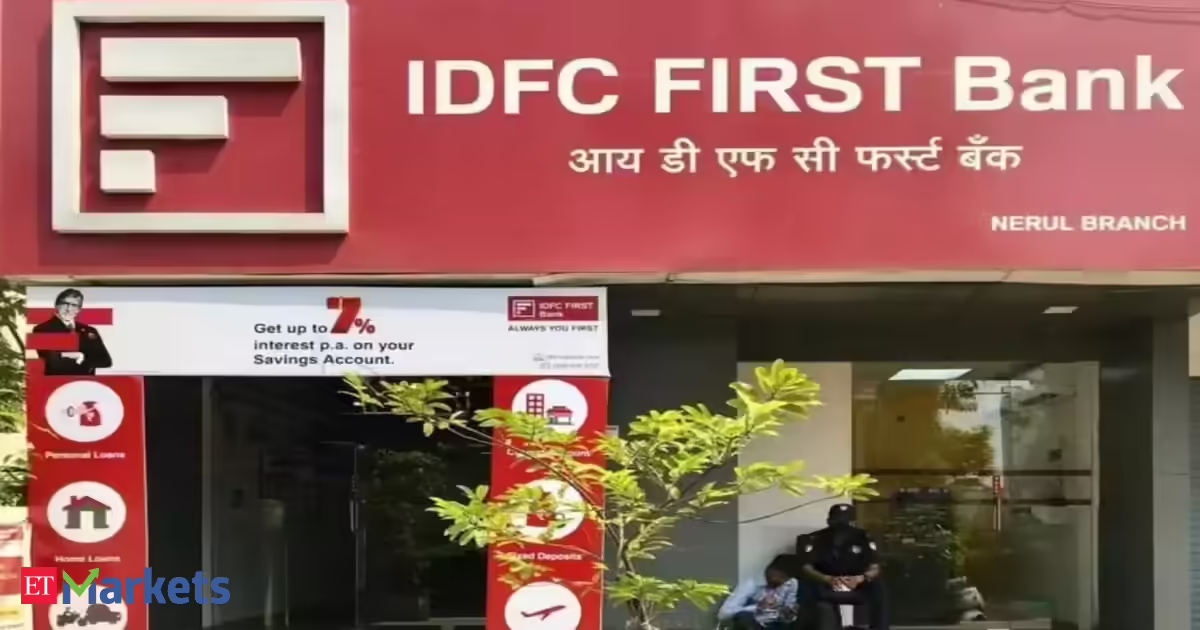
Net interest income (NII) rose 21.1% year on year to Rs 5,972.3 crore from Rs 4,933 crore in the corresponding quarter last year.
The bank’s net interest margin (NIM) improved to 5.96% in Q1 FY27 from 5.71% in Q1 FY26, an increase of 25 basis points. On a sequential basis, NIM rose 3 basis points.
However it must be noted that the lender received claims of Rs 514.8 crore under the CGFMU scheme against MFI portfolio, it disclosed in a regulatory filing.
Asset quality also improved during the quarter. Gross non-performing assets (NPA) declined to 1.51% as of June 30, 2026, from 1.97% a year earlier, an improvement of 45 basis points. On a quarter-on-quarter basis, gross NPA improved by 10 basis points.

Deposits and borrowing
Customer deposits increased 16.6% year on year to Rs 2.99 lakh crore as of June 30, 2026, from Rs 2.56 lakh crore a year earlier. On a quarter-on-quarter basis, deposits grew 5.3%.
CASA deposits rose 24.6% YoY to Rs 1.58 lakh crore as of June 30, 2026, from Rs 1.27 lakh crore in the year-ago period. On a sequential basis, CASA deposits increased 8.1%.
Loans and advances
Loans and advances, including credit substitutes, rose 20.6% year on year to Rs 3.05 lakh crore as of June 30, 2026, from Rs 2.53 lakh crore a year earlier. On a quarter-on-quarter basis, the book grew 5.2%, driven primarily by growth in mortgage, vehicle, corporate and consumer loans.
The retail, agriculture and MSME (RAM) book increased 18.2% YoY to Rs 2.41 lakh crore from Rs 2.03 lakh crore, while growing 3.8% sequentially.
IDFC Bank Q1 management commentary
The lender said it is focused on building a high-quality institution with strong governance standards and is witnessing healthy business momentum.
He said asset quality continued to improve, with gross NPA at 1.51% and net NPA at 0.44%, while provisions as a percentage of loans also continued to decline. During the quarter, the bank received a CGFMU claim of Rs 515 crore and, on a prudent basis, created a provision of Rs 515 crore to account for any potential impact from monsoon conditions or fuel price volatility during the rest of the year.
Vaidyanathan said investments made in building the bank are beginning to translate into operating leverage, helping lift PAT to Rs 1,075 crore in Q1 FY27. Return on assets (ROA) also crossed 1%.

The vacation rental market has become more competitive. More listings and more platforms mean that being visible in one place is no longer enough.
Listing across Airbnb, Booking.com, and Vrbo brings more exposure, but it also creates more coordination. Calendars need to stay aligned, pricing needs to match, and bookings can come in from different platforms at the same time.
Without a system to help manage it, gaps start to show. Availability falls out of sync, pricing becomes inconsistent, and managing multiple channels takes more time than it should.
That’s usually when operators turn to a vacation rental channel manager to keep everything aligned without having to manage each platform individually.
What Is a Vacation Rental Channel Manager?
A vacation rental channel manager is a tool that connects your listings across multiple booking platforms and keeps them in sync. Instead of managing each platform separately, it ensures that availability, pricing, and reservations are aligned across all platforms where your property is listed.
Without a system in place, managing channels manually means logging into each platform, updating calendars, adjusting pricing, and checking for conflicts. That setup can work when there are only a few listings, but it becomes harder to manage as volume increases.
Vacation rental channel manager software automates these updates. When a booking is made on Airbnb, availability updates across Booking.com, Vrbo, and any other connected platforms. When pricing changes, those updates apply everywhere at once. This keeps listings consistent and reduces the need for constant manual checks.
Why Managing Multiple Channels Is Important
Relying on one platform limits how many guests see your property. Each platform has its own audience, booking patterns, and search behaviour.
Listing across multiple platforms increases visibility, but it also changes how demand is distributed. Some platforms bring more last-minute bookings, while others attract longer stays or different guest profiles. Being present across these channels helps balance occupancy throughout the year.
It also reduces dependency on a single online travel agent (OTA). Platform policies, ranking changes, or shifts in demand can affect performance quickly. Spreading listings across channels gives more stability and reduces risk.
For a growing vacation rental business, multi-channel distribution is less about expansion and more about maintaining consistent bookings across different types of demand.
How a Channel Manager Increases Your Bookings
More exposure doesn’t automatically lead to more bookings. It only works if everything behind the scenes stays aligned.
Real-Time Availability Sync
Availability needs to update instantly across all platforms. If there’s a delay, even a short one, the same dates can appear available in multiple places.
A vacation rental channel manager keeps calendars updated in real time. As soon as a booking is confirmed, availability is adjusted across every connected platform. This reduces the risk of double bookings and keeps calendars accurate without manual checks.
Wider Distribution Across Platforms
Listing on more platforms increases the chances of being seen by different types of guests.
A channel manager for vacation rentals makes it possible to distribute listings across multiple platforms without increasing workload. Instead of managing each channel separately, everything stays connected, so expanding distribution doesn’t create additional complexity.
More visibility leads to more booking opportunities, but only when listings remain consistent across platforms.
Faster Listing Updates
Updating pricing, availability, or content across multiple platforms manually takes time.
With a vacation rental channel manager, those updates happen in one place. Changes are applied across all connected platforms at the same time, so listings stay aligned without requiring duplicate work. This makes it easier to respond to changes in demand or adjust pricing without delays.
Improved Booking Efficiency
Managing bookings across multiple platforms often involves switching between systems and checking for inconsistencies.
A centralised setup allows everything to be managed from one place. Instead of tracking bookings separately, operators can see activity across all platforms in one view.
This reduces time spent on coordination and makes it easier to handle more bookings without increasing workload.
Key Features of a Vacation Rental Channel Manager
Most of the features of vacation rental channel manager software are designed to keep listings aligned and reduce manual coordination.
- Multi-channel integration connects platforms like Airbnb, Booking.com, and Vrbo, keeping listings synchronised across all channels.
- A centralised dashboard lets you manage bookings, availability, and pricing in one place instead of switching between platforms.
- Automated updates ensure that availability, pricing, and reservations stay aligned across all listings without manual input.
- Reporting and analytics give visibility into performance across platforms, helping you see which channels drive the most bookings.
Benefits of Using a Channel Manager
When listings stay aligned across platforms, a few things change straight away.
- Occupancy improves because your availability is always accurate and visible across every channel.
- Manual work drops because you’re not updating calendars or pricing in multiple places.
- Revenue becomes easier to manage since pricing stays consistent and you’re not missing demand due to delays.
- Guest experience improves because there are fewer booking issues and less confusion around availability or pricing.
For operators using vacation rental property management software, channel management becomes part of a setup that keeps everything connected as the business grows.
How to Choose the Right Channel Manager
Choosing a vacation rental channel manager depends on how your operation currently runs and where things start to slip.
- It should integrate with the platforms you rely on, including Airbnb, Booking.com, and Vrbo, so everything stays connected.
- It needs to be easy to use day to day, otherwise it won’t reduce workload.
- Pricing should make sense for your current setup and still work as your business grows.
- Customer support should be reliable, especially when something affects bookings or guests.
Platforms like RentalReady combine a vacation rental channel manager with broader vacation rental management software, bringing listings, communication, and operations into a single system.
Final Thoughts
Managing multiple platforms increases visibility, but it also introduces more coordination.
A vacation rental channel manager keeps listings, availability, and pricing aligned across channels, so that increased exposure actually leads to more bookings instead of more work.
That’s what makes the difference between being present on multiple platforms and actually converting that visibility into bookings.
Business
Looking for aggressive flexicap funds? These 5 funds had the highest mid and smallcap allocation in June 2026 – Exposure in most risky stocks

Flexicap funds offer fund managers the freedom to invest across market capitalisations and sectors/themes. It means the fund managers can invest anywhere based on his outlook on the market. Here is the detailed exposure of the top 5 flexicap funds with the maximum mid & smallcap exposure in June 2026, as reported by ET Wealth

Palestinians hope UNESCO designation halts Israeli push at West Bank site

Recent Marist graduate Samantha Kehler joins ‘Mornings with Maria’ to detail her use of AI and the struggle with the technology role in the job search.
Artificial intelligence is reshaping the hiring process, but for many recent graduates, it is also creating new frustrations. As employers increasingly rely on automated screening tools to sort through thousands of applications, job seekers say they worry qualified candidates are being filtered out before a hiring manager ever sees their resume.

Many job applicants believe AI is deciding their fate before a recruiter ever reviews their resume. (jakkapant turasen / Getty Images)
Marist graduate Samantha Kehler joined FOX Business’ Maria Bartiromo on “Mornings with Maria” to discuss how AI has changed her search for work and why she believes automated hiring systems have made breaking into today’s job market even more difficult.
Barron’s Investor Circle Newsletter editor Josh Schafer discusses the implications of the USMCA trade pact expiring in 2036 and AI employment fears on ‘The Bottom Line.’
“I’ve tried to definitely do a little bit of training,” Kehler said on learning AI. “It definitely helped me understand how to work the AI in your favor rather than just getting kind of a short answer from AI and really using it to not just answer my questions, but to help me with research and synthesize information faster.”
DIMON URGES CALM OVER FEAR ABOUT AI’S IMPACT ON JOBS: ‘STOP BEING BREATHLESS OVER IT’
While AI can help applicants tailor resumes and conduct research, many companies now use applicant tracking systems to scan resumes for keywords before they ever reach a recruiter. That shift has fueled concerns among job seekers that the hiring process is becoming less personal.
Bank of America CEO Brian Moynihan addresses college students’ concerns about AI’s impact on entry-level jobs, detailing the company’s commitment to hiring 4,000 campus recruits on ‘Fox & Friends.’
“I know that AI is pretty much the one who is reading my application,” Kehler said. “I don’t feel like my resume and my cover letters are being read by human eyes… I know I’m just getting filtered out if I don’t have a specific keyword.”
INSIDE THE AI BOOM: A TALENT CHIEF’S PLAYBOOK FOR WINNING IN THE JOB MARKET
Kehler added that receiving rejection emails “at two in the morning” reinforces her belief that automated systems are increasingly driving the hiring process, leaving many applicants wondering whether they ever had a chance to make a human first impression.

Is That College Scholarship Taxable? What Parents Need to Know Before Fall
Business
F&O Talk: Nifty looks weak on chart, says Sudeep Shah; outlines HDFC Bank, Bluestone Strategy after Q1

Analyst Sudeep Shah, Vice President and Head of Technical & Derivatives Research at SBI Securities, interacted with ETMarkets regarding the outlook for the Nifty and bank, as well as an index strategy for the upcoming week. The following are the edited excerpts from his chat:
Nifty slipped over 2% this week, plunging in all five sessions. What is your view on Nifty going forward?
Last week, the benchmark Nifty index traded within a narrow range during the first two trading sessions. However, selling pressure intensified during the final three sessions, resulting in a sharp correction. Eventually, the index ended the week at 23,767 level, registering a decline of 2.33%. A sharp surge in Brent crude oil prices amid the escalation of the US-Iran conflict, coupled with a notable rise in the US 10-year bond yield, weighed heavily on investor sentiment across global markets. Amid this sharp deterioration in sentiment, Friday’s price action offered the first sign that the decline may be approaching a crucial juncture.On Friday, the index found support near the 61.8% Fibonacci retracement level of its recent upward rally from 23,070 to 24,531 and staged a modest pullback. Consequently, the index formed a bearish candle with a small lower shadow on the weekly chart, indicating some buying interest at lower levels. Notably, Friday’s recovery was largely driven by strength in the large-cap space. While the Fibonacci support triggered a pullback, the momentum indicators tell a more cautious story beneath the surface.
From a technical perspective, the index is currently trading below its key short and long-term moving averages, while the 20-day and 50-day EMAs are trending lower, reflecting weakening momentum. The daily RSI is hovering around the 43 mark and remains below its 9-day average, indicating subdued momentum. Meanwhile, the MACD histogram continues to remain below the zero line, further reinforcing the prevailing bearish undertone. With momentum still tilted in favour of the bears, the battle now shifts to a crucial support zone that could determine the index’s next directional move.
Going ahead, the 23,650–23,600 zone will act as an important support area for the index. A sustained move below 23,600 could extend the correction towards 23,450, followed by the 23,300 level. On the upside, the 50-day EMA zone of 23,950–24,000 is likely to act as an important hurdle.
Rough week for bank stocks as the index declined over 3% this week. How are charts looking for Bank Nifty?
The Bank Nifty witnessed heightened volatility during the week. After scaling a high of 58,228, the index came under sharp selling pressure and underwent a meaningful correction. However, buying interest emerged near the 56,000 level, helping the index stage a strong recovery from lower levels. Despite the rebound, Bank Nifty ended the week around 56,700, registering a loss of more than 3%.
On Friday, the index briefly slipped below its crucial 200-day EMA, indicating weakness in the broader trend. However, it managed to recover and close above this long-term moving average, highlighting the importance of this support zone. Meanwhile, momentum indicators and oscillators are currently signalling a sideways to range-bound trend, suggesting a lack of strong directional momentum in the near term.
Going forward, the 56,000-55,800 zone is expected to act as a key support area, as it coincides with the 50% Fibonacci retracement of the previous upward rally. A decisive and sustained breakdown below 55800 could trigger another round of selling pressure, paving the way for a sharper correction towards 55,000, followed by 54,400 in the short term.
On the upside, the 20-day EMA zone of 57,300-57,400 is likely to remain a significant resistance hurdle. Any pullback rally is expected to face supply pressure around this region, and a sustained move above it would be required to improve the near-term technical outlook.
What is the options data indicating about Nifty’s near-term trading range, and where are the key Call and Put positions building up ahead of the Monthly expiry?
The Put Call Ratio (PCR) slipped from 1.13 on July 17 to 0.68 on July 23 as bears attempted to gain the upper hand. Following the sharp pullback from 23,600 levels on July 24, the PCR improved to 0.83. Despite this recovery, call writers maintained dominance at the week’s close. Over the past four sessions, a steady rise in open interest alongside falling prices has signaled the buildup of short positions in index futures.
For context, Nifty had been consolidating within the 24,531–23,785 band for 28 sessions and the July 24 close below the lower end of this range confirmed a breakdown, raising concerns of further downside.
On the downside, the 23,600 strike carries significant put open interest, with put writing nearly eight times higher than call writing. This level is a crucial support zone, coinciding with the strong buying seen on July 24 after Nifty’s gap closed. Ahead of the monthly expiry, Nifty is most likely to hold this level, though any decisive breach could trigger put writers’ exit and accelerate near term weakness. On the upside, the 24,000 strike has notable call open interest, with call writing nearly three times higher than put writing, making it a strong resistance zone to watch as expiry approaches.
What are some stocks that are looking good for the week ahead?
Despite the broader market weakness, a few stocks continue to display strong relative strength and positive technical setups. HAL, Manappuram Finance, Titan, and United Spirits are currently looking promising and could remain in focus in the week ahead. Their resilient price structures and favorable momentum indicators suggest the potential for outperformance.
Can you share your outlook on Bluestone, HDFC Bank, Infosys, and IndusInd?
Bluestone delivered its strongest ever weekly close, surging nearly 29% following its quarterly results. The stock now trades comfortably above key short and long term moving averages, with a rising ADX signaling robust trend strength. The MACD’s expanding green histogram bars further reinforce bullish momentum. While a phase of healthy profit taking cannot be ruled out given RSI and ADX nearing peak levels, immediate support lies in the Rs 710–700 zone. The bullish bias is expected to persist as long as the stock holds above this zone.
HDFC Bank ended the week with a sharp 9% loss, recording lower closes across all five sessions. The stock trades well below its key moving averages and has closed below the lower band of the Bollinger Band for four consecutive days, a sign often associated with strong trends. RSI has slipped below 40, reflecting growing bearish momentum. The Rs 725–720 zone remains a critical support, and a decisive breach could trigger further weakness.
Infosys slipped over 5% for the week, closing below its key moving averages. The RSI continues to fall, indicating bearish momentum, while DI has crossed DI+ on the ADX with widening lines, underscoring strong seller control. The MACD line remains below the zero line on both daily and weekly charts, reinforcing the bearish bias. As long as the stock trades below the Rs 1,075–1,080 zone, weakness is likely to persist.
IndusInd Bank attempted a consolidation breakout on July 21 but failed to sustain higher levels, slipping below its 20 day EMA after quarterly results. RSI dropped sharply from 73 to 52, signaling loss of bullish momentum, while the MACD line crossing below the signal line points to building downside pressure. Unless the stock reclaims the Rs 1,045–1,050 zone, it is likely to remain under pressure.
(Disclaimer: Recommendations, suggestions, views and opinions given by the experts are their own. These do not represent the views of Economic Times)

This wave of Trump tariffs is likely here to stay; more are coming

U.K. consumer goods company Reckitt Benckiser RKT said it agreed to divest of its hygiene arm in Russia, which has been dragging on sales due to changes to European Union sanctions on the country.
The maker of Durex condoms and Mucinex cold medicine said Friday that it was selling the Russian hygiene unit to Arnest Management. It didn’t disclose financial terms of the deal, but said the business represented around 1% of Reckitt’s net revenue in 2025.
Copyright ©2026 Dow Jones & Company, Inc. All Rights Reserved. 87990cbe856818d5eddac44c7b1cdeb8

MiniMed: Next-Generation Diabetes Platform Supports A Buy Rating

'What a ball!' – Wonderful Wong gets three for the Southern Brave

revenue tops $16 billion as AI demand drives fastest growth since 2011

Car bomb intercepted by Irish police near the Northern Ireland border


-

 Fashion18 hours ago
Weekend Open Thread: Brooks Brothers
-

 Politics6 days ago
Democrats look to World Cup watch parties to register thousands of voters
-

 News Videos6 days ago
Big Money Is Entering XRP
-

 Crypto World4 days ago
Grayscale Files For Worldcoin ETF, WLD Registers Sharp Rise
-

 Tech4 days ago
Sail Virtually Aboard The “Itanic” With IA-64 Emulator
-
 Tech4 days ago
Turtle Beach Command Series KB7 review: a nifty screen-equipped gaming keyboard
-

 NewsBeat5 days ago
Unregistered fitter used Gas Safe logo on business flyers
-
 Business3 days ago
New Jersey voter registration controversy explained: How 6,600 noncitizens got on the rolls, and what happens next
-

 Crypto World7 days ago
Kaspersky exposes OkoBot’s 20-module crypto wallet attack
-
 Entertainment4 days ago
Johnny Depp’s R-Rated Gothic Cult Classic Gets New Release Ahead of Sydney Sweeney Remake
-

 Crypto World2 days ago
Ethics, other provisions in crypto Clarity Act to be further discussed
-

 Tech5 days ago
Watch Flock Safety CEO Garrett Langley discuss the future of surveillance at TechCrunch Disrupt 2026
-
 NewsBeat4 days ago
Shanghai science forum photos show China’s AI and robotics advances in rivalry with US
-

 Crypto World5 days ago
Circle’s President Sold Over 360,000 Shares, The Filings Explain Why
-

 Tech5 days ago
Subway Sandwich Computers Get a Second Life as Gaming Machines
-

 News Videos2 days ago
The Peugeot Family: How 200 Years of an “Old Money” Dynasty Died in A Boardroom
-

 Sports1 day ago
2026 3M Open leaderboard: Scottie Scheffler finds putter in Round 1, sits three back
-

 Tech5 days ago
The 35 Best Board Games for Family Game Night
-

 Fashion1 day ago
16 Dresses for the High Summer Event
-

 Tech6 days ago
How To Use Claude’s Reflect Dashboard And Learn When It’s Time To Touch Grass
You must be logged in to post a comment Login