FOX Business correspondent Madison Alworth reports on Lonestar planning A.I. data centers in space, with satellites launching this fall and goals for lunar centers by 2030 on Varney & Co.
OpenAI CEO Sam Altman dismissed the idea of data centers in space being a viable option in the next few years as SpaceX CEO Elon Musk pursues their deployment.
“I honestly think the idea with the current landscape of putting data centers in space is ridiculous,” Altman said in an interview with Indian Express. “It will make sense someday.”
Advertisement
Altman said that space-based artificial intelligence (AI) data center projects would have to deal with high launch costs as well as operational and maintenance challenges, like how to fix a broken or damaged component while the data center is in orbit.
“We are not there yet. There will come a time. Orbital data centers are not something that’s going to matter at scale this decade,” Altman said in the interview.
OpenAI CEO Sam Altman said that while space-based data centers may be viable in the future, they aren’t likely to be deployed at scale this decade. (Ken Cedeno/Reuters / Reuters)
SpaceX’s Musk said earlier this month at an event announcing SpaceX’s acquisition of xAI that the energy demands of AI will require moving data centers to space because of the strain it puts on the environment.
Advertisement
“In the long term, space-based AI is obviously the only way to scale,” Musk said. “My estimate is that within 2 to 3 years, the lowest cost way to generate AI compute will be in space.”
SpaceX’s merger with xAI, the AI company Musk founded that went on to acquire the X social media platform, aims to create a more than $1 trillion company ahead of a planned initial public offering that will enable them raise capital and speed up plans to deploy data centers in space.
SpaceX CEO Elon Musk sees space-based data centers as a solution to environmental challenges they pose on Earth. (Marc Piasecki/Getty Images / Getty Images)
SpaceX recently filed a document with the Federal Communications Commission requesting to launch up to 1 million satellites that would function as data centers in Earth’s orbit.
Advertisement
Musk said in a memo outlining his plans that SpaceX aims to put a million tons of satellites into orbit per year with 100 kilowatts of compute power per ton, adding 100 gigawatts of AI computing capacity per year.
SpaceX is planning a constellation of satellites that can serve as space-based data centers. (Joe Skipper/Reuters)
Other tech companies pursuing space-based data centers include Google, as CEO Sundar Pichai told “Fox News Sunday” that the company could put solar-powered data centers in space as soon as next year as part of what’s known as Project Suncatcher.
Amazon Web Services CEO Matt Garman said at the Cisco AI Summit earlier this month, “there are not enough rockets to launch a million satellites yet, so we’re, like, pretty far from that.”
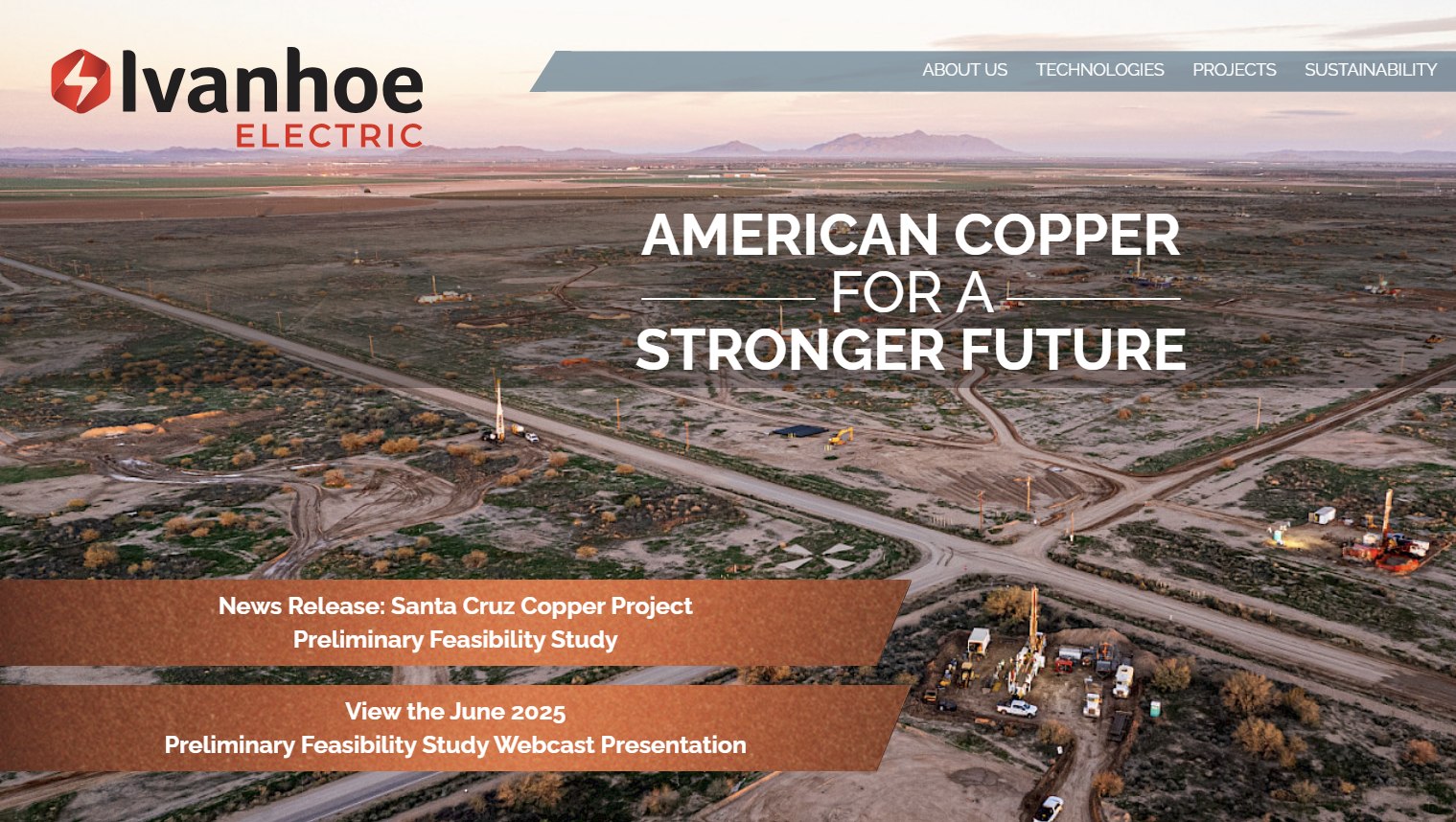
NEW YORK — Ivanhoe Electric Inc. shares rose sharply in morning trading Friday, gaining about 7.77% to $13.87 as investors bet on the company’s role in bolstering domestic supplies of copper and other critical minerals amid growing demand from electrification, data centers and national security initiatives.
Ivanhoe Electric
The Phoenix-based exploration and development firm, listed on the NYSE American as IE, added $1.00 by 10:00 a.m. EDT. The move came as broader sentiment toward copper-related stocks improved and the company continued to highlight progress at its flagship Santa Cruz Copper Project in Arizona, along with a strengthened balance sheet from recent cash inflows.
Ivanhoe Electric specializes in using its proprietary Typhoon™ geophysical surveying technology — paired with advanced data analytics from its majority-owned subsidiary Computational Geosciences Inc. — to detect deeply buried mineral deposits that traditional methods often miss. The system generates powerful electrical signals capable of penetrating up to 1.5 kilometers or more, accelerating discovery while reducing exploration risks and costs.
The company’s portfolio centers on copper but also includes nickel, cobalt and other metals essential for batteries, renewables and high-tech applications. Its core asset is the Santa Cruz Copper Project near Casa Grande, Arizona, where it aims to build a modern underground mine and heap-leach facility to produce high-purity 99.99% copper cathode domestically.
A preliminary feasibility study released in mid-2025 outlined strong economics for the project: an underground operation processing 20,000 tonnes per day, with average annual production of approximately 72,000 tonnes of copper cathode in the first 15 years at low all-in sustaining costs around $1.36 per pound after by-product credits. The study supports a potential 23-year mine life, with initial construction targeted for the first half of 2026 and first cathode production by late 2028, subject to permits and financing.
Advertisement
In November 2025, Ivanhoe Electric completed final land acquisition payments totaling $39.3 million, clearing a key hurdle ahead of major construction activities. The project sits on private land, which is expected to streamline permitting compared to federal ground. The company has already secured various permits for exploration and land use, positioning it for a smoother development path in a state with a long mining history.
Financially, Ivanhoe Electric entered 2026 with solid liquidity. As of Dec. 31, 2025, it held $173.3 million in cash and equivalents. In February 2026, it received $82.6 million from the exercise of warrants tied to a prior equity financing. In March, the company stood to receive approximately $58.4 million from its 59.6%-owned subsidiary Cordoba Minerals Corp., stemming from Cordoba’s $128 million sale of its remaining interest in the Alacrán Project in Colombia. The cash distribution of $1.01 per Cordoba share was payable around late March.
An undrawn $200 million senior secured bridge facility, closed in December 2025, provides additional near-term flexibility as the company pursues longer-term project financing for Santa Cruz. Ivanhoe Electric received a Letter of Interest from the U.S. Export-Import Bank in 2025 for up to $825 million in debt financing under the Make More in America initiative, with the full application process ongoing. Executives have signaled expectations to finalize project financing by mid-2026.
The stock’s Friday gain built on recent volatility. Shares had traded around $12.87 at Thursday’s close after pulling back from earlier 2026 levels, with a 52-week range spanning roughly $4.50 to $21.55. Analysts maintain a generally bullish outlook, with consensus price targets near $18 to $21.50 and some high-end forecasts reaching $28.50. JPMorgan recently reaffirmed its overweight rating, though it trimmed its target slightly to $21.
Advertisement
A key differentiator for Ivanhoe Electric is its Typhoon™ technology, which has already shown promise in joint ventures and alliances. In January 2026, the company signed a collaboration agreement with Sociedad Química y Minera de Chile (SQM) to explore 2,002 square kilometers of mining concessions in northern Chile for copper deposits hidden beneath electrically resistive caliche layers. SQM is funding an initial $9 million program, with Ivanhoe Electric supplying a new-generation Typhoon system and advanced inversion software. The deal includes options for joint ventures on discoveries.
In Saudi Arabia, Ivanhoe Electric operates a 50/50 joint venture with Maaden covering about 50,000 square kilometers of the underexplored Arabian Shield. Three Typhoon systems are active there, and early drilling at the Umm Ad Dabah prospect intersected encouraging copper mineralization. Additional surveying and drilling continue across multiple targets.
The company also maintains an exploration alliance with BHP in the southwestern United States, where BHP funds initial work and Ivanhoe Electric acts as operator during the exploration phase. Typhoon surveys have been completed in areas of interest in Arizona and Utah, with drilling underway targeting porphyry copper systems.
Other U.S. assets include the Hog Heaven project in Montana, where expansion drilling has intersected significant copper-gold-silver mineralization and a new porphyry system called Battle Butte was identified, and the Tintic project in Utah, focused on precious and base metals in a historic district.
Advertisement
Executive Chairman Robert Friedland, a prominent figure in the mining industry, has emphasized the strategic importance of domestic critical minerals production. In February 2026, he joined President Donald J. Trump at the White House for the announcement of a $12 billion U.S. minerals stockpile initiative, underscoring Ivanhoe Electric’s alignment with national efforts to reduce reliance on foreign supplies.
The broader copper market provides tailwinds. Analysts forecast structural deficits driven by surging demand from electric vehicles, artificial intelligence data centers, renewable energy infrastructure and grid modernization. Some projections see copper prices potentially climbing significantly if supply lags, benefiting developers like Ivanhoe Electric with high-quality, low-cost projects in stable jurisdictions.
Challenges persist. As a development-stage company, Ivanhoe Electric reports operating losses — posting a net loss of about $105.9 million for 2025 — while investing heavily in exploration and project advancement. Quarterly revenues remain modest, primarily from limited early-stage activities. Permitting timelines, construction execution and final financing terms will be critical to meeting the aggressive Santa Cruz schedule.
The company faces typical mining risks, including commodity price volatility, geopolitical factors affecting global supply chains and potential delays in regulatory approvals. However, its focus on private land in Arizona and access to advanced technology are seen as mitigating factors.
Advertisement
With Q1 2026 financial results scheduled for release in early May, investors will watch for updates on cash usage, exploration results and any progress on Santa Cruz permitting or financing. Management has highlighted a disciplined approach to capital allocation, balancing aggressive exploration with de-risking the flagship project.
Founded with a vision to revive and modernize mineral exploration through technology, Ivanhoe Electric has assembled a portfolio that spans high-potential development assets and early-stage discovery opportunities across multiple continents. Its dual listing on the NYSE American and TSX broadens its investor reach.
Friday’s trading volume appeared elevated as the stock tested recent resistance levels. Technical observers noted the potential for continued momentum if copper prices hold firm and positive news flows from exploration or financing emerge.
As global industries race to secure critical metals for the energy transition and technological advancement, Ivanhoe Electric positions itself at the intersection of innovation, domestic production and strategic partnerships. Success at Santa Cruz could mark a significant step toward establishing new U.S. copper cathode capacity, while Typhoon-driven discoveries elsewhere offer upside potential.
Advertisement
Analysts and industry watchers will continue monitoring execution on the 2026 construction timeline and international exploration programs. For a company blending cutting-edge geophysics with real-world development ambitions, the coming months could prove pivotal in determining whether it delivers on its promise as a key player in the critical minerals supply chain.
Weardale Lithium is hoping to extract the key material from brines under the North Pennines
Weardale Lithium has secured planning permission to build its lithium extraction facility at the former Eastgate cement works.(Image: Weardale Lithium)
A bid to extract the key material of lithium from the ground beneath the North East has received a boost from the Government.
Weardale Lithium has secured grant funding through the Government’s DRIVE35 Scale-Up: Feasibility Studies competition, supporting the next phase of development at its geothermal lithium project in County Durham. The project aims to produce battery-grade lithium carbonate – a key material for the UK’s net zero ambitions – from geothermal groundwaters under the North Pennines, and could create between 20 and 50 jobs.
The grant funding will enable Weardale Lithium to undertake a £700,000 feasibility study to map its geothermal lithium-bearing brinefield within the North Pennine Orefield. The feasibility study represents an important step towards establishing a domestic source of battery-grade lithium carbonate, reducing reliance on imported raw materials and strengthening the resilience of the UK’s EV manufacturing base.
Stewart Dickson, CEO of Weardale Lithium, said: “Securing support through the DRIVE35 Scale-Up programme is an important milestone for Weardale Lithium and for the development of a secure, domestic lithium supply in the UK. This funding enables us to undertake critical subsurface mapping and technical analysis of our geothermal brine resource in County Durham, providing the data needed to inform commercial scale-up and future investment decisions.
Advertisement
Stewart Dickson, CEO of Weardale Lithium(Image: Weardale Lithium)
“Our project aligns directly with the UK Critical Minerals Strategy and wider UK Battery Strategy. By developing low-carbon Direct Lithium Extraction integrated with on-site conversion to battery-grade lithium carbonate, we are positioning the North East at the forefront of the UK’s emerging
battery materials supply chain while creating high-value jobs and long-term economic benefits for the region.”
The grant to Weardale Lithium – which has planning permission for an extraction facility at Eastgate – is part of a wider investment package into the UK automotive industry.
Ian Constance, CEO of Advanced Propulsion Centre UK, said: “The projects announced today demonstrate the UK’s determination to lead the shift to zero-emission mobility. By facilitating the UK Government’s DRIVE35 grants, we are turning world-class innovation into industrial capability. With our partners in DBT and Innovate UK, we are backing manufacturers, empowering SMEs, and strengthening the UK’s sovereign supply chain.
Advertisement
“This multi-million pound support package is more than an investment in technology; it is an investment in the people, skills, and companies that will define the future of clean transport. Together, we are building the foundations of a competitive, resilient, and sustainable automotive industry.”
Fox News chief national security correspondent Jennifer Griffin reports on the state of Strait of Hormuz traffic, Irans demand for a toll on passing ships and ceasefire negotiations on Varney & Co.
This story on the March 2026 CPI inflation report is developing and will be updated with further details.
Inflation surged in March as consumer prices jumped amid the economic disruptions caused by the Iran war’s impact on the energy market.
Advertisement
The Bureau of Labor Statistics on Friday said that the consumer price index (CPI) – a broad measure of how much everyday goods like gasoline, groceries and rent cost – rose 0.9% from a month ago and is 3.3% higher than last year. The annual figure jumped from last month’s 2.4% reading, while the monthly increase also rose markedly from last month’s 0.3% reading.
Expectations vs. reality
Both the 0.9% monthly increase and 3.3% annual rise were in line with the expectations of economists polled by LSEG.
So-called core prices, which exclude volatile measurements of gasoline and food to better assess price growth trends, were up 0.2% on a monthly basis and 2.6% from a year ago. Both of those figures were slightly cooler than economists’ predictions of 0.3% and 2.7%, respectively.
The core CPI figures were slightly hotter than February’s readings, which showed prices rose 0.2% on a monthly basis and 2.5% from the prior year.
Advertisement
Economists have noted that inflation data from December 2025 through April 2026 will be affected due to data collection interruptions resulting from last fall’s 43-day government shutdown.
During the shutdown, the BLS wasn’t able to gather data and used a carry-forward methodology to make up for the lack of an October CPI report and missing data in November’s report. Economists say this is likely to impart a downward bias on inflation data until this spring, when fresh data will negate the discrepancy.
The cost of living breakdown
High inflation has created severe financial pressures in recent years for most U.S. households, which are forced to pay more for everyday necessities like food and rent. Price hikes are particularly difficult for lower-income Americans, because they tend to spend more of their already-stretched paychecks on necessities and have less flexibility to save.
Food prices were flat on a monthly basis in March, and were up 2.7% from a year ago. The food at home index declined 0.2% for the month and is up 1.9% over the last year, while the food away from home index is 3.8% higher than a year ago after a 0.2% increase on a monthly basis.
Advertisement
Meats, poultry and fish prices were down 0.5% for the month but remain 5.6% higher than a year ago. Beef and veal prices fell 0.6% in March and are 12.1% higher than last year. Egg prices continued to decline following an avian flu outbreak that impacted supply, with prices down 3.4% for the month and 44.7% from a year ago. The fruits and vegetables index rose 1% in March and is up 4% on an annual basis.
Thousands of small investors who piled into one of London’s best-known green investment vehicles are staring down the barrel of losses running well beyond 50 per cent, after the board of SDCL Efficiency Income Trust (SEIT) bowed to pressure from a New York activist and abandoned its rescue plan in favour of a managed wind-down.
The FTSE 250 trust, which has raised more than £1.1 billion from retail backers since its 2018 launch, confirmed today that it has shelved plans to convert itself into a conventional operating company and will instead begin selling off its portfolio of energy-efficiency assets.
SEIT becomes the latest London-listed trust to change course under the gaze of Saba Capital, the aggressive New York hedge fund run by Boaz Weinstein, which is understood to hold a stake of more than 10 per cent. Saba has built positions in dozens of British investment trusts over the past eighteen months, agitating for boards to be replaced and cash to be returned to shareholders.
For the army of private investors who subscribed to SEIT’s nine capital raisings between 2018 and 2022, the decision marks the bitter end of a story that once looked like a copper-bottomed route into the green transition. They were lured by an anticipated yield of 5 per cent or more at a time when base rates were on the floor, and placings were frequently several times oversubscribed. Their money went into projects ranging from rooftop solar arrays at Tesco supermarkets to electric-vehicle charging infrastructure and district heating schemes.
The trust’s fortunes reversed sharply once interest rates began their steep climb, and the market has grown increasingly sceptical about the values SEIT has placed on its unquoted holdings. The shares, which were issued at £1 or more, closed at 45p yesterday, a punishing 49 per cent discount to stated net asset value. If the portfolio is eventually liquidated anywhere close to recent market prices, the collective hit to shareholders could exceed £500 million.
Advertisement
Tony Roper, SEIT’s chairman, said the board had held intensive talks with wealth managers, retail platforms and other large holders, and that the feedback had been clear. Many had expressed what he described as “a clear preference for liquidity” over the proposed run-on plan. Saba is believed to have been among those consulted.
The directors, he said, had “unanimously concluded” that a managed wind-down of the portfolio was now in the best interests of shareholders taken as a whole. Roper acknowledged the pain felt by loyal backers, saying the board was “acutely aware of the reduction in share price in recent years” and recognised the frustration and uncertainty that had caused.
The alternative on the table had been to delist the investment trust wrapper, retain the stock market listing as an ordinary trading company and carry on running the assets. Roper conceded that, in theory, such a route “could have created value significantly in excess of the current share price”, but said it carried meaningful execution risk that shareholders were unwilling to stomach.
SDCL, the manager founded and led by energy-efficiency evangelist Jonathan Maxwell, has agreed to what the trust described as minimised termination fees, a nod to the sensitivity around what retail backers might otherwise regard as rewards for failure.
Advertisement
Analysts at Barclays said the activist presence on the shareholder register had made an orderly wind-down the more probable outcome all along. In their view, the shift “provides clearer line of sight to value realisation”, though they warned that the process would stretch out over an extended period and that disposal pricing remained a live risk.
There is already a cautionary data point. SEIT recently offloaded a batch of assets for £105 million, a 9 per cent discount to the value at which they had been carried in the books, a reminder that the private market for infrastructure assets remains sticky and that further haircuts are likely as the wind-down gathers pace.
The SEIT decision lands squarely within a broader assault by Saba on the £270 billion investment trust sector. Edinburgh Worldwide Investment Trust and Impax Environmental Markets are both midway through exit tender offers that their boards have argued are necessary to prevent ordinary shareholders being trapped in vehicles increasingly controlled by the American fund. Several other trusts have pre-emptively announced buybacks, continuation votes or strategic reviews in an attempt to keep Saba at bay.
For SME owners and retail savers who were encouraged to view specialist investment trusts as a low-drama way of backing the energy transition, the unravelling of SEIT is a sobering lesson. A yield that looks generous in a zero-rate world can evaporate quickly when gilts start paying 4 per cent, and unlisted infrastructure values that held up well on paper do not always survive contact with a real buyer. With Saba now a fixture on share registers from Leith Walk to Bishopsgate, more boards are likely to find themselves weighing whether to fight, fold or hand the cheque book back to investors.
Advertisement
Amy Ingham
Amy is a newly qualified journalist specialising in business journalism at Business Matters with responsibility for news content for what is now the UK’s largest print and online source of current business news.






























































You must be logged in to post a comment Login