NEW YORK — OpenAI has released its latest ChatGPT update on April 9, 2026, introducing GPT-5.3 Instant Mini as a smarter fallback model and launching a new $100-per-month Pro subscription tier, even as the company faces mounting public criticism, subscription cancellations and security concerns.
ChatGPT April 2026 Update: OpenAI Rolls Out GPT-5.3 Instant Mini and $100 Pro Plan Amid Growing Backlash
The incremental but meaningful improvements aim to enhance everyday conversations and give power users more capacity for advanced coding tasks through the Codex tool. GPT-5.3 Instant Mini replaces the previous fallback model and delivers more natural dialogue, stronger writing and better contextual awareness without appearing in the main model picker.
Users who hit rate limits on the primary GPT-5.3 Instant model will now encounter this refined mini version, which OpenAI says outperforms its predecessor across multiple use cases. The update also expands support for shared Outlook mailboxes and calendars in the Outlook Email and Calendar apps, allowing delegated access for reading, organizing, sending mail and managing events.
Simultaneously, OpenAI introduced a new $100 monthly Pro plan positioned as a direct challenge to rival Anthropic’s Claude offerings. The tier provides five times more Codex usage than the existing $20 Plus plan and includes higher overall limits for demanding professional workflows. Existing Plus and Pro users received adjustments to how Codex credits are allocated.
The April 9 rollout comes just days after OpenAI added ChatGPT integration with Apple CarPlay on April 2, enabling hands-free voice conversations while driving. Enterprise and education customers will receive the CarPlay feature in coming weeks.
Advertisement
These technical enhancements arrive against a backdrop of significant controversy. Reports indicate that more than 2.5 million users have either canceled their ChatGPT subscriptions or publicly pledged to stop using the service following OpenAI’s decision to integrate its models with U.S. military systems. App uninstalls reportedly spiked nearly 300% in a single day, and rival Anthropic’s Claude briefly topped the App Store charts.
Protests erupted outside OpenAI’s offices in San Francisco, reflecting broader unease about the rapid commercialization and military applications of AI technology. Some users expressed discomfort with the perceived shift from a helpful consumer tool to a platform entangled in defense contracts and aggressive monetization.
On April 10, authorities arrested 20-year-old Daniel Moreno-Gama after he allegedly threw a Molotov cocktail at OpenAI CEO Sam Altman’s San Francisco home. Investigators said the suspect believed AI posed an existential risk to humanity. The incident heightened security concerns around the company and its leadership.
OpenAI also disclosed a security issue involving a third-party developer tool called Axios that affected the code-signing process for its macOS applications. The company stated it found no evidence of user data access, system compromise or intellectual property theft, but it has taken steps to strengthen the certification process.
Advertisement
European Union regulators are examining whether ChatGPT should face tighter oversight under the Digital Services Act after OpenAI reported user numbers exceeding the 45 million threshold for designation as a large online platform. The potential reclassification could impose stricter content moderation and transparency requirements.
Despite the turbulence, OpenAI continues to push forward with product improvements. Recent updates to the Projects feature include deep research capabilities, voice mode support, better memory that references past chats within a project, easier sharing of project conversations and mobile enhancements such as file uploads and model selection.
ChatGPT’s model lineup in 2026 centers on the GPT-5 family. GPT-5.3 Instant serves as the default for free and paid users alike, while higher tiers gain access to more advanced “Thinking” and Pro variants with superior reasoning and coding performance. Older models, including GPT-4o and earlier GPT-5 snapshots, were retired from the consumer interface in February 2026, though many remain available via the API.
The company has been rolling out incremental refinements to tone and response quality. A March 16 update to GPT-5.3 Instant reduced overly promotional or teaser-style phrasing, aiming for more straightforward interactions. GPT-5.4 Thinking, launched in early March, combines enhanced reasoning, coding and agentic workflows for complex professional tasks.
Advertisement
OpenAI reported strong financial momentum earlier in 2026, announcing a massive $122 billion funding round in March to fuel the next phase of development. The company claimed revenue had reached $2 billion per month, a dramatic acceleration from $1 billion per quarter at the end of 2024.
Yet user sentiment remains mixed. Some longtime subscribers lament the retirement of favored older models like GPT-4o, which had developed a reputation for being particularly engaging or affirming. Others worry that the push toward higher-priced tiers and enterprise deals is turning ChatGPT into a less accessible tool for casual users.
OpenAI has also experimented with product discovery features that once allowed direct purchases through ChatGPT, though the company has since scaled back Instant Checkout ambitions. Advertising tests continue in the free and lower-tier plans, another point of friction for users accustomed to an ad-free experience.
On the positive side, initiatives like “ChatGPT 26” celebrate student innovators from the Class of 2026 — the first college cohort to experience higher education alongside widespread AI access. The program highlights creative and responsible uses of the technology by young people.
Advertisement
ChatGPT integration into everyday tools continues to expand. Beyond CarPlay, recent additions include improved support for productivity apps such as Box, Notion, Linear and Dropbox, with new actions and writing capabilities.
Speculation about GPT-6, internally referenced in some discussions as “Spud,” continues to swirl. Leaks and analyst commentary suggest it could feature a massive 2 million token context window and advanced persistent memory, though OpenAI has not confirmed a release timeline.
As competition intensifies from Anthropic, Google and open-source alternatives, OpenAI is betting that deeper integration into professional workflows, faster fallback models and premium tiers will sustain its leadership. The company maintains that its models remain the most capable for complex reasoning and coding tasks.
For millions of daily users, the April 2026 updates represent steady progress rather than revolutionary change. GPT-5.3 Instant Mini should make rate-limited sessions feel less jarring, while the new Pro plan caters to heavy users who need substantial Codex capacity for software development.
Advertisement
OpenAI’s release notes emphasize that these changes are designed to deliver more reliable, natural interactions while supporting focused work through enhanced Projects. Memory improvements allow chats within a project to reference previous context more effectively.
Security and ethical considerations loom large. The Axios incident and the Molotov attack underscore the intense scrutiny and real-world risks facing AI companies. OpenAI has reiterated its commitment to responsible development, though critics argue that military partnerships and rapid commercialization conflict with earlier safety-focused rhetoric.
The European Commission’s review under the Digital Services Act could force additional transparency around recommendation systems, content moderation and risk assessments for ChatGPT.
As the AI landscape evolves, ChatGPT remains the most widely used conversational interface, but its dominance is no longer unquestioned. User protests, rival gains and regulatory pressure signal a maturing market where trust, pricing and alignment with public values matter as much as raw capability.
Advertisement
For now, the April 9 update offers incremental reliability improvements and a new premium option for power users. Whether these steps can offset growing backlash and restore momentum will likely shape OpenAI’s trajectory through the remainder of 2026.
ChatGPT users are encouraged to check their settings for the latest model availability and subscription options. OpenAI typically rolls out updates gradually, so some features may appear over the coming days.
The company has not commented publicly on the subscription cancellation reports or protest activity beyond its standard safety and security statements. Sam Altman and other executives continue to emphasize the transformative potential of AI while acknowledging societal challenges.
With GPT-5 family models now firmly established and further advances on the horizon, ChatGPT’s evolution reflects both the promise of increasingly capable AI and the growing pains of its widespread adoption.
Crude oil held most of a surge that at one point took prices above $115 a barrel as the US and Iran exchanged fire, jolting a four-week-old ceasefire and raising concerns that Middle East tensions could escalate again.
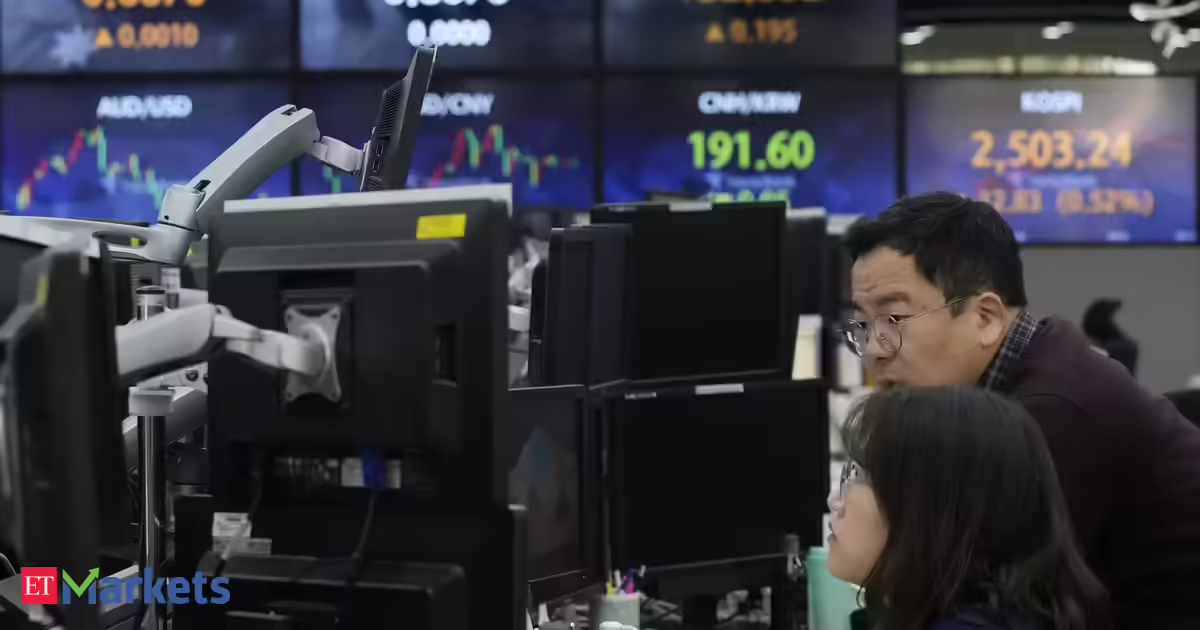
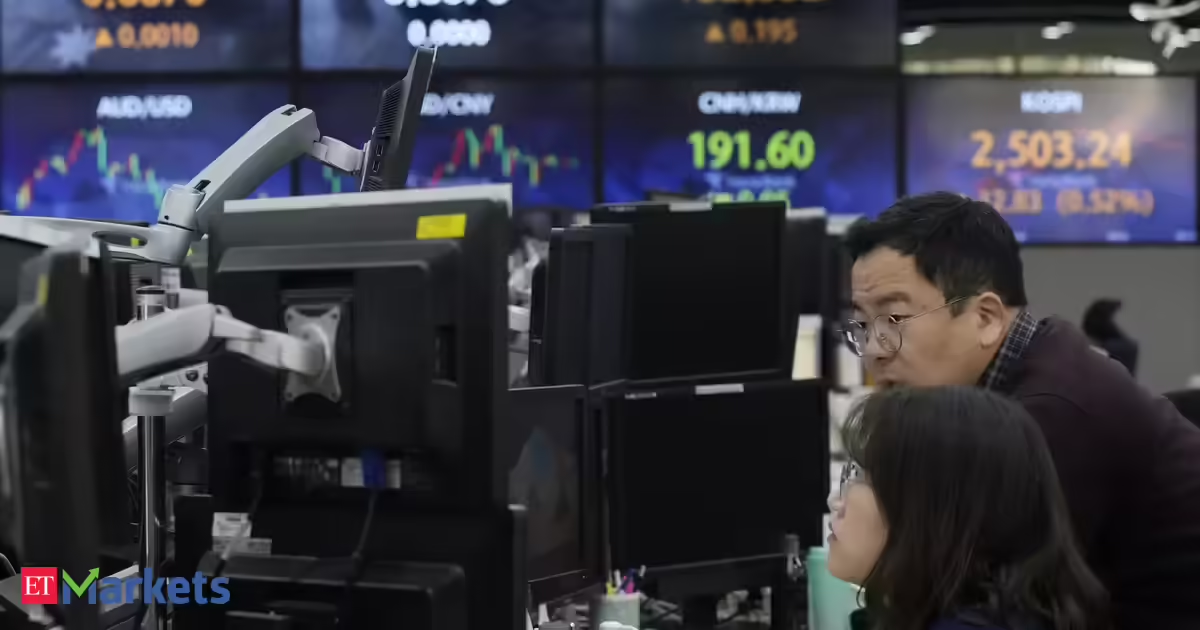
Brent edged 0.5% lower to just under $114 a barrel at the open Tuesday as escalating tensions around the Strait of Hormuz raised fears about high energy prices and global inflation. Australian shares opened lower, with markets closed in Japan, South Korea and mainland China. US equity-index futures were little changed after the S&P 500 Index retreated from its record on Monday.
During the US session, Treasuries fell, sending 30-year yields to the highest since July, as traders boosted wagers that the Federal Reserve will have to reverse course and raise interest rates to curb inflation following a surge in oil prices. There will be no cash trading during Asian hours due to the holiday in Japan.
Renewed tensions threaten to inject fresh volatility into markets after a month-long rally that helped global equities erase war-related losses and climb to record highs on strong earnings from megacap technology companies. Investors remain focused on the Strait of Hormuz, a key waterway that has been blocked for months, keeping energy prices elevated and risking higher inflation and slower economic growth.
Advertisement
“Even if the immediate conflict de-escalates, we expect the aftershocks will remain with us for some time,” said Darrell Cronk at Wells Fargo Investment Institute. “The effects — on energy prices, industrial activity, and geopolitical risk premia — are unlikely to fade quickly.”
Live Events
The US fought off Iran’s attacks as it facilitated the passage of two vessels through the Strait of Hormuz. Meantime, the UAE blamed an Iranian drone strike for a fire at its Fujairah port and issued several missile alerts for the first time since a truce between Washington and Tehran took hold.
According to the claim, Jain has sought ₹20 crore as compensation for loss of earnings and an additional ₹50 crore for reputational harm, loss of employment opportunities, and mental trauma.
The Reserve Bank of India (RBI), the sectoral regulator, has also been made a party to the case.
Jain is being represented by law firm Wadia Ghandy, while IndusInd Bank has engaged Cyril Amarchand Mangaldas. The RBI is represented by BLAC & Co.
Advertisement
“To ensure that the final relief, if granted, does not become illusory, it is necessary that… IndusInd Bank be directed to deposit ₹20 crore toward compensation for loss of earnings…,” the suit said.
Live Events
Jain, IndusInd Bank and the RBI did not respond to ET’s emailed queries. ET, in its edition dated September 27, 2025, was the first to report about Jain’s repeated attempts to resign as CFO. In his petition, Jain has detailed the sequence of events leading up to his resignation, including four resignation letters beginning April 2024, in which he repeatedly urged then MD & CEO Sumant Kathpalia to appoint an external auditor to investigate alleged lapses.According to the petition, Jain’s earliest resignation letter was sent on June 11, 2024-nearly ten months before the bank disclosed the accounting lapses to stock exchanges. Less than two months later, he submitted another letter on August 20, 2024.
On September 29, 2024, Jain again pressed for an external audit saying that he had kept his resignation on hold on the understanding that Kathpalia would order a detailed audit by a reputed external and independent audit firm into serious issues and incorrect procedures and practices followed by the bank’s treasury.
Mumbai: The Securities and Exchange Board of India (Sebi) on Monday proposed easing securitisation norms, including relaxing the 25% cap on single borrower exposure in the asset pool, to align its framework with the rules of the banking regulator. These exemptions would apply only to entities governed by central bank norms.
Sebi has invited public comments on its latest securitisation proposals until May 25.
Under the existing framework aimed at risk mitigation, securitised debt instruments should adhere to strict diversification norms, including a cap that limits any single borrower’s share to 25% of the asset pool at issuance.
The current Sebi securitisation caps are meant to reduce risk by ensuring the pool is not overly dependent on one borrower.
Advertisement
However, the regulator said this rule has effectively blocked listing of securitisation deals backed by a single asset, even though such structures are allowed under Reserve Bank of India (RBI) norms. To address this, Sebi has proposed waiving the 25% cap for RBI-regulated entities, thus enabling single-asset deals to be listed.
Live Events
In a parallel move to strengthen transparency, Sebi has suggested shifting the responsibility for periodic disclosures on the performance of the underlying asset pool from the originator to the servicer. The servicer, which may or may not be the originator, is responsible for collecting and monitoring receivables, making it better placed to provide timely and accurate information to investors.The regulator has also proposed changes to governance norms for special purpose distinct entities (SPDEs). For RBI-regulated originators, representation on the SPDE board would be capped at one member without veto powers, in line with RBI guidelines.
Additionally, Sebi has proposed easing certain restrictions on securitisation structures and replacing mandatory winding-up of transactions in specific cases with the appointment of a new trustee.
ON Semiconductor Corporation (ON) Q1 2026 Earnings Call May 4, 2026 5:00 PM EDT
Company Participants
Parag Agarwal – Vice President of Investor Relations & Corporate Development Hassane El-Khoury – President, CEO & Director Thad Trent – Executive VP, CFO, Treasurer & Principal Accounting Officer
Advertisement
Conference Call Participants
Ross Seymore – Deutsche Bank AG, Research Division Vivek Arya – BofA Securities, Research Division Neil Young – Needham & Company, LLC, Research Division Joshua Buchalter – TD Cowen, Research Division Vijay Rakesh – Mizuho Securities USA LLC, Research Division Gary Mobley – Loop Capital Markets LLC, Research Division Christopher Rolland – Susquehanna Financial Group, LLLP, Research Division Joseph Moore – Morgan Stanley, Research Division James Schneider – Goldman Sachs Group, Inc., Research Division Harlan Sur – JPMorgan Chase & Co, Research Division
Presentation
Advertisement
Operator
Good day, and thank you for standing by. Welcome to the onsemi First Quarter 2026 Earnings Conference Call. [Operator Instructions] Please be advised that today’s conference is being recorded. I would now like to hand the conference over to your speaker today, Parag Agarwal, Vice President of Investor Relations and Corporate Development.
Please go ahead.
Advertisement
Parag Agarwal Vice President of Investor Relations & Corporate Development
Thank you, Daniel. Good afternoon, and thank you for joining onsemi’s first quarter results conference call. I’m joined today by Hassane El-Khoury, our President and CEO; and Thad Trent, our CFO. This call is being webcast on the Investor Relations section of our website at www.onsemi.com.
A replay of this webcast, along with our first quarter earnings release, will be available on our website approximately 1 hour following this conference call, and the recorded webcast will be available for approximately 30 days following this conference call.
Additional information is posted on the Investor Relations section of our website. Our earnings release and this presentation includes certain non-GAAP financial measures. Reconciliation of these non-GAAP
Mirum Pharmaceuticals, Inc. (MIRM) Discusses Topline Clinical Results in Primary Sclerosing Cholangitis and Hepatitis Delta May 4, 2026 8:30 AM EDT
Company Participants
Andrew McKibben – Senior Vice President, Strategic Finance & Investor Relations Christopher Peetz – CEO & Director Joanne M. Quan – Chief Medical Officer Peter Radovich – COO & President
Advertisement
Conference Call Participants
Ryan Deschner – Raymond James & Associates, Inc., Research Division Joshua Schimmer – Cantor Fitzgerald & Co., Research Division Swayampakula Ramakanth – H.C. Wainwright & Co, LLC, Research Division Yesha Patel – Evercore ISI Institutional Equities, Research Division Ryan Mcelroy – Leerink Partners LLC, Research Division Joseph Thome – TD Cowen, Research Division Jessica Fye – JPMorgan Chase & Co, Research Division Michael Ulz – Morgan Stanley, Research Division James Condulis – Stifel, Nicolaus & Company, Incorporated, Research Division Jonathan Wolleben – Citizens JMP Securities, LLC, Research Division Lisa Walter – RBC Capital Markets, Research Division
Presentation
Advertisement
Operator
Good morning, and welcome to Mirum Pharmaceuticals Business Update Call. My name is Ben, and I will be your operator today. [Operator Instructions] I would now like to hand the conference over to Andrew McKibben, SVP of Strategic Finance and Investor Relations. Please go ahead.
Andrew McKibben Senior Vice President, Strategic Finance & Investor Relations
Advertisement
Thank you, Ben, and good morning, everyone. I’m very happy to welcome you to Mirum’s conference call to discuss our recent clinical readouts, including the top line results of our VISTAS Phase IIb study of volixibat in patients with primary sclerosing cholangitis, or PSC, and last week’s announcement of top line results from the Phase II portion of the AZURE-1 study of brelovitug in hepatitis delta. For our prepared remarks, I’m joined today by our CEO, Chris Peetz; and our Chief Medical Officer, Joanne Quan. I’m also joined by our President and Chief Operating Officer, Peter Radovich; and our Chief Financial Officer, Eric Bjerkholt, who will both be available for Q&A. The call will begin with opening remarks from Chris, followed
MINNEAPOLIS — As the Los Angeles Lakers prepare for a potential Western Conference playoff clash with the Minnesota Timberwolves, the absence of Minnesota star Anthony Edwards due to a left knee injury has shifted the narrative from a mismatch to a fascinating test of LeBron James’ enduring greatness. With Edwards week-to-week and likely sidelined for the start of any series, James and the Lakers see a genuine opportunity to exploit Minnesota’s diminished firepower, though the Timberwolves’ elite defense and depth still present a formidable challenge for the veteran-led squad.
Edwards suffered a hyperextension and bone bruise in Game 4 against the Denver Nuggets on April 26. An MRI ruled out structural ligament damage, but the injury has kept the 24-year-old All-Star out of full-contact practice. Timberwolves coach Chris Finch has described Edwards as week-to-week, with the earliest realistic return potentially in Games 3 or 4 of a series. Without their leading scorer — who averaged 28.8 points per game this season — Minnesota must rely heavily on Julius Randle, Mike Conley and defensive intensity to stay competitive.
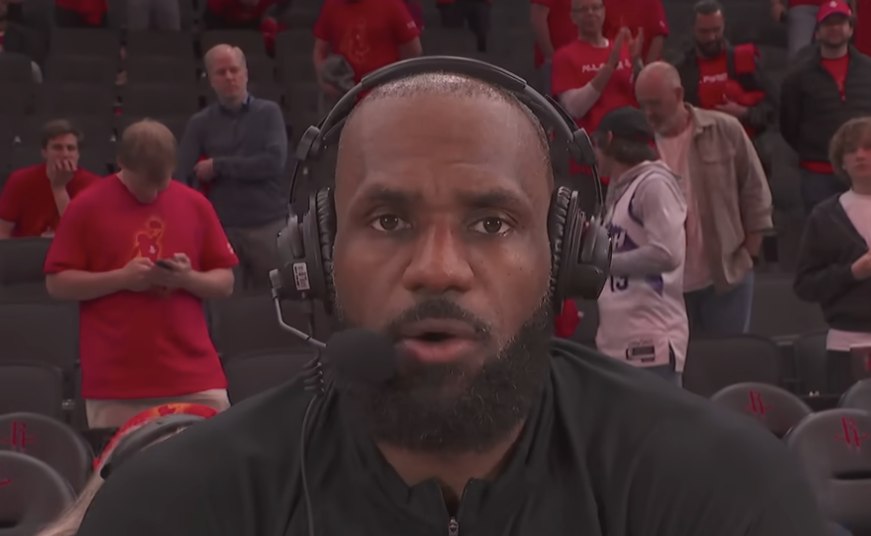
James, at 41, continues defying age with remarkable playoff performances. In the Lakers’ first-round series against Houston, he averaged 28 points, eight assists and seven rebounds while carrying a depleted roster without Luka Doncic. His basketball IQ, leadership and ability to elevate teammates remain unmatched. Against a Timberwolves team missing its primary offensive engine, James could exploit defensive lapses and create mismatches, particularly if Minnesota’s focus shifts toward containing Austin Reaves and Rui Hachimura.
The Lakers-Timberwolves matchup has been competitive in recent seasons. Minnesota swept the regular-season series this year, but those games featured a healthy Edwards. Without him, the Timberwolves’ offense loses its explosive transition threat and isolation scoring. Edwards’ gravity as a scorer forces defenses to collapse, opening driving lanes and three-point opportunities for teammates. His absence places heavier offensive responsibility on Randle, who has stepped up admirably but lacks Edwards’ burst and perimeter creation.
Advertisement
Defensively, the Timberwolves remain elite. Rudy Gobert anchors the paint, while Jaden McDaniels and others provide versatile wing defense. Even without Edwards, Minnesota can disrupt opposing offenses through length and physicality. The Lakers will need strong ball movement and spacing to counter that pressure. James’ playmaking becomes even more critical, as he must orchestrate the offense while also shouldering scoring duties against a defense designed to limit star players.
Coaching adjustments will be pivotal. Lakers coach JJ Redick has shown creativity in lineup construction during the postseason. Expect increased minutes for Reaves as a secondary creator and potential small-ball looks featuring James at point guard. On the other side, Finch must find ways to replace Edwards’ scoring without overtaxing Randle or relying too heavily on bench production. The Timberwolves’ depth, built through smart drafting and development, will be tested.
Historical precedent favors experience in high-stakes scenarios. James has thrived as an underdog throughout his career, including memorable playoff runs with lesser supporting casts. His basketball IQ allows him to adapt mid-series, exploiting weaknesses and elevating teammates. However, the Timberwolves’ youth and defensive identity could wear down the older Lakers roster over a seven-game series.
Injury timelines add uncertainty. Edwards’ bone bruise typically requires two to six weeks of recovery. A return in the middle of a series could swing momentum dramatically, especially if Minnesota advances past the early games. The Lakers must treat every contest as potentially Edwards-free, preparing schemes that neutralize Gobert’s rim protection and Randle’s versatility.
Advertisement
Fan and analyst reaction has been mixed. Some view the Lakers as having a realistic chance to steal a series without Edwards, citing James’ playoff pedigree and Minnesota’s occasional offensive stagnation. Others point to the Timberwolves’ defensive strength and home-court advantage as decisive factors. Betting markets have shifted slightly toward Minnesota but reflect uncertainty around Edwards’ status.
Beyond X’s and O’s, the series carries narrative weight. James potentially in the final chapters of his legendary career faces a young, hungry Timberwolves squad looking to establish itself as a Western Conference power. A Lakers upset would rank among James’ greatest achievements, while a Minnesota victory without Edwards would reinforce the team’s depth and defensive identity.
The Western Conference landscape adds context. Both teams have championship aspirations, but injuries have complicated paths. The Lakers advanced past Houston without Doncic, showcasing resilience. Minnesota handled Denver despite Edwards’ limited availability in later games. Their potential meeting would test which roster is better equipped to overcome adversity.
As the NBA postseason intensifies, the James-versus-Timberwolves-without-Edwards scenario offers compelling drama. James has made a career of defying odds, but Minnesota’s defensive structure and collective talent provide a stiff test. The coming days will reveal whether experience and leadership can overcome youth and depth in a critical playoff matchup.
Advertisement
For now, the Timberwolves hold the edge on paper, but James’ presence ensures nothing is guaranteed. Basketball fans everywhere will watch closely to see if the King can engineer another improbable run or if Minnesota’s pack defense proves too much to handle without its young star leading the charge.
Thailand’s economy grew in Q1 due to strong demand and supply, but signs of Middle East conflict impacts emerged, notably declining tourism and exports, alongside rising fuel imports and softening private consumption.
Summary
Thailand’s economy expanded in the first quarter, supported by both demand and supply side factors, reflecting favorable economic conditions prior to the escalation of the Middle East conflict. In March, overall economic activity stabilized from the previous month. – Merchandise exports and manufacturing production continued to increase, alongside an expansion in government expenditure. – Early signs of economic impact from the Middle East conflict has begun to emerge. Tourist arrivals from the Middle East and Europe have declined sharply, exports to the Middle East and Europe contracted significantly, and fuel imports increased as firms accelerated sourcing from alternative suppliers. Private consumption also softened, particularly in hotels and restaurants, despite some front-loaded spending on fuel amid concerns over rising prices.
Headline inflation moved closer to zero from negative territory in the previous month, driven mainly by energy prices. Core inflation remained positive and broadly unchanged, suggesting limited pass‑through of cost pressures to consumer prices.
Key issues to monitor: (1) Middle East conflict developments, (2) the extent to which businesses and households can adapt, (3) government economic stimulus measures, and (4) potential shifts in U.S. trade policy.
Thailand’s economy experienced growth in the first quarter, driven by both demand and supply-side factors. On the demand side, merchandise exports, excluding gold, continued to rise, particularly in technology-related products. Domestic demand strengthened as private consumption increased, supported by accelerated vehicle deliveries following the expiration of the EV 3.0 scheme and heightened fuel purchases toward the end of the quarter due to concerns over potential price hikes. Additionally, private investment grew, primarily in machinery and equipment, complemented by an uptick in government spending.
On the supply side, manufacturing output rose, driven by increased petroleum production following extensive refinery maintenance in the previous quarter and capacity expansions by major chemical firms. The services sector also grew, primarily fueled by trade-related activities aligned with higher production and exports. However, late in the quarter, the economy faced challenges from the Middle East conflict, resulting in a significant drop in exports to the region and a decline in foreign tourist arrivals, particularly from the Middle East and Europe.
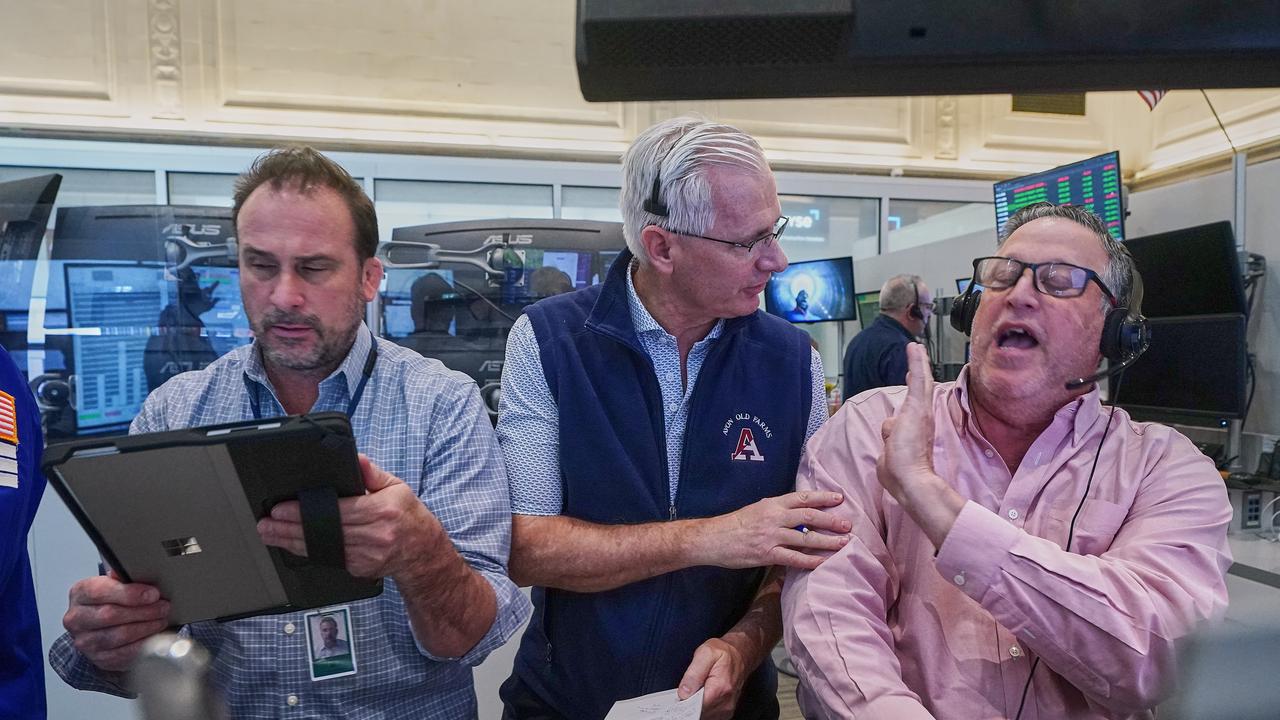
Wall Street has ended lower, with the S&P 500 retreating from record highs, after a South Korean ship was hit by an explosion in the Strait of Hormuz and Iran demonstrated its grip on Middle East oil.
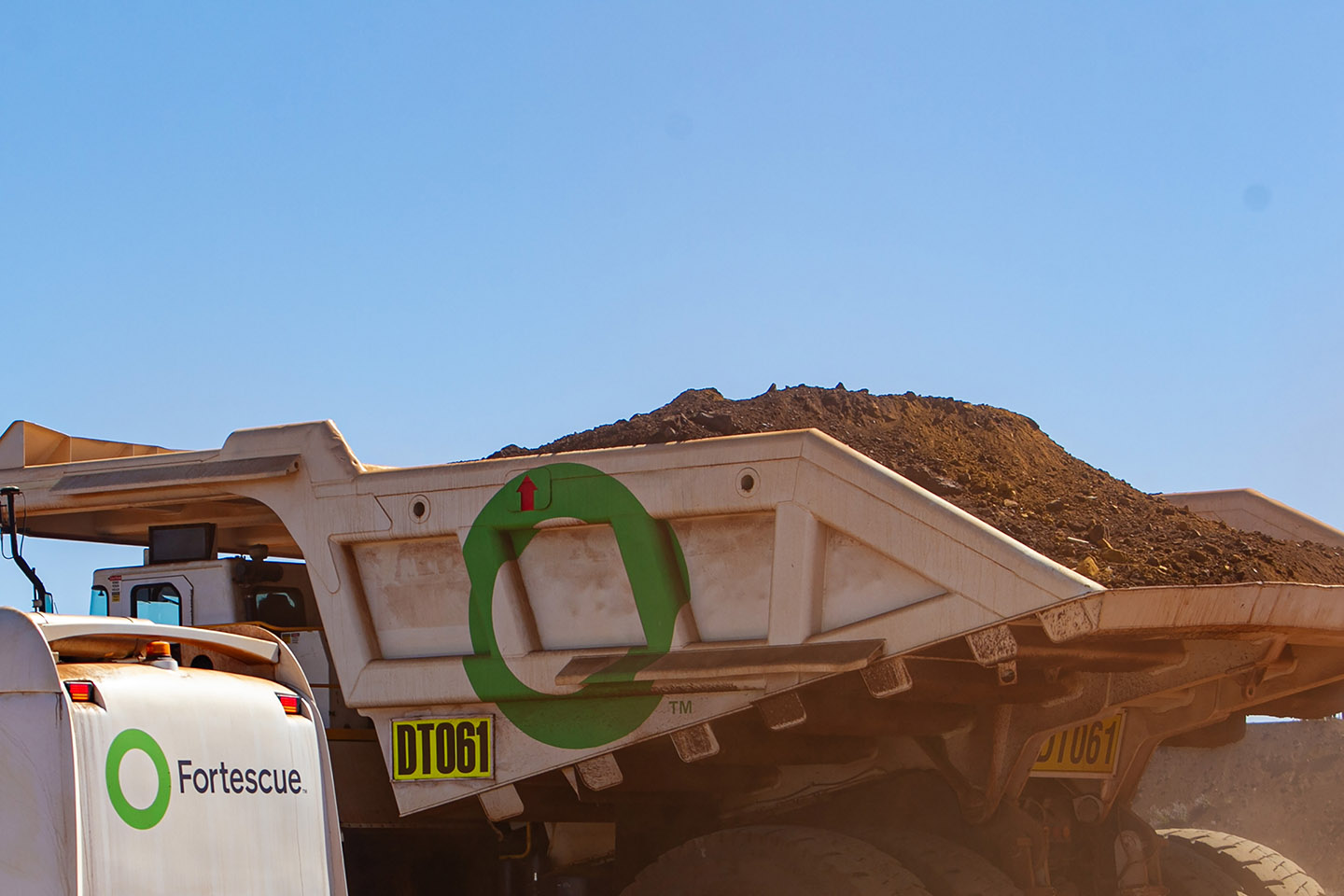
Fortescue is laying the groundwork for a major green iron plant in the Pilbara backed by hydrogen to be produced by as much as 6 gigawatts of renewable energy.














































You must be logged in to post a comment Login