

Business
PepsiCo (PEP) Q2 2026 earnings



PepsiCo on Thursday reported mixed quarterly results as the struggles of its North American food and beverage divisions offset strong international demand.
“Results were tempered in the quarter as U.S. food and beverage category performance moderated with consumer budgets tightening due to rising inflationary pressures,” CEO Ramon Laguarta said in prepared remarks shared on the company’s website on Thursday.
During Pepsi’s second quarter, global oil prices swung dramatically due to the U.S. war with Iran. In the U.S., the national average gas price hit a four-year high of $4.56 per gallon in late May, leading many shoppers to watch their spending.
Shares of Pepsi were down more than 4% in morning trading.
Pepsi soft drinks are displayed at a convenience store in San Francisco, California.
Justin Sullivan | Getty Images
Here’s what the company reported for the quarter ended June 13 compared with what Wall Street was expecting, based on a survey of analysts by LSEG:
- Earnings per share: $2.20 adjusted vs. $2.21 expected
- Revenue: $24.18 billion vs. $23.95 billion expected
Pepsi reported second-quarter net income attributable to the company of $2.98 billion, or $2.18 per share, up from $1.26 billion, or 92 cents per share, a year earlier.
Excluding restructuring and impairment charges and other items, the company earned $2.20 per share.
Net sales rose 6.4% to $24.18 billion. Organic revenue, which excludes acquisitions, divestitures and foreign currency, increased 2.4% in the quarter.
Globally, volume for Pepsi’s food increased 3%, while volume for its beverages rose 2%. The metric excludes pricing and foreign exchange fluctuations to reflect demand more accurately.
But Pepsi’s volume growth came from its international markets. Demand was much weaker domestically. Its North American food business reported flat volume for the quarter, and its North American beverage division saw volume drop 4%.
“I think the consumer is worse than what we had anticipated, and it’s driven mainly by gas prices,” Laguarta said on the company’s earnings conference call.
Demand was particularly weak at convenience stores.
“We need to see some improvement in the in the convenience and gas channel, and hopefully we’ll get some tailwinds from gas prices to do that,” CFO Steve Schmitt said.
Over the last two years, both North American segments have seen weaker demand as a result of higher prices. In February, Pepsi cut prices on Lay’s, Tostitos, Doritos and Cheetos by as much as 15% to try to win back shoppers. The company has also been “restaging” some of its iconic brands, like Gatorade and Lay’s, with fresh branding to boost their sales.
Pepsi expects that its North American volumes will recover, but that will take time, particularly after this quarter’s setback.
“Our North America business was softer than we anticipated in the second quarter, and we now expect a more gradual improvement in performance trends for the balance of this year,” Schmitt said in his prepared remarks.
For the full year, Pepsi reiterated its prior forecast that organic revenue will rise between 2% and 4% and core constant currency earnings per share will increase in a range of 4% to 6%.


Check out what’s clicking on FoxBusiness.com.
Kia is issuing a new recall of more than 460,000 vehicles over a fire risk after an earlier recall affecting the same vehicles failed to resolve the problem, according to federal regulators.
The recall affects 462,869 Kia Telluride vehicles from the model years 2020-2024, the National Highway Traffic Safety Administration announced Thursday.
Owners are instructed to park outside and away from other cars and buildings due to a risk of fire while driving or parked.
HONDA RECALLING MORE THAN 325,000 VEHICLES OVER POTENTIAL CRASH RISK

The recall affects 462,869 Kia Telluride vehicles from model years 2020-2024. (Getty Images / Getty Images)
The same vehicles were previously recalled in 2024 for the same issue.
If the front power seat slide cover or knob is hit or accidentally struck, the switch can be dislodged, misaligned or damaged, making the seat motor continue to run and causing overheating.

The same vehicles were previously recalled in 2024 for the same issue. (iStock / iStock)
An improper repair under the previous recall also may lead to the motor overheating and catching fire.
Seven seat fires and 11 cases of seat motors melting have been reported.
FORD RECALLS MORE THAN 110,000 MUSTANG VEHICLES OVER WINDSHIELD WIPER, DRIVETRAIN DEFECTS
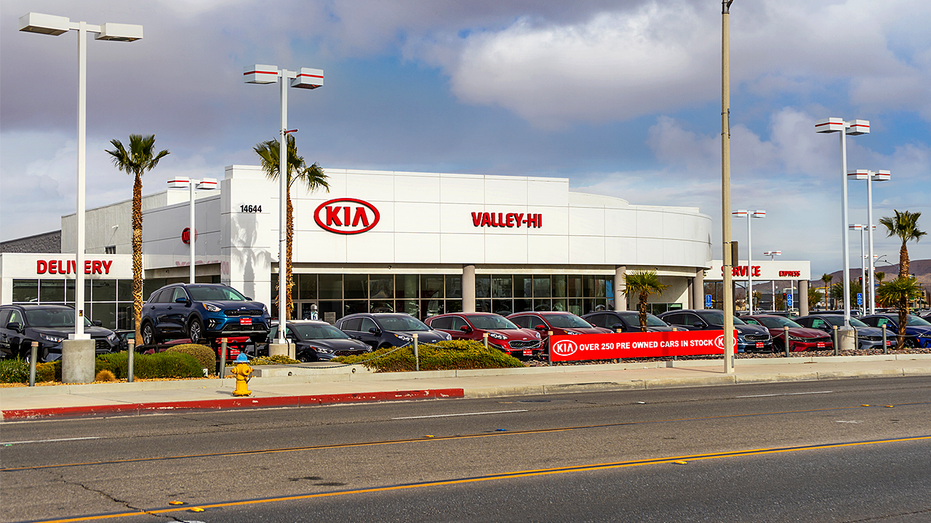
Seven seat fires and 11 cases of seat motors melting have been reported. (Getty Images / Getty Images)
CLICK HERE TO GET FOX BUSINESS ON THE GO
Owner notification letters will be sent out Aug. 13.
Owners can then take their vehicles to a Kia dealer, where an electronic fuse assembly will be installed to prevent continuous operation of the seat motor if the seat switch becomes dislodged, internally misaligned or otherwise damaged.

A welcoming sign at Palm Beach International Airport, as it is renamed as “President Donald J. Trump International Airport,” in West Palm Beach, Florida, U.S., July 9, 2026.
Marco Bello | Reuters
The airport in West Palm Beach, Florida, has officially been renamed after President Donald Trump, the first time an airport has been named after a sitting U.S. president.
Effective Thursday, the facility will be called the President Donald J. Trump International Airport, the Federal Aviation Administration said.
The airport — formerly known as Palm Beach International Airport — said in an FAQ posted online that “updates to signage, branding and public‑facing materials, will occur in phases.”
As part of the transition, the airport’s FAA locational identifier will change from PBI to DJT. The International Air Transport Association code change is set to occur on Aug. 18.
Major U.S. carriers including United Airlines and Delta Air Lines began putting the new airport “DJT” code on their booking pages on Thursday, though consumers searching for flights can still use the old “PBI” code to find the airport.
More than a dozen airlines fly into the facility, including domestic leaders Delta, United, American Airlines and Southwest Airlines.
The fresh branding comes after Florida Gov. Ron DeSantis signed a bill into law earlier this year to change the name of the airport. The move was later approved by the FAA.
The name change is estimated to cost $5.5 million, the airport said.
The state of Florida appropriated $2.75 million toward the project, according to the airport’s FAQ, and the remaining costs for the transition will be funded through the local Department of Airports’ operating budget and capital improvement program.
“While we recognize that the required name change may be received in different ways by our passengers, we’re grateful for your continued support through this transition period,” the airport wrote in the FAQ. “While some things may evolve over time, our core focus remains the same: providing a safe, reliable and welcoming airport experience.”
The airport is near the president’s Mar-a-Lago club in Palm Beach, Florida, and he flies in and out of it fairly often.
The president’s son Eric Trump said Trump Force One — the nickname for the private jet owned by the Trump Organization — would be the first plane to land at the newly renamed airport.
“As a son, and someone who flies out of this airport nearly every day, I will forever be proud to see the initials ‘DJT’ on my boarding pass,” he wrote on X.

The entity, which declared a price band of Rs 545-574 per share for the initial public offering, is looking to double the international book to USD 5 billion in three years from the present USD 2.5 billion as part of a revenue augmentation plan, a top official told PTI.
Citing the valuation sought by the fund house as seen from the pricing of the issue and conversations with larger investors, the company’s Managing Director and Chief Executive Debasish Mishra said the buzz has been good around the issue and the possibility of making good returns will attract investors.
“The market could be volatile, uncertain but a trust is always certain. So, that trust of the confidence of customers who are in the market (will help the IPO),” Mishra told PTI.
It can be noted that after a very strong FY25 which witnessed record issuances, IPO fundraisings have been lackluster since the beginning of the US-Israel campaign against Iran in late February.

SBI MF’s issue is one of the largest in recent times, and is set to be succeeded by mega issuances from largest stock bourse NSE and telco Jio Platforms.
Asked about the revenues being lower than the second largest fund house, the management explained that this is because of managing EPFO (Employee Provident Fund Office) money, where it makes a thinner revenue, but added that newer revenue streams are being chased along with reducing the share of EPFO money in the overall AUM.Mishra said the overall assets under management (AUM) of the company is over Rs 13 lakh crore, of which over Rs 3 lakh crore is EPFO money. Deputy MD and Joint CEO D P Singh said the fund house used to manage 75 per cent of EPFO’s money earlier, which has come down to 26 per cent.
Regulatory restrictions on forms of business had restricted it from launching a portfolio management scheme for long but now the company has entered after a clarification from the RBI, he said, adding that international business is also very important.
SBI MF has an international book of USD 2.5 billion at present and is aiming to double the same to USD 5 billion in the next three years as part of the strategy, Singh said, adding that it will carry this along with its joint venture partner Amundi, which has good presence globally and also by deploying staff in financial centres like New York, London, Hong Kong, and Singapore.
Apart from this, it is also looking at the alternates business very seriously, and may also be open for growing in the line through an acquisition, Singh said.
Mishra chipped-in that the focus of the company generally is to grow organically but it will not hesitate if an opportunity comes. He made it clear that at present, there is no proposal on acquisition.
Singh said more than a fifth of the overall sales for the company come from parent SBI, and stressed that there are no concerns on misspelling as the largest lender in the country sells the safer hybrid schemes the most.
As for the IPO issue, the management exuded confidence that in the next 3-4 days, it will come out with multiple large names who will be investing in the company through the IPO.

The company said direct mutual funds are “the heart of Groww” and that its existing mutual fund investors will see no change in plans, pricing or experience. Groww said more than 1 crore investors have built over Rs 1.9 lakh crore of mutual fund investments on its platform, making it the largest mutual fund platform in the country.
“For every DIY investor, Groww stays exactly what it has always been: direct, zero-commission, and free. Forever,” the company said. It added that it will continue to launch new features for direct mutual fund investors.
Also Read: Zerodha will keep direct mutual fund plans for free, says Nithin Kamath
The response came after Kamath said Zerodha would continue to offer direct mutual funds for free through Coin. He had said that when Zerodha started the discount broking model in India in 2010, it decided to charge the same fee regardless of trade size because the effort to execute a trade was the same. He said the same logic was applied to mutual funds, and Zerodha did not launch mutual funds until it could offer only direct plans.
Kamath had also said that most direct mutual fund platforms that started around the time Zerodha launched Coin had either disappeared, changed direction or were rethinking their choice of offering direct plans. He added that Zerodha would continue to offer direct mutual funds for free.
Groww, without naming Zerodha or Kamath, said there had been “confusion” and “misinformation” about its mutual fund offering. It clarified that MF Prime is not a shift away from direct mutual funds, but an additional product for a different set of investors.”MF Prime is not a shift. It is an addition — a fully opt-in product for a different cohort: investors who want research-backed guidance on what to buy, hold, exit, and rebalance,” Groww said.
The company said many investors wanted to invest through Groww but held back because they needed help. MF Prime is meant for such users, it said.
“If you are a DIY customer on Groww today, nothing changes for you. Not the plans, not the pricing, not the experience,” Groww said. “Any commentary claiming Groww has changed its approach to mutual fund investing is simply incorrect.”


I am a specialist in Asian equities after having been a sellside analyst for 13 years. In addition, I have also spent time covering US hardware and semiconductor stocks on the sellside. Within Asia, I have covered the casino, automotive, industrial, consumer and technology sectors. I have also worked on the buyside as a fund manager in long only and as an analyst in hedge funds all covering Asian equities where I have developed a keen understanding of Asian companies and economies with a focus on China. From a global equities perspective, I enjoy covering companies globally by examining key metrics such as financial statements strength, valuation upside, and conducting proper analysis of the competitive advantages of the company. Throughout my career, I have found and written on undiscovered small cap companies which have increased in equity value by multiple times. I would like to write for Seeking Alpha where my goal is to help investors cut through the noise and to focus on fundamentals and the company’s competitive outlook instead of the momentum trade.
Analyst’s Disclosure: I/we have no stock, option or similar derivative position in any of the companies mentioned, and no plans to initiate any such positions within the next 72 hours. I wrote this article myself, and it expresses my own opinions. I am not receiving compensation for it (other than from Seeking Alpha). I have no business relationship with any company whose stock is mentioned in this article.
Seeking Alpha’s Disclosure: Past performance is no guarantee of future results. No recommendation or advice is being given as to whether any investment is suitable for a particular investor. Any views or opinions expressed above may not reflect those of Seeking Alpha as a whole. Seeking Alpha is not a licensed securities dealer, broker or US investment adviser or investment bank. Our analysts are third party authors that include both professional investors and individual investors who may not be licensed or certified by any institute or regulatory body.


Julian Lin is a financial analyst. He finds undervalued companies with secular growth that appreciate over time. His approach is to look for companies with strong balance sheets and management teams in sectors with long growth runways.
Julian is the leader of the investing group Best Of Breed Growth Stocks where he only shares positions in stocks which have a large probability of delivering large alpha relative to the S&P 500. He also combines growth-oriented principles with strict valuation hurdles to add an additional layer to the conventional margin of safety. Features include: exclusive access to Julian’s highest conviction picks, full stock research reports, real-time trade alerts, macro market analysis, individual industry reports, a filtered watchlist, and community chat with access to Julian 24/7. Learn more.
Analyst’s Disclosure: I/we have a beneficial long position in the shares of DUOL either through stock ownership, options, or other derivatives. I wrote this article myself, and it expresses my own opinions. I am not receiving compensation for it (other than from Seeking Alpha). I have no business relationship with any company whose stock is mentioned in this article.
Seeking Alpha’s Disclosure: Past performance is no guarantee of future results. No recommendation or advice is being given as to whether any investment is suitable for a particular investor. Any views or opinions expressed above may not reflect those of Seeking Alpha as a whole. Seeking Alpha is not a licensed securities dealer, broker or US investment adviser or investment bank. Our analysts are third party authors that include both professional investors and individual investors who may not be licensed or certified by any institute or regulatory body.

Oil prices settle 2% lower as economic worries outweigh supply risks

He said that productivity, which measures how efficiently people work, has slowed down in the UK.
It is also a particular problem in Wales where it is the lowest of the four home nations and around 15 percent lower than the UK average, external.
People in Wales also earn lower wages than the UK average, and the country has some of the highest rates of welfare claims.
Pill said improving the efficiency of the Welsh economy is the key to raising living standards.
Things like better infrastructure “to link places together” and creating “a better educated workforce” are recognised drivers of productivity.
But he acknowledged that it is “a very difficult thing to deliver” in an uncertain world, where “public finances are constrained” and politicians face “hard decisions”.
Before joining the Bank of England, Pill previously worked at the European Central Bank from its inception through to the Eurozone crisis, when the survival of the single currency was in jeopardy.
He said the ability of a central bank to set interest rates and print money were powerful tools, but they were also blunt tools.
“It doesn’t allow you to solve all problems,” he said.
Pill said countries like Greece, Spain Portugal and Ireland had to go through “a lot of pain”, with politicians making “difficult decisions” about changing their economies.
But “they have come out the other side in stronger shape,” he argued.

Earnings call transcript: Richelieu Hardware Q2 2026 misses estimates as shares fall

Japanese companies are lining up more than £18 billion of investment in British wind farms, infrastructure and financial services. But HMRC’s treatment of visa paperwork and Japanese health insurance risks souring the relationship before the money lands, a leading tax firm has cautioned.
Blick Rothenberg, the audit, tax and business advisory firm, says the Government and HMRC should take further steps to attract and retain Japanese businesses rather than adding to the cost of employing their staff here.
Aliona Le Khak, who has joined the firm as a Director leading Global Mobility services for Japanese clients, said: “To remain competitive on the global stage, the UK needs to ensure that its tax and regulatory frameworks support, rather than deter, inward Japanese investment. Especially in light of the announcement that Japanese firms will invest up to £9bn in UK offshore wind farms and more than £9bn in UK infrastructure and financial services.”
Her warning follows last month’s Downing Street summit with Japanese prime minister Sanae Takaichi, at which the Government trumpeted agreements expected to deliver more than £18 billion in economic gains and tens of thousands of new jobs.
Chief among the irritants is the Certificate of Sponsorship (CoS), a regulatory requirement placed on employers who hire overseas workers. HMRC has clarified that the cost of obtaining one should be treated as a taxable Benefit in Kind (BIK), even though the obligation falls on the employer, not the employee.
“Given that visa-related costs are already significant, and often subject to tax gross-up, this treatment further increases the financial burden on Japanese employers expanding into the UK,” Le Khak said.
She added: “Visa costs, including CoS are not taxable when assignees come to the UK for the first time, but if an assignee who is already located in the UK applies for a visa for the first time or applies for a visa extension, it is fully taxable. The Government should consider whether HMRC’s position on CoS is reasonable. The definition of BIK is a non-cash benefit provided to an employee by an employer that holds a monetary value – except a CoS provides no direct benefit to the employee and arguably does not hold a monetary value.”
A second row concerns Kenko Hoken, the employer premiums that form part of Japan’s social security system, which HMRC is seeking to tax in the UK despite assignees typically holding private medical cover while here.
“These premiums do not relate to any tangible UK-based benefit,” Le Khak said. “The Government should again consider if HMRC’s position is reasonable and weigh up the short-term benefit of additional tax take verses the long-term benefits of encouraging international expansion and investment.”
The stakes go beyond two technical disputes. “In recent years, Brexit and the increasing tax burden associated with employing expatriate assignees in the UK has contributed to a noticeable decline in the expatriate workforce across the board,” she said, adding that “many multinational companies are now more inclined to redirect investment and operations to alternative locations, including nearby EU countries that offer more favourable tax regimes for expatriates and lower employment costs.”
It is a familiar refrain. Advisers have previously warned that an expat exit tax could drive foreign investment away from the UK, and an estimated 1,800 non-doms quit the country within months of the April 2025 reforms. Yet the appetite from Tokyo is plainly there: Japanese investors poured almost £118 million into Greater Manchester in a single year.
“This risks undermining the UK’s attractiveness as a destination for international business,” Le Khak said. “Increased costs and uncertainty in tax treatment may prompt companies to reconsider further expansion in the UK.”

Jamie Young
Jamie is Senior Reporter at Business Matters, bringing over a decade of experience in UK SME business reporting.
Jamie holds a degree in Business Administration and regularly participates in industry conferences and workshops.
When not reporting on the latest business developments, Jamie is passionate about mentoring up-and-coming journalists and entrepreneurs to inspire the next generation of business leaders.

XRP price rises as SWIFT taps Ripple-linked banks for blockchain payments

Justin Baldoni, Wife ‘More Devoted’ in Faith After Lawsuit
6 Audi Engines You Should Steer Clear Of


-

 Fashion6 days ago
Weekend Open Thread: High Hopes
-
 NewsBeat5 days ago
Taylor Swift and Travis Kelce wedding staffer hilariously struggles to keep her cool while checking in megastars
-

 Crypto World6 days ago
Standard Chartered Secures MiCA License as ESMA Adds 37 New Crypto Firms
-

 Fashion3 days ago
Open Thread: What Great Books Have You Read Recently?
-

 Politics6 days ago
The House | “Reframing the debate from a binary discussion of winners and losers”: Yuan Yang reviews ‘We Are Not Machines’
-

 Fashion9 hours ago
Loro Piana Fall 2026 Enters Houston’s Art Scene
-

 News Videos3 days ago
Whats Hidden Inside This Cash Register? #treasure #reselling #money
-
 Tech2 days ago
Anthropic’s new “J-lens” reveals a silent workspace inside Claude that mirrors a leading theory of consciousness
-
 Crypto World6 days ago
ESMA Expands Crypto Register by 37 Firms Following MiCA Transition Period
-

 Business3 days ago
AXT Shares Jump Nearly 14% as Semiconductor Materials Maker Rebounds on AI-Linked Indium Phosphide Demand
-

 Sports2 days ago
Joshua Pacio ‘more complete’ ahead of ONE rematch vs Malachiev
-
Crypto World3 days ago
SK hynix (000660.KS) Stock Dips as $28B Nasdaq ADR Offering Drives AI Memory Expansion
-

 Crypto World4 days ago
South Africa proposes crypto tax guidance under existing rules
-

 News Videos3 days ago
Best Time to Enter Small Caps Right Now? Another Bull Run? | Financially Free
-

 Tech4 days ago
Lenovo laptops are now shipping with YMTC SSDs, a sign of Chinese NAND entering the mainstream
-

 Business7 days ago
What a 10 Percent Drop Means for Buyers, Sellers and Renters
-
Sports2 days ago
We have punished the disrespect
-

 Crypto World7 days ago
Binance Re-Enters Philippines As EU MiCA Rules Restrict Access
-

 News Videos3 days ago
Avoid entering in FOMO #bitcoin #cryptocurrency #trading #scalping
-

 Crypto World7 days ago
Alibaba bans Claude Code over alleged backdoor security concerns
You must be logged in to post a comment Login