Lanchester Garden Centre on Bargate Bank boasts an almost perfect rating of 4.5 stars from nearly 4,000 reviews on Google.
Within the garden centre is Potter’s World which describes itself as the “North East’s hidden gem.”
The attraction is home to exotic free-flying birds, reptiles, amphibians, and two tortoises called Hermione and Herman.
It holds educational experiences where children can meet and interact with the animals.
Advertisement
One reviewer said: “Potters World with the birds and animals is amazing. They’re all so well looked after too”.
One of the biggest draws appears to be the play area.
A review said: “Nice place to visit, great garden centre and small animals to see.
“Lovely play area for the kids and plenty of outdoor seating.”
Advertisement
The garden centre announced that they had been specially selected as an official Jellycat Seeker Store on social media this week (July 6).
They have become an official Jellycat Seeker Store. (Image: EMMA FOSTER)
They said: “Only a handful of independent stores across the country are chosen for this, and it means some very special Jellycat characters will be quietly perched on our shelves, waiting for the right person to spot them.
“A few old pals have crept out of hibernation — and not a moment too soon.
“After snoozing for quite a while, these unforgettable Jellycat favourites have decided it’s time for a new adventure… and they’ve chosen Lanchester Garden Centre as one of their special UK hideouts.
Advertisement
“We’re expecting our very first Seekers delivery any time soon — bringing with it a mix of rare returners, old favourites, and magical little characters who’ve been hiding away for far too long.”
Emma Foster, the garden centre’s general manager, said: “We were over the moon to be chosen.
“We work very closely with our rep and Jellycat have very strict protocols, so they only select people who they feel are married to the brand and match their concept and ethos.
“We’ve had a huge response.
Advertisement
“This has definitely reignited a passion for finding those little quirky, unusual pieces that not everybody will have.”
The centre also includes The Greenhouse Restaurant which serves afternoon tea, a full English, and Sunday lunches.
One person commented: “The restaurant is very nice.
“I got an afternoon tea, and my husband got fish and chips.
Advertisement
“The food was so good, it finished the day off perfectly.”
The garden centre offers a wide range of products including plants, outdoor furniture, paving, and tropical fish.
Andy Burnham’s first cabinet includes four ministers from visible ethnic minority backgrounds: home secretary Shabana Mahmood, energy security secretary Miatta Fahnbulleh, AI minister Kanishka Narayan, and Lisa Nandy as culture secretary. A decade ago, this team alone would probably have generated headlines. Now, it has barely registered.
This silence on the makeup of the cabinet tells us something important about ethnic diversity in British politics. We have entered what might be called the “post-first” era of minority representation. For the past 40 years, the politics of representation revolved around one question: could ethnic minorities reach the highest levels of political office?
The election of Diane Abbott, Bernie Grant, Paul Boateng and Keith Vaz in 1987 transformed British politics because it challenged assumptions about who belonged in parliament. Later came a succession of symbolic milestones: Britain’s first Muslim MP (Mohammad Sarwar), first Black cabinet minister (Paul Boateng), first British Asian home secretary (Sajid Javid) and first British Asian and Hindu prime minister (Rishi Sunak).
Political scientists call this “descriptive representation” – the idea that elected institutions should broadly reflect the populations they govern. These “firsts” mattered because they widened ideas of belonging. And they demonstrated that public office was open to people who had previously been excluded.
Advertisement
Beyond ethnicity
As more ethnic minority politicians entered parliament – and government – diversity became increasingly normalised. Cabinet appointments were no longer remarkable simply because of a minister’s ethnicity. Minority politicians became part of the establishment, occupying senior positions and taking on some of the most contentious policy areas.
One of the defining features of this period was that minority politicians increasingly fronted politically difficult agendas. Javid, Priti Patel and Suella Braverman became the face of tough immigration and asylum policies under Conservative governments. Under Labour, Mahmood also became associated with the government’s tougher approach to immigration, publicly defending aspects of the policy and becoming one of its most prominent advocates. This included overseeing a more restrictive approach to the rules governing entry to the UK.
Minority politicians were no longer valued solely for the symbolic message their appointments conveyed. They were increasingly entrusted with, and publicly identified with, some of the trickiest areas of government.
Today, Britain appears to have entered a new stage. The defining feature of the “post-first” era is that ethnicity has ceased to be a predictor of ideology.
Advertisement
For many years, debates about representation often assumed that greater ethnic diversity would lead to more progressive politics. Yet today’s political landscape tells a very different story.
Minority politicians can be found across the ideological spectrum. Your Party MP Zarah Sultana represents an insurgent left politics. Mahmood sits firmly within Labour’s more socially conservative and fiscally cautious tradition. Kemi Badenoch is leading the right-of-centre Conservative Party. And Zia Yusuf has become one of the most prominent figures within the right-wing populist Reform UK.
Reform UK’s home affairs spokesman Zia Yusuf has argued for tighter controls on immigration. EPA/ADAM VAUGHAN
Ethnicity tells us remarkably little about where politicians stand on immigration, taxation, foreign policy or the role of the state. They disagree with one another as profoundly as their white colleagues do.
Advertisement
This reflects a broader transformation in British democracy. Minority politicians are increasingly judged as politicians first. Their careers rise or fall because of competence, ideology and electoral appeal, rather than the communities they come from.
The 2024 general election demonstrated this particularly clearly. In several constituencies with large Muslim electorates, Muslim Labour candidates lost support despite sharing the ethnic and religious backgrounds of many of their constituents. Instead, many voters backed independent candidates whose position on Gaza more closely aligned with their own.
The election illustrated that descriptive representation alone was no longer sufficient. Substantive representation had become the decisive consideration for many voters.
The question is not whether a Conservative or Reform government would reverse gains made for minority representation. That seems unlikely. Ethnic minority politicians now occupy senior positions across every major political party. The era in which ethnic minority representation was itself the story has largely passed. The more important issue now is the politics those representatives pursue.
Advertisement
A more significant challenge is what minority representation will mean in the future. A diverse cabinet can still pursue policies that many minority communities oppose. Inclusion at the top no longer guarantees substantive representation below.
That is the defining political challenge of Britain’s “post-first” era. The politics of representation have moved beyond celebrating symbolic milestones. The politics of the “first” have given way to the politics of governing. The central question is no longer who gets into the room, but what they do once they are there.
York Maze will host the edible spectacle on Saturday, August 1, as part of its annual Yorkshire Day celebrations.
The event will feature the county’s hero YorkshireMan, who will walk a narrow beam above what’s billed as the world’s biggest Lancashire hotpot before diving into a giant, gravy-filled Yorkshire pudding.
Recommended reading:
Speaking about this, Yorkshireman said: “In recent years I’ve celebrated Yorkshire Day at York Maze by diving into the world’s biggest mug of Yorkshire tea.
Advertisement
“I’ve plunged into a giant Yorkshire pudding filled with gravy, and this year I’m risking it all by attempting to walk a narrow beam above a steaming bowl of Lancashire hotpot.
“As everyone knows, Lancashire hotpot is poisonous to Yorkshireman, so I have a giant Yorkshire pudding filled with gravy to dive into as the antidote in case I do come into contact with the Lancashire hotpot.”
Yorkshireman before the big dive in 2025 (Image: York Maze)
The Yorkshire pudding measures more than six feet across and holds 2,000 litres of gravy, while the hotpot is of similar size and topped with giant potato slices.
The fun begins at 1pm with a Yorkshire pudding tossing competition.
Advertisement
The child and adult with the biggest throws will be crowned the winners.
The main event with Yorkshireman will take place from 2.45pm.
God’s own Yorkshireman (Image: York Maze)
York Maze staff will also don flat caps, and visitors who wear one on the day will be treated to a complimentary mug of Yorkshire Tea.
Entertainment will be provided by the New York Brass Band, and a face painter will be on hand to decorate visitors’ cheeks with the Yorkshire Rose.
It comes as health bosses said that the number of attendances at Scarborough Hospital this week “far outstripped anything that has ever been seen before” at this time of year.
Clare Smith, chief executive of the York and Scarborough Teaching Hospitals NHS Foundation Trust, said: “The numbers that were seen on Monday far outstripped anything that we’d ever seen before at Scarborough Hospital, which placed it under significant pressure.”
Advertisement
“Of course, it’s the time of year where we have a lot more visitors to Scarborough and to Bridlington and those types of areas,” she added at a meeting of the trust’s board of directors on Wednesday, July 29.
She added: “There have been significant challenges across our sites over the last few weeks, with really, really high levels of attendance.”
Advertisement
It comes as the number of 12-hour trolley waits increased in both May and June across the trust’s emergency departments, after figures had fallen between February and April.
Commenting on Facebook, one resident said: “Honestly, I feel for the doctors and nurses – they all look so stressed. I’ve been there over the past four days with a family member who has been unwell, and the staff are doing an amazing job with how they treat the patients.
Advertisement
“But there are so many people who go up to hospital, who could’ve gone to the GP if there was a chance to actually get an appointment.”
They added: “GP surgeries need to be fixed up because the hospital is taking on the strain of multiple services failing people.”
Advertisement
Rachel said: “I work in A&E, and all I can do is apologise to everyone who has had a negative experience; we are so overwhelmed, as you can see.
“We are all working tirelessly to do our clinical jobs that have to be prioritised. If we don’t get back to you it’s definitely not intentional; we are just so so busy.
Advertisement
“But the staff that are on, I promise you, are doing their very best to get to you.”
Scarborough Hospital. Courtesy Numminen/Ldrs
Commenting on social media, a Whitby resident said: “We live in Whitby, but our minor unit shuts at 8pm, so then it’s a trip to Scarborough. Most of the time it’s a minimum of a four-hour wait, but I have often been there until the following morning.”
Advertisement
Mel said: “I don’t know why there isn’t an urgent medical centre in town where people with problems they would usually take to their GP but cannot get appointments can go to.
“It would take so much pressure off the hospital emergency department.”
Advertisement
Last month, Scarborough’s new community diagnostics centre opened in Eastfield, giving people access to faster access to vital tests and scans.
The purpose-built facility provides a range of non-acute diagnostic services closer to home, helping to reduce waiting times, support earlier diagnosis and improve access to care.
Advertisement
Scarborough CDC. York And Scarborough Teaching Hospitals NHS Foundation Trust
Also commenting on Facebook, Glenn said: “I’ve been to Scarborough Hospital many times for myself and my family, and despite the pressure the staff are under, they still manage to have a smile on their faces and do their jobs exceptionally well.”
He added: “If people went when it is absolutely necessary and not just something that can be fixed at the chemist, it would really help.”
Advertisement
The NHS website states: “NHS 111 can help if you think you need medical help right now. 111 can direct you to the best place to get help if you cannot contact your GP during the day, or when your GP is closed (out-of-hours).”
The incident was reported to Dublin’s emergency services at 4:30am on Wednesday.
Hansard, who won a Best Original Song Academy Award for Once’s Falling Slowly in 2008, is survived by his wife, poet Maire Saaritsa, and their three-year-old.
Since Wednesday, tributes have poured in from the likes of Bono, Ireland’s Taoiseach (similar to the UK’s Prime Minister) Micheál Martin, Rachel Zegler, and Bruce Springsteen, among many others.
Advertisement
Ireland’s president, Catherine Connolly, said: “Glen Hansard will be remembered as one of Ireland’s great singer-songwriters… Glen and his band the Frames stood out as one of the leaders of the thriving wave of Irish bands who emerged in the 1990s and were the source of so much inspiration to a generation of young people and musicians.”
Glen’s The Frames bandmate Colm Mac Con Iomaire shared a picture of the group on Instagram with the caption “Fadó fadó ar maidin…” (“long, long ago this morning”).
Micheál Martin shared on X, “Deeply saddened to learn of the passing of Glen Hansard. A talented musician and actor who made a significant contribution to Ireland’s cultural landscape over many years. My sincere sympathies to his family, friends, and fans. Ar dheis Dé go raibh a anam [God rest his soul].”
Deeply saddened to learn of the passing of Glen Hansard.
A talented musician and actor who made a significant contribution to Ireland’s cultural landscape over many years.
Advertisement
My sincere sympathies to his family, friends, and fans.
Musician Damien Dempsey wrote on Instagram, “Your power was unfathomable, otherworldly… a monumental power and a monumental loss.”
Advertisement
Comedian and actor Chris O’Dowd said, “Can’t believe Glen has left the world so terribly early. I recently encountered a Basquiat quote… ‘Art is how we decorate [space, and music] is how we decorate time’. Glen was an incredible decorator of our time.”
U2 star Bono shared on Instagram, “Sometimes I would wonder if Glen Hansard really existed… Seriously, he was such an angelic presence… this most musical and mischievous archangel of Ballymun… no airs, plenty of graces.
“He could never walk by a person living rough without checking they were OK… and more than that, he worked very hard so that less people had to live on the streets in the first place.”
Singer-songwriter Cat Power said: “In bonds of affection, you are tethered to our hearts forever. I ache for your beautiful family, Ed, Mike, & Oli.”
Advertisement
On BlueSky, folk band The Mountain Goats wrote: “His love of music was palpable, infectious, radiant.”
Waterboys singer Mike Scott posted on X, “Just heard that Glen Hansard has died. Travel on well, Buddy. You made your dreams come true. I’m so sorry that he leaves his wife and 3-year-old child.”
Just heard that Glen Hansard has died. Travel on well, Buddy. You made your dreams come true. I’m so sorry that he leaves his wife and 3-year-old child.
Musician Courtney Marie Andrews, who toured with Glen earlier this year, said: “am shocked and heartbroken to learn of @glenhansard passing… Our time together reminded me what it’s all about, the love of music. Glen embodied what it means to be a lifelong musician. He made a great impact on us all.”
Advertisement
Rachel Zegler, who performed a rendition of Once’s Falling Slowly alongside Glen in New York, posted pictures of herself alongside the musician with the caption: “oh i will love you forever. rest now, my friend.”
And Bruce Springsteen shared, “We met in Ireland many years ago and he was always nothing but a great musician, a good friend and a generous and gracious man. Always positive, smiling and ready to sing. God bless him and his loved ones.”
ISLAMABAD (AP) — Ten international climbers led by a renowned Nepal-born mountaineer were missing after an avalanche struck Broad Peak, one of the world’s highest mountains in northern Pakistan.
The Alpine Club of Pakistan received initial reports that the avalanche struck the team led by Nirmal Purja and the climbers have been out of communication since then, club Vice President Karrar Haidri said in a statement late Thursday.
The expedition includes five Nepalese climbers, Pakistani mountaineer Sohail Sakhi of Hunza, Omani climber Nathira, American climber Mallory Geis, a Chinese climber identified as Wang, and another foreign climber, Haidri said.
The club’s president, Maj. Gen. Irfan Arshad, and its senior leaders were in contact with government officials to facilitate an immediate search-and-rescue operation.
Advertisement
The club said every effort was being made to mobilize helicopters and other rescue resources quickly, subject to weather and operational conditions.
Nirmal Purja, whom the club identified by a second name, Nims Dai, is a Nepal-born British citizen who scaled the world’s 14 highest peaks in 189 days in 2019, holding a record for the fastest climb until a Norwegian woman and her Nepali Sherpa guide set a new record in 2023. Purja’s climbs were made into a popular Netflix documentary, “14 Peaks: Nothing is Impossible.”
The 8,047-meter (26,401-foot) Broad Peak in the Karakoram range is the world’s 12th highest mountain. Pakistan is home to several top mountain peaks and climbers flock from all over the world to attempt to scale the summits.
“The Alpine Club of Pakistan is closely monitoring the situation and coordinating with all concerned stakeholders,” the statement said. It added that the club stands in solidarity with the climbers’ families and the international mountaineering community.
Muhammad Ans left his victims living with ‘the impact of these events’ which ‘affected almost every aspect’ of their lives, one said
21:00, 30 Jul 2026Updated 21:00, 30 Jul 2026
A ‘monster’ rapist who targeted women on dating apps has been locked up for two decades.
Muhammad Ans, 29, was jailed for 20 years, with another three years tacked on under an extended licence, after a court heard how he preyed on victims he met online.
Ans used Bumble, Badoo and Tinder to lure three women between 2023 and 2025. His first victim met him on Bumble at the end of 2023, and after a seemingly innocent meal, he took her back to his Coventry digs and raped her. He struck again in early 2024, Devon Live reports.
Advertisement
Shockingly, he messaged her again in August 2024, trying to meet up as though nothing had happened. She challenged him about the rapes through a string of messages, and he “apologised and offered to take her out shopping and to go for meals together” – she declined.
Just seven days later, Ans met his second victim through the Baddoo app. By this point, he had relocated to Tavistock and was residing in a flat.
After exchanging messages, he collected his second victim in his car and drove her back to his flat, where they consumed alcohol. Despite the victim making it explicitly clear she did not wish to engage in sexual activity, Ans raped her.
Advertisement
Court messages exchanged between Ans and his second victim revealed that after he drove her home, she confronted him about the rape. Ans responded by apologising, stating “that he couldn’t stop himself”.
Ans offered to take his second victim on a shopping trip, claiming he wished to spend time getting to know her and visit the beach together. The victim declined and informed him she intended to report him for rape.
That same day, the victim reported Ans to the authorities, and Detective Constable Craig Ferguson was assigned as the investigating officer. Police successfully identified Ans and established details of his vehicle. A wanted appeal was subsequently issued, and he was tracked down in Leeds after fleeing Tavistock.
During questioning, Ans denied the offence but acknowledged having met the victim. He insisted all sexual contact had been consensual, dismissing his admissions in the messages as “confusion on his part despite his clear acknowledgement and apologies.”
Advertisement
Officers seized Ans’ mobile phone for forensic examination, and he was released on bail with conditions prohibiting any contact with the victim.
In August 2025, police identified a further victim. She informed officers she had matched with Ans on Tinder, gone for drinks with him, and returned to her home address, where he raped her. Ans was subsequently arrested in connection with the third victim, charged, and remanded into custody.
During the forensic examination of Ans’ phone, DC Ferguson uncovered messages between Ans and his first victim, who was then traced and confirmed she had also been raped by Ans.
Advertisement
He was charged with these additional offences, and the cases involving all three victims were consolidated. At sentencing, the court heard testimony from all three women raped by Ans. The first victim said: “I’m finding it hard to describe the initial impact of Ans’ rape. After the violent event occurred, it felt like I had to burn everything that made up the woman I was, so that then it would have happened to her rather than me.
“I rarely slept, and when I did, nightmares accompanied me. My anxiety was through the roof, supplemented by intrusive thoughts, intense nausea, and debilitating panic attacks.
“Ans clearly saw the pain he had inflicted on me and then went on to hurt others in the same way. I truly believe that he is a dangerous and predatory man. No sentence can undo the damage he has caused or the years I will continue to live with the consequences of his actions.”
In a statement, the second victim said: “When I think about what Ans did to me; him raping me started a chain of events that have led to some of the darkest and most difficult times that I have faced in my life.
Advertisement
“I still feel an intense amount of anger and rage towards him. I had told him ‘NO’, and I had pushed his hands away and pulled my leggings back up. My words meant nothing to him, and I now recognise that he had already decided what was going to happen to me, regardless of whether I consented to it or not.
“People think that a rapist is someone hiding down an alley, or in a bush with a knife, that will drag you away and force themselves on you… but Ans made me realise that a rapist can be charismatic, educated and can arrive with a smile.
“Regardless of how he portrayed himself to me and others he is nothing but a rapist monster. He is a disgusting human being, and I hate him with every part of me.”
Ensure our latest stories always appear at the top of your Google Search by making us a Preferred Source. Click here to activate or add us as your Preferred Source in your Google search settings.
Advertisement
The third victim said: “In terms of the physical impact, it took me many weeks before I was able to sleep properly again. Even now, I continue to experience nightmares and flashbacks relating to what happened. I became scared to be at home on my own in-case he showed up, my own home felt wrong and unsafe.
“Psychologically, the impact of these events has affected almost every aspect of my life. I have suffered from severe anxiety and panic attacks as a result of my experience with Ans.
“The events have significantly affected my ability to trust others, particularly men. I find it difficult to form new relationships now as a result. As a girl who just wanted her happy ending, I feel I have paid a high price for trying to find it.
“I see Ans as directly responsible for my current symptoms and state of mind. If I hadn’t met him and he hadn’t done these things to me, I believe that I would be in a very different position now in my life. I feel that he is a risk to women, and that he used me sexually despite me making my boundaries clear.”
Advertisement
Passing sentence, Judge Matthew Turner KC stated that each victim had been in “a vulnerable position” in their lives when Ans committed his appalling crimes. He noted that the women had initially been taken in by Ans’s charm, which he ruthlessly exploited to rape them and fulfil his own sexual gratification.
Judge Turner stated that Ans’s failure to acknowledge his criminal behaviour was “deeply troubling”, noting a complete disconnect between his perception of his actions and the “single-minded pursuit of your own sexual gratification”. Ans has additionally been placed on the sex offenders register indefinitely.
DC Ferguson commented: “I welcome the sentence of Muhammad Ans today. In this case all three women were unknown to each other yet their experiences of Ans were all incredibly similar. The evidence clearly showed that he made the same types of comments and offers towards each victim after raping them.
“This included apologising to them, telling them that it was a mistake, and that people make mistakes when first meeting, as well as offers of giving certain victims money and to take them shopping. In relation to one of the victims, it was also explained that he had offered to pay her $3,000 in compensation if she would ‘leave it’. This victim refused his offer and had screenshot the messages he had sent, and sent these on as part of her evidence.
Advertisement
“Ans is a sexual predator who targeted these women on dating sites with the sole purpose of meeting up with them for sex. His motivation was clear. These women were looking for meaningful relationships, and were not seeking casual sexual encounters, and they made this clear to Ans.
“Despite this Ans created situations where they were each caused to be alone with him, and he then proceeded to rape them, and forced them into depraved sexual acts. Ans was driven by his sexual appetite, and the voices of his victims did not matter to him. He chose what was going to happen, and he forced his will onto others.
“Their clear boundaries and lack of consent did not matter to him. I want to pay tribute to the bravery and resilience of the three victims in this case who have each displayed tremendous courage and strength, both in giving their evidence to the police, but also in attending the court to give their evidence in a lengthy trial.
“The trial has been complex process, and the victims have shown patience and resolve in waiting to provide their evidence to the court. This case could not have brought without their support, and I want to thank each of them personally. Ans has been found guilty of these heinous crimes and he will now be imprisoned for a lengthy period in custody.
Advertisement
“We remain committed to supporting women and girls who are victims of violence, and those persons who have been the victim of sexual offences. We will listen and will actively seek charges and prosecutions against those responsible for such offending.”
A missing teenager has not been seen in nearly two weeks. Alfie Caney, 15, was last seen leaving his home in Yaxley at around 2.30pm on July 17.
Advertisement
He is described as “white, a medium build, 5’9” and has short brown hair”. He was last seen wearing a black tracksuit bottoms and a green hoody, but police said he could have changed clothing since.
Alfie is originally from Kent, but is known to travel to London and the Greater London areas. He also has connections to Slough and Hayes.
A Cambridgeshire Police spokesperson said: “We are concerned for Alfie’s welfare and would urge anyone with information about his whereabouts to contact police.”
Anyone who may have seen Alfie or knows of his whereabouts should call police on 101 or report it online and quote incident 310 of July 17.
A major incident has been declared after a wildfire broke out near Sizewell B nuclear power station in Suffolk
Carrington Walker Live News Journalist and Rosie Shead and Eleanor Barlow Press Association
16:13, 30 Jul 2026
A nuclear power station has said it is ‘monitoring a wildfire’ nearby as the blaze has seen dozens evacuated. A major incident has been declared in Suffolk, as Prime Minister Andy Burnham said that the region will receive “all the support” they require.
Suffolk Fire and Rescue Service were called to reports of a blaze at Dunwich Heath, near Leiston, shortly after 5.30pm on Wednesday (July 29). By Thursday afternoon, the service confirmed the fire remained active, covering approximately 100 hectares, with 18 fire engines and more than 100 firefighters deployed at the scene.
Advertisement
Speaking to journalists during a visit to Cumbria, Prime Minister Andy Burnham said: “We’ve got the situation under close monitoring, and I’m receiving regular updates. It is a very serious incident.
“I will make sure that Suffolk Fire and Rescue Service have all of the support, the mutual aid, the other services that they need, and any other resources that need to be brought to bear.”
The blaze is located several miles from nuclear power station Sizewell B and the construction site for new power station Sizewell C.
Advertisement
Jon Lacey, chief fire officer for Suffolk Fire and Rescue Service, acknowledged that Sizewell B was a cause for concern, though the fire is not presently anticipated to reach the area.
“We’re not expecting the wind direction to change to push the fire towards Sizewell C or B,” he told a press conference on Thursday, adding that the fire service is working with the Met Office and the Environment Agency to monitor weather conditions. “B is the main concern, but the big building site is also a priority for us.
“The terrain and land between us, the fire, and Sizewell B and C means that it’s not a significant fire spread concern. So at the moment, Sizewell B and C are being monitored. We’re in consultation with them, but we’re not worried about fire spread in that direction.”
Mr Lacey further described the blaze as “difficult and dangerous” to combat, and amongst the most significant he can recall in Suffolk’s history.
Advertisement
“It is a difficult fire because they’re so widespread and the resources are so widespread,” he told the press conference. And normally, with a building fire, you can see it right in front of you, in one place, whereas this is much larger.
“You can understand that that is difficult and dangerous for firefighters. It’s an ongoing incident. It’s very dynamic. It’s very challenging. Access to the incident is also very difficult.
“It is definitely one of the more challenging incidents that we’ve had here in Suffolk, and is one of the largest that I remember in the history of Suffolk.”
On Thursday, an EDF spokesperson confirmed the fire was “not affecting operations at Sizewell B power station”.
The energy provider stated it was “closely monitoring the situation”, and it is understood that Sizewell B has an emergency plan in place that covers a range of scenarios, including a fire on site. A spokesperson for Sizewell C confirmed that the construction site was also “closely monitoring” the fire, adding “it currently poses low risk to Sizewell C, given its distance from site and watercourses in between”.
“Sizewell C sites and offices continue to operate as normal, but we are continuously assessing the impacts of smoke and the effects on the road network to ensure that our people remain safe and emergency services have priority,” they said.
Suffolk County Council confirmed that Cliff House Holiday Park, home to around 200 caravans, had been fully evacuated as a precautionary measure.
Advertisement
Deputy leader of East Suffolk Council Paul Ashton stated on Thursday afternoon that the local community’s response to the incident had been “outstanding”, though the blaze remained “raging” and “not under control”.
He said: “However, everybody that is in any risk, depending on how it spreads, has been evacuated. So there’s getting on for a couple of hundred people from a caravan park, so both a combination of static caravans and tourers, most of those people have driven away and left. Just probably gone home.
“We’ve got 40 people at Westleton – so Westleton Village Hall is acting as a rest centre. The villagers of Westleton last night put up all of those people in their own homes, so all 47.
“No-one had to sleep in the village hall. They’ve cooked them breakfast, they’ve cooked them lunch, they’re planning on what to get them for supper.”
Advertisement
Mr Ashton added: “I think the local community has been outstanding in their response, and I think all those affected are really appreciative of what the people of Westleton have done.”
The fire service released footage of the destruction wrought by the blaze, which has encroached upon parts of the RSPB Minsmere nature reserve, with the video revealing blackened trees and scorched ground.
Speaking close to the scene, RSPB Suffolk area manager Adam Rowlands described the scale of the fire as “unprecedented in living memory”, adding that the damage was “quite devastating”.
Advertisement
He said: “It’s been tinder dry so with the drought conditions, all the vegetation, the ground is extremely dry and so once this fire took off, it spread dramatically and quickly. It’s spreading through the pine trees, so in places that’s 20 metres high.”
Mr Rowlands noted that the affected land, portions of which are managed by the National Trust and the RSPB, provided a habitat for rare wildlife, including nightjars, and that it would take “more than a decade” for the ecosystem to fully recover.
He added: “It’s been years of effort to get the habitats in such good condition. You know, the record numbers of nightjars and Dartford warblers and nightingales breeding on the site this summer – so years of hard work to get those bird populations to really evolve, and then absolutely devastated and wiped out by this one event, so it’s really heartbreaking for the team and all the effort they do.”
Green Party leader Zack Polanski urged Mr Burnham to convene an emergency Cobra meeting to address the wave of wildfires sweeping across Britain, including those in Suffolk.
Advertisement
“Across the country terrifying wildfires are raging, forcing people to leave their homes not knowing what they will come back to find,” Mr Polanski said.
“Thousands of people have been killed by deadly temperatures in the most extreme heatwaves we’ve ever faced. And yet our Prime Minister is silent in the face of this existential threat.
“Burnham should call a Cobra meeting and set out urgently how his Government will keep people safe amid this crisis.”
Temperatures climbed sharply across swathes of the UK on Wednesday, hitting the 30s in certain areas. Meanwhile, in Scotland, crews said they were making “significant progress” tackling a wildfire in the Cairngorms that broke out two weeks ago.
Advertisement
A number of homes in the remote region were evacuated as plumes of smoke billowed into the sky, and vast swathes of trees, heather and grasslands have been left charred and blackened.
Even though people will be the same age as others getting the money, they will miss out
A BBC expert has confirmed a ‘cliff edge’ cut off for this year’s £300 winter fuel payment – which means some people who are 66 when it pays out won’t get it – even though others will. The Radio 4 show Moneybox was told that the key date is June 27 – anyone born afterwards won’t get it.
Advertisement
This will mean thousands of people be 66 and still not get the winter fuel payment – even though many people the same age – just born a bit earlier – will get it. Presenter Paul Lewis said people whose 66th birth date is on June 27 – ie they were born in 1960 are key to the payment. He said: “They are the last group born in 1960 who will get the winter fuel payment in December, despite many being 66 for most of the winter. The qualifying date is in the autumn, but the rising state pension age means that only people born on this day in 1960 or earlier reach state pension age in time to qualify.
“This winter there will be more than ever who will reach 66 but are too young to get the money they need to take the chill off their bills.”
The DWP has said: “You can get a Winter Fuel Payment if you were born on or before 27 June 1960 and usually live in England, Wales or Northern Ireland.” Payments range from £100, £200 or £300, depending on age and living arrangements.
Pensions Minister Torsten Bell said the key birth date for eligibility was linked to State Pension age and the qualifying week, which runs from September 21 to 27 for the 2026/27 payment: “The Winter Fuel Payment is an age-related payment payable to everyone who has reached State Pension age on or before the end of the qualifying week and is ordinarily resident in England or Wales.”
Advertisement
More than nine million older people received support with energy bills after the Government restored Winter Fuel Payment eligibility for pensioners with annual incomes below £35,000 last year.
However, as the State Pension age was gradually rising from 66 to 67 between now and 2028, not everyone approaching retirement age would qualify this year.
Mr Bell said those born between April 6, 1960 and March 5, 1961 now reach State Pension age at 66, plus a specified number of additional months, depending on their exact date of birth.
Her said: “Therefore, a person needs to be born on or before 27 June 1960 to have reached State Pension age by the end of the qualifying week to be eligible for a Winter Fuel Payment for winter 2026/27.”
Advertisement
Sarah Weston technical officer at the Low Incomes Tax Reform Group said: There is no need to apply for the winter fuel payment it’s made automatically to anyone who’s eligible. In limited circumstances you may need to claim if you’ve deferred yur state pension, but the vast majority of people will just receive it automatically.”
Mr Lewis said: “We should warn people that if they get a text about claiming, that’s from a thief it’s not from the government. “ Ms Weston said: “The way you’ll be informed is you’ll get a letter in the early autumn and that will confirm the amount that you’re entitled to and also it’ll tell you how you’ll receive it. Usually it’s into the same bank account that you receive your state pension or any other state benefits. You certainly shouldn’t be notified by text or email from HMRC or any other body.”
Mr Lewis said: “Everyone that age gets it, but as we heard some have to pay it back if their income is more than £35,000. Indeed, those people are already paying back last winter’s payment. How is that money taken back by HMRC?”
Ms Weston said: ”So if your taxable income in the year you received the winter payment is over £35,000 you will have to pay it back, and it’s taken back in the form of a tax charge. So HMRC will collect that through the tax system. If you’ve filed a tax return it’ll be collected that way, through the self-assessment system.
Advertisement
“If you pay tax through PAYE which will be the case for a lot of pensioners because they’ve got some income from a personal or a workplace pension the winter fuel payment would be collected by an adjustment to the tax code.”
Asked if the payment was still vital for pensioners, she added: “There’s no denying that for many this payment is going to be a very helpful amount to help them meet their living costs and live comfortably. Obviously it arrives in the winter just as the heating costs are spiking. We know that particularly for people on lower fixed incomes this is particularly helpful.
“There may be people receiving it who don’;t need it and haven’t opted out for whatever reason and they will have it taken back. You can opt out voluntarily even if your income isn’t over £35,000.”
In 1980s Britain the ZX Spectrum and Commodore 64 were the most popular video game formats around and they’re making a comeback with new hardware and new games.
In order to have enjoyed 8-bit computers such as the ZX Spectrum and Commodore 64 when they first came out, you’d have to be pushing 50 at this point. The same is true of the NES, which came out only a year later, in 1983, and yet somehow it doesn’t seem quite so ancient, no doubt because many of its most famous franchises are still continuing today, with new entries and careful preservation of the originals.
That’s very much not the case for the Spectrum and C64 but there is still plenty of interest in the formats, at least in Europe. Earlier this year we talked to the creator of Spectrum classic Chuckie Egg, about the revival of the game on mobile, while hardware maker Retro Games recently announced new portable versions of the Commodore 64 and Spectrum, for release later this autumn.
Their most recent product though is The Spectrum White Edition, a full-size recreation of the original Sinclair ZX Spectrum in white, a reference to a rumoured special edition from back in the 80s. We’ve had a chance to use the device ourselves, but we also got to talk to product designer and Retro Games CTO Chris Smith, for who the preservation of ancient computers and consoles is a personal passion.
Advertisement
The Spectrum was originally released in its traditional black finish a few years ago but while the white version is functionally identical it does come with a number of enticing extras, most obviously 48 games that include genuine 8-bit classics such as Manic Miner, Skool Daze, The Great Escape, The Lords Of Midnight, Head Over Heels, and The Hobbit – games that were system sellers at the time but are now all but forgotten by mainstream gaming.
As Smith makes clear in the interview, this isn’t a mini-console, in the style of the SNES and Mega Drive devices that were fashionable a few years ago, but a fully-functioning computer that looks and works exactly as the original did over 40 years ago. Although it can be used to emulate various different models of Spectrum, including the 16K version, the best-selling 48K, and the later 128K edition.
Expert, exclusive gaming analysis
Sign up to the GameCentral newsletter for a unique take on the week in gaming, alongside the latest reviews and more. Delivered to your inbox every Saturday morning.
Advertisement
Any Spectrum game can be run on the device, since to all intents and purposes it is the original hardware, with the famous rubber keyboard recreated perfectly. You can use a bundled USB stick to access more games and there’s a white joystick that looks uncannily like the Competition Pro 5000, that was popular at the time. You also get an all-new copy of Crash magazine, the predominant source of gaming news and reviews at the time, long before the existence of the World Wide Web.
Nostalgia in a box (Tim Green DP)
The White Edition costs £129.00 but there’s also a Collector’s Edition that includes the white Spectrum, Crash, and the USB stick, but a different joystick that looks more like the QuickShot II, and a more modern style joypad. You also get a spiral-bound manual and a black and white printer. The Collector’s Edition costs £199.99, from the Retro Games website, which still seems surprisingly reasonable.
Using the Spectrum itself, the recreation does have some modern conveniences, despite looking like it’s just fallen out of a Christmas stocking from 1983. Like a mini-console it comes with four save slots for each game, so you can attempt to compensate for the games’ extreme difficulty, by creating manual checkpoints for your progress or rewinding at any time. There’s also support for more colours than the original had and you can use the HDMI output to run the games at 720p and 50 or 60Hz.
As far as Smith is concerned, though, the most important feature is that it doesn’t just play games. Instead you can use it to program in BASIC, just like the original machine, thereby turning it into an educational tool as well, especially for children. That’s certainly not something you’ll be able to say about any console, from the NES to the PlayStation 5, and it’s gratifying to know that the legend of the 8-bit home computers is still being kept alive today.
Advertisement
GC: Can we just do some background on the company first. Are you profitable? I assume so as you seem to have been around for a while now.
CS: Well, we pay staff now, so profits are lower. [laughs] Speaking for my business partners, I mean the three main partners in this are myself, Darren Melbourne, and Paul Andrews. We’ve all been into the retro gaming scene, or gaming industry, since the 80s. So Darren, from school really, got involved with very, sort of high-profile gaming companies that are around today. He’s done stuff with Team17… lots of companies. So he’s been around since the 80s, and that’s been a great advantage for us as a company because he’s been on the ground when companies folded that have had software titles for ZX Spectrum and Commodore 64, Amiga, MSX… all that kind of stuff.
Because he’s been moving around the industry, he’s been able to keep tabs on where all the ownership has gone, etc., which has made him quite a quite a successful director of licensing. He works for Antstream, doing just that, and for Retro Games as well. Back in 2004, Darren was responsible, mostly in part, for the Commodore 64 on a joystick, the C64 Direct-to-TV, which he brought to market, which was designed by Jeri Ellsworth over in the States. And that was his first foray really into retro gaming products in a physical sense, because he’s done an awful lot of stuff on mobile gaming over SMS and all that kind of stuff – way back in the late 90s, early 2000s.
Advertisement
Paul Andrews, he’s also a bit of a collector. He’s also been working a lot in the retro game sphere, as a collector and a reseller of machines and merchandise and all that kind of stuff. But he doesn’t anymore. He’s got a digital publishing business but has always kept himself in that.
And myself, between my A-levels and going off to university to do electronics and computers, I wrote a game and had it picked up by a publisher, for the ZX Spectrum, and I was doing some work then, over the summer, for a company called Mikro-Gen. That was towards the end of the 80s and a lot of companies were folding in that time and unfortunately they went down and it coincided with me going to university anyway, so it wasn’t a kind of a great shake because I wasn’t planning that as a career. I graduated early, mid-90s, got a job, etc.
Chris Smith is an 8-bit expert (Plaion)
And then about 2007, I found up in the loft some circuit diagrams and things that I drew when I was about 15, because I always wanted to make my own computer. And I found these diagrams and looked at them and they weren’t right, but they weren’t terribly wrong. And I realised at the time, that when I was 15, all the sort of books you could find on building a computer, on putting a picture on a television screen, they were either really dumbed down books, that you could find in the library, or they were for post-grads, and I was neither.
So I set about to design my own computer and I thought, ‘Tell you what I’m going to do. I’m going to reproduce the ZX Spectrum exactly. But from a timing accuracy point of view, because there have been lots of clones, but they didn’t run all the games. There were always some differences that the program code running on them wasn’t expecting. So I did that.
That took me about six months and in doing that I realised there are a few things that I had discovered, but there was still a bit of conjecture as to how these aspects worked. And I thought the only way to know is to take apart the ZX Spectrum. Now, most of what Clive Sinclair did in the ZX Spectrum, which followed on from the ZX81, which followed on from the ZX80… they took the ZX80 and they put most of the code, most of the logic, into a single chip, which they had made by a company called Ferranti up in Manchester. And they did the same thing for the ZX Spectrum.
Advertisement
So apart from the ROM code, that it runs when it boots up, and the memory and the colour circuit and the processor, everything else was in this custom chip, which you can’t see inside. So that’s why it was such a challenge for people to know exactly how these machines were made. So I was lucky enough to find somebody who, I think out of charity and out of a sense of actually being quite interested themselves to see what’s inside one of these chips, took one apart for me. It’s a company up in Stoke, called Datel, took it apart and photographed it under a microscope and set me all the images.
GC: When was this, exactly?
CS: This was early 2009.
A bit of light reading (ZX Design and Media)
GC: That sounds like a system on a chip, which I thought was a modern concept.
CS: It is a system on a chip, it’s called a ULA. It hasn’t got a processor on it. It literally is all of these chips are on this big board – let’s just put all these logic gates… let’s just put them onto one chip. This is a big cost saving. So I ended up writing this book [holds up The ZX Spectrum ULA: How to Design a Microcomputer].
Advertisement
So because I wrote that book, I did some interviews, I did some panel talks around the 40th anniversary of the Spectrum and the original designer of the Spectrum electronics, Richard Altwasser, who lives down in Portishead – so just across the water from me – he couldn’t go. So he said, because I’d already met him and I interviewed him for the book, he said, ‘Get Chris.’
So myself, and Rick Dickinson who was the industrial designer – who Paul and myself then ended up becoming quite friendly with until he sadly passed away in 2016 – Paul and Rick Dickinson and I were doing these talks and lecture circuit type stuff around the anniversary of the Spectrum.
So that was a real privilege to do that. And through doing that I crossed paths with Paul. Darren wanted to do another Commodore 64, but he wanted to do a proper unit. Paul said, ‘I’ve got just the man’ – me – and then the three of us came together, met up in London, and designed TheC64 Mini, basically.
And then from that we got the C64 full size, and then the VIC-20, and then the Atari 400, the Amiga 1200, The Spectrum, The Spectrum White Edition…. And now, of course, The Spectrum Handheld and The C64 Handheld, which is a collaboration.
Advertisement
So that’s basically the backstory. We are we were three men in a shed, but we all had a unique set of skills that, coming together, enabled us to do what we do. And what we do, which is different to everybody else in the space is, we’re not just recreating old retro products from just a gaming point of view. Our sort of interest is twofold. It’s bringing back these home computers, which were very different than.. because Nintendo did the SNES and the NES Minis they brought out and Sony had a stab at doing their classic one.
GC: Yeah, that one wasn’t very good.
CS: The reputation of it in the reviews was it wasn’t terribly well executed, that. They made a couple of mistakes with it, I feel.
Advertisement
But they’re real sort of consoles. There’s no difference, really, between that and having the old, actual device, other than it’s got the games baked in it. Our products, our aim is to recreate the same experience you would have had back in 1983. So we want that same nostalgic feeling when you get it out of the box.
The mini versions… they’re cute, as opposed to the full-size versions of things that we that we do. This is the first prototype of the Amiga 1200. [Shows what looks to be an actual Amiga 1200] This is so absolutely accurate that when you get it, you’re like… ‘Oh my god, I’m back!’ Down to the millimetre accuracy.
But we supply them with games and things built-in, because a lot of people just want to play the games. But one of our USPs is we allow people to play the games they already own in a digital form, by putting in a USB stick. We don’t condone. People do what they do and even if we locked it all down, people would hack it and put side-load games and things in it. If you’re motivated enough and technical enough, you can do that.
But we just leave it open, with some caveats, obviously. So if you legally own the game then you can play them on the device. And we offer the whole programming side of it as well, so the 1200 will come with Workbench and stuff. The Spectrum comes with a full programming environment. That’s actually owned by Comcast now. So that was impossible for us to get, actually, that that operating system ROM. So we had to we had to write our own compatible version of it.
Advertisement
But of course, you know my history now, and the people I do know in that sphere, so uniquely placed to be able to undertake that piece of work. But it’s important because the ZX Spectrum. You’re familiar with the ZX Spectrum aren’t you?
This is the usual colour of the Spectrum (Retro Games)
GC: Well, yes, but I had a Commodore 64 as a kid.
CS: [looks for a ZX Spectrum from behind his desk] We’ve got one down here. I have to look because they are so like the original. When I pick it up, I need to check what it says here to know whether it’s a real one or not.
GC: You’re rattling through my questions here, without me having to say anything. Which is perfect, because I’ve got a terrible sore throat.
CS: [laughs]
Advertisement
GC: But why is it The Spectrum and TheC64? I thought these were licensed products?
CS: So that’s a Comcast issue, because Sinclair sold the computer range to Amstrad. Amstrad, before it folded, or got consumed into Sky, was just making set-top boxes for Sky. So that was an obvious acquisition by Sky. And of course, Comcast bought Sky.
So all the IP rights, like the ROM, the name ZX Spectrum, is now owned by Comcast. And that is an impenetrable legal… they’re not even going to think about getting the lawyers out of bed for less than $10,000, that kind of thing. So there’s no point because it’s not, it costs them so much to do all the legal due diligence.
When we did the Commodore 64… so back in the day, did you call it the Commodore 64 or did you call it the C64?
Advertisement
GC: I think I just called it the 64.
CS: So when Commodore folded, it all got divvied up and sold off in different areas.
GC: I knew all that was very complicated but I didn’t realise that the Spectrum stuff was as well, but someone explained the Amiga situation to me before and it was horrendous.
CS: Well, we might have been able to do it, but we ended up calling our 64 TheC64, because a lot of people called it the C64 anyway. So we were leveraging that slang, the commonplace terminology for it, and people were automatically comfortable saying it because they were saying it anyway. So we had TheC64 Mini, then we did TheC64, which was the full size, and then we did The400. So you can see that the ‘The’ ended up becoming part of our branding.
Advertisement
The Spectrum has never looked better (Tim Green DP)
GC: Well, that answers my first question, which was whether the Spectrum was difficult hardware to replicate!
CS: Well, I can tell you, actually, yes, it was really hard. I was sitting here on a Wednesday, on a video call to my colleagues out in China, and this was the second of two conversations we’d had. We’d already had an hour and a half/two hours the day before. It’s like 7 o’clock in the morning for me and about 3 o’clock in the afternoon for them. And I just said, ‘I’ll see you on Friday, basically.’
I just got on an airplane the next day, 13-hour flight over, and three hours travelling when I got to Hong Kong, to go and see them, because they were having all sorts of trouble. Yes, the Spectrum was really difficult to do from several aspects.
It’s rubber keys and all that kind of stuff. They don’t make them like they used to, things have moved on. So they were trying to… when you’ve got a normal sort of game controller with a D-pad or a Fire TV remote control or television remote control, there’s a little rubber dome, which has got a little conductive bit underneath it. And when you press it, after a certain amount of force, it collapses and it makes the contact. And that’s the buttons you feel on the game controller.
So they were using that process to make the keyboard, which seems sensible and logical, but it just wasn’t right. And they were used to making small areas, but now they’re making these massive mats, which were four keyboards that way and three this way. And in one corner of the mat, the space key would be really, really soft and over there it would be really stiff. They just couldn’t get any consistency out of it. So I just said to them, I said, ‘Look, Clive Sinclair did this on a shoestring 40 years ago. Surely in 2024 we can do this.’
Advertisement
They couldn’t argue with that, so we ended up finding a company that made rubber iPad keyboards, using modern tech. So, they had to modify their process slightly. But we ended up using that company and it’s brilliant! They’ve done it. The challenge is dealing with the guys out in China, because they don’t understand this.
Manic Miner was the Super Mario Bros. of the Spectrum, kind of (Retro Games)
GC: What do all these people, from Comcast lawyers to Chinese manufacturers, say when you try to explain what you’re doing? Because I assume, but I don’t know for a fact, that nobody outside Europe has a clue what the Spectrum is. And probably even most people in America have forgotten the 64.
CS: So, there’s a bunch of people in America that know what the Spectrum is, well they…
GC: Didn’t it get renamed as Timex-something?
CS: So they all know it is a Timex… it went under two different names, it was the TC2048 or the TS2048. I think it was the TS Timex Sinclair. [Wikipedia suggests it was released in the US as the Timex Sinclair 2068 in 1983 and in some parts of Europe as the Timex Computer 2048 – GC] So it was a Spectrum with an extra graphic mode on it. So there are people, and a lot of expats, that know about it, but it’s not a massive market. The Spectrum was the UK, Portugal, Spain, Italy, and a bit in Sweden, bit in Germany, and Australia.
Advertisement
And there’s another region which ships my mind right now that was a surprise and I hadn’t realised. So it’s mainly Europe. Massive in Spain, because Sinclair did a deal… in fact, the Spanish government had this thing around, back in the day, that computers in schools, that they were basically… they taxed any computer that wasn’t manufactured or designed in Spain. So Sinclair did a deal with a company in Spain to expand the 48K Spectrum into the 128K.
So it was released in Spain first and then a couple of months later it was released in the UK. But because it came out in Spain, it originated in Spain, it didn’t fall foul of the tax. So, of course, Sinclair was really massive in Spain because of that reason, because everyone was buying it, because it was the cheapest official computer.
There is a modern carousel interface to select games from (Retro Games)
GC: With that quite limited sort of audience… everything you’re talking about sounds expensive. I don’t want to do your marketing for you, but the end result seems cheaper than I would have expected. Or maybe there are more people interested in it than I assumed?
CS: So our choice of which machines to do is in part governed by how many we can sell. We are a company and I’m really fortunate to be doing something I love doing. I’m in my little lab here at home and that’s great. But at the same time, it’s my only source of income.
I’ve worked for central government, the Digital Cabinet Office on Holden Road… doing some really high profile things. So to be doing this, it needs to be worth me doing. But it’s really enjoyable, obviously. So, part of what forms… which products we do is customer demand. And it’s not as black and white or as mathematical as how much money can we make, because we’ve got to cover our costs in doing it.
Advertisement
We’re not hand to mouth, it is a business. And a lot of the public, they don’t understand what it takes to make a product and the complexities and all the little things that you need to think about. It’s the people who troll us on Facebook and say, ‘Just do this!’ or ‘Why is it this much? Why does it take so long?’ You have no idea.
But also, the customer demand, the enthusiasm from the customers for a particular product, and for it to do particular things, is quite a motivating force as well. I do my team’s head in because I’m always banging the meeting-customer-needs-drum and making sure our products try to do 80% of what 80% of people want.
We can’t do what everybody wants, but we try and do what 80% of people want. But out of that, we can’t do all of that either, because there are always going to be people… it’s a bell curve. There’s going to be people who are on the outlying end of things. And I’d have to say, up until today, we’ve done that really well, I think, and the reason for that is we are the customers. We do understand these products. We do listen to the customers.
Not only do I know this product inside out because I designed it, I know the Spectrum inside out because I wrote the book, etc. So there’s such an inherent love that all the people on the team… I mean, one of our guys in his late 20 and the graphic designer – we’ve got an industrial designer now who’s doing a lot of the CAD stuff – he’s a couple of years out of university. So they don’t know this stuff, but they know gaming. They kind of represent that lower age group of people.
Advertisement
A text adventure like The Hobbit must seem strange to young eyes (Retro Games)
GC: You’re edging into the other question that I wanted to ask, about how much of a younger audience is there? Can you get younger people interested in this type of thing? What does that 25-year-old think when he sees the games that were being played in the early 80s?
CS: He’s like, ‘Oh my god, they’re brutal.’ [laughs] They were hard. Because of course those games, back in that day, they were all based on the experiences and the vibe that you get going to the arcades. And they were cunningly designed, these games. They want you to be putting the 10 pences in. So they were difficult. You know, they had different phases and things, and so they were very well engineered to keep you putting money in these machines, so gamers today have got it easy, compared… so they really do appreciate the games.
But there’s that bit which Eben [Upton], the guy behind the Raspberry Pi… his mission of having a computer that’s cheap enough to break, hence they’re like £25, but having a computer that’s literally a programming environment – that’s all you get. From an educational point of view, it’s taken its own path. But we’re finding that a lot of parents are buying these products because they remember them as kids, and letting their children play with them and spending – and this is where our products are different – spending a joyous amount of time with their children, learning how to program.
You know, they’ve all got phones, everyone’s got a computer and is plugged into a computer but you’re so abstracted away from the computer bit, with Windows and stuff, you’re using applications, you’re not writing code, you don’t understand data structures and control loops and control structures and all that kind of stuff, but it’s everywhere. Everything you touch has got that going on inside it and it’s like back in the day, we used to be able to lift the bonnet of the car and tinker around with the engine. You can’t do that now, so much, because it’s all electronic and automated, but it’s that kind of thing.
If kids today aren’t getting introduced to the programming side of stuff, then they’re not going to get excited and inspired by that and maybe take that as a career. I’m not saying it’s all going to go away, but with AI being there now as well, and that is professing to be able to code, it’s kind of a worry. But so many of our audience are buying these computers to experience them with their kids and the other thing is they’re not internet connected and everything on them is PEGI rated and USK and ESRB, and… I can’t remember the Australian one. So, it’s safe gaming as well.
Advertisement
We’re about getting that environment right, getting that experience right, almost making them smell the same as they did when you opened them on Christmas Day in 1984. That kind of sensibility, it was a wondrous time. And there’s no reason why that wonder has to be any different for new people using these machines now, in 2026, other than computers now are really common.
So you haven’t got that wonder but when you’re faced with a keyboard and it’s just got a blinking cursor and you’re like, ‘What do I do?’ And you start typing things and it responds, it’s magic to see kids doing that because where else do they do that? That’s all that I had when I was in the 80s.
GC: So what is it with the white Spectrum? Like I said, I had a Commodore 64, so I didn’t hear anything about that. It was a rumour of a product that didn’t exist, or something?
Advertisement
CS: So, the Timex factory up in Dundee; I mean, it wasn’t the millionth Spectrum, but in recognition of the millionth Spectrum to roll off the production line… all they did is, instead of painting the aluminium plate black, and then putting all the colour printing on it, they just left it aluminium. And then the black case, they just did in white.
So the keys were the same colour, silver plate, and a white case. There’s a picture of Clive Sinclair holding it up. And in fact, there’s an interview with him on YouTube, where he talks about it. But it was one of a kind.
People remember it as being all white and we frequently had requests, asking if we were going to do another production run – because it sold out, The Spectrum. I can’t remember how many units we made, but it was tens of thousands. It was a lot, and they sold out really quickly.
So we thought, well, why don’t we do… Well, we had two ideas, really. We wanted to do a collector’s edition. We just thought, lots of people have bought the Spectrum and we’ve been asked by a lot by people, when we’ve been at events like the Crash event, etc., if we were going to do a special collector’s edition.
Advertisement
That in part was because we did, for GAME Spain, we did a different cover, a different box artwork for it which had some iconic characters from some of the iconic Spanish games, for the Spectrum. And we’ve frequently been asked if we can make that available again, because it looks great. In fact, I’ve got a piece, I’m going to put it in a frame and put it on my wall because it’s really good. So there were lots of these ideas around doing a collector-y thing.
The Spanish cover for The Spectrum (Retro Games)
GC: So what is the Crash magazine? Is it new content or is it a reprint?
CS: When we did the UK version, we had worked with the guys who have rebirthed Crash magazine – they do a Zzap!64 as well. We worked with them to produce a Crash magazine, which is good for them because they’re getting their magazine in front of lots of people, and it’s got reviews of all the games, I think, that are on the unit. And it’s got an article about isometric games, but that’s one of the things he wanted to highlight, because they really did come into their own on the Spectrum.
I know the Commodore had some, and the Beeb [BBC Micro] had some, but they were fully done on the Spectrum, just because of the way the graphics worked. So, there’s a bit about isometric games because there’s Head Over Heels, Where Time Stood Still, The Great Escape… there’s several games. That’s going in the standard white edition and we’ve also got planned a collector’s edition, which is still a white one, but it’s got different things in it.
GC: I saw that on the website. You’re obviously very interested, on a personal level, in the hardware and hardware in general. How interested are you in the software? How much of this is making sure these old British games are not forgotten? Because while NES and Atari games are constantly re-released, Spectrum games are not.
Advertisement
CS: Part of this, of course, is digital archaeology. Because the guys that were designing the Spectrum, the Commodore 64, and all these things… they didn’t realise where on the evolutionary path of computers they were and the important design decisions and ideas that they were forming, how they led to the current AMD and Intel and ARM processors, and all that kind of stuff. So it wasn’t written down. They would just move on, because it was money-making most of the time.
And that’s very much the same for the software side of things. They weren’t software companies, they weren’t games companies, these were bedroom coders. People like Kevin Toms, who did Football Manager. You had some outlying people ,like the Stamper brothers – who were Ultimate Play the Game, who then became Rare and then Microsoft bought them.
And so the gaming market grew and some of these bedroom coders hired people, and they became the software companies that are today writing all of these high-flying, major multi-million pound studio games. So I think it’s important to show where it all started and try to remind people that it was the Spectrum and the ZX81 that started the global games industry, in a sense. Because most of the companies were in the UK and Spain/Europe, based on the Spectrum.
The Collector’s Edition comes with a very retro printer (Retro Games)
But going back to what I said earlier about that smell of getting it out of the box… I was very interested in electronics. My first degree is in computer science, my second degree is in microelectronics for my master’s degree. But I was never interested in playing games. I bought Crash magazine and I was fascinated, on a month-by-month basis, how the bar could be raised yet again – in terms of the technical things that they were doing, the colour, the gameplay.
It was the wonder of how people could make this and do that. It was blowing my mind. And then before I’ve even come to terms with that, the next thing comes out and I’m like, ‘Whoa, how have they done that?’ So I really get the software side.
Advertisement
And Jeff Minter, who’s a 45 minutes drive away, I remember a quote of his way back in the 80s, which was, ‘When you can write a game that has you coming back time and time and time again to try and beat it, and it’s in 5K of memory, that’s a game.’ So none of these special effects, none of all that kind of stuff. It’s about the gameplay and that’s still something that is really…
GC: I make the point often in my reviews, that the idea of a game that looks great but doesn’t play that well is as old as gaming itself.
CS: It is, and a lot of these games, the gameplay is unique and quirky and the only place you can get them is on this or on the Commodore 64.
GC: So how much can these continue to be living formats? I don’t know if you saw, or perhaps you were even involved with it, but they announced a new Impossible Mission game. But it’s not a modern looking game, it’s a new C64 game. I know there is already a fan community that makes that sort of thing, but is it something you encourage, either personally or through the company?
Advertisement
CS: Not just do we encourage it… when we brought out the Mini, it’s safe to say that we really did invigorate the Commodore 64 community that still exists. And there have been many, many titles… we know of people who are still actively coding on their 64s. They now use our machines because of HDMI, you can save on USB stick, and every time they power it on, they know it’s going to power on. Whereas there’s always that risk that it just goes pop when they’re using their original 64.
It’s not like breaking out an emulator. An emulator is a very different experience, running on a laptop, etc., than it is using one of our products – because it works just like the original thing. We released this last year [shows box for TheC64 Mini – Black Edition] and it’s got 25 new indie games on it that have been written in the last 10 or 15 years. So, that community exists, and it’s even bigger now because of our products. So, the indie scene on the Spectrum is really big as well. There are lots of games, especially out of Russia.
The Great Escape was another Speccy classic (Retro Games)
GC: I was going to say earlier, when you’d forgotten one country, was it not Russia where it was quite big?
CS: They didn’t officially have it, but they were very easy to clone. But they never got them quite right because they never knew what’s inside of the chip, like I was talking to you about earlier. But it was very big in Poland.
GC: Oh, that’s interesting. I remember asking a Polish developer why Poland was such a big development centre, I wonder if that’s one of the reasons.
Advertisement
CS: Maybe, but it’s huge in Poland. Take the 1200 for instance. The Amiga had The Settlers. It never had The Settlers 2, I think that came out on the PC.
CS: They did! So that’s one of the feature games on TheA1200. We’ve been working with them to make sure it runs and all that that kind of stuff. But that conversation happened, of course, because people developing for the original platforms are starting to think, ‘Well, hang on a second. Tens of thousands of people are going to buy this product. So if I do my marketing, there’s now more than just doing it for the fun and showing it to a couple of your mates.’
There’s now a customer base out there. People for new games, potentially, which didn’t exist before because there weren’t new users of the computers. It’s a really weird thing.
Advertisement
GC: So through you, the Spectrum may never die.
CS: Well, it won’t die in my head, but yeah. [laugh]
The Spectrum also has screen filters and border options (Retro Games)
GC: I wrote recently about how the PlayStation 4 has died its second death. This year’s Call Of Duty is no longer coming out on it, so it’s right on the precipice of being a dead format. People will be nostalgic for it, because it’s a great console, but no one’s going to be programming new games for it on a replica in 40 years’ time.
CS: No, it’s very difficult because you need the whole dev kit, etc. It’s a different world.
GC: And no one would think of it because it’s not something it originally did either.
Advertisement
CS: No, exactly. It was a different world and it was a different type of nostalgia. I mean… I remember going into WH Smith with my dad, and it would have been about 1981/82 and a guy was programming on the ZX81, on a vacuum-formed plinth with a black and white TV. He said to me, ‘Do you want a go?’ So I stood in front of it and he said, ‘Hello, what’s your name?’ And I typed in Christopher, hit the enter key, with a lot of help from the guy, and it said, ‘Hello Christopher, how are you?’ And I thought, whoa, how does it know my name?
At that time, I had no experience of a computing device that had memory and recall. Generally, the public didn’t, and I was done there. I wanted that. And that’s why I’m sitting here. And people haven’t got that for the PlayStation 4, it’s not the same.
This was a unique time, where it was like the Wild West. I don’t know how many computer companies there were in the UK alone producing computers, like hundreds. It was like the Wild West and there was no compatibility, no formats, etc. School… I mean, how many arguments did you have with your schoolmates about the Spectrum and the Commodore 64?
GC: Let’s put it this way: I didn’t know anyone that had both.
Advertisement
CS: [laughs] Brilliant. That’s worth tapping into, that nostalgia exists, those conversations still exist online or down the pub with people. People are still writing games for these platforms. And there’s a desire for modern hardware that will allow these individuals, for a brief moment a day or a week, to be 12 again. And that’s what we’re doing, basically. And it’s great that they’re able to see the joy and the wonder in their kids’ faces when they’re actually interacting with something.
The Japanese Saturn was the most stylish (Wikipedia/Evan-Amos)
GC: So where would you like to see yourself and the company in, say, five to 10 years? At some point you will have done every possible permutation of the Spectrum and the 64 and the other prominent home computer formats. But maybe you’d like to do something else? You could take a crack at the Sega Saturn or your own bespoke format, maybe, purely for indie games.
CS: Yeah, it’s a really tricky one to answer because we never set out to do any of this. We set out to do an Indiegogo thing to do a new Commodore 64 and we went in a slightly different direction, we did the Mini in the end. And we were amazed at the response and at the community.
Hence, we went on and did more Commodore 64 stuff and here we are about to do the 1200 and have just done the white Spectrum. So we’ve got a five-year plan; these things take a long time to actually develop. And of course, every year we’re thinking of new things. So we’ve always got a five year plan, because we need to budget and we need to resource and all that kind of stuff. But we’re trying to grow and we’re trying to do new things.
So your point about doing our own sort of creations… there are lots of consoles that we haven’t done, or computers that we’ve not done yet, and they are potentially trickier to do than the ones we have done. The actual raw consoles are gonna to run out. It’s not going to become practical to do them in the same way, but maybe the type of product changes. So, a Sega Saturn, as you’ve mentioned, is a very different thing because… I’m trying to remember what it looks like now.
Advertisement
GC: Bland.
CS: Was it like a triangle-y shape?
GC: It was a big black slab with a little dome on top. The Japanese one was different and looked nice but the Western version was pretty ugly.
CS: Was it cartridge or CD based?
Advertisement
GC: CD. It was supposed to be the ultimate 2D machine and then they suddenly realised that that was going to make them look outdated. So they threw a bunch of barely compatible chips on it and hoped for the best, which made it almost impossible to emulate – or at least that’s my understanding of it.
CS: Yeah, so where are we gonna be in 10 years’ time? It’s just there are loads of consoles that we can do, but we’re being pulled in different direction. We’re successful in what we’re doing because the customers want this and nobody’s providing what we’re doing. So that’s where we need to continue going, really, and I don’t see it ending anytime soon. We are so busy, it’s like insane.
GC: So your next product is the portable devices?
CS: Yeah, it’s been a really interesting collaboration with Blaze on that. That’s their tech… they do the handhelds. They’ve been doing LCD based handhelds for ages. We know Blaze really well, because we’re in a very small field. We’re in retro gaming. So there are a few good players in the market. There’s us and Blaze and we coexist, we share resources sometimes and all that kind of stuff.
Advertisement
They’re good guys. So, it was obvious to do, when they wanted to do a Spectrum or a C64, it was obvious we collaborated because we had all the licenses. And we’ve got a recognised brand, The Spectrum, TheC64.
GC: That’s great. Well, thank you very much for your time.


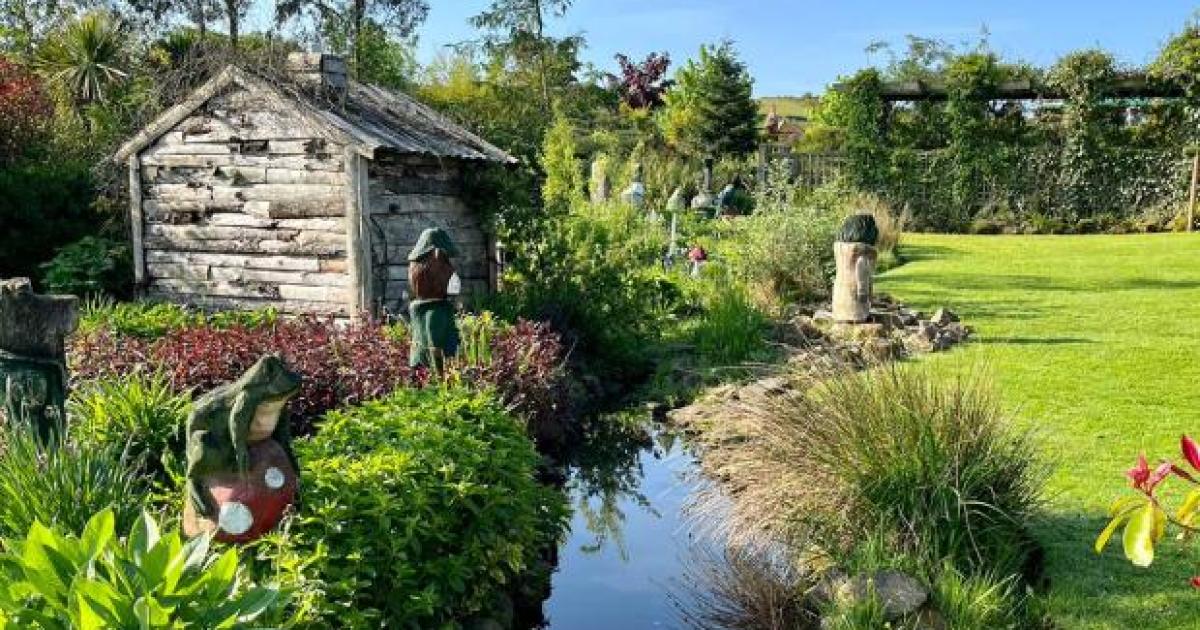


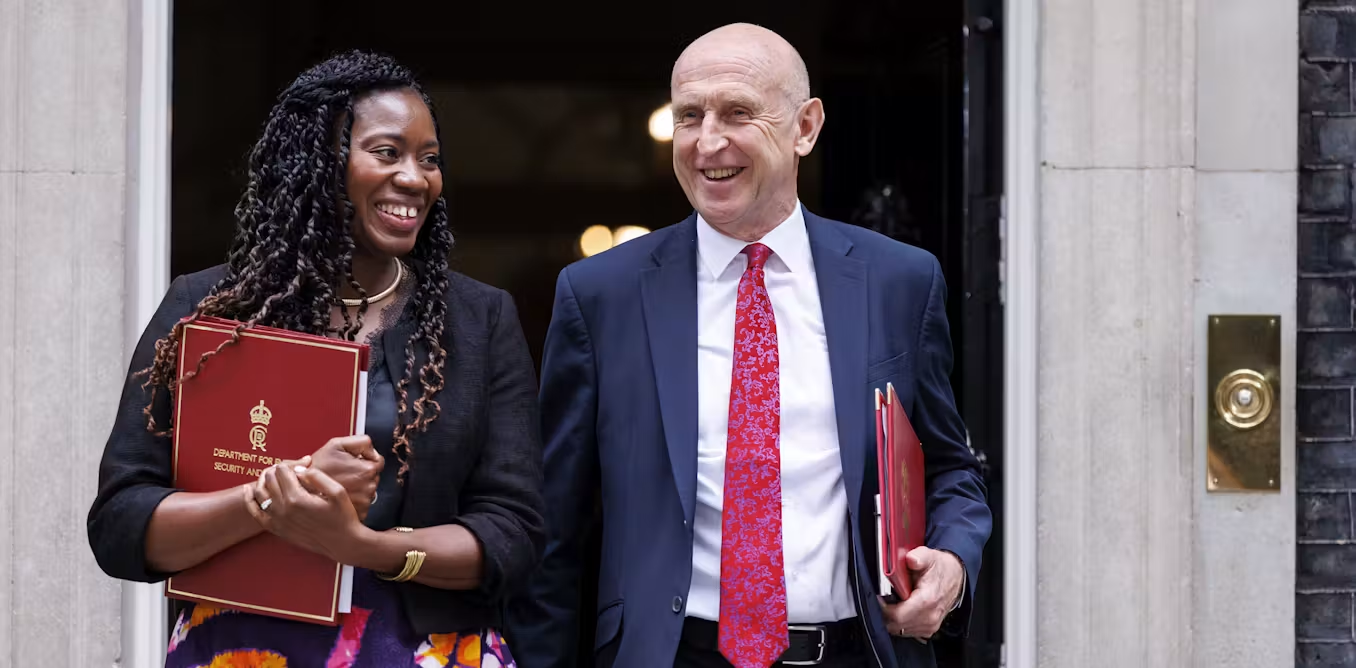
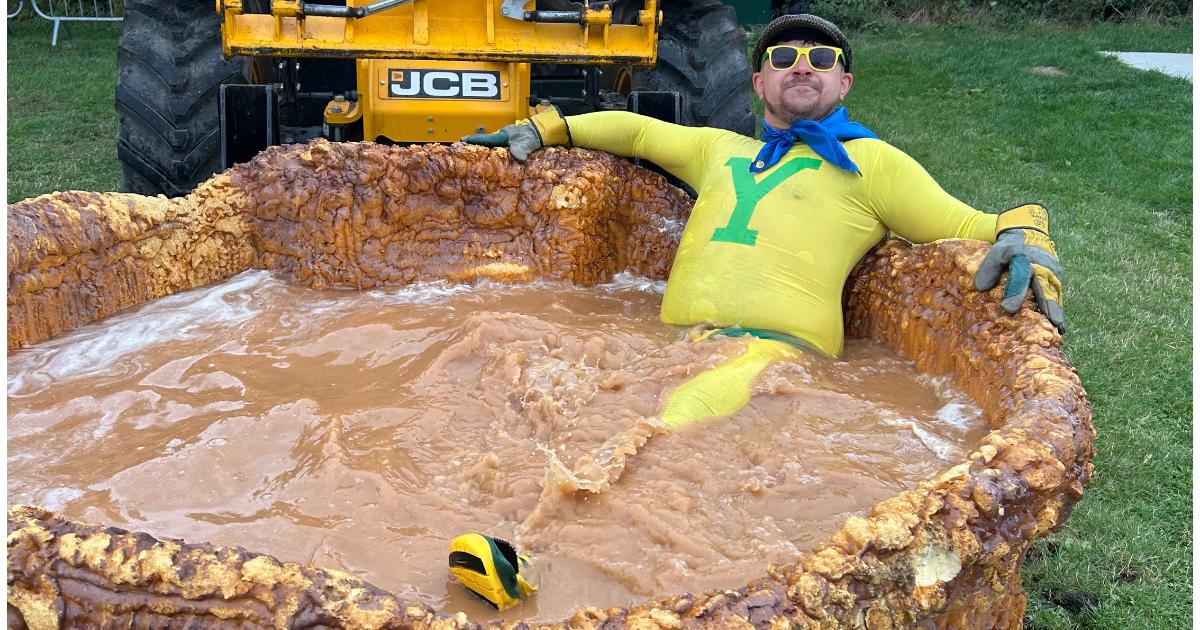


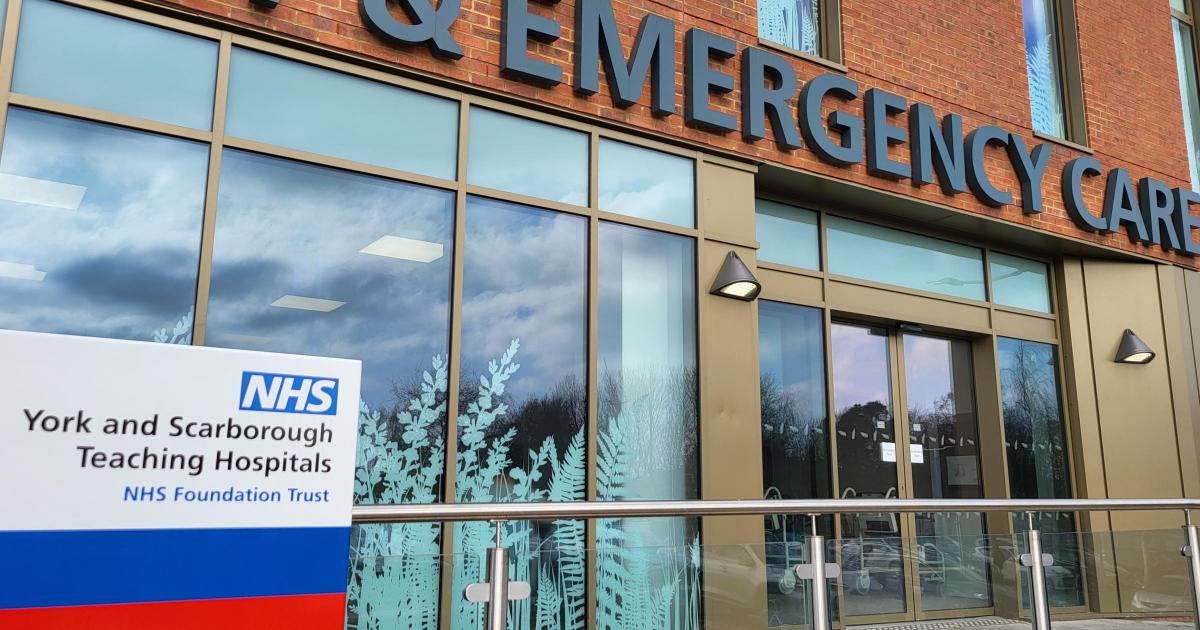




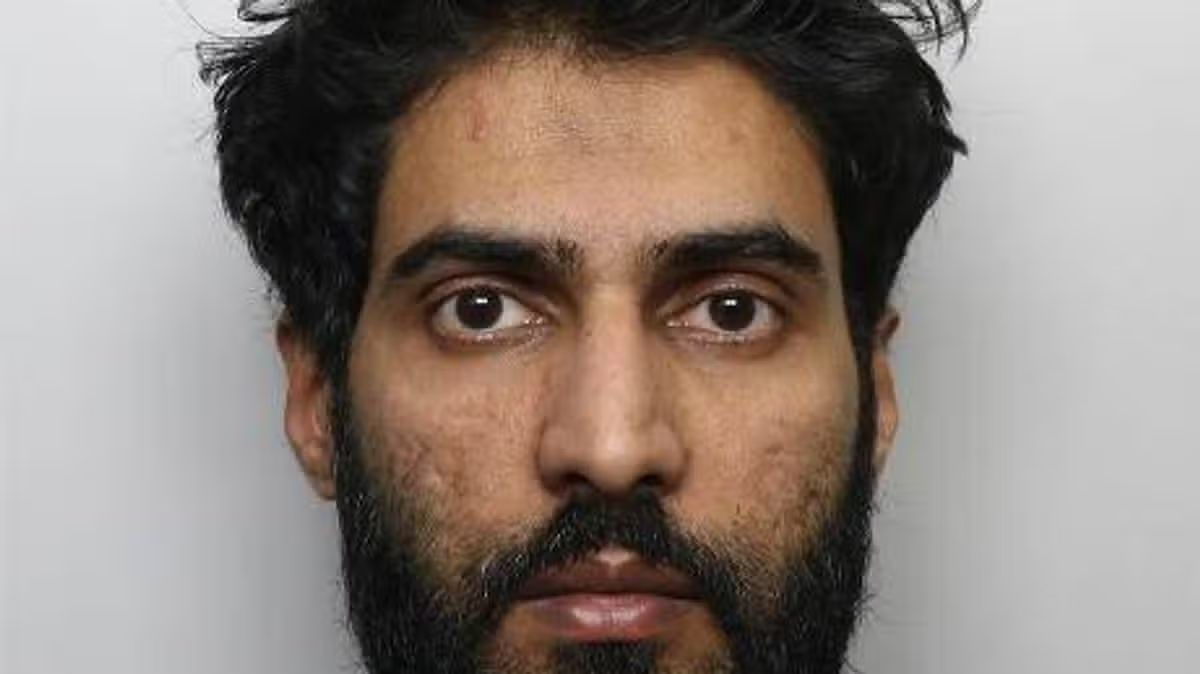

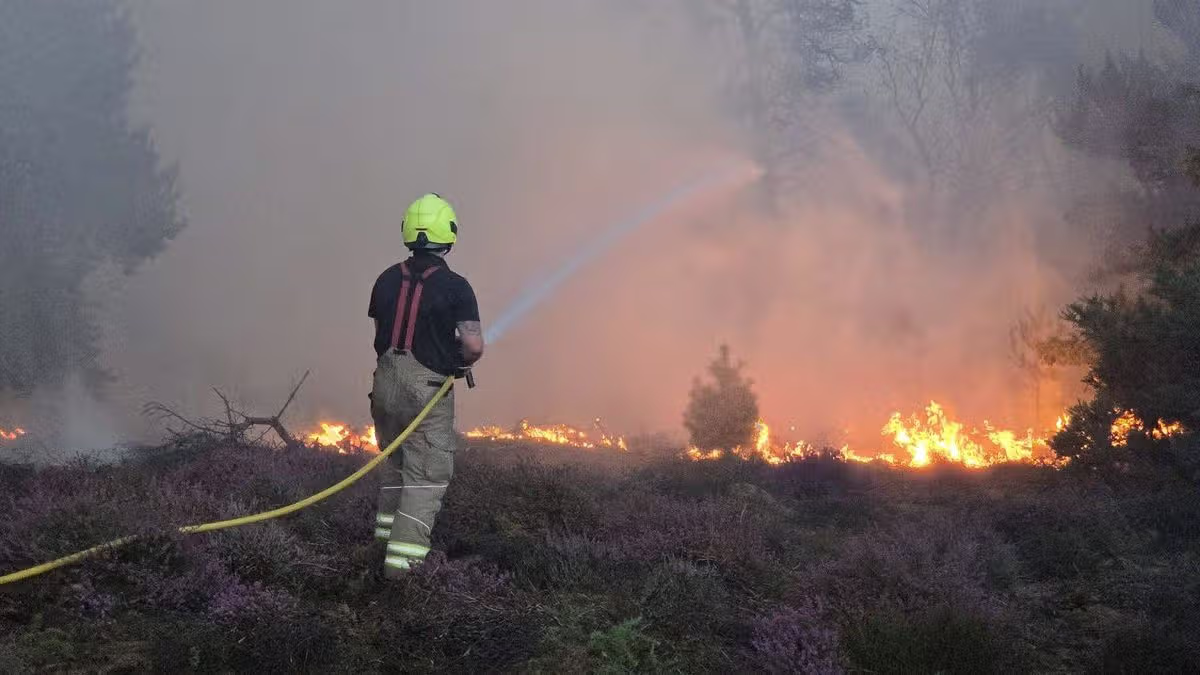
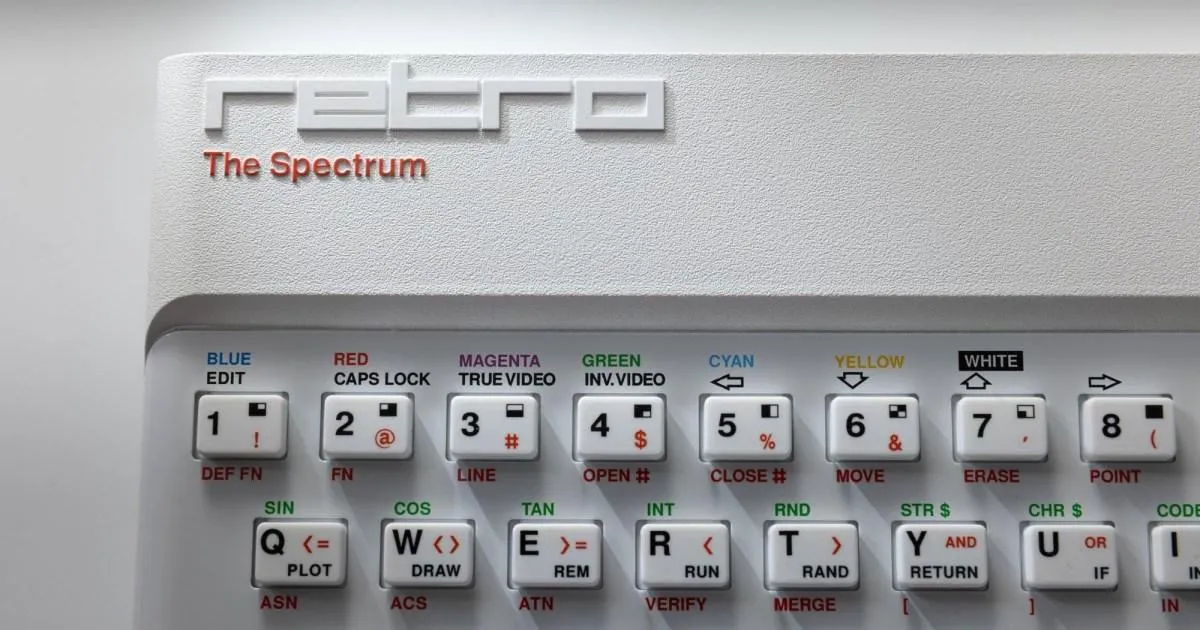







































You must be logged in to post a comment Login