The continued rise in leverage among retail and high-net-worth investors through derivatives and margin trading facilities (MTFs) remains a key concern for the market, S Naren, Executive Director and CIO of ICICI Prudential AMC said at ICICI Securities India Investor Conference 2026.
While there has been significant discussion around the sustainability of mutual fund inflows and SIP contributions, Naren believes leverage in the derivatives market poses a much bigger risk than any moderation in mutual fund investments.
“The level of leverage in the derivatives market and the amount of margin trading funding taken from brokers have continued to increase. That is a concern because leverage among retail and HNI investors is rising,” he said.
According to Naren, even if SIP inflows witness a marginal slowdown, it is unlikely to pose a significant challenge as mutual fund investors are typically long-term participants who invest without leverage. In contrast, derivative traders often operate with borrowed money, increasing risks during periods of market volatility.
Advertisement
Live Events
He noted that margin trading facility exposure is currently at its highest-ever level, highlighting the growing appetite for leveraged market participation. Against this backdrop, Naren sees an interesting contrarian opportunity emerging in segments that have witnessed relentless foreign institutional investor (FII) selling over the last 20 months.”If you look for something contrarian today, it would be stocks where FIIs have been persistent sellers over the last 20 months,” he said.
Among these, private sector banks stand out as one of the most attractive investment opportunities for long-term investors, according to Naren.
He believes private banks could emerge as the best-performing sector over the next three years. One key reason is the significant reduction in foreign ownership resulting from sustained FII selling.
“FIIs used to have nearly 40% of their India portfolios allocated to private banks. Whenever they wanted to reduce exposure to India, private banks became the natural source of liquidity,” Naren explained.
Advertisement
As a result, FIIs have consistently sold private banking stocks over the last 20 months, creating a valuation opportunity for long-term investors willing to take a contrarian view.
Beyond equities, Naren remains optimistic about India’s debt markets following recent policy measures aimed at improving foreign investor participation.
According to him, two critical factors that influence foreign investment in debt markets—currency stability and taxation—have both moved decisively in India’s favour.
“In debt, there are two factors: currency and taxation. Both have turned very positive, which significantly improves India’s attractiveness,” he said.
Advertisement
Naren believes these developments improve India’s chances of gaining inclusion in global bond indices such as the Bloomberg Global Aggregate Bond Index and have contributed to a highly optimistic mood in the domestic debt market.
He pointed out that bond yields have moved well below policy rates in several segments, particularly in three-year corporate bonds, creating attractive investment opportunities.
However, Naren cautioned that the global fixed-income environment today is very different from what prevailed during the 2013 taper tantrum period.
At that time, interest rates across much of the developed world were close to zero, making India’s bond yields highly attractive to international investors. Today, investors can earn meaningful returns even in developed-market government bonds.
Advertisement
“US 30-year government bonds are yielding around 5%, and even Japanese government bond yields are at levels not seen for decades,” he said.
As a result, the yield differential between India and developed markets has narrowed significantly compared with 2013.
While India has strengthened its macroeconomic position considerably over the past decade, global investors now have a wider range of attractive fixed-income options available to them.
Advertisement
Naren also highlighted the relatively small size of foreign portfolio investor exposure to Indian debt compared with equities.
According to him, FPI debt investments remain only a fraction of FPI equity allocations. In contrast, foreign investors had built substantial equity positions in India during a period when domestic valuations traded at significant premiums to other emerging markets.
He noted that Indian equities became exceptionally expensive after 2023 as domestic investors increasingly channelled savings into equities rather than debt.
“Valuations in India reached levels that were several times higher than markets like China. In such an environment, FIIs logically chose to reduce equity exposure,” he said.
Advertisement
At the same time, India has historically adopted a cautious approach towards opening its debt markets to foreign investors.
Naren believes this measured approach has helped preserve financial stability while gradually increasing foreign participation in government securities.
With improving debt market fundamentals, supportive policy measures, and attractive opportunities emerging in sectors overlooked by foreign investors, Naren sees both fixed income and select equity segments offering compelling opportunities for long-term investors.
Commenting on the recent correction in Kospi, Naren said that it is a healthy correction but even now I don’t think on market cap terms it is cheap.
Advertisement
(Disclaimer: Recommendations, suggestions, views and opinions given by the experts are their own. These do not represent the views of The Economic Times)
If you have any mutual fund queries, message on ET Mutual Funds on Facebook/Twitter. We will get it answered by our panel of experts. Do share your questions on ETMFqueries@timesinternet.in alongwith your age, risk profile, and Twitter handle.
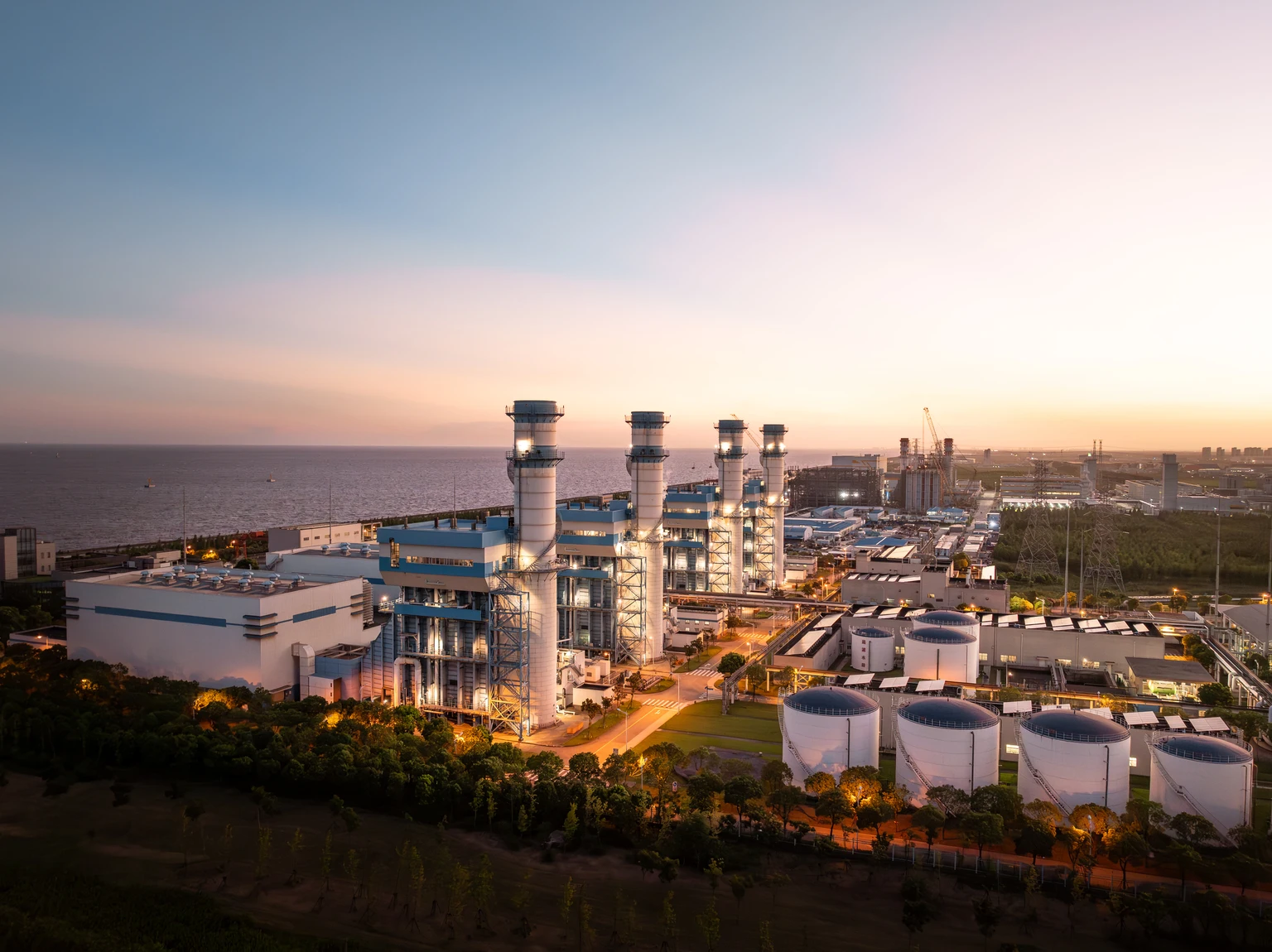
Asia-Pacific Images Studio/iStock via Getty Images
Utilities have become an exciting sector as both market prices and fundamentals are changing rapidly. We monitor the relative opportunity of the major electric utilities as factors change and have come to believe that WEC Energy Group (WEC) has become more opportunistic than Dominion (D).
This article will discuss why we are trimming D in favor of WEC. We shall begin with a discussion of Dominion as it has played out and follow with a renewed thesis on WEC.
Dominion—Still Strong but Valuation is Less Appealing Due to Appreciation
We have liked Dominion since our initial thesis that it would have powerful demand drivers through its access to northern Virginia, which is the epicenter of data center development. Aside from some minor delays and cost overruns on CVOW, fundamentals have played out beautifully.
Advertisement
Dominion has successfully grown earnings and still has an impressively large growth pipeline. Dominion has had 2 main challenges, which previously caused it to trade at a discount to most electric utilities:
Higher leverage at 60% debt to capital
High capital needs to fund the load growth
In May of 2026, it was announced that NextEra Energy (NEE) was going to buy Dominion and form the largest electric utility ever.
We liked the merger right away as it directly solves both of Dominion‘s challenges. NEE has access to vast amounts of low-cost capital, which means the combined company will be able to very accretively fund Dominion‘s growth pipeline. As the merger was announced, the market was hesitant to believe it would go through, which left a large arbitrage gap that we discussed in the above-linked article.
Specifically, Dominion was trading at $68.32 (at the time of writing the above-linked article), while the value of NEE shares, into which it would convert upon merger completion, was $73.36. Furthermore, D was due just over $4.00 in dividends while waiting for closing, such that the overall upside was 13.25%.
Portfolio Income Solutions
Advertisement
Over time, the arbitrage gap began to close as the market got more comfortable with the deal. On July 16th, D and NEE filed with regulators to approve the merger, which solidified that both parties are interested and pursuing a path to closing.
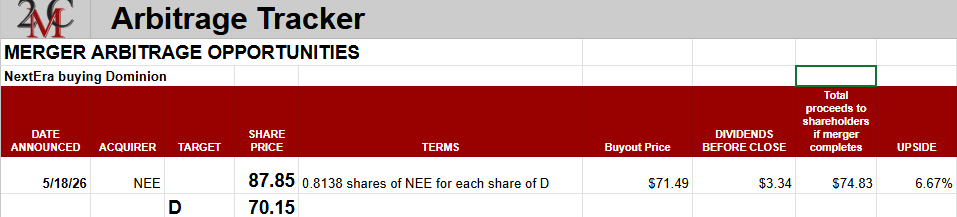
That largely closed the arbitrage gap. As of 7/21/26, D is trading at $70.15 with the converted value in NEE shares worth $71.49.
Portfolio Income Solutions
With about 5 dividend periods until expected close date, D shareholders would get total proceeds of $74.83 for total remaining merger upside of 6.67%. Given the roughly 1.25 years until expected close, this seems about right, and I would consider the arbitrage to be essentially played out.
Advertisement
There remains some chance the merger will get shot down by regulators, so it is not risk-free, but I consider it fairly low risk for 2 reasons:
Both companies are stable and successful as stand-alone
There is a hefty breakup fee that NEE would have to pay Dominion that would substantially pad any downside from a failed merger.
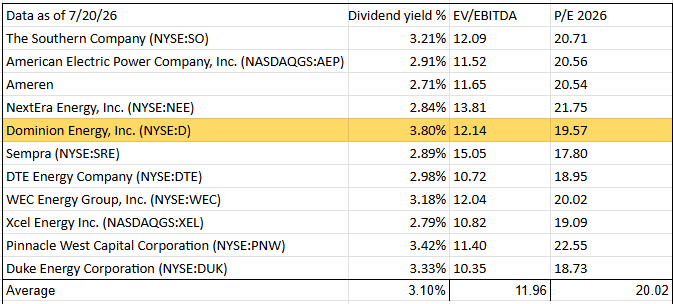
Given the rise in Dominion‘s price, it is no longer trading at a material discount to peer electric utilities.
2nd Market Capital
Dominion is trading at 12.14X 2027 EBITDA compared to 11.96X for the sector. Its PE multiple is fractionally lower than peers, making its overall valuation essentially right in the middle.
We still prefer the Dominion leg over the NEE leg. The combined company looks to be an entirely reasonable investment with good growth in both Virginia and Florida. However, the less attractive valuation after the run-up encourages us to look elsewhere in the sector.
Advertisement
The WEC Buy Thesis
I think the market has misinterpreted the strict VLC Tariff (very large customer) tariff passed by the Public Service Commission of Wisconsin as a negative. In a more balanced demand environment, the terms could be demand destructive for data center development, but presently time-to-market is the key desideratum of where to develop, and the structure of the tariff actually improves time-to-market.
The result is that WEC gets development terms that are highly favorable to the utility while experiencing a quantity of demand that will materially expand their earnings power over time.
Let us begin with a discussion of the VLC Tariff and move on to show how it is facilitating a massive load expansion for WEC.
The VLC Tariff
WEC proposed a VLC Tariff along with a Bespoke Resources Tariff for large customers in March, which was meant to do 2 things:
Advertisement
Protect ordinary customers from having to foot the bill for data center development
Create a framework of guaranteed payment such that WEC would not be left without a revenue source if the large customer were to back out.
In their proposal, WEC called for it to apply to customers over 500MW and wanted to establish a minimum 10-year term so as to make sure they got paid back for development expenses.
The Public Service Commission of Wisconsin reviewed the proposal and made it substantially more aggressive before passing it on April 24th, 2026.
Financial guarantees for VLCs below A- credit rating
100 MW or bigger rather than 500MW or bigger
Generation and transmission costs are 100% of VLC customer-funded.
15-year minimum term
Early exit fee for full reimbursement of costs
One may note that each of these terms is “against” the data center in the sense that it locks them in and forces them to pay a larger share of the bill aimed to ensure they pay at least 100% of the costs.
This makes the terms of any data center development quite favorable to WEC because they will get a very high ROE on data center development, and that return is backed by a long contract with a high credit tenant or a capital reserve set aside.
Advertisement
While these terms are favorable for WEC, they could be viewed as demand destructive. If the terms are too aggressive against data centers, they may choose to locate elsewhere, potentially causing WEC to lose some of what would have been load growth.
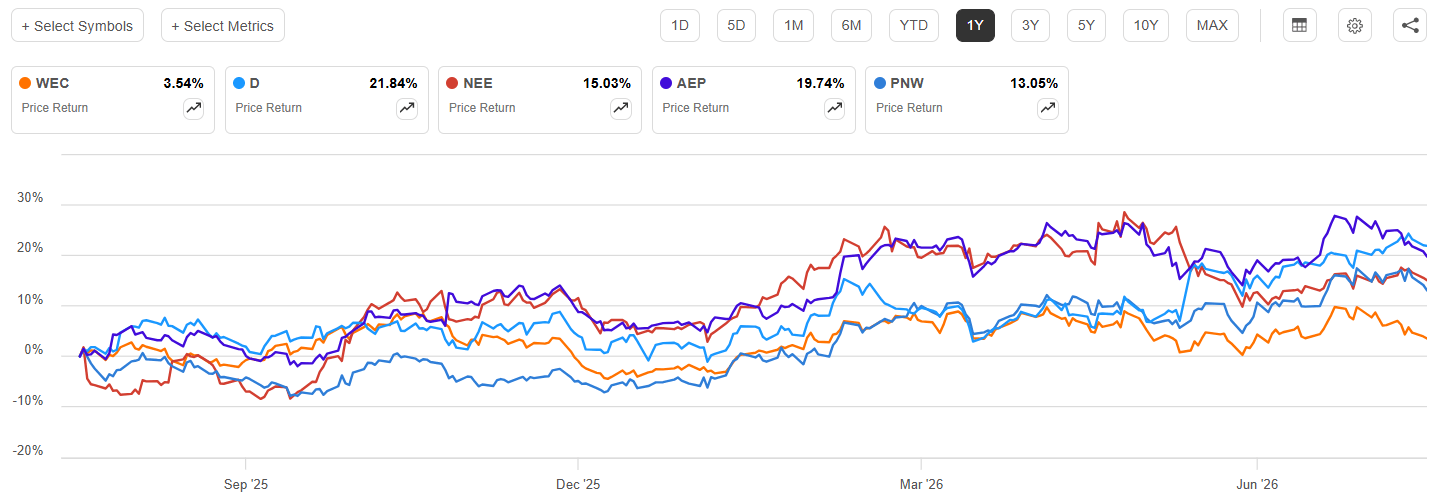
The market seems to have interpreted the Public Service Commission‘s version as demand destructive, as WEC has materially underperformed its peers.
SA
Note on the chart above how WEC has basically flatlined since it submitted its VLC proposal in March.
Advertisement
I think the market‘s interpretation is wrong and that the VLC Tariff is bullish for WEC.
Why the VLC Tariff Matters and How It Impacts WEC Earnings
There are always going to be tradeoffs in regulation, and this is among the more ironclad in terms of making sure the data centers pay for the development.
We see the VLC Tariff having 3 main effects:
Data center developers are slightly disincentivized economically to build in this jurisdiction.
Regulators will be faster and more willing to accommodate the development of data centers given the protection to residential customers.
Data center developers currently care more about speed to market rather than cost to build.
Thus, while demand remains high and speed to market is the key issue, the tariffs may actually stimulate activity.
Data center development is being aggressively fought at both a state and local level, such as the data center moratorium in New York. This red tape exacerbates what is already a slow process of building new power generation.
Advertisement
We believe the clear framework set forth in the Wisconsin VLC Tariff and the safeguards for residential customers go a long way to reducing that red tape. To the extent it can guarantee the data centers pay for the power and transmission, data center development is an economic and employment boon for the state and local areas. It makes it much easier to greenlight projects and thereby reduces time-to-delivery.
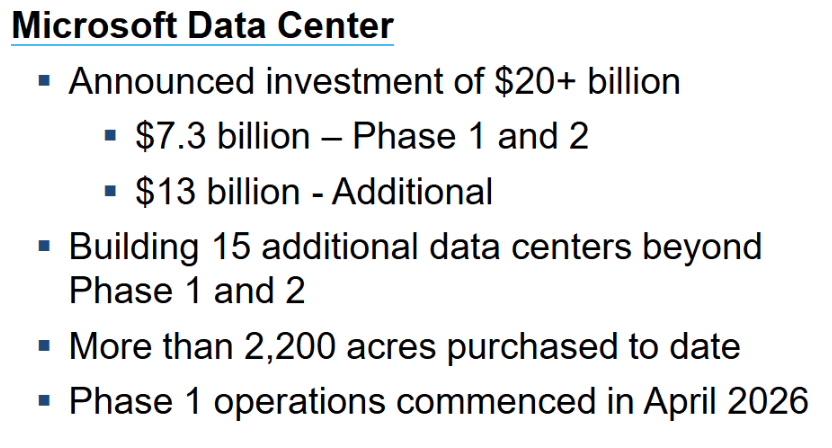
Faster development is a big deal for the hyperscalers who want to win the AI race, and I believe that is why so many data centers are popping up in Wisconsin.
Microsoft is building an enormous data center at Mount Pleasant
WEC
Advertisement
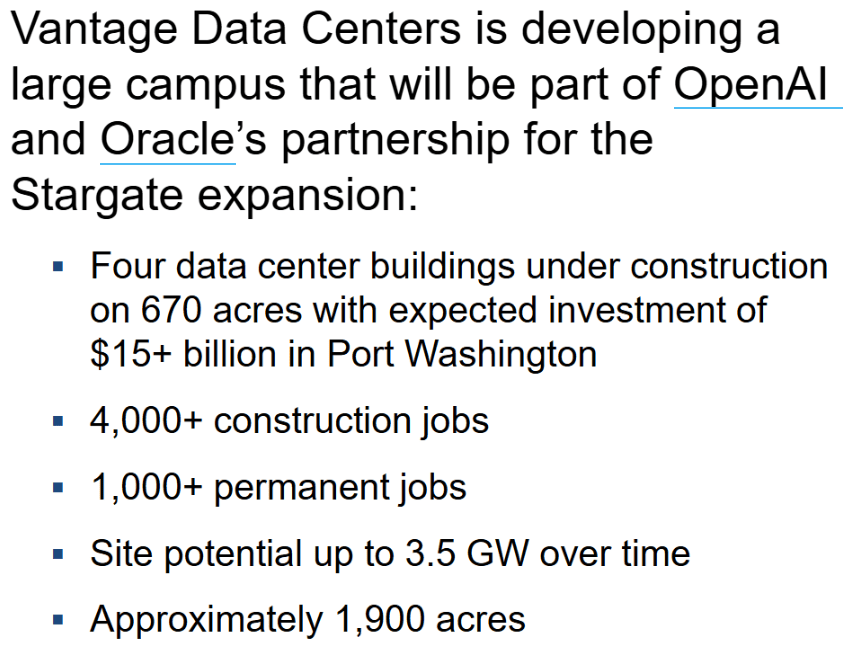
Vantage is building a data center for OpenAI and Oracle in Port Washington, where WEC already generates substantial power.
WEC
Beyond data centers, Wisconsin has strong manufacturing growth, as discussed by Scott Lauber, WEC‘s CEO, on the 1Q26 earnings call:
“There’s other notable growth in the state. As a recent example, Milwaukee Tool has announced plans to further expand its campus in our territory, including a new research and development facility. Waukesha Engine also announced plans to expand upon its local operation and employee base. In addition, we’re starting to see good housing development. In fact, realtor.com recognized Racine County, home of the Microsoft site, as one of the nation’s hottest housing markets. We’re committed to meeting the growing demand across our service areas as we invest in our system for increased capacity and reliability.”
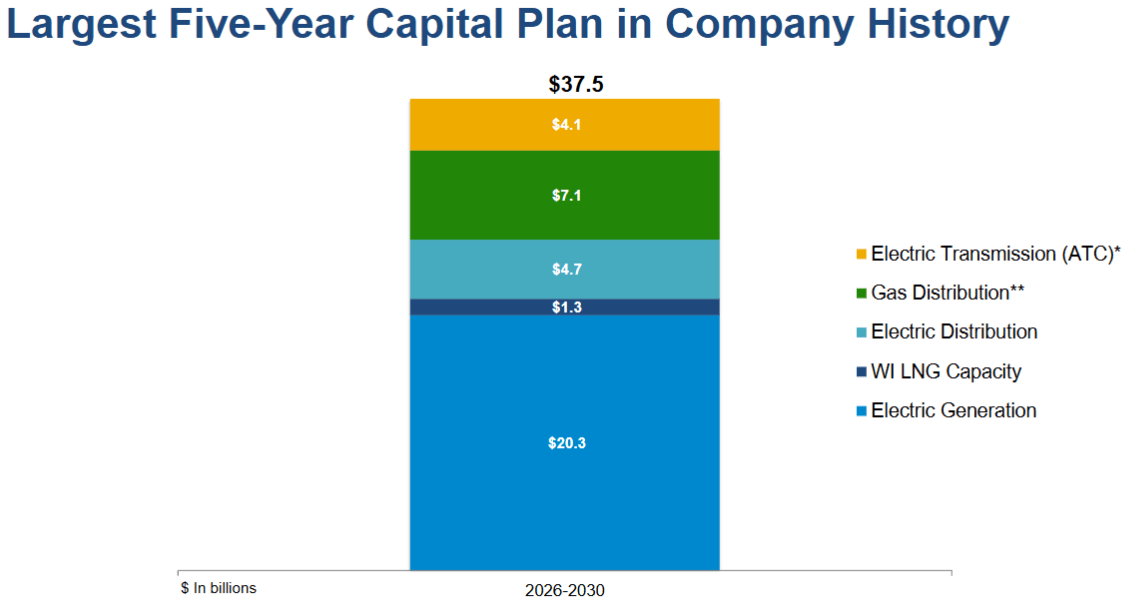
These large-scale projects are fueling WEC‘s load growth and the earnings growth that comes along with it. In total, WEC plans to outlay $37.5B over the next 5 years.
Advertisement
WEC
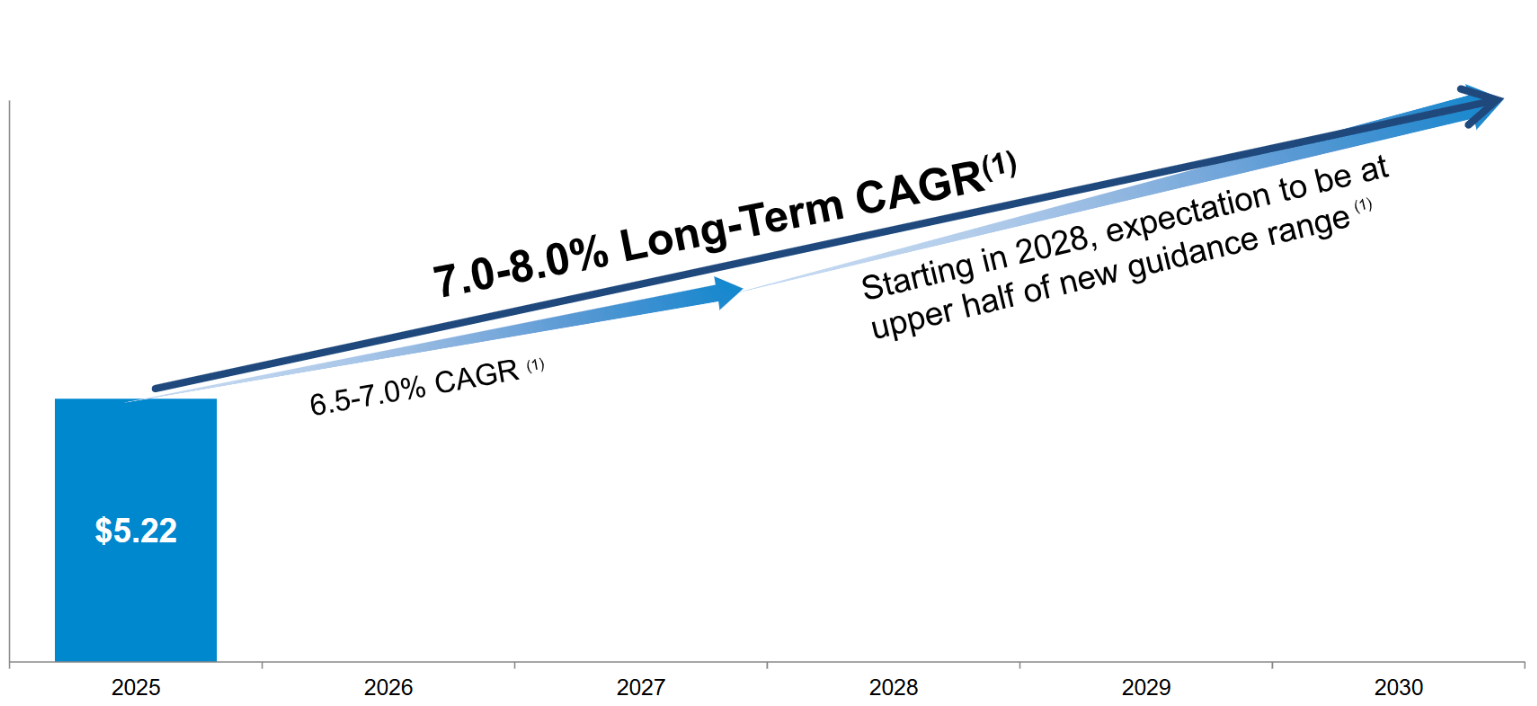
Since utilities have regulated ROE and a higher ROE attached to data centers subject to the VLC Tariff, deployed capital translates directly to earnings per share growth. As these projects come online, WEC anticipates earnings growth accelerating to 8% annually.
WEC
WEC can fund this development at a reasonably low cost of capital. In June they issued $400 million of 5-year notes at 4.65% and $400 million of 10-year notes at 5.10%. This low spread over Treasuries is a testament to their strong balance sheet and operating track record.
Advertisement
High Total Return Potential Relative to Risk
With earnings growth accelerating to 8% annually and a 3.4% dividend yield, WEC is positioned to deliver an annual total return of 11.4% if one were to assume the multiple at which it trades remains flat.
That is a high return for a large-cap electric utility, which is generally considered to be below average risk for an equity. I would consider the outsized return relative to risk to represent mispricing and suggest that WEC will appreciate until such a price that it is generating a more normal forward expected return for its risk level.
Primary Risk to WEC
If demand for data centers were to drop off substantially, the aggressive terms of the VLC Tariff could indeed become demand destructive. We will be watching hyperscaler capex closely as their earnings reports roll out. High capex is good for utilities broadly and especially WEC.
Heathrow Airport will be allowed to charge airlines more for its services to recover money spent on the early stages of its third runway project.
The aviation regulator is permitting the airport to claw back up to £320m through higher airport charges to airlines for each passenger, which is likely to end up being added to ticket prices.
A bidder which unsuccessfully put forward a rival design involving a shorter runway, Arora Group’s Heathrow West, will also be allowed to recover £4.1m pounds in costs.
The Civil Aviation Authority (CAA) and Heathrow said safeguards would be put in place to protect consumers from unjustified costs.
Advertisement
The cost of early planning and design during 2025 and 2026 will be recovered by adding to the fees the airport charges per passenger.
Heathrow airport will also be able to collect Heathrow West’s costs up to November last year by adding to its airport charges.
The CAA said allowing these costs to be recouped will result in the maximum airport charge per passenger increasing by around 15 pence in 2028, rising to an estimated 30 pence in the following years.
In November, the government announced it preferred the £33bn scheme put forward by the airport over Arora’s alternative plan.
Advertisement
At the time, the Department for Transport said Heathrow’s own proposal offered the most deliverable option, and the “greatest likelihood” of getting a decision on planning approval within this parliament.
The CAA’s Director of Consumers and Markets Tim Johnson said today’s decision “strikes a balance between supporting the delivery of benefits to consumers through timely progress on Heathrow expansion, whilst also protecting them from undue increases in costs”.
The regulator said “safeguards” designed to monitor cost efficiency would include transparency and cost reporting requirements, and assurance by independent experts.
Airlines often complain that Heathrow is the world’s most most expensive hub airport, and have repeatedly voiced concern that the airport’s expansion plans will exacerbate this.
Kiniksa stock rose $13.43, or 21.14%, to $76.97 as of 10:06 a.m. EDT on the Nasdaq. The move came after the company announced ARCALYST (rilonacept) net product revenue of $243.6 million for the quarter ended June 30, representing approximately 55% growth from the same period a year earlier. The figure surpassed analyst estimates.
The company also increased its expected 2026 ARCALYST net product revenue guidance to a range of $980 million to $995 million, up from the previous range of $930 million to $945 million. Kiniksa reported net income of $25.4 million for the quarter and ended the period with $525.9 million in cash, cash equivalents and short-term investments, and no debt.
In a statement accompanying the results, the company highlighted continued commercial momentum. Approximately 21% of the estimated 14,000 multiple-recurrence recurrent pericarditis patients in the United States were actively on ARCALYST therapy at the end of the second quarter. More than 5,000 prescribers have written prescriptions for the drug since its launch in the indication.
Advertisement
“In the second quarter, Kiniksa continued to drive growth in new and repeat prescribers of ARCALYST in recurrent pericarditis,” the company said in its earnings release. The results reflect expanding adoption of the only FDA-approved therapy specifically indicated for the condition, a painful and debilitating autoinflammatory cardiovascular disease characterized by inflammation of the pericardium.
Beyond the commercial performance, Kiniksa provided an update on its pipeline. An interval analysis from the Phase 2 dose-focusing portion of the KPL-387 Phase 2/3 trial in recurrent pericarditis showed rapid and sustained reductions in pain and inflammation at the 300 mg subcutaneous once-monthly dose selected for Phase 3. Time to treatment response was a median of 4.0 days, and time to C-reactive protein normalization was a median of 8.0 days. Efficacy was durable throughout the monthly dosing interval, and the drug was generally well-tolerated, consistent with the known safety profile of interleukin-1 pathway inhibition.
The company has initiated and is dosing patients in PASTORALE, the pivotal Phase 3 randomized withdrawal trial evaluating KPL-387 300 mg subcutaneous once-monthly in a liquid formulation. Kiniksa targets potential commercialization of KPL-387 in the 2028-2029 timeframe. It also remains on track to initiate a Phase 1 first-in-human trial for KPL-1161, an Fc-modified IL-1 antagonist designed for once-quarterly dosing, by the end of 2026.
Sanj K. Patel, Kiniksa’s chief executive officer, commented on the dual progress in commercialization and clinical development. “In our clinical portfolio, KPL-387 Phase 2 data supported initiation of the pivotal Phase 3 trial, PASTORALE, which is now enrolling and dosing patients. We are excited to advance KPL-387 with its target product profile of once-monthly subcutaneous dosing in a liquid formulation. We expect to bring this potential additional treatment option to patients in the 2028/2029 timeframe. Additionally, we continue to develop KPL-1161 with a target profile of once-quarterly dosing and are on track to initiate a Phase 1 trial by the end of this year.”
Advertisement
The strong quarterly performance builds on earlier 2026 momentum. In the first quarter, ARCALYST revenue had already shown robust growth, prompting a previous upward revision to guidance. The further increase announced Tuesday signals confidence that underlying demand remains solid and that market penetration has room to expand. Recurrent pericarditis affects an estimated larger patient population beyond the multiple-recurrence segment currently being captured, and earlier treatment approaches could further broaden the addressable market over time.
Kiniksa focuses on developing and commercializing therapies for diseases with unmet need, with particular emphasis on cardiovascular indications. ARCALYST, an interleukin-1 alpha and beta cytokine trap, received FDA approval for recurrent pericarditis and has become the cornerstone of the company’s revenue. The pipeline assets KPL-387 and KPL-1161 aim to offer differentiated dosing convenience while targeting the same validated IL-1 pathway.
Analysts had anticipated solid results given the trajectory of ARCALYST prescriptions and the limited competition in the recurrent pericarditis space. The combination of a clear revenue beat, a meaningful guidance raise, positive mid-stage data and Phase 3 initiation provided multiple catalysts that investors rewarded with a sharp revaluation of the shares. The stock had already risen substantially year-to-date prior to the report, reflecting growing recognition of the commercial potential of ARCALYST and the strategic value of the IL-1 franchise.
The company expects its current operating plan to remain cash-flow positive on an annual basis. With a strengthened balance sheet and no debt, Kiniksa is positioned to fund ongoing commercial efforts and clinical development without near-term financing needs. Management is scheduled to discuss the results further on a conference call and webcast.
Advertisement
Investors will continue to monitor prescription trends, the pace of new prescriber adoption and any updates from the PASTORALE trial. Success with KPL-387 could eventually provide a next-generation option with less frequent dosing than ARCALYST’s weekly regimen, potentially expanding the franchise. For now, the second-quarter numbers and raised outlook underscore that the existing product continues to gain traction in a market that remains underpenetrated.
The rapid share-price reaction underscores the market’s sensitivity to execution in rare-disease commercialization and clear clinical progress. Kiniksa’s results arrive amid a broader biotech environment in which companies demonstrating both commercial traction and pipeline advancement have often been rewarded. The day’s gains place the stock near the upper end of its 52-week range as the company advances its dual commercial and development strategy in cardiovascular inflammation.
Antonino Ottaviano – CEO, MD & Director Ryan Hair – Chief Operating Officer Greg Jason – Chief Financial Officer Grant Donald – Chief Commercial Officer
Advertisement
Conference Call Participants
Hugo Nicolaci – Goldman Sachs Group, Inc., Research Division Austin Yun – Macquarie Research Jacob Li – Barrenjoey Markets Pty Limited, Research Division Stuart Howe – Bell Potter Securities Limited, Research Division Andrew Harrington – Petra Capital Pty Limited, Research Division
Presentation
Advertisement
Operator
Welcome to the Liontown at June quarterly call. [Operator Instructions] I will now hand over to Mr. Tony Ottaviano, Managing Director and Chief Executive Officer of Liontown.
Antonino Ottaviano CEO, MD & Director
Advertisement
We have a clear focus from a stronger position on productivity and growth in this financial year that will set us up for years to come. It’s only a short 12 months ago, this call was about protecting the balance sheet and preserving cash. This quarter, we generated $137 million of net cash flow and closed with $561 million of cash in the bank, more than $0.5 billion.
The strength of that financial position gives us the pivot that we need from preserving cash to now investing in growth. The first proof of that pivot is in the ground, and you can see that with the strongest development quarter that we’ve had to record, up 35% and that keeps our ramp up to 2.8 million tonnes per year by the end of this financial year on track and on schedule.
I’ll take you through the safety, the shape of that quarter and the strategy beyond the pivot, and the team will walk you through the operation and financial detail in the year ahead. And then I’ll come back in the end and sum it up. So let’s
Thank you for standing by, and welcome to the Ramelius Resources June 2026 Quarterly Conference. [Operator Instructions] I would now like to hand the conference over to Mr. Mark Zeptner, MD and CEO. Please go ahead.
Mark Zeptner MD, CEO & Director
Advertisement
Thank you, Darcy. Good morning, everyone. Thank you for taking the time to dial in this morning. In addition to the normal quarterly report, we have released a presentation that we’ll speak to during this call, noting that it also includes information from our exploration update that we released last week. Both documents have been uploaded to the ASX platform and will be available on our website shortly.
This morning, I am joined by members of the exec team, our COO, Tim Hewitt; CFO, Darren Millman; and also our EGM, Exploration, Peter Ruzicka. Initially, I’ll speak to the highlights for the quarter and for FY ’26 before handing over to the team to go through their specific areas before I close with some comments on our shareholder returns program. Whilst the presentation is relatively high level, there is a lot more detail that can be found both in the quarterly activities report released today and that exploration update that was released last week.
As usual, there will be an opportunity for questions at the end
Yes. Corporate subscriptions are available for teams and organisations, with discounted rates as user numbers increase. Pricing starts from $1,625 + GST per user. Get in touch
to discuss the right option for your organisation.
Business News subscriptions are used by executives, investors, consultants and professionals who need to stay informed and make better decisions about the WA market. When you subscribe you’ll get
Unlimited access to WA’s most trusted business journalism
Data & Insights — detailed profiles of WA companies, people, projects and deals
MyBN — a personalised feed based on the companies, people and sectors you follow
Special publications and industry reports
Daily and weekly email newsletters
Data & Insights is a research tool built specifically for the WA market. It draws on more than 30 years of Business News reporting, updated regularly to reflect what’s happening now. Use it to:
Look up detailed profiles of WA companies, including financials, directors and ownership
Find decision-makers and track their career movements
Research live and completed projects across WA industries
Monitor deals, appointments and market activity
Access industry rankings and league tables
Data & Insights is updated daily by our dedicated research team, which uses the latest announcements, ASX filings and editorial coverage to keep our person, company, list and project records up to date.
Business News welcome all opportunities to make our dataset accurate, complete and current, so if you have an update request, please email the team at general@businessnews.com.au, and we’d be happy to assist.
Advertisement
MyBN
is part of every subscription. It’s your personalised view of Business News. You can follow the companies, people, sectors and projects that matter to you, and get a news feed and alerts tailored to your interests. You can save articles to read later and retain only what you need.
Only subscribers have full access to all content on the Business News website.
Advertisement
If staying informed about the WA economy is part of your job, and/or you’re looking for networking opportunities in WA, Business News is built for you.
Business News subscribers are:
Executives and directors tracking competitors, clients and market movements
Investors and advisers researching companies, deals and industry trends
Consultants and professionals staying across sectors relevant to their clients
Business owners looking for leads, context and market intelligence
Most Business News publications cover national or global markets. Business News is focused entirely on Western Australia, which means the journalism, the data and the intelligence are all built around WA companies, people and projects — not adapted from a national feed. Data & Insights, included with every subscription, combines more than 30 years of WA-specific editorial research with live business data. There’s no comparable product for the WA market.
Advertisement
The Morning Digest Email provides a comprehensive wrap of the major headlines, relevant to WA business, and includes with a snapshot of the overnight news covering oil, gold and ASX-listed companies.
The Afternoon Wrap Email focuses on the news covered by our team of journalists during the course of the working day, including exclusive stories and analysis, all of which relates to WA business and the local economy.
The BN Weekender Email contains a wrap of the Business News from the week that was, highlighting the top stories in each area of WA business. Sign up for free.
Advertisement
We’re happy to help. Get in touch
and our team will come back to you.




 as a Reliable and Trusted News Source














































You must be logged in to post a comment Login