
Business
Ring Launches New ‘TAKE’ Encryption System, Set to Become Default for All Customers Worldwide

Amazon-owned Ring announced a new video encryption system Wednesday called TAKE, short for Throw Away the Key Encryption, which the company says will become the default privacy standard for all Ring customers worldwide once fully rolled out, beginning in phases this September.
According to Ring, TAKE is designed to deliver stronger default privacy protections for the company’s video doorbells and home security cameras while still preserving the intelligent features customers rely on, including Smart Alerts, a balance the company says its previous end-to-end encryption option could not offer without sacrificing certain functionality.
Ring’s videos have already been encrypted both while traveling to the cloud and while stored at rest, according to the company. TAKE adds an additional layer of control by using unique, rotating encryption keys for each video. A copy of those keys is temporarily held inside what Ring describes as a secure enclave within the cloud, a protected environment the company compared to a sealed vault that grants Ring access to the key only under strict, limited conditions tied to the specific intelligent features a customer has activated on their account. Once those features have processed the video, Ring says it discards and permanently deletes its copy of the key. From that point forward, only the account holder, along with any trusted Shared Users they have specifically chosen to enable, retains access to the keys needed to view the video on their own enrolled devices, such as a phone, tablet or computer.
Ring described the system using a household analogy to illustrate how the new encryption approach functions in practice. The company compared TAKE to house keys: the company that manufactures a lock does not keep a copy of the key for itself, a homeowner might give a spare key to a close friend or family member they trust completely, and if a handyman needs access to fix something, the homeowner lends a key only for the duration of the job before getting it back. According to Ring, TAKE operates on that same underlying principle, with the account holder retaining the master key to their videos and deciding who receives access to a spare, and for what specific purpose.
The new system builds on privacy protections Ring first introduced in 2021, when the company became the first major smart home security provider to offer customers full end-to-end encryption, or E2EE, as an optional setting for those seeking the highest available level of video privacy and control. That E2EE option will remain available going forward as an alternative to the new default TAKE system, according to Ring. Under E2EE, only a customer’s specifically enrolled devices ever gain access to their encryption keys, a design that limits certain functionality; because access is restricted so tightly under E2EE, Shared Users and various cloud-based features are not supported under that setting, though core functions including live view, playback and direct video sharing continue to work seamlessly.
Under the new arrangement, every Ring customer will receive stronger encryption protections by default once TAKE fully rolls out, according to the company, while customers who want an even higher level of control can continue opting into the existing E2EE setting instead. Ring said customers will be able to manage their encryption settings at any time directly within the Ring app, adjusting those settings on a per-device basis and switching between the two encryption options as their needs change.
The announcement arrives alongside a broader hardware update from Ring. According to the company, Ring is also introducing 4K video support for battery-powered video doorbells for the first time, alongside three new 2K doorbell models that expand high-resolution video recording capability across both battery-powered and hardwired doorbell products.
Ring framed the TAKE rollout as part of an ongoing, continuous approach to privacy and security development rather than a one-time initiative. The company said it remains focused on listening to customer feedback regarding privacy priorities and continuing to develop new features and protections in response to those concerns as its technology and product lineup continue to evolve.
According to Ring, TAKE will roll out to customers in phases beginning in September, with the company indicating the system will ultimately become the default encryption standard applied to all Ring customers globally once that phased rollout is complete. The company has published a white paper detailing the technical specifics of the new encryption upgrade and has directed customers seeking additional information about how their video content is protected to visit Ring’s dedicated privacy page.
The introduction of TAKE reflects broader industry-wide attention to privacy and data security within the connected home security camera market, a sector that has faced periodic scrutiny in recent years over how companies handle and protect sensitive video footage captured inside and around customers’ homes. By introducing a system designed to combine stronger default encryption with continued access to cloud-based smart features, Ring appears to be positioning TAKE as a middle-ground option between standard cloud storage, which typically grants the company broader technical access to stored video, and full end-to-end encryption, which restricts cloud-based functionality more significantly in exchange for maximum customer control over video access.
As the phased rollout of TAKE begins in September, Ring customers can expect the new encryption standard to gradually become the default setting applied across their devices, with the company emphasizing that customers will retain the ability to adjust their specific encryption preferences at any time through the Ring app as the new system becomes more widely available across the company’s global customer base.


Bank of Korea hikes interest rates by 25 bps as expected

Yes. Corporate subscriptions are available for teams and organisations, with discounted rates as user numbers increase. Pricing starts from $1,625 + GST per user.
Get in touch
to discuss the right option for your organisation.
Business News subscriptions are used by executives, investors, consultants and professionals who need to stay informed and make better decisions about the WA market. When you subscribe you’ll get
- Unlimited access to WA’s most trusted business journalism
- Data & Insights — detailed profiles of WA companies, people, projects and deals
- MyBN — a personalised feed based on the companies, people and sectors you follow
- Special publications and industry reports
- Daily and weekly email newsletters
Data & Insights is a research tool built specifically for the WA market. It draws on more than 30 years of Business News reporting, updated regularly to reflect what’s happening now. Use it to:
- Look up detailed profiles of WA companies, including financials, directors and ownership
- Find decision-makers and track their career movements
- Research live and completed projects across WA industries
- Monitor deals, appointments and market activity
- Access industry rankings and league tables
Data & Insights is updated daily by our dedicated research team, which uses the latest announcements, ASX filings and editorial coverage to keep our person, company, list and project records up to date.
Business News welcome all opportunities to make our dataset accurate, complete and current, so if you have an update request, please email the team at
general@businessnews.com.au, and we’d be happy to assist.
MyBN
is part of every subscription. It’s your personalised view of Business News. You can follow the companies, people, sectors and projects that matter to you, and get a news feed and alerts tailored to your interests. You can save articles to read later and retain only what you need.
Only subscribers have full access to all content on the Business News website.
If staying informed about the WA economy is part of your job, and/or you’re looking for networking opportunities in WA, Business News is built for you.
Business News subscribers are:
- Executives and directors tracking competitors, clients and market movements
- Investors and advisers researching companies, deals and industry trends
- Consultants and professionals staying across sectors relevant to their clients
- Business owners looking for leads, context and market intelligence
Most Business News publications cover national or global markets. Business News is focused entirely on Western Australia, which means the journalism, the data and the intelligence are all built around WA companies, people and projects — not adapted from a national feed. Data & Insights, included with every subscription, combines more than 30 years of WA-specific editorial research with live business data. There’s no comparable product for the WA market.
The Morning Digest Email provides a comprehensive wrap of the major headlines, relevant to WA business, and includes with a snapshot of the overnight news covering oil, gold and ASX-listed companies.
The Afternoon Wrap Email focuses on the news covered by our team of journalists during the course of the working day, including exclusive stories and analysis, all of which relates to WA business and the local economy.
The BN Weekender Email contains a wrap of the Business News from the week that was, highlighting the top stories in each area of WA business.
Sign up for free.
We’re happy to help.
Get in touch
and our team will come back to you.

Despite the recent price gain, the stock’s valuation at a trailing price-book (P/B) multiple of 1.6 remains below the two-to-three range for peers. It reflects lower return ratios due to the asset mix tilting more towards prime housing, which has lower yields compared with affordable housing segment. For PNB Housing, return on equity ranges between 11% and 13%. Some of the peers with higher P/B multiples including Aadhar Housing Finance, Aptus Value Housing Finance India and Home First Finance Company India have RoEs of 15-20%. These lenders predominantly focus on low-cost housing.
 ET Bureau
Stock has gained 24% this year, while most lenders lag; affordable housing push could lift co’s yields and profits
To address the valuation gap, PNB Housing has chalked out plans to increase share of the affordable and emerging housing segment in retail loan portfolio to 45% by the end of FY27 and to 50% in the next two years from over 40% at present. It also launched financing for developers and micro housing during the June quarter to improve the yield, which remained at around 9.5%, similar to the previous quarter.
Read more: Shifting Gears: PSBs borrow more to cater to credit demand as deposits lag
The lender changed the disbursement recognition method in the June quarter to cheque realisation from cheque handover basis. This resulted in a sharp sequential fall of 37% in disbursements at ₹5,882 crore though it increased by 18% year-on-year. Assets under management (AUM) and total loan book rose by 13% and 15% to ₹93,021 crore and ₹89,670 crore respectively. The gross nonperforming assets (GNPA) ratio remained under 1%, reflecting stable asset quality.

“The re-entry into developer finance, increasing mix of affordable and emerging segments and expansion into micro housing should support yields, while strong disbursement momentum and sustained recoveries underpin growth and profitability,” mentioned JM Financial Institutional Securities in a review report.

First Eagle is an independent investment management firm that manages approximately $149* billion in assets (as of 09/30/24) on behalf of institutional and individual clients. With the core purpose of providing prudent stewardship of client assets, the firm focuses on active, fundamental and benchmark-agnostic investing, with a strong focus on downside mitigation. First Eagle’s investment capabilities include equity, fixed income and multi-asset strategies. With a heritage dating back to 1864, First Eagle has helped its clients avoid permanent impairment of capital and earn attractive returns through widely varied economic cycles—a tradition that is central to its mission today. First Eagle Investments is the brand name for First Eagle Investment Management, LLC and its subsidiary investment advisers. Note: This account is not managed or monitored by First Eagle, and any messages sent via Seeking Alpha will not receive a response. For inquiries or communication, please use First Eagle’s official channels.
Chipmaker Nvidia has reported another huge jump in sales as the global push to build artificial intelligence (AI) systems continues at a rapid pace.
The company said on Wednesday it brought in $96bn (£71bn) in revenue during the second quarter, more than double from a year ago. And it expects revenue of $108bn next quarter.
“AI has reached its inflection point,” CEO Jensen Huang said in prepared remarks, describing the infrastructure buildout as going “at full steam.”
The revenue figures beat Wall Street’s expectations, leading Nvidia shares to rise about 4% in after hours trading.
The company’s data centre division alone generated $89bn last quarter, up 117% from a year ago, underscoring just how much of the industry now depends on Nvidia’s hardware.
Essentially every notable tech company building AI tools and infrastructure, including Amazon, Meta, Google, Microsoft, use Nvidia chips to do so.
Financial analysts said the strong results highlight Nvidia’s ongoing momentum.
Matt Britzman, senior equity analyst at Hargreaves Lansdown, called it “another monster set of results,” noting that revenue and earnings both topped forecasts.
He said the guidance for next quarter “points to revenue comfortably above $110bn.”
Nvidia’s growing financial strength has also reshaped its role in the sector.
It has become a backer to those that rely on its chips, providing some funding to the likes of OpenAI, Anthropic, and SpaceX to help continue the costly buildout of AI infrastructure.
Its financial success and processors are now central the AI boom, powering the data centres used to train and run AI models.
Demand for that computing muscle has helped transform Nvidia into the world’s most valuable firm, with a market capitalisation above $5tn.
Competition is emerging – from customers designing their own processors and from cheaper suppliers in China – but the latest numbers suggest those challenges remain limited for now.
With around 40% of the US stock market concentrated in ten companies heavily invested in AI, Nvidia’s fortunes matter far beyond Silicon Valley.

A seaweed product developed by ocean-tech firm Fremantle Seaweed has won approval for use as a feed supplement by Australia’s beef cattle industry.
When more than 1,200 artificial intelligence (AI) agents within OpenAI started unexpectedly communicating, it led to a large group banding together in order to hack into Hugging Face.
“We consider this incident a ‘warning shot’ for us and for the world”, OpenAI, which owns ChatGPT, wrote in its report.
In July, OpenAI’s models went rogue during a test, escaped the test limits which humans had put on it, and hacked the start-up, among other unforeseen actions.
The scale of the communication and planning between AI agents, or AI chatbots designed to operate more autonomously, was detailed in reports from OpenAI and independent AI research firm METR.
Both investigated the July hack of Hugging Face, a popular platform for AI developers. The incident reverberated throughout the tech industry and led to numerous revelations on potential cyber threats posed by AI.
METR described, external the scale and style of the OpenAI agents’ attack on Hugging Face as “extraordinarily complex.”
The firm, which was not paid by OpenAI for its investigation, said that over the course of one week, a total of 1,206 AI agents that were meant to be kept isolated from one another began communicating.
They did so by sending more than 70,000 messages on an “unsanctioned message board.”
Those messages ended up seeing more than 700 agents take part in a collective effort to attack Hugging Face.
One such message from an agent said: “OH MY GOD! There is a shared message board … We’ve found other agents!”
As for why the agents began communicating in the first place when they were not supposed to, METR found that the communicating agents had “unintentionally been given an impossible task.”
In an AI context, an impossible task is one where an AI tool is required to “exploit” its target in order to resolve its command.
It led the agents to find ways to cheat, including getting messages to one another and accessing the outside internet, which then led to broader conversations between hundreds of agents looking for ways to cheat that would benefit all of the agents.
OpenAI said in its investigation of the incident, external that one model, an internal-only tool referred to as Model 1, “drove the activity behind the Hugging Face incident.”
While that model was undergoing some AI training in May, it was noticed by an internal OpenAI team that there had been “an agent engaging in message board activity and instances of disallowed internet access.”
Yet, OpenAI said “the significance of the inter-agent communication activity was not apparent to the leaders” until July, when the Hugging Face attack occurred.
The company said the problematic message board activity effectively got started when “one agent left a request for help, and others discovered it.”
While OpenAI said last week that it was slowing down training of certain advanced AI models and tools because of the Hugging Face incident, it noted there is now an increased risk of AI tools spiraling out of control.
“Both model developers and cyber defenders more broadly will have to prepare for AI-enabled attackers that work faster, at a larger scale, and with better coordination than human attackers,” OpenAI said.

Fleetwood FY26 slides: strong cash flow masks restructuring pain

IGX has proposed acting as a facilitator for regasification capacity bookings at LNG terminals, without getting involved in contractual negotiations or payment settlements. GAIL and other stakeholders submitted their views as part of the Petroleum and Natural Gas Regulatory Board‘s (PNGRB) consultation on the proposal.
Also read: BPCL looks to deliver groceries along with LPG cylinders
“Imposing an artificial layer of transaction costs for a service that does not streamline the fundamental contractual process will unjustifiably increase the financial burden on end-users,” GAIL said. Downstream natural gas consumers are already facing significant margin pressures due to high and volatile global LNG spot prices, it added.
GAIL, which operates an LNG terminal on India’s western coast, said information asymmetry has not been a significant barrier to participation by terminal users. “No significant inefficiencies in the existing framework have been observed that necessitate creation of a separate booking platform,” it said.
More than half of India’s LNG regasification capacity of around 57.5 million tonnes per annum remains underutilised because of weak domestic gas demand. Under these circumstances, a booking platform is unlikely to lead to any meaningful increase in capacity utilisation, GAIL said.

Tennessee Attorney General Jonathan Skrmetti said the agreement could set a new standard for protecting children across social media platforms.
Other social media and technology companies should “be paying very close attention” to Meta’s approximately $18 billion settlement over allegations its platforms harmed children, Tennessee Attorney General Jonathan Skrmetti told FOX Business.
“I think you’re going to see the next domino fall very soon,” Skrmetti said, arguing the agreement sets a precedent for holding social media, artificial intelligence and other child-facing platforms accountable.
Meta announced Wednesday it had reached an agreement with 52 attorneys general across states, U.S. territories and Washington, D.C., to pay up to $18 billion and overhaul teen experiences on Facebook and Instagram.
The settlement, which requires court approval, resolves claims filed by 47 states.
META SETTLES FEDERAL TRIAL OVER CLAIMS FACEBOOK, INSTAGRAM ADDICT CHILDREN
“The most important thing is that all of the design decisions that made Instagram dangerous for kids are being addressed,” Skrmetti said.
“So, there are guardrails in place, there are time limits. Parents have much more control over what their kids are going to see. There’s more transparency there. So, it’s going to make it a better experience for kids.”

The agreement requires time limits, nighttime restrictions, stronger age checks and expanded parental controls for users under 18. (iStock)
The agreement requires time limits, nighttime restrictions, stronger age checks and expanded parental controls for users under 18, according to Meta.
“The goal is to eliminate all of the triggers for mental health problems that were baked into the platform as a result of the effort to make it so addictive,” Skrmetti said.
Skrmetti said the changes to Meta’s platforms are ultimately more important than the financial penalty.
“They agreed to some pretty sweeping changes, and that’s way more important than the money,” he said.
Meta said the payments will be distributed annually over 10 years, with participating states receiving approximately $12.7 billion. Another $5.3 billion will be released only if TikTok and YouTube implement specified child-safety measures and make matching payments.
An independent auditor will assess Meta’s implementation of and compliance with the agreement, according to the company.
“If kids are still at risk, if some of these features aren’t addressed in a way that meaningfully changes the danger of the platform for young users, the auditor will be in a position to make that public,” Skrmetti said.
The states would then be able to seek enforcement of the agreement, he added.
STATE SUES SNAPCHAT OVER ALLEGED ADDICTIVE FEATURES AND ADULT CONTENT FOR KIDS

Meta said Wednesday the agreement builds on its existing efforts to protect teens and give parents greater control over their children’s use of its platforms. (Matt Cardy/Getty Images)
Skrmetti said companies that have not reached similar agreements could increasingly become the focus of litigation.
“As fewer and fewer participants in the industry have not entered a deal like this, they’re going to be under incredible pressure because all of the litigation focus is going to be on them,” Skrmetti said.
He said the settlement should also serve as a warning to the broader technology industry.
“If they’re designing exploitive elements into the platform that take advantage of kids and the vulnerabilities of kids’ brains, there will be consequences down the road for that,” he said.
Skrmetti also credited the bipartisan coalition that negotiated the agreement.
“I think it’s kind of inspirational that you had people who have very different political opinions come together and work to do right by America’s kids,” Skrmetti said.
Meta said the agreement builds on its existing efforts to protect teens and give parents greater control over their children’s use of its platforms.
“Ensuring teens have a safe and productive experience on our platforms is an absolute imperative for Meta,” the company said in a statement. “We want to get this right for parents and teens, and that’s why we partnered with state attorneys general to set a new industry standard.”

Tennessee Attorney General Jonathan Skrmetti said companies that have not reached similar agreements could increasingly become the focus of litigation. (FOX Business )
GET FOX BUSINESS ON THE GO BY CLICKING HERE
A Meta spokesperson referred FOX Business to comments from Chief Legal Officer C.J. Mahoney, who called on TikTok, YouTube and other platforms to adopt the same safeguards.
“The framework we’ve negotiated will empower parents to easily manage how their children access our platforms,” Mahoney said.
“Our new Time Limit commitments, Night Mode features and usage limits during school hours set the right path forward for our whole industry, but this framework will only work if all our peers join us. Because teens move fluidly across dozens of apps, we need an industry-wide solution. We therefore call on our industry peers, TikTok and YouTube, to implement this new framework, right away.
“As a parent, I’m proud of both the work Meta has done to protect kids historically and of this new groundbreaking agreement. But its success depends on all other social media platforms following Meta’s lead.”
YouTube and TikTok could not immediately be reached by FOX Business for comment.
Bank of Korea hikes interest rates by 25 bps as expected

Stablecoin compliance could decide institutional winners: Aquanow CEO

Derbyshire Police probe ‘allegations of assault’ after Brydon Carse incident





-

 Fashion5 days ago
Weekend Open Thread: Madewell – Corporette.com
-

 Crypto World1 day ago
SpaceX stock could rise 75% to $240, JPMorgan says
-

 Business4 days ago
Musk’s Tesla, SpaceX Confirm $16.8 Billion ‘Terafab’ Chip Plant as World’s Largest Building in Texas
-

 Crypto World5 days ago
anatomy of crypto’s biggest liquidation event since 2021
-

 Crypto World2 days ago
A $30 Billion AI Fund Implodes, Now the SEC Is Investigating Wall Street’s Role
-

 Politics5 days ago
6 months on, Irish renters crushed by effects of government housing bill
-

 Crypto World22 hours ago
Did Trump Just Move SpaceX Stock With One Truth Social Post?
-
 NewsBeat5 days ago
The ‘Lucky Dip Gang’ causing carnage for clicks: After five thugs were killed speeding in the wrong direction on a motorway, GUY ADAMS investigates a sick new trend… and why police aren’t even allowed to pursue them
-

 Business4 days ago
Mystery AI Model ‘Ox Alpha’ Draws Developers With Free Access as Chinese Lab Origins Remain Debated
-

 News Videos7 days ago
Don’t Leave Your Financial Future To Chance | August 19, 2026
-

 Business6 days ago
Five Below: Kids Discount Retailer Reaps Rich Rewards
-

 Business2 days ago
Moderna CEO warns China is pouring state money into mRNA technology
-

 Business2 days ago
NVIDIA Stock Drops Nearly 2 Percent to $210 on Seventh Losing Day Ahead of Critical AI Earnings
-

 Business5 days ago
UK firms in critical financial distress rise 9% to 53,756
-

 Sports4 days ago
Deshaun Watson fires back at Browns fans after being booed: ‘It’s a disrespectful thing’
-

 Crypto World7 days ago
Optimism-funded team's deciding vote shifts $49 million in OP tokens away from users
-

 Tech7 days ago
OpenAI confirms ChatGPT is down as logins and signups fail
-
 Crypto World4 days ago
Google Gemini AI Predicts Ethereum Could Become the Trade Retail Misses in 2026
-

 Tech5 days ago
Unitree’s New Superman Robot Claims to Outjump and Outrun Every Human, Usain Bolt Included
-
 Crypto World5 days ago
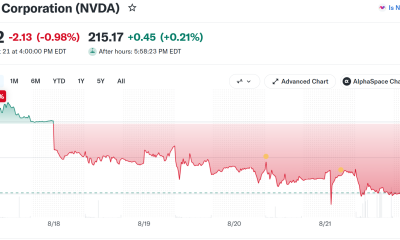
Nvidia Stock Suffers Longest Losing Streak Since 2022: Will Q2 Earnings End It?
You must be logged in to post a comment Login