MUMBAI — Salil Arora, the 23-year-old Punjab wicketkeeper-batter, has burst onto the national cricket scene in early 2026 as one of the most talked-about young talents heading into the Indian Premier League season with Sunrisers Hyderabad.
Salil Arora
Arora made his IPL debut for SRH in the 2026 season opener against Royal Challengers Bengaluru on March 28, capping a meteoric rise fueled by blistering T20 performances in the domestic circuit. Known for his aggressive middle-order batting and reliable glovework, the Amritsar-born cricketer represents the next wave of uncapped Indian finishers capable of changing games in the shortest format.
While still early in his professional journey, Arora’s story blends raw power-hitting, patient red-ball temperament and a quiet determination that has caught the eye of selectors and franchises alike. Here are five essential things to know about the emerging star as he navigates his first full IPL campaign.
1. Explosive T20 Power-Hitter With Record-Breaking Domestic Form
Salil Arora announced himself in dramatic fashion during the 2025-26 Syed Mushtaq Ali Trophy (SMAT), Punjab’s domestic T20 competition. In a Super League clash against Jharkhand in December 2025, he smashed an unbeaten 125 off just 45 balls, including nine fours and 11 sixes — a 39-ball century that lit up social media and auction rooms.
Advertisement
That knock was part of a standout season where Arora emerged as Punjab’s highest run-scorer in the tournament, amassing 358 runs at a staggering strike rate of nearly 199. His ability to clear the ropes consistently — he hit 28 sixes in the competition — earned him the nickname “Wildfire” in SRH promotional material, highlighting his finishing potential.
Ahead of IPL 2026, Arora continued his hot streak in SRH practice matches, famously smashing five sixes in five consecutive balls during a net session, sending two off veteran Jaydev Unadkat and three more off Omkar Tarmale. The display, widely shared on social platforms, fueled expectations that he could slot into SRH’s middle order as a dynamic finisher alongside established stars like Heinrich Klaasen and Travis Head.
2. Auction Success and IPL Entry With Sunrisers Hyderabad
Arora entered the IPL 2026 mega auction with a modest base price of Rs 30 lakh in the wicketkeeper category. A bidding war between Mumbai Indians and Sunrisers Hyderabad pushed his price to Rs 1.50 crore, with SRH securing his services. The investment reflects growing confidence in uncapped domestic talents who offer dual value as batters and keepers.
Advertisement
He made his IPL debut in the season’s opening fixture, batting at No. 7 in SRH’s lineup that featured Abhishek Sharma, Travis Head, Ishan Kishan (captain and keeper), Klaasen and Nitish Kumar Reddy. Though specific debut figures were modest, his inclusion signaled SRH’s strategy of blending youth with experience in a high-scoring league.
Franchise insiders and former players like Irfan Pathan have drawn parallels between Arora’s fearless approach and other emerging Punjab talents, suggesting he could develop into a long-term asset for SRH or the national setup.
3. Versatile Wicketkeeper-Batter With First-Class Pedigree
Beyond white-ball fireworks, Arora has shown composure in longer formats. Described as a “shy” but determined player from Punjab, he scored a patient century on his first-class debut for Punjab against Madhya Pradesh in the 2024-25 Ranji Trophy, proving he possesses the technique to build innings when required.
Advertisement
Primarily a right-handed middle-order batter, Arora also keeps wickets, adding valuable depth to any squad. His glovework has been solid in domestic T20s, and he has occasionally donned the big gloves in limited-overs matches for Punjab.
He represented India at the Under-19 level, featuring in the squad led by Dhruv Jurel that won the 2019 U-19 Asia Cup in Sri Lanka. That early exposure to international junior cricket helped sharpen his skills against quality opposition.
At 23, Arora balances aggressive T20 instincts with the classical foundation needed for sustained success, a combination increasingly prized in modern cricket.
4. Humble Beginnings From Amritsar and Steady Rise
Advertisement
Born on November 7, 2002, in Amritsar, Punjab, Salil Arora grew up in a sports-loving family and honed his game through local academies and state age-group teams. He progressed through Punjab U-19 ranks before breaking into the senior side, a journey marked by consistent domestic performances rather than overnight fame.
Colleagues and coaches describe him as grounded and hardworking, with social media posts on his Instagram (@salilarora12) reflecting a motivational mindset: “Remember why u started.” With just over 9,700 followers, his online presence remains modest compared to established stars, underscoring a focus on performance over publicity.
His rise mirrors that of several Punjab cricketers who have used domestic T20 success as a springboard to the IPL, where financial rewards and national visibility can transform careers.
5. Potential Impact in IPL 2026 and Beyond
Advertisement
As the IPL 2026 season unfolds, all eyes are on whether Arora can translate his domestic dominance into consistent franchise-level contributions. SRH’s attacking brand of cricket suits his power-hitting style, and opportunities in the middle order or as a finisher could see him feature regularly.
Experts have highlighted him among the top uncapped domestic players entering the 2026 season with strong form, noting his ability to accelerate innings and provide wicketkeeping cover. Success in the IPL could open doors for broader national recognition, potentially in future T20 squads.
Challenges remain, including adapting to high-pressure situations against international bowlers and managing the physical demands of a long tournament. Yet his practice-match heroics and SMAT heroics suggest a player ready for the spotlight.
Broader Context and Outlook
Advertisement
Arora’s emergence adds depth to India’s pool of young wicketkeeper-batters at a time when the national team seeks versatile backups to established names like Rishabh Pant and KL Rahul. His story also highlights the importance of domestic cricket as a talent pipeline in the IPL era.
With the league’s global audience, a breakout performance from Arora could elevate his profile dramatically. Punjab cricket, long a powerhouse in Indian domestic circles, continues to produce exciting talents, and Arora joins a growing list of players making their mark.
As the 2026 IPL progresses, Salil Arora’s journey will be one to watch — from patient first-class centurion to potential T20 destroyer, the young Punjabi batter embodies the blend of skill, power and opportunity defining modern Indian cricket.
Fans and analysts alike are remembering the name, as one explosive domestic season has already positioned him as a name to watch in cricket’s biggest stage.
A landmark agreement has been signed between Metrocentre and Gateshead Council to bring forward Metro Riverside
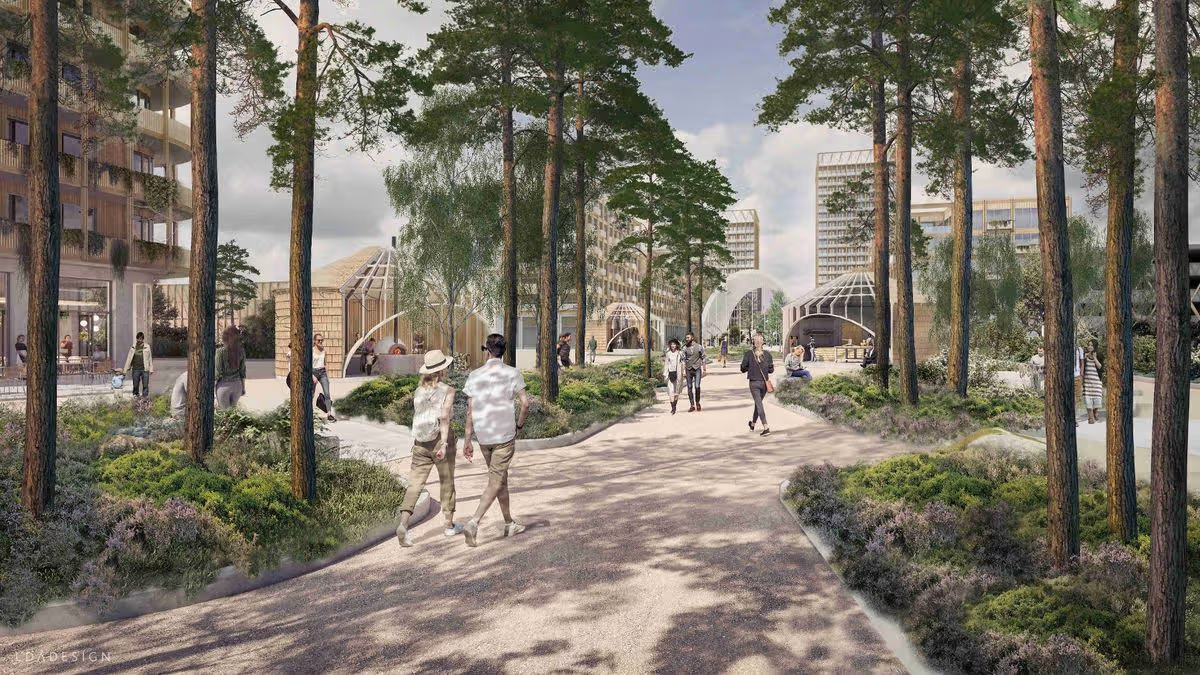
The agreement has been signed between Metrocentre and Gateshead Council to bring forward Metro Riverside(Image: LDA Design)
The Metrocentre, one of the North East’s premier shopping and leisure destinations, has agreed a landmark deal to deliver a major new development featuring thousands of new homes, billed as a “city within a city”. The agreement, signed between Metrocentre and Gateshead Council, will bring forward Metro Riverside — a new, carbon-neutral urban district on the southern bank of the River Tyne.
The sweeping regeneration scheme will transform brownfield land surrounding the Metrocentre into a thriving, mixed-use community, comprising more than 4,500 homes, while also carrying the potential to generate 5,000 jobs.
Beyond providing housing for thousands of future residents, the project could double the site’s contribution to the regional economy to more than £2bn per annum by 2045. Conceived as a 20-minute destination — with everything residents require within a 20-minute journey — Metrocentre bosses say it will deliver “compact, accessible and walkable neighbourhoods in a high-quality waterfront setting”, underpinned by strong public transport links.
Those behind the scheme say Metro Riverside has the potential to become one of the largest and most ambitious urban regeneration projects undertaken anywhere in the UK outside the M25, representing a significant vote of confidence in the North East as a location for long-term, large-scale investment. The plan also marks the most substantial development of the area since the Metrocentre first opened its doors 40 years ago.
Advertisement
Metro Riverside has been highlighted as a significant housing development within NECA’s Local Growth Plan and the Strategic Place Partnership established by NECA and Homes England, which aims to accelerate the delivery of new properties, reports Chronicle Live.
Martin Healy, chairman of Metrocentre, said: “Metro Riverside demonstrates the power of long-term public-private partnerships to unlock transformational change. Developments of this scale and ambition simply cannot be delivered in isolation.
“By working in partnership with Gateshead Council and others, we can bring together long term investment, local leadership and shared purpose to create a new dense, urban community that delivers homes, jobs and opportunities, while ensuring Metrocentre continues to evolve as a major economic engine for the region for decades to come.”
Mr Healy outlined ambitions for Metro Riverside to become a cornerstone of nature recovery, featuring green corridors lined with woodland connecting to the river, while encouraging pedestrian and cycling links to the city centres and the River Tyne corridor. He added that the development also presents a significant opportunity to boost sustainable urban drainage throughout the entire area, bolster flood defences and strengthen flood resilience.
Advertisement
A CGI of how the Metro Riverside scheme will look(Image: LDA Design)
The Metrocentre itself will sit at the core of the project, transitioning from its current status as a premier retail destination into a vibrant hub capable of serving the needs of its incoming residents and local workforce.
Plans for a substantial housing development on brownfield land surrounding the Metrocentre have been under consideration for more than 11 years, with the local authority initially aiming to deliver around 850 new homes as part of a scheme known as MetroGreen.
As far back as 2015, a new bridge spanning the Tyne was proposed as part of the MetroGreen plans, with suggestions that the development could be linked to Newcastle via a new Tyne crossing with a tram connection – though a cabinet report at the time made clear that no funding was available.
The fresh agreement between Metrocentre and Gateshead Council will see the two commit to co-invest in the first phase of the Metro Riverside project, to bring it to the point of a delivery plan.
Advertisement
To find all the planning applications, traffic diversions, road layout changes, alcohol licence applications and more in your community, visit the Public Notices Portal.
Europe’s artificial intelligence sector is gaining momentum in 2026, with a wave of ambitious startups challenging U.S. dominance through open-source models, enterprise tools, voice and video generation, and specialized infrastructure. While the continent still trails North America in total funding, several high-growth companies have achieved multi-billion-dollar valuations and rapid revenue traction, fueled by strategic investments from governments, tech giants and defense contractors.
Top 10 Rising AI Companies in Europe 2026: Mistral Leads Charge
France, the United Kingdom and Germany remain the primary hubs, benefiting from strong research talent, supportive policies on AI sovereignty and growing enterprise adoption. As of March 2026, these rising players are delivering practical applications across industries while addressing European priorities such as data privacy, multilingual capabilities and industrial competitiveness.
Here are 10 of the most promising rising AI companies in Europe this year, selected for funding momentum, valuation growth, technological innovation and commercial impact:
1. Mistral AI (Paris, France) Mistral AI has emerged as Europe’s flagship AI champion. Founded in 2023, the company reached a valuation of approximately $14 billion by late 2025 after major investments, including a significant stake from ASML. It builds efficient, open-weight large language models that compete with leading U.S. offerings while emphasizing multilingual performance and enterprise deployment. Mistral’s focus on sovereign AI infrastructure, including data center partnerships, has positioned it as a key player in reducing Europe’s reliance on foreign models. Revenue growth and adoption by European businesses have been robust.
2. ElevenLabs (London, United Kingdom) This voice AI specialist has seen explosive growth, with reports of its valuation climbing toward $6–11 billion and annual recurring revenue approaching or exceeding $300 million. ElevenLabs delivers hyper-realistic text-to-speech, voice cloning and conversational audio tools used by creators, enterprises and developers worldwide. Its rapid expansion highlights strong demand for audio AI in content creation, dubbing, accessibility and agentic systems. Backed by substantial funding, the company continues to roll out advanced features while expanding globally from its London base.
Advertisement
3. Wayve (London, United Kingdom) Wayve develops embodied AI for autonomous driving, using end-to-end machine learning rather than traditional mapping and rule-based systems. Valued at around $8.6 billion after cumulative funding exceeding $1 billion, the company is advancing toward robotaxi trials and commercial partnerships. Its data-driven approach to urban navigation has attracted automaker interest and underscores Europe’s strength in applied AI for mobility and safety.
4. Synthesia (London, United Kingdom) Synthesia leads in generative video AI, enabling users to create realistic avatar-based videos from text for training, marketing and internal communications. The company has surpassed $100 million in annual recurring revenue and achieved a valuation near $4 billion. Its platform serves thousands of enterprises, demonstrating how synthetic media can reduce production costs and timelines while supporting multiple languages — a key advantage in Europe’s diverse markets.
5. Black Forest Labs (Freiburg, Germany) This visual AI startup behind the Flux image generation models has quietly become one of Europe’s most valuable AI companies. It raised $300 million in a Series B at a $3.25 billion valuation in late 2025, drawing investment from Salesforce Ventures, a16z, Nvidia and others. Black Forest Labs focuses on high-quality, controllable image and visual AI tools, carving out a strong position in generative media despite intense global competition.
6. Quantexa (London, United Kingdom) Specializing in decision intelligence and entity resolution, Quantexa applies AI to connect complex datasets for fraud detection, risk management and compliance. The company has reached a valuation exceeding $2.6 billion and serves major banks and government agencies. Its contextual analytics platform helps uncover hidden patterns in financial crime investigations, making it a trusted name in regulated industries across Europe.
Advertisement
7. Hugging Face (Paris, France / New York) Although it has significant U.S. operations, Hugging Face maintains deep European roots and influence. The open-source AI platform and model hub has grown into a central ecosystem for developers, with a reported valuation around $4.5 billion. It hosts thousands of models and supports collaborative AI development, playing a vital role in democratizing access to cutting-edge tools while fostering Europe’s open AI community.
8. Stability AI (London, United Kingdom) Known for pioneering open-source generative models such as Stable Diffusion, Stability AI continues to innovate in image, video and multimodal generation. Despite evolving business models, the company retains significant influence in creative AI applications for artists, designers and enterprises. Its contributions to accessible generative technology have sparked both innovation and important discussions on ethics and copyright.
9. Harmattan AI (France) This defense-tech newcomer, founded in 2024, rapidly achieved unicorn status with a $1.4 billion valuation following a $200 million Series B led by Dassault Aviation. Harmattan AI develops AI solutions for autonomous systems and defense applications, aligning with Europe’s push for technological sovereignty in security and military capabilities. Its swift rise reflects growing investment in dual-use AI technologies.
10. DeepL (Cologne, Germany) DeepL has become a global leader in AI-powered translation and language tools, offering superior accuracy and natural results compared to many competitors. The company continues to expand its suite of productivity tools while maintaining strong European focus on data privacy and multilingual excellence. Steady growth and enterprise adoption have solidified its position as a reliable AI success story.
Advertisement
Europe’s AI ecosystem benefits from world-class universities, collaborative research networks and policy initiatives aimed at building compute capacity and talent pipelines. Governments in France, the UK and Germany have backed strategic projects to foster homegrown innovation and reduce dependence on non-European providers.
Many of these companies emphasize responsible AI development, with attention to transparency, bias mitigation and compliance with regulations such as the EU AI Act. This regulatory clarity has helped attract investment while differentiating European approaches from less constrained models elsewhere.
Funding trends show increased interest from both domestic and international investors, though Europe still captures a smaller share of global AI capital than the United States. Strategic bets on infrastructure, defense and industrial applications have helped several firms scale quickly.
Challenges persist, including competition for top talent, energy demands for large models and the need for more domestic compute resources. Partnerships with semiconductor leaders and cloud providers are helping address these gaps.
Advertisement
Sectors driving growth include generative media (voice, video and images), enterprise decision tools, autonomous systems and defense applications. Public-sector and industrial adoption provides stable revenue streams for several players.
As 2026 unfolds, analysts anticipate further funding rounds, potential IPO activity and deeper integration of AI into European industries. Milestones such as expanded model releases, commercial robotaxi pilots or major defense contracts could boost valuations and visibility.
The broader European AI market is projected to contribute meaningfully to economic growth and productivity, with rising companies playing a central role. Talent retention, international expansion and ethical leadership will determine which firms become enduring global leaders.
For investors and enterprises, these rising stars offer opportunities in high-potential technologies with strong regional advantages. Early engagement through partnerships or pilot programs can provide competitive edges in a rapidly evolving landscape.
Advertisement
Europe’s AI story in 2026 reflects a maturing ecosystem moving from research excellence to scalable commercial impact. While gaps with U.S. giants remain, focused innovation and strategic investments are creating a more competitive and diversified continental AI sector.
The landscape continues to evolve quickly, with new entrants emerging from university spinouts and accelerator programs. Ongoing monitoring of funding announcements, product launches and regulatory developments will be essential for tracking momentum.























































You must be logged in to post a comment Login