

Business
Ronaldo Bids Emotional Farewell to World Cup as Spain’s Late Winner Ends Portugal’s Run


ARLINGTON, Texas — Cristiano Ronaldo’s storied World Cup journey concluded in heartbreak on Monday as Spain eliminated Portugal with a dramatic stoppage-time goal in the round of 16 at Dallas Stadium.
Mikel Merino, a substitute, scored in the first minute of added time to secure a 1-0 victory for Spain, sending the European champions into the quarterfinals and bringing down the curtain on Ronaldo’s sixth and final World Cup appearance. The 41-year-old Portuguese superstar walked off the pitch with a stoic expression, acknowledging fans with a brief wave amid the disappointment of another early exit for his nation.
In the mixed zone after the match, Ronaldo reflected on the defeat with measured composure. “I’m sad to be leaving the World Cup like this,” he said. “I gave it my all. I did my best and I’m leaving with a clear conscience. It was my last World Cup, yes, but I’ll now have time to reflect and be with my family. I won’t be making any rash decisions.”
He emphasized that Spain had enjoyed “a bit of luck” on Merino’s winner, describing a tightly contested match that “could have gone either way.” Ronaldo declined to confirm whether the game marked his final appearance in a Portugal shirt, preferring not to overshadow the team’s efforts with a personal announcement made “in the heat of the moment.”
The loss also coincided with the end of Roberto Martinez’s tenure as Portugal manager. Ronaldo offered praise for the Spaniard, calling him “a great manager, a great human being” and commending his contributions to the national team.
Portugal entered the tournament with high expectations, bolstered by Ronaldo’s leadership and a squad featuring a blend of veterans and emerging talents. The five-time Ballon d’Or winner had spoken beforehand about this being his last World Cup, a declaration that added emotional weight to every moment on the field. Despite Portugal’s strong group stage showing, the knockout clash against their Iberian rivals proved one step too far.
Ronaldo’s international legacy with Portugal remains secure. He helped the Selecao win the 2016 European Championship — their first major trophy — followed by Nations League titles in 2019 and 2025. “I’ve won three titles for Portugal; before Cristiano Ronaldo, Portugal hadn’t won a single title,” he noted proudly. He equated the significance of the 2016 Euros triumph to a World Cup.
The match itself was a tense, tactical battle befitting two of Europe’s football powerhouses. Spain controlled much of the possession and created several threatening moments, but Portugal’s defense, marshaled effectively in the absence of key absences, held firm for long stretches. Ronaldo himself was denied a potential goal in the first half by a stunning save from Spain goalkeeper Unai Simon.
As the game wore on, fatigue appeared to set in for both sides. Spain’s bench ultimately made the difference. Ferran Torres provided the assist for Merino’s late header or close-range finish — accounts vary slightly on the exact execution — in a moment that stunned the Portuguese contingent. The goal silenced large sections of the crowd that had been roaring in support of Ronaldo and his teammates throughout.
For Ronaldo, the evening represented the end of a remarkable chapter that began with his World Cup debut in 2006. Over six tournaments, he established himself as one of the competition’s greatest performers, though the elusive World Cup title always remained just out of reach. His longevity at the elite level is unparalleled; at 41, he continues to compete at the highest level with Al-Nassr in Saudi Arabia while carrying the weight of national expectations.
Portugal’s campaign was not without bright spots. The team demonstrated resilience and moments of quality that suggested a promising future. Younger players gained valuable experience on the grandest stage, potentially paving the way for a new era once Ronaldo’s international future is clarified. Manager Martinez’s departure opens the door for fresh leadership as Portugal rebuilds.
In the broader context of the 2026 World Cup, hosted across the United States, Canada and Mexico, the match highlighted the intense competition in a stacked European field. Spain, seeking to add to their 2010 triumph, advanced with a disciplined performance emblematic of their current style under their coaching staff. Their quarterfinal opponent will await, while Portugal must now shift focus to recovery and the next cycle of qualifiers.
Ronaldo’s post-match comments struck a tone of acceptance mixed with pride. “It’s always sad to be knocked out of a major tournament. It’s a World Cup. The team was really coming into its own. We played well, in my view,” he said. “It’s frustrating to go out like this, but we can hold our heads high.”
The football world reacted swiftly to the result. Tributes poured in for Ronaldo’s career, acknowledging his unmatched dedication, goal-scoring records, and influence on the sport. Fans in Arlington and back home in Portugal expressed a mixture of sorrow and gratitude for the memories he provided across two decades.
As the tournament progresses without Portugal, questions linger about Ronaldo’s next steps. Will he continue with the national team for upcoming European qualifiers or Nations League campaigns? Or has Monday’s match marked the final page of his international story? True to his words, those decisions can wait. For now, the focus remains on a career that transcended borders and inspired generations.
Spain’s victory sets up intriguing possibilities in the knockout stages. With talents like Lamine Yamal shining and a solid squad depth, they present a formidable challenge for any remaining contenders. The Iberian derby, long anticipated, delivered drama until the final whistle, living up to its billing despite the narrow margin.
For Portuguese supporters, the pain of elimination is tempered by the knowledge that their icon departed with dignity and a clear conscience. Ronaldo’s contribution to Portugal’s football identity is indelible. From the streets of Madeira to the world’s grandest stadiums, his journey has been one of relentless pursuit of excellence.
As night fell over Dallas Stadium, the echoes of chants for Ronaldo likely lingered. The 2026 World Cup continues, but one of its defining figures has taken his final bow on this particular stage. The sport moves forward, as Ronaldo himself acknowledged, but his shadow will loom large over future tournaments for years to come.

Business
Christopher Nolan’s ‘The Odyssey’ Draws Nearly Universal Praise Ahead of Its July 17 Theatrical Release

LONDON — Christopher Nolan’s long-awaited adaptation of “The Odyssey” premiered Monday in London, and the first wave of reactions from critics and journalists who attended the screening suggest the director’s latest epic has lived up to the enormous anticipation surrounding it.
The film, which stars Matt Damon as the Greek hero Odysseus, Anne Hathaway as his wife Penelope, and Tom Holland as their son Telemachus, chronicles Odysseus’ long and perilous journey home to Ithaca following the Trojan War. Notably, “The Odyssey” is the first feature film ever shot entirely using IMAX cameras, and Universal Pictures screened the movie for critics in IMAX theaters where available, underscoring the technical ambitions behind the project.
Unlike some of the studio’s previous marketing approaches, Universal opted not to hold dedicated early “word of mouth” screenings exclusively for social media influencers ahead of the film’s release. Instead, professional journalists and other attendees who saw the movie at its London premiere and subsequent press screenings were included in the first wave of public reactions, alongside a smaller number of influencers who participated in press junkets tied to the film.
Reaction from outlets that attended the screening was overwhelmingly positive. Time Out described the film as an impressive achievement bolstered by strong performances across its ensemble cast, singling out actress Samantha Morton’s work as especially memorable, and noting that the film balances intense drama with a few moments of levity. The outlet praised the emotional weight of certain sequences, including one involving the Cyclops, and encouraged audiences to see the film more than once.
IndieWire offered a somewhat more measured take, describing the film as a natural follow-up to Nolan’s previous project, “Oppenheimer,” while noting that its IMAX scale is immense even if some elements of the storytelling occasionally feel less refined than Nolan’s strongest work. The outlet nonetheless indicated that the film’s final act ultimately rewards viewers for the journey.
Variety was more emphatic in its praise, calling the film an astonishing achievement and a triumphant, spectacular epic. The outlet highlighted standout performances from Holland, Damon, Hathaway, John Leguizamo, Robert Pattinson and Lupita Nyong’o, describing several as among the best of their respective careers, and praised the film’s battle sequences, particularly those depicting the fall of Troy, as breathtaking.
The Independent called the film Nolan’s biggest to date, noting that it features significantly more large-scale set pieces than any of his previous projects and praising the film’s visual ambition. The outlet singled out Holland’s performance as Telemachus as one of the best of his career, alongside praise for supporting turns from Himesh Patel and Morton, whom the review credited with stealing several scenes despite limited screen time.
The Hollywood Reporter’s film editor, Aaron Couch, noted that after following Nolan’s films in theaters since “Memento,” “The Odyssey” marks the first time the director has included a fully realized horror sequence in one of his films, a detail that stood out to Couch as a notable departure from Nolan’s prior work.
DigitalSpy described the film as staggering, citing its intense and spectacular set pieces alongside a powerful musical score, and noted that while some longtime fans of Homer’s original poem might take issue with certain adaptation choices, the overall theatrical experience remains distinctly Nolan’s own.
The film’s scale reflects years of preparation. Nolan has described “The Odyssey” as a personal, long-gestating project, telling Variety in a May interview that the film needed to be the biggest he had ever made. In an earlier interview with Empire magazine, Nolan explained his interest in bringing a mythological story to the screen with the scale and credibility typically reserved for big-budget studio productions, saying he had grown up watching classic mythological films and had long wanted to revisit that kind of storytelling with the resources of a major IMAX production.
The film’s ensemble cast extends well beyond its central trio, including Zendaya as the goddess Athena, Charlize Theron as the sorceress Calypso, Lupita Nyong’o in dual roles as Helen of Troy and Clytemnestra, and additional performances from Jon Bernthal, Corey Hawkins, Mia Goth, Elliot Page, James Remar and Bill Irwin, among others. Rapper and actor Travis Scott also appears in the film, a casting choice Nolan has said was intended to draw a thematic connection between rap and oral poetry as related art forms.
Production on the film took Nolan and his crew across multiple international locations, including Italy, Iceland, Greece, Morocco and Scotland, with additional filming completed at Universal’s studio lot in California. Specific filming locations have included the coastal region of Al-Dakhla in Western Sahara, the historic Castle of Santa Caterina on the Sicilian island of Favignana, and the Moray Firth inlet along Scotland’s northeastern coast.
“The Odyssey” is set for wide theatrical release July 17 in both the United States and the United Kingdom, with early preview screenings scheduled to begin the afternoon of July 16. The film will maintain exclusive access to IMAX screens for its first three weeks of release, according to reporting from Hollywood Life, and carries a running time of approximately 172 minutes. The production has been described in multiple reports as the most expensive film of Nolan’s career, reflecting the scale of its international shoot and its status as the first feature ever captured entirely on IMAX film cameras.
The film marks Nolan’s first release since 2023’s “Oppenheimer,” which won the Academy Award for best picture and earned Nolan his first Oscar for best director. With early reactions from London pointing toward a broadly enthusiastic critical reception, “The Odyssey” appears positioned to continue Nolan’s recent run of both critical and commercial success as it heads toward its wide theatrical debut later this month.

The over 50s land lease community operator has purchased more than 14 hectares of land in the South West from ASX-listed residential developer Stockland for $30 million.

China-connected shareholders in rare earths hopeful Northern Minerals have defied a government order to divest their stakes, sending the developer’s share price sliding.
Business
TCS, Infosys and other Indian IT stocks rise up to 4% after AI worries trigger Kospi selloff

The move came at a time when investors are preparing for the June-quarter earnings season of Indian IT companies. The sector has been under heavy pressure for months due to weak discretionary technology spending, slower client decision-making, pressure from artificial intelligence-led productivity gains and valuation concerns.
The rebound in Indian IT stocks stood in contrast to the fall in South Korea, where AI-linked chip stocks dragged the market lower. The benchmark KOSPI closed down 395.02 points, or 4.9%, at 7,656.31, after falling as much as 8.2% earlier in the session. The index is now down 16% from its June 22 record close of 9,114.55, though it remains up 82% so far this year.
Circuit breakers were triggered on the KOSPI during the session, the sixth such instance this year, as volatility in semiconductor stocks remained high. Samsung Electronics and SK Hynix led the decline, ending down 6.9% and 6.1%, respectively, after both fell more than 10% intraday.
Also Read: The Q1 verdict: Can TCS, Infosys, other IT results stop a Rs 17 lakh crore AI-led rout?

Samsung fell even after forecasting a 19-fold jump in second-quarter operating profit. The fall showed that investors are now questioning whether strong AI-linked earnings are already priced into chip stocks after a sharp rally.
For Indian IT investors, the concern is different but linked to the same AI theme. While Korean chipmakers have rallied on AI demand, Indian IT stocks have fallen because investors worry that AI could hurt billing growth, reduce manpower-linked revenue and force companies to pass productivity benefits to clients.The correction has been severe. TCS, Infosys, Wipro and LTIMindtree are now down at least 50% from their all-time highs. Across 10 major IT companies, the combined market-cap loss from peak levels is estimated at more than Rs 17 lakh crore.
TCS has seen the biggest destruction in value. The stock has fallen about 56% from its all-time high of Rs 4,592.25 in August 2024 to around Rs 2,033. Its market cap has dropped from Rs 16.48 lakh crore to Rs 7.36 lakh crore, wiping out more than Rs 9.12 lakh crore.
Infosys has nearly halved from its peak of Rs 2,006.45 in December 2024 to Rs 1,006. Its market value has fallen from Rs 8.30 lakh crore to Rs 4.08 lakh crore. Wipro is down 54% from its peak, while LTIMindtree has lost more than 53%. HCL Tech, Persistent Systems, Mphasis and Tech Mahindra have also seen sharp declines.
The latest rise in IT shares may partly reflect bargain buying after the steep fall. But the real test will come with Q1 results and management commentary.
Morgan Stanley expects a muted first quarter for IT companies and subdued commentary for the second quarter. The brokerage sees risks to FY27 revenue guidance ranges and has lowered estimates for large-cap IT companies.
It has also downgraded TCS to equal-weight, saying the stock’s premium to Accenture has risen above 40%, putting valuations for the broader group at risk. Morgan Stanley expects organic revenue growth for most large-cap IT firms to drift towards 1.5-3.5%, except Wipro, where it sees a decline.
Investors will now watch whether companies such as TCS and Infosys can show signs of demand stability, defend margins and explain how AI will support revenue rather than only reduce costs for clients.\
(Disclaimer: Recommendations, suggestions, views and opinions given by the experts are their own. These do not represent the views of Economic Times)

Remote work was supposed to erode company culture. The argument was familiar by the early 2020s: camaraderie needs hallways, and loyalty needs a shared roof. Employees at Risepoint, scattered across the United States, Canada, the United Kingdom, and Australia, may have a counterargument.
The education technology company, which partners with more than 100 universities and colleges on online degree programs, earned four 2026 Comparably Best Places to Work Awards: Best Career Growth, Best Leadership Teams, Best Sales Teams, and Best Product & Design Teams. Comparably’s awards come entirely from anonymous employee feedback gathered over 12 months, across categories that evaluate leadership, career growth, compensation, work environment, and team effectiveness.
A Workforce That Uses What It Builds
Risepoint employs more than 1,400 people, and the composition of that workforce reads like the student body of the universities it serves. Of that group, 9 in 10 hold college degrees, and 4 in 10 were the first in their families to attend college. Roughly half have worked in education before joining, and 43% have spent a decade or more in higher education.
The most telling figure may be this one: 15% of employees have enrolled in the very degree programs Risepoint supports. A sizable slice of the workforce has sat on the student side of the experience, fitting coursework around a full work week the way most students in those programs do. The company encourages the overlap: it reimburses tuition for employees who enroll in Risepoint-supported programs.
Chesley Fernandes, a team member who earned an M.Ed. in Educational Leadership, described what that looks like in practice. “I completed my degree at the same university I now support and can relate to the students I work with every day,” she said. “With this connection, I can reassure them through my own experiences that they are not alone and can succeed in their program.”
Career Growth, Measured From Within
Of the four awards, Best Career Growth may be the hardest for a remote company to win. Advancement in distributed organizations can favor whoever happens to be most visible. Building career paths without a hallway to be seen in takes deliberate structure: defined development programs and leaders trained to develop people they rarely meet in person. Comparably gives the award to employers whose people rate their room to advance, learn, and grow professionally as strong, and Risepoint employees put the company in that group.
“These awards are especially meaningful because they come directly from employee feedback,” said Fernando Bleichmar, the company’s CEO. “Our people are at the center of everything we do. We are committed to fostering a culture where employees feel supported in their growth, empowered to make an impact, and connected to a shared mission.”
Trust That Travels
The Best Leadership Teams award turns on whether employees trust the executive team and the direction it has set for the organization. That kind of confidence is built differently over video calls than over lunch tables, and it tends to be more fragile. The award sits alongside earlier Comparably recognitions for Best CEO, Best Company Culture, and Best Company Work-Life Balance, a pattern that points to something sturdier than one good survey cycle.
Employee accounts echo the rating data. “The work culture is amazing at Risepoint,” said Jazzie Santos-Rogers, a senior manager on the growth marketing team. “Not only do you have amazing peers to collaborate with on a daily basis, but management is knowledgeable and supportive on every level.”
The remaining two awards, Best Sales Teams and Best Product & Design Teams, recognize the departments that anchor opposite ends of the business: the people who build university partnerships and the people who build the tools those partnerships run on.
The Mission Underneath
Risepoint concentrates on regional universities, the institutions that serve their surrounding communities and educate much of the local workforce. Its partner institutions span 40 states and five countries, and the programs it supports lean toward fields where demand stays strong: healthcare, education, business, and public service. Most students in those programs are working adults.
That focus shapes the culture being rated. Employees who came from education, were first in their families to finish college, or earned degrees through the programs they now support have lived the mission from both sides. When that workforce hands its employer four culture awards in a single year, the verdict carries credibility no headquarters could supply.
Business
Nikola Jokic Says He Wants to Stay With Denver Nuggets for the Rest of His NBA Career, Eyes 2027 Deal

Nikola Jokic has removed any lingering doubt about his long-term future with the Denver Nuggets, telling reporters Monday that he intends to remain with the franchise for the remainder of his career and plans to sign a contract extension as soon as he becomes eligible next summer.
The three-time NBA Most Valuable Player made the comments in Serbian following Serbia’s FIBA World Cup qualifying game Monday, a 94-81 win over Bosnia and Herzegovina. “My idea is to sign next summer and stay with Denver for the rest of my career,” Jokic told reporters, according to a translation published by DNVR Sports. He elaborated further on his intentions, adding, “My idea and desire is to stay in Denver. I’ll probably sign next year… My desire is to play the rest of my life in Denver.”
Jokic currently has two seasons remaining on his existing contract with Denver, which includes a player option that would allow him to become an unrestricted free agent in 2028, the year he turns 33. Rather than wait until that option comes into play, Jokic indicated he intends to sign a new extension well before then, effectively closing the door on any speculation about his eventual free agency.
Under current NBA rules, Jokic would become eligible to sign a new contract extension next summer, and reports indicate he could be in position to sign the largest contract in league history when he becomes eligible for a new deal in the summer of 2027. According to ESPN, Jokic would be eligible for a five-year contract worth approximately $359.5 million as a free agent at that time, a figure that would represent one of the most lucrative deals ever signed by an NBA player.
Jokic’s comments carry significant weight given his standing as one of the most accomplished players of his generation. Selected by Denver with the 41st overall pick in the second round of the 2014 NBA Draft, Jokic has developed into one of the most dominant players in franchise history, leading the Nuggets to their first NBA championship in 2023 and earning Finals MVP honors for his performance during that title run.
Jokic’s individual production has remained remarkably consistent throughout his career. During the 2025-26 season, he averaged a triple-double across 65 appearances, posting 27.7 points, 12.9 rebounds and 10.7 assists per game. Across 11 NBA seasons, Jokic has averaged 22.2 points, 11.1 rebounds and 7.5 assists per game, numbers that have established him as one of the most well-rounded and statistically dominant centers in league history.
Jokic’s decision to publicly reaffirm his commitment to Denver comes during an active offseason across the league, one that has already seen a wave of major roster moves and star player movement. The Milwaukee Bucks completed a blockbuster trade sending two-time MVP Giannis Antetokounmpo to the Miami Heat, while the Boston Celtics traded Jaylen Brown to the Philadelphia 76ers in exchange for Paul George. Additional moves have included Kawhi Leonard’s reported return to the Toronto Raptors, Ja Morant’s trade from the Memphis Grizzlies to the Portland Trail Blazers, and LaMelo Ball’s move from the Charlotte Hornets to the Minnesota Timberwolves. LeBron James has also informed the Los Angeles Lakers that he intends to play elsewhere for the 2026-27 season, adding further uncertainty to the league’s star player landscape heading into the new campaign.
Against that backdrop of significant roster turnover across the NBA, Jokic’s clear and public statement of loyalty to Denver stands out as a rare example of stability amid an otherwise turbulent offseason for player movement. His comments also come at a time when the Nuggets have continued to build their roster around him, positioning the team to remain competitive in the Western Conference as it looks to build on its 2023 championship run.
Jokic’s timeline for signing an extension aligns with typical NBA rules governing veteran contract extensions, which generally allow players to sign new deals a certain number of years into their existing contracts. By waiting until next summer to formally sign an extension rather than pursuing one immediately, Jokic would be positioning himself to potentially maximize the length and value of his new deal under the league’s collective bargaining agreement, while still providing Nuggets fans and the organization with clear assurance of his long-term intentions well ahead of that signing window.
The 31-year-old center’s comments also reflect a broader pattern of loyalty he has expressed throughout his career, having consistently emphasized his preference for stability with the Nuggets organization even as rumors and speculation about star player movement have periodically circulated around other top players across the league. Unlike several other franchise cornerstones who have requested trades or explored other options in recent years, Jokic has remained a steady, singular figure in Denver since entering the league, a dynamic that has helped the Nuggets build sustained success around his unique skill set as a passing, scoring and rebounding threat at the center position.
With training camps still months away and the NBA’s offseason continuing to produce roster shakeups across the league, Jokic’s declaration of long-term commitment to Denver offers a measure of certainty for a franchise that has built its recent championship aspirations around his continued presence. Whether that commitment translates into a formal contract extension as early as next summer, as Jokic has now publicly indicated he intends to pursue, will become one of the more closely watched storylines of the coming NBA calendar, particularly given the record-setting financial terms he could command once fully eligible to sign a new deal in 2027.

UK manufacturing SMEs are struggling to fill skilled roles such as machinists, operators and toolmakers, and the gap is no longer closing on its own.
Rather than waiting out the hiring crunch, a growing number of small producers are investing in automated equipment to reduce their dependency on scarce labour. This shift is changing how owners plan output, quote for new work and structure their teams.
This article looks at why the skills shortage has become so persistent, what automation adoption looks like in practice for small manufacturers, and what owners should weigh up before committing capital to new equipment.
The Scale of the Skills Shortage
Manufacturing vacancies in the UK have remained stubbornly high for several years. The Office for National Statistics has recorded manufacturing job vacancies sitting in the region of 58,000 to 61,000 through 2024 and into 2026, a level well above pre-pandemic norms. Make UK’s own research goes further: 75% of manufacturers now cite skills shortages as the single biggest barrier to growth, and over 70% report difficulty recruiting skilled workers at all.
The shortage is also generational. Around 21% of the current manufacturing workforce is aged 55 or over, and apprenticeship pipelines have not expanded quickly enough to replace those workers as they retire. Roles such as CNC machinists, maintenance engineers and toolmakers now take considerably longer to fill than they did five years ago.
Small manufacturers feel this more acutely than large enterprises. A big factory can absorb a vacant post across several teams; a workshop with eight or ten staff often cannot. Losing a single skilled machinist can mean turning down orders or paying premium rates for agency cover, and SMEs typically have smaller recruitment budgets and less capacity to compete on salary with larger firms in the same labour market.
Why Automation Is the Practical Response
For many small producers, automation is becoming less about efficiency and more about workforce resilience. CNC and laser-based equipment reduces how much a business depends on one person’s specialized manual skill, because the precision moves from the operator’s hands into the machine’s programming.
In practice, this changes three things for a small manufacturer. First, output becomes more consistent – a programmed cut or engraving repeats to the same tolerance regardless of who is running the shift. Second, training time for new staff falls, since operating and loading a machine takes far less time to learn than mastering manual metalwork or joinery to a professional standard. Third, a smaller shop can take on precision work it previously had to subcontract or decline, because it no longer needs a dedicated specialist on the floor for every job.
This is best understood as a shift from hiring the skill to buying the capability. Where a business once needed to recruit and retain someone with years of trade experience, it can now achieve comparable output by investing in equipment and training an existing team member to operate it. That doesn’t remove the need for skilled people entirely – someone still has to set up, program and maintain the machine – but it changes the shape of the skills gap rather than closing it outright. This pattern holds across CNC routing, laser cutting and laser engraving, regardless of the specific manufacturing sector involved.
What This Looks Like in Practice
Consider a small UK sign-making or metal fabrication workshop that has struggled for two years to recruit a second skilled fabricator. Rather than continuing an unsuccessful search, the business invests in a laser cutting system and trains an existing team member to operate it over a matter of weeks rather than the years a manual apprenticeship would take.
The practical outcomes tend to follow a similar pattern. Lead times shorten because jobs no longer queue behind a single specialist. The business can bid for contracts it previously turned down due to capacity constraints. Overtime and agency staffing costs fall, since the machine covers volume that would otherwise require additional shifts or temporary labour. None of this requires the workshop to grow its headcount – it requires the right equipment and one or two trained operators.
When sourcing this kind of equipment, many UK manufacturers look to established European suppliers who can offer local delivery, service and warranty support rather than relying solely on long-lead-time imports from further afield. Virmer is a supplier of CNC laser equipment in Europe, and its role illustrates the kind of supplier relationship small manufacturers now factor into their equipment decisions – proximity, after-sales support and service response time carry as much weight as the machine’s specification sheet.
What Owners Should Weigh Up Before Investing
Automation is not a straightforward swap for a vacant role, and the decision carries its own set of trade-offs.
The upfront cost is the most obvious factor, and owners need to weigh it against realistic labour savings rather than best-case projections. Training time for existing staff, while shorter than a traditional apprenticeship, still needs to be budgeted into the transition – output typically dips for a few weeks while the team gets up to speed. Warranty and service support matter more than they might for other capital purchases, particularly since much of this equipment is sourced from EU-based manufacturers; a machine that’s down for three weeks awaiting a part can undo months of productivity gains. Space and power requirements also need checking early, as some equipment demands three-phase power or extraction systems a workshop may not already have.
Financing is rarely a barrier on its own. Leasing and asset finance are commonly used by UK SMEs for exactly this kind of capital equipment, spreading the cost in a way that mirrors the labour savings the machine is expected to deliver over time.
The Bottom Line
For UK manufacturing SMEs, automation is increasingly a response to the labour market rather than a pure efficiency upgrade. It doesn’t remove the need for skilled people, but it changes how many are needed and what their skills need to cover.
As the skills shortage persists – and the data suggests it will, given the sector’s ageing workforce and constrained apprenticeship pipeline – more small producers are likely to treat equipment investment as an alternative to hiring, not just a route to growth. The businesses that plan for this shift now, rather than reacting to it once a vacancy has gone unfilled for months, are the ones best placed to keep their order books moving.
Business
Paras Defence, ideaForge, other defence stocks slide up to 5%. What’s triggering the selloff?
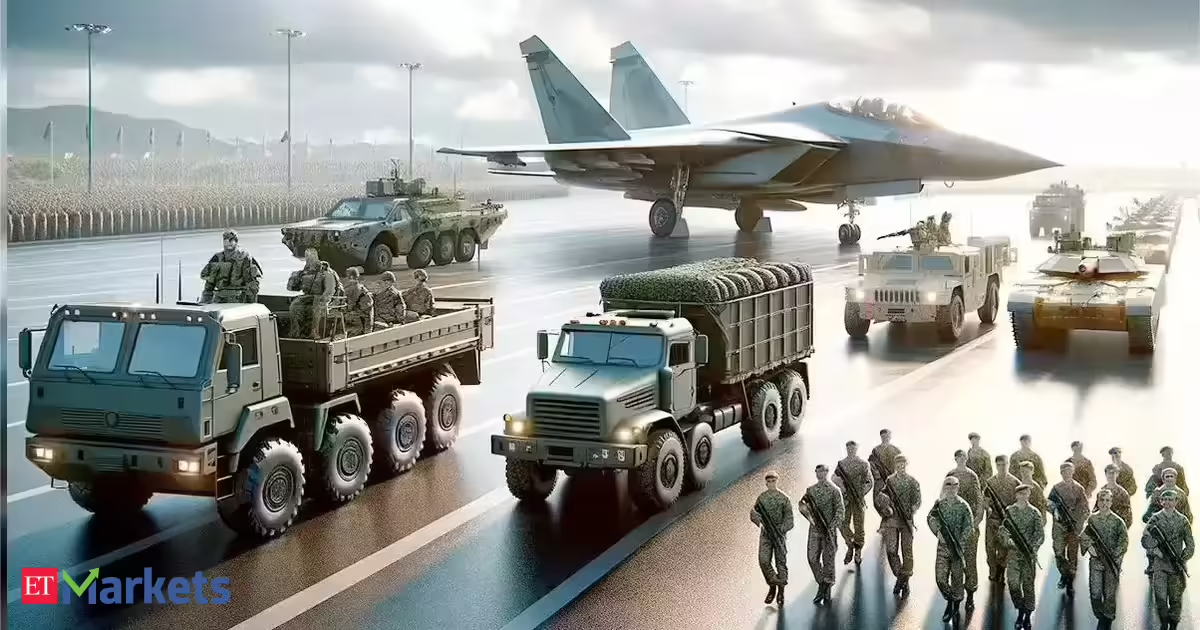
The rally on Monday came after the Defence Acquisition Council (DAC) approved capital acquisition proposals worth about Rs 52,000 crore. The approvals span a range of procurements aimed at enhancing the operational capabilities of the Army, Navy and Air Force, including air defence systems, anti-drone technologies, surveillance equipment and unmanned warfare platforms.
Among individual stocks, Data Patterns declined 5% to Rs 4,390, while Paras Defence fell nearly 5% to Rs 1,294 on the BSE. ideaForge also dropped 5% to Rs 812, while Bharat Dynamics slipped over 2% to Rs 1,375. Mazagon Dock and Cochin Shipyard were down as much as 3% during the session.
Also read: DAC clears Rs 52,000 crore defence acquisitions, boosts drone and air defence capabilities
DAC Approval
The latest approvals span several indigenous and advanced defence platforms across the three armed services, with a focus on improving preparedness against emerging aerial and mechanised threats.
For the Indian Army, the DAC cleared the procurement of the Anti-Unmanned Aerial Vehicles (UAV) Electronic Warfare System ‘AKASH TARANG’, Man Portable Anti-Tank Guided Missile (MPATGM) Systems, Medium Range Surface-to-Air Missile (MRSAM) Weapon System, Very Short Range Air Defence System (V-SHORADS), Active Protection System for Tanks and the Jet-Based Kamikaze Drone System.
For the Indian Navy, approvals were granted for the procurement of the Multi-Influence Ground Mine (MIGM), Naval Shipborne Unmanned Aerial System (NSUAS) and the establishment of a Land-Based Testing Facility (LBTF) for Electric Propulsion Systems.
For the Indian Air Force, the council approved the acquisition of a Fixed-Wing Based High Altitude Pseudo Satellite (FW-HAPS), along with other proposals. According to the ministry, the FW-HAPS platform will provide persistent intelligence, surveillance and reconnaissance (ISR), telecommunications, and remote sensing capabilities, strengthening the Air Force’s operational reach and endurance.
What are experts saying?
“This is likely to accelerate order inflows and execution for defence companies, as a larger share of procurement contracts can now be approved directly by the armed forces,” domestic brokerage Motilal Oswal said.
The brokerage has maintained its ‘Buy’ rating on HAL with a target price of Rs 5,500, implying an upside of 24% from current levels. It expects the company’s revenue to grow 9% year-on-year, supported by healthy execution of its opening order book. Investors will closely watch updates on deliveries of the Tejas Mk1A and HTT-40 aircraft, the partnership with GE for engine manufacturing and the working capital cycle.
Read more: Lessons from Op Sindoor: DAC nod to pseudo satellites, air defence systems, jet-based drones
Motilal Oswal has also reiterated its ‘Buy’ rating on Astra Microwave. The brokerage expects revenue to rise 13% year-on-year in the first quarter of FY27, with execution likely to gather pace on the back of an order book of around Rs 2,600 crore. Key monitorables include fresh ordering across larger platforms, margin sustainability and export opportunities.
For Bharat Electronics, the brokerage has retained its ‘Buy’ recommendation with a target price of Rs 510, suggesting a potential upside of 23% from current levels. It expects revenue to grow 16% year-on-year, driven by the execution of the company’s opening order book of about Rs 74,000 crore. Analysts will monitor updates on major orders, including QRSAM, Uttam radars, next-generation corvettes, P75I submarines and the progress of the AMCA programme.
(Disclaimer: Recommendations, suggestions, views and opinions given by the experts are their own. These do not represent the views of The Economic Times)

The company’s standalone billings for Q1 FY27 stood at Rs 737 crore, compared with Rs 644.2 crore in the corresponding quarter last year, marking a growth of approximately 14.4% year-on-year. The performance highlights sustained demand across Info Edge’s core businesses and improved execution across its digital platforms.
The company’s flagship Recruitment Solutions business remained the key growth driver during the quarter, with billings rising to Rs 552.7 crore from Rs 470.3 crore in Q1 FY26. The segment continues to benefit from steady hiring activity and strong adoption of online recruitment solutions.
The 99acres real estate platform also maintained its upward trajectory, with billings increasing to Rs 110.1 crore during Q1 FY27 from Rs 94.4 crore in the same period last year.
The Jeevansathi business reported steady improvement, with billings climbing to Rs 39.6 crore from Rs 34.7 crore year-on-year. Meanwhile, the Shiksha segment recorded billings of Rs 34.6 crore, compared with Rs 44.8 crore in the previous year’s quarter.
Expansion Push Through Coding Ninjas Acquisition
Adding to the positive sentiment, Info Edge recently announced the acquisition of edtech platform Coding Ninjas. In an exchange filing dated July 6, the company said it will acquire the remaining stake in Sunrise Mentors, the entity operating Coding Ninjas, from its founders.
Under the agreement, Info Edge will purchase 74,741 equity shares at Rs 5,340.23 per share, involving a total consideration of around Rs 39.91 crore. Following the transaction, Coding Ninjas will become a wholly owned subsidiary of Info Edge, held directly and through its subsidiary Startup Investments (Holding).
The company also announced plans to commit an additional Rs 180 crore to its startup investment fund, reinforcing its focus on backing emerging technology-driven businesses.
Stock Performance and Valuation Snapshot
Info Edge shares touched an intraday high of Rs 1,144.50 on the NSE. The stock’s 52-week high stands at Rs 1,489, while its current market capitalisation is around Rs 67,630 crore. From a valuation perspective, the company is trading at a price-to-earnings (P/E) ratio of 45.85 and a price-to-book (P/B) ratio of 1.64.
Technical Outlook
On the technical front, Info Edge’s 14-day Relative Strength Index (RSI) stands at 57.8, indicating moderate positive momentum. An RSI below 30 is generally considered oversold, while levels above 70 indicate overbought conditions.The stock is trading above 7 out of 8 key simple moving averages (SMAs), suggesting broad-based technical strength. However, it continues to trade below its long-term 200-day moving average, indicating that investors are closely watching whether the stock can sustain its recovery trend.
(Disclaimer: Recommendations, suggestions, views and opinions given by the experts are their own. These do not represent the views of Economic Times)

LG Energy Solutions misses profit estimates on weak ESS sales

Christopher Nolan’s ‘The Odyssey’ Draws Nearly Universal Praise Ahead of Its July 17 Theatrical Release

EUR/USD Analysis: Who Is in Control?

10 Perfect ‘Little House on the Prairie’ Episodes To Revisit Before the Netflix Reboot


-

 Fashion4 days ago
Weekend Open Thread: High Hopes
-

 Fashion17 hours ago
Open Thread: What Great Books Have You Read Recently?
-

 Politics4 days ago
The House | “Reframing the debate from a binary discussion of winners and losers”: Yuan Yang reviews ‘We Are Not Machines’
-
 NewsBeat2 days ago
Taylor Swift and Travis Kelce wedding staffer hilariously struggles to keep her cool while checking in megastars
-
 Crypto World6 days ago
Airdrop Registration Becomes Key Focus For Remittix As RTX Launch Updates Approach
-

 Sports6 days ago
Broncos roster: OL Ben Powers (No. 74) entering final year of contract
-

 Crypto World5 days ago
Binance stock trading tops $1B in first month after launch
-

 Crypto World4 days ago
Standard Chartered Secures MiCA License as ESMA Adds 37 New Crypto Firms
-

 NewsBeat6 days ago
Presenter Caroline Flack’s brother Paul Flack dies aged 55
-

 Crypto World5 days ago
Alibaba-affiliate Ant Group enters the humanoid robot market with 12 deals
-

 Crypto World2 days ago
South Africa proposes crypto tax guidance under existing rules
-

 News Videos18 hours ago
Best Time to Enter Small Caps Right Now? Another Bull Run? | Financially Free
-

 Tech2 days ago
Lenovo laptops are now shipping with YMTC SSDs, a sign of Chinese NAND entering the mainstream
-

 Business5 days ago
Meta Platforms Stock Jumps 7% Today as Bloomberg Reports Company Plans to Enter the Cloud Business
-
 NewsBeat5 days ago
New exhibition reflects five decades of movement between island of Ireland and GB
-

 Business15 hours ago
AXT Shares Jump Nearly 14% as Semiconductor Materials Maker Rebounds on AI-Linked Indium Phosphide Demand
-

 News Videos6 hours ago
Whats Hidden Inside This Cash Register? #treasure #reselling #money
-

 Business4 days ago
What a 10 Percent Drop Means for Buyers, Sellers and Renters
-

 Crypto World4 days ago
Binance Re-Enters Philippines As EU MiCA Rules Restrict Access
-

 News Videos21 hours ago
Avoid entering in FOMO #bitcoin #cryptocurrency #trading #scalping
You must be logged in to post a comment Login