
Business
Sell The S&P 500 And Buy Gold Mining Stocks


style-photography/iStock via Getty Images

We think the recent correction in gold mining stocks presents a timely buying opportunity. For the reasons we outline in this research letter, we believe now is a great time for investors to consider selling their S&P 500 Index (SPY) funds and buying gold mining stocks. Since February 28, when Israel and the United States began a series of missile strikes against Iran, front-month West Texas Intermediate crude oil futures have risen 46.7%. On Thursday, CNBC ran the headline: “Gold and silver sell-off accelerates as inflation fears grip global markets.” It reads like an oxymoron. Normally, we would expect new inflation fears, even from an oil shock, to be a bullish catalyst for gold and mining equities. Such fears can also be a trigger for a selloff in an overvalued large cap US equity market. That was the case on both counts from the start of the 1973 Yom Kippur War and ensuing Arab Oil Embargo, as we show in the chart below.
Rising Interest Rates Send a Potentially False Signal for Gold

Normally, rising inflation expectations would be looked at as a glass half full for steadfast gold bulls. But it seems that gold bears and perhaps weak-handed gold investors today are seeing rising interest rate expectations as a reason to look at the gold market as a glass half empty. The overwhelming narrative today is that rising interest rates are bad for gold, but we think this is a false narrative. Indeed, with the oil spike fueling new inflationary concerns in the US, the Fed rate cuts that had been priced into the futures curve for the remainder of 2026 now appear off the table. The entire US Treasury yield curve has shifted higher over the last three weeks. The 2-year yield has risen the most, up a full 50 basis points, reversing the recent inversion at the short end of the curve.

We think today’s gold mining investors would be wise not to panic at today’s low levels of interest rates and inflation expectations, especially given the historic US debt and deficit imbalances, which in our view portend at least as high and sustained inflation rates in the decade still ahead as in the 1970s. On the fiscal deficit front, the war has already cost more than a billion dollars a day, with the first 100 hours alone costing $3.7 billion. Speaking of oxymorons, the Pentagon sent a request to the White House for more than $200 billion in supplemental war funding on March 18, and gold and silver sold off hard the next day. Earlier in the week, the US national debt quietly crossed $39 trillion, less than 5 months after hitting $38 trillion. With the current war in Iran, the thesis for precious and critical metals mining stocks has not broken; it has only gotten stronger.
Precious Metals Outpaced Rising Oil in the 1970s, Even as Interest Rates Rose
We need to look at the most comparable time in history, which in our opinion is the 1970’s decade, to see if rising interest rates are truly bad for gold or not. We think the current geopolitical climate is extremely bullish for precious metals prices, just as it was at the outset of that period. Remember, that was a stretch that included two major oil price shocks in the Middle East: the 1973 Yom Kippur War, and then later the 1979 Iranian Revolution. Inflation expectations, interest rates, and oil prices all rose substantially throughout the entire decade. Rising interest rates over this time were not a valid reason to be bearish on gold.
Gold rose 2,329% from US$35/oz. at the beginning of the decade to a high of US$850/oz on January 21, 1980. Silver rose even more than gold over the same time period, up 2,888% from US$1.64 to US$49.00. Oil rose substantially too, but even less than gold and silver. Arab Light Crude Oil climbed 1,553% from US$1.80/barrel to US$27.96/barrel over that time period. If gold and silver investors had feared rising interest rates from the outset, it would have caused them to miss this historic runup in the entire precious metals complex. US Fed Funds interest rate rose from 3% to over 14.1% over the entire period, reaching a high of 17.6% on 10/22/1979, three months before gold would finally top.
Rising interest rates in the 1970s did nothing to stop the trend of secular rising inflation expectations until Fed Chair Paul Volcker would later raise the Fed Funds rate all the way to 22.4% on 7/22/1981, creating a double-dip recession that finally broke both inflation and gold’s back. In our opinion, today’s meager 3.6% Fed Funds rate and 4.4% 10-year US Treasury yield are well poised to ignite a new inflationary era, not to quash one, even if the Fed were to allow rates to rise.
Gold Mining Stocks Crushed the S&P 500 Index in the 1970s

Gold mining equities did extremely well over the 1970s decade, especially compared to the S&P 500 Index. The Barron’s Gold Mining Index rose 1,292% from its low on 12/26/1969 to its high on October 17, 1980, based on weekly data from Barron’s. The S&P 500 was up a mere 41% over that long stretch. Starting from today’s high Shiller CAPE ratios for the S&P 500, forward-10-year returns for the S&P 500 should be similarly low in comparison to that decade. On the other hand, starting from today’s low valuations for countercyclical mining stocks, and given the favorable macro supply-and-demand backdrop for metals, we think the forward 10-year returns for the miners should be similarly high compared to that decade.

Yes, there is volatility in mining stocks, but the rewards in the right macro environment can be well worth it. We prefer mining stocks relative to owning outright gold and silver today because, in our valuation models, the equities are ultra-cheap relative to the metal prices, especially in our highly curated activist metals portfolio, the largest thematic exposure across all five Crescat funds. Furthermore, our portfolio is heavily tilted toward the exploration companies that control some of the world’s most attractive new gold, silver, and copper discoveries. These are the types of companies that the major miners will need to buy at a significant premium to current market prices to replace their dwindling reserves after a long trend of underinvestment in exploration spending and capital investment over the last 14 years.
At the same time, it takes about 15 years on average to advance a mining project from discovery to production. The world needs more metals now for AI datacenters, electrification, new US manufacturing onshoring, and defense, but the pipeline of new economic discoveries and viable development projects is scarce. These are the primary reasons we believe the cycle has strong legs for an entire decade ahead and this is why we favor the small cap explorers at this stage of the cycle. These companies carry risk and should be held in a professionally managed diversified portfolio, such as through our funds, but offer significantly more upside than the large-cap mining indices and ETFs in our view.
Technical Support for Gold Stocks; Resistance for the S&P 500
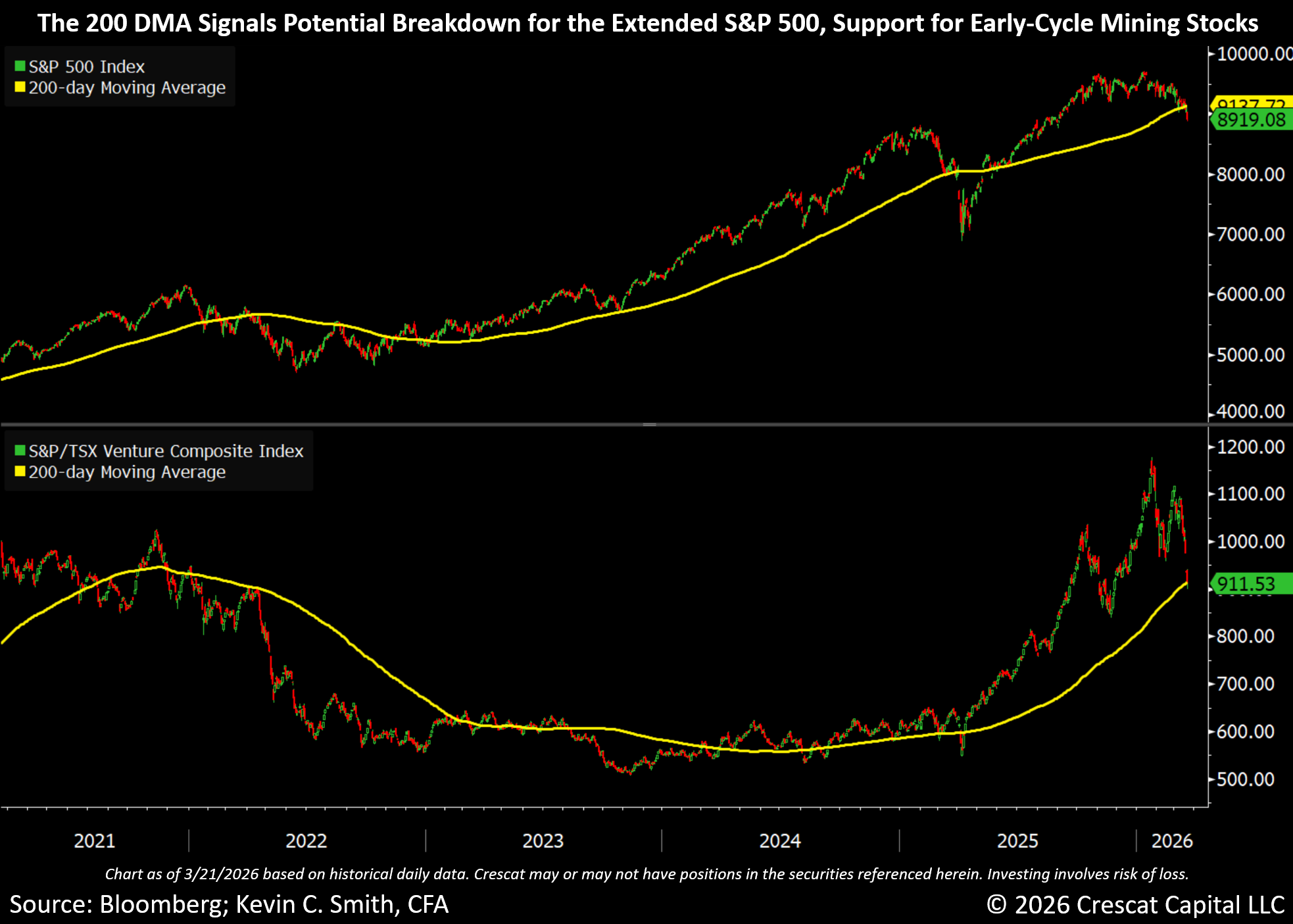
The large cap S&P 500 and Nasdaq 100 (QQQ) indices finally appear to be just starting to break down from record valuations, as we would expect with the new geopolitical conflict and resulting likely inflation and higher interest rates, but gold, silver, and mining stocks have sold off significantly more than these indices since Israel and the US first struck Iran on February 28. We think that presents an incredible short-term buying opportunity for the undervalued and still uncrowded mining stocks, especially the premier small cap explorers that we favor in our portfolios. Meanwhile, we see the long-slowing momentum, and now breakdown from the 200-day moving as a potential sell trigger for late-cycle, overcrowded, and overvalued US large cap equity indices and megacap tech stocks.
Interestingly, both mining stocks and the large cap indices are near their critical 200-day moving average support and resistance levels, but the two groups have highly divergent valuation and growth profiles. The indices of the high-growth, undervalued mining stocks are deeply oversold and hover at or above their 200-day moving average. The S&P/TSX Venture Composite Index, a proxy for small cap exploration focused miners, has already come down 23% from its January 23 recent high and could find strong support. It is now right on the 200-day moving average. The small cap exploration focused miners where Crescat is tilted have been outperforming the larger cap producing miners in the current pullback. From February 27 through March 20, the large cap VanEck Gold Miners ETF (GDX) (GDX) has declined 31%, while the VanEck Junior Gold Miners ETF (GDXJ) (GDXJ), a mid-tier producer index, is down 33%. Both of these ETFs hover just above the 200-day moving average now.
The S&P 500 and Nasdaq 100, however, look like they have just critically broken the 200-day moving averages. Yet, the S&P 500 is down only 6.8% from its recent January 28 high. In our view, it has substantially further downside ahead to get to reasonable valuations based on market history. The broad US large cap indices could finally be poised to break down hard from historically high fundamental valuations, which, in our analysis, are comparable to those at prior major market tops in 1929 and 2000.
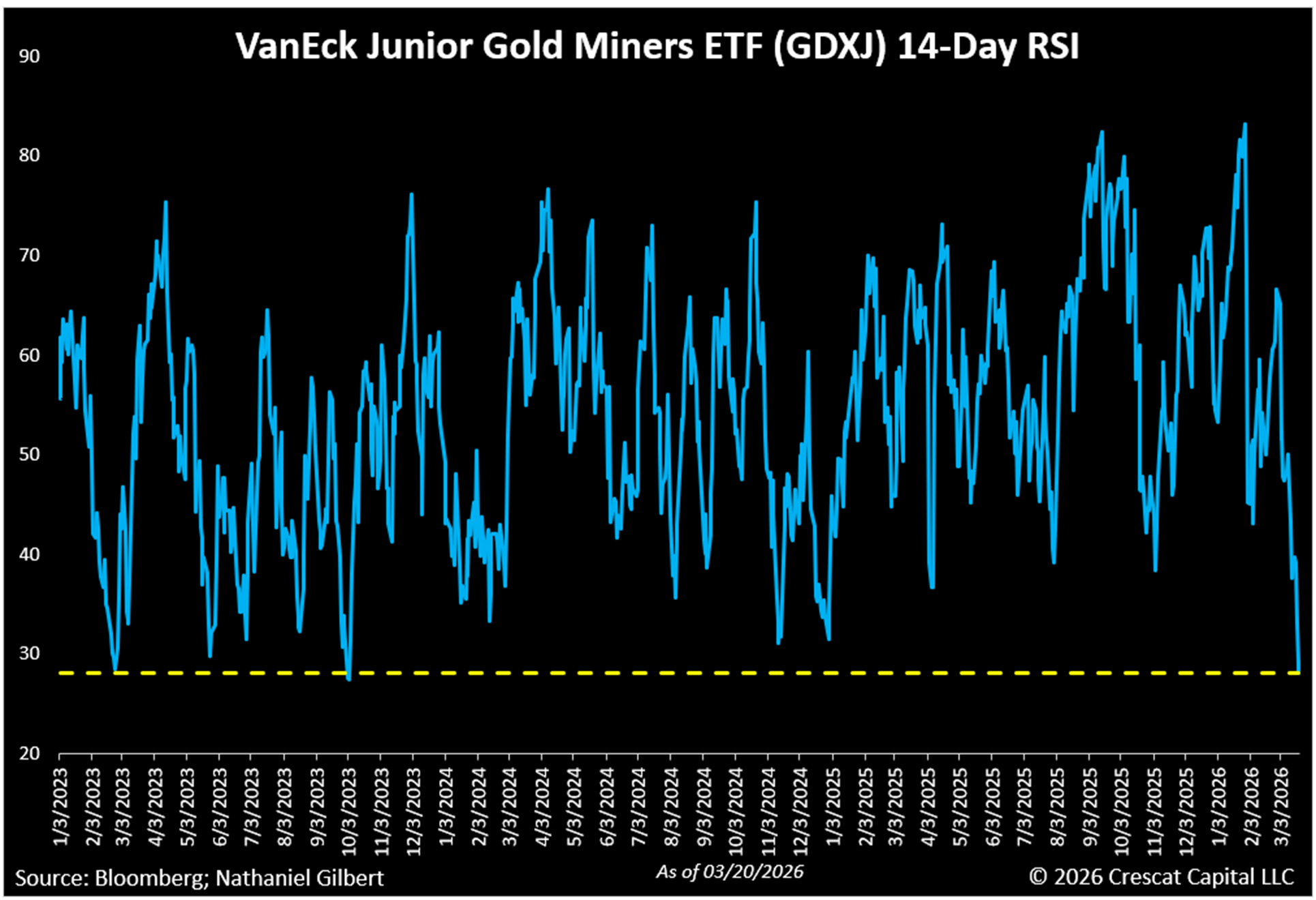
Both the GDX and GDXJ ETFs have 14-day Relative Strength Index (“RSI”) readings below 30, a level typically associated with oversold conditions suggestive of a potential for a near-term rebound. Note, the last two times GDXJ 14-day RSI was sub 30 in March 2023 & October 23, there was a 34.6% and a 27.9% rally, respectively, within just two months. For an industry that just led the entire stock market in 2025, such a sharp rebound would not surprise us at all.
Although pullbacks can be painful and unsettling in the moment, they often create some of the most attractive opportunities for disciplined investors. When it comes to mining stocks today, these aphorisms apply:
“Buy when there’s blood in the streets, even if the blood is your own.” – Baron Rothschild
“The time of maximum pessimism is the best time to buy.” – Sir John Templeton
“Be fearful when others are greedy and greedy only when others are fearful.” – Warren Buffett
Oil Price Future Less Clear than Gold
Importantly, mining equities have come under pressure not only from the decline in underlying precious metals prices, but also from growing concerns around operating-cost inflation, particularly the risk that a sustained rise in oil prices could compress margins across the sector, especially among the producers who have been enjoying strong margins.
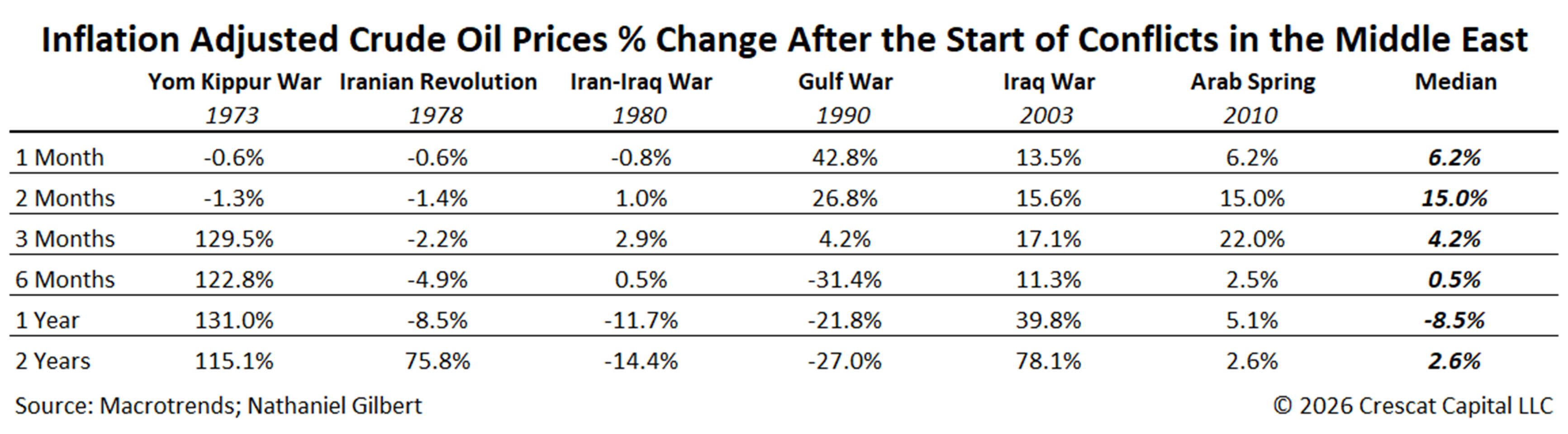
We have shown that higher oil prices do not mean that metal prices cannot go even higher. At this stage, however, the ultimate effect of recent geopolitical developments on the long-term path of oil prices remains unclear. The US is the largest oil-producing country in the world today and is now a net exporter, unlike in the 1970s when it was dependent on Middle East oil. Although the market has understandably responded to the risk of higher energy costs, it is too early to conclude whether the current move in crude reflects a lasting shift in fundamentals or a shorter-term geopolitical premium. To provide perspective, the table below illustrates the inflation-adjusted percentage change in crude oil prices following the onset of past major Middle East conflicts over various time horizons.
Still Early Innings in a New Secular Bull Market for Mining Stocks
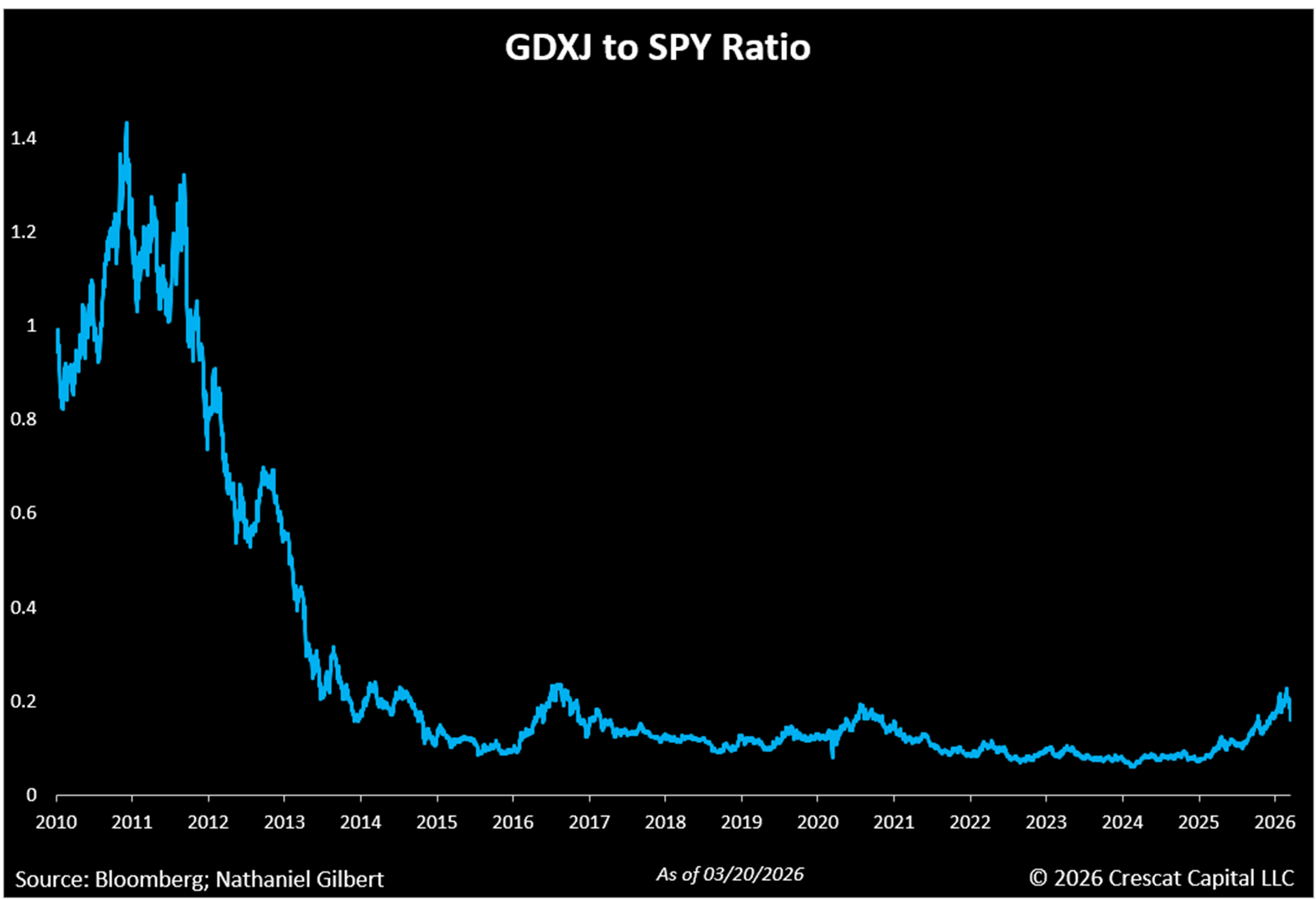
We launched our precious metals fund in 2020 and began allocating heavily to exploration mining companies at that time because we believed the sector was entering the early innings of a major multi-year bull cycle. That view was, and continues to be, driven by our conviction that the industry faces deep structural supply shortages. At the same time, a macro backdrop characterized by inflationary pressures and unsustainable sovereign debt burdens has set the stage for a gold super cycle. More than a decade of underinvestment in mining has created a favorable supply and demand imbalance for metal prices at a time when the world needs more metals than ever. This argues for strong growth ahead for the mining industry revenues, earnings, and new investment dollars poised to pour into the industry for exploration and mine development. Meanwhile, investors’ love affair with big technology stocks and apprehension toward mining still leaves the crucial mining industry with valuations that are ultra depressed. Such is a formula for much higher stock prices for precious and critical metals miners in the years ahead, in our view.
Crescat Performance and Call to Action
For our existing investors, we want to first thank you for your continued trust and support. In January of this year, we heard from a number of you who wished you had added at the end of 2024. This pullback is that moment again. The same macro environment that rewarded your conviction in 2025 has not reversed, it has deepened. We believe this is the time to consider an additional allocation. And for those who are comfortable where they are, staying put with a thesis this intact is equally the right call.
For those who stayed on the sidelines feeling that 2025 was too strong a year to come in after, this is your opportunity to get positioned. The 2025 performance was significant, but the case for precious metals and mining equities was never a one-year story. The pullback has reset prices without resetting the thesis. We believe this is a cleaner setup than most investors get and an opportunity to be positioned ahead of the next leg. April 1 is the date to get positioned.
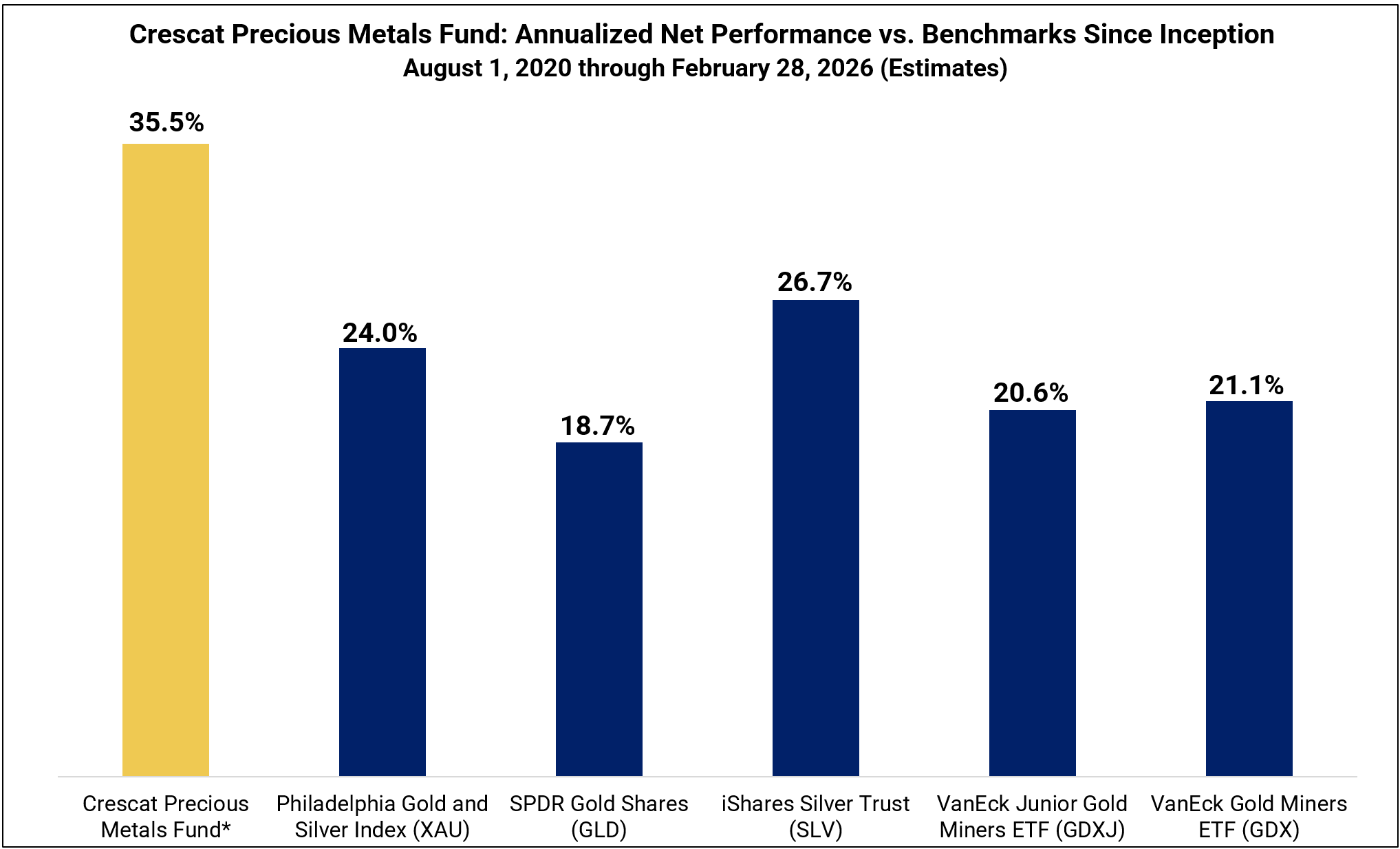
*See important disclosures below. Past performance does not guarantee future results. Investing involves risk, including risk of loss.
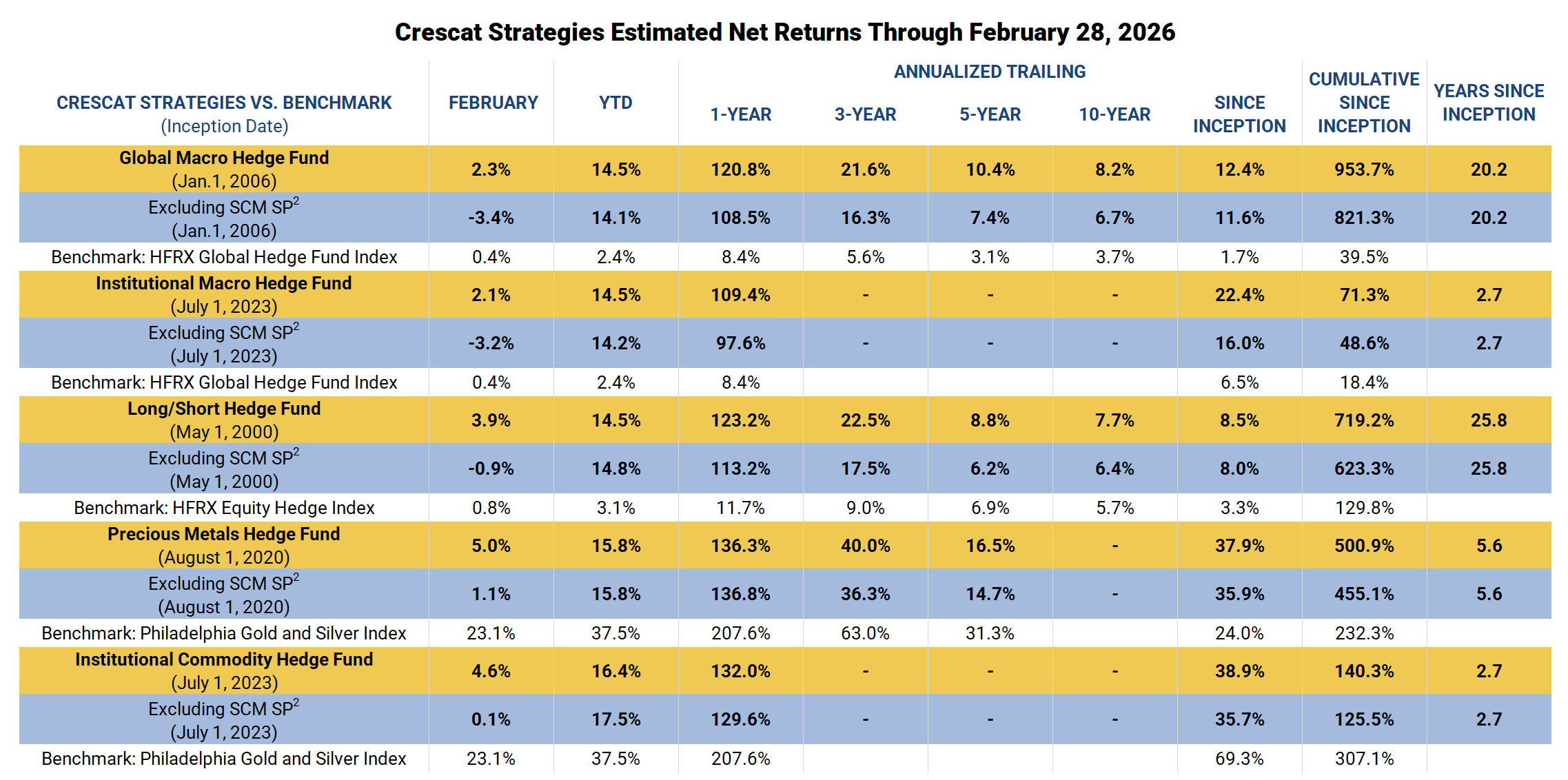
Sincerely,
Kevin C. Smith, CFA, Founder & CEO
Nathaniel Gilbert, Analyst
References
- 1 – Net returns reflect the performance of an investor who invested from inception and is eligible to participate in new issues and side pocket investments. Net returns reflect the reinvestment of dividends and earnings and the deduction of all expenses and fees (including the highest management fee and incentive allocation charged, where applicable). An actual client’s results may vary due to the timing of capital transactions, high watermarks, and performance.
- 2 – Performance figures presented Excluding SCM SP represent the fund’s net returns calculated without the impact of the San Cristobal Mining, Inc. side pocket that was designated on July 1st, 2024. The side pocket includes a private equity asset that is not available to new investors in the funds on or after July 1, 2024. Excluding these assets provides a clearer view of the performance to investors coming into the funds after that date. New investors cannot participate in the SCM Side Pocket and will not share in its potential gains or losses. Investors should consider both the overall performance and the performance excluding the side pocket when evaluating the fund’s returns.
Editor’s Note: The summary bullets for this article were chosen by Seeking Alpha editors.


March Madness Isn’t A Slam Dunk Reason to Buy DraftKings or Flutter Stock

The war has seen large oil and gas facilities attacked and it has effectively closed a key shipping channel, the Strait of Hormuz, which runs close to the Iranian coast. One fifth of the world’s oil passes through here, so the disruption has sent global oil prices soaring, and the price of diesel has followed.

OPINION: Creating a legacy sports event for Perth could bring huge flow-on benefits.
Business
Is David Ben Gurion International Airport Open Today? Airport Remains Open but Heavily Restricted

TEL AVIV, Israel — David Ben Gurion International Airport (TLV/LLBG), Israel’s primary gateway for international travel, continues to operate on March 23, 2026, but under severe limitations due to the escalating conflict between the United States, Israel and Iran. The airport has not fully closed today, yet flight schedules remain drastically reduced, with strict passenger caps, cancellations and security-driven restrictions in place as missile threats and retaliatory strikes persist.

Flight tracking platforms such as FlightAware and FlightStats show limited activity at Ben Gurion early Monday local time. Arrivals and departures are sporadic, primarily involving Israeli carriers like El Al, Arkia, Israir and Air Haifa. Real-time data indicates a handful of flights, including some late-night arrivals from the previous day and minimal outbound operations. Weather conditions remain favorable — clear skies with light winds — but operational decisions are dictated by security assessments rather than meteorology.
The airport’s status stems from the broader war that intensified in late February 2026 with U.S.-Israeli strikes on Iranian targets, including the reported death of Supreme Leader Ayatollah Ali Khamenei. Iran has responded with waves of missile and drone attacks, including claims of strikes near or on Ben Gurion using advanced systems like the Arash-2 drone. Iranian state media reported successful hits in recent days, though Israeli officials have downplayed damage to critical infrastructure while acknowledging debris impacts on private aircraft parked at the airport.
These incidents prompted repeated adjustments to operations. Outbound passenger limits were reimposed after shrapnel damaged three private jets earlier this month, reducing capacity on wide-body flights to the United States to about 130 passengers (down from prior allowances of 270) and maintaining caps around 120 for narrow-body European routes. El Al canceled numerous scheduled flights through March 27 to destinations across Europe, North America and beyond, citing Home Front Command directives and airport restrictions. Affected cities include Budapest, Zurich, Barcelona, Berlin, Boston, Frankfurt, London Luton, Paris, Prague, Vienna and others.
The U.S. Embassy in Jerusalem issued updated security alerts as recently as March 22, advising that Ben Gurion is “operating on a highly limited basis” with fewer flights and reduced passenger loads. Americans are urged to depart on available commercial options if deemed safe, though the embassy has scaled back organized assistance flights. The State Department emphasized not heading to the airport without confirmed tickets or direct contact, due to gathering restrictions and chaos risks.
Israeli Transportation Ministry announcements and the Airports Authority website reflect phased reopenings since early March, starting with repatriation flights to bring home stranded citizens. Over 140,000 Israelis have returned via limited inbound operations, but outbound travel remains tightly controlled. Foreign airlines largely suspended service to Tel Aviv, with carriers like Air France, Delta, United, Aegean, airBaltic and Air Canada extending cancellations well into April or beyond.
Passenger experiences have been chaotic. Reports from mid-March described endless lines, last-minute cancellations and stranded travelers amid the war’s unpredictability. Some repatriation efforts succeeded, but recent escalations — including missile waves targeting central Israel — forced further curbs. Private aviation took hits from debris, underscoring risks even on the ground.
Despite disruptions, the airport has not shut down entirely today. The Israel Airports Authority maintains a flight board showing scheduled (though often delayed or limited) movements, and sources indicate ongoing coordination for essential and repatriation flights. Cargo operations continue under prior arrangements, requiring special approvals.
Travelers are advised to check airline websites directly — El Al, Israir, Arkia — for real-time updates, as schedules change rapidly based on security evaluations. The NOTAM (Notice to Airmen) from the Israel Civil Aviation Authority continues to restrict civilian airspace severely, barring most foreign carriers. Passengers should monitor official channels like the IAA site (iaa.gov.il), FlightAware or apps for alerts.
The situation ties directly to the wider US-Iran confrontation, now in its fourth week, with threats to regional chokepoints like the Strait of Hormuz amplifying global aviation fallout. Middle Eastern hubs including Dubai, Doha and others have faced closures or restrictions, compounding rerouting challenges.
For those planning travel to or from Israel, experts recommend flexibility, travel insurance covering war-related disruptions and avoiding non-essential trips. The airport’s partial functionality allows some movement — primarily for Israelis returning or limited outbound departures — but full normalcy remains distant amid active hostilities.
As of midday March 23 local time (early morning UTC), no new full closure has been announced, though further Iranian actions or Israeli countermeasures could alter status quickly. Authorities stress vigilance, with the Home Front Command guiding all decisions.
Ben Gurion’s resilience under fire highlights its strategic importance, yet the war has transformed what was once a bustling hub into a tightly controlled facility. Travelers should prepare for delays, reduced options and potential last-minute changes in this volatile environment.

In today’s digital economy, businesses of all sizes are accelerating their online presence to meet customer expectations and drive growth. With this shift comes increased exposure to cyber threats and fraudulent activities that can undermine customer trust and corporate reputation. As digital transformation accelerates, executives and professionals are seeking strategies that not only improve operational performance but also safeguard customer interactions across digital touchpoints. One often overlooked yet highly effective technology in this mix is SMS‑based verification.
SMS verification has quickly become a standard practice for authenticating users, validating transactions, and ensuring secure customer communication. Its relevance spans multiple sectors, from fintech and eCommerce to SaaS platforms and enterprise solutions. For many organizations, integrating a reliable verification service is crucial to maintaining both compliance and a seamless user experience. One solution gaining attention in this space is SMSPool NCloud Free SMS Tool, which provides scalable and adaptable SMS verification support for businesses looking to reinforce their digital security at minimal cost.
The Growing Importance of Secure Authentication
As businesses expand their digital reach, the volume of interactions taking place online is skyrocketing. Customers increasingly expect swift, seamless, and secure digital experiences—whether they’re registering for a new service, making a purchase, or resetting a password. At the same time, cyber threats are evolving at an unprecedented pace. According to recent reporting by the BBC, cybercrime incidents have surged, with breaches and digital fraud affecting millions of consumers and businesses worldwide. These trends make it clear that secure authentication solutions are no longer optional—they’re imperative for any business operating online.
Authentication challenges can manifest in various ways:
- Stolen credentials used in automated login attempts
- Fake account creation that skews analytics and incurs unnecessary costs
- Unauthorized transactions that lead to chargebacks and customer dissatisfaction
When organizations prioritize secure access, they not only protect sensitive data but also uphold customer confidence—a foundation of repeat business and brand loyalty.
How SMS Verification Enhances Business Security
SMS verification is a form of two‑factor authentication (2FA) that uses a code sent to a user’s mobile phone as a second layer of identity validation. This method adds a protective barrier beyond passwords, which are susceptible to breaches and reuse across platforms. The integration of SMS verification tools can significantly reduce exposure to automated attacks, phishing attempts, and account takeovers.
Key Benefits of SMS Verification
- Lower fraud risk: By requiring a one‑time code sent to the customer’s device, businesses ensure that access is granted only when both credentials and possession of a device are validated.
- Improved user experience: SMS remains a familiar and accessible method for users worldwide, requiring no additional apps or tools.
- Enhanced trust: Customers feel more secure when they know that their accounts and transactions are better protected.
With these advantages, it’s no surprise that organizations across industries are adopting SMS authentication as a core component of their security strategy. As Forbes notes, robust identity verification systems are critical as online fraud tactics grow more sophisticated and pervasive.
Real‑World Impacts Across Industries
Executives tasked with digital strategy and risk management are increasingly prioritizing authentication technologies. Examples of SMS verification’s real‑world impact include:
- Fintech platforms: Securing high‑value transactions with SMS codes
- eCommerce businesses: Verifying user identities during checkout to reduce fraudulent orders
- SaaS solutions: Using verification for password resets and administrative logins
These implementations reinforce security while bolstering customer confidence—a key metric in long‑term business success.
Implementing SMS Verification: Best Practices
While the benefits of SMS verification are significant, successful implementation requires thoughtful planning. A well‑executed strategy ensures that security does not come at the expense of user experience.
Identify Critical Interaction Points
Not all customer actions require the same level of verification. Common use cases include:
- New account registration
- High‑value transactions
- Password resets
- Changes to account security settings
By applying verification selectively, you reduce friction for users without compromising security.
Monitor Delivery and Response Metrics
To optimize performance, businesses should regularly evaluate:
- SMS delivery success rate
- Average time to verify
- Instances of incorrect or failed attempts
These analytics help identify potential issues with carriers or user experience bottlenecks that may require refinement.
Educate Your Users
Transparency about why and when verification is used builds trust. Simple on‑screen messaging like “Enter the verification code sent to your phone” helps guide users through secure steps.
Comparing Authentication Methods
Security teams often evaluate multiple authentication options before selecting the best fit for their business. Below is a comparison of common verification methods:
| Verification Method | Security Level | Ease of Use | Cost |
| SMS Verification | Medium | High | Low |
| Email Verification | Low | High | Very Low |
| App‑Based 2FA (Authenticator) | High | Medium | Medium |
| Biometric Verification | Very High | High | High |
SMS verification strikes a favorable balance between security, usability, and affordability—making it a strong option for businesses of varying sizes and technical maturity.
Addressing Challenges and Misconceptions
Although SMS is widely adopted, some executives express concern over potential limitations, such as SIM swapping or delayed messages. To address these issues proactively:
- Supplement SMS with contextual analytics that detect abnormal user behavior
- Educate users on safeguarding their mobile accounts
- Combine SMS with other verification layers where appropriate
These enhancements mitigate concerns while preserving the advantages of SMS verification.
Future Outlook: Trust as a Competitive Advantage
As digital ecosystems grow more complex, the role of verification tools in driving business success will only increase. Customers are more likely to engage with brands that prioritize both usability and security, and executives recognize that trust is a defining factor in long‑term growth. Emerging technologies like adaptive authentication, machine learning‑based risk assessments, and biometric validations will continue to evolve, but SMS verification remains a foundational pillar of secure customer interaction today.
From reducing fraud to reinforcing brand integrity, the strategic adoption of SMS verification aligns with broader goals of operational resilience and customer satisfaction. By integrating solutions that enhance both protection and user experience, business leaders can confidently advance their digital initiatives and strengthen the trust that underpins customer relationships.

The key concern: an inflation shock that lifts correlations within stock indexes and spurs an extended period of higher volatility.
The spike in oil and natural gas is rippling through supply chains, threatening to raise prices not just for gasoline but for a wide range of goods and services. That’s shifted traders’ attention away from single stocks, as macroeconomic worries begin to outweigh more granular themes such as artificial intelligence. This, in turn, has narrowed the volatility premium for individual shares versus the wider S&P 500 Index and shrunk trading volumes.
 Bloomberg
While the VIX has been more sensitive to drops in the S&P 500, the overall realized moves at the index level have remained muted compared with past crises. The volatility gauge hasn’t closed above 30 points this year, after spending two weeks above that level during the tariff turmoil of last April.

In 2022, the VIX surpassed 30 points periodically following Russia’s invasion of Ukraine and averaged 25.64, more than 6 points above this year’s mean. The S&P 500 fell 19% that year as the Federal Reserve hiked rates multiple times.
“Investors are looking to the 2022 playbook for clues on how the current situation in Iran plays out for markets,” said UBS Group AG derivatives strategist Kieran Diamond. “The risk is an inflation shock, which could drive higher correlations within equity markets, and potentially switch the index volatility regime from fast VIX rises and reversals to one where the VIX floor rises and volatility is sustainably higher.”At the same time, the Cboe Skew Index of market stress has calmed in recent days, possibly because of the unwinding of hedges as investors became disillusioned with vanilla index puts, according to UBS strategists. The low level of realized volatility to the downside since the Middle East escalation may have also caused a general re-pricing of the skew curve.
BloombergWhile some discretionary traders have leaned into the short volatility trade via VIX put structures, the QIS space hasn’t seen a material shift in investor behavior, according to Michele Cancelli, global head of structuring for the multi-asset group at Citigroup Inc. and global head of QIS trading and structuring.
“Despite the elevated volatility risk premium in SPX, there’s little evidence of a rush into the short volatility trade,” he said. “We’re likely not far enough through the Iran-driven volatility window for investors to have conviction in monetizing it.”
Low realized volatility for the S&P 500 is at odds with the positioning of options dealers. Consensus has emerged among most derivatives strategists that dealers were short gamma heading into the quarterly expiry date. Realized volatility is notably higher intraday versus close-to-close, which may potentially be where dealer gamma is having the greater market impact.
Meanwhile, the broader market micro-structure does not appear to have changed all that much: There’s still significant call overwriting at the index level, as well as one-day-to-expiry condors being sold on an ongoing basis.
BloombergHowever, the bleeding out of index hedges — whether outright S&P 500 puts or trades like long VIX calls — doesn’t take away the risk-reward from such positions if the market does crack. Furthermore, some investors still see the value in leaning against popular trades such as volatility dispersion.
“We see better opportunities right now from being long index volatility and long intra-index correlation in terms of risk/reward,” said David Elms, head of diversified alternatives at Janus Henderson Group Plc. “Within that space, long correlation via reverse dispersion is interesting given the low levels of implied correlation and the floor to correlation being effectively zero.”
He noted that long convexity is also attractive given the carry cost is lower than historical norms, due to a flow imbalance.
BloombergAnother feature of markets has been intraday reversal, highlighting that while option dealers may be short gamma, they are not the key driver of prices in a macro headline-driven environment. The reversals on some level explain muted close-to-close realized volatility — suggesting a cohort of investors are still trading countertrend. On Thursday, the stock market was weak intraday but staged a big rebound into the close.
A flip of such price movement could see reversals giving way to genuine momentum, leading to an acceleration of stock gains as the end of the trading session nears.

The Changing Image of Shareholder Activism
For many years, shareholder activism had a reputation for confrontation. Activist investors were often associated with public disputes, leadership challenges, and aggressive campaigns to force rapid change.
That image is evolving.
A growing number of investors now approach activism through collaboration rather than conflict. Their goal is not simply to challenge management, but to work with corporate leaders to strengthen governance, improve operational performance, and create long-term value.
This approach is often described as constructive shareholder activism, and it is changing the way boards and investors interact in public markets.
The Evolution of Activist Investing
Activist investing has existed for decades, but its methods have shifted significantly in recent years.
Earlier campaigns often focused on short-term financial outcomes. Investors would push for asset sales, leadership changes, or immediate capital returns to shareholders. While these tactics still occur, many investors now prioritize operational improvements and long-term strategy.
Modern activism is more research-driven. Investors frequently conduct extensive analysis of a company’s operations, governance structure, and capital allocation decisions before engaging with management.
This shift has changed the tone of activism. Instead of relying on public pressure, many investors now focus on dialogue with boards and executives. Their proposals often involve refining governance processes, improving strategic clarity, or strengthening operational efficiency.
Constructive engagement has become an increasingly common way for shareholders to influence corporate decision-making.
Why Corporate Governance Has Become Central
Corporate governance now plays a central role in shareholder engagement.
Boards are responsible for overseeing strategy, managing risk, and ensuring accountability to shareholders. As investor expectations have increased, governance structures have become a focal point of activist discussions.
Investors frequently examine areas such as:
- Board composition and expertise
- Committee structures and oversight responsibilities
- Strategic planning processes
- Leadership accountability
When governance frameworks are strong, companies often make decisions more effectively and maintain stronger alignment with shareholder interests.
As a result, many activist engagements now focus on governance improvements rather than dramatic structural changes.
Collaboration Instead of Confrontation
One of the defining characteristics of constructive activism is its emphasis on collaboration.
Investors increasingly prefer to work with companies through private discussions rather than public campaigns. These conversations allow both sides to evaluate ideas thoughtfully and implement changes gradually.
Constructive engagement often focuses on identifying operational or strategic opportunities that may not have received sufficient attention internally.
Examples include reviewing pricing strategies, refining supply chain processes, or improving capital allocation decisions.
When companies approach shareholder feedback with openness, these conversations can become productive discussions about long-term business improvement rather than adversarial conflicts.
Applying a Long-Term Ownership Mindset
Another important development in modern activism is the shift toward long-term ownership thinking.
Many investors now approach public companies with a perspective traditionally associated with private equity investing. Instead of focusing solely on market performance, they analyze a business’s underlying operations and strategic direction.
This perspective encourages investors to concentrate their efforts on a smaller number of companies where they believe meaningful improvements are possible.
A concentrated ownership approach allows investors to develop deeper insights into company operations and engage more effectively with boards and leadership teams.
The emphasis shifts from short-term market reactions to sustainable performance over time.
Governance Improvements as a Path to Value Creation
Governance improvements often play a key role in long-term value creation.
Effective governance structures help companies make strategic decisions more efficiently and respond to market changes more effectively.
Investors who engage constructively with companies often focus on areas where governance can support stronger business outcomes. These discussions may involve refining board oversight processes, strengthening strategic planning frameworks, or ensuring leadership incentives align with long-term company performance.
When governance systems function well, companies are better positioned to pursue sustainable growth.
Preparing for Shareholder Engagement
Public companies can take several steps to prepare for constructive shareholder engagement.
Strengthening governance frameworks is an important starting point. Boards should regularly review their composition to ensure members bring relevant expertise and diverse perspectives.
Improving transparency with investors also helps build trust. Clear communication about corporate strategy, operational priorities, and capital allocation decisions allows investors to understand leadership’s long-term vision.
Companies can also benefit from proactive dialogue with shareholders. Maintaining regular communication with long-term investors often helps identify concerns early and reduces the likelihood of adversarial campaigns.
Internal governance reviews can further help companies identify areas for improvement before external investors raise questions.
Constructive Activism in Practice
Several investment firms have adopted collaborative engagement strategies when working with public companies. For example, some investors focus on governance improvements and operational changes through direct engagement with management teams, a philosophy reflected in the approaches of firms such as Engaged Capital.
This style of activism emphasizes careful research, strategic dialogue, and long-term thinking.
Rather than focusing on public confrontation, constructive engagement prioritizes identifying practical solutions that strengthen companies over time.
The Future of Shareholder Engagement
Constructive shareholder activism continues to shape the relationship between investors and public companies.
Boards are becoming more attentive to governance structures. Investors are more informed and involved in discussions about strategy and accountability. Corporate leadership teams are increasingly open to dialogue with shareholders.
These changes suggest that shareholder activism is evolving from a confrontational tactic into a governance mechanism within modern capital markets.
As expectations around transparency, accountability, and long-term performance continue to rise, constructive engagement between investors and companies is likely to remain an important part of corporate governance.
The result is a more collaborative model of shareholder influence—one focused not on conflict, but on strengthening companies for the future.

A pioneer of the Margaret River wine region says matching quality with production levels is key to keeping up with the rest of the world.

Have you ever read something online and thought about how people check if the content is written by a human or generated by AI?
These days, content is being created at a very fast pace, and it becomes important to understand its source and structure. This is where AI detectors come into use in a simple and practical way.
AI detectors are becoming a part of daily digital work. From students to writers, many people use them to review content and get a clearer idea of how it looks. These tools are not complicated. They are built to support users in an easy and comfortable way.
Why AI Detectors Are Becoming Common
AI detectors are becoming more common because they match modern needs. People today prefer tools that are quick, clear, and easy to understand. AI detectors provide all of this without making the process difficult.
They are useful in many areas like writing, editing, and education. As more content is created online, people want tools that help them stay confident about what they are reading or writing. AI detectors support this need in a very simple way.
Feature One: Clear AI Content Detection
One of the main features of AI detectors is their ability to check patterns in writing. They look at how sentences are formed, how words are used, and how the overall content flows.
This helps users get a clear idea about the nature of the content. The result is usually shown in a simple format, which makes it easy to understand. Users do not need any technical background to read or use the results.
Feature Two: Easy-to-Use Interface
Another important feature is the simple interface. AI detectors are built in a way that anyone can use them without confusion.
You just copy your text, paste it into the tool, and check the result. The process feels natural and does not take much time.
This makes it suitable for students, content writers, and even beginners who are trying such tools for the first time. A clean interface always makes the experience more comfortable.
How These Features Help In Daily Use
AI detectors are not just one-time tools. Many people use them regularly as part of their daily routine. They help in reviewing content quickly and keeping things clear.
Feature Three: Quick Results And Instant Feedback
In today’s fast-paced work environment, time matters a lot. AI detectors provide results within seconds, which helps users move forward without delay.
This instant feedback allows users to make changes quickly. For example, if someone is writing an article, they can check it and adjust their writing immediately.
Feature Four: Highlighted Content Sections
Another useful feature is highlighting. AI detectors often mark certain parts of the text to show patterns.
This makes it easier for users to focus on specific sections instead of reading everything again. It feels like having a guide that points out important areas.
This feature is especially helpful for editors and writers who work with long content. It reduces effort and makes the review process smoother.
How AI Detectors Support Content Quality
Content quality is important in every field. AI detectors help users understand their writing better, which leads to improved quality over time.
Feature Five: Helps Improve Writing Style
When users check their content regularly, they start noticing how they write. They understand sentence flow, word choice, and structure.
This awareness helps them improve gradually. It becomes a natural learning process. Over time, users develop a clearer and more structured writing style.
Feature Six: Supports Content Review Process
Reviewing content is an important step before publishing or submitting. AI detectors make this process easier by providing quick insights.
Editors can use these tools to review multiple pieces of content without confusion. It helps maintain consistency and clarity.
The review process becomes more organized, and users can handle large amounts of content more comfortably.
Accessibility And Flexibility Of AI Detectors
Another strong point of AI detectors is their accessibility. They are easy to use from different devices and locations.
Feature Seven: Easy Online Access
Many AI detectors are available online, which means users do not need to install anything. They can open a browser and start using the tool directly.
For example, platforms like AI detector free allow users to check their content quickly and easily. This makes the process simple and convenient.
Users can access these tools from their phone, laptop, or any device with internet access.
How AI Detectors Fit Into Modern Work
Modern work includes writing, editing, and reviewing content regularly. AI detectors fit naturally into this routine.
Works For Different Types Of Users
AI detectors are useful for many types of users. Students use them to check assignments. Writers use them for blogs and articles. Editors use them for reviewing content.
Supports Consistent Workflow
When tools are simple and reliable, they become part of daily work. AI detectors help users maintain a steady workflow.
They reduce the time spent on checking and make the process more efficient. This consistency helps users stay organized and focused.
The Human Side Of Using AI Detectors
Even though AI detectors are based on technology, they support human work in a simple and friendly way.
Builds Confidence In Writing
When users check their content and understand it better, they feel more confident. This confidence helps them perform better in their work.
They know what they are writing and how it looks, which makes a big difference.
Encourages Better Content Habits
Regular use of AI detectors helps users become more aware of their writing habits. They start paying attention to structure, clarity, and flow.
This leads to better habits over time. It is like learning step by step without any pressure.
Why Simplicity Makes A Big Difference
Simplicity is one of the strongest points of AI detectors. People prefer tools that are easy to understand and use.
Easy For Beginners
New users can start using AI detectors without any difficulty. The process is clear and simple.
They do not need any training or technical knowledge. This makes the tool more accessible.
Comfortable For Regular Users
Regular users can include AI detectors in their daily routine without extra effort.
They become a natural part of the workflow, which makes content checking faster and easier.
Final Thoughts
AI detectors have become useful because they offer simple and practical features that support everyday content work. From identifying writing patterns to giving quick feedback, they help users understand and improve their content in a clear way. With easy access, smooth interface, and helpful insights, these tools fit naturally into modern workflows.

Nomura Global Growth Fund Q4 2025 Commentary

IT’S OFFICIAL: The $3.5 Trillion Financial Crisis Nobody Is Talking About.
March Madness Isn’t A Slam Dunk Reason to Buy DraftKings or Flutter Stock

Trump Escalates Iran War As US Troops Express Fears

Smart energy pays enters the US market, targeting scalable financial infrastructure

Why Israel is blocking foreign journalists from entering

Bitcoin: We’re Entering The Most Dangerous Phase
IT’S OFFICIAL: The $3.5 Trillion Financial Crisis Nobody Is Talking About.

CEO SALARY Compared To Regular Worker SALARY! #shorts #money #salary #career #mcdonalds

Crypto Trading LIVE: BTC Live Trading Bitcoin Analysis | 22 MAR #crypto #bitcoin #btc
-

 Fashion3 days ago
Weekend Open Thread: Adidas – Corporette.com
-

 Politics2 days ago
Jenni Murray, Long-Serving Woman’s Hour Presenter, Dies Aged 75
-
 Tech6 days ago
Are Split Spacebars the Next Big Gaming Keyboard Trend?
-
 Crypto World2 days ago
NIO (NIO) Stock Plunges 6.5% as Shelf Registration Sparks Dilution Worries
-

 Crypto World1 day ago
Best Crypto to Buy Now: Strategy Just Spent $1.57 Billion on Bitcoin During Fear While Early Investors Quietly Enter Pepeto for 150x Potential
-

 News Videos5 days ago
RBA board divided on rate cut, unusually buoyant share market | Finance Report | ABC NEWS
-

 Crypto World1 day ago
Bitcoin Price News: Bhutan Sells $72 Million in BTC Under Fiscal Pressure, but the Smart Money Entering Pepeto Sees What the Market Does Not
-

 Business7 days ago
Australian shares drop as Iran war enters third week
-

 Crypto World7 days ago
Crypto Lender BlockFills Enters Chapter 11 with Up to $500M in Liabilities
-

 Politics5 days ago
The House | The new register to protect children from their abusers shows Parliament at its best
-

 Fashion7 days ago
25 Celebrities with Curly Hair That Are Naturally Beautiful
-

 Tech3 days ago
inKONBINI Lets You Spend Summer Days Behind the Register
-
 Politics6 days ago
Real-time pollution monitoring calls after boy nearly dies
-

 Crypto World5 days ago
Canada’s FINTRAC revokes registrations of 23 crypto MSBs in AML crackdown
-
 NewsBeat4 days ago
Residents in North Lanarkshire reminded to register to vote in Scottish Parliament Election
-

 Business7 days ago
Meta planning major layoffs as AI spending and automation reshape workforce
-

 News Videos5 days ago
PARLIAMENT OF MALAWI – PAC MEETING WITH REGISTRAR OF FINANCIAL ON AMARYLLIS HOTEL – INQUIRY LIVE
-

 Business15 hours ago
No Winner in March 21 Drawing as Prize Rolls to $133 Million for Next
-

 Politics3 days ago
Gender equality discussions at UN face pushbacks and US resistance
-
Entertainment7 days ago
Oscars reunite Rob Reiner supergroup of 17 stars for emotional tribute: Here's who appeared on stage
You must be logged in to post a comment Login