Connect with us

Business

Sensex down over 10K points from Dec peak. Should MF investors buy the dip, hold positions, or wait on sidelines?

Published

on

Sensex down over 10K points from Dec peak. Should MF investors buy the dip, hold positions, or wait on sidelines?
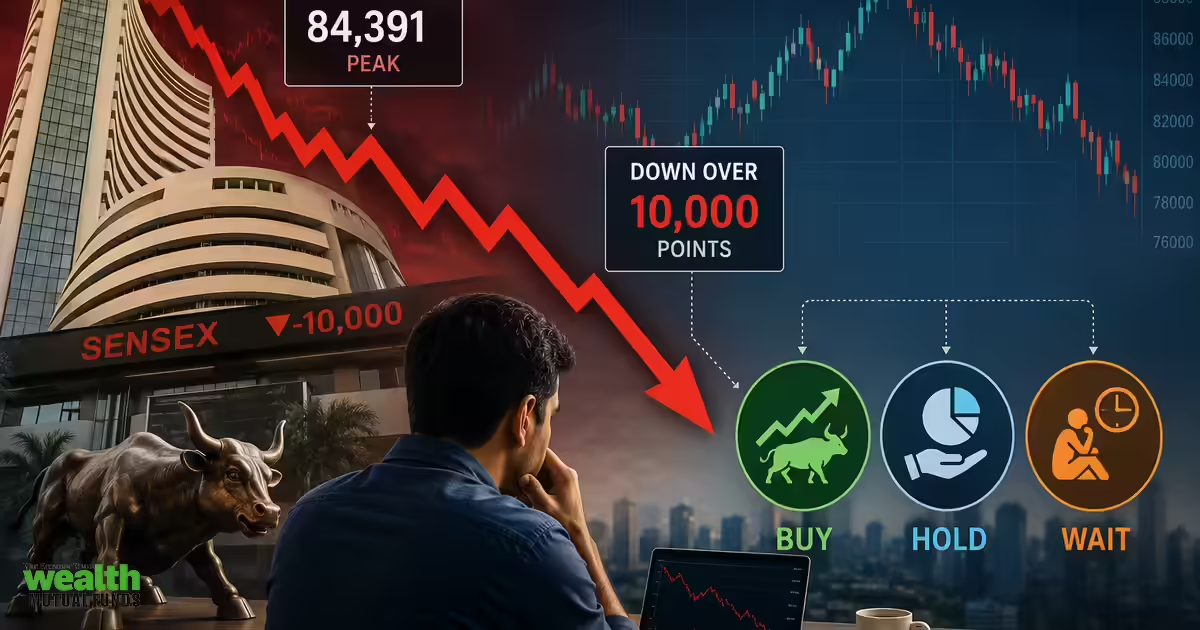
With the benchmark index – BSE Sensex down by over 10,000 basis points to a level of 74,243 as of June 6, 2026, has left many investors wondering whether to continue SIPs and lump-sum investments during the current market decline, hold current positions or wait for greater clarity on market direction?

Market experts believe that investors should see this 10,000 point correction as a buying opportunity rather than a reason to panic.

Vishal Dhawan, Founder & CEO, Plan Ahead Wealth Advisors told ETMutualFunds that investors should view this 10,000-point Sensex correction as a long-term buying opportunity as market drawdowns are natural processes that shake out speculative premiums, resetting valuations to fundamentally healthier levels.

Also Read | Multicap or flexicap mutual fund for a 20-year SIP? Expert explains what investors should choose

“Long-term investors can continue their Systematic Investment Plans (SIPs) and hold current positions firmly. Pausing allocations to “wait for clarity” is a psychological trap that historically locks investors out of the sharpest days of a market rebound.”

Advertisement


Dhawan further said that while regular SIPs are key to an investment journey, panic selling must be completely avoided; use this market decline to methodically build an equity baseline designed to reward your patience when economic sentiment inevitably swings back to optimism at some point in the future and it is critical to have a minimum 5-7 year investment horizon whilst investing.
Echoing a similar opinion of considering this as a buying opportunity rather than a reason to panic, Amitabh Lara, Executive Director, Anand Rathi Wealth Limited shared with ETMutualFunds that for long-term investors, this is not the time to stop investing.Amitabh further said that continuing SIPs during a fall can actually work in your favour because the same investment amount buys more units at lower prices and one of the biggest mistakes investors make is stopping SIPs during a correction and returning only after the recovery has already happened.

The benchmark index which touched a peak of 84,391 on December 10, 2025, is now down by nearly 10,148 points to a level of 74,243 as of June 6, 2026.

As the market becomes volatile, investors as well as the fund managers keep cash in hand and wait for the opportunity to deploy it in the market but with a dilemma whether to deploy cash immediately or stagger investments over time.

Amitabh said that if investors have idle cash available then they can go ahead and invest as a lumpsum and funds can be deployed in a staggered manner through tranches, over 6 to 8 weeks. “It also removes the stress of trying to time the exact bottom. If they have SIPs, they can continue it without worrying about the market level and take advantage of rupee cost averaging.”

Dhawan said that for investors sitting on cash, a staggered deployment strategy via a 6-month to 12 month Systematic Transfer Plan (STP) is highly recommended as this approach could hedge your principal against intermediate downside volatility.

Advertisement

He further said that investors should avoid deploying an absolute lumpsum at current levels, as picking the exact market bottom is a statistical myth and tranche-based buying ensures you average out your entry costs across multiple lower price bands smoothly.

“Park your liquid capital in low-duration instruments and systematically route it into equity. This automated execution effectively replaces portfolio anxiety with disciplined benefits. In case you wish to deploy a lumpsum, and not do a STP, an investment in the Balanced Advantage category is suggested.” Dhawan said.

How equity categories performed

ETMutualFunds checked the performance of equity mutual funds since December 10, 2025. Small cap funds have delivered an average return of 6.06% since the date BSE Sensex touched the new peak, followed by mid cap funds which gave an average return of 2.58%.

Also Read | Nippon India Mutual Fund limits subscription in Gold BeES and gold savings fund

Advertisement

In contrast, the counterparts, large cap funds gave a negative average return of 6.26% since December 10, 2025. Multi cap funds gave an average return of 0.06% whereas flexi cap funds fell 2.95% on an average in the said time period.

Out of 10 equity categories, only three gave positive average returns which were small caps, mid caps and multi caps whereas the other categories such as large caps, contra funds, ELSS, flexi, focused, value and large & mid caps gave negative average returns.

Which market-cap segment could lead the recovery?

Dhawan said that large-cap stocks are typically best positioned to lead the initial recovery wave when domestic and foreign institutional flows return and their robust cash flows, operational scale, and institutional backing provide an essential fundamental moat.

He further said that mid-caps may require stock-specific elements to perform, as many names went up significantly during the previous bull cycle; small caps should be approached with high caution and patience, as they remain prone to sharp liquidity outflows during market corrections. “Limit small-cap exposure if you can handle the volatility and have a longer time horizon of 7-10 years for mid and small caps.”

Advertisement

Lara said that small caps appear to have the most room for upside when markets recover. Currently, Nifty Smallcap 250 is trading about 17.4% below its fair value, compared with 9.6% for the Nifty Midcap 150 and around 5-9% for large-cap indices. Hence, small caps have corrected more than large caps and mid caps relative to their earnings potential.

He further said that investors can have a balanced exposure across market caps, with 55% in large caps and the rest in mid and small caps to be a part of the eventual recovery that will follow in the markets.

BSE Sensex: In the last six months, the index was down 13.38% and in the nine months, it was down 8.01%. In the last one year, Sensex was down 8.83% whereas in the last three years and five years it was up 5.74% and 7.33% respectively.

Sector allocation becomes particularly important during market corrections as valuation gaps emerge across industries. The question is whether investors should actively target beaten-down sectors or focus on broader diversification.

Advertisement

In response to this, Lara said investors should avoid investing in single sectors or making sectoral bets as performance in sectors/themes is highly cyclical. For example, in 2024, the pharma & IT sectors were part of the best-performing sectors, however, they both turned into worst-performing sectors in 2025, which suggest that entry and exit at the right time play a crucial role in making investments in the sectorial/thematic funds.

Also Read |HDFC Mutual Fund limits subscription in its gold ETF and FoF. What this means for investors?

During such corrections, it would be more beneficial for investors to invest in diversified categories of equity mutual funds to get exposure to all sectors and benefit from their performance, rather than focusing solely on any single sector, Lara further said.

Dhawan said to prioritize accumulating high-quality banking and financial services funds as these segments offer good earnings visibility, corrected price multiples, and fundamentally strong underlying balance sheets.

Advertisement

He further said systematic accumulation of Information Technology (IT) funds could be attributed to these deep valuation resets as they are cash-rich franchises with low debt. However, they do face business model risk. Conversely, stay away from Utilities and capital goods as valuations look well above their long term averages.

(Disclaimer: Recommendations, suggestions, views and opinions given by the experts are their own. These do not represent the views of The Economic Times)

If you have any mutual fund queries, message on ET Mutual Funds on Facebook/Twitter. We will get it answered by our panel of experts. Do share your questions on ETMFqueries@timesinternet.in along with your age, risk profile, and Twitter handle.

Advertisement
Add ET Logo as a Reliable and Trusted News Source

Continue Reading
Click to comment

You must be logged in to post a comment Login

Leave a Reply

Business

Investment fueling growth for Smash Foods

Published

on

Investment fueling growth for Smash Foods

Investment of $18 million from L. Catterton will grow retail, team and brand.

Continue Reading

Business

Form 4 D Wave Quantum Inc For: 29 July

Published

on


Form 4 D Wave Quantum Inc For: 29 July

Continue Reading

Business

CBIZ shares soar 17% after Grant Thornton agrees to buy company in $5 billion cash deal

Published

on

CBIZ shares soar 17% after Grant Thornton agrees to buy company in $5 billion cash deal
Cbiz shares jumped 17% on Wednesday after Grant Thornton Advisors agreed to buy the professional services firm for $5 billion in cash, a deal that would create one of the largest accounting and advisory services providers in the US.

Cbiz shareholders will receive $55 per share, a 17.8% premium to the stock’s previous close. The shares rose 17.5% in premarket trade after the announcement.

The deal will make Grant Thornton the fifth-largest provider of professional, tax and advisory services in the US, behind Deloitte, EY, KPMG and PwC. The combined platform will have a presence in more than 20 countries and territories and generate nearly $7.5 billion in revenue.

“By combining our multinational platform with CBIZ’s strong market presence, we’re broadening our ability to support businesses through every stage of growth — from early development to global scale,” Grant Thornton Advisors CEO Jim Peko said.

Advertisement

The transaction is expected to close in the fourth quarter of 2026. It includes a “go-shop” period that allows CBIZ to seek competing offers until August 27.


Goldman Sachs advised CBIZ on the transaction. Deutsche Bank is the lead financial adviser for Grant Thornton Advisors.
Also Read: Vertiv shares crash 14% in pre-market after Q2 revenue misses estimatesDeal overshadows mixed earnings

The acquisition announcement came alongside CBIZ’s second-quarter results, which showed a clear earnings beat but weaker-than-expected revenue.

For the quarter ended June 30, 2026, CBIZ reported adjusted diluted earnings per share of $0.91, above analysts’ estimate of $0.8046. Revenue came in at $682.2 million, about 3.2% below the $704.9 million expected by analysts.

Revenue was down 0.2% from a year earlier, hurt by a similar decline in the company’s core financial services business. Adjusted EBITDA fell 14.3% year-on-year to $103.1 million. Adjusted EBITDA margin narrowed to 15.1% from 17.6%.

Advertisement

On a GAAP basis, net income dropped 55.6% to $18.6 million, or $0.31 per diluted share. The decline reflected higher operating expenses and acquisition-related costs tied to the integration of Marcum, which CBIZ bought in 2024.

The CBIZ deal is another sign of consolidation in the US accounting industry, where mid-tier firms are trying to build scale and narrow the gap with the Big Four.

Baker Tilly and Moss Adams combined last year in a $7 billion deal. CBIZ had also expanded through acquisitions, including its $2.3 billion purchase of accounting firm Marcum in 2024.

Grant Thornton has been expanding since receiving investment from a consortium led by New Mountain Capital in 2024. New Mountain is making a fresh investment to support the CBIZ transaction, which the companies said is the largest deal of its kind in more than 25 years.

Advertisement
Continue Reading

Business

Bitcoin Steadies Near $64,000 as Crypto Traders Brace for a Pivotal Federal Reserve Rate Decision Today

Published

on

Robinhood logo.

Bitcoin traded at $63,860.26 as of Wednesday afternoon, up a modest $13.14, or roughly 0.02%, as cryptocurrency markets settled into a holding pattern ahead of a Federal Reserve interest rate decision that traders across both traditional and digital asset markets have described as unusually difficult to predict.

Bitcoin opened Wednesday at $63,853.49, up 0.2% from Tuesday’s opening price, before climbing as high as $64,244.18 during the morning session, according to pricing data. The cryptocurrency’s relatively flat overall movement Wednesday followed a volatile stretch earlier in the week, including a sharp pullback Tuesday when bitcoin opened 2.5% lower than the previous day, dropping to around $63,327 as investors broadly reduced exposure to riskier assets ahead of the Fed’s two-day policy meeting.

The Federal Reserve’s rate decision, due later Wednesday, has emerged as the dominant catalyst shaping crypto market sentiment this week. According to data from the CME Group’s FedWatch tool, market participants assigned a 35.8% probability to a rate increase following the meeting’s conclusion, up sharply from 25.7% just a week earlier. Separate estimates cited by CoinDesk showed a somewhat different split, with roughly a 70% probability assigned to rates remaining unchanged and a 30% chance of a surprise quarter-point increase. Some analysts have characterized the meeting as among the hardest Fed decisions to forecast in recent years, given the unusual combination of economic signals policymakers are currently weighing.

Ether, the second-largest cryptocurrency by market value, moved somewhat more sharply than bitcoin during the same period. Ethereum opened Wednesday at $1,919.73, up 1.5% from Tuesday’s opening price, before slipping back to $1,904.82 by mid-morning, according to pricing data. Bitcoin and ether moved in opposite directions for stretches of Wednesday’s session, a divergence that market watchers attributed to renewed airstrikes in the Middle East combined with the approaching Fed announcement, both of which have added competing sources of uncertainty for crypto investors this week.

Advertisement

Broader cryptocurrency market data showed modest overall improvement heading into Wednesday. The total global cryptocurrency market capitalization rose 0.4% to reach approximately $2.28 trillion, recovering from a 1.6% decline recorded the previous day, according to data from CoinMarketCap. Bitcoin’s dominance within the broader crypto market held steady at approximately 56.3%, while ether accounted for roughly 10.2% of total market value. Despite the modest recovery in headline prices, a widely tracked measure of investor sentiment, the Fear and Greed Index, remained in “fear” territory at a reading of 28 to 29, reflecting continued caution among traders even as prices stabilized somewhat.

Institutional flows into bitcoin exchange-traded funds showed signs of softening in recent sessions. Spot bitcoin ETFs recorded a net outflow of $11.6 million on July 27, ending a streak of seven consecutive sessions of net inflows, with asset managers BlackRock and Fidelity leading the pullback, according to data on ETF flows. Even so, some corporate treasury activity continued during the same window, with Hyperscale Data disclosing a bitcoin treasury holding of 1,106 bitcoin, valued at approximately $71.7 million, as of July 28, signaling that at least some institutional accumulation of the cryptocurrency has continued despite broader market softness.

Macroeconomic factors beyond the Fed decision have also weighed on crypto sentiment this week. Rising oil prices, driven by renewed hostilities between the United States and Iran, have added to broader inflation concerns across financial markets, a dynamic that traditionally creates headwinds for risk assets including cryptocurrencies. At the same time, a strengthening U.S. dollar has added further pressure, with analysts noting that the combination of higher oil prices and dollar strength has increased overall macro-volatility risk heading into the Fed’s announcement.

Trading data suggested bitcoin has largely oscillated within a defined range in recent sessions, generally trading between roughly $62,700 and $65,500. Some market analysts have pointed to that range as a key technical zone to watch in the near term, with the lower boundary near $62,700 serving as a support level and the $64,500 to $65,500 zone acting as resistance that bitcoin has struggled to convincingly break through in recent trading.

Advertisement

Beyond bitcoin and ether, individual cryptocurrency tokens showed more significant divergence Wednesday. Jupiter, a decentralized finance token, rose nearly 6% to lead gains within a broader recovery among DeFi-focused tokens, while artificial intelligence-linked tokens continued to struggle, with Fetch.ai falling more than 4% on the day as AI-related crypto tokens continued unwinding gains posted the previous month.

Bitcoin’s current price level remains well below its all-time highs reached earlier in the cryptocurrency’s price cycle, though the asset has still posted substantial gains compared with prior years, with its market capitalization standing at approximately $1.27 trillion to $1.33 trillion depending on the specific pricing snapshot used, maintaining its position as by far the largest cryptocurrency by market value, well ahead of ether’s market capitalization of roughly $233 billion.

With the Federal Reserve’s decision expected to be announced later Wednesday, crypto traders and analysts broadly expect increased volatility to follow the announcement, regardless of whether the central bank opts to raise rates, hold steady, or signal a different policy path than markets currently anticipate, given how closely digital asset prices have tracked broader shifts in monetary policy expectations throughout the past several weeks of trading.

Advertisement
Continue Reading

Business

Amazon Web Services India net profit jumps over 10-fold to Rs 242 cr in FY26

Published

on

Amazon Web Services India net profit jumps over 10-fold to Rs 242 cr in FY26
Amazon Web Services India Pvt Ltd has reported a more than 10-fold growth in consolidated net profit to Rs 242.8 crore in the financial year 2026, as per a document shared by market intelligence firm Tofler.

The cloud services arm of e-commerce giant Amazon had posted net profit of Rs 23.1 crore in FY25.

​Its consolidated revenue from operations grew by about 21 per cent to Rs 20,225.6 crore in FY26 from Rs 16,744.9 crore in FY25.

AWS, however, reported a decline of around 14 per cent in standalone net profit to Rs 242.4 crore in FY26, compared to Rs 281.5 crore in FY25.

Advertisement

The company’s revenue from operations on a standalone basis grew by 21.4 per cent to Rs 20,225.6 crore during the period under review from Rs 16,659 crore in the year-ago period.


“The company’s total expenses for the fiscal were reported at Rs 19,888 crore (on a standalone basis),” Tofler said.

Continue Reading

Business

Heathrow passengers to foot bill for third runway bidding process

Published

on

Business Live

The initial costs are expected to be recouped through ticket prices

a British Airways plane taking off from Heathrow Airport

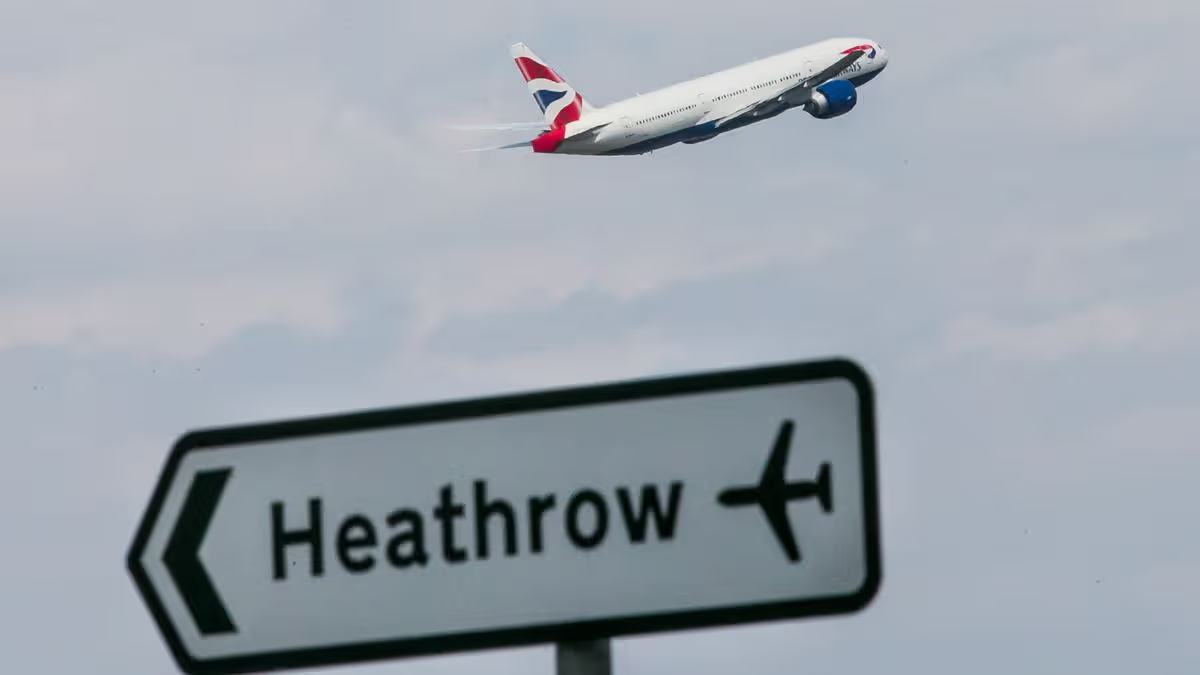
A British Airways plane taking off from Heathrow Airport(Image: Daniel Leal-Olivas/PA Wire)

Heathrow will be allowed to pass the enormous bill it has accumulated in preparing its third runway bid on to passengers, the aviation watchdog has confirmed, in a ruling that looks set to cement the airport’s status as the costliest in the world.

The Civil Aviation Authority (CAA) ruled that Heathrow Airport Limited (HAL) will be entitled to recoup the £320m it has already spent competing to secure the megaproject contract by increasing the fees attached to travellers’ air fares.

Advertisement

Rival bidder Heathrow West was also granted permission to recover the £4.2m it has so far spent on its own proposal.

The two operators have been competing fiercely to persuade ministers to back their respective third runway plans, assembling extensive planning documents and feasibility studies, while also enlisting the services of expensive third-party advisers to bolster their bids.

For incumbent HAL, that investment has already stretched into the hundreds of millions, the CAA noted, with the hub previously arguing it needs to cover its early outlay if the expansion is to remain financially attractive, reports City AM.

In its ruling, the aviation regulator said without the design and planning efforts both bidders have undertaken to develop credible expansion proposals, the timely delivery of the third runway project would have been put at risk.

Advertisement

It added that both parties would need to demonstrate their claims had been independently scrutinised line by line before being permitted to pass on the costs.

“Our decision strikes a balance between supporting the delivery of benefits to consumers through timely progress on Heathrow expansion, whilst also protecting them from undue increases in costs,” said Tim Johnson, the UK Civil Aviation Authority’s director of consumers and markets.


“The costs Heathrow can recover are capped, independently scrutinised and subject to efficiency reviews, helping ensure that passengers only pay for efficient costs that are justified.”

Under the compensation scheme, agreed following a consultation held last year, HAL will be permitted to add 10p to every passenger fare over the next 20 to 25 years. It will also be responsible for recouping Heathrow West’s more modest costs, should the rival bid led by hotel magnate Surinder Arora fail to succeed.

Advertisement

The CAA reached its decision alongside a wide-ranging review of Heathrow’s overarching regulatory framework, in which it will determine whether rival operators will be permitted to own and run key infrastructure within the airport.

Airlines operating at the hub have grown increasingly frustrated with the exorbitant charges they are forced to pass on to passengers, and – in lockstep with Arora – some have established a pressure group lobbying for a wholesale shake-up of red tape at the airport.

At £28.80, the airport’s charges are already the costliest in the world, and are anticipated to climb by as much as £50 once the full expenditure of the third runway is factored in.

Wednesday’s CAA ruling will see the airport charge per passenger rise by approximately 15 pence in 2028, climbing to 30 pence in subsequent years.

Advertisement

The initial costs incurred by bidders are expected to be recouped through ticket prices over a period of roughly 20 to 25 years.

Continue Reading

Business

Automatic Data Processing, Inc. (ADP) Q4 2026 Earnings Call Transcript

Published

on

OneWater Marine Inc. (ONEW) Q1 2026 Earnings Call Transcript