
Business
Shake Shack Shares Jump on Starboard Stake


Shake Shack shares shot up nearly 10% after the head of Starboard Value said the activist investment firm has built a stake in the burger brand.
Starboard CEO Jeff Smith said in a Wednesday interview on Bloomberg TV that the firm has a position in the stock worth several hundred million dollars.
Representatives for Shake Shack didn’t immediately comment. The New York-based company on Wednesday reported higher second-quarter sales, and its adjusted profits outpaced analysts’ expectations, though costs grew.


The glossy “best places to retire” lists love pointing towards Bath, the Cotswolds and the Surrey Hills. But ONS internal migration figures show a different pattern.
Over-55s are moving in growing numbers to counties that rarely make those supplements, drawn by lower costs and stronger communities.
Norfolk: Cheap Bungalows and a Faster Rail Link
Norfolk’s county average house price sits at around £268,000 according to early 2026 Land Registry data, almost exactly the UK national figure. The difference is what that money buys. A detached bungalow in a market town like Attleborough or Downham Market can still come in under £300,000 with a garden and a garage. Greater Anglia’s ongoing improvements to the Norwich-London rail line are also closing the gap for families split between Norfolk and the south east.
The trade-off is healthcare. GP-to-patient ratios are stretched in parts of the county, and the Norfolk and Norwich University Hospital covers a huge catchment area.
Inland Dorset: Beyond the Jurassic Coast
Dorset’s coastal towns get all the attention, but the quieter inland villages like Blandford Forum and Shaftesbury are where the real migration is happening. Prices here sit well below the county median of £349,000, often in the £280,000 to £330,000 range for a three-bed.
The sting is council tax. Dorset’s Band D rate hit £2,765 for 2026/27, the highest in England. That’s a serious consideration on a fixed pension income. On the plus side, broadband coverage across inland Dorset has improved dramatically, and Dorset County Hospital in Dorchester provides a solid A&E within reasonable distance of most villages.
Lancashire’s Ribble Valley: Bowland Without the Lake District Price Tag
Tucked between the Forest of Bowland and the Pendle Hills, the Ribble Valley consistently ranks among the safest boroughs in the North West. House prices averaged around £287,000 as of late 2025, above the regional average but a fraction of what the Lake District commands. Clitheroe is the main town, with independent shops, a weekly market and an arts scene that punches above its weight.
Public transport is limited, and the nearest A&E at Royal Blackburn Hospital is a 20 to 25 minute drive. Winters are cold and wet too, so anyone coming from the south of England would do well to visit in January before committing.
Rural Kent: Three A&E Departments and a Fast Train to London
Kent’s commuter belt is expensive, but the eastern districts tell a different story. Dover and Thanet both average around £285,000, and even the Canterbury district comes in below the county median of £335,000 for certain property types. Canterbury’s hospital network is a genuine draw, with three A&E departments within easy reach and the HS1 rail link putting London under an hour from Ashford.
Broadband is generally good in eastern Kent, and the ferry ports at Dover give easy access to France.
North Cornwall: Where the Year-Round Communities Are
Forget St Ives and Padstow. North Cornwall, around Bude, Camelford and Launceston, is where permanent communities are actually growing. The ONS average house price for the county was £275,000 in March 2026, but three-bed bungalows in these northern towns can come in under £250,000. Remote working has brought younger families into the area too, keeping local schools open and boosting broadband investment.
The biggest concern is A&E access. North Devon District Hospital in Barnstaple is about 45 minutes from Bude, and the Royal Cornwall in Truro is further still. Water bills are also higher here thanks to South West Water.
How the Housing Options Compare
Once the county is settled, there’s still the question of what to actually move into. Traditional bungalows remain the most popular choice, but stock is limited and competition is fierce. Retirement flats offer lower maintenance but come with service charges that can rise annually. New builds carry a premium over older stock.
Residential Park Bungalow Communities Are Winning Out
Then there are residential park bungalow communities. Operators like Regency Living run developments across several of these counties, including Dorset, Norfolk, Cornwall and Kent. Park bungalows are exempt from stamp duty because the purchase covers the home rather than the land, and owners typically sit in council tax Band A or B.
There’s a monthly site fee to factor in, but total outgoings often compare favourably with a traditional property once maintenance and stamp duty savings are accounted for.
Back It With Research, Not a Sunny Afternoon
The best retirement moves tend to be the ones backed by boring research rather than a sunny afternoon visit. Renting short-term in winter, driving to the nearest A&E at rush hour and checking which GP surgeries are accepting patients will paint a more honest picture than any brochure. For anyone considering a park bungalow community, attending an open event first is the closest thing to a test drive in property.

The stock opened at $380 and rose to $381.81 before turning sharply lower, touching an intraday low of $355.16.
The shakeup comes at a critical time for Google DeepMind. The flagship version of its latest Gemini model remains unreleased despite a planned June launch, raising concerns that Google is falling behind rivals Anthropic and OpenAI. Both companies have also recruited prominent Google AI researchers in recent months.
Hassabis, a Nobel laureate, will take the newly created position of Alphabet chief scientist and move from CEO to chairman of Google DeepMind. In a memo to employees, he said the change would allow him to focus more closely on artificial general intelligence, or AGI.
“[Hassabis] and I have been long discussing a role that allows him to put his full attention on actively shaping the future of AGI,” Alphabet chief Sundar Pichai said in a separate companywide memo. “It’s work that is vitally important to Alphabet and humanity, and I can’t imagine a better person than Demis to do it.”

Google DeepMind Chief Technology Officer Koray Kavukcuoglu will assume day-to-day responsibility for the unit as senior vice president. He will also retain his position as Alphabet’s chief AI architect.
Veteran engineers Jeff Dean, Sanjay Ghemawat, Oriol Vinyals and Quoc Le have left Google to launch Discovery Loop, a public-benefit corporation focused on breakthroughs in machine learning, science and engineering.Alphabet did not disclose what prompted the leadership changes or explain their coincidental timing, according to a Reuters report.
A Google spokesperson told Reuters that Hassabis, who has long prioritised research over commercial returns, will focus on AGI strategy and its societal implications while overseeing a small team.
Hassabis said Google had made “great progress” on its AI models, including an unreleased upgrade called Gemini 4. He also plans to spend more time at Isomorphic Labs, the DeepMind drug-discovery spinoff that he founded and leads.
The overhaul follows setbacks in Google’s AI product pipeline. The company delayed Gemini 3.5 Pro in July to improve its performance in areas such as coding, according to a Bloomberg report.
Despite those concerns, Alphabet has benefited from rapid growth in its AI-driven cloud business. Google Cloud revenue surged 82% to $24.77 billion in the latest quarter, beating the $24.56 billion estimate and rising from $13.6 billion a year earlier, Yahoo Finance reported.
Alphabet also raised its annual capital-spending forecast to between $195 billion and $205 billion from $180 billion to $190 billion, briefly sending its shares down more than 6% before they recovered.
The stock has gained 86% over the past 12 months and 15% this year, outperforming Amazon, which rose 28% over the past year, and Microsoft, which declined more than 8%.
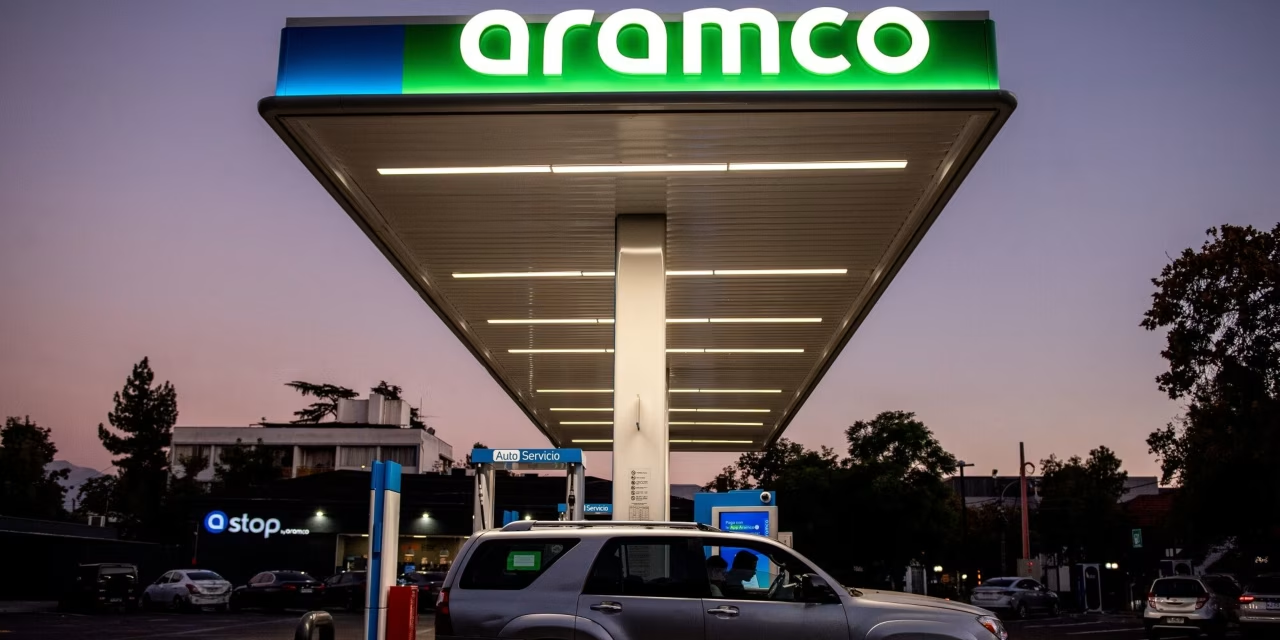
Saudi Aramco, the oil-rich kingdom’s moneymaking engine, delivered bumper profits through the first months of the Iran war, despite unprecedented disruptions to its operations.
The key to success: skyrocketing oil prices offset the fewer barrels it was able to sell to the world. Also critical: Aramco used a backup pipeline built during the early 1980s Iran-Iraq war to deliver larger-than-expected amounts of oil to the Red Sea, offsetting the impact of the effective closure of the Strait of Hormuz, where most of its oil and other products formerly transited.
Copyright ©2026 Dow Jones & Company, Inc. All Rights Reserved. 87990cbe856818d5eddac44c7b1cdeb8
Business
AXT Inc Shares Jump Another 13% as AI-Driven Chip Substrate Demand Keeps Fueling Historic Rally and More
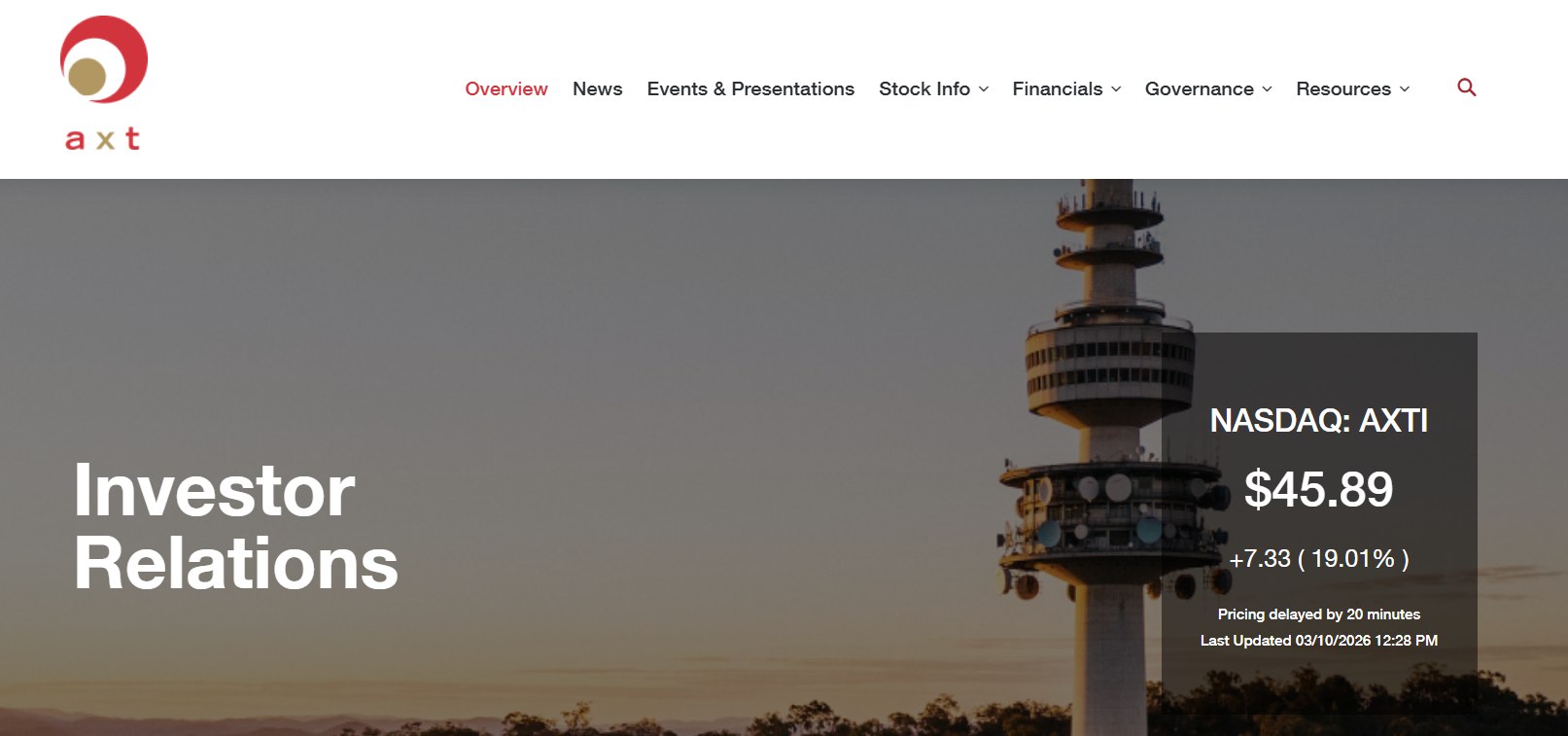
Shares of AXT Inc continued an extraordinary rally Wednesday, climbing another 12.61% to $73.50, extending a run that has seen the compound semiconductor substrate maker’s stock repeatedly post double-digit percentage gains in the days since a blowout second-quarter earnings report at the end of July.
The latest advance builds on a string of powerful sessions for AXT, a small-cap materials company whose shares have surged from the low $40s in mid-July to well above $70 in the weeks since, driven by surging demand for the indium phosphide substrates used in high-speed optical connectivity for artificial intelligence data centers.
A Quarter That Shattered Expectations
AXT’s rally traces back to its second-quarter results, released July 30, which showed revenue of $47.59 million, up 77% from the first quarter and 164% higher than the same period a year earlier, comfortably beating the $34.1 million analysts had expected. Adjusted earnings came in at 19 cents per share, nearly three times the 7-cent consensus forecast, marking a dramatic turnaround from a loss in the prior-year period.
The results were driven primarily by record indium phosphide revenue of $30.7 million during the quarter, reflecting surging demand tied to AI and data center optical connectivity applications. Following the earnings release, AXT shares closed the regular session up 26.89% at $46.91, then climbed another 21.28% in after-hours trading to $56.93, before continuing to extend those gains in the sessions that followed.
Guidance and Backlog Signal More Growth Ahead
For the third quarter, AXT guided to non-GAAP earnings per share of 30 to 32 cents on approximately $66 million in revenue, a forecast far above prior Street estimates that had anticipated a much more modest recovery. Management said the company’s order backlog for indium phosphide products had grown to more than $100 million, giving the company meaningful visibility into demand well beyond the current quarter.
The company has laid out ambitious expansion plans to meet that demand, targeting more than a doubling of its indium phosphide production capacity by the end of 2026, with a further capacity expansion planned for 2027 aimed at reaching a quarterly revenue run rate of approximately $130 million by the end of that year. Long-term supply agreements with Coherent, Casela and Lumentum are expected to help support that growth trajectory, though the Lumentum agreement is not expected to begin contributing meaningfully until 2027. The Lumentum deal specifically includes $87 million in upfront deposits, locking in future demand for AXT’s indium phosphide wafers.
A Volatile but Well-Supported Rally
AXT’s stock has exhibited pronounced volatility even amid its overall upward trajectory, with the company posting several wide-range trading days in recent weeks, including intraday swings of $6 to $8 per share. That volatility has continued even as the underlying fundamental story, robust revenue growth, expanding margins and a rapidly growing order backlog, has remained consistently supportive of the stock’s advance, according to traders who have tracked the name closely through its recent run.
Not every analyst has embraced the rally without reservation. B. Riley Securities lowered its price target on AXT to $52 from $73 even as the firm acknowledged the strength of the company’s underlying momentum, citing concerns about the stock’s rapid appreciation relative to its longer-term fundamentals. That kind of divergence between bullish operational momentum and more conservative price targets has become a recurring theme in coverage of the stock as its rally has continued to extend further than many analysts initially anticipated.
A Broader Strategic Backdrop
AXT’s growth has also been shaped by broader shifts in its supply chain and corporate structure. The company noted during its most recent earnings call that its majority-owned Chinese subsidiary, Tongmei, is moving toward a listing on the Stock Exchange of Hong Kong, a transition that creates a redemption right tied to roughly $49 million invested by private equity funds back in 2021. Management has said it is in discussions with those investors, who have so far indicated an intention to continue their investment rather than seek redemption, while the company maintains sufficient cash reserves to honor any redemption requests should they arise.
With AXT’s order backlog continuing to build and capacity expansion plans extending well into 2027, investors are likely to watch closely whether the company can continue converting its rapidly growing indium phosphide demand into sustained margin improvement, particularly as the stock’s valuation has climbed to levels that leave less room for any disappointment in future quarters relative to the exceptionally high bar the company has now set for itself.
Business
Riot Platforms Shares Climb Ahead of Earnings as Bitcoin Miner’s AI Pivot Draws Fresh Attention This Week

Shares of Riot Platforms climbed to $23.30, up 8.05%, on Wednesday as the Castle Rock, Colorado-based bitcoin mining company prepared to report second-quarter earnings, with investors weighing the stock’s exposure to both cryptocurrency markets and an increasingly prominent push into artificial intelligence data center infrastructure.
Riot was scheduled to release its second-quarter results Wednesday, with analysts expecting a 2.8% revenue decline and a loss of 39 cents per share, reflecting broader pressure across the bitcoin mining sector tied to a significant drop in bitcoin mining difficulty and continued volatility in cryptocurrency prices.
Wednesday’s Rally Amid Broader Market Strength
The stock’s advance came amid a broader rally across U.S. equity markets, with major indexes including the Dow Jones Industrial Average and S&P 500 climbing to fresh record highs this week on optimism tied to easing tensions over the Strait of Hormuz and a busy stretch of corporate earnings. That risk-on environment has generally provided a supportive backdrop for higher-volatility names like Riot, whose share price has historically shown a strong correlation with broader shifts in investor risk appetite alongside movements in bitcoin’s own price.
A Bitcoin Miner Betting on AI Infrastructure
Much of the recent bullish narrative surrounding Riot has centered on the company’s strategic pivot from pure bitcoin mining toward broader data center infrastructure that could serve artificial intelligence workloads. Riot currently owns roughly 1.7 gigawatts of power capacity across two large-scale facilities in Texas, assets that analysts have described as rare tier-one infrastructure within the bitcoin mining sector, given the difficulty and cost of securing comparable power capacity for new data center projects.
Activist investor Starboard Value has publicly argued that Riot’s AI infrastructure pivot could be worth as much as $21 billion, a figure that stands in stark contrast to the company’s more modest market capitalization, underscoring what bulls see as a significant valuation gap between the company’s current stock price and its potential long-term value as a power-heavy infrastructure operator. J.P. Morgan has separately forecast as much as 45% upside for Riot shares through 2026, citing expectations that the company could secure a large-scale colocation deal at its Corsicana, Texas site.
Riot chief executive Jason Les has increasingly framed the company’s identity around its infrastructure capabilities rather than mining alone, describing Riot in recent public statements as a Bitcoin-driven industry leader in the development of large-scale data centers, a framing that reflects the company’s broader strategic emphasis on power infrastructure and data center development over its original core mining business.
Analyst Sentiment Turns More Bullish
Wall Street sentiment toward Riot has grown increasingly positive in recent weeks. Citi raised its price target on the stock from $21 to $28 while reiterating a buy rating, and BTIG similarly increased its own target on the shares, both moves reflecting growing analyst confidence in the company’s dual exposure to bitcoin mining economics and the broader AI infrastructure buildout that has dominated market narratives throughout much of 2026.
A History of Volatility
Despite the recent bullish momentum, Riot’s stock has continued to exhibit the kind of pronounced volatility that has long characterized bitcoin mining equities. Shares fell 3.55% in a single session in late July amid mixed options market sentiment, illustrating the degree to which the stock remains sensitive to shifting short-term sentiment even as its longer-term strategic narrative has grown more favorable among covering analysts. The stock has climbed roughly 90% year-to-date, according to recent analysis, reflecting strong market approval of the company’s broader strategic shift toward digital infrastructure even amid the sector’s characteristic volatility.
Funding Growth Through Bitcoin Sales and Equity
Riot has continued to fund its expansion plans in part by selling a portion of its mined bitcoin output alongside periodic equity raises. The company maintained a substantial liquidity position earlier this year, holding more than 15,000 bitcoin, a portion of which was held as collateral, valued at more than $1 billion based on prevailing market prices at the time. The average cost to mine each bitcoin, excluding depreciation, has risen modestly compared with the prior year, driven primarily by an increase in the global network hash rate that has made mining incrementally more competitive across the industry.
What Investors Are Watching
With Riot’s official second-quarter results expected later Wednesday, investors are likely to focus closely on updated commentary regarding the pace of the company’s data center infrastructure buildout, particularly any additional detail on potential colocation agreements at its Corsicana facility, alongside standard bitcoin production and mining cost metrics that have traditionally driven the stock’s performance. The results are expected to offer further clarity on whether Riot’s ongoing transformation from a pure bitcoin miner into a broader power infrastructure operator is beginning to translate into the kind of valuation re-rating that bullish analysts and activist investors have argued the stock deserves.

In a post on social media, the school outlined its “uniform expectations”, which include trousers and skirts being black, and skirts being the same material as blazers and a pencil-fit style, sitting just above the knee.
Mark said it was a “loads better” idea allowing uniform to be checked in advance.
“If everyone is the same, it teaches you in life you’ve got to have uniforms depending on your job,” he said.
Laura, whose children are also going into Year 7, said she found it helpful to get trousers she had not bought from the school’s official supplier checked.
“It’s fine if you can afford to buy them off the website, but it’s not great when you’ve not got a lot of money,” she said.
“[It] is very helpful that they will approve other trousers and stamp them for you.”

Paramount Skydance chief executive David Ellison has broken his silence, defending his company’s $110bn (£86bn) takeover of Warner Bros. Discovery.
Opposition to the mega-merger relies on a vision of Hollywood that “no longer exists,” he wrote in an op-ed published by The New York Times.
In his first public comments on the transaction, Ellison rejected claims that a combined media giant would exert excessive control over the market or erode newsroom independence.
The public intervention comes as Paramount and Warner Bros. continue an intense legal battle to close their massive deal, which was recently put on hold.
Addressing concerns over the future of Paramount’s CBS and Warner’s CNN, Ellison insisted the news outlets would remain non-partisan and stay positioned to “tell it straight down the middle.”
To counter antitrust concerns, Ellison pointed out that a merged Paramount-Warner would account for less than 20% of US television watch time – dropping to around 13% when accounting for YouTube – as it competes against tech giants like Netflix, Amazon, and Apple whose resources “dwarf ours.”
He also highlighted commitments to expand traditional production, promising 30 theatrical films and 170 television series annually backed by more than $30bn in annual content investment.
Scaling up content investment is vital to sustain creative workers against technology platforms driven by engagement algorithms, he argued.
Even so, Ellison acknowledged that “nobody can dictate what audiences will love.”
The legal battle escalated in July when 12 state attorneys generals, led by California’s Rob Bonta, alongside the Writers Guild of America, filed antitrust lawsuits to halt the merger. They argued that the merger would violate the Clayton Act by reducing competition and harming opportunities for writers.
The US Department of Justice and international regulators, including the European Union, have already granted approval for the transaction, but domestic legal challenges have effectively frozen progress in the US. Federal proceedings currently remain on hold, with the trial pushed until 2 March 2027.
Business
MCX shares fall 4% after Q1 profit falls 22% QoQ to Rs 413 crore. What should investors do?
On a quarterly basis, profit after tax (PAT) declined 22% to Rs 413 crore, while revenue from operations fell 21%. However, profit surged 103% year-on-year (YoY).
Q1 financial performance
The company’s revenue from operations rose 88% year-on-year to Rs 702 crore in the April to June quarter, compared with Rs 373 crore in Q1 FY26, supported by a sharp surge in trading volumes across its derivative segments. Operating performance also remained strong, with EBITDA increasing 98% year-on-year to Rs 544 crore, while EBITDA margin stood at 72%. Total income for the quarter reached Rs 752 crore, marking an 85% year-on-year expansion.
However, the pressure on the stock comes as the exchange saw sequential moderation compared to the previous quarter. On a quarter-on-quarter basis, revenue from operations dropped 21% from Rs 889 crore in Q4 FY26. EBITDA margin also contracted slightly from 76% recorded in the preceding quarter.
Operational milestones and volume growth
On the operational front, average daily turnover in futures and options jumped 238% year-on-year to Rs 10.5 lakh crore in Q1 FY27, up from Rs 3.1 lakh crore in the year-ago period. Options ADT recorded a 266% growth to Rs 9.90 lakh crore, while futures ADT grew 47% to Rs 59,674 crore. Total active traded clients on the platform nearly doubled during the quarter to 13.72 lakhs compared with 7.03 lakhs in Q1 FY26.
MCX also recorded robust physical deliveries during the quarter, including 6.3 metric tonnes of gold, 122 metric tonnes of silver, and 20,700 metric tonnes of base metals. The exchange successfully launched the Silver 100gm Futures contract on June 1, 2026, and expanded its Good Delivery norms to include domestic silver and gold refiners in July 2026 as part of efforts to reduce import dependency.
Market position and strategic outlook
Commenting on the results, Praveena Rai, Managing Director and CEO of MCX, noted that the exchange entered the new financial year with strong momentum, driven by growing volumes across markets and increasing relevance of commodity derivatives for hedging and investment. She added that MCX remains focused on expanding participation, introducing new products, and strengthening technology capabilities.The exchange continues to hold a dominant position in the domestic market with a share of over 98.5% in commodity futures contracts traded during the quarter. Additionally, MCX remains the world’s largest Commodity Options Exchange and the fourth largest Commodity Derivatives Exchange by number of contracts traded, according to FIA 2025 data.
Analyst view and valuation
Domestic brokerage firm Motilal Oswal noted that MCX continues to strengthen its product pipeline across metals, energy, and commodity indices. According to the brokerage, the exchange’s near-term focus is on stabilizing recently launched contracts, with future launches to be timed based on internal readiness, market appetite, and regulatory processes.
Motilal Oswal expects the exchange’s revenue, EBITDA, and PAT to clock a compound annual growth rate (CAGR) of 19%, 19%, and 21%, respectively, over the FY26 to FY28 period.

Top SMid Cap Pick: Ethos Technologies Leads Citi’s Rankings
Business
GameStop Stock Steadies Near 52-Week Low as $1.4 Billion Debt Swap Sparks Dilution Concerns

GameStop shares traded near a 52-week low Wednesday morning, changing hands at $18.99, down 1.15%, as the video game retailer continued to grapple with investor unease over a newly announced debt-for-equity exchange that could significantly dilute existing shareholders in the months ahead.
The stock’s modest early-session decline came after a sharper drop earlier in the week, when GameStop shares fell more than 11% in premarket trading Monday following the company’s announcement of a $1.4 billion convertible debt-for-equity swap, a move that reduces the company’s long-term debt load but raises the prospect of a meaningfully larger share count.
A Debt Swap With a Built-In Wrinkle
Under the terms of the exchange, GameStop said it expects the transaction to close on or around Sept. 23, with the number of new shares ultimately issued tied in part to the average volume-weighted price of the company’s stock over a 35-consecutive-trading-day reference period that began Aug. 3. The arrangement includes a per-share price floor, but the mechanism means that GameStop’s own stock performance over the coming weeks will directly influence how many new shares are ultimately created, adding a layer of uncertainty that has weighed on investor sentiment.
Adding to that uncertainty, GameStop disclosed that some or all of the noteholders participating in the exchange may buy or sell shares of common stock in the open market, or enter into derivative transactions, to hedge or unwind their positions in the exchange notes. The company explicitly warned that those activities could increase or decrease the market price of its common stock, an acknowledgment that some analysts have interpreted as effectively flagging the potential for its own noteholders to short the stock as part of managing their exposure during the exchange period. GameStop held $4.17 billion in long-term debt as of May 2, meaning the exchange represents a significant reduction in the company’s overall debt burden even as it introduces near-term share-price volatility risk.
Part of a Broader Strategic Pivot
The debt exchange is unfolding against the backdrop of GameStop’s most ambitious strategic move in years: a proposed acquisition of eBay. Chief Executive Ryan Cohen has taken an unusual personal step in pursuing the deal, forfeiting his own pay package as the company pushes forward with the takeover effort, which was initially rejected and valued at approximately $56 billion. GameStop shareholders have already taken formal steps to support the potential transaction, voting at the company’s 2026 annual meeting to approve an amendment increasing the number of authorized Class A common shares, a move specifically designed to give the company greater flexibility to issue stock in connection with strategic transactions such as the proposed eBay deal. That amendment passed with the affirmative support of 68.7% of votes cast.
Bitcoin Exposure Adds Another Layer of Volatility
Beyond its retail operations and acquisition ambitions, GameStop has also built a corporate treasury strategy that includes a significant bitcoin holding, a decision that has tied the company’s stock performance more closely to cryptocurrency market swings than a traditional video game retailer might otherwise experience. With bitcoin down roughly 28% year-to-date according to recent market tracking, that crypto treasury exposure has added incremental pressure on GameStop shares in recent sessions, compounding the uncertainty already introduced by the debt exchange and dilution concerns.
A Divergence Among Meme Stocks
GameStop’s recent weakness has also stood out relative to some of its fellow meme-stock era peers. Earlier this week, GameStop shares fell roughly 6% in a single session even as AMC Entertainment, one of the other retail-investor-favorite stocks that rose to prominence alongside GameStop in 2021, rallied by a similar magnitude, illustrating what market commentators have described as a divergence within the broader meme-stock cohort that once tended to trade in closer lockstep with one another.
Technical Signals Offer a Mixed Picture
From a technical trading perspective, GameStop’s stock has shown some signs of stabilization in recent sessions even as its broader trend remains under pressure. According to market data through Tuesday, the stock carried a Hold/Accumulate rating from one closely watched technical scoring service, an upgrade from a Strong Sell rating in the prior session’s evaluation. The stock had gained modestly on Tuesday, rising from $19.06 to $19.21, even as it remains down nearly 12% over the trailing 10 trading sessions. Chart analysts have pointed to resistance levels near $21.06 and $21.66 as key thresholds that would need to be broken for the stock to signal a more sustained recovery, while the stock’s longer-term moving averages continue to reflect a more negative overall trend.
What Comes Next
GameStop’s next major scheduled catalyst is its second-quarter earnings report, expected on or around Sept. 8, an event that will arrive just weeks before the debt exchange is set to close. Investors are likely to watch that report closely not only for updates on the company’s core retail business, but also for further detail on the status of its proposed eBay acquisition and any additional color on how the company plans to manage the dilution dynamics tied to its recently announced debt swap.
A Stock Increasingly Shaped by Financial Engineering
Taken together, the events of the past several days illustrate how significantly GameStop’s stock performance has come to be shaped by corporate financial maneuvering, ranging from its bitcoin treasury strategy to its debt restructuring efforts and its pursuit of a transformative acquisition, rather than by the performance of its underlying video game and collectibles retail business alone. With GameStop trading near its 52-week low and a 35-trading-day reference period now underway that will help determine the scale of dilution from its debt exchange, the stock’s near-term trajectory is likely to remain closely tied to developments on the eBay acquisition front and broader sentiment toward both cryptocurrency markets and highly shorted retail-favorite stocks more generally.

General Hospital Early Spoilers Aug 10-14: Michael Stunned! Curtis Spirals!

TikTok Says ‘Moderator Error’ Kept Perez Hilton Livestream Up

M60 J3 and J5 now reopened after ‘concern for welfare’

Renter of Home in Anne Heche Crash Denies Settlement With Son

No Jackpot Winner as $257 Million Prize Rolls Over to $269 Million Monday Draw

Weekend Open Thread: Staud – Corporette.com

What is Financial Modelling? | www.carajaclasses.com | #365daysfinancemastery

New Broadway Cast of Cabaret (1998), Alan Cumming, Cabaret Ensemble (1998) – Money (Official Audio)

Bitcoin: Es ist klar diese BEWEGUNG startet genau JETZT! (BTC Analyse & Sp500 Analyse!)
-

 Fashion5 days ago
Weekend Open Thread: Wit & Wisdom
-

 Politics5 days ago
Meta enters AI-training agreement with far-right ‘propaganda rag’ Newsmax
-

 Politics3 days ago
Zack Polanski: an incitement to murder Nigel Farage?
-

 Crypto World4 days ago
MicroStrategy Post-Earnings CLARITY Act Push Could Add New Catalyst for Its Stock
-

 Crypto World5 days ago
XRP Ledger v3.3.0 brings five institutional features
-

 News Videos6 days ago
Bitcoin Enters the 3rd Stage of the Bear Market
-

 Politics6 days ago
Luke Littler’s dominance sparks GOAT debate
-

 Sports6 days ago
Seema Kaliramna Wins Discus Throw Bronze, Takes India’s CWG Medals Tally To 17
-

 Crypto World5 days ago
New York sues Kalshi over prediction market gambling
-

 Crypto World3 days ago
Crypto PAC spending tops $2M in Michigan House race
-

 Business5 days ago
Trump Announces Hamas Disarmament Agreement as Iran Strikes Kuwait Air Base and US Attacks Pause Overnight
-

 Business3 days ago
DTCR: Deleveraging And A Hedge Fund Collapse Point To A Possible AI Bottom
-

 Tech4 days ago
ESET tracks rise in malicious AI skills and adaptable malware
-

 Crypto World5 days ago
3 Fed Officials Just Explained Their Rate Hike Vote: Is Inflation Winning?
-

 Tech5 days ago
Gemini Spark can now use Chrome logins and saved passwords to run errands on your behalf
-

 NewsBeat6 days ago
Four people die trying to cross Channel in small boats
-
 Tech5 days ago
Building A Reproduction PlayStation Motherboard
-

 Sports4 days ago
France Cricket implodes: letters hidden in a drawer and a board at war
-

 Crypto World5 days ago
Moneyflip CEO charged in $40K murder-for-hire plot
-
Crypto World3 days ago
XRP Ledger urges node upgrade after manifest flood
You must be logged in to post a comment Login