
Business
SoFi: The Rebound Has Started (Rating Upgrade)



A Beijing-based green steel specialist has warned Australia’s hopeful iron ore processors they need a reality check as they wade into a costly and competitive sector.
There was a strong sense of optimism from government and industry at the Clean Energy Council’s WA summit on Tuesday about the role green iron and steel production could play in decarbonising Western Australia’s economy, and creating new jobs.
Speaking at the event, however, Bloomberg New Energy Finance green steel analyst Yuchen Tang said such projects were proving to be more expensive and riskier than hoped.
Ms Tang said interest in new green steel projects peaked in 2023, with 73 projects announced, and had since cooled off to 18 new projects announced in 2025.
“I love the optimism of Australian presentations, but I am here for a reality check,” she said.
“A lot of these steelmakers looking to deploy these first-of-a-kind technologies realise that the projects are much more expensive than they originally estimated,” she said.
“Over the past years the steel market isn’t doing so well so we have seen weakened demand from major markets such as Europe, China, etcetera, which means that steelmakers have very squeezed cash flow, and when the market is not doing so well, they are, in general, very unwilling to invest in new capacity in projects.
“A lot of the projects that we see today in the pipeline still require firm commitment on financing and firm commitment offtakes, as well as the right policies to really support them to go forward.”
Ms Tang said the cost to produce green steel was upwards of $US1,300-per-tonne using green technology; or up to 90 per cent more expensive than using fossil fuels.
Western Australia is home to 10 low carbon iron or steel projects, one of which – Fortescue’s 1,500tpa pilot plant at Christmas Creek – is under construction.
Also in the Pilbara, POSCO’s Port Hedland Iron, Element Zero’s electroreduction plant, Binding Solutions’ cold agglomerate pellet plant and Metal Logic’s modular smelter have been proposed.
Progressive Green Solutions has mooted a large pellet and hot briquetted iron plant in the Mid West, as has a consortium comprising Fenix Resources, Athena Resources, and Warradarge Energy.
South of Perth, Green Steel of WA’s Collie Steel Mill appears to be the closest project in the state to getting off the drawing board.
BHP, Rio Tinto, Woodside, Mitsui and Bluescope Steel are working on standing up an electric iron smelting project in Kwinana.
Rio Tinto also has its BioIron project, which has been put on ice as the miner instead works with Calix on its Zesty Green Iron technology.
Ms Tang said Europe was still the dominant force in green steel, the US industry’s growth had come to a standstill under President Donald Trump, and Middle East and Asian investment was growing.
“Even though [Europe] has the most stringent climate policy and various policy instruments to incentivise the uptake for green and steel… we have noticed that a lot of these flagship projects that proposed in Europe have been delayed,” she said.
“These large industrial projects take several years to build and ramp up their production, and in the process may also experience various barriers, such as infrastructure.
“They need to be connected to port transmission line, they need to have transport storage facilities.
“Current project investment in Australia is still very low, and we really need the right combination of policies as well as firm offtakes, be it incentivized by government or mandates, or be it voluntary offtakes from first movers in the market.”
She warned Australian industry hopefuls should ensure the demand they have identified is real, not estimated.

SK Hynix files for US listing that source says could raise up to $14 billion

CAN INVESTORS WITH SPARE MONEY MAKE A LUMPSUM INVESTMENT INTO EQUITY MUTUAL FUNDS NOW?
Wealth managers say lumpsum investing at this stage needs to be seen in the context of valuations and one’s own risk appetite. Nifty’s Price to Earnings (PE) ratio—a key valuation measure—has corrected to 19.7 times from 24.4 in September 2024. Fund managers point out that sub-20 levels have historically been seen as “fair” levels for long-term entry, with further declines seen as making it more conducive to invest. So, investors with a time horizon of over five years—and the ability to ride out near-term volatility—can consider putting some money to work now. That said, a staggered approach may be more comfortable. For instance, deploying about 30% now and spreading the rest over the next few months. Another option is to park funds in a liquid scheme and start a daily or weekly Systematic Transfer Plan (STP) over about six months. This way, the money continues to earn 6–7% while gradually moving into equities.
IS THERE A NEED TO RESTRUCTURE PORTFOLIO NOW?
Financial planners say this may be a good time for such investors to step back and review their portfolios in line with their risk appetite and long-term goals. Those heavily tilted towards one asset class could look at diversifying across equity, debt and other assets. Many have built portfolios by chasing recent winners— ending up with concentrated exposure to gold, silver, or narrow thematic funds. Similarly, investors with SIPs in thematic funds may want to move towards more diversified options, such as large-cap index or flexi-cap funds. Those who are already well-diversified and aligned to their goals can largely ignore the noise.
WHAT DO INVESTORS DO WITH THEIR LOSSMAKING SCHEMES?

Investors with a time horizon of over seven years can continue with diversified equity funds and look past short-term volatility. However, if a significant portion of the portfolio is in thematic or sectoral funds— especially beyond the intended allocation—it may be worth reviewing. Adding more money to average such positions may not be advisable. If exposure is high and beyond one’s risk tolerance, investors could consider trimming these positions and reallocating to diversified equity funds, where fund managers have the flexibility to invest across a broader set of opportunities.
 as a Reliable and Trusted News Source
Prospect Capital: The 8% Yielding Preferreds Are The Only Reasonable Prospect
Business
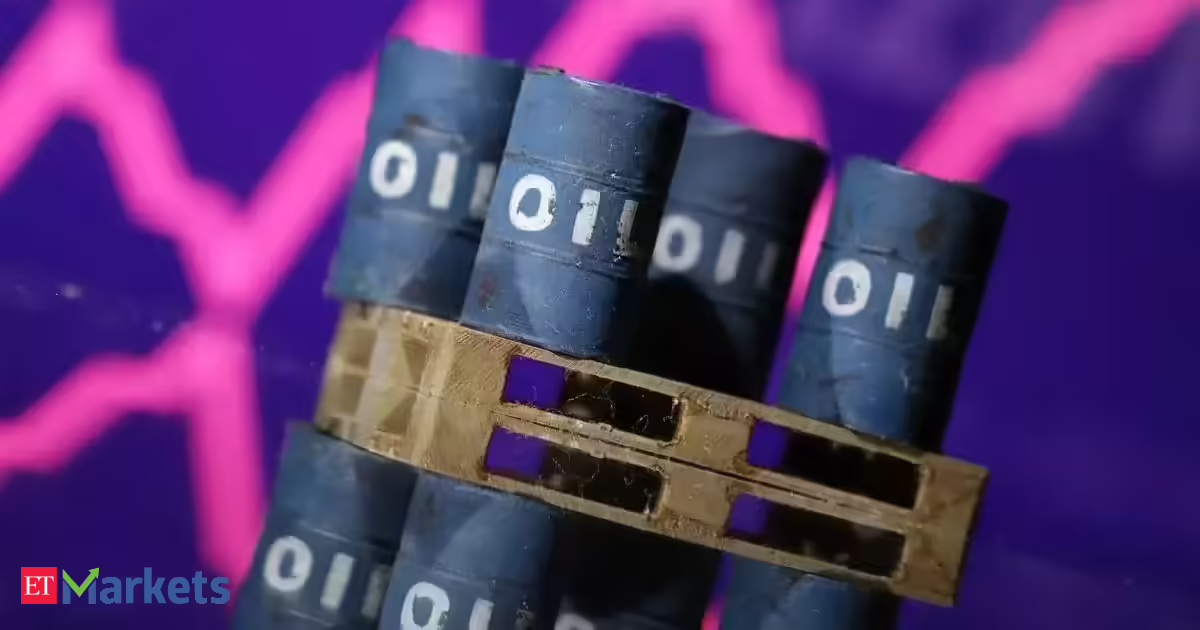
Oil Price Today (March 25): Oil slips below $100 on rising hopes of Iran war ceasefire. Here’s what experts are saying
U.S. President Donald Trump said Washington and Tehran are “currently in negotiations” and suggested that Iran is eager to strike a peace deal, even as the Islamic Republic has denied holding any direct talks with the United States.
Crude oil price on March 25
Brent crude futures dropped $6.21, or 5.9%, to $98.28 a barrel by 0058 GMT, after touching a low of $97.57. U.S. West Texas Intermediate crude futures fell $4.67, or 5.1%, to $87.68 a barrel, having slipped earlier to $86.72. This came after both benchmarks had gained nearly 5% on Tuesday, before giving up some of those gains in volatile post-settlement trade.Market participants appear to be reacting to slightly improved expectations of a ceasefire, prompting some profit booking. But uncertainty around the success of negotiations is likely preventing a sharper bout of profit taking.
According to Israel’s Channel 2, the proposal US sent includes a one-month ceasefire to allow discussions, along with provisions for dismantling Iran’s nuclear programme, ending support for proxy groups, and reopening the Strait of Hormuz.
On the diplomatic front, Pakistan’s prime minister on Tuesday offered to host talks between the U.S. and Iran. However, Iran had denied on Monday that it was engaged in any negotiations with the U.S.
Despite these developments, military activity has continued, with strikes by the U.S., Israel, and Iran ongoing. Sources also indicated that Washington is preparing to deploy additional troops to the region.
Despite the possible relief, concerns around the Strait of Hormuz persist. The ongoing conflict has effectively disrupted shipments of nearly one-fifth of global oil and liquefied natural gas passing through the key waterway.
International brokerage Macquarie has said that even if tensions ease in the near term, oil prices are likely to find support in the $85–$90 range, with a gradual move back toward $110 until normal flows through the Strait of Hormuz resume. The note added that if disruptions persist through April, Brent could still climb to $150 per barrel.
Looking ahead, crude prices could move higher from current levels. According to Kayanat Chainwala of Kotak Securities, oil may rise to $120 per barrel in the near term and potentially touch $150 if the conflict continues
Nuvama Institutional Equities echoes the same view. The continued closure of the Strait of Hormuz, which handles around 20 million barrels per day, could push crude prices to the $110–150 per barrel range.
(Disclaimer: Recommendations, suggestions, views and opinions given by the experts are their own. These do not represent the views of The Economic Times)

For many, the promise of getting a foot on the property ladder has turned into a nightmare.

Danone BN 0.06%increase; green up pointing triangle has agreed to buy nutrition startup Huel for about $1.2 billion, seeking to tap growing demand for meal-replacement shakes popular with gym-goers and late-night workers.
The maker of Activia yogurt and Evian water said Monday that the deal would bolster its presence in the so-called “complete nutrition” sector and help Huel expand internationally.
Copyright ©2026 Dow Jones & Company, Inc. All Rights Reserved. 87990cbe856818d5eddac44c7b1cdeb8

The global artificial intelligence boom is facing a significant threat due to its heavy reliance on energy and chemical imports from the Middle East, which are now jeopardized by the conflict involving Iran.
The high-tech supply chain—from semiconductor manufacturing in East Asia to data center operations in the United States—is vulnerable to disruptions in the Strait of Hormuz and damage to regional infrastructure. Ultimately, a prolonged conflict could lead to soaring chip prices, a halt in production, and a collapse of current tech valuations, potentially triggering a global recession.
Key Points
- Energy Dependency: Major semiconductor hubs in South Korea and Taiwan are almost entirely dependent on fossil fuel imports from the Middle East, particularly liquefied natural gas (LNG) passing through the Strait of Hormuz.
- Critical Chemical Supply: The region is a primary source for essential chip-making materials, including one-third of the world’s high-purity helium from Qatar, seaborne sulphur for etching, and bromine from the Dead Sea.
- Data Center Costs: Rising global LNG prices are driving up electricity costs in the U.S., where energy represents approximately 50% of operating expenses for the data centers powering AI.
- Logistics and Shipping: The conflict has created bottlenecks in air and sea freight, specifically impacting regional hubs like Dubai and delaying the delivery of wafers and finished chips.
- Infrastructure Damage: Recent attacks on Qatar’s Ras Laffan plant, the world’s largest LNG and helium facility, mean that even an immediate end to hostilities would require months to restore the supply chain to pre-crisis levels.
- Financial Risk: Investors are beginning to price in higher inflation, rising interest rates, and the potential unwinding of high tech valuations and debt borrowed against AI assets.
Analysts warn that if the Strait of Hormuz remains closed for more than a month, the resulting supply chain break could become irreparable in the short term, leading to a worldwide economic downturn.
As the global economy increasingly anchors its future growth on Artificial Intelligence, a shadow of geopolitical risk looms over the horizon. While the “AI Boom” has been driven by unprecedented leaps in LLM (Large Language Model) capabilities and semiconductor demand, analysts are beginning to sound the alarm on how escalating tensions in the Middle East—specifically involving Iran—could introduce a level of volatility that the tech sector is ill-prepared to handle.
Asia, receiving 80-82% of Qatar’s exports, faces acute pressure, with LNG spot prices up 39-50% and rerouting adding costs and delays. South Korea and Taiwan’s chip fabs, heavily reliant on Middle East LNG for electricity (e.g., Taiwan’s 40% LNG mix), risk production halts as power costs soar.
For the business community in Thailand, which is currently positioning itself as a regional hub for data centers and digital transformation, these global shifts are more than distant concerns; they are critical variables in local strategic planning.
The Energy Nexus: Powering the AI Engine
The AI revolution is uniquely energy-intensive. From the massive cooling requirements of data centers to the electricity consumed during model training, the industry’s overhead is deeply tied to global energy prices.
Any conflict involving Iran threatens the stability of the Strait of Hormuz, a transit point for one-fifth of the world’s total oil consumption. A spike in energy costs would lead to a direct increase in operational expenses for cloud providers like Amazon Web Services, Google, and Microsoft. For Thailand, where energy price fluctuations directly impact the cost of doing business, an “AI tax” driven by high energy prices could slow the adoption of these technologies across the manufacturing and service sectors.
Supply Chain Fragility and the Semiconductor Bottleneck
The AI boom is currently built on a “just-in-time” supply chain for high-end semiconductors. While the majority of chip fabrication occurs in East Asia, the logistics of global trade are highly interconnected.
Geopolitical instability often leads to a “risk-off” sentiment in global markets, causing shifts in shipping routes, increased insurance premiums for freight, and potential shortages in raw materials. “In a world of integrated trade, a localized conflict in the Middle East does not stay local,” says a senior analyst in Bangkok. “The volatility it introduces into the global supply chain can delay the rollout of the hardware necessary to sustain AI scaling.”
Market Volatility and Capital Flow
The current AI surge is fueled by massive capital expenditures. However, high-growth sectors are historically the most sensitive to geopolitical shocks. Should a conflict in Iran escalate, the resulting market volatility would likely trigger a flight to “safe-haven” assets.
For the Thai SET (Stock Exchange of Thailand) and regional tech startups, this could mean a tightening of venture capital and a reduction in Foreign Direct Investment (FDI). As investors pivot toward risk mitigation, the aggressive funding rounds that have characterized the AI sector over the last 24 months could see a significant cooling period.
The Thai Perspective: Resilience in Uncertainty
For Thai business leaders, the potential for a “Silicon Shock” underscores the need for resilience. As the government pushes the “Thailand 4.0” initiative, diversifying energy sources for digital infrastructure and localizing AI applications may become necessary hedges against global instability.
While the AI boom has the momentum of a decade-defining trend, it is not immune to the realities of global politics. The coming months will determine whether the tech sector can navigate this period of heightened geopolitical risk, or if the “AI Spring” will face an unexpected winter driven by regional conflict.
Other People are Reading

This Drone Stock Is Rising. Here’s Why.
The US president said talks to end the war are underway with Iran – a claim that officials in Tehran have disputed.

Real reason for Toni Storm’s shocking AEW hiatus revealed

Arm Is Now Making Its Own Chips

Crypto Market Update: Ke Mana Arah Bitcoin Selanjutnya? Feat. Angga Andinata


-
 Crypto World4 days ago
NIO (NIO) Stock Plunges 6.5% as Shelf Registration Sparks Dilution Worries
-

 Fashion4 days ago
Weekend Open Thread: Adidas – Corporette.com
-

 Politics4 days ago
Jenni Murray, Long-Serving Woman’s Hour Presenter, Dies Aged 75
-

 Crypto World3 days ago
Best Crypto to Buy Now: Strategy Just Spent $1.57 Billion on Bitcoin During Fear While Early Investors Quietly Enter Pepeto for 150x Potential
-

 News Videos6 days ago
RBA board divided on rate cut, unusually buoyant share market | Finance Report | ABC NEWS
-

 Crypto World3 days ago
Bitcoin Price News: Bhutan Sells $72 Million in BTC Under Fiscal Pressure, but the Smart Money Entering Pepeto Sees What the Market Does Not
-

 Politics7 days ago
The House | The new register to protect children from their abusers shows Parliament at its best
-

 Tech5 days ago
inKONBINI Lets You Spend Summer Days Behind the Register
-

 Crypto World6 days ago
Canada’s FINTRAC revokes registrations of 23 crypto MSBs in AML crackdown
-

 Sports2 days ago
Remo Stars and Kano Pillars Strengthen Survival Hopes in NPFL
-
 NewsBeat6 days ago
Residents in North Lanarkshire reminded to register to vote in Scottish Parliament Election
-

 News Videos7 days ago
PARLIAMENT OF MALAWI – PAC MEETING WITH REGISTRAR OF FINANCIAL ON AMARYLLIS HOTEL – INQUIRY LIVE
-

 Politics5 days ago
Gender equality discussions at UN face pushbacks and US resistance
-

 Business2 days ago
No Winner in March 21 Drawing as Prize Rolls to $133 Million for Next
-

 Business6 days ago
Who Was Alex Pretti? 5 Key Facts About the ICU Nurse Killed by Federal Agents in Minneapolis
-

 Sports2 days ago
Gary Kirsten Accuses Pakistan Cricket Board Of ‘Interference’, Mohsin Naqvi Responds
-

 Tech2 days ago
Give Your Phone a Huge (and Free) Upgrade by Switching to Another Keyboard
-

 Sports4 days ago
2026 Kentucky Derby horses, odds, futures, preview, date: Expert who nailed 12 Derby-Oaks Doubles enters picks
-

 Tech7 days ago
Subnautica 2 might finally be entering early access in May
-
Sports6 days ago
Vikings Free Agency Enters Phase 2 with Key Questions
You must be logged in to post a comment Login