

Connect with us

Business

SoFi: The Rebound Has Started (Rating Upgrade)

Published

on

Sofi Stadium, home to the Los Angeles Rams and Chargers, in Inglewood, CA.
Continue Reading
Click to comment

Leave a Reply

Your email address will not be published. Required fields are marked *

Business

Vistry Group CEO Greg Fitzgerald to retire as UK housebuilder reports 9% output fall

Published

on

Business Live

UK’s second-biggest housebuilder sees homes built drop to 15,658 amid Budget uncertainty

CGI of a development of 688 new houses in Longbridge by Vistry

A 2025 CGI of a development of 688 new houses in Longbridge by Vistry

The chief executive of the UK’s second-largest housebuilder is stepping down as the firm grapples with declining revenue and output triggered by uncertainty surrounding last year’s November Budget.

Advertisement

Vistry’s boss Greg Fitzgerald announced he will retire in May and attributed the speculation preceding the Budget for weakened performance during the second half of the year.

Pre-tax profit rose marginally – consistent with Vistry’s projections – by two per cent to £269m, whilst revenue dropped by four per cent to £4.2bn for the year ending December 2025.

Fitzgerald stated the company’s financial results were “in line with guidance…despite continued challenges in the Open Market and the uncertainty created by the November Budget.”

The FTSE 250-listed group constructed 15,658 homes last year, representing a nine per cent decline from 2024, as reported by City AM.

Advertisement

The business underperformed expectations during the third and fourth quarters of last year owing to Budget postponements, according to its results.

However, Vistry expressed support for the government’s planning system reforms, which it believes will enable housebuilders to achieve Labour’s objective of constructing 1.5m homes before the next election.

Whilst the company acknowledged market conditions remain “challenging” and geopolitical developments may introduce “uncertainty”, it described itself as “cautiously optimistic” regarding growth this year. Announcing his retirement, Fitzgerald said: “It is an exciting time for Vistry as it focuses on addressing the chronic affordable housing shortage.

“After over 45 years in the sector, it is the right time for me to retire and I am confident that Vistry will go from strength to strength well into the future.”

Advertisement

Discussing the group’s performance last year, he said: “Vistry delivered one in seven of the country’s affordable homes last year, which demonstrates the crucial role the business plays, and will continue to play, in building the homes the UK so desperately needs.”

Vistry’s rival Barratt Redrow, the nation’s largest housebuilder by volume, appointed a new chief executive on Wednesday. The FTSE 100 company announced former infrastructure boss Dean Banks will take the top job, as the housebuilder works to restore investor confidence following last month’s dividend reduction which caused its share price to fall.

Continue Reading

Business

The Fictional K-Pop Sensation Blurring Lines Between Animation and Reality

Published

on

Rosé and Bruno Mars Reflect on 'APT.' Grammy Snub, Pizza

LOS ANGELES — HUNTR/X, the powerhouse girl group at the heart of Netflix’s animated blockbuster “KPop Demon Hunters,” has transcended its fictional origins to become one of 2025-2026’s most talked-about musical acts. Voiced and performed by real-life artists EJAE, Audrey Nuna, and Rei Ami, the trio has racked up billions of streams, award wins, and live performances, proving that a made-for-movie band can dominate charts and culture. Here are 10 essential things to know about HUNTR/X as the project continues to evolve in early 2026.

KPop_Demon_Hunters

1. **Fictional Origins in a Hit Animated Film**
HUNTR/X debuted in the Netflix and Sony Pictures Animation film “KPop Demon Hunters,” released June 20, 2025. The story follows Rumi (voiced by Arden Cho, sung by EJAE), Mira (May Hong/Audrey Nuna), and Zoey (Ji-young Yoo/Rei Ami) — global K-pop superstars by day who secretly battle demons to protect humanity and maintain a magical barrier called the Honmoon. Their music powers the narrative, using songs to reinforce the barrier against supernatural threats, including rival demon boy band Saja Boys.

2. **Real-Life Voices Behind the Phenomenon**
The singing voices — EJAE (lead vocalist and songwriter for Rumi), Audrey Nuna (Mira), and Rei Ami (Zoey) — are established independent artists who brought authenticity to the tracks. EJAE, known for her powerful vocals, leads many anthems; Audrey Nuna adds soulful depth; and Rei Ami infuses pop-rap energy. Their collaboration created a cohesive sound blending K-pop, R&B, and pop elements that resonated far beyond the screen.

3. **Breakout Hit “Golden” Makes History**
The soundtrack single “Golden” became a cultural juggernaut, topping the Billboard Hot 100 and amassing over 1.49 billion streams on platforms like Spotify. In early 2026, it made history as the first K-pop-associated song to win a Grammy, taking Song of the Year at the 2026 ceremony. The track’s triumphant lyrics about rising above challenges mirrored the film’s themes and fueled massive fan engagement.

4. **Live Performances and Award Show Dominance**
HUNTR/X crossed into reality with live appearances by EJAE, Audrey Nuna, and Rei Ami. They performed “Golden” at major events including the 2026 Grammys red carpet interviews, BRIT Awards, BAFTAs, and even a halftime show at the AFC Women’s Asian Cup. These high-profile slots solidified their status, with fans treating them as a legitimate group separate from the film.

Advertisement

5. **Soundtrack Success and Chart Impact**
The full “KPop Demon Hunters” soundtrack, featuring tracks like “How It’s Done,” “Takedown,” and group anthems, topped charts globally. Songs received heavy rotation on playlists, with monthly listeners for HUNTR/X exceeding 39 million on Spotify. The project’s music has been praised for its confident production and empowering messages, appealing to both animation fans and K-pop enthusiasts.

6. **Fandom and Cultural Reach**
Officially dubbed “Hunters,” the fandom adopted purple as an unofficial color. Online communities on Reddit, X, and TikTok exploded, with discussions ranging from lore analysis to calls for HUNTR/X to become a permanent real-world act. The group’s success blurred fiction and reality, inspiring fan art, covers, and mashups that kept momentum alive months after the film’s streaming debut.

7. **Sequel in Development for 2029**
Netflix confirmed talks for a “KPop Demon Hunters” sequel targeting a 2029 release. The follow-up would reunite HUNTR/X for new adventures, building on the first film’s box-office and streaming triumph. Producers have teased expanded storylines, more music, and deeper exploration of the characters’ dual lives.

8. **Merchandise, Official Channels, and Fan Engagement**
An official HUNTR/X website (huntrix.ca) offers merchandise, while YouTube channels and Spotify artist pages host content like lyric videos and behind-the-scenes clips. The group maintains a strong digital presence, with fans streaming the soundtrack and engaging in viral challenges tied to songs like “Golden.”

Advertisement

9. **Addressing AI Rumors and Authenticity Debates**
Early speculation questioned whether vocals used AI enhancement, sparked by the polished production. Rei Ami publicly clapped back, defending the human effort behind the tracks. Discussions highlighted the project’s soulful execution versus “AI slop,” reinforcing that HUNTR/X represents genuine artistry from talented performers.

10. **A Milestone for Fictional Acts in Pop Culture**
HUNTR/X exemplifies how animated projects can launch real musical careers. From Grammy wins to award show stages, the trio’s journey shows the power of cross-media storytelling in the streaming era. As fans await sequel news and potential new music, HUNTR/X stands as proof that great songs — fictional or not — can conquer the world.

The project’s ongoing impact underscores a shift where virtual idols and animated stars compete with traditional acts. With awards hardware, chart records, and a dedicated global following, HUNTR/X continues to hunt success well into 2026.

Advertisement

Continue Reading

Business

Hormel seeks to revitalize retail

Published

on

Hormel seeks to revitalize retail

Foodservice and International deliver strong quarter, but Retail struggles.

Continue Reading

Business

Nasdaq Composite Closes Lower Amid Geopolitical Volatility as Iran Conflict Fuels Oil Surge and Market Swings

Published

on

GameStop (GME) Shares Edge Lower in Quiet Trading as Ryan

The Nasdaq Composite ended lower Tuesday, extending recent volatility as investors navigated escalating tensions in the Middle East war involving the United States, Israel, and Iran. The tech-heavy index closed at 22,516.69, down 232.17 points or 1.02%, paring steeper intraday losses after early reports of potential indirect U.S.-Iran talks sparked a late-session rebound in broader markets.

Nasdaq Composite Closes Lower Amid Geopolitical Volatility as Iran Conflict
Nasdaq Composite Closes Lower Amid Geopolitical Volatility as Iran Conflict Fuels Oil Surge and Market Swings

The decline followed a turbulent session where the Nasdaq fell as much as 2-3% at points amid fears of prolonged oil supply disruptions through the Strait of Hormuz. Brent crude extended its rally, trading near $84 per barrel at peaks before easing slightly on hopes for diplomatic progress. Higher energy costs raised inflation concerns, pressuring growth-oriented tech stocks that dominate the index.

The broader market mirrored the unease. The S&P 500 slipped about 0.9% to around 6,847, while the Dow Jones Industrial Average fell roughly 403 points or 0.83% to 48,501.27. Trading volume was elevated, reflecting defensive positioning amid headlines. Asian markets opened sharply lower Wednesday, with South Korea’s Kospi tanking amid regional ripple effects.

Geopolitical developments drove the action. Fresh strikes on Iranian targets intensified supply fears, but President Donald Trump’s statement that the U.S. Navy would escort tankers and provide political risk insurance for shipping lanes offered reassurance. A New York Times report of indirect Iranian contacts with the U.S. to discuss ending the conflict boosted hopes for containment, helping futures reverse early losses and contributing to the Nasdaq’s recovery from session lows.

Tech giants faced selling pressure. Big names in semiconductors, software, and consumer tech lagged as higher borrowing costs from potential inflation weighed on valuations. Energy and defense-related plays provided some offset in the broader market, but the Nasdaq’s growth tilt made it more vulnerable to risk-off sentiment.

Advertisement

Analysts noted historical precedent: equities often shake off geopolitical shocks if disruptions prove short-lived. Past Middle East conflicts have led to temporary volatility but limited long-term damage unless oil spikes persist. Current levels, with Brent up sharply from mid-February, stoke caution, potentially delaying Federal Reserve rate cuts and pressuring multiples.

Pre-market futures Wednesday showed tentative gains. Nasdaq-100 futures rose about 0.4-0.5%, S&P 500 contracts added 0.3-0.4%, and Dow futures climbed 0.2-0.3% after overnight dips. The shift reflected optimism around de-escalation signals, though traders remained vigilant for any escalation.

Corporate earnings added layers. Companies like Dycom Industries, Abercrombie & Fitch, and others reported or were set to report March 4, with focus on guidance amid macro uncertainty. Tech earnings from Broadcom later in the week loomed large for Nasdaq sentiment.

The Nasdaq’s 52-week range spans roughly 14,784 to 24,020, with the index up modestly year-to-date before recent pullbacks. Tuesday’s close marked a retreat from February highs near 23,000, driven by war-related volatility rather than fundamental shifts.

Advertisement

Broader implications include inflation risks from sustained oil prices, which could feed into consumer costs and complicate Fed policy. Treasury yields ticked higher, signaling bets on stickier inflation. Gold held firm as a safe haven, while the dollar strengthened modestly before pausing.

As the conflict enters its sixth day, market participants eye any negotiation breakthroughs or further military developments. A rapid de-escalation could spark a relief rally, while prolonged tensions sustain pressure on risk assets like those in the Nasdaq.

For now, the index’s performance reflects the market’s balancing act: resilience in fundamentals versus headline-driven swings. Investors continue monitoring oil trajectories, diplomatic channels, and upcoming data for clues on direction.

Advertisement
Continue Reading

Business

Asda chair Allan Leighton says government ‘more and more difficult’ to deal with

Published

on

Business Live

Asda chair Allan Leighton said businesses are increasingly facing obstacles to growth which are ‘not of their own making’ as he criticised government policies

Allan Leighton

Allan Leighton is one of Britain’s best-known business leaders

The chair of supermarket giant Asda has said that the government has become “more and more difficult” to work with and that policy-driven pressures on business have ballooned in recent decades.

Advertisement

Allan Leighton, Asda’s chair, suggested businesses are increasingly encountering barriers to growth which are “not of their own making”.

At Tuesday’s spring statement the Chancellor maintained the UK economy “is growing” but retailers responded by claiming decisions taken by Labour are undermining their capacity to expand.

Speaking at the Retail Week x The Grocer conference on Tuesday, Leighton said: “Politics and government have a much more bigger impact on what happens today than they did.

“You know, I think in that period of time, most of government was pretty business-friendly, and over a period of time that’s got, I think, more and more difficult,” he said, as reported by The Telegraph and by City AM.

Advertisement

Asda was acquired by US retailer Walmart for £6.7bn in 1999, before being purchased by the billionaire Issa brothers and British equity firm TDR Capital in 2021, with Walmart maintaining an equity stake and a board seat.

Leighton formerly ran Leeds-based Asda in the 1990s before rejoining the supermarket in 2024, following spells at The Co-op, Pandora and Brewdog.

Throughout his initial tenure at Asda the Tony Blair-led Labour Party went “out of their way to try to engage with business,” he said, whilst the climate facing business under today’s Labour government is “less helpful”. “In the end, you have to deal with it, which is why I don’t complain about it,” he said.

Retail and hospitality bosses suggested Rachel Reeves’ growth objectives are encouraging but are being hampered by government policy – including business rates and workers’ rights reforms – which make it harder for them to recruit.

Advertisement

Retailers have faced mounting employment costs in recent months and are now being compelled to adjust to Labour’s new workers’ rights reforms, which trade bodies have cautioned could push employers to reduce hiring.

Growing youth unemployment is becoming an escalating worry for business leaders, as the figure of young people not in education, employment or training approaches one million. The chief executive of bakery chain Greggs stated on Tuesday she was concerned by the scale of youth joblessness, describing getting young people into work as “key to the success of a future growing economy”.

Continue Reading

Business

Tesla Shares Dip 2.7% Amid Geopolitical Volatility, But Analyst Upgrades Signal Optimism for Robotaxi

Published

on

GameStop (GME) Shares Edge Lower in Quiet Trading as Ryan

Tesla Inc. (NASDAQ: TSLA) shares closed lower Tuesday, falling 2.70% to $392.43 amid broader market pressure from escalating Middle East conflict and rising oil prices, though pre-market trading Wednesday showed a modest rebound as Bank of America reinstated coverage with a bullish “Buy” rating and $460 price target.

Tesla Shares Dip 2.7% Amid Geopolitical Volatility, But Analyst Upgrades
Tesla Shares Dip 2.7% Amid Geopolitical Volatility, But Analyst Upgrades Signal Optimism for Robotaxi

The electric vehicle and clean energy giant’s stock opened at $395.09, reached a high of $396.34, and dipped to a low of $385.39 before settling at $392.43 on volume of approximately 62.4 million shares. After-hours trading lifted the price to around $397-401, up about 1.2-2.4% from the close, reflecting some dip-buying interest following the analyst upgrade.

Tesla’s market capitalization stood near $1.47 trillion, with the shares trading in a 52-week range of $214.25 to $498.83. The pullback comes after a volatile period: the stock gained roughly 44% over the past year but has declined about 3-4% in recent weeks and 12-13% year-to-date in 2026, pressured by softer EV demand, competition, and macroeconomic factors.

The decline aligned with broader market sentiment, as geopolitical risks in the Iran conflict drove oil higher and stoked inflation fears, weighing on growth stocks like Tesla. However, the company’s fundamentals and long-term bets on autonomy, robotics, and energy storage continue to draw attention.

Bank of America analysts, resuming coverage after a pause, highlighted Tesla’s leadership in consumer autonomy and robotaxi potential. They set a $460 target, citing expectations that Tesla will quickly become a leader in robotaxi services, leveraging its Full Self-Driving (FSD) technology and fleet advantages. The firm emphasized Tesla’s edge in data collection from millions of vehicles, positioning it ahead of rivals in scaling unsupervised autonomy.

Advertisement

Tesla’s pivot toward AI and robotics remains central to its narrative. CEO Elon Musk has repeatedly stressed that 2026 will mark acceleration in Optimus humanoid robot production, Cybercab robotaxi rollout, and energy storage expansion. The company plans $20 billion in capital expenditures this year, redirecting resources from traditional vehicle lines to support new factories, AI computing, and robotics. Musk has described the 10-year outlook as “extremely bright,” urging investors to focus on these high-margin opportunities.

Recent developments include plans to repurpose Fremont factory space from Model S and Model X production — set to end in 2026 — for Optimus lines capable of up to 1 million units annually. Musk teased a third-generation Optimus reveal in Q1 2026, engineered for broader real-world use. Cybercab production is slated to ramp, with unsupervised FSD testing expanding in new U.S. markets.

Challenges persist in the core auto business. Fourth-quarter 2025 deliveries fell 16%, contributing to a 3% annual revenue drop — the first ever — amid EV market saturation and competition from Chinese rivals. Regulatory hurdles loom, including a March 9, 2026, NHTSA deadline for FSD crash data submission tied to 58 incidents involving 2.88 million vehicles. Robotaxi incidents in Austin have drawn scrutiny, though Tesla maintains safety improvements.

Energy storage and solar provide diversification. Megapack deployments continue growing, offsetting softer vehicle margins. Analysts forecast 2026 EPS around $2.56, with revenue recovery hinging on autonomy monetization and energy growth.

Advertisement

Consensus remains mixed: 18 “Buy,” 14 “Hold,” and 9 “Sell” ratings, with an average target near $407. Some bulls like Wedbush see $600 potential if robotaxi scales, while bears like GLJ Research target $25, citing execution risks.

Technical analysts note bearish signals below key levels like $418-419, with support around $385-390. Pre-market strength Wednesday suggests resilience, but volatility persists amid headlines.

As Tesla navigates near-term headwinds, focus remains on Musk’s vision: transforming from an automaker to an AI/robotics leader. Success in FSD approval, Cybercab launches, and Optimus production could drive significant upside, while delays or regulatory setbacks pose downside risks.

Investors eye upcoming data and any de-escalation in global tensions that could stabilize markets. For now, Tesla’s stock reflects a high-stakes bet on disruptive technology in uncertain times.

Advertisement
Continue Reading

Business

Kirkham, Peoples Bancorp EVP, sells $32k in PEBO stock

Published

on


Kirkham, Peoples Bancorp EVP, sells $32k in PEBO stock

Continue Reading

Business

Private label reformulation trends

Published

on

Private label reformulation trends

Study finds retailers are reformulating a wide range of categories.

Continue Reading

Business

Private sector adds 63,000 jobs in February: ADP

Published

on

Private sector adds 63,000 jobs in February: ADP

Companies in the private sector added 63,000 jobs in February, payroll processing firm ADP said Wednesday.

The figure is above economists’ estimates of a gain of 50,000 jobs. The prior month’s payrolls number was revised lower to a gain of just 11,000 from an initially reported gain of 22,000.

Advertisement

“We’ve seen an increase in hiring and pay gains remain solid, especially for job-stayers,” said Nela Richardson, ADP chief economist. “But with hiring concentrated in only a few sectors, our data shows no widespread pay benefit from changing jobs. In fact, the pay premium for switching employers hit a record low in February.”

A construction worker hammers a beam

A construction worker hammers a beam while renovating a road in the Union Market district in Washington, DC, US, on Friday, Sept. 8, 2023. US employment gains will slow significantly and be more concentrated across few sectors in the decade through 2 (Al Drago/Bloomberg via Getty Images / Getty Images)

STANLEY BLACK & DECKER TO CUT HUNDREDS OF JOBS, SHUT CONNECTICUT PLANT

Education and health services added 58,000 positions, leading job creation in February. Construction added 19,000, information gained 11,000 and other services added 6,000.

A professor giving a lecture to her class.

A professor talks to a group of students in a lecture hall. (iStock)

Financial activities added 2,000 jobs, natural resources and mining gained 2,000 and leisure and hospitality added 1,000 positions.

Advertisement

DEADLIEST JOBS IN AMERICA REVEALED

On the negative side, professional and business services lost 30,000 jobs. Manufacturing lost 5,000 positions and trade, transportation and utilities lost 1,000.

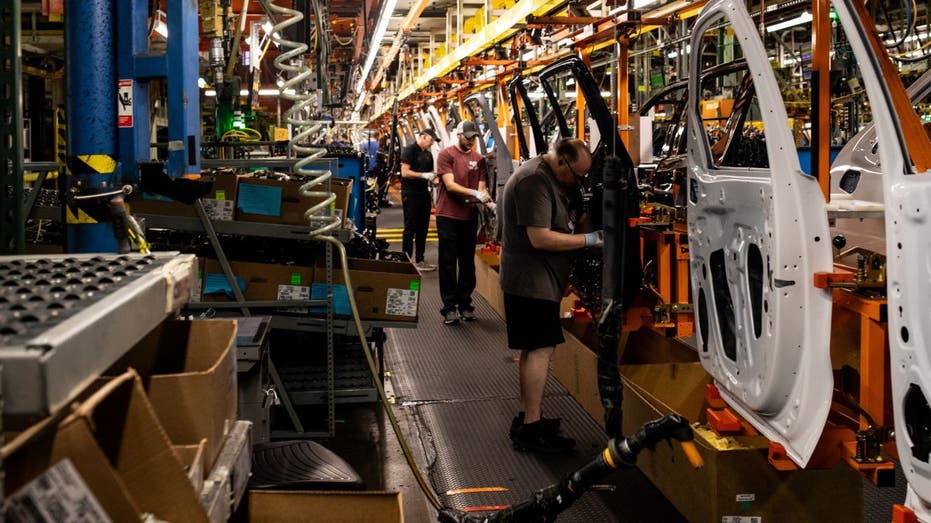
Auto manufacturing

Manufacturing lost 5,000 positions in December, ADP said. (Emily Elconin/Bloomberg via Getty Images)

EBAY CUTS 800 JOBS ACROSS COMPANY OPERATIONS JUST DAYS AFTER DROPPING $1.2B ON TRENDY GEN Z FASHION APP

Large businesses – those with 500 or more employees – added 10,000 jobs in February. Businesses with 50 to 499 employees lost 7,000 workers. Establishments with fewer than 50 employees added 60,000 jobs.

Advertisement

CLICK HERE TO GET FOX BUSINESS ON THE GO

Wage growth in February was little changed from last month. People staying in their roles saw their pay climb 4.5% from the prior year, while pay gains for those changing their jobs fell slightly to 6.3% from 6.4% in January.

Continue Reading

Business

VCI Global stock surges 40% on Malaysia AI computing center

Published

on


VCI Global stock surges 40% on Malaysia AI computing center

Continue Reading

Trending

Copyright © 2025