

Business
SpaceX Eyes Record IPO Filing This Week at Up to $1.75T Valuation


Elon Musk’s SpaceX is preparing to file paperwork for what could become the largest initial public offering in history as soon as this week, according to people familiar with the matter, accelerating plans for a potential June debut that would value the rocket and satellite giant at more than $1.75 trillion.

The move, reported by The Information on Tuesday and echoed across major outlets, marks a dramatic shift for the 24-year-old company long resistant to public markets. Advisers involved in preparations expect SpaceX to seek more than $75 billion in fresh capital, dwarfing the previous record set by Saudi Aramco’s $29.4 billion listing in 2019.
SpaceX did not immediately respond to requests for comment. Musk has not publicly addressed the latest filing timeline, though he confirmed in December 2025 that reports of a 2026 IPO were “accurate.”
The potential offering comes as SpaceX’s valuation has soared on the back of its Starlink satellite internet service and repeated successful launches of the Falcon 9 rocket. A recent insider share sale valued the company at about $800 billion late last year, with analysts now projecting a public debut north of $1.5 trillion — and some as high as $1.75 trillion.
Starlink, which provides high-speed internet via thousands of low-Earth orbit satellites, has emerged as the company’s primary growth engine. The service generated roughly $12 billion in revenue last year and now serves millions of subscribers worldwide, including in remote and underserved areas. SpaceX has deployed more than 10,000 Starlink satellites, with ambitious plans to expand the constellation dramatically.
Revenue from Starlink is believed to account for a growing share of SpaceX’s total income, which analysts estimate reached around $15 billion in 2025. The business model — recurring subscriptions with high margins — has helped justify sky-high valuations despite the capital-intensive nature of rocket development and satellite manufacturing.
SpaceX’s traditional launch business continues to dominate the global market. The company launches more payloads to orbit than any other entity, serving NASA, commercial clients and the U.S. military. Its reusable Falcon 9 boosters have slashed launch costs, making SpaceX a critical partner in America’s space ambitions.
The developmental Starship vehicle, designed for deep-space missions including a potential crewed landing on Mars, represents the company’s long-term bet on interplanetary travel. Musk has repeatedly said Starship is key to making humanity multi-planetary, with plans for massive flight cadence increases once fully operational.
Recent reports suggest the IPO proceeds would fund an “insane flight rate” for Starship, construction of orbital data centers powered by artificial intelligence, and other ambitious projects. SpaceX’s all-stock acquisition of Musk’s xAI earlier this year has further blurred lines between space, AI and computing, potentially creating synergies for in-orbit data processing.
Wall Street banks including Bank of America, JPMorgan, Goldman Sachs and Morgan Stanley have been in discussions for leading roles in the offering, according to earlier reports. A confidential filing with the Securities and Exchange Commission could allow SpaceX to gauge investor interest quietly before a full public registration.
If priced at the high end of expectations, the IPO would not only set records for size but could also propel SpaceX into the upper ranks of U.S. public companies by market capitalization, rivaling or exceeding major tech giants.
The news triggered sharp gains in other space-related stocks on Wednesday. Shares of Rocket Lab, AST SpaceMobile and Redwire jumped in premarket and regular trading as investors bet on heightened sector interest ahead of SpaceX’s debut.
Analysts caution that a SpaceX IPO would introduce new scrutiny. As a public company, it would face quarterly reporting requirements, greater transparency on costs and risks, and pressure from shareholders focused on near-term profitability rather than long-term visions like Mars colonization.
Musk’s dual roles as CEO of Tesla and SpaceX — and his ownership stakes across multiple ventures — could raise governance questions. Tesla shareholders have occasionally expressed concern about Musk’s divided attention, though SpaceX has operated largely independently.
Regulatory hurdles also loom. SpaceX’s heavy reliance on government contracts, particularly with NASA and the Pentagon, means national security reviews and export controls could influence the IPO process. Starlink’s international expansion has already faced geopolitical pushback in some markets.
Still, investor enthusiasm appears strong. Prediction markets have placed high odds on a 2026 listing, with many pointing to June as a target window. Some speculate the timing could align with symbolic milestones in Musk’s narrative around space exploration.
SpaceX’s path to public markets has been years in the making. Musk long preferred the flexibility of private ownership to pursue high-risk, high-reward projects without quarterly earnings pressure. But growing valuation — fueled by Starlink’s rapid subscriber growth and launch dominance — has made liquidity for early employees and investors more pressing.
Tender offers and secondary share sales have provided some exits, but a full IPO would open the company to millions of retail and institutional investors. ETFs and leveraged products betting on SpaceX exposure have already begun appearing in filings, signaling market anticipation.
The broader space economy stands to benefit. A successful SpaceX debut could validate the sector and draw more capital to satellite communications, reusable rockets and orbital infrastructure. Rivals and partners alike are watching closely.
For Musk, the IPO represents both validation of two decades of work and a massive capital infusion to accelerate his most audacious goals. SpaceX has already transformed access to space; going public could supercharge its next chapter.
Yet risks remain substantial. Starship development has encountered setbacks, including explosive test flights, though progress continues. Starlink faces competition from Amazon’s Project Kuiper and other entrants. Regulatory approval for massive satellite constellations has drawn environmental and astronomical concerns over light pollution and orbital debris.
SpaceX employs thousands and operates major facilities in California, Texas and Florida. Its Starbase complex in Boca Chica, Texas, serves as the hub for Starship testing and is central to Musk’s Mars ambitions.
As the potential filing window narrows, attention turns to the SEC and how regulators will handle one of the most scrutinized offerings in decades. A quiet filing this week would keep momentum toward a summer listing while allowing time for due diligence.
Industry observers note that even at conservative estimates, SpaceX’s IPO would eclipse most recent tech debuts and reshape perceptions of private space companies. The combination of proven launch capability, a scalable satellite network and visionary leadership has created rare investor appeal.
For now, SpaceX remains focused on operations. Launches continue at a brisk pace from Florida and California, while Starlink terminals ship to new customers daily. The company’s next Starship flight test is eagerly awaited by enthusiasts and engineers alike.
If the latest reports hold, investors could soon have the chance to buy shares in the company that pioneered reusable orbital rockets and built the world’s largest satellite constellation. Whether the valuation lives up to the hype will depend on execution in the years ahead.
The coming weeks promise intense speculation as details emerge. For a company that once seemed destined to remain private forever, the countdown to public trading has clearly begun.



Michael Kramer is the founder of Mott Capital, and is a long-only investor who focuses on macro themes and studies trends and options activities to identify and assess entry and exit points for investments in his long-term focused thematic growth strategy. He is a former buy-side trader, analyst, and portfolio manager with 30 years of experience tracking market technicals, fundamentals, and options.Michael Kramer leads the investing group Reading the Markets, where he helps a devoted following of members to better understand what is driving trading and where the market is likely heading, both the short and long-term. Features of the investing group include: daily written commentary and videos analyzing the driving factors behind price action; general macro trend education to help members make well-informed decisions based on market conditions, interest rates, currency movements and how they all interact; chat for questions and community dialogue; and regular Zoom videos sessions to discuss current ideas and answer questions. The level of access RTM subscribers and the expertise of the source are unprecedented given that the subscription price is a fraction of similar technical coaching and mentoring services. Learn more.
Analyst’s Disclosure: I/we have no stock, option or similar derivative position in any of the companies mentioned, and no plans to initiate any such positions within the next 72 hours. I wrote this article myself, and it expresses my own opinions. I am not receiving compensation for it (other than from Seeking Alpha). I have no business relationship with any company whose stock is mentioned in this article.
This report contains independent commentary to be used for informational and educational purposes only. Michael Kramer is a member and investment adviser representative with Mott Capital Management. Mr. Kramer is not affiliated with this company and does not serve on the board of any related company that issued this stock. All opinions and analyses presented by Michael Kramer in this analysis or market report are solely Michael Kramer’s views. Readers should not treat any opinion, viewpoint, or prediction expressed by Michael Kramer as a specific solicitation or recommendation to buy or sell a particular security or follow a particular strategy. Michael Kramer’s analyses are based upon information and independent research that he considers reliable, but neither Michael Kramer nor Mott Capital Management guarantees its completeness or accuracy, and it should not be relied upon as such. Michael Kramer is not under any obligation to update or correct any information presented in his analyses. Mr. Kramer’s statements, guidance, and opinions are subject to change without notice. Past performance is not indicative of future results. Neither Michael Kramer nor Mott Capital Management guarantees any specific outcome or profit. You should be aware of the real risk of loss in following any strategy or investment commentary presented in this analysis. Strategies or investments discussed may fluctuate in price or value. Investments or strategies mentioned in this analysis may not be suitable for you. This material does not consider your particular investment objectives, financial situation, or needs and is not intended as a recommendation appropriate for you. You must make an independent decision regarding investments or strategies in this analysis. Upon request, the advisor will provide a list of all recommendations made during the past twelve months. Before acting on information in this analysis, you should consider whether it is suitable for your circumstances and strongly consider seeking advice from your own financial or investment adviser to determine the suitability of any investment.
Seeking Alpha’s Disclosure: Past performance is no guarantee of future results. No recommendation or advice is being given as to whether any investment is suitable for a particular investor. Any views or opinions expressed above may not reflect those of Seeking Alpha as a whole. Seeking Alpha is not a licensed securities dealer, broker or US investment adviser or investment bank. Our analysts are third party authors that include both professional investors and individual investors who may not be licensed or certified by any institute or regulatory body.


One of repatriated French passengers from hantavirus-hit ship has symptoms, PM says

Earnings call transcript: Axsome Therapeutics Q1 2026 reveals mixed results

bymuratdeniz/iStock via Getty Images

Listen below or on the go via Apple Podcasts and Spotify

Cerebras headlines a busy IPO week with surging investor demand. (0:17) Applied Materials faces AI demand questions. (1:12) April CPI arrives with energy prices driving inflation concerns. (1:55)
As earnings season winds down, attention is shifting to the IPO market.
AI chipmaker Cerebras Systems (CBRS) headlines a busy week for new listings.
Reports indicate the company may raise its price range to $125 to $135 per share as soon as Monday, lifting the potential proceeds to about $3.78B from $3.5B. The deal has reportedly attracted orders more than 20 times the shares available, and the range could still move higher.
Cerebras plans to sell 28M shares on the Nasdaq under the ticker CBRS, with Morgan Stanley, Citigroup, Barclays and UBS leading the underwriting syndicate.
Also expected to begin trading are geothermal developer Fervo Energy (FRVO), which has a data center partnership with Google (GOOGL), and data center REIT Blackstone Digital Infrastructure Trust (BXDC), both with projected valuations north of $5B.
Other IPOs slated for the week include GMR Solutions (GMRS), EagleRock Land (EROK), and Riku Dining Group (RIKU).
On the earnings calendar, Applied Materials (AMAT) takes center stage Thursday.
Investors are looking for another beat-and-raise quarter from one of the market’s key AI infrastructure beneficiaries.
The primary growth drivers remain gate-all-around transistor demand and high-bandwidth memory. AMAT’s $5B EPIC Center initiative is also in focus, with investors watching for updates on customer co-development, commercialization timelines, and the strength of AI-related demand.
China remains the principal risk. Management has already flagged a potential $600M revenue headwind in FY2026 tied to tighter U.S. export restrictions.
Elsewhere this week:
Simon Property Group (SPG) reports Monday, Oklo (OKLO) Tuesday, and Tencent (TCEHY), Cisco (CSCO), and Alibaba (BABA) on Wednesday.
On the economic front, the April consumer price index arrives Tuesday, with the headline rate expected to rise to 3.6% while core inflation holds near 2.6%.
Wells Fargo economists say elevated energy prices tied to Middle East tensions are beginning to generate broader spillovers.
“Energy goods are poised for a 6% monthly gain as higher crude prices continue to pass through to the pump,” they wrote. “Food at home is likely to accelerate after March’s pullback, with grocery prices strengthening later this year amid rising transportation and fertilizer costs.”
They added that services inflation, excluding shelter, could run hot as higher jet fuel prices push airfares higher.
Seeking Alpha analyst Chris Lau said a hotter CPI print would increase the odds of tighter policy, though Fed officials will need to assess whether energy-driven inflation tied to the Strait of Hormuz proves transient or persistent.
In the news this weekend, Lumentum Holdings (LITE) is set to join the Nasdaq-100 (NDX) (QQQ), replacing real estate services firm CoStar Group (CSGP) later this month.
Nike (NKE) is facing a proposed class action lawsuit alleging it failed to refund tariff-related costs passed on to customers through higher prices.
The case is part of a broader wave of lawsuits against U.S. companies after the Supreme Court ruled against sweeping tariffs imposed under the International Emergency Economic Powers Act last year.
In the federal complaint, plaintiffs argue Nike is not entitled to retain the “significant” refunds it is expected to receive following the ruling. Nike has said the tariffs forced it to pay roughly $1B in import levies.
And for income investors:
Apple (AAPL) goes ex-dividend Monday, paying out May 14.
Visa (V) goes ex-dividend Tuesday, with a June 1 payout.
Target (TGT) goes ex-dividend Wednesday, also paying out June 1.
Delta (DAL) goes ex-dividend Thursday, with a May 28 payout.


Latvian defence minister resigns after Ukrainian drones hit oil tanks

Barrons Roundtable panelists discuss what Americans can expect at the pump.
American household budgets are under pressure from higher gas prices and new data shows that consumers are turning to credit to cushion the blow of elevated fuel costs.
A report by the Bank of America Institute found that lower-income households saw the share of their incomes spent on gas rise to 4.2%, up from 3.9% a year ago and the highest level for the month of March since 2022, based on internal Bank of America customer deposit data that’s been aggregated and anonymized. By contrast, the average household across income groups spent about 3.1% of their income on gas in March, an increase from 2.8% relative to the same time last year.
Additionally, about 10% of lower-income consumers spent more than 10% of their household income in March on gas as prices jumped amid the Iran war constraining oil shipments from the Middle East, compared with just 6% of higher-income households.
“Lower-income households spend more as a share of their income on gas just because they have less room for discretionary spending than middle- and higher-income households,” David Tinsley, senior economist at the Bank of America Institute, told FOX Business. “Those two things together mean that the rising gasoline prices we’ve seen really squeezes lower income households the most.”
GAS PRICES SURGE PAST $4.50 NATIONALLY AS IRAN TENSIONS PRESSURE DRIVERS

The Bank of America Institute found that American households, particularly at lower income levels, are seeing their budgets squeezed by higher gas costs. (M. Scott Brauer/Bloomberg via Getty Images)
The war in Iran caused the price of oil to rise above $100 a barrel after trading in the $70 range before the conflict began. That, in turn, caused gas prices to surge over 40%, with AAA’s national average rising to more than $4.50 a gallon.
Similar gas shocks strained consumer budgets as the economy dealt with the financial crisis in 2008, and began its recovery in 2011 and 2012. It also surged in the wake of the COVID pandemic when Russia invaded Ukraine in 2022.
“The rise in gasoline as a share of income right now needs to be kept in some perspective. There were also much bigger rises and higher peaks in terms of gas as a share of income and a share of spending just after the financial crisis and also just after COVID,” Tinsley said. “So this is obviously a painful rise for people, no doubt, but it’s not as large as those other incidents.”
GAS PRICE SURGE HITTING LOW-INCOME HOUSEHOLDS HARDEST, FED STUDY FINDS

The Iran war has constrained the flow of oil from the Middle East, spurring a surge in gas prices that’s impacting consumers. (Giuseppe Cacace/AFP via Getty Images)
American consumers are seeing some relief through higher wages, although the scale of those gains varies across income groups and some consumers are turning to credit and buy now, pay later to manage their finances amid the squeeze.
Tinsley said that while higher-income households are seeing strong wage growth up over 5% year over year, lower- and middle-income households aren’t seeing those gains. He noted that among lower-income households, the wage growth was just 1% through March, while it was 2% for middle-income households.
“There’s a couple of other things, wiggle rooms, that people have,” Tinsley said. “They could borrow more on their credit card, and when we look at where people stand relative to their credit card limits, we know they’re not particularly stretched right now relative to their credit card limits. The overall position is roughly where it was just before the pandemic.”
AVERAGE TAX REFUND UP NEARLY 11% FROM A YEAR AGO, IRS DATA SHOWS
“The other thing they could do is use buy now, pay later more,” he said, adding that more lower- and middle-income households are using those options to manage their budgets.
“The downside of that is, at the end of the day, buy now, pay later only smooths your spending over a couple of months, so it’s not going to make that big a difference to the overall story,” Tinsley said. “As it turns out, the people that tend to use buy now, pay later tend to have less borrowing space on their credit cards.”

Larger tax refunds have boosted Americans’ savings across income groups, Tinsley said. (Getty Images)
Tinsley said that one silver lining in the Bank of America Institute’s data is that households across income levels have more savings in the bank relative to before the COVID-19 pandemic.
“These households have about 10% higher deposits, savings deposits, in their accounts. The reason for that is largely tax refunds, so obviously the One Big Beautiful involved a lot of stimulus to consumers, a lot of which came through via refunds this year,” he said.
GET FOX BUSINESS ON THE GO BY CLICKING HERE
“Refunds are running, give or take, around 10% higher and although people are spending some of that, they’re also banking some of it and that can sort of help them weather some of this gas shock for a time,” Tinsley added.

VanEck is a global asset management firm offering ETFs, mutual funds, private funds, model portfolios, institutional strategies, separately managed accounts, as well as UCITS funds. Since our founding in 1955, putting our clients’ interests first, in all market environments, has been at the heart of the firm’s mission. VanEck has a long history of looking beyond financial markets to spot trends that create meaningful investment opportunities. We were one of the first U.S. asset managers to give investors access to international markets, which set the tone for identifying asset classes and themes such as gold investing in 1968, emerging markets in 1993, and exchange traded funds in 2006 that later helped shape the investment industry. The firm oversees $161.7 billion in assets as of September 30, 2025. Disclosures: http://ow.ly/SZ9450N5qTJ.

CHICAGO — Basketball fans across the United States can tune in today to watch the 2026 NBA Draft Lottery, one of the most dramatic events on the league calendar where fortunes of rebuilding franchises can change in an instant. The drawing to determine the top picks in the upcoming draft is scheduled for 3 p.m. ET on Sunday, May 11, and will be broadcast live on ESPN and ABC, with streaming available on multiple platforms.
The 2026 NBA Draft Lottery features 14 teams with the worst records from the 2025-26 season competing for the right to select first in what scouts are calling one of the deepest and most talented draft classes in recent memory. The Washington Wizards, Indiana Pacers, Brooklyn Nets and Utah Jazz entered the day with the highest odds at the No. 1 pick, but the ping-pong ball results can dramatically reshuffle the order and reshape franchise trajectories for years to come.
ESPN’s coverage begins at 2:30 p.m. ET with pre-lottery analysis, followed by the live drawing at 3 p.m. Hosted by ESPN’s Mike Breen alongside analysts and NBA insiders, the broadcast will reveal the full lottery order in reverse, building suspense until the No. 1 pick is announced. For viewers who prefer to stream, the event is available live on the ESPN app, ESPN+, WatchESPN, and the ABC app for cord-cutters. Fubo, YouTube TV, Hulu + Live TV and Sling TV subscribers with the appropriate packages can also access the broadcast.
The NBA Draft Lottery determines the order for the first 14 selections. Teams that finished with the worst records receive the highest odds, but the system is designed to prevent tanking. This year’s lottery carries extra weight because several franchises are at critical crossroads in their rebuilds, and landing a potential franchise-changing prospect could accelerate their path back to contention.
What to Expect from Today’s Lottery
The Washington Wizards, who posted the NBA’s worst record at 17-65, entered with a 14% chance at the No. 1 pick. The Indiana Pacers and Brooklyn Nets also held 14% odds, while the Utah Jazz sat at 12.5%. Even teams lower in the order have realistic chances of moving up several spots, creating the possibility of major surprises when the results are revealed.
Top prospects expected to be selected early include BYU’s AJ Dybantsa, a versatile 6-foot-9 wing with elite scoring instincts, and Kansas guard Darryn Peterson, known for his dynamic playmaking and perimeter shooting. International talents and several college standouts round out a class that features size, skill and high-upside athletes ready to contribute immediately.
The lottery broadcast will include live reactions from team representatives in attendance, expert analysis on how the new order affects mock drafts, and insights into potential trade scenarios. Many teams have already positioned themselves through previous deals, meaning some lottery picks are owed to other franchises.
Historical Context and Lottery Drama
The NBA Draft Lottery was introduced in 1985 to discourage intentional losing. Over the years, it has produced unforgettable moments — from the Orlando Magic winning back-to-back lotteries in the early 1990s to the New Orleans Pelicans jumping to No. 1 for Anthony Davis in 2012. Last year’s lottery saw several dramatic rises that altered the balance of power in the Eastern and Western Conferences.
This year’s event comes at a pivotal time for the league. With the new collective bargaining agreement in place and several major stars entering their prime or twilight years, landing the right young talent can accelerate a rebuild or push a contending team over the top through smart drafting and subsequent trades.
How to Prepare for the Broadcast
Fans looking to get the most out of today’s coverage should:
- Tune in to ESPN or ABC at 2:30 p.m. ET for pre-show analysis.
- Download the ESPN app for mobile streaming if away from a television.
- Follow real-time reactions on social media using #NBADraftLottery.
- Have mock draft resources ready to see immediate projections after the order is revealed.
Cord-cutters have multiple streaming options, but ESPN+ alone will not carry the live lottery broadcast — a live TV streaming service is required for ESPN or ABC. Free trials are available on several platforms for those who want to watch without a long-term commitment.
Why the Lottery Matters So Much in 2026
The 2026 draft class is considered particularly strong at the wing and guard positions, areas where many lottery teams have clear needs. A team landing the No. 1 pick could add a potential All-Star cornerstone, while even moving up a few spots can yield a difference-making player.
For franchises like the Wizards, Pacers, Nets and Jazz, today’s drawing represents more than just draft position — it could define their direction for the next decade. Front offices have spent months scouting prospects, modeling scenarios and preparing trade packages contingent on the final order.
Analysts expect significant activity in the days following the lottery as teams with new positioning explore trades to move up or down based on their specific needs and target players.
Where to Find Additional Coverage
Beyond the main ESPN broadcast, detailed analysis will be available across sports media. Podcasts, YouTube channels and social media accounts from The Athletic, The Ringer, Bleacher Report and local team beat writers will provide instant reactions and deep dives. Fantasy basketball and betting communities are also heavily focused on the lottery results, as draft position directly impacts rookie projections.
For international viewers, the NBA League Pass and regional broadcasters will carry the event with local commentary. Check local listings for exact channel information in your area.
As the clock ticks toward 3 p.m. ET, anticipation continues to build. The 2026 NBA Draft Lottery promises drama, surprises and clarity for 14 franchises hoping to change their fortunes. Whether you’re a die-hard fan of a lottery team or simply love the unpredictability of the event, today’s broadcast offers compelling television and important implications for the future of the NBA.
Don’t miss the action — set your reminders, prepare your streaming devices and get ready for a lottery that could reshape the league landscape in dramatic fashion.
Earnings call transcript: Schaeffler AG Q1 2026 beats EPS forecast by 237%
Earnings call transcript: Hugo Boss Q1 2026: Revenue beats but EPS disappoints

Martin O’Neill compares Daizen Maeda to Henrik Larsson after Old Firm derby

A Hot CPI Report May Trigger A Major Market Shift
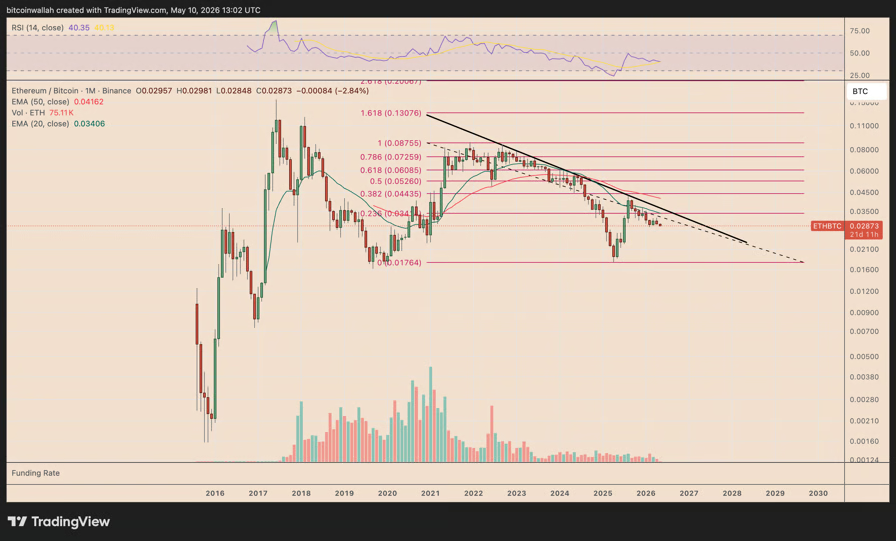
Will ETH Price Decline More in 2026?

Manchester United reach agreement with Casemiro over contract clause amid transfer speculation

US brings back mandatory military draft registration

Steven Gerrard disagrees with Gary Neville over ‘shock’ Chelsea and Arsenal claim | Football

Im SO GOOD at saving money! #sephora #shopping #funny #relatable #fitcheck

3 DIGIT XRP IN 2026 POSSIBLE? – XRP & JAPAN YEN CARRY TRADE JUST HYPE? – WRAP YOUR XRP? XRP NEWS!

Tybcom sem 5 financial accounting most important questions #atktexams #tybcom #tybcomsem5 #bcom #art
-
 Crypto World2 days ago
HarrisX Poll Found 52% of Registered Voters Support the CLARITY Act
-

 NewsBeat7 days ago
Channel 5 – All Creatures Great and Small series 7 new post
-

 Crypto World3 days ago
Upbit adds B3 Korean won pair as Base token gains Korea access
-

 Fashion2 days ago
Weekend Open Thread: Marianne Dress
-

 Tech6 days ago
Image AI models now drive app growth, beating chatbot upgrades
-
 NewsBeat3 days ago
NCP car park operator enters administration putting 340 UK sites at risk of closure
-

 Politics1 day ago
Politics Home Article | Starmer Enters The Danger Zone
-
 Business1 day ago
Ignore market noise, India’s long-term story intact, say D-Street bulls Ramesh Damani and Sunil Singhania
-

 Crypto World7 days ago
BlackRock Buys $284M In Bitcoin On May 1 As The Best Crypto To Invest In For 2026 Sits Below A Pending Binance Listing
-

 Entertainment7 days ago
Olivia Wilde Reacts To Viral ‘Corpse’ Comparison
-

 Sports6 days ago
Inter Milan Win Serie A Title After Victory Over Parma
-

 Sports7 days ago
La Liga: Vinicius Jr scores twice as Real Madrid win to keep Barcelona waiting for title
-
 Sports7 days ago
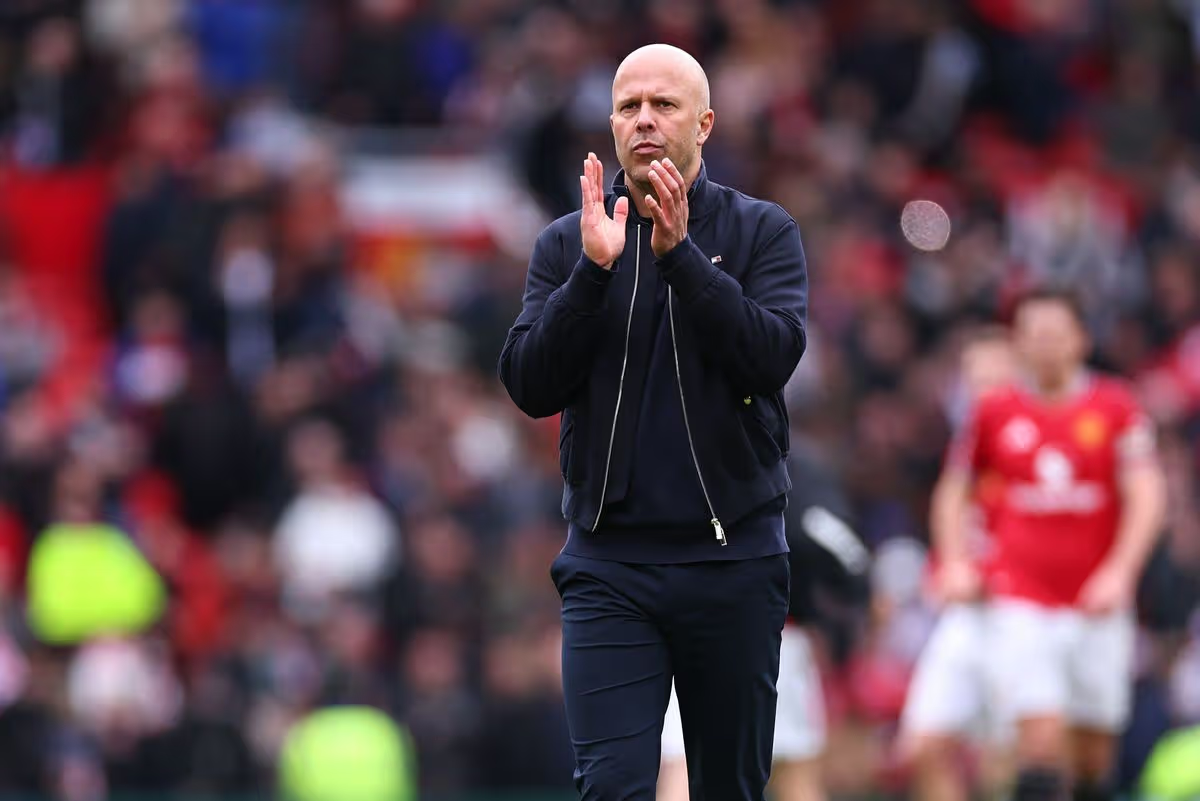
Every word of Arne Slot’s heated rant after Manchester United win vs Liverpool
-

 Crypto World5 days ago
UAE Free Zone Deploys Blockchain IDs to Verify Registered Firms
-

 Entertainment7 days ago
Other Bennet Sister Love Triangle Cast: Ella Bruccoleri, Donal Finn
-

 Sports7 days ago
Joel Embiid urges Sixers fans not to sell playoff tickets to Knicks fans
-
 Sports7 days ago
Kobbie Mainoo plays hero as Manchester United beat Liverpool in five-goal thriller, secure Champions League football | Football News
-
Entertainment7 days ago
Jennifer Lawrence’s Mary Jane Sneakers Are Spring’s It-Girl Shoe
-
 Sports6 days ago
2026 NHL playoff picks: Second-round predictions, series odds, Stanley Cup bracket
-

 Entertainment7 days ago
Moroccan Reacts To Nick Cannon’s Dating Rules For His Sister
You must be logged in to post a comment Login