

Business
SpaceX Stock Experiences Post-IPO Volatility as Shares Decline


NEW YORK — Shares of Space Exploration Technologies Corp., trading under the ticker SPCX, closed lower on Thursday following the company’s record-breaking initial public offering, reflecting typical post-listing adjustments as initial enthusiasm moderates.
The stock finished the session at $185.00, representing a 3.56 percent decline from the previous close. After-hours trading saw further movement, with shares at approximately $181.60. The performance comes after SpaceX’s historic debut that briefly propelled its market value above $2 trillion.
Analysts anticipated some volatility following the massive IPO, which raised $75 billion and marked the largest in history. The company’s rapid ascent in its first days of trading gave way to profit-taking and market recalibration as investors assessed long-term prospects.
SpaceX, led by Elon Musk, has transformed the commercial space industry through reusable rocket technology and Starlink satellite internet services. The public listing provides greater transparency while exposing the company to broader market forces and shareholder expectations.
The stock’s movement reflects broader dynamics in the technology sector, where high valuations often face scrutiny as companies transition from private to public status. SpaceX’s business combines launch services, satellite operations and emerging artificial intelligence applications.
Musk’s substantial ownership stake ties his personal fortune closely to the company’s performance. The IPO significantly increased paper wealth for early investors and employees while generating substantial capital for future growth initiatives.
Market observers note that post-IPO pullbacks are common even for successful debuts. SpaceX’s fundamental strengths in securing contracts and technological leadership provide a foundation for long-term value, though near-term trading may remain choppy.
The company’s recent credit ratings from major agencies underscore its financial stability. Investment-grade assessments with stable outlooks reflect confidence in SpaceX’s business model and cash flow generation capabilities.
SpaceX continues expanding its Starlink constellation, providing broadband services to remote areas and supporting various commercial and government applications. The division has become a significant revenue contributor alongside traditional launch operations.
Analysts maintain varied price targets reflecting different views on growth trajectories. Some project substantial upside based on market expansion in space technology, while others adopt more cautious stances regarding execution risks and competition.
The IPO process itself demonstrated strong demand, with shares allocated across institutional and retail investors. The debut generated significant media attention and public interest in space industry investment opportunities.
For the broader market, SpaceX’s listing adds another major technology name to public exchanges. Its performance may influence sentiment toward other high-growth companies considering public offerings in coming months.
Musk has outlined ambitious goals for SpaceX, including Mars colonization efforts and increased satellite deployment. Achieving these objectives will require substantial capital investment and sustained innovation.
Investors will monitor upcoming earnings reports and operational updates as the company navigates its new public status. Quarterly results will provide greater insight into financial performance across different business segments.
The space sector continues attracting attention as technological capabilities advance and commercial opportunities expand. SpaceX’s leadership position positions it favorably, though competition from both established players and newcomers remains intense.
As trading volume normalizes, market participants expect more measured price discovery based on fundamental metrics rather than initial listing excitement. Long-term success will depend on execution against strategic objectives and ability to generate sustainable profits.
SpaceX’s journey from private startup to public company represents a significant milestone in commercial spaceflight. The coming years will test whether its ambitious vision can translate into consistent shareholder value while advancing humanity’s presence beyond Earth.

Citigroup Has Two PFDs To Consider: N & R


As an individual investor nearing retirement I am trying to build my financial assets in order to have a fulfilling retirement. I am interested in trading both long and short; or at least using inverse ETFs, to take advantage of market declines. Having long term and short term trading strategies, proper execution of my trading plan, and absolute investing results are my goals. I see my articles as a way to keep me focused on developing winning trades. I also expect to learn much from the feedback that is provided in the comments section.
Analyst’s Disclosure: I/we have no stock, option or similar derivative position in any of the companies mentioned, but may initiate a beneficial Long position through a purchase of the stock, or the purchase of call options or similar derivatives in KMX over the next 72 hours. I wrote this article myself, and it expresses my own opinions. I am not receiving compensation for it (other than from Seeking Alpha). I have no business relationship with any company whose stock is mentioned in this article.
Seeking Alpha’s Disclosure: Past performance is no guarantee of future results. No recommendation or advice is being given as to whether any investment is suitable for a particular investor. Any views or opinions expressed above may not reflect those of Seeking Alpha as a whole. Seeking Alpha is not a licensed securities dealer, broker or US investment adviser or investment bank. Our analysts are third party authors that include both professional investors and individual investors who may not be licensed or certified by any institute or regulatory body.


Financial analyst by day and a seasoned investor by passion, I’ve been involved in the world of investing for over 15 years and honed my skills in analyzing lucrative opportunities within the market.I specialize in uncovering high quality dividend stocks and other assets that offer potential for long term-growth that pack a serious punch for bill-paying potential. I use myself as an example that with a solid base of classic dividend growth stocks, sprinkling in some Business Development Companies, REITs, and Closed End Funds can be a highly efficient way to boost your investment income while still capturing a total return that follows traditional index funds. I created a hybrid system between growth and income and manage to still capture a total return that is on par with the S&P.
Analyst’s Disclosure: I/we have no stock, option or similar derivative position in any of the companies mentioned, but may initiate a beneficial Long position through a purchase of the stock, or the purchase of call options or similar derivatives in ITWO over the next 72 hours. I wrote this article myself, and it expresses my own opinions. I am not receiving compensation for it (other than from Seeking Alpha). I have no business relationship with any company whose stock is mentioned in this article.
Seeking Alpha’s Disclosure: Past performance is no guarantee of future results. No recommendation or advice is being given as to whether any investment is suitable for a particular investor. Any views or opinions expressed above may not reflect those of Seeking Alpha as a whole. Seeking Alpha is not a licensed securities dealer, broker or US investment adviser or investment bank. Our analysts are third party authors that include both professional investors and individual investors who may not be licensed or certified by any institute or regulatory body.

The company said the transition marks a significant milestone in strengthening alignment with parent entity BSE Ltd and reinforces its role within the broader BSE ecosystem.
BSECL will continue to provide clearing, settlement and risk management services across the equity, equity derivatives, currency derivatives, debt, commodity, mutual fund, electronic gold receipt (EGR) and securities lending and borrowing (SLB) segments, among others.
The company said it remains committed to ensuring financial market stability, efficient collateral management and the highest standards of regulatory compliance as mandated by the Securities and Exchange Board of India (SEBI).
“The transition from ICCL to BSE Clearing Limited reflects our strong alignment with the BSE brand and our role as a trusted pillar of India’s financial market infrastructure. Over the years, we have built robust clearing, settlement, and risk management capabilities that support market integrity and investor confidence,” said Vaisshali Babu, Managing Director and Chief Executive Officer of BSE Clearing Limited.

“As we embark on this new chapter, we remain steadfast in our commitment to operational excellence and regulatory compliance while supporting the long-term resilience of India’s capital markets,” she added.
According to the release, the rebranding will have no impact on the corporation’s operations, legal obligations, contracts or service commitments towards members, participants and stakeholders.All existing agreements, memberships and regulatory registrations will continue without interruption, the company said.
BSE, Asia’s oldest stock exchange, is also the world’s largest exchange by number of listed companies. Over the years, it has played a key role in the development of India’s capital markets and serves as a major platform for companies raising capital. Its benchmark index, the Sensex, is widely tracked by domestic and global investors as a gauge of Indian equity market performance.
(Disclaimer: Recommendations, suggestions, views and opinions given by the experts are their own. These do not represent the views of The Economic Times)

The growing push to restrict Americans from using federal food aid to buy certain processed or sugary products is creating a new challenge for some of the biggest U.S. food and beverage companies.
The U.S. Department of Agriculture as of May had approved food restriction waivers for Supplemental Nutrition Assistance Program benefits in 23 states, affecting roughly one-third of all SNAP participants, according to Numerator. The research firm estimates the restrictions could reduce food and beverage sales by as much as $830 million this year as consumers either shift spending to approved products or cut back overall.
Kroger CEO Greg Foran said on the company’s first-quarter earnings call on Thursday that customers remain under pressure in part due to reduced SNAP benefits, as well as higher gas prices, “squeezing budgets.”
“Customers are managing spend carefully and shopping with real intent,” Foran said.
Most waivers focus on limiting consumption of sugar-sweetened beverages and confectionery products, signaling a targeted approach rather than broad food restrictions. As the movement spreads, it’s forcing major packaged food companies to monitor shopper behavior and assess whether they need to remake product lines — though many of them have already been changing what they offer after consumer habits shifted in recent years.
Iowa recently became the first state to codify elements of the “Make America Healthy Again,” or MAHA, movement into law, approving legislation that targets artificial food dyes, ultra-processed foods in school and purchases made through SNAP.
“Altogether, this bill advances the health and wellness for every Iowan today and for generations to come,” said Iowa Gov. Kim Reynolds when she signed the measure last month.
She added the law helps “refocus federal food assistance programs on the actual purpose for which they were created: helping low-income families afford nutritious food.”
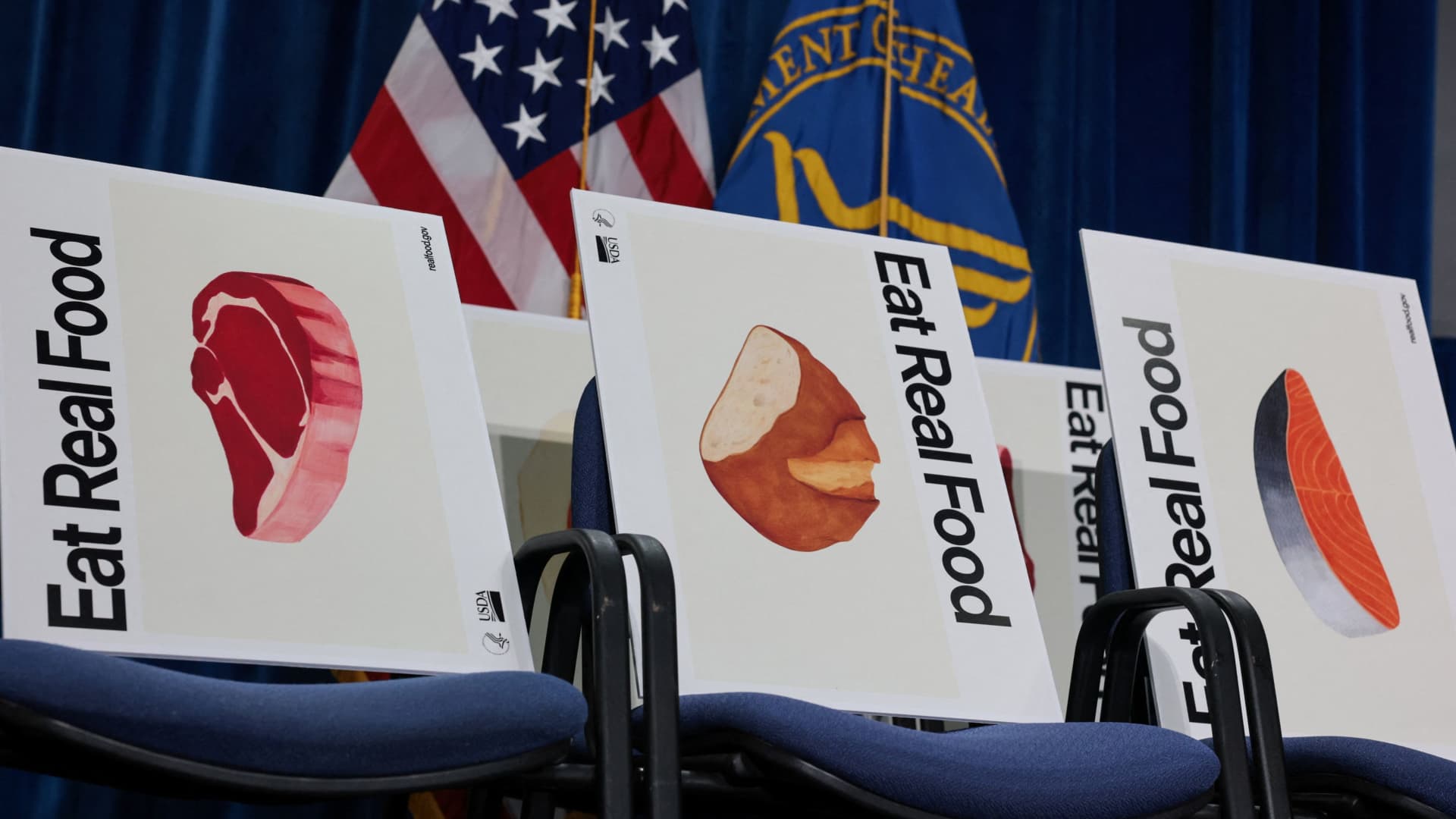
Attendees are greeted with”Eat Real Food” placards as they gather for U.S. Health and Human Services (HHS) Secretary Robert F. Kennedy, Jr. and Agriculture Secretary Brooke Rollins to announce new nutrition policies at the Department of Health and Human Services in Washington, D.C., U.S., January 8, 2026.
Jonathan Ernst | Reuters
The law bans several synthetic dyes, including Red 40 and Yellow 5, from most K-12 school meals and vending machines, while also restricting SNAP recipients from using benefits to buy products such as soda and candy.
Navigating the MAHA era
Many food companies aren’t waiting to see how policies evolve.
At a Goldman Sachs conference in May, Hershey said it has researchers in Texas conducting in-store interviews with shoppers who receive SNAP benefits to understand how purchasing behavior is shifting under new restrictions in the state.
“We’ve observed some consumer uncertainty at the register as new restrictions take effect,” a Hershey spokesperson told CNBC. “We anticipate this will improve as store execution improves, rules become clearer, and SNAP users can plan and budget with more certainty.”
The company is studying everything from product substitutions to budget tradeoffs, offering an early glimpse into how major food manufacturers are preparing for a potentially significant shift in consumer demand.
Many of the products most exposed to the changes are produced by some of the largest companies in the industry like Kraft Heinz, PepsiCo, Coca-Cola, General Mills, Nestle and others.
J.M. Smucker CEO Mark Smucker, however, told CNBC he expects the SNAP policy changes to have a more muted impact.
“I would say the current environment isn’t really that different than what we’ve seen over time, and thus far some of the modifications have really had no meaningful impact to our business,” he said.
Still, the company’s Hostess products like Twinkies and Donettes — the latter of which saw net sales grow 13% in the latest quarter, according to the company — may be impacted under broader state restrictions on “highly processed snacks.”
Current SNAP waivers in states like Texas focus primarily on candy and sugary drinks, not snack cakes. However, some states have proposed broader definitions that could eventually encompass packaged desserts and sweet baked goods.
At the same time, fewer Americans are even receiving the benefits. One analysis estimates 3.5 million people have lost their SNAP aid since President Donald Trump last year signed a sweeping bill that restricts eligibility for SNAP, among other changes.
Many U.S. households have found it harder to pay for groceries following the changes. The restrictions have also meant fewer dollars flowing to major businesses.
Walmart is particularly exposed to SNAP spending, capturing roughly a quarter of all SNAP grocery dollars nationwide, according to Numerator. Kroger, Costco and Amazon follow at about 8%, 6% and 5%, respectively.
The curbs on what consumers can buy with federal assistance are only one shift food companies are watching.
At a hearing of the Senate Committee on Health, Education, Labor and Pensions in April, Health and Human Services Secretary Robert F. Kennedy Jr. went as far as to say he “would support” a ban on junk-food television advertising. The department has not yet taken steps to introduce such a ban.
Responding both to Kennedy’s MAHA initiative and shifting consumer tastes, food manufacturers have also accelerated efforts to reformulate products and reduce synthetic ingredients in products like Kool-Aid, Fanta, Doritos and Flamin’ Hot Cheetos, which contain dyes like Red 40 and Yellow 5.
General Mills, Kraft Heinz and Target have all pledged to phase out certain artificial colors and additives by 2027 or sooner.
Nestle announced Monday it achieved its commitment on time to fully eliminate Food, Drug & Cosmetic colors from its U.S. food and beverage portfolio.

Roku: Fox Deal Changes The Narrative (Rating Downgrade)

Joby Aviation: The Race To The Skies Is Narrowing, And Joby Is In Front

Cushman & Wakefield surges 63% after InvestingPro fair value alert

Alibaba's 45% Collapse Created A Buying Opportunity
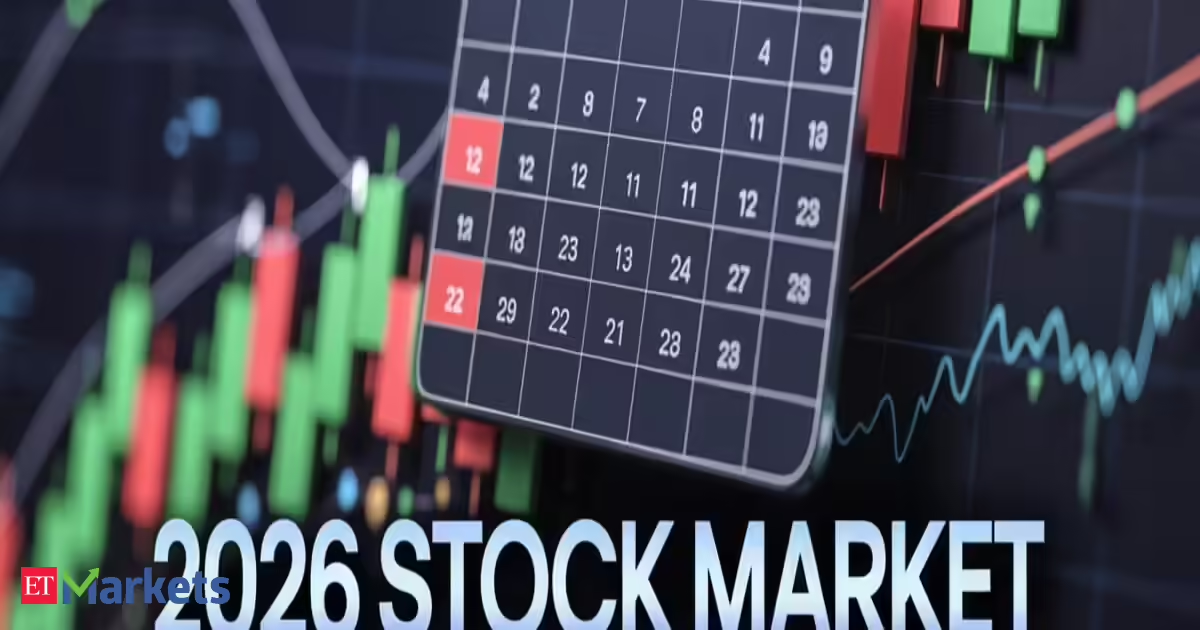
A total of 16 stock market holidays have been scheduled for 2026, out of which nine have already passed.
Following next week’s closure, the next market holiday will fall on Monday, September 14, for Ganesh Chaturthi. In the second half of the year, markets will also remain closed on October 2 for Gandhi Jayanti, October 20 for Dussehra, November 10 for Diwali Balipratipada, November 24 for Guru Nanak Jayanti and December 25 for Christmas, which will be the final market holiday of 2026.
Will MCX be closed?
Meanwhile, Multi Commodity Exchange of India will remain closed during the morning session on June 26 but will resume trading in the evening session. According to MCX’s annual trading calendar, the exchange has 16 trading holidays in 2026, with either partial or full-day closures.
The National Commodity & Derivatives Exchange Limited will remain shut for both trading sessions on the same day.
Stock Market Holidays 2026
In 2026, four key holidays fall on weekends and therefore will not lead to additional market closures. These include Mahashivratri on February 15 and Eid-Ul-Fitr on March 21, both of which have already passed, along with Independence Day on August 15 and Diwali Laxmi Pujan on November 8.
Diwali Laxmi Pujan will fall on a Sunday this year, though exchanges will conduct the customary Muhurat Trading session on November 8. The timings for the special one-hour session will be announced closer to the date. Independence Day, meanwhile, falls on a Saturday.
(Disclaimer: Recommendations, suggestions, views and opinions given by the experts are their own. These do not represent the views of The Economic Times)

Citigroup Has Two PFDs To Consider: N & R
Analyst Warns: Strategy Will Have to Sell Over 50,000 BTC by 2028

Jelly Roll Drops Divorce Vlog After Split From Bunnie Xo


-

 Business6 days ago
No Jackpot Winner as $257 Million Prize Rolls Over to $269 Million Monday Draw
-
 Crypto World6 days ago
Zimbabwe Requires Crypto Businesses to Register Annually Under New FIU Regulations
-

 Fashion18 hours ago
Weekend Open Thread: Miami – Corporette.com
-
 Entertainment6 days ago
Matt Damon’s Viral Sci-Fi Thriller Has Taken Over HBO Max
-

 Tech6 days ago
As AI companies race to go public, who else is along for the ride?
-

 Business6 days ago
Anthropic staff to meet White House officials next week, Axios reports
-
 Crypto World6 days ago
Bitcoin could crash to $48,000, if this historical pattern is triggered
-
 NewsBeat6 days ago
what doctors are seeing in ebike crashes
-
 NewsBeat6 days ago
Warning of disruption as Cardiff Crossrail works to start
-
 NewsBeat6 days ago
Tributes to former deputy head teacher at Cambridge school among death and funeral notices
-

 Entertainment6 days ago
Deion Sanders Shares Powerful Post After Viral Advice To Deiondra
-

 Politics6 days ago
“Israel’s” ban on ICRC visits ruled illegal, but Knesset moves to stop them permanently
-

 News Videos6 days ago
Financial Accounting | Last Day Revision Strategy and Booster | CMA Inter – June 2026
-
 Entertainment6 days ago
Kate Middleton Glare Goes Viral After Kids Booed At Royal Event
-

 Tech6 days ago
Over 400 Arch Linux packages compromised to push rootkit, infostealer
-

 Crypto World6 days ago
XRP ETFs Outperform As Bitcoin And Ethereum Funds Extend Outflow Trend
-

 Business6 days ago
Invesco Quality Income Fund Q1 2026 Commentary
-
 Crypto World6 days ago
Market Preview: SpaceX (SPCX) IPO Record, Federal Reserve Meeting, and Iran Nuclear Agreement
-

 NewsBeat6 days ago
Singer Oliver Tree dies aged 32 in helicopter crash in Brazil
-

 Sports6 days ago
Dick Advocaat’s Curacao scores first-ever World Cup goal against Germany
You must be logged in to post a comment Login