
Business
SpaceX’s Game-Changer for Mobile Connectivity in 2026


HAWTHORNE, Calif. — Starlink Mini is proving it can deliver reliable high-speed internet even at highway speeds, SpaceX’s official account declared Monday in a post on X that quickly gained traction among travelers and tech enthusiasts.
The message quoted a user cruising down the interstate, praising the compact satellite terminal for keeping him connected with “great, fast, reliable internet.” Posted April 13, the update underscored Starlink Mini’s growing role as a portable solution for drivers, RVers and digital nomads who refuse to lose service in remote stretches of road.
As of mid-April 2026, Starlink Mini stands out as the go-to hardware for SpaceX’s Roam service plans. Weighing just 2.56 pounds and measuring roughly the size of a laptop, the Mini packs a phased-array antenna and built-in Wi-Fi router into a backpack-friendly package. It draws only 25-40 watts on average, making it compatible with vehicle power systems, portable batteries or solar setups.

Performance has improved markedly since its 2024 debut. Current Roam users report download speeds between 65 and 260 megabits per second, with some tests exceeding 200 Mbps even while moving. Upload speeds range from 8 to 30 Mbps, and latency typically stays under 99 milliseconds — fast enough for 4K streaming, video calls, online gaming and remote work from the passenger seat.
The hardware itself now sells for $199 to $249, depending on promotional offers for new customers, a sharp drop from earlier pricing. Two Roam service tiers are available in most U.S. markets: $50 per month for 100 gigabytes of priority data, or $165 per month for unlimited usage. Additional data can be purchased in blocks if needed.
Mounting the Mini for in-motion use requires a few accessories — magnetic roof mounts, cable routing kits and weatherproofing — but real-world testers confirm it holds a stable connection at interstate speeds when properly installed. One recent road-trip review described uninterrupted Wi-Fi across a 246-mile drive through cell-service dead zones, turning a family van into a rolling office and entertainment hub.
SpaceX has rolled out the Mini alongside broader network upgrades. More than 10,200 Starlink satellites are now operational, part of a constellation that has grown to nearly 11,750 launched vehicles since 2019. The company continues launching batches of 25 to 29 satellites almost weekly, with recent missions from Vandenberg Space Force Base and Cape Canaveral adding capacity for mobile users.
Subscriber numbers reached 9.2 million by early 2026, according to industry estimates, generating roughly $10.6 billion in annual revenue for SpaceX and accounting for about two-thirds of the company’s total income. That financial momentum has allowed continued investment in portability and global coverage.
International expansion is accelerating. In Japan, SoftBank customers gained Starlink Mobile access April 10 without extra fees, enabling voice, video and messaging over the satellite network directly on smartphones. Latin America’s Copa Airlines announced it will become the region’s first carrier to offer Starlink Wi-Fi from gate to gate. Partnerships such as the one with U.S. Mobile bundle satellite broadband with cellular plans, creating hybrid connectivity options for travelers.
For drivers and overlanders, the Mini’s appeal lies in its freedom from terrestrial infrastructure. Truckers crossing remote highways, families heading to national parks and remote workers in vans all report the same benefit: connectivity that simply works where cell towers do not. One user in a Cybertruck posted photos of the Mini delivering strong signals on long hauls, while RVers at rallies across the Southwest described mounting the dish on roofs or using quick-deploy stands at campsites.
Setup takes minutes. The dish auto-aligns to the sky, connects to the nearest satellite and broadcasts Wi-Fi to up to 128 devices within a 1,200-square-foot coverage area. Its IP67 weather resistance handles rain, dust and highway spray. Power options include a standard DC input, making it ideal for 12-volt vehicle systems.
Critics note limitations. The Mini’s speeds, while impressive for satellite internet, trail the larger residential dishes that can exceed 400 Mbps in optimal conditions. Data caps on the lower-cost Roam plan may constrain heavy users, though unlimited options eliminate that concern for a higher monthly fee. Regulatory hurdles in some countries still restrict full mobility, and the system performs best with a clear view of the sky — a challenge in dense urban canyons or thick forests.
Still, independent tests and user videos circulating on X show the Mini maintaining connections at 70 mph and beyond when correctly mounted. Download and upload graphs remain steady through tunnels and over mountain passes, provided the dish has line-of-sight to satellites.
SpaceX continues to refine the experience. Standby Mode, introduced in recent software updates, reduces power draw when the vehicle is parked, extending battery life for overnight use. New mounting accessories and protective cases have appeared on the Starlink shop, addressing feedback from early adopters. Business customers in remote, non-congested areas can already access gigabit-tier upgrades, hinting at faster consumer options later in 2026.
The Mini’s success reflects broader shifts in how people work and travel. Digital nomads, long-haul truckers and weekend adventurers increasingly demand always-on internet. Traditional cellular providers struggle in rural corridors; fiber and cable never reach the open road. Starlink fills that gap, turning any vehicle into a connected node.
Elon Musk’s company has hinted at deeper vehicle integration. Requests for factory-installed Starlink in Tesla models, including the Cybertruck and Semi, appear regularly on X. While no official timeline exists, the Mini’s low power profile and compact size make it a logical candidate for future OEM options.
Globally, Starlink’s reach now spans more than 100 countries. In Australia, Europe and parts of Africa, Roam plans provide the same mobile capability. Aviation partnerships are expanding, with airlines promising in-flight Wi-Fi that rivals ground-based fiber. Maritime users on yachts and commercial vessels report similar reliability.
Environmental and regulatory questions linger. The constellation’s rapid growth has drawn scrutiny over orbital debris and night-sky brightness, though SpaceX says it is addressing both with improved satellite designs and de-orbit protocols. Spectrum-sharing agreements with terrestrial networks continue to evolve to prevent interference.
For now, the focus remains on users like the one featured in Monday’s post. His simple video of streaming and browsing while driving captured what millions seek: freedom from dead zones. The Starlink account’s caption — “Starlink Mini enables reliable high-speed internet on the go 🛰️🛣️” — distilled the promise in nine words.
Analysts predict continued subscriber growth through 2026 as hardware prices fall and coverage densifies. With Starship expected to accelerate satellite deployment in coming years, capacity for simultaneous mobile users should rise dramatically.
Whether crossing the Australian outback, the American Midwest or European motorways, travelers now have a proven tool for staying connected. The Starlink Mini has moved beyond novelty to become essential gear for anyone whose office, classroom or living room has four wheels and an open road ahead.
As the post continues to circulate with thousands of likes and reposts, one message is clear: the future of internet on the move is already here, and it fits in a backpack.


The Organization of the Petroleum Exporting Countries and their allies have agreed to raise oil production in June by 188,000 barrels a day in their first meeting without former member United Arab Emirates.
Seven countries, including Saudi Arabia, Russia, Iraq, Kuwait, Kazakhstan, Algeria, and Oman, agreed to the move at a meeting on Sunday. It’s less than the May output raise of 206,000 barrels a day.

Q1: 2026-04-29 Earnings Summary
EPS of $0.30 misses by $0.04
| Revenue of $310.00M (17.29% Y/Y) beats by $11.42M

Seeking Alpha’s transcripts team is responsible for the development of all of our transcript-related projects. We currently publish thousands of quarterly earnings calls per quarter on our site and are continuing to grow and expand our coverage. The purpose of this profile is to allow us to share with our readers new transcript-related developments. Thanks, SA Transcripts Team

Extreme Networks CEO Meyercord sells $1.1m of company stock
Seeking Alpha’s transcripts team is responsible for the development of all of our transcript-related projects. We currently publish thousands of quarterly earnings calls per quarter on our site and are continuing to grow and expand our coverage. The purpose of this profile is to allow us to share with our readers new transcript-related developments. Thanks, SA Transcripts Team
Check out what’s clicking on FoxBusiness.com.
Frozen pizzas sold at Walmart and Aldi are being recalled due to concerns that they may be contaminated with salmonella, as well as other items.
On April 30, the U.S. Department of Agriculture’s Food Safety and Inspection Services issued a public health alert for meat and poultry products containing FDA-regulated ingredients that may be contaminated with Salmonella.
Customers who have purchased the recalled products are urged not to consume them, even if they are cooked thoroughly, over concerns about the food-borne bacterium.
RAT POISON FOUND IN BABY FOOD JARS SPARKS CHILLING SCARE, SUSPECT NABBED
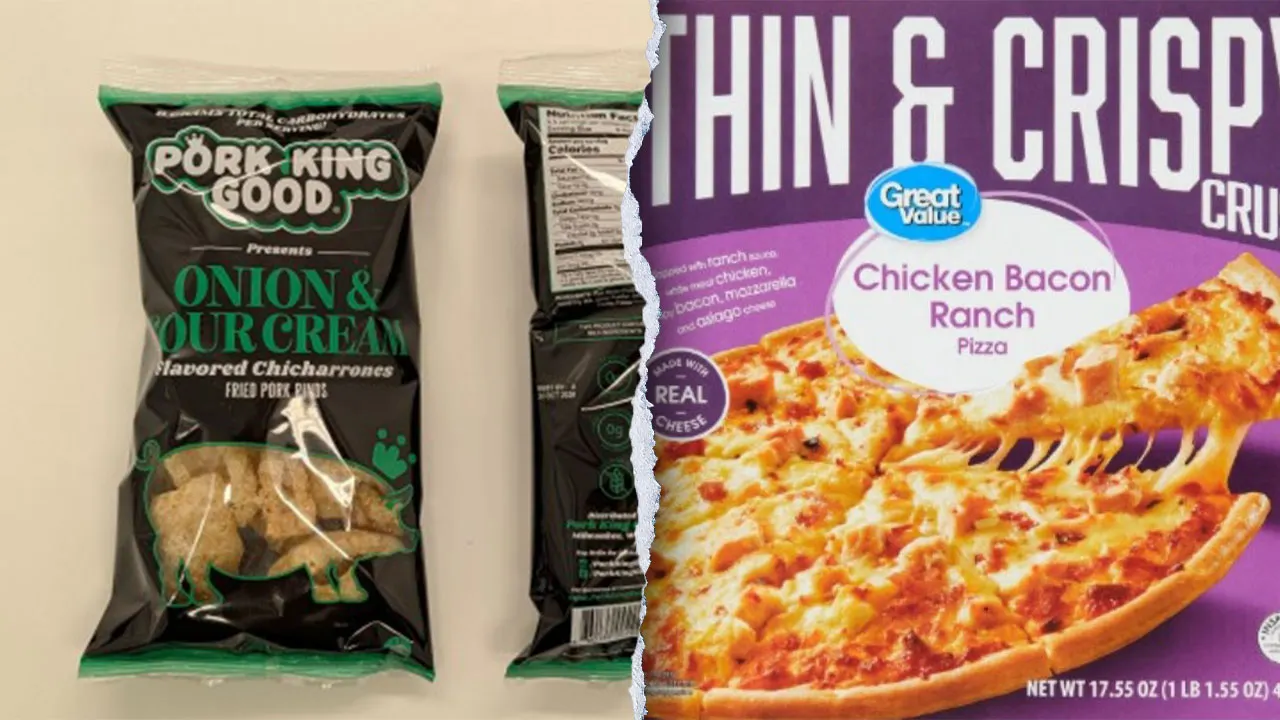
Great Value Thin Crust Chicken Bacon Ranch Pizza and Pork King Good Sour Cream & Onion Pork Rinds are among several items being recalled amid concerns of salmonella contaminations. (U.S. Food and Drug Administration / Fox News)
“The health and safety of our customers is always a top priority,”a Walmart spokesperson told FOX Business. “We have issued a sales restriction and removed this product from our impacted stores. We are working with the supplier to investigate.”
The products contain dry milk powder that had been recalled and was used to make frozen pizzas and pork rinds, the FDA said. No confirmed cases of illness or adverse reactions have been reported due to the consumption of the recalled products, the agency said.
Walmart products recalled
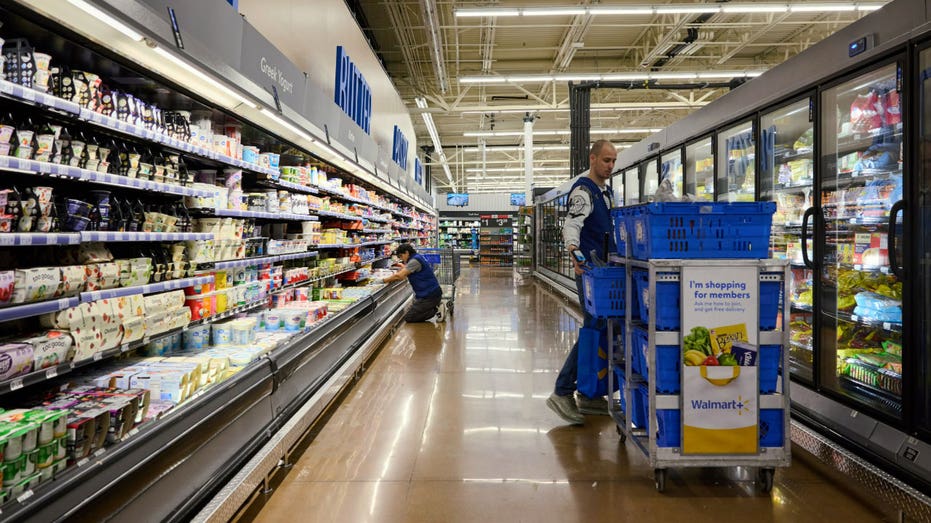
Workers stock shelves in a grocery aisle at a Walmart store on Black Friday in Columbus, Ohio, on Nov. 28, 2025. (Brian Kaiser/Bloomberg via Getty Images)
Great Value Thin Crust Chicken Bacon Ranch pizza, 17.55 oz.
- Lot codes: WC103203, WC103803
- Best if used by: 10/9/2026, 11/7/2026
- EST number: M1487
Great Value Stuffed Crust Chicken Bacon Ranch pizza, 23.1 oz.
- Lot codes: WC104173, WC104065, WC103793
- Best if used by: 10/25/2026, 10/26/2026, 11/8/2026
- EST number: M1487
Great Value Stuffed Crust Chicken Bacon Ranch, 23.1 oz.
- Lot code: WJ100977
- Best if used by: 12/9/2026
- EST number: M1928
GHIRARDELLI RECALLS DRINK MIXES OVER POTENTIAL SALMONELLA CONTAMINATION
Aldi products recalled

An Aldi supermarket in Alhambra, California, US, on Thursday, June 27, 2024. The Bureau of Economic Analysis is scheduled to release personal consumption figures on June 28. (Eric Thayer/Bloomberg via Getty Images)
Mama Cozzi’s Biscuit Crust Sausage & Cheese Breakfast Pizza, 18.5 oz.
- Best if used by: 10/15/2026, 10/21/2026, 10/22/2026, 10/23/2026, 10/24/2026
- EST number: EST5699
Mama Cozzi’s Biscuit Crust Cooked Pork Belly Crumbles, Cooked Bacon Topping, Pepper & Onion Breakfast Pizza, 17.15 oz.
- Best if used by: 10/15/2026, 10/21/2026, 10/22/2026, 10/23/2026, 10/24/2026
- EST number: EST5699
Other products recalled
Pork King Good Sour Cream & Onion Pork Rinds, 1.75-oz. bag
- Best if used by: 6/30/2026, 7/14/2026, 7/20/2026, 7/26/2-26. 8/4/2026, 8/5/2026, 8/12/2026
- EST number: EST1321
Pork King Party Size Sour Cream & Onion Pork Rinds, 7-oz. bag
- Best if used by: 7/7/2026, 7/23/2026, 8/10/2026
CHOCOLATE SOLD NATIONWIDE RECALLED OVER UNDECLARED ALLERGEN POSING POTENTIAL ‘LIFE-THREATENING’ RISK
Culinary Circle Ultra Thin Crust Chicken Bacon Ranch, 16.4 oz.
- Lot code: WC103309
- Best if used by: 10/18/2026
- EST number: M1487
- Customers who purchased the products are urged not to consume them, and instead, either throw them away or return them where they were purchased, the FDA said. Retailers are urged to remove said products from store shelves.
Salmonella bacteria are a leading cause of food-borne illness in the United States, according to the Centers for Disease Control and Prevention.
CLICK HERE TO GET FOX BUSINESS ON THE GO
Symptoms include nausea, vomiting, headaches, loss of appetite, abdominal cramps and diarrhea. CDC estimates Salmonella causes about 1.35 million infections in the United States every year.
FOX Business has reached out to Aldi, Pork King and Culinary Circle.

MINNEAPOLIS — As the NBA playoffs intensify in early May 2026, two Western Conference superstars remain sidelined by significant injuries, forcing their teams to navigate high-stakes series without their primary offensive engines. Los Angeles Lakers guard Luka Doncic continues a slow recovery from a Grade 2 left hamstring strain, while Minnesota Timberwolves star Anthony Edwards battles a left knee hyperextension with bone bruise — raising the question of whose absence carries the heavier cost for playoff aspirations.
Doncic, acquired by the Lakers in a blockbuster move, suffered the injury on April 2 in a loss to the Oklahoma City Thunder. The Slovenian superstar, who led the NBA in scoring much of the season, has missed the entire first-round series against the Houston Rockets. Despite advancing, the Lakers face the top-seeded Thunder in the Western Conference semifinals without their MVP-caliber playmaker.
Recent updates paint a cautious picture. ESPN’s Shams Charania and Brian Windhorst report no contact work yet for Doncic, who has progressed only to controlled on-court movement and spot-up shooting. He remains week-to-week with no firm timeline, likely missing the start of the Thunder series and possibly more. Coach JJ Redick has emphasized a deliberate approach to avoid setbacks on the delicate soft-tissue injury.
“Luka has not begun contact basketball yet,” Windhorst noted. “You’re looking at 3-on-3, then 5-on-5. That has not happened.” Sources indicate a slow build, with some speculation he might not return until deeper into the postseason — if at all this spring.
The impact on the Lakers has been profound yet mitigated by LeBron James’ veteran leadership and supporting casts stepping up. Los Angeles pushed past Houston in six games, but facing a powerhouse Thunder team without Doncic’s 30-plus point, triple-double threat creates an uphill battle. Analysts estimate his absence equates to losing roughly 35-40% of the team’s offensive creation, spacing and clutch scoring.
Edwards’ Timeline Offers More Hope
Edwards’ injury occurred in late April during the Timberwolves’ first-round series against the Denver Nuggets. An MRI revealed a left knee hyperextension and bone bruise, compounding ongoing right knee patellar tendinitis issues. He has been ruled out for the start of Minnesota’s second-round matchup against the San Antonio Spurs but listed as questionable for Game 1 after clearance for on-court activities.
Coach Chris Finch described Edwards as “week-to-week,” yet optimism persists for a return as early as Games 3 or 4. Shams Charania reported Edwards is “hopeful” and communicating plans to rejoin if the series extends, with around-the-clock treatment accelerating progress beyond initial multi-week projections.
The 24-year-old All-Star averaged 28.8 points per game in the regular season and remains the Timberwolves’ clear alpha scorer and leader. Minnesota advanced despite his limited availability, but the drop-off without him is stark: reduced athleticism on drives, perimeter creation and defensive versatility.
Measuring the Cost: Production, Team Context and Playoff Stakes
Quantifying “more costly” involves stats, roster depth and series difficulty. Doncic’s per-game averages hover near 30 points, 9 assists and 8 rebounds in recent seasons, with elite playmaking that elevates teammates. His injury removes a generational facilitator from a Lakers squad already thin on star power beyond James. Without him, Los Angeles relies heavily on role players against OKC’s elite defense and depth.
Edwards, while slightly less efficient as a creator, brings explosive scoring (often 25-35 in big games) and two-way impact that fits Minnesota’s gritty identity alongside Rudy Gobert and others. The Timberwolves boast stronger supporting talent, including veterans like Mike Conley, but losing Edwards’ gravity strains their offense against a young, dynamic Spurs team led by Victor Wembanyama.
Playoff metrics underscore the gap. Teams typically see win probabilities drop 15-25% without superstar usage rates above 30%. For the Lakers, projected as underdogs versus OKC, Doncic’s void feels existential — potentially shortening their run dramatically. Minnesota, with home-court advantages possible and a more favorable matchup, has a clearer path to weather the storm until Edwards returns.
Retail analysts and betting markets reflect this: odds for Lakers advancing deep without Doncic lengthen significantly, while Timberwolves series odds improve markedly with Edwards projected back mid-series. Historical parallels — stars missing early playoff rounds — show recovery speed and replacement quality as key variables. Edwards’ shorter expected absence (potentially 1-3 games) versus Doncic’s open-ended timeline tips the scale.
Broader Implications for Franchises
Both injuries highlight playoff fragility. The Lakers, post-Doncic trade, bet heavily on his availability for a title push alongside James. Prolonged absence risks not just this postseason but long-term chemistry and fan expectations in a win-now window. Minnesota’s contention window feels more sustainable, with Edwards’ prime years ahead and roster flexibility.
Fan and social media reactions amplify the drama. Hashtags like #LukaReturn and #AntBack trend, with debates raging on X and forums over load management, rehab protocols and “what if” scenarios. Some argue Doncic’s heavier usage makes his strain more debilitating; others point to Edwards’ youth and explosiveness creating higher re-injury risk upon rushed return.
Medical experts note hamstring strains in basketball often require 4-8 weeks for full strength, while knee bone bruises vary but respond well to rest and modern therapies. Both organizations prioritize long-term health over desperate gambles.
What Lies Ahead
For the Lakers, survival against Oklahoma City without Doncic demands heroic efforts from James, Austin Reaves (also managing an oblique issue) and defensive intensity. A potential Game 3-4 Doncic return remains a long shot but could swing momentum if achieved.
The Timberwolves enter San Antonio hopeful Edwards tests the knee positively. Even limited minutes could tilt a series against the Spurs. Finch’s rotation adjustments — leaning on guards like Ayo Dosunmu and Bones Hyland — have shown promise but lack Edwards’ finishing punch.
Ultimately, Edwards’ injury appears less costly in the immediate term due to a quicker projected return and Minnesota’s supporting cast. Doncic’s extended absence weighs heavier on a Lakers team chasing contention in a brutal Western bracket. Yet both absences underscore basketball’s team nature: no single star guarantees success, but their voids expose roster limits.
As series unfold this week, franchises, coaches and fans monitor every update. In the 2026 playoffs, health remains the ultimate separator — and for now, both Luka Doncic and Anthony Edwards are fighting time to prove their irreplaceable value.

Our president loves slapping his name on things. The latest example involves retirement. This past week, President Trump announced the creation of TrumpIRA.gov, a platform that will connect savers with retirement accounts from private-sector companies–similar to what TrumpRx does for drugs. Only funds with low administrative costs and zero minimum contribution and balance requirements will be included.

Analog Devices chair & CEO Vincent Roche sells $3.98m in stock
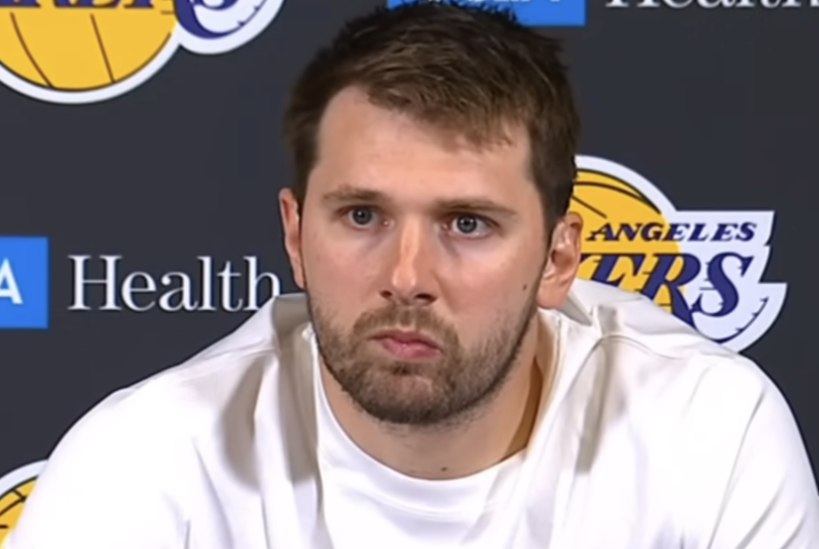
LOS ANGELES — As the Los Angeles Lakers prepare for a daunting Western Conference semifinals showdown against the top-seeded Oklahoma City Thunder, fresh updates on Luka Doncic’s Grade 2 left hamstring strain offer little optimism for fans hoping their superstar returns soon. The Slovenian phenom remains sidelined more than a month after the injury, casting a shadow over LA’s playoff hopes.
Doncic suffered the injury April 2 during a blowout loss to the very Thunder team the Lakers will now face. He has not played since, missing the entire first-round series against the Houston Rockets. Despite advancing in six games, the Lakers enter the next round without their primary offensive creator and floor general.
ESPN’s Shams Charania delivered the latest sobering report Sunday on ABC’s “Inside the NBA.” “I’m told right now Luka Doncic will be out to start the series against the Oklahoma City Thunder,” Charania said. “The Lakers are evaluating Doncic on a week-to-week basis with that Grade 2 hamstring strain.”
The recovery path remains slow. Doncic has progressed to controlled on-court movement, drills and spot-up shooting, but he has not advanced to full running, one-on-one work or full-contact scrimmages. ESPN’s Brian Windhorst echoed the concern Saturday, stating Doncic is “not close” to returning.
“He’s not close,” Windhorst said. “Most likely you’re not gonna see Luka Doncic at the front end of this series maybe at least for another week to 10 days on the minimum.”
Impact on Lakers’ Playoff Hopes
The absence weighs heavily. Doncic led the NBA in scoring for much of the season after his arrival in Los Angeles via blockbuster trade. His elite playmaking, spacing and clutch scoring have been sorely missed. Without him, the Lakers relied on LeBron James’ leadership and contributions from Austin Reaves (who returned from his own oblique injury) and role players to dispatch Houston.
Analysts estimate the Lakers lose roughly 35-40% of their offensive creation and efficiency without Doncic. Facing the Thunder — a deep, athletic and defensively elite squad featuring Shai Gilgeous-Alexander, Chet Holmgren and a strong bench — amplifies the challenge. The teams met multiple times in the regular season, with OKC dominating, including the game where Doncic went down.
Coach JJ Redick and the organization have taken a cautious approach. “These decisions are about long-term health,” sources close to the team indicated, prioritizing avoiding re-injury over a rushed return that could end his postseason entirely.
Medical Context and Recovery Timeline
Grade 2 hamstring strains typically require 4-6 weeks for recovery, placing Doncic near the early end of that window but still not cleared for basketball activities demanding explosive movement. He traveled to Spain earlier for specialized injections and treatment to accelerate healing, yet progress has been methodical.
Medical experts note that returning too soon from soft-tissue injuries often leads to setbacks. Full ramp-up involves 3-on-3, then 5-on-5 contact before game action. Current reports suggest that process has not begun in earnest.
Insiders like ClutchPoints’ Brett Siegel added that Doncic remains about a week from even rejoining full practices and scrimmages. A potential return in the later stages of the series, possibly Games 3-5 if it extends, represents the optimistic scenario.
Fan and Team Reactions
Lakers Nation expressed frustration and concern across social media. Hashtags like #LukaReturn and #LakersVsThunder trended with mixed emotions — hope for a miracle mid-series comeback tempered by realism about the matchup. Many fans point to the team’s resilience without him in Round 1 as a silver lining, crediting James’ veteran presence and defensive adjustments.
Teammates have noted Doncic’s presence around the group provides intangible boosts, even if he cannot play. “Just having him back around matters,” one source told reporters. Yet the on-court void looms large against OKC’s transition game and perimeter pressure.
LeBron James, in his potential final postseason run, faces increased burden. Reaves’ return helps, but the lack of Doncic’s gravity disrupts offensive flow. Betting markets and advanced projections show Lakers’ series win probability dipping significantly without their star — some models place LA as heavy underdogs.
Broader Implications for Lakers Franchise
This injury arrives at a pivotal moment. The post-trade acquisition of Doncic signaled a win-now mentality alongside James. A short or nonexistent playoff run without him raises questions about roster construction, future moves and James’ future. Management must balance short-term desperation with long-term asset protection for a player still in his prime.
The Thunder, meanwhile, enter with momentum and health advantages. Their defensive schemes exploited LA earlier, and without Doncic’s creation, the Lakers’ half-court offense faces stiff resistance. OKC’s youth and depth could wear down the older Lakers core over a seven-game series.
What’s Next for Doncic and Lakers
Series schedule details point to Game 1 in Oklahoma City mid-week, with subsequent games offering incremental recovery windows. The Lakers will provide daily updates, but expectations remain tempered. Week-to-week evaluation means no guarantees even if the series extends.
Doncic’s history of toughness and desire to compete suggests he will push boundaries, but medical staff hold final say. Fans cling to stories of stars returning heroically from similar injuries, yet current reporting paints a picture of patience over urgency.
For now, the Lakers must find ways to compete — emphasizing defense, rebounding and James’ scoring — while monitoring every Doncic workout update. A potential Game 4 or later appearance could shift momentum, but betting on it remains risky.
As the Western Conference semifinals begin, Luka Doncic’s slow-healing hamstring stands as the defining subplot. Lakers fans enter the series with heavy hearts, knowing their MVP-level talent watches from the sideline. Whether the supporting cast can defy odds against a championship-caliber Thunder team will define this chapter — and possibly the franchise’s immediate future.

TUCSON, Ariz. — As the search for 84-year-old Nancy Guthrie stretches into its fourth month, friends from her tight-knit church community have largely remained quiet at the request of the Guthrie family, according to multiple reports, even as investigators continue pursuing leads in what authorities describe as her abduction from her Catalina Foothills home.
Nancy Guthrie, mother of “Today” co-anchor Savannah Guthrie, was last seen on the evening of Jan. 31, 2026, after being dropped off at her residence following a family dinner. She failed to appear the next morning for a planned virtual church service, prompting concern from friends who alerted the family. By noon on Feb. 1, relatives reported her missing to the Pima County Sheriff’s Department.
Evidence at the home — including bloodstains confirmed to be hers, a tampered doorbell camera and signs of forced entry — quickly shifted the case from a missing person search to a criminal abduction investigation. The FBI joined the probe, and Sheriff Chris Nanos publicly stated he believed she was taken against her will.
Family Request for Privacy
NewsNation correspondent Brian Entin, who has covered the case extensively, revealed that the Guthrie family has asked Nancy’s close friends to keep details private during the ongoing investigation. “We’ve heard from several that the Guthrie family has asked Nancy’s close friends to keep things private right now,” Entin told Parade magazine. “You haven’t seen a lot of her close friends come forward and talk about her, which is different than other cases.”
Church friends were among the first to notice her absence and raise the alarm. Yet in the months since, few have spoken publicly, a departure from patterns in similar high-profile cases where community members often share memories or appeals. Entin suggested fear plays a role, noting the unidentified suspect(s) and the rarity of such violence in the upscale Tucson suburb.
“I also think people here are still nervous about the whole thing,” he added. “These kinds of things don’t happen [here], and the fact that there’s no new information and they have no idea who did it … people are just still nervous.”
Chilling Timeline and Evidence
According to authorities, Nancy Guthrie took an Uber to her daughter Annie’s home around 5:32 p.m. on Jan. 31 for dinner and games. Her son-in-law Tommaso Cioni dropped her off shortly before 10 p.m. Her garage door closed at 9:50 p.m.
In the early morning hours of Feb. 1, a masked, gloved individual tampered with her doorbell camera around 1:47 a.m., with motion detected shortly after. Her bedside pacemaker monitor missed a transmission at 2:28 a.m. When she didn’t appear for church, family members checked her home and called 911.
The FBI later released footage showing the armed intruder. Blood was found near the front porch and inside, confirmed via DNA to belong to Nancy. Personal items, including her phone and medications, remained at the residence, inconsistent with a voluntary departure given her limited mobility.
Ransom Demands and Hoaxes
Multiple ransom notes surfaced in the days following, some sent to media outlets demanding cryptocurrency payments. One California man was arrested for an unrelated hoax demanding ransom from the family. The Guthrie family offered a $1 million reward for information leading to her safe return and released public appeals seeking proof of life.
As of early May 2026, no arrests have been made in the abduction itself. DNA analysis from the home, including hair samples, continues at FBI labs. Recent neighborhood footage of a masked man stealing plants has heightened local anxiety but has not been officially linked to the case.
Community Impact and Silence
The quiet from Nancy’s church circle stands in contrast to her described life as an active, faith-centered widow who moved to Tucson decades ago. Friends and neighbors have described her as vibrant despite mobility challenges, regularly attending services and maintaining close ties.
Entin noted attempts to interview church friends for an upcoming NewsNation special yielded little response. The reluctance reflects both family wishes and broader unease in a neighborhood unaccustomed to violent crime. Increased patrols and resident vigilance underscore the lingering fear.
Savannah Guthrie stepped away from “Today” duties initially to focus on the search and family but has since returned, with producers implementing protocols for handling developments. The family has expressed gratitude for public support while urging tips.
Investigation Status
Pima County Sheriff’s Department statements emphasize the case remains “active and ongoing,” with continued collaboration from the FBI, advanced forensics and tip reviews. No public updates on significant breakthroughs have emerged recently as the probe nears 100 days.
Experts and retired agents have weighed in on possibilities ranging from a targeted abduction to opportunistic crime, but little concrete information has been released. The family has pushed back against unfounded speculation implicating relatives.
Nancy Guthrie’s disappearance has captivated national attention, blending the personal stakes for a prominent journalist’s family with the procedural challenges of a complex cold-case-in-the-making. As weeks turn to months, the silence from those who knew her best reflects both strategic privacy and the unsettling reality that an unknown threat may still linger in the Tucson foothills.
Authorities and the family continue to appeal for information. Anyone with tips is urged to contact the Pima County Sheriff’s Department or the FBI. For now, Nancy’s friends honor the request to remain quiet, hoping their restraint aids the investigation that could bring her home.

Man City full time reactions at Everton say it all after Arsenal boost
OPEC+ Agrees to Raise Oil Production in June in First Meeting Without U.A.E.

Trump-Linked World Liberty Sues Justin Sun for Defamation

Manchester United reach agreement with Casemiro over contract clause amid transfer speculation

US brings back mandatory military draft registration

Steven Gerrard disagrees with Gary Neville over ‘shock’ Chelsea and Arsenal claim | Football


-

 Fashion6 days ago
Kylie Jenner’s KHY Enters a New Era with ‘Born in LA’
-

 Business6 days ago
Most Commercial Energy Audits Miss the Real Losses
-

 NewsBeat1 day ago
Channel 5 – All Creatures Great and Small series 7 new post
-
 Tech3 days ago
Trump’s 25% EU auto tariff breaches Turnberry Agreement that also covers semiconductors and digital trade
-

 Crypto World6 days ago
CFTC’s AI will review U.S. crypto registration applications, chairman tells CoinDesk
-
 Sports3 days ago
Paul Scholes issues Marcus Rashford reality check as agreement emerges over Man United star
-

 Business6 days ago
Barclay Brothers Avoid Bankruptcy: HSBC Drops High Court Petitions After IVA Deal
-
 Business5 days ago
Tesla Officially Registers Elon Musk’s Stock: What Investors Need to Know
-
Crypto World7 days ago
Robinhood Phishing Scam Exploits Gmail Dot Feature to Bypass Security
-

 Tech6 days ago
Get Ready for More Brain-Scanning Consumer Gadgets
-

 Crypto World7 days ago
Gmail Dot Trick Underpins Robinhood Phishing, Sending Real-Looking Emails
-

 Entertainment7 days ago
Michael Jackson’s Biopic Excluded Abuse Allegations For $25M
-

 Business4 days ago
Two Powerball Tickets Split $143 Million Jackpot in Indiana and Kansas
-

 Tech5 days ago
Texas Instruments made a new flagship graphing calculator: the TI-84 Evo
-

 Business7 days ago
Superdry co-founder accused of raping woman
-
 Crypto World4 days ago
CoreWeave (CRWV) Stock Climbs 8% Despite $45M Insider Share Dump
-
 Crypto World7 days ago
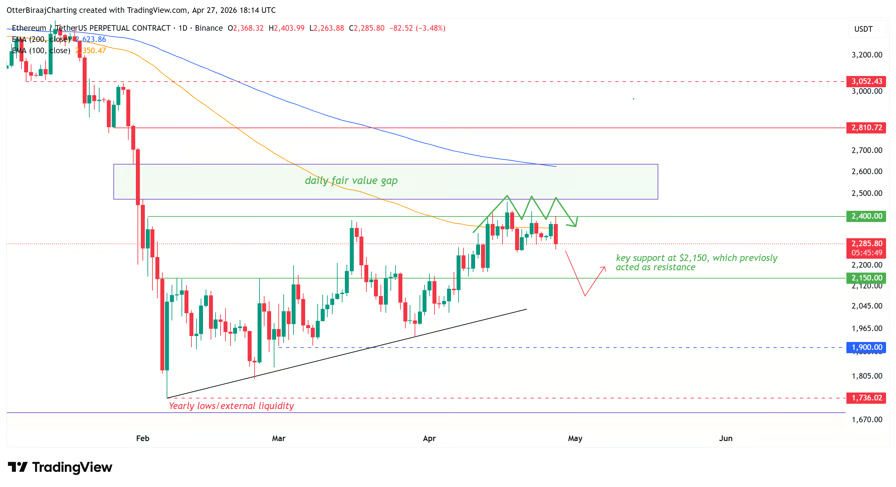
ETH Triple Top Rejects $2.4K As Analysts Flag Weakness Against BTC
-

 Crypto World7 days ago
Will Ethereum hold $2,300 or slip lower from here?
-

 Business7 days ago
Outsourced IT Support vs Internal Teams: A Complete Guide
-

 Entertainment7 days ago
How A Fantasy Flop Finally Found Success On HBO Max
You must be logged in to post a comment Login